Expert Insights on Viscosity Management for Textile Printing
Effective viscosity management requires more than reaching one target number. This guide explains how test...
Viscosity is one of the most frequently discussed parameters in textile printing. Printing mills use it to inspect stock pastes, compare thickeners, adjust color pastes and monitor production batches.
However, viscosity is also one of the most frequently misunderstood parameters. A value such as 5,000, 20,000 or 50,000 mPa·s has limited meaning unless the concentration, preparation procedure, temperature, instrument, spindle and rotational speed are known.
Even when two products provide the same reading under one laboratory condition, they may behave differently during pumping, screen passage, coating, fabric penetration and storage. This is because printing performance depends on rheology, not only on a single viscosity result.
Professional viscosity management therefore requires three connected controls: a repeatable measurement method, a stable preparation process and verification under the actual printing conditions.
Why Viscosity Management Matters
Printing paste must remain sufficiently stable during preparation and storage while still flowing through the printing equipment. After it reaches the fabric, it must help control spreading, penetration and pattern definition.
Poor viscosity management can affect both production efficiency and final textile quality.
Viscosity that is too high may cause
Difficult pumping or paste circulation
Reduced screen passage
Incomplete paste transfer
Area padat yang tidak merata
Excessive surface deposition
Higher filtration or cleaning requirements
Viscosity that is too low may cause
Uncontrolled spreading
Loss of fine-line definition
Excessive fabric penetration
Uneven colorant placement
Separation or settling in some formulations
Variation in application pickup
The correct viscosity is process-specific
The target depends on the thickener, printing method, fabric, design, colorant system, equipment speed and post-treatment. A value that works well in rotary-screen reactive printing may not be suitable for pigment printing or digital pretreatment.
Viscosity and Rheology Are Not the Same
Viscosity describes resistance to flow under a defined measurement condition. Rheology describes how the paste behaves across different shear, time and structural conditions.
Viskositas satu titik
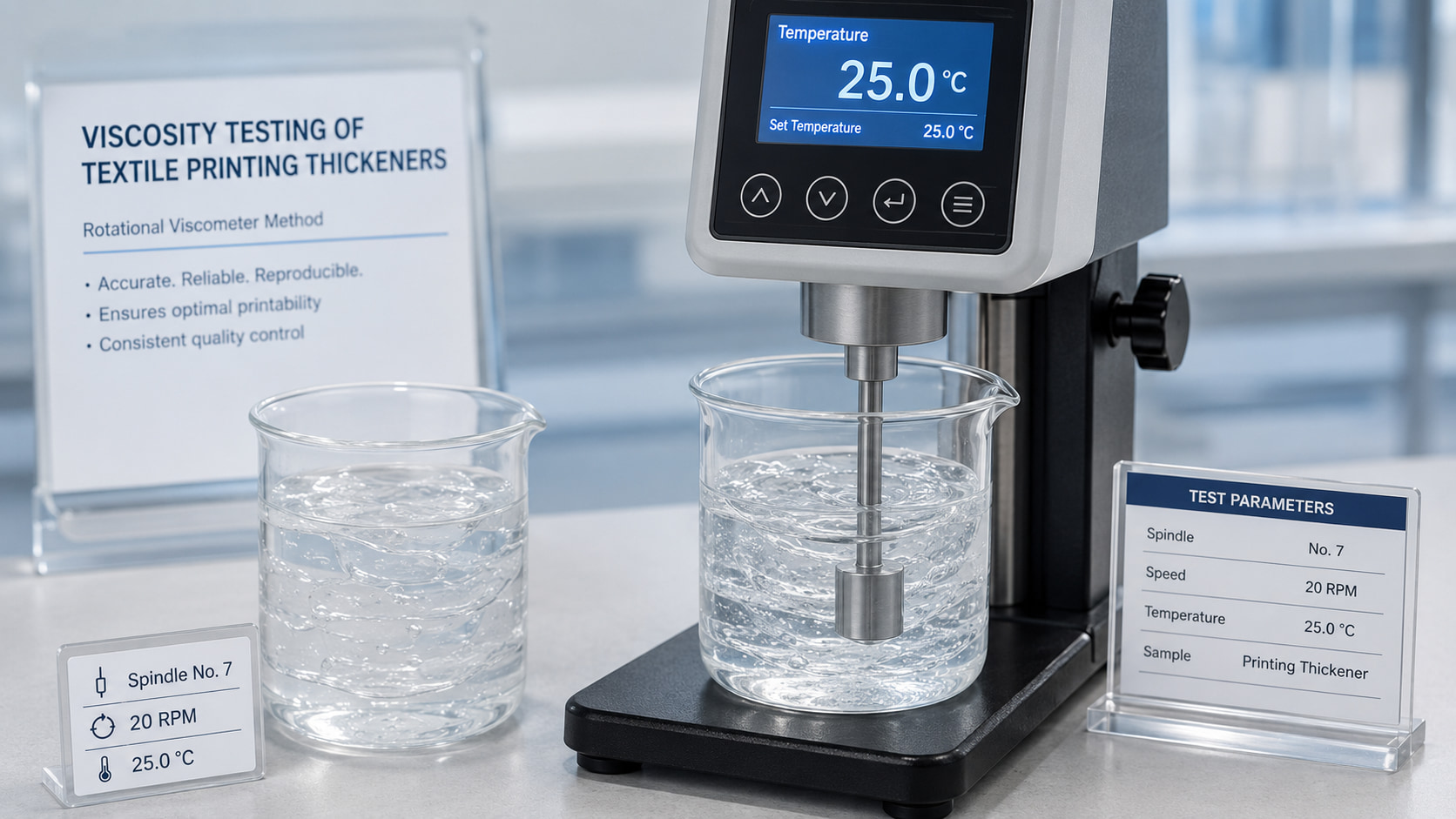
A single-point measurement records the apparent viscosity at one spindle and one rotational speed. It is useful for routine quality control when the method is standardized.
Perilaku pengenceran akibat geser
Many printing pastes become easier to move when exposed to stronger mixing, pumping or screen pressure. This can support paste circulation and transfer.
Pemulihan struktural
After the mechanical force is reduced, the paste may recover part of its original structure. Appropriate recovery helps control spreading after the paste reaches the fabric.
Time-dependent behavior
Some pastes change after extended mixing, circulation or resting. Their result may depend on both the applied shear and the time allowed for recovery.
Why equal viscosity does not prove equal performance
Two products can show the same value at one test speed while producing different values at another speed. They may therefore behave differently during screen passage and after deposition on the textile.
1. Define a Complete Viscosity Test Method
A viscosity value should never be separated from its measurement method. Without the method, buyers cannot make a reliable supplier or batch comparison.
A complete method should record
Product or paste identification
Sample concentration
Dasar perhitungan konsentrasi
Sumber air
Powder or liquid addition procedure
Mixer and mixing speed
Waktu pencampuran dan hidrasi
Sample resting time
Suhu pengukuran
Instrument model or measurement principle
Poros, rotor, atau geometri
Kecepatan putaran
Waktu membaca
Satuan yang dilaporkan
Use one method for reference and candidate
The current thickener and candidate should be prepared together using the same containers, water, mixer, hydration period and measurement settings.
A supplier value may use another method
A supplier TDS can provide a useful specification reference, but the buyer should not compare it directly with an internal result unless the methods are aligned.
Preserve the approved method
The method used during sample approval should become part of the incoming inspection procedure for the first commercial batch.
2. Control Measurement Temperature
Temperature can significantly influence apparent viscosity. Samples measured immediately after high-speed mixing may be warmer than samples that have rested in the laboratory.
Condition all samples equally
Reference and candidate samples should reach the same defined temperature before measurement.
Record the actual temperature
Writing “room temperature” may be insufficient when the laboratory temperature changes by season or shift.
Control mixing-generated heat
Extended high-speed mixing can raise the sample temperature. A lower result may reflect heat rather than a weaker thickener.
Monitor production temperature
Pumping, circulation, workshop conditions and machine operation can change paste temperature during a long production run.
Do not correct temperature-related change immediately
Before adding more thickener or water, condition the sample and repeat the measurement under the approved temperature.
3. Standardize Concentration and Water Quality
Small concentration differences can produce large viscosity differences, especially in polymer-thickened systems.
Use accurate weighing
Record the actual weight of water, thickener and other ingredients. Do not rely only on container marks or visual estimates.
Define the concentration basis
Clarify whether concentration is based on supplied product weight, dry polymer, active content or total finished paste.
Control water loss
Water remaining in transfer containers or lost through evaporation changes the final concentration.
Use the same water source
Water hardness, conductivity and pH can affect polymer hydration and chemical compatibility.
Test actual production water
Deionized water is useful for controlled screening, but final approval should include the water used in routine factory preparation.
4. Control Dispersion and Hydration
Incomplete hydration is a common cause of unstable viscosity. A paste may appear uniform while dry material remains trapped inside hydrated lumps.
Create liquid circulation before powder addition
Start the mixer and establish stable movement before introducing powdered sodium alginate, CMC, CMS or another thickener.
Add powder gradually
Dumping the complete quantity into one location encourages surface hydration and lump formation.
Use a repeatable addition time
One operator may add the product in two minutes while another requires ten minutes. This difference can change dispersion and final viscosity.
Allow the required hydration period
Visible dispersion does not prove that the polymer has developed its final properties. Follow the current grade instructions and use defined measurement times.
Check different vessel positions
Material near the surface, wall or bottom may not experience the same circulation as material near the impeller.
5. Understand the Effect of Shear
Printing paste experiences different shear conditions during preparation, pumping, circulation, screen passage and fabric application.
Laboratory mixing shear
Mixer type, impeller design, speed, vessel size and filling level determine how mechanical energy enters the sample.
Viscometer shear
Changing the spindle or rotational speed changes the measurement condition and may produce a different apparent viscosity.
Machine shear
Pumps, pipes, screens, squeegees and coating units expose the paste to conditions that a low-speed laboratory test may not represent.
Excessive shear during preparation
Unnecessary high-speed mixing after hydration may introduce air, increase temperature or change the structure of the formulation.
Compare multiple speeds where useful
Multi-speed measurements can help identify whether two samples with a similar routine-control result have different shear responses.
6. Evaluate Dyes, Salts, Alkalis and Binders
A thickener does not operate in clean water during textile printing. Colorants and auxiliaries can change viscosity, rheology and holding stability.
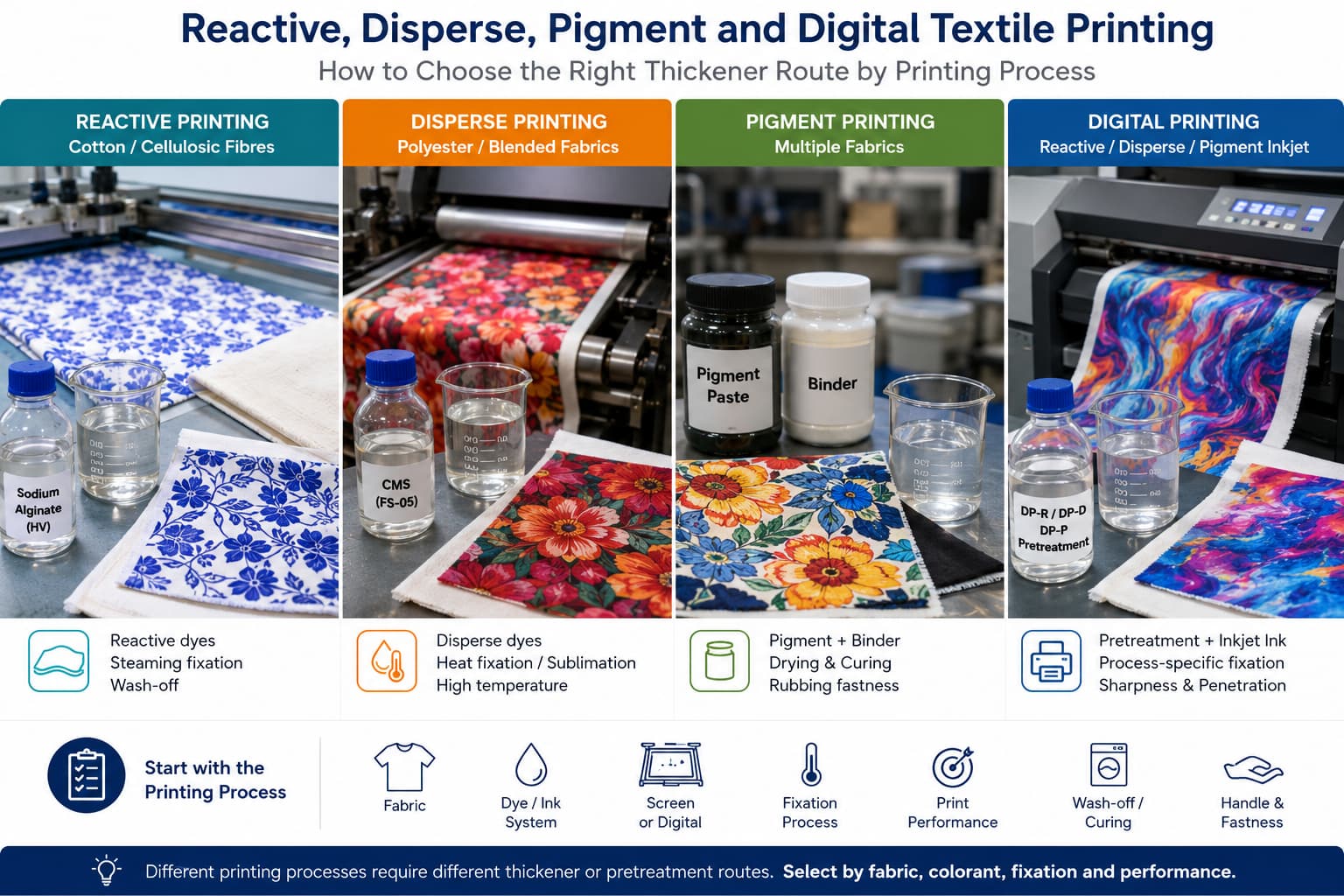
Pencetakan reaktif
Salts, alkalis, reactive dyes and humectants should be added at realistic production concentrations. The natrium alginat grade should be evaluated in the complete reactive paste.
Pencetakan pigmen
Pigment, binder, crosslinker and other auxiliaries may influence both viscosity and physical stability. Binder compatibility is more important than the thickener’s clean-water result.
CMC and CMS systems
CMC dan CMS grades can respond differently to pH, salts and other polymers.
Digital printing pretreatment
A pasta cetak digital should be tested with the actual reactive, disperse or pigment ink route, fabric and pretreatment process.
Mengatur urutan penjumlahan
Local exposure to concentrated salts, alkalis or binders may create a different result from gradual addition into a well-prepared polymer phase.
7. Monitor Viscosity Over Time
One immediate measurement cannot describe how the paste will behave during storage and production.
Suggested measurement stages
Immediately after mixing
After the specified hydration period
After completion of the full formulation
After the normal factory holding period
During a representative production run
After extended circulation where relevant
Viscosity increase over time
Possible causes include continued hydration, evaporation, lower temperature or concentration error.
Viscosity decrease over time
Possible causes include chemical interaction, temperature increase, excessive shear, contamination or incompatibility between formulation components.
Relate change to performance
A numerical change becomes commercially important when it affects paste transfer, fabric pickup, print definition, shade or production stability.
8. Control Evaporation and Unrecorded Dilution
Open storage and repeated correction are common causes of unexplained viscosity variation.
Keep laboratory samples covered
Two samples cannot be compared fairly when one loses more water during hydration or storage.
Review production-tank exposure
Long circulation, warm workshops and open tanks may gradually increase paste concentration.
Record every water addition
Operators should not add water only until the paste appears familiar. Record the quantity, time and reason for each correction.
Avoid repeated correction cycles
Adding water, then adding thickener, and then adding more water can move the formulation away from the approved chemical balance.
Investigate the cause first
Confirm temperature, hydration, concentration and test method before changing the formula.
9. Connect Filtration, Foam and Viscosity
Filtration and foam can influence both the measurement result and machine performance.
Undissolved material
Lumps and gels can make a sample appear nonuniform and may create unstable or nonrepeatable readings.
Air entrainment
Air introduced by high-speed mixing can interfere with viscometer contact, increase apparent volume and produce irregular readings.
Define the filtration method
Record the filter opening, sample quantity, pressure or gravity condition and filtration time.
Inspect retained material
Determine whether the residue consists of dry powder, hydrated polymer, precipitated chemicals, fibres or foreign contamination.
Do not use filtration to hide incompatibility
Filtration removes particles but does not permanently correct a chemically unstable formulation.
10. Build Production Viscosity Control Points
Reliable production requires clearly defined checkpoints rather than irregular testing only after a problem appears.
Record water, product weight, addition time, mixer settings, temperature and hydration period.
Completed color paste
Measure after the full chemical system has been added and sufficiently mixed.
Pre-production release
Confirm viscosity, appearance, pH and filtration before the paste enters routine production.
In-process monitoring
Record paste temperature, viscosity, circulation behavior and any corrective additions during long runs.
End-of-run review
Compare fabric and paste data from the beginning, middle and end of the production run.
Viscosity Priorities by Printing Process
Proses Pencetakan
Viscosity Management Priority
Additional Checks
Reactive flat-screen printing
Paste transfer, edge control and holding stability
Dye compatibility, penetration and wash-off
Reactive rotary-screen printing
Circulation, high-shear flow and recovery
Screen passage and long-run consistency
Pencetakan pigmen
Binder compatibility and shear response
Curing, rubbing performance and handle
Selected disperse printing
Paste stability, screen transfer and fixation compatibility
Color uniformity and final surface result
Pretreatment digital reaktif
Uniform application pickup and storage stability
Ink spreading, fixation and wash-off
Pretreatment digital dispersi
Application uniformity and filtration
Drying, fixation and migration control
Pigment digital pretreatment
Binder stability, pH and application consistency
Curing, fastness and fabric handle
These priorities identify what should be monitored. They do not establish one universal viscosity target for each process.
How to Correct High or Low Viscosity
When viscosity is higher than expected
First confirm temperature, concentration, evaporation, hydration time, measurement settings and sample identification.
Controlled dilution may be considered only after the cause has been identified and the effect on every other formulation component has been reviewed.
When viscosity is lower than expected
First confirm weighing, water quantity, hydration, temperature, chemical additions and test method.
Adding more thickener immediately can create incomplete hydration and local high-concentration areas. Prepare any correction using a controlled procedure.
When viscosity changes after chemical addition
Repeat the formula in stages and measure after each critical component. This can help identify salt, alkali, acid, binder or polymer interaction.
When the number is correct but printing is poor
Review rheology, filtration, foam, fabric absorbency, machine conditions and application quantity. The target number itself may not represent the correct performance window.
Laboratory-to-Production Scale-Up
A small laboratory beaker and a production tank do not create identical mixing, heat transfer or circulation.
Keep the laboratory record
Record the approved mixer, addition time, hydration period, temperature and measurement method.
Use a limited production batch
A pilot or controlled first batch can reveal dispersion, foam, filtration and transfer issues before full conversion.
Do not copy mixer RPM directly
Identical rotational speed does not produce identical liquid movement in vessels of different diameter, depth and impeller design.
Check vessel uniformity
Where appropriate, compare samples from different positions before releasing the paste.
Monitor the actual operating period
Production paste may remain in storage or circulation much longer than a laboratory sample.
How to Compare Thickener Samples
Step 1: Select a current reference
Use a representative sample of the product approved in routine production.
Langkah 2: Sesuaikan metode pengujian
Use the same concentration, water, mixer, hydration, temperature, spindle and speed.
Step 3: Compare equal concentration
Begin with an equal-concentration comparison before optimizing the candidate dosage.
Step 4: Compare more than viscosity
Dispersion
Waktu hidrasi
Penyaringan
Busa
Multi-speed behavior
Menjaga stabilitas
Step 5: Test the complete formulation
Add the actual dyes, pigments, salts, alkalis, binders and auxiliaries.
Step 6: Complete an application trial
Evaluate printing, fixation, washing or curing on representative fabric.
Step 7: Optimize dosage
Adjust the candidate in controlled steps while maintaining the same final quality requirements.
How to Read Viscosity Information on a TDS
Check the concentration
Confirm whether the value is measured using a one-percent, two-percent, three-percent or another defined solution or paste.
Check the temperature
The stated result should be connected with a measurement temperature.
Check the instrument and speed
A complete method may identify the instrument, spindle and rotational speed. Ask the supplier when these details are not shown.
Distinguish typical values from specifications
A typical value describes a reference result. An agreed specification defines the commercial acceptance range.
Check whether the value belongs to the raw material or final paste
Powder-solution viscosity, supplied-liquid viscosity and completed printing-paste viscosity are different measurements.
Confirm batch-document expectations
Ask whether viscosity will appear on the batch COA and which method will be used.
A matched viscosity result is an initial qualification step. Final approval requires complete formulation testing, representative textile evaluation and verification of the commercial batch📧 Email: Service@fsxchemical.com
Ketahui mengapa nilai viskositas pengental dalam pencetakan tekstil tidak dapat dibandingkan tanpa menyesuaikan konsentrasi, suhu, alat ukur, spindel, kecepatan, metode persiapan, dan waktu pengujian.
Pelajari cara memilih bahan pengental dan metode pra-perlakuan untuk pencetakan tekstil reaktif, disperse, pigmen, dan digital berdasarkan jenis kain, pewarna atau tinta, proses fiksasi, daya lepas saat pencucian, serta persyaratan kualitas cetakan.
Pelajari cara mengevaluasi produsen pengental untuk pencetakan tekstil dengan memeriksa identitas perusahaan, kapasitas produksi, metode pengujian, keterlacakan batch, dokumen teknis, dukungan sampel, dan pasokan ekspor.
Bandingkan CMC, CMS, natrium alginat, dan pasta cetak digital untuk pencetakan tekstil. Pelajari bagaimana masing-masing bahan tersebut sesuai dengan proses pencetakan reaktif, dispersi, pigmen, dan digital, serta hal-hal apa saja yang perlu diperhatikan pembeli sebelum melakukan pengujian sampel, penyesuaian kualitas, dan pembelian dalam jumlah besar.
Sodium alginat banyak digunakan dalam pencetakan tekstil sebagai pengental yang stabil dan tahan cuci untuk pasta cetak reaktif. Pelajari cara mengevaluasi tingkat viskositas, kemurnian, dan kesesuaian penggunaannya sebelum membeli, serta bagaimana FSX Chemical mendukung pembeli di seluruh dunia dengan data teknis dan sampel.
Karboximetil selulosa (CMC) banyak digunakan dalam proses pencetakan, pelapisan, dan pewarnaan tekstil. Panduan ini akan menjelaskan cara mengevaluasi jenis-jenis CMC, parameter mana yang paling penting, serta bagaimana FSX Chemical dapat mendukung keputusan pembelian.
Karboximetil selulosa digunakan sebagai pengental dan penstabil dalam tinta berbasis air, pencetakan gravure, serta pra-perlakuan pencetakan inkjet. Panduan ini membahas parameter utama setiap jenis produk serta pertimbangan dalam pemilihan pemasok bagi tim pengadaan.
Baik natrium alginat maupun CMC digunakan sebagai pengental dalam pencetakan tekstil, namun keduanya cocok untuk sistem pewarnaan dan kondisi proses yang berbeda. Panduan ini menjelaskan perbedaan utama di antara keduanya serta kapan masing-masing harus digunakan.
Pencetakan inkjet digital pada tekstil memiliki persyaratan pasta dan pra-perlakuan yang berbeda dibandingkan dengan pencetakan sablon. Panduan ini menjelaskan bagaimana natrium alginat digunakan dalam pencetakan tekstil digital serta parameter kualitas apa saja yang harus ditentukan oleh tim pengadaan.
CMC kelas pangan dan kelas industri memiliki struktur kimia dasar yang sama, namun berbeda secara signifikan dalam hal kemurnian, rentang DS, dan persyaratan regulasi. Panduan ini menjelaskan perbedaan-perbedaan utama tersebut serta mengapa penggunaan kelas yang salah dapat menimbulkan masalah dalam proses produksi.
Persiapan pasta yang tepat sama pentingnya dengan pemilihan kadar dalam pencetakan tekstil dengan pewarna reaktif. Panduan ini membahas metode pelarutan natrium alginat, kisaran konsentrasi sesuai dengan penggunaannya, kondisi penyimpanan, serta cara mengatasi masalah umum dalam persiapan.
Sodium alginat adalah polimer alami yang dapat terurai secara hayati, namun penggunaannya dalam pencetakan tekstil menghasilkan air limbah yang perlu dikelola. Panduan ini membahas profil lingkungan sodium alginat, karakteristik air limbah hasil pencucian, serta hal-hal yang perlu dipahami oleh tim pengadaan terkait pemilihan bahan pengental dan dampaknya terhadap lingkungan.
Berikan nama produk, kegunaan, jumlah, tujuan pengiriman, serta TDS,
foto sampel, atau dokumen lain yang sudah Anda miliki. FSX Chemical akan meninjau
informasi tersebut dan merekomendasikan langkah selanjutnya terkait penawaran harga, pencocokan sampel,
atau pemilihan produk.
Informasi ProdukNama produk, kelas, model, foto label, atau referensi pemasok.
Dokumen yang TersediaTDS, SDS, COA, foto sampel, daftar produk, atau data pengujian.
Rincian PesananPerkiraan jumlah, kemasan, negara tujuan, pelabuhan, atau syarat perdagangan.
Permohonan atau MasalahProses pencetakan tekstil, kebutuhan formulasi, masalah terkini, atau target kinerja.

 ID
ID  EN
EN  BN
BN  ES
ES  TR
TR  FR
FR  RU
RU  AR
AR  UR
UR  VI
VI  TL
TL  HI
HI  UK
UK  KK
KK  KA
KA  UZ
UZ