CMC Degree of Substitution (DS): How It Affects Salt Tolerance, Solubility and Textile Printing Performance
Degree of substitution is one of the most important structural specifications of CMC. Higher DS...
Degree of substitution (DS) is one of the most important structural specifications used to describe sodium carboxymethyl cellulose (CMC), but it should not be treated as a simple quality ranking. DS describes the average number of hydroxyl groups on each anhydroglucose unit that have been replaced by carboxymethyl groups. This structural change affects how CMC interacts with water, salts, acids, dyes and auxiliaries. In textile printing, higher DS can support improved solubility and electrolyte tolerance in suitable grades, but viscosity, paste rheology and print performance also depend on molecular weight, substitution uniformity, purity, concentration and the complete formulation. This guide explains how to interpret DS when selecting CMC for textile printing rather than buying from DS alone.
What Is the Degree of Substitution (DS) of CMC?
Carboxymethyl cellulose is produced by introducing carboxymethyl groups into the cellulose structure.
Each anhydroglucose unit in cellulose contains three hydroxyl positions that can theoretically be substituted.
Therefore, the theoretical DS range is:
DS = 0 to 3
A DS value represents the average number of hydroxyl groups replaced by carboxymethyl groups per anhydroglucose unit.
For example, a DS of 1.0 does not mean every glucose unit has exactly one identical substitution. It means the average substitution across the polymer is approximately one carboxymethyl group per anhydroglucose unit.
This distinction matters because two CMC products with the same average DS can still have different molecular weight, substitution distribution, purity, particle size, dissolution speed and rheology.
Published CMC reviews identify DS as a major structural parameter affecting solubility, viscosity behavior, acid resistance, stability and salt tolerance.
Why DS Changes CMC Behavior
Native cellulose contains extensive hydrogen bonding and crystalline regions that make it poorly soluble in water.
Introducing sodium carboxymethyl groups changes this structure.
The substituted groups are hydrophilic, anionic in suitable aqueous conditions, capable of increasing interaction with water and responsive to ionic strength and pH.
As substitution increases, the cellulose chain generally becomes more water-compatible and less dominated by unsubstituted cellulose-like regions.
This helps explain why DS can influence dissolution, hydration, electrolyte response, acid resistance, chain expansion and rheological behavior.
However, DS is only one structural parameter.
A textile buyer should think of CMC performance as:
DS + Molecular Weight + Substitution Uniformity + Purity + Concentration + Water + Complete Formula
How DS Affects Water Solubility and Hydration
One of the clearest effects of carboxymethyl substitution is improved water compatibility.
Published CMC literature shows that very low-substitution material can remain only swellable or partially soluble, while increasing substitution generally improves water solubility.
For practical textile grades, the useful question is not simply whether CMC eventually dissolves.
The mill should evaluate dispersion during powder addition, hydration speed, final solution uniformity, fish-eye formation, undissolved residue and filtration behavior.
A higher-DS route may support easier hydration in suitable products because more hydrophilic carboxymethyl groups are present.
However, a lower-DS product with optimized particle size and good manufacturing uniformity can sometimes disperse more smoothly than a poorly processed higher-DS grade.
This is why DS should be verified together with an actual dissolution test.
How DS Affects Salt and Electrolyte Tolerance
CMC is an anionic polyelectrolyte.
Its polymer chains carry negatively charged carboxymethyl groups in suitable aqueous conditions.
When electrolytes are added, dissolved ions can screen the electrostatic repulsion between polymer chains.
This can change chain expansion, apparent viscosity, rheology and solution stability.
Higher substitution generally introduces more carboxymethyl functionality and is commonly associated with improved salt tolerance in CMC literature.
For textile printing, this can be valuable when the complete formula contains electrolytes, dyes, alkali, auxiliary salts or hard-water ions.
But higher DS does not mean salt-proof.
Actual electrolyte tolerance also depends on salt type, salt concentration, valence of the cation, CMC molecular weight, polymer concentration, temperature and pH.
Divalent and multivalent ions can affect anionic polymers much more strongly than simple monovalent salts.
Therefore, salt tolerance should be measured in the buyer’s actual formulation rather than inferred from DS alone.
How DS Can Influence Acid Stability
CMC behavior changes with pH because carboxymethyl groups can change ionization state as the environment becomes more acidic.
At sufficiently low pH, the carboxylate groups become more protonated and polymer solubility or solution behavior can change.
Higher substitution is generally associated with improved acid resistance in CMC literature, but the practical limit still depends on actual pH, acid type, exposure time, temperature, electrolyte concentration and CMC grade.
Textile printing formulations can encounter acidic or alkaline components at different process stages.
Therefore, a buyer requiring acid tolerance should ask for application testing under the actual formula rather than accepting a generic “acid-resistant CMC” claim.
Does Higher DS Mean Higher Viscosity?
No—not automatically.
This is one of the most important purchasing mistakes to avoid.
DS and viscosity describe different aspects of the product.
DS describes chemical substitution.
Viscosity is strongly influenced by molecular weight / degree of polymerization, polymer concentration, temperature, water quality, salt content, substitution distribution and measurement method.
A higher-DS CMC can have a lower viscosity than a lower-DS CMC if its molecular weight is lower.
Likewise, two CMC grades can have similar viscosity in pure water while reacting very differently after salt, dye or alkali is added.
For textile printing, the correct specification is therefore not:
“Give me the highest DS and highest viscosity.”
এটি:
“Give me the DS, molecular-weight/viscosity route and formulation compatibility that produce the required paste performance.”
DS vs. Molecular Weight: Two Different Specifications
নির্দিষ্টকরণ
What It Mainly Describes
Why It Matters in Printing
প্রতিস্থাপনের ডিগ্রি
Average chemical substitution of cellulose hydroxyl groups
These specifications interact, but they are not interchangeable.
A CMC buyer who requests only “DS 1.5” still has not defined viscosity, concentration for viscosity testing, purity, particle size, salt tolerance or application route.
Why Substitution Uniformity Matters
Average DS does not describe where the carboxymethyl groups are distributed along the cellulose chain.
If substitution is uneven, some regions can remain more cellulose-like and less water-compatible.
Research on sodium CMC solutions has shown that weakly substituted regions can contribute to hydrophobic association and aggregation in water.
This helps explain why two grades with the same average DS can show different clarity, hydration speed, gel particles, rheology and filtration residue.
In printing-paste production, consistent substitution distribution can therefore be as important as the reported average DS.
Substitution uniformity is not always listed directly on commercial TDS documents, so the buyer often evaluates it indirectly through dissolution behavior, solution clarity, filtration and batch repeatability.
DS in Reactive Textile Printing
Reactive dye printing is one of the most technically sensitive areas for cellulose-derived thickeners.
CMC still contains unsubstituted hydroxyl groups.
Depending on CMC structure, dye chemistry and fixation conditions, these remaining hydroxyl groups can interact with reactive dyes.
This is one reason ordinary industrial CMC should not automatically be treated as a universal one-to-one replacement for sodium alginate in reactive printing.
Higher-substitution CMC routes may be evaluated where the goal is to reduce undesirable dye-thickener interaction and improve electrolyte compatibility, but final suitability still depends on the actual reactive dye system.
FSX Chemical’s current CMC application guidance therefore treats higher-, medium- and lower-DS grades as different evaluation routes rather than claiming that one DS is universally best.
For a reactive printing trial, compare color yield, background staining, print definition, paste stability, wash-off and fabric hand using the same dye, fabric, alkali, auxiliaries and fixation process.
DS in Disperse, Pigment and Compound Thickener Systems
CMC is also evaluated in selected disperse, pigment and compound-thickener formulations.
In these systems, DS can influence dissolution, compatibility with salts and auxiliaries, solution stability, blend behavior and water retention.
However, the most important selection variables can differ by route.
ডিসপার্স প্রিন্টিং
Evaluate compatibility with the disperse color paste, thermal process and wash/clearing route.
পিগমেন্ট প্রিন্টিং
Evaluate compatibility with binder, crosslinker, electrolyte and curing conditions.
Compound Thickener Systems
CMC may be blended with other polymers to adjust paste body, flow, cost, salt response and printing transfer.
The best DS for a blend is therefore a formulation decision, not a universal product ranking.
What Happens When Salt Is Added to a CMC Printing Paste?
A useful textile laboratory test is to measure viscosity before and after a controlled salt addition.
A simple comparison can follow this sequence:
CMC Solution → Initial Viscosity → Controlled Salt Addition → Mixing → Defined Holding Time → Final Viscosity
Record CMC concentration, salt identity, salt concentration, water quality, temperature, viscometer, spindle/rotor, RPM and holding time.
The meaningful result is not only the final viscosity.
Also observe flocculation, gel formation, phase separation, loss of clarity and recovery after mixing.
This provides a more useful salt-tolerance profile than DS alone.
Water Hardness, Metal Ions and DS
Water quality can significantly change the behavior of an anionic polymer.
Calcium, magnesium and other multivalent ions can interact more strongly with carboxylate groups than sodium or other monovalent ions.
This can change viscosity, aggregation, solubility and paste stability.
A higher-DS route may offer better tolerance in selected formulations, but hard-water performance should still be tested directly.
When comparing CMC samples, use the buyer’s actual plant water and a controlled reference water where possible.
If the result changes sharply between the two, water hardness should become part of the production specification.
Why Two CMC Grades with Similar DS Can Dissolve Differently
DS is only one reason CMC dissolves well or poorly.
Other important factors include particle size, particle-size distribution, surface treatment, powder addition rate, mixing intensity, water temperature, molecular weight, substitution uniformity and residual salts.
One grade may disperse easily but hydrate slowly.
Another may hydrate rapidly but create fish-eyes if added too quickly.
Therefore, a purchasing test should include a standardized preparation method rather than judging the powder from DS and viscosity on paper.
How to Compare CMC Grades Without Mistaking DS for Performance
Two commercial grades with different DS usually differ in other properties as well. A side-by-side trial can establish suitability, but it cannot prove that DS alone caused the difference unless molecular size, purity and other relevant variables are controlled.
Align the specification before preparing samples
Request the reported DS or degree-of-etherification method and its basis. Record moisture, purity basis and viscosity conditions separately. ASTM D1439-22 lists distinct methods for moisture, degree of etherification, viscosity, purity and residual salts. Referring to that standard does not mean a supplier has performed every method or that FSX is certified to it; agree the actual methods used.
Use two comparison passes
Pass
নিয়ন্ত্রণ
Interpretation
Equal as-supplied dosage
Powder concentration, water, hydration, rest time, temperature and measurement procedure
Practical difference when the mill weighs the same amount of purchased material
Application-optimized dosage
Final recipe mass and dye/auxiliary levels; optimize each candidate within its recommended range
Actual consumption required to meet the same printing requirements
If reliable purity and moisture results are available, an additional equal-active-polymer comparison can help separate salt and moisture dilution from polymer behavior. Label it separately; do not silently change the concentration basis between samples.
Challenge with the actual electrolyte package
After full hydration, compare a no-added-salt control and defined additions of the relevant production salts. Match final mass, mixing, pH, temperature and elapsed time. Include the complete dye paste before approval. Record viscosity with instrument, spindle and speed, then inspect residue, holding stability, screen behavior and finished-print quality.
A higher-DS grade may be a useful candidate when the existing grade loses function in the intended recipe, but it is not an automatic 1:1 replacement. Retain the reference sample and accepted process window so the first commercial batch can be checked against the approved trial.
How to Validate DS in a Textile Printing Trial
The laboratory solution test is only the first stage.
The complete printing trial should use:
Same Fabric → Same Colorant → Same Formula → Same Thickener Dosage → Same Machine Conditions → Same Fixation → Same Washing
Then compare paste body, screen or application transfer, edge definition, color yield, penetration, background cleanliness, wash-off, fabric hand and production repeatability.
If one candidate has higher DS but performs worse on the fabric, the printing result should take priority over the specification ranking.
DS is a selection tool—not the final acceptance criterion.
What Buyers Should Request on a CMC TDS or COA
A useful CMC purchasing specification should include more than DS.
নির্দিষ্টকরণ
Why It Matters
প্রতিস্থাপনের ডিগ্রি
Structural substitution and ionic behavior
সান্দ্রতা
Paste body and thickening route
Viscosity test concentration
Required for meaningful comparison
সান্দ্রতা পদ্ধতি
Instrument, spindle/rotor, RPM and temperature affect result
Purity / active content
Controls effective CMC content and residual by-products
আর্দ্রতা
Affects active-content calculation and storage
পিএইচ
Useful for formula compatibility
Particle size
Influences dispersion and hydration
Application recommendation
Confirms the grade was designed for a relevant route
For a printing project, the buyer should also request a representative sample and compare it under the complete production formula.
Common Mistakes When Buying CMC by DS
Mistake 1: Higher DS Means Higher Viscosity
Incorrect. Molecular weight and test conditions strongly influence viscosity.
Mistake 2: Higher DS Is Always Better
Incorrect. Higher DS can improve selected solubility and electrolyte-related properties, but the best route depends on the application and cost-performance target.
Mistake 3: Same DS Means Same Product
Incorrect. Molecular weight, substitution distribution, purity and particle structure can differ.
Incorrect. Salt, dye, alkali, binder and water hardness can change the complete paste.
Mistake 5: CMC Can Replace Sodium Alginate 1:1 Because DS Is High
Incorrect. Reactive printing compatibility must be validated with the actual dyes, fixation and washing process.
Mistake 6: One DS Is Suitable for Every Textile Route
Incorrect. Reactive, disperse, pigment and compound-thickener formulations impose different compatibility requirements.
How to Choose a Higher-, Medium- or Lower-DS Route
Consider a Higher-DS Route When:
Electrolyte tolerance is an important concern.
Dissolution and higher substitution are part of the required specification.
Reactive-printing compatibility is being specifically evaluated.
Acid/salt stability requires a stronger candidate route.
Consider a Medium-DS Route When:
The goal is balanced dissolution, viscosity and formulation control.
The mill is comparing several compound-thickener formulations.
Extreme electrolyte tolerance is not the only selection criterion.
Consider a Lower-DS Route When:
The formulation requires a specific paste-body or cost route.
The product has already demonstrated adequate dissolution and compatibility.
Application trials show no need for a higher-substitution grade.
This is also consistent with FSX Chemical’s current CMC grade-matching approach, which separates higher-, medium- and lower-DS routes by application testing rather than presenting DS as a universal performance ranking.
DS means degree of substitution. It is the average number of hydroxyl groups on each cellulose anhydroglucose unit that have been replaced by carboxymethyl groups.
2. What is the maximum theoretical DS of CMC?
Each anhydroglucose unit has three hydroxyl positions, so the theoretical maximum DS is 3.
3. Does higher DS improve CMC solubility?
In general, increasing carboxymethyl substitution improves water compatibility and solubility, but actual dissolution also depends on substitution uniformity, particle size, molecular weight and preparation conditions.
4. Does higher DS improve salt tolerance?
Higher substitution is commonly associated with improved salt tolerance, but actual performance depends on salt type, concentration, ion valence, pH, water quality and the specific CMC grade.
5. Does higher DS mean higher CMC viscosity?
No. Viscosity is strongly influenced by molecular weight, concentration and test method. A higher-DS grade can have lower viscosity than a lower-DS grade.
6. Can two CMC grades with the same DS perform differently?
Yes. They may have different molecular weight, substitution distribution, purity, particle size and rheology.
7. Why does CMC viscosity fall after salt is added?
Electrolytes can screen the electrostatic repulsion between anionic CMC chains, causing chain contraction and changes in apparent viscosity.
8. Does hard water affect CMC?
It can. Calcium, magnesium and other multivalent ions may change viscosity, aggregation and solution stability, so plant water should be included in formulation trials.
9. Is high-DS CMC always suitable for reactive printing?
No. Higher substitution can be a useful evaluation route, but compatibility with the actual reactive dyes, alkali, fixation and wash-off process must still be confirmed.
10. Can high-DS CMC replace sodium alginate one-to-one?
Not automatically. The two polymers have different structures and dye interactions. Use controlled printing trials rather than a universal replacement ratio.
11. What specifications should I compare besides DS?
Compare viscosity and its test method, purity, moisture, pH, particle size, dissolution, salt tolerance and complete printing-paste performance.
12. What should I send FSX Chemical for CMC grade matching?
Send the current CMC or thickener TDS, required DS, viscosity method, printing route, full or simplified formula, fabric, current dosage and the main performance target.
Match CMC DS to Your Textile Printing Formula with FSX Chemical
If you are comparing CMC grades by DS, do not stop at the specification sheet. FSX Chemical can help evaluate whether a higher-, medium- or lower-DS route is technically relevant to your printing formula.
For a useful comparison, send:
Your current CMC or thickener product/TDS
Required or current DS
সান্দ্রতা এবং সম্পূর্ণ পরীক্ষণ পদ্ধতি
Purity requirement
Textile printing route
Dye or pigment system
কাপড়
সম্পূর্ণ বা সরলীকৃত পেস্ট সূত্র
Salt/alkali/binder conditions
বর্তমান মাত্রা
Water quality where relevant
Current dissolution, salt-tolerance, color or printing problem
দিয়ে শুরু করুন নমুনা ও মিলान for a controlled laboratory comparison.
Degree of substitution is a structural specification, not a complete performance rating. The correct CMC grade is the one whose DS, molecular-weight route, dissolution, electrolyte tolerance and rheology remain suitable inside the actual textile printing formulation.
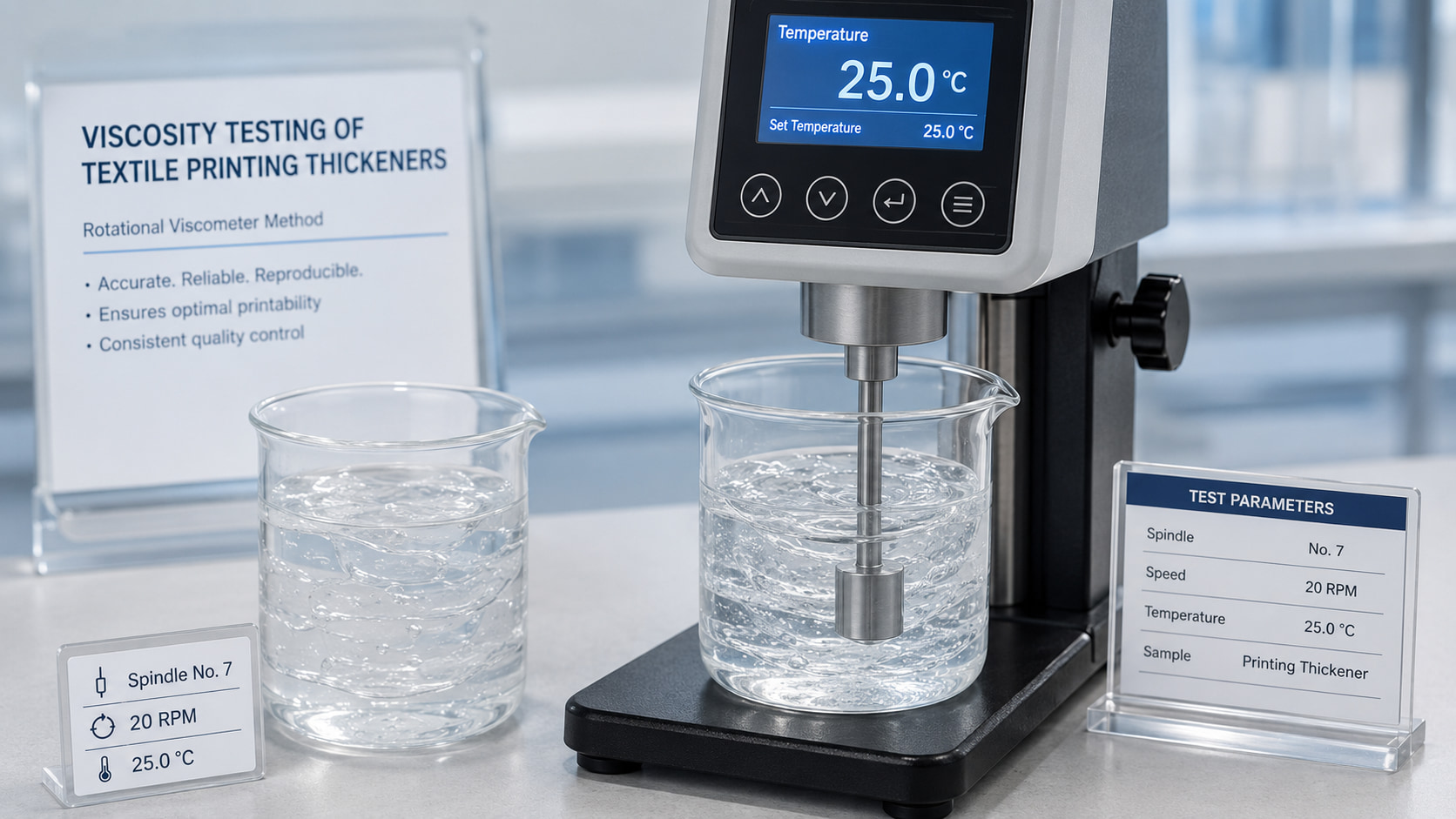
জানুন কেন টেক্সটাইল প্রিন্টিং থিকেনার সান্দ্রতা (ভিসকোসিটি) মানগুলো তুলনা করা যায় না যদি না সেগুলোর ঘনত্ব, তাপমাত্রা, যন্ত্র, স্পিন্ডল, গতি, প্রস্তুতি পদ্ধতি এবং পরীক্ষার সময় মিল থাকে।.
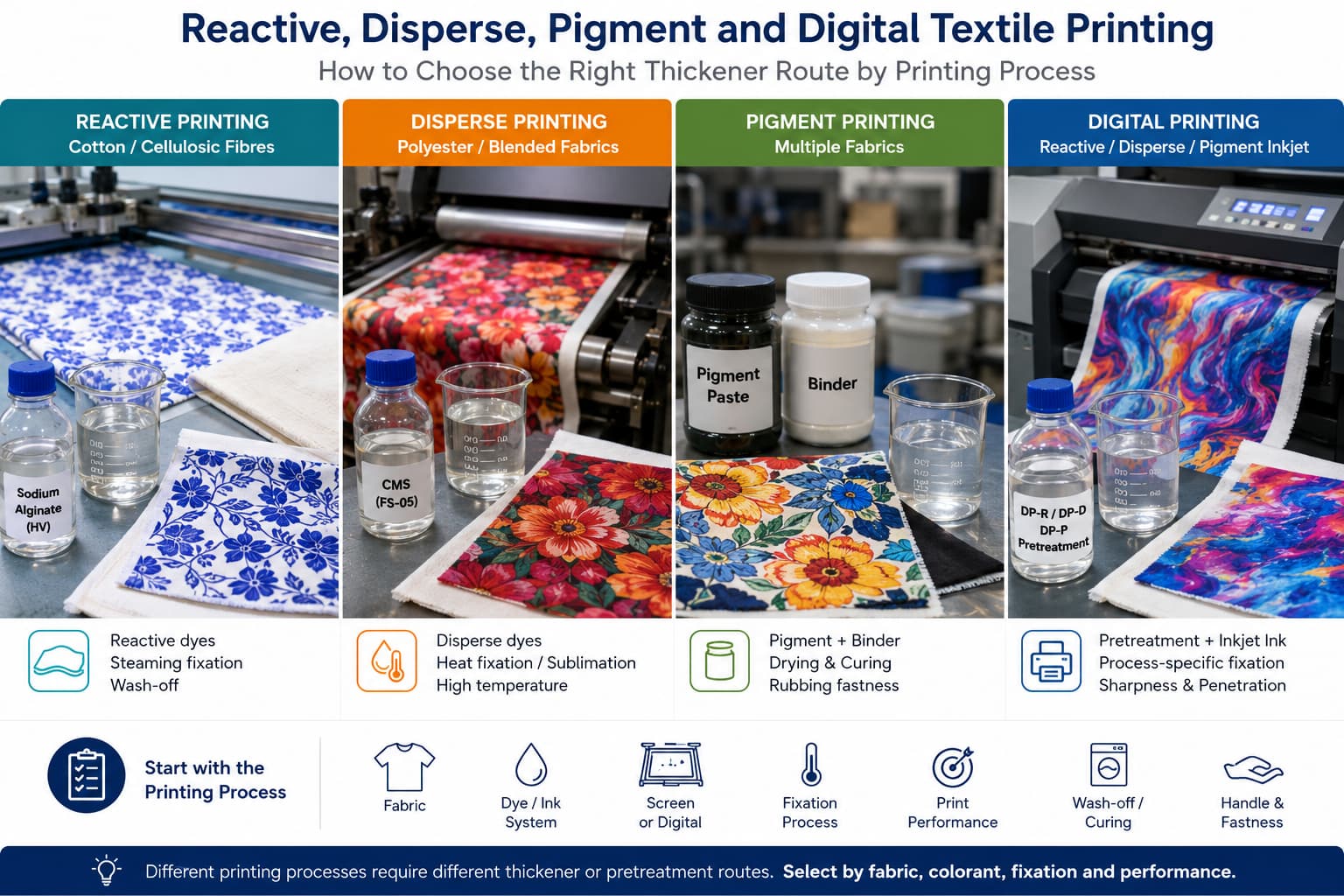
কাপড়, রঞ্জক বা কালি, স্থিরীকরণ, ধুয়ে ফেলার এবং মুদ্রণ-মানের প্রয়োজনীয়তার ভিত্তিতে প্রতিক্রিয়াশীল, বিচ্ছুরিত, পিগমেন্ট এবং ডিজিটাল টেক্সটাইল প্রিন্টিংয়ের জন্য ঘনকারী ও প্রিট্রিটমেন্ট পদ্ধতি কীভাবে নির্বাচন করবেন তা শিখুন।.
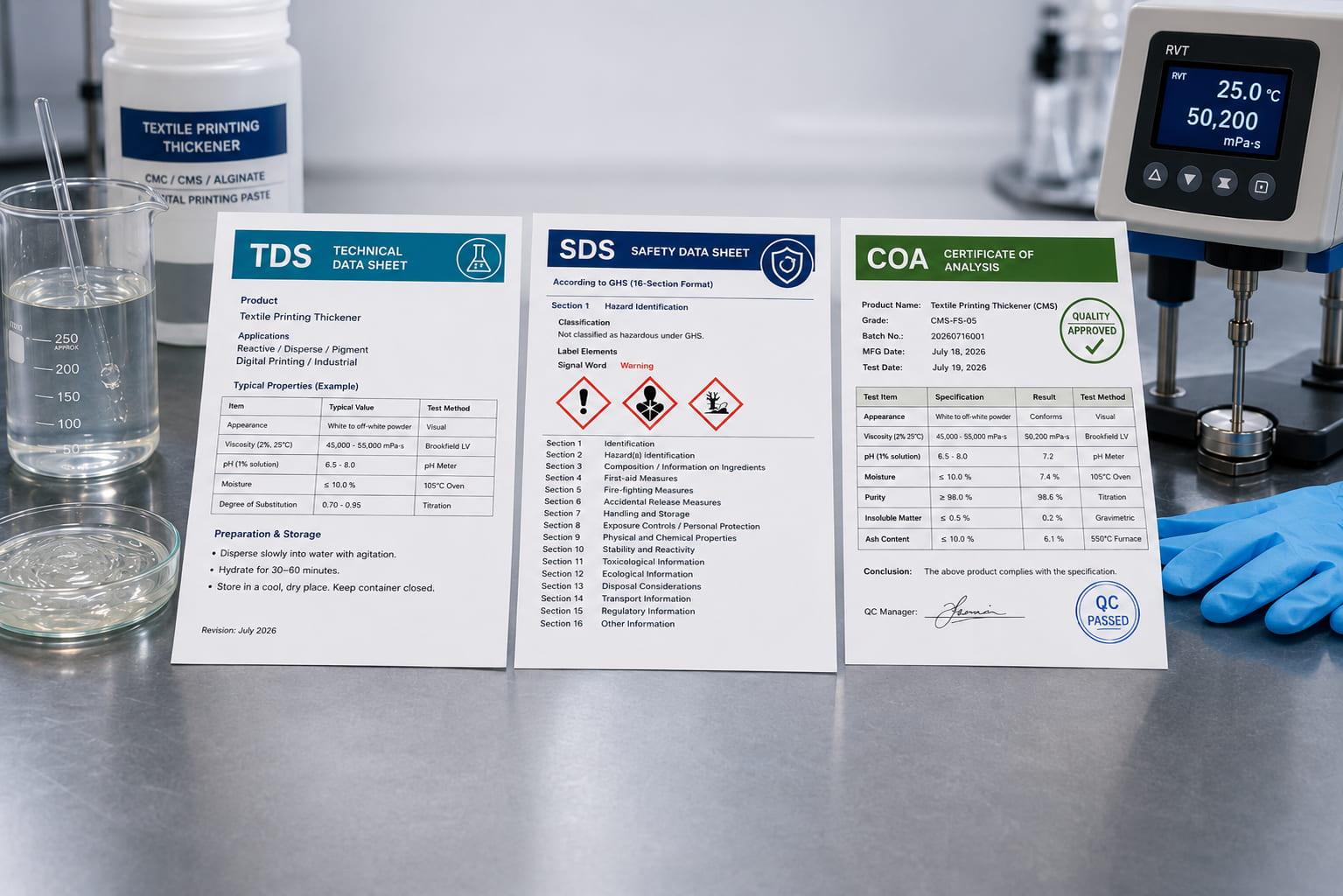
TDS, SDS এবং COA ডকুমেন্টের মধ্যে পার্থক্য শিখুন, টেক্সটাইল প্রিন্টিং ক্রেতাদের কী যাচাই করা উচিত এবং স্পেসিফিকেশন, নিরাপত্তা তথ্য, পরীক্ষা পদ্ধতি, ব্যাচ ফলাফল ও ডকুমেন্ট ইস্যুকারী কীভাবে যাচাই করবেন।.
টেক্সটাইল প্রিন্টিংয়ের জন্য CMC, CMS, সোডিয়াম অ্যালজিনেট এবং ডিজিটাল প্রিন্টিং পেষ্টের তুলনা করুন। প্রতিটি পদ্ধতি কীভাবে রিয়্যাক্টিভ, ডিসপার্স, পিগমেন্ট এবং ডিজিটাল প্রক্রিয়ার সঙ্গে খাপ খায় এবং নমুনা পরীক্ষা, গ্রেড মিলान ও বৃহৎ পরিমাণে ক্রয়ের আগে ক্রেতাদের কী কী বিষয় পর্যালোচনা করা উচিত তা শিখুন।.
সোডিয়াম অ্যালজিনেট টেক্সটাইল প্রিন্টিং-এ রিঅ্যাক্টিভ প্রিন্টিং পেষ্টের জন্য একটি স্থিতিশীল ও ধোয়াযোগ্য ঘনকারী হিসেবে ব্যাপকভাবে ব্যবহৃত হয়। কেনার আগে সান্দ্রতা গ্রেড, বিশুদ্ধতা এবং প্রয়োগের উপযোগিতা কীভাবে মূল্যায়ন করবেন এবং FSX কেমিক্যাল কীভাবে প্রযুক্তিগত তথ্য ও নমুনা দিয়ে বিশ্বব্যাপী ক্রেতাদের সহায়তা করে তা জানুন।.
কার্বক্সিমেথাইল সেলুলোজ (CMC) বস্ত্রের মুদ্রণ, সাইজিং এবং রঙ করার প্রক্রিয়ায় ব্যাপকভাবে ব্যবহৃত হয়। এই গাইডে CMC গ্রেডগুলো কীভাবে মূল্যায়ন করবেন, কোন প্যারামিটারগুলো সবচেয়ে গুরুত্বপূর্ণ এবং FSX Chemical কীভাবে ক্রয় সিদ্ধান্তে সহায়তা করতে পারে তা ব্যাখ্যা করা হবে।.
কার্বক্সিমেথাইল সেলুলোজ জল-ভিত্তিক ইঙ্ক, গ্র্যাভুর প্রিন্টিং এবং ইঙ্কজেট প্রি-ট্রিটমেন্টে ঘনকারী ও স্থিতিশীলকারী হিসেবে ব্যবহৃত হয়। এই গাইডে ক্রয় দলের জন্য মূল গ্রেড পরামিতি এবং উৎস নির্ধারণ সংক্রান্ত বিবেচনাসমূহ অন্তর্ভুক্ত রয়েছে।.
সঠিক CMC সরবরাহকারী নির্বাচন শুধুমাত্র দামের তুলনা করলেই হয় না। এই গাইডে মূল্যায়ন মানদণ্ড, নথিপত্রের চেকলিস্ট এবং ট্রায়াল প্রক্রিয়া অন্তর্ভুক্ত রয়েছে, যা ক্রয় দলকে বৃহৎ পরিমাণের অর্ডার দেওয়ার আগে অনুসরণ করা উচিত।.
CMC-ভিত্তিক প্রিন্টিং পেষ্ট পিগমেন্ট, রিঅ্যাক্টিভ এবং ডিজিটাল টেক্সটাইল প্রিন্টিংয়ে ব্যবহৃত হয়। এই গাইডে কোন প্যারামিটারগুলো গুরুত্বপূর্ণ, সরবরাহকারীদের কীভাবে তুলনা করবেন এবং বড় অর্ডার দেওয়ার আগে কী জানতে হবে তা ব্যাখ্যা করা হয়েছে।.
টেক্সটাইল প্রিন্টিং-এ ঘনকারী হিসেবে সোডিয়াম অ্যালজিনেট এবং CMC উভয়ই ব্যবহৃত হয়, তবে এগুলো ভিন্ন রঞ্জক ব্যবস্থা ও প্রক্রিয়া শর্তের জন্য উপযুক্ত। এই গাইডে মূল পার্থক্যগুলো এবং কখন কোনটি ব্যবহার করতে হবে তা ব্যাখ্যা করা হয়েছে।.
খাদ্য-গ্রেড এবং শিল্প-গ্রেড CMC একই মৌলিক রাসায়নিক গঠন ভাগ করে, তবে বিশুদ্ধতা, DS পরিসর এবং নিয়ন্ত্রক প্রয়োজনীয়তায় এদের মধ্যে উল্লেখযোগ্য পার্থক্য রয়েছে। এই গাইডে মূল পার্থক্যগুলো এবং ভুল গ্রেড ব্যবহার করলে কেন উৎপাদন সমস্যা সৃষ্টি হয় তা ব্যাখ্যা করা হয়েছে।.
রঙ স্থিরীকরণ হার সরাসরি প্রভাবিত করে রঙের ফলন, ধোয়ার স্থায়িত্ব এবং দূষিত জল নির্গমনের পরিমাণ রিঅ্যাক্টিভ ডাই প্রিন্টিং-এ। এই গাইডে ব্যাখ্যা করা হয়েছে কীভাবে সোডিয়াম অ্যালজিনেট রঙ স্থিরীকরণে সহায়তা করে, কোন পেস্ট পরামিতিগুলো স্থিরীকরণ হারে প্রভাব ফেলে এবং উৎপাদনে কম স্থিরীকরণের সমস্যা কীভাবে সমাধান করতে হয়।.
পণ্যের নাম, ব্যবহার, পরিমাণ, গন্তব্য এবং আপনার কাছে থাকা যেকোনো TDS, নমুনা ছবি বা ডকুমেন্ট শেয়ার করুন। FSX Chemical এই তথ্য পর্যালোচনা করবে এবং কোটেশন, নমুনা মিলানো বা পণ্য নির্বাচনের পরবর্তী ধাপের জন্য পরামর্শ দেবে।.
পণ্যের তথ্যপণ্যের নাম, গ্রেড, মডেল, লেবেলের ছবি বা সরবরাহকারীর রেফারেন্স।.