
Carboxymethyl Starch CMS Manufacturer for Textile Printing
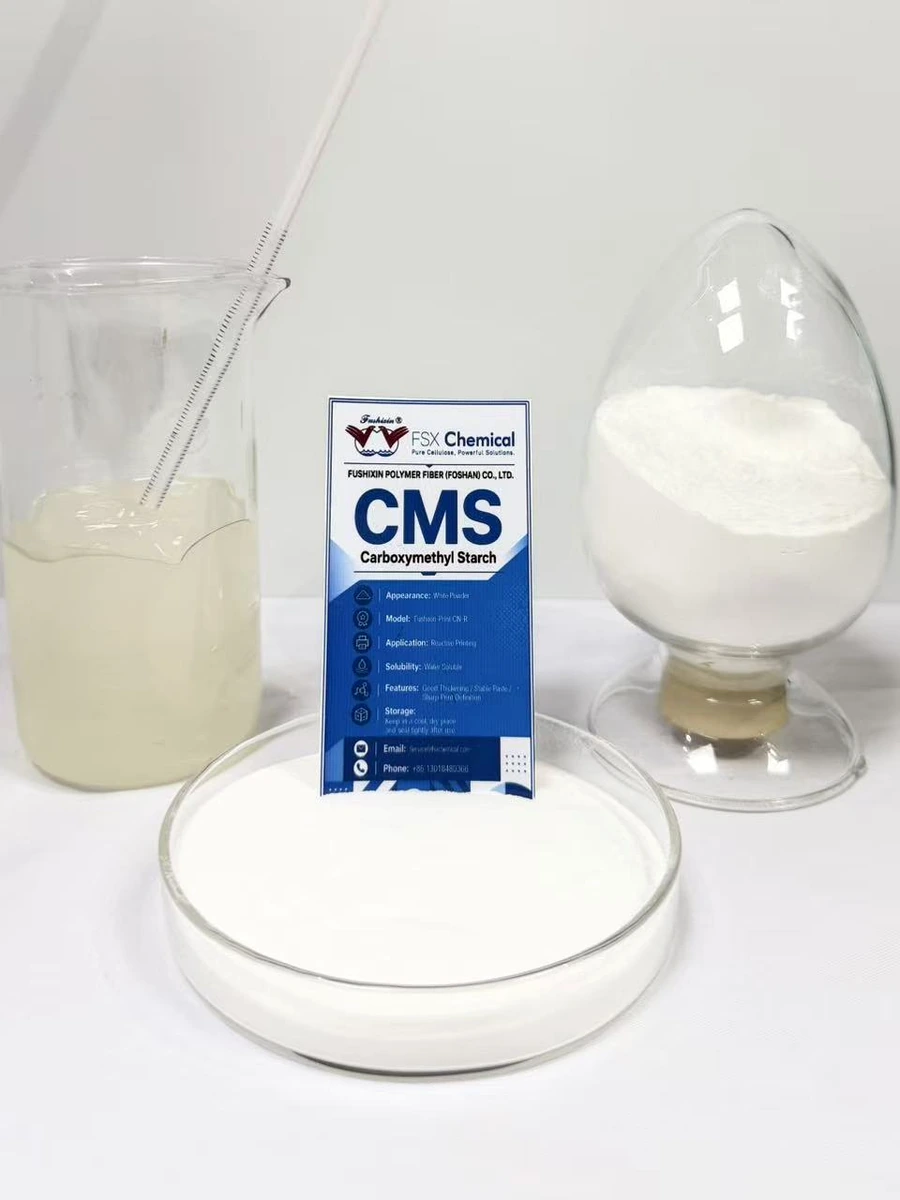
FSX Chemical supplies factory-backed Carboxymethyl Starch (CMS) for textile printing paste adjustment, helping mills improve paste body, printing stability and cost control across reactive, disperse and blended printing systems.
How CMS Works in Textile Printing Paste
FSX Chemical CMS (carboxymethyl starch) is a modified-starch textile printing thickener used to build paste viscosity, support print definition and improve wash-off performance in selected reactive, disperse and special printing processes.
Efficient viscosity build-up
Helps form stable printing paste with practical viscosity and paste body for rotary screen, flat-screen and selected textile printing routes.
Cleaner print definition
Supports stable paste transfer, cleaner pattern edges and repeatable print effects when the CMS grade is matched to the fabric and dye system.
Controlled screen transfer
Helps balance paste flow, mesh release and fabric penetration during continuous printing, especially when viscosity and dosage are adjusted correctly.
Practical wash-off
CMS can be removed during washing under proper process conditions, supporting background clarity and acceptable fabric hand feel after printing.
Process-specific grade routes
The FSX Chemical CMS series covers reactive, disperse, vat discharge and alkali burn-out printing routes with process-specific grade selection.
Cost-adjustment route
With direct factory supply, CMS can be evaluated as a practical cost-adjustment route after lab matching and small-batch production testing.
CMS Series by Printing Route
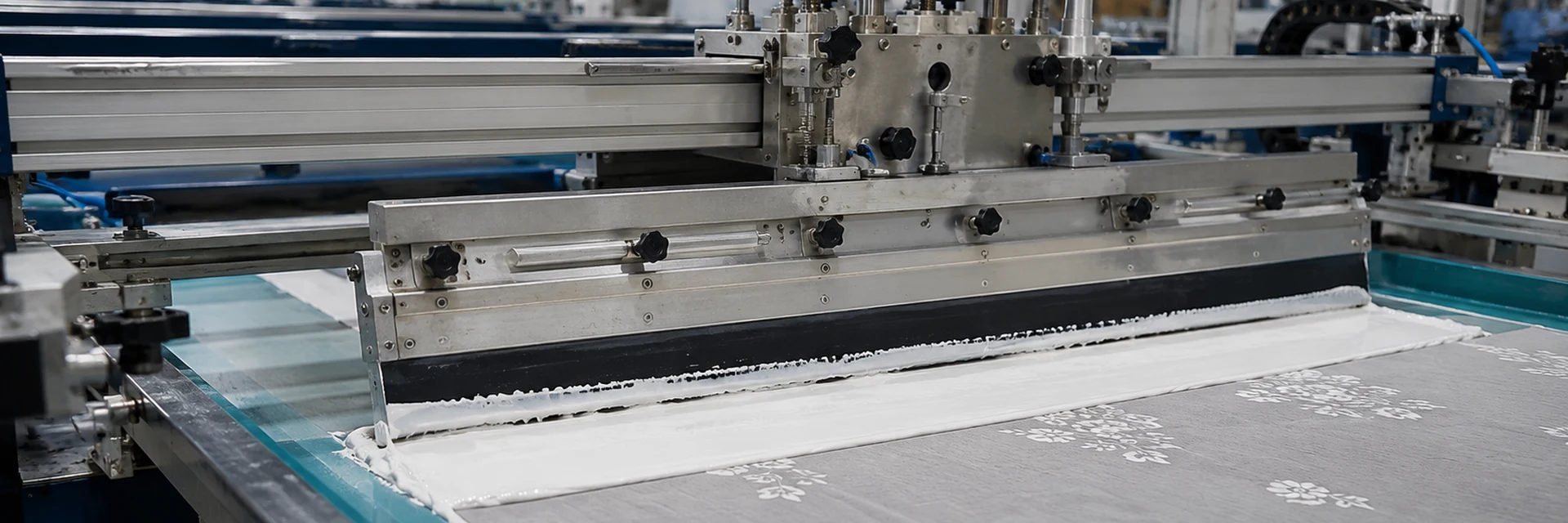
Where CMS Fits in Different Textile Printing Processes
Different printing routes ask for different paste behavior. FSX Chemical produces CMS grades for reactive, disperse, vat discharge and selected burn-out printing systems. Use these scenarios to compare the fabric, process conditions and recommended CMS grade before sample testing.
Reactive Printing on Cotton or Viscose
Disperse Printing on Polyester
Vat Discharge Printing on Cellulosic Fabrics
Alkali Burn-Out Printing on Polyester Blends
Where CMS Starts to Matter in the Printing Line
CMS begins to influence the paste from stock preparation and continues to affect screen transfer, print edge, wash-off and fabric hand feel. The highlighted steps show where carboxymethyl starch has the most direct impact in a textile printing process.
Paste
Paste
Kain
Printed Fabric
Fix
Kain
How to Read a CMS Print Trial After Washing
A CMS trial should be judged on more than viscosity. After printing and washing, compare the shade, pattern edge, paste transfer, fabric background and hand feel under the same recipe and process conditions.

What to Check Before Approving a Grade
These points help compare CMS performance across reactive, disperse and special printing routes. Final judgment should always be based on the dye system, fabric type and actual production process.
Colour yield and shade brightness
Compare colour depth, brightness and shade consistency against your target sample on the same fabric and recipe.
Ketajaman tepi
Look for cleaner outlines and less bleeding around fine details, especially in small patterns or multi-colour designs.
Paste transfer and penetration
Check whether the paste passes through the screen evenly and transfers to the fabric without dragging, blocking or unstable flow.
Fabric background after washing
After washing, review the background for visible residue, staining or dullness, especially on light-colour fabrics.
Tekstur saat disentuh setelah dicuci
Touch and compare the fabric after the standard washing process to confirm whether the handle is acceptable for the final product.
Paste and batch stability
Check viscosity stability, paste standing behaviour and repeatability between trial batches before moving to bulk production.

When CMS Is Worth Testing as a Cost-Control Route
CMS should not be treated as a simple low-cost substitute. In the right reactive, disperse or special printing system, it can help mills balance paste performance, process stability and formulation cost after sample testing.
Where CMS Usually Makes Sense
CMS is most useful when the mill wants to keep print quality acceptable while improving formulation cost or process flexibility. It is often reviewed in reactive, disperse, pigment, vat discharge and burn-out printing routes, depending on fabric, dye chemistry and production conditions.
In reactive printing, CMS may be tested against sodium alginate when cost control is important. The result should be judged by colour yield, edge sharpness, wash-off, hand feel and paste stability, not by raw material price alone.
CMS should not be described as a complete replacement for sodium alginate. It is better treated as a route to test in selected systems, especially when the customer can provide a current sample, TDS, recipe direction or target viscosity for comparison.
CMS should not be added directly into digital inkjet ink systems. For digital textile printing pretreatment, coating or inkjet preparation applications, refer to the Digital Printing Paste application page.
Start with the CMS Grade That Matches Your Printing Route
Choose the situation closest to your production line. The selector gives a practical starting point for CMS sample testing, while the final grade still needs to be confirmed by fabric, dye system, viscosity target and process conditions.
Fushixin PrintCN-R
CMS route for reactive textile printing paste
Fushixin Print FS-05
CMS route for disperse printing on polyester
Fushixin Cetak H5
Modified thickener route for discharge and burn-out printing
Kirimkan Persyaratan Produk Anda
Berikan nama produk, kegunaan, jumlah, tujuan pengiriman, serta TDS, foto sampel, atau dokumen lain yang sudah Anda miliki. FSX Chemical akan meninjau informasi tersebut dan merekomendasikan langkah selanjutnya terkait penawaran harga, pencocokan sampel, atau pemilihan produk.