Why Printing Paste Viscosity Drops After Adding Dye, Salt or Alkali
Printing paste can become thinner after dye, salt or alkali is added because of simple...
Printing paste viscosity often drops after dye, salt or alkali is added, but the cause is not always a weak thickener. The apparent loss can come from simple dilution, electrolyte screening of anionic polymer chains, a pH shift, dye or auxiliary interactions, incomplete equilibration, temperature change, or an unsuitable addition sequence. Sodium alginate, CMC, CMS and synthetic thickeners do not respond identically, and multivalent ions can even increase viscosity or create gels instead of thinning the paste. This guide shows textile mills how to identify which component changed the paste, separate dilution from chemical sensitivity, and validate the complete printing formula before increasing thickener dosage.
Why Printing Paste Can Become Thinner After Chemical Addition
A stock thickener is usually measured under a simple, controlled condition such as thickener + water + defined concentration + defined temperature. The production printing paste is different.
It can contain dye solution or pigment dispersion, salt, alkali, urea or humectants, dispersing agents, binders, fixers, reducing or oxidizing auxiliaries, wetting agents and defoamers.
Each addition changes either the polymer concentration, the chemical environment, the temperature, or all three.
FSX Chemical’s current technical guidance therefore recommends measuring viscosity after critical components are added rather than assuming that the water-only stock paste predicts the final formula.
The useful question is not “Why did the thickener fail?” It is “Which variable changed when the viscosity changed?”
Four Different Mechanisms That Can Look Like the Same Problem
Alkali, acid or dye package creates a non-dilution change
Temperature / measurement effect
Sample is warmer or test conditions differ
Viscosity partly recovers after conditioning to standard temperature
More than one mechanism can occur in the same paste. A reactive dye solution can simultaneously add water, urea, dye-associated salts and heat.
If all components are added at once, the root cause becomes difficult to identify.
1. Dilution: Did You Simply Reduce the Polymer Concentration?
This is the simplest explanation and one of the easiest to overlook.
Suppose a mill prepares a concentrated stock thickening and then adds a dye solution containing dye, water, urea and other dissolved auxiliaries. The final paste now contains the same amount of polymer distributed through a larger total mass or volume.
The effective thickener concentration has decreased.
Because polymer concentration and viscosity are often strongly nonlinear, even a moderate dilution can create a large viscosity drop.
Before blaming salt or dye chemistry, calculate:
Final Thickener Concentration = Thickener Solids in Final Paste ÷ Total Final Paste Mass
Then prepare a dilution control:
Stock Paste + Same Amount of Water, but No Dye/Salt/Alkali
If the control loses nearly the same amount of viscosity, the main effect is dilution rather than chemical incompatibility.
2. Electrolyte Screening: Why Salt Can Collapse an Anionic Polymer Coil
Many textile thickeners—including sodium alginate, CMC and CMS—contain negatively charged groups in aqueous solution.
These charged polymer chains can expand because like charges along the chain repel each other. When monovalent salts are added, dissolved ions can screen part of that electrostatic repulsion.
The chain can adopt a more compact conformation, reducing its hydrodynamic volume and apparent thickening efficiency.
This general polyelectrolyte mechanism is well established: increasing ionic strength can reduce intrinsic viscosity because charge screening allows an expanded anionic chain to contract.
The size of the effect depends on thickener chemistry, degree of substitution where relevant, molecular weight, polymer concentration, salt type, salt concentration and water hardness.
There is no universal percentage viscosity loss after salt addition.
3. Alkali: pH Change and Ionic Strength Happen Together
Alkali is more complicated than a neutral salt.
When sodium bicarbonate, sodium carbonate, sodium hydroxide or another alkaline material is added, at least two variables can change: pH and ionic strength.
Depending on the polymer, pH can change ionization of carboxyl groups, hydration, polymer-chain conformation and compatibility with other paste components.
At the same time, sodium-containing alkali increases the concentration of counterions in solution.
Therefore, if viscosity falls after alkali addition, do not conclude “High pH destroyed the thickener.”
First investigate final pH, alkali identity, dosage, ionic strength, water quality, temperature and addition order.
In reactive printing, alkali timing also affects dye chemical stability, which is separate from thickener rheology.
4. Dye Addition: Colorant Chemistry Is More Than “Adding Color”
A dye product is not always chemically neutral to the thickener.
Depending on dye class and commercial form, the colorant addition can introduce water, electrolytes, dispersants, solubilizing agents, pH-control chemicals and other formulation components.
Reactive dye solutions can change ionic strength and pH. Disperse dyes are supplied as dispersions containing dispersing chemistry and fine particles. Pigment dispersions can interact with binder and synthetic-thickener systems.
FSX Chemical’s current CMC/CMS technical guidance notes that viscosity changes after colorant addition can result from electrolyte, pH or ingredient compatibility and recommends testing the stock paste and final color paste under the same conditions.
Do not compare only “before dye” and “after dye.” Also compare:
Water-Dilution Control vs. Dye-Containing Sample
The difference between those two samples reveals the chemical contribution beyond dilution.
5. Temperature: A Hidden Reason the Final Paste Reads Lower
Viscosity is temperature-dependent.
A printing paste can become warmer because dye was dissolved in warm water, urea solution was heated, high-speed mixing generated heat, or the color kitchen is warmer than the QC laboratory.
If the stock paste is measured at 25°C and the completed paste is measured at 32°C, part of the apparent viscosity loss may simply be a temperature effect.
A useful control is:
Measure Warm → Condition Back to Standard Temperature → Measure Again
If viscosity recovers substantially after temperature conditioning, the original comparison was not temperature-controlled.
Do not correct such a paste by adding more thickener before confirming the test temperature.
Why Addition Order Can Change the Result
The final ingredient list is not the whole formula. The sequence of addition can change local chemical conditions during mixing.
A practical general principle in printing-paste preparation is to add thinner solutions or dispersions gradually into a well-prepared thickening while maintaining controlled agitation.
This can reduce local over-dilution, localized high salt concentration, gel or floc formation and poor dye dispersion.
For many water-soluble polysaccharide thickeners, a useful starting sequence is:
Water → Controlled Thickener Hydration → Dye/Auxiliary Addition → Salt/Alkali at the Validated Stage → Final Adjustment
This is not a universal recipe. Some pigment or specialty formulations require a different order because binder, neutralizer, synthetic thickener or fixer interactions dominate.
Local High Concentration vs. Final Average Concentration
A formula can be chemically acceptable at its final average composition and still fail during addition.
Pouring concentrated salt or alkali directly into one region of a thickener paste creates a temporary local concentration far higher than the final calculated value.
That can cause local polymer collapse, gel particles, flocculation or irreversible-looking lumps.
Possible controls include pre-dissolving the chemical where the process allows, adding gradually, maintaining effective circulation and avoiding dead zones in the tank.
Therefore, “same final formula” does not always mean “same paste” if the addition procedure changes.
How Sodium Alginate Can Respond
Sodium alginate is an anionic polysaccharide widely used as a benchmark thickener in conventional reactive printing.
Monovalent electrolytes can alter chain expansion and apparent viscosity.
However, sodium alginate has an important exception: divalent calcium can create stronger interchain association and may increase viscosity or cause gelation rather than thinning.
If alginate viscosity changes after salt or alkali addition, check whether the change is a drop or increase, total hardness, calcium contamination, final electrolyte package and temperature.
Carboxymethyl cellulose is also an anionic polymer.
Its salt tolerance depends strongly on the commercial grade, including degree of substitution, substitution uniformity, molecular weight, purity and concentration.
Published reviews of CMC note that degree of substitution has a significant effect on solubility, viscosity stability and salt tolerance.
A CMC grade that produces high viscosity in pure water can therefore lose more or less viscosity in an electrolyte-containing print paste than another grade with a similar initial viscosity.
Pure-water viscosity and salt tolerance are separate purchasing parameters.
How CMS Can Respond
Carboxymethyl starch is another anionic modified polysaccharide used in selected disperse, reactive and specialty printing systems.
CMS can respond to salt concentration, pH, alkali, temperature and water quality.
Different CMS grades can show significantly different electrolyte response because substitution, starch structure and molecular characteristics vary.
Therefore, a CMS grade should be tested at:
Stock Paste → After Dye → After Salt → After Alkali → After Holding
rather than selected by water viscosity alone.
How Synthetic Thickeners Can Respond
Synthetic thickeners—especially those used in pigment-printing systems—operate through a different polymer architecture from sodium alginate, CMC or CMS.
Some synthetic thickener systems are highly sensitive to electrolyte concentration, neutralization state and binder/auxiliary chemistry.
Possible symptoms include rapid viscosity loss after pigment or binder addition, loss of body after salt contamination and different viscosity after pH adjustment.
Because commercial synthetic thickeners vary widely, do not transfer an electrolyte rule from one product to another.
In pigment printing, evaluate the complete Pigment + Binder + Thickener + Fixer + Auxiliaries system rather than testing the thickener in water alone.
Important Exception: Calcium Can Increase Viscosity or Cause Gelation
Not every ion causes viscosity loss.
Multivalent ions can create stronger interactions with anionic polysaccharides. The clearest textile example is sodium alginate with Ca²⁺.
The progression can be:
Normal Alginate → Increased Association → Higher Apparent Viscosity → Gel Particles → Calcium Alginate Gel / Precipitate
If the paste becomes unexpectedly thicker after adding an auxiliary or using a new water source, do not assume the thickener concentration increased. Check calcium and other multivalent contamination.
This exception is why the title describes a common problem—not a universal rule for every chemical addition.
The Best Diagnostic: Build the Formula in Stages
The most useful troubleshooting experiment is a staged addition test.
Stage 0: Stock Thickener
Measure the fully hydrated thickener under the standard method.
Stage 1: Dilution Control
Add the same amount of plain water that the dye solution would contribute.
Stage 2: Add Dye
Use the real dye solution or dispersion.
Stage 3: Add Salt / Electrolyte
Use the production identity and dosage.
Stage 4: Add Alkali or pH-Control Component
Add using the approved sequence.
Stage 5: Add Remaining Auxiliaries
Complete the formula.
Stage 6: Hold
Measure again after realistic production holding time.
At every stage, record paste mass, temperature, pH, conductivity where useful, viscosity, appearance, gel/floc and foam.
This creates a viscosity-loss map of the formula.
How to Test Whether the Dye Is the Cause
Use three samples prepared from the same stock paste.
Halimbawa
Addition
Layunin
A
Nothing
Stock-paste baseline
B
Same water volume as dye solution
Measures dilution
C
Actual dye solution/dispersion
Measures dilution + dye-package effect
If B and C show similar viscosity, dilution is probably dominant.
If C drops substantially more than B, investigate dye-associated salt, pH, dispersant/solubilizer and polymer-dye interaction.
Repeat with representative light and dark shades if dye loading changes widely in production.
How to Build a Salt-Response Test
Prepare one fully hydrated thickener stock and split it into equal samples.
Add controlled salt levels while keeping final total mass, temperature, mixing and holding time constant.
Likewise, restoring the original stock-paste viscosity by adding more thickener does not guarantee better printing.
The corrected paste can become too elastic, difficult to transfer, too high in polymer solids or harder to wash off.
The target is the approved application rheology—not the original water-only viscosity number.
Should You Add More Thickener to Correct the Viscosity?
Only after the cause is identified.
Use this sequence:
Verify Test Method → Check Dilution → Check Temperature → Identify Chemical Effect → Print Test → Then Consider Dosage Adjustment
Adding dry powder directly to an already completed paste can create incomplete hydration, lumps, local high concentration and air incorporation.
If a dosage correction is technically justified, use a controlled preparation method such as an approved concentrated stock paste or the mill’s validated correction procedure.
Paste becomes thicker or gels after chemical addition
Calcium/multivalent ions, local concentration
All salts reduce viscosity
Viscosity is lower but printing remains good
Shear rheology, recovery, deposit
Original stock viscosity must be restored
Corrected paste becomes hard to wash
Excess thickener solids, dosage correction
More viscosity always improves printing
Same formula differs between shifts
Water, temperature, addition order, holding time
Thickener batch is the only variable
Production QC and Formula Control
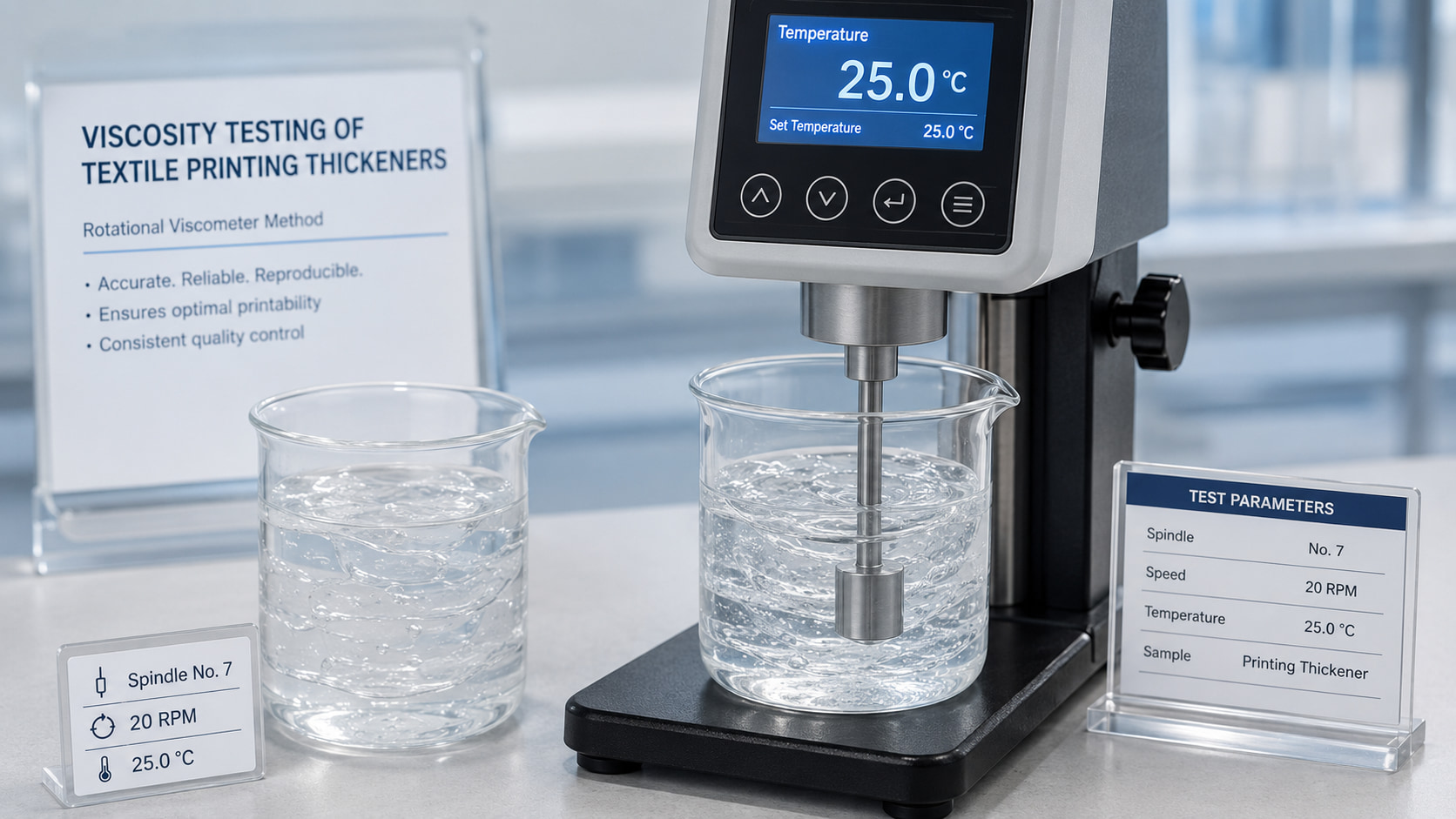
A useful viscosity-control record can include thickener batch, stock concentration, hydration time, water source, stock viscosity, dye identity and dosage, salt identity and dosage, alkali identity and dosage, final pH, paste temperature, final viscosity, holding-time viscosity and viscometer/spindle/RPM.
For a recurring problem, add one column after each critical formulation stage.
This turns viscosity troubleshooting from an operator impression into a traceable process.
Total Cost in Use
A viscosity drop can create unnecessary cost if the response is simply to add more thickener.
Possible hidden costs include extra thickener, longer hydration or mixing, poor screen transfer, higher wash-off load, shade correction and rework.
A useful framework is:
Total Cost in Use = Thickener + Formula Chemicals + Preparation + Printing Efficiency + Fixation/Washing + Rework + Quality Loss
Sometimes the cheapest solution is not a higher-viscosity grade. It may be a better salt-tolerant grade, a corrected dilution calculation, a different addition order, temperature-controlled viscosity testing or a compound-thickener route.
The correct solution is the one that keeps the complete paste inside a stable production window.
What Information Should You Send to a Thickener Supplier?
If your printing paste loses viscosity after dye, salt or alkali is added, send:
Current thickener name/TDS/sample
Thickener concentration
Stock viscosity and complete test method
Dye class and commercial product
Dye dosage and dissolution/dispersion method
Amount of water introduced with the dye
Salt identity and dosage
Alkali identity and dosage
Final pH
Water hardness/conductivity where relevant
Addition sequence
Paste temperature
Pagpapanatili ng oras
Pangwakas na lapot
Printing route and current defect
FSX Chemical can use this information through Mga Halimbawa at Pagtutugma to identify whether the next trial should focus on thickener grade, dosage, salt tolerance or formulation sequence.
How Should a Mill Diagnose a Printing-Paste Viscosity Drop?
A practical decision chain is:
Verify Measurement → Calculate Dilution → Condition Temperature → Add Components Separately → Measure Salt/pH Response → Hold → Print → Approve Final Formula
Dye addition can reduce viscosity simply by diluting the polymer concentration.
Monovalent salts can reduce the effective hydrodynamic size of anionic polymer chains through charge screening.
Alkali changes both pH and ionic strength, so the two effects should not be confused.
Dyes and commercial dispersions can introduce salts, solvents and auxiliary chemistry in addition to color.
Calcium and other multivalent ions can create the opposite response—viscosity increase, association or gelation.
The final acceptance standard is complete-paste printing performance, not restoration of the original stock-paste viscosity.
Madalas Itanong na Mga Tanong
1. Why does printing paste viscosity drop after adding dye?
The dye addition may dilute the thickener, add electrolytes or change pH and temperature. Use a water-only dilution control to separate dilution from dye-package chemistry.
2. Why does salt reduce thickener viscosity?
For many anionic thickeners, dissolved ions screen repulsion between charged polymer segments, allowing chains to contract and reducing hydrodynamic volume and apparent viscosity.
3. Does salt always reduce printing paste viscosity?
No. Response depends on polymer and ion type. Multivalent ions such as calcium can increase alginate association and eventually cause gelation.
4. Why does alkali reduce paste viscosity?
Alkali can change both pH and ionic strength. The effect depends on thickener chemistry, alkali type, concentration, water and formula.
5. Does a viscosity drop mean the thickener has degraded?
Not necessarily. Dilution, ionic screening and temperature can create a reversible or formulation-dependent viscosity decrease without polymer degradation.
6. Should I add more thickener after dye makes the paste thinner?
Only after identifying the cause and checking actual printing performance. Restoring the stock-paste viscosity can produce excessive polymer solids or unsuitable rheology.
7. How can I tell whether dilution is the cause?
Add the same amount of plain water to a control sample. If the viscosity drop is similar to the dye-containing sample, dilution is the dominant effect.
8. Why can the same thickener tolerate one dye better than another?
Commercial dyes can differ in electrolyte level, pH, dispersants, solvents and other formulation components.
9. Why does viscosity drop after high-speed mixing?
The paste may have warmed, undergone shear thinning or not yet recovered its structure. Condition the sample and remeasure after a defined recovery time.
10. Can hard water make the response worse?
Yes. Calcium and magnesium add ionic complexity, and calcium can strongly associate with sodium alginate. Compare plant water with a controlled reference water.
11. What is the best way to find which ingredient causes the drop?
Prepare the formula in stages and measure after water dilution, dye, salt, alkali and remaining auxiliaries separately.
12. What should I send FSX Chemical for viscosity-loss troubleshooting?
Send the current thickener, concentration, viscosity method, dye, salt, alkali, water, addition order, temperature, holding time and the viscosity after each stage if available.
Find the Real Cause Before Adding More Thickener
If your printing paste loses viscosity after dye, salt or alkali is added, FSX Chemical can help determine whether the cause is dilution, electrolyte sensitivity, pH, water quality, temperature or the thickener grade itself.
For a useful technical comparison, send:
Your current thickener sample, TDS or COA
Stock concentration and viscosity
Kompletong pamamaraan ng pagsusuri ng viskosidad
Dye class, product and dosage
Dye dissolution/dispersion method
Water added with the dye
Salt type and dosage
Alkali type and dosage
Final pH
Plant-water information
Addition order
Paste temperature
Pagpapanatili ng oras
Viscosity after each critical stage where available
When printing paste becomes thinner after dye, salt or alkali is added, do not correct the number first. Identify whether the paste was diluted, ionically screened, chemically shifted or simply measured under different conditions—then optimize the complete printing system.
Alamin kung bakit hindi maaaring ikumpara ang mga halaga ng viskosidad ng pampapalapot sa pagpi-print ng tela nang hindi tinutugma ang konsentrasyon, temperatura, instrumento, spindle, bilis, paraan ng paghahanda, at oras ng pagsubok.
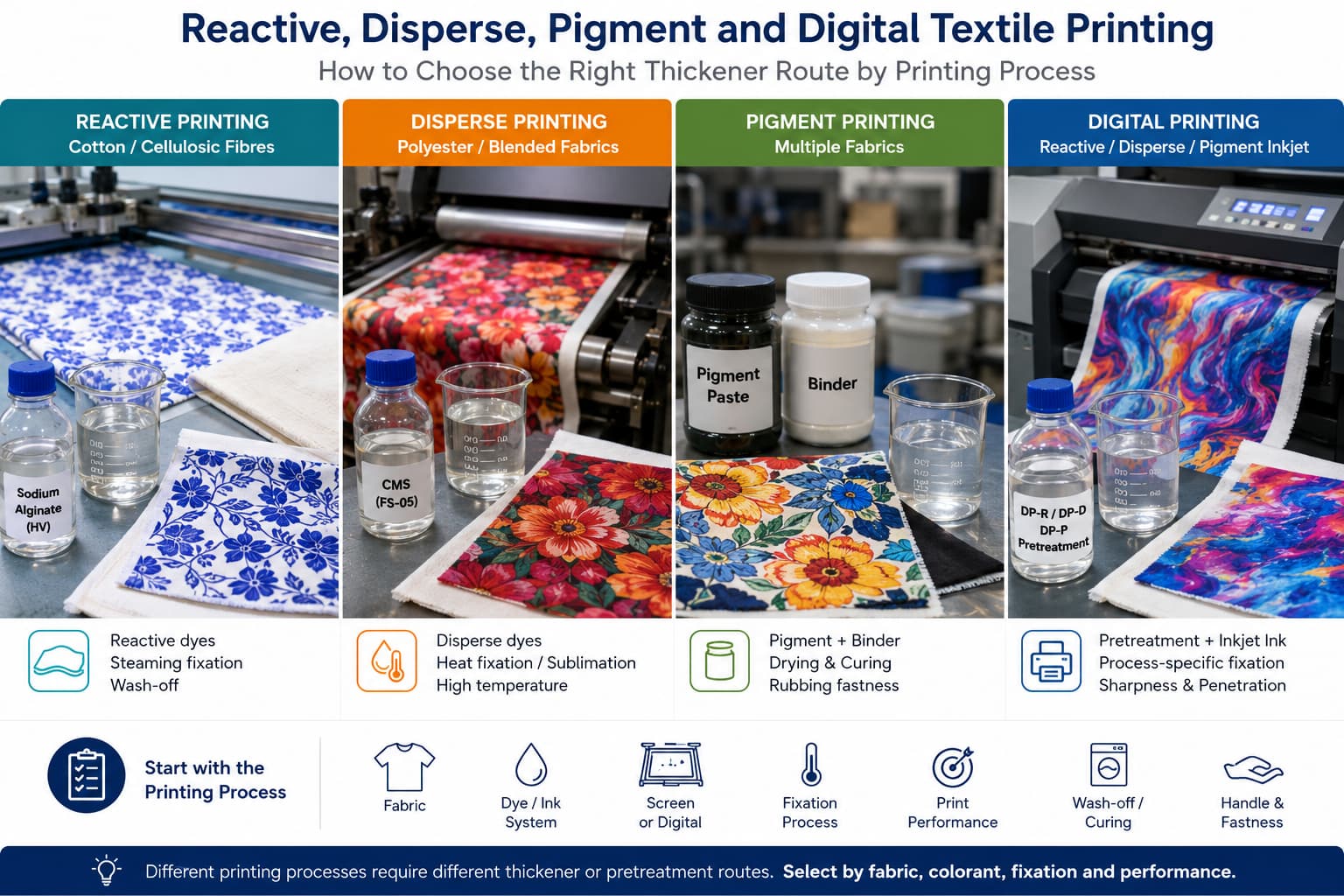
Matutong pumili ng pampatigas at mga paraan ng paunang paggamot para sa reaktibo, disperse, pigment, at digital na pagpi-print sa tela batay sa tela, tina o tinta, fiksasyon, paghuhugas, at mga kinakailangan sa kalidad ng pagpi-print.
Ihambing ang CMC, CMS, sodium alginate, at digital printing paste para sa pagpi-print ng tela. Alamin kung paano nababagay ang bawat uri sa mga prosesong reaktibo, disperse, pigment, at digital, at kung ano ang dapat suriin ng mga mamimili bago magsagawa ng pagsubok ng sample, pagtutugma ng grado, at malakihang pagbili.
Malawakang ginagamit ang sodium alginate sa pagpi-print ng tela bilang matatag at maaaring hugasan na pampalapot para sa reaktibong pasta sa pagpi-print. Alamin kung paano suriin ang grado ng viskosidad, kadalisayan, at pagiging angkop sa aplikasyon bago bumili, at kung paano sinusuportahan ng FSX Chemical ang mga mamimili sa buong mundo sa pamamagitan ng teknikal na datos at mga sample.
Carboxymethyl cellulose (CMC) ay malawakang ginagamit sa pagpi-print, pagsi-size, at pagtatina ng mga tela. Ipapaliwanag ng gabay na ito kung paano susuriin ang mga grado ng CMC, kung aling mga parameter ang pinakamahalaga, at kung paano makakatulong ang FSX Chemical sa mga desisyon sa pagbili.
Carboxymethyl cellulose is used as a thickener and stabilizer in water-based inks, gravure printing, and inkjet pre-treatment. This guide covers the key grade parameters and sourcing considerations for procurement teams.
Parehong ginagamit ang sodium alginate at CMC bilang pampalapot sa pagpi-print ng tela, ngunit angkop ang mga ito sa iba't ibang sistema ng pangkulay at kondisyon ng proseso. Ipinapaliwanag ng gabay na ito ang mga pangunahing pagkakaiba at kung kailan dapat gamitin ang bawat isa.
Ang digital inkjet printing sa tela ay may iba't ibang kinakailangan sa paste at paunang paggamot kumpara sa screen printing. Ipinapaliwanag ng gabay na ito kung paano ginagamit ang sodium alginate sa digital na pagpi-print ng tela at kung anong mga parameter ng grado ang dapat tukuyin ng mga koponan sa pagbili.
Food-grade and industrial-grade CMC share the same base chemistry but differ significantly in purity, DS range, and regulatory requirements. This guide explains the key differences and why using the wrong grade creates production problems.
Ang wastong paghahanda ng pasta ay kasinghalaga ng pagpili ng grado sa pagpi-print ng tela gamit ang reaktibong pangkulay. Saklaw ng gabay na ito ang mga pamamaraan ng paglusaw ng sodium alginate, mga saklaw ng konsentrasyon ayon sa aplikasyon, mga kondisyon sa pag-iimbak, at kung paano lutasin ang mga karaniwang problema sa paghahanda.
Ang sodium alginate ay isang natural at nabubulok na polymer, ngunit ang paggamit nito sa pagpi-print ng tela ay nagbubunga ng maruming tubig na kailangang pamahalaan. Saklaw ng gabay na ito ang profile sa kapaligiran ng sodium alginate, ang mga katangian ng effluent mula sa paghuhugas, at kung ano ang dapat maunawaan ng mga koponan sa pagbili tungkol sa pagpili ng pampalapot at sa epekto nito sa kapaligiran.
Direktang nakakaapekto ang bilis ng pagkakabit ng tina sa ani ng kulay, tibay ng kulay sa paghuhugas, at dami ng dumi sa tubig sa pagpi-print gamit ang reaktibong tina. Ipinapaliwanag ng gabay na ito kung paano sinusuportahan ng sodium alginate ang pagkakabit ng tina, kung aling mga parameter ng pasta ang nakakaapekto sa bilis ng pagkakabit, at kung paano ayusin ang mababang pagkakabit sa produksyon.
Ibahagi ang pangalan ng produkto, aplikasyon, dami, destinasyon, at anumang TDS, larawan ng sample o dokumento na mayroon ka na. Susuriin ng FSX Chemical ang impormasyon at irekomenda ang susunod na hakbang para sa quotation, pagtutugma ng sample, o pagpili ng produkto.
Impormasyon ng ProduktoPangalan ng produkto, grado, modelo, larawan sa etiketa o sanggunian ng tagapagtustos.
Magagamit na mga dokumentoTDS, SDS, COA, larawan ng sample, listahan ng produkto o datos ng pagsubok.
Mga Detalye ng OrderTinatayang dami, pag-iimpake, bansang patutunguhan, pantalan o termino sa kalakalan.
Aplikasyon o IsyuProseso ng pagpi-print sa tela, pangangailangan sa pormulasyon, kasalukuyang isyu o target na pagganap.

 TL
TL  EN
EN  BN
BN  ES
ES  TR
TR  FR
FR  ID
ID  RU
RU  AR
AR  UR
UR  VI
VI  HI
HI  UK
UK  KK
KK  KA
KA  UZ
UZ