Anionic Acrylic Thickener with Cationic Fixers: How to Prevent Flocculation and Viscosity Collapse
Anionic acrylic thickeners and cationic fixers can coexist in selected pigment-printing formulations, but they create a higher-risk compatibility system because oppositely charged polymers can associate, neutralize each other and form polyelectrolyte complexes. Depending on charge density, dosage, ionic strength, pH, addition order and local concentration, the result may range from acceptable stability to sudden viscosity collapse, stringy gel, flocculation, sediment, filtration residue or screen blockage. The correct strategy is not to assume that all cationic fixers are incompatible with all anionic thickeners. Instead, mills should identify the first unstable addition stage, dilute and meter ionic components carefully, compare staged controls, monitor viscosity retention and appearance, and approve the complete pigment-binder-fixer paste under real holding and printing conditions.
Why Can Cationic Fixer Destabilize an Anionic Acrylic Thickener?
Anionic acrylic thickeners contain negatively charged groups after activation.
A cationic fixer contains positively charged functionality.
When the two meet, electrostatic attraction can occur.
Depending on the formulation, this can create:
- Partial charge neutralization
- Polymer association
- Polyelectrolyte complexes
- Flocculation
- Loss of polymer expansion
- Viscosity collapse
The practical mechanism can be simplified as:
Anionic Thickener + Cationic Fixer → Electrostatic Association → Rheology Change / Complex Formation
But the outcome is not determined by charge sign alone.
It also depends on:
- Charge density
- Molecular weight
- Dozaj
- Final and local concentration
- Ionic strength
- pH
- Karıştırma
- Addition order
Therefore, compatibility must be tested in the complete paste.
What Does “Anionic Acrylic Thickener” Mean?
Many synthetic pigment-printing thickeners are acrylic or polyacrylate polymers that become negatively charged after neutralization.
The negative charge helps:
- Expand the polymer in water
- Build hydrodynamic volume
- Create viscosity
In an ASE-type system, this charge-driven swelling is a major thickening mechanism.
In HASE, pH-driven swelling is combined with hydrophobic associative interactions.
This means that anything changing:
- Charge environment
- Counterions
- Electrolytes
- Surfactants
can change the rheology.
What Does “Cationic Fixer” Mean?
“Cationic fixer” is a broad application term.
Commercial fixers can use different polymer or quaternary-ammonium-type chemistries and can differ significantly in:
- Cationic charge density
- Solids
- Molecular weight
- pH
- Salt content
- Water content
Therefore:
Cationic Fixer A ≠ Cationic Fixer B.
A paste that is stable with one fixer should not be assumed to tolerate another fixer at the same weight percentage.
The commercial TDS / SDS and controlled compatibility trial should define the route.
Opposite Charges and Polyelectrolyte Complex Formation
Oppositely charged polymers can form polyelectrolyte complexes.
In some industrial systems, this behavior is deliberately used for flocculation.
In pigment printing, uncontrolled complex formation is usually undesirable because the paste must remain:
- Homogeneous
- Pumpable
- Filterable
- Screenable
Complex formation can lead to:
- Turbidity increase
- Stringy particles
- Soft gel
- Large flocs
- Viscosity loss
The exact result depends strongly on the ratio between positive and negative charges.
This is why compatibility cannot be predicted from the fixer name alone.
Cationic + Anionic Does Not Always Mean Immediate Failure
It is incorrect to state that every cationic fixer is automatically incompatible with every anionic acrylic thickener.
Some complete formulations can remain usable because:
- The cationic dosage is low.
- The fixer has moderate charge density.
- The thickener concentration is sufficient.
- The binder / surfactant package changes the interaction.
- The fixer is highly diluted before addition.
- The ionic environment screens some direct electrostatic interaction.
Other combinations may fail immediately.
The correct technical position is:
Anionic + Cationic = High Compatibility Risk That Requires Controlled Testing.
Typical Symptoms of Ionic Incompatibility
Watch for:
- Sudden viscosity collapse
- Viscosity spike followed by collapse
- Stringy gel
- Cloudiness / turbidity
- Visible flocs
- Sediment
- Filtreleme artığı
- Ekran tıkanması
- Delayed holding instability
Different symptoms can indicate different interaction zones.
For example, a clean viscosity loss without visible flocs can indicate partial charge screening / neutralization, while large particles suggest stronger complex aggregation.
Why Viscosity Can Collapse
An anionic acrylic thickener often depends on electrostatic repulsion between charged groups to stay expanded.
A cationic polymer can reduce the effective negative charge by association or charge neutralization.
A simplified route is:
Negative Polymer Charge ↓ → Chain Expansion ↓ → Hydrodynamic Volume ↓ → Viscosity ↓
At the same time, the fixer may introduce:
- Additional electrolytes
- Su
- pH shift
so the observed viscosity collapse can have more than one cause.
Do not diagnose all loss as direct cationic complexation without controls.
Why Flocs, Gel Particles or Sediment Can Form
If positive and negative polymer charges approach a range where complex formation is favored, polymer-rich particles can form.
Those particles may:
- Remain suspended
- Aggregate into larger flocs
- Settle slowly
- Stick to screens or filters
The result depends on:
- Charge ratio
- Molecular weight
- Karıştırma yoğunluğu
- Ionic strength
- Toplama sırası
One fixer concentration can produce strong flocculation while a lower or higher ratio may behave differently.
Do not assume incompatibility changes linearly with fixer dosage.
Local Concentration Is Often More Important Than Final Dosage
A final formula may contain only a small percentage of cationic fixer.
But during addition, a concentrated fixer stream can contact a thickener-rich zone before full dilution occurs.
For several seconds, the local cationic-to-anionic ratio can be dramatically different from the final tank average.
This can trigger:
- Local polymer complexation
- Jel parçacıkları
- Permanent flocs
even if the fully diluted theoretical formula might otherwise be stable.
Therefore:
Final Dosage Alone Does Not Describe Compatibility Risk.
Addition Order and Charge Shock
One common compatibility problem is direct addition of concentrated cationic fixer into a highly concentrated anionic thickener environment.
A controlled route may instead evaluate:
Build Complete Pigment/Binder Paste → Ensure Homogeneity → Add Properly Diluted Fixer Slowly → Recheck pH / Viscosity
But this is a starting logic, not a universal production recipe.
Some fixer systems may require another sequence.
Always follow:
Current Fixer TDS + Current Thickener TDS + Controlled Trial.
Why Fixer Dilution Can Improve Stability
Dilution lowers the instantaneous cationic charge concentration at the addition point.
This can reduce:
- Local charge shock
- Rapid polymer complexation
- Gel formation
However, dilution also adds more water.
Therefore, a fair test must keep total formula water constant.
When comparing fixer dilution levels, adjust the base water so each sample has:
Same Final Fixer Solids + Same Total Water + Same Final Formula Mass.
This separates true compatibility improvement from simple dilution.
Addition Rate and Mixing
Fast addition increases local concentration gradients.
Slow metered addition with adequate circulation can reduce the risk.
Define:
- Fixer feed time
- Feed location
- Mixer condition
- Post-addition mixing time
Avoid:
- Pouring concentrated fixer onto the paste surface without circulation
- Adding into a dead zone
- Measuring viscosity before the batch becomes homogeneous
Scale-up should preserve controlled mass transfer, not laboratory RPM.
Ionic Strength and Electrolyte Effects
Cationic fixer can add ionic material even beyond its polymeric charge.
Higher ionic strength can change anionic polyacrylate thickening by screening electrostatic repulsion.
This means a paste may lose viscosity because of:
- Direct anionic–cationic association
- General electrolyte screening
- Both mechanisms together
Polyelectrolyte research also shows that electrolyte level can change the formation and flocculation behavior of oppositely charged polymer complexes.
Use ionic controls if the root cause is unclear.
pH and Thickener Activation
Before blaming the cationic fixer, confirm the acrylic thickener is correctly activated.
Record:
- pH before fixer
- Viscosity before fixer
- pH after fixer
- Viscosity after fixer
If the fixer shifts pH outside the thickener’s useful activation range, viscosity can change even without strong polyelectrolyte complexation.
For acrylic activation principles, review pH and neutralization control for acrylic thickener.
Binder Compatibility in the Same System
Pigment binder is another polymer dispersion inside the paste.
It can change:
- Surfactant balance
- pH
- Electrolyte load
- Reoloji
- Fixer distribution
A cationic fixer may be compatible with the thickener in a simplified water system but unstable after binder is added.
Therefore, test at least:
- Thickener + Fixer
- Thickener + Binder + Fixer
- Complete pigment paste + Fixer
The production decision should be based on the complete paste.
Pigment Dispersion and Surfactant Effects
Pigment dispersions contain:
- Dispersants
- Surfactants
- Electrolytes
- Su
Some pigment dispersants are anionic.
A cationic fixer can therefore interact not only with the acrylic thickener but also with the pigment-dispersion package.
This can create:
- Pigment flocculation
- Color nonuniformity
- Filtreleme artığı
- Additional viscosity change
Do not interpret every floc as a thickener–fixer complex.
The pigment dispersion can be part of the interaction.
ASE vs. HASE Sensitivity
ASE relies mainly on pH-driven anionic swelling.
HASE combines anionic swelling with hydrophobic associative thickening.
A cationic fixer can influence HASE through:
- Charge interactions
- Electrolyte effects
- Binder / surfactant network changes
Therefore, HASE can show a more complex response than a simple water viscosity drop.
Always recheck:
- Low-shear viscosity
- Higher-shear flow
- Recovery
- Elasticity
after fixer addition.
Not All Cationic Fixers Have the Same Charge Density
Two commercial fixers can have the same recommended dosage but very different effective charge behavior.
Important supplier data can include:
- Ionic nature
- Solids
- pH
- Charge density if available
- Önerilen doz
- Application method
If charge-density data is not available, use a controlled dosage and dilution ladder to compare practical compatibility.
Do not substitute fixers 1:1 only because both are described as cationic.
Why Charge Ratio Matters
Oppositely charged polymers can behave differently at different positive-to-negative charge ratios.
At one ratio, the system may remain dispersed.
At another, complex formation and flocculation can become much stronger.
At still another, excess charge can partially restabilize some dispersions.
Therefore:
Compatibility vs. Fixer Dosage May Be Nonlinear.
This is why a dosage ladder is more informative than testing only:
0% Fixer vs. Full Production Dose.
Build a Stage-by-Stage Compatibility Map
| Sahne | Measure | Main Question |
|---|---|---|
| Activated thickener | pH / viscosity / appearance | Is the thickener baseline stable? |
| After pigment | pH / viscosity / floc | Does pigment change ionic stability? |
| After binder | pH / viscosity / appearance | Is the binder compatible? |
| After fixer | pH / viscosity / floc | Does the cationic addition trigger failure? |
| After holding | Viscosity / sediment / filtration | Is instability delayed? |
The first stage showing a major change becomes the focus of the next test.
Use Water-Dilution and Ionic Controls
When fixer addition causes viscosity loss, prepare at least:
- Control A: paste + equivalent water only
- Control B: paste + diluted fixer
- Control C: paste + fixer at current production method
If A loses similar viscosity to B, dilution is significant.
If B or C changes much more, ionic / cationic chemistry is contributing.
If C is much worse than B, local concentration and addition method are major variables.
Build a Fixer-Dosage Ladder
Test several fixer levels around the production range.
For each point, record:
- Fixer dosage
- Final pH
- Fresh viscosity
- Viscosity retention
- Turbidity
- Gel / floc
- Tutma stabilitesi
- Printing performance
Calculate:
Viscosity Retention (%) = Viscosity After Fixer ÷ Viscosity Before Fixer × 100
The curve can reveal a compatibility threshold or unstable zone.
Build a Fixer-Dilution Ladder
Keep fixer active solids constant but change its pre-dilution level.
Compare:
- Undiluted / supplier-approved concentrated addition
- Moderate dilution
- Higher dilution
Keep total formula water constant.
Record:
- Immediate flocculation
- Nihai viskozite
- Tutma stabilitesi
If dilution strongly improves stability, local charge shock is likely contributing.
Compare Valid Addition Sequences
Possible controlled comparisons can include:
| Sequence | Purpose |
|---|---|
| Complete pigment/binder paste → diluted fixer | Late fixer addition route |
| Binder system → diluted fixer → thickener adjustment | Alternative supplier-approved route |
| Current production sequence | Reference |
These are trial structures, not universal recipes.
Do not test a sequence that conflicts with the fixer or thickener supplier’s current technical instructions.
Tutma Kararlılığı
Opposite-charge interactions can be immediate or delayed.
Measure:
- Fresh viscosity
- Intermediate viscosity
- End-of-shift viscosity
- Turbidity
- Floc / sediment
- pH
A paste that looks smooth immediately after fixer addition but forms sediment two hours later has not passed.
Use the real factory holding time.
Filtration, Gel and Screen-Blocking Risk
Visible compatibility is not enough.
Small polymer complexes can accumulate on:
- Filters
- Screen mesh
- Pumps
- Transfer lines
Include a standardized filtration or screen-residue check during qualification.
Record:
- Filtration time
- Residue amount
- Jel parçacıkları
- Screen-cleaning frequency
A paste with acceptable viscosity but excessive residue is not production-stable.
Screen Printing Validation
Print the candidate fixer/thickener combinations under matched conditions.
Check:
- Ekran bölümü
- Beginning-to-end flow
- Yazdırma tanımı
- Katı alan homojenliği
- Ekran tıkanması
- Color consistency
Fixer compatibility should not be approved from beaker appearance alone.
FSX current synthetic printing guidance also emphasizes testing paste stability, screen transfer and finished print performance together.
Does More Cationic Fixer Always Improve Fastness?
No.
The useful fixer dosage should be the lowest level that delivers the required finished performance without destabilizing the paste.
Excess cationic fixer can create:
- More ionic incompatibility
- Higher chemical cost
- More residue
- Potential fabric-hand changes
Pigment rubbing performance is also controlled strongly by:
- Binder level
- Binder distribution
- Sertleştirme
- Pigment / binder ratio
Do not use fixer dosage to compensate blindly for an under-cured or under-bindered pigment system.
Fabric Hand and Film Balance
Any fixer optimization should include fabric hand.
The printed area contains:
- Pigment
- Binder film
- Residual thickener polymer
- Fixer / auxiliary residue
Increasing multiple polymeric components can create a heavier hand.
Değerlendirin:
Fastness + Hand + Rheology + Compatibility
together.
Recommended Laboratory Workflow
- Confirm the thickener is correctly activated.
- Record baseline pH and viscosity.
- Prepare pigment + binder reference without fixer.
- Add fixer through the current production method.
- Record immediate viscosity, pH and appearance.
- Run water-dilution control.
- Build a fixer-dosage ladder.
- Build a fixer-dilution ladder if instability remains.
- Compare one valid alternative addition sequence.
- Hold for the production time.
- Filter / inspect residue.
- Screen print and cure.
- Compare rubbing, shade and fabric hand.
For broader thickener testing principles, review Essential Testing Parameters for Textile Printing Thickeners.
GO / CONDITIONAL / FAIL Decision Gates
| Decision | Meaning | Example |
|---|---|---|
| GO | Stable paste and acceptable print | No floc, stable viscosity, clean screen |
| CONDITIONAL | Stability improves after controlled process change | Fixer needs dilution / slower addition |
| FAIL | Critical incompatibility remains | Persistent flocculation or screen blockage |
A CONDITIONAL result should trigger a clearly documented process adjustment—not informal operator correction.
Production Trial Approval
After laboratory screening, run the approved condition on the real machine.
Record:
- Thickener grade / batch
- Thickener dosage
- Fixer grade / batch
- Fixer dosage
- Fixer dilution
- Addition rate
- Final pH
- Start / mid / end-run viscosity
- Filtration / residue
- Screen behavior
- Sertleştirme
- Dry / wet rubbing
- Kumaş el
Approve a production window, not one successful short run.
Common Compatibility Mistakes
1. Saying Anionic Thickener and Cationic Fixer Can Never Be Used Together
The risk is high, but actual compatibility is formula- and dosage-dependent.
2. Pouring Concentrated Fixer Directly into a Thickener-Rich Zone
Local charge shock can create irreversible flocculation.
3. Increasing Thickener Immediately After Viscosity Loss
The root cause may be charge neutralization or electrolyte screening.
4. Testing Only Final Viscosity
Floc, sediment and filtration residue can still be unacceptable.
5. Using Only One Fixer Dose
Opposite-charge compatibility can be nonlinear.
6. Ignoring Pigment Dispersant
Cationic fixer can also interact with anionic pigment-dispersion components.
7. Assuming More Fixer Always Improves Rubbing
Binder and curing remain central to pigment fastness.
8. Scaling Laboratory RPM Directly to Production
Scale-up should control local concentration and mass transfer.
Troubleshooting Table
| Gözlemlenen Sorun | İlk Kontrol Edilecek Değişkenler | Varsaymayın |
|---|---|---|
| Immediate viscosity collapse after fixer | Charge interaction, ionic load, pH, dilution | More thickener is the first fix |
| Gel particles appear at addition point | Fixer concentration, feed rate, mixing | Final fixer dosage is too high |
| Paste looks stable but later sediments | Delayed complex formation, holding time | Fresh appearance proves stability |
| Filter residue increases | Polymer complexes, pigment flocculation | Viscosity alone defines compatibility |
| Only one pigment color flocculates | Pigment dispersant / surfactant package | The thickener/fixer pair is universally incompatible |
| Diluted fixer works better | Local charge shock | The chemistry changed; only concentration path changed |
| Fixer level improves rubbing but paste destabilizes | Binder / curing / minimum effective fixer | Maximum fixer gives best system |
| Lab is stable but bulk batch flocculates | Feed location, addition time, circulation | Same ingredient percentages guarantee same result |
Toplam Kullanım Maliyeti
Incompatibility creates cost through:
- Extra thickener
- Extra fixer
- Rejected paste
- Ekran temizliği
- Filter replacement
- Makine duruş süresi
- Yeniden işleme
A useful model is:
Total Cost in Use = Thickener + Fixer + Binder + Preparation Control + Filtration / Cleaning + Machine Efficiency + Rework + Quality Loss
A fixer with a higher price per kilogram can be cheaper overall if it:
- Works at lower dosage
- Has better anionic-system compatibility
- Reduces screen blockage
- Maintains stable rheology
Likewise, a more compatible thickener can justify a higher purchase price if it reduces formula correction.
Compare cost per acceptable printed meter.
What Information Should You Send to a Supplier?
For useful anionic-thickener / cationic-fixer troubleshooting, provide:
- Current acrylic thickener / TDS
- Thickener dosage
- Thickener ionic nature
- Current fixer / TDS
- Fixer ionic nature and solids if available
- Fixer dosage
- Current fixer dilution
- Ingredient addition sequence
- Final pH
- Viskozite ve tam test yöntemi
- Pigment product / dosage
- Binder grade / dosage
- Water hardness / conductivity if available
- Bekletme süresi
- Observed symptom: thinning, floc, gel, sediment or screen blockage
FSX Chemical bu bilgileri şu yollarla kullanabilir: Örnekler ve Eşleştirme to structure a controlled compatibility trial.
İnceleme Synthetic Printing Thickeners ve Textile Printing Thickener Applications for process-based matching.
How Should a Mill Prevent Flocculation Between Anionic Acrylic Thickener and Cationic Fixer?
A practical control chain is:
Confirm Thickener Activation → Identify Fixer Charge / Solids → Build Baseline Paste → Dilute and Meter Fixer → Monitor pH / Viscosity / Floc → Build Dosage Ladder → Hold → Filter → Screen Print → Approve Production SOP
Temel ilkeler şunlardır:
- Opposite polymer charges can form complexes, but incompatibility is not determined by charge sign alone.
- Local concentration and addition order can create charge shock even when the final fixer dosage is low.
- Dilution and controlled addition can reduce local incompatibility, but total formula water must be controlled during comparison.
- Viscosity collapse can result from both charge interaction and general electrolyte screening.
- Pigment dispersants and binder chemistry can participate in the same ionic compatibility problem.
- The approved route must pass holding, filtration, screen printing, fastness and fabric-hand checks—not viscosity alone.
Sık Sorulan Sorular
1. Are anionic acrylic thickeners incompatible with all cationic fixers?
No. They are a high-risk combination because opposite charges can interact, but actual compatibility depends on charge density, dosage, dilution, pH, ionic strength and the complete formulation.
2. Why does viscosity collapse after adding cationic fixer?
The fixer can partially neutralize or associate with the anionic polymer, reducing chain expansion. It can also add electrolytes or shift pH.
3. Why do gel particles form immediately after fixer addition?
Concentrated cationic fixer can create a local charge-shock zone before it is diluted throughout the paste, causing rapid polymer-complex formation.
4. Does diluting the fixer help?
It can reduce local cationic concentration and therefore reduce charge shock. Compare dilution levels while keeping total formula water constant.
5. Should the fixer always be added last?
Not universally. Late addition to a homogeneous paste is a useful route to evaluate, but the actual commercial fixer and thickener TDS should define the approved sequence.
6. Can cationic fixer interact with pigment dispersion?
Yes. Some pigment dispersions contain anionic dispersants or surfactants that can also interact with cationic polymers.
7. Why is the paste stable in water but unstable after binder is added?
Binder changes surfactants, electrolytes, polymer particles and pH, creating a different ionic and colloidal environment.
8. Is HASE more compatible with cationic fixer than ASE?
Not automatically. HASE has an additional associative mechanism, but its anionic charge and binder/surfactant interactions still require complete-paste testing.
9. Can more thickener compensate for cationic-fixer viscosity loss?
Sometimes the numerical viscosity can be restored, but the underlying ionic incompatibility, flocculation or filtration risk may remain. Fix the root cause first.
10. Does more cationic fixer always improve rubbing fastness?
No. Pigment fixation depends strongly on binder and curing. Use the lowest fixer dose that achieves the required finished performance without destabilizing the paste.
11. What should I test besides viscosity?
Check pH, turbidity, visible floc, sediment, holding stability, filtration residue, screen running, dry/wet rubbing and fabric hand.
12. What should I send FSX Chemical for compatibility troubleshooting?
Send the thickener and fixer TDS, both dosages, fixer dilution, addition sequence, pH, viscosity method, pigment, binder, water quality, holding time and the exact instability symptom.
Test Anionic Thickener and Cationic Fixer Before Production Approval
If your pigment paste loses viscosity, forms stringy gel, develops sediment or blocks screens after a cationic fixer is added, FSX Chemical can help structure a controlled compatibility trial around the actual formula.
For a useful technical review, send:
- Your current acrylic thickener sample, TDS or COA
- Thickener dosage
- Cationic fixer TDS / ionic information
- Fixer dosage and dilution
- Current addition sequence
- Final pH
- Viskozite ve tam test yöntemi
- Pigment and binder system
- Water hardness / conductivity if available
- Bekletme süresi
- Photos or description of floc, gel, sediment or screen residue
Şöyle başlayın: Örnekler ve Eşleştirme for a controlled current-vs-candidate evaluation.
İnceleme Synthetic Printing Thickeners for the current FSX pigment-printing thickener route.
Ayrıca şunları da yapabilirsiniz: Fabrikadan Doğrudan Fiyat Teklifi İsteyin after the suitable thickener / fixer working window is confirmed or FSX Chemical ile İletişime Geçin teknik tartışma için📧 E-posta: Service@fsxchemical.com
The safest way to combine an anionic acrylic thickener with a cationic fixer is not to rely on the final recipe percentage. Control the local charge environment during addition, verify viscosity and flocculation stage by stage, and approve the complete paste only after holding, filtration and screen-printing validation.
İlgili yazılar
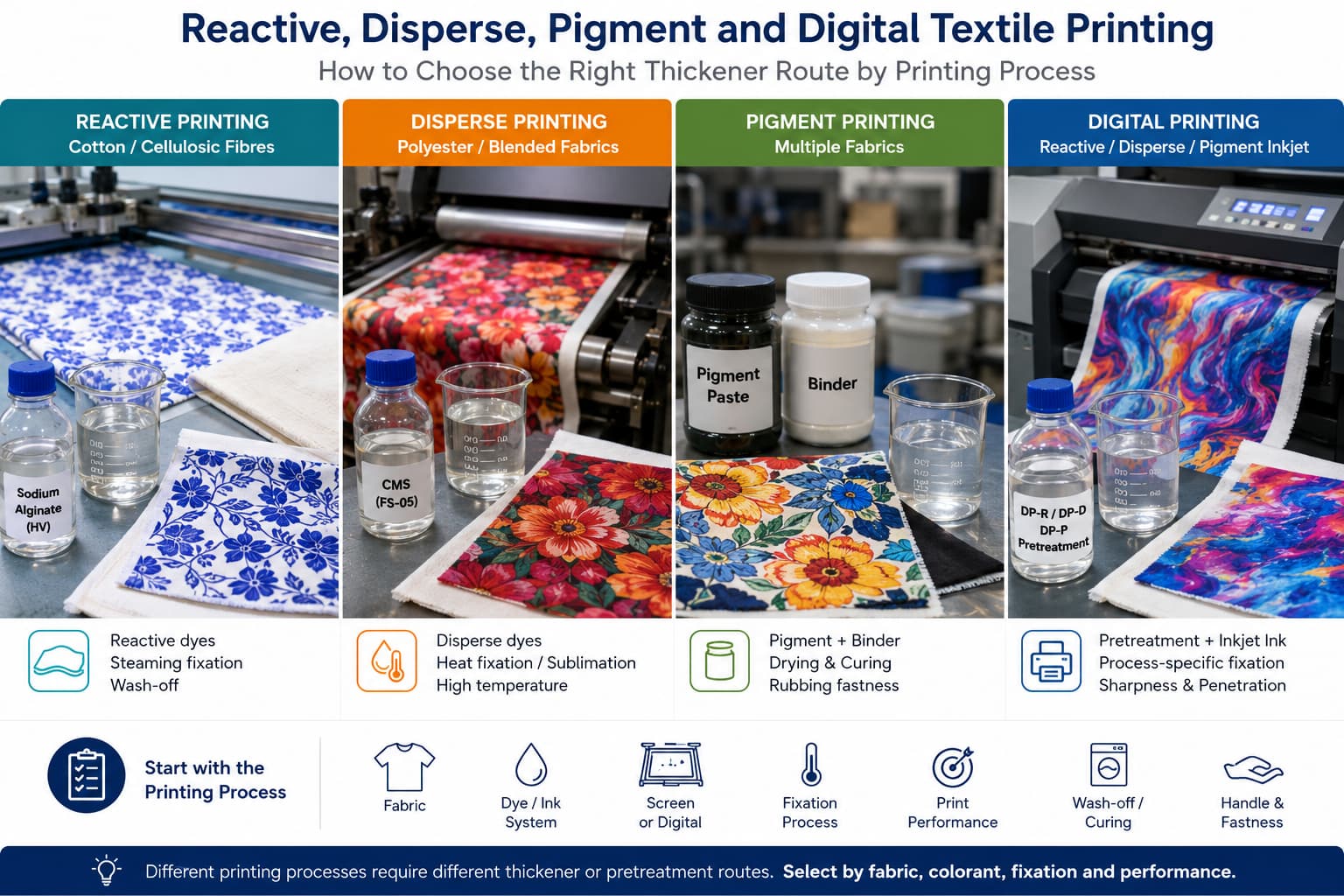
Boya ve Baskı Yöntemine Göre Tekstil Baskı Kıvam Artırıcıları
Cellulose-Based Textile Printing Paste: CMC Grade and Supplier Evaluation
Tekstil Baskısında Sodyum Aljinat ve CMC: Performans ve Maliyet Karşılaştırması
Kumaşınız İçin Doğru Tekstil Baskı Kalınlaştırıcısını Nasıl Seçersiniz?
Textile Printing Chemicals and Their Functions: 10 Key Groups
Textile Printing Thickeners Compared: Sodium Alginate, CMC, CMS and Digital Paste
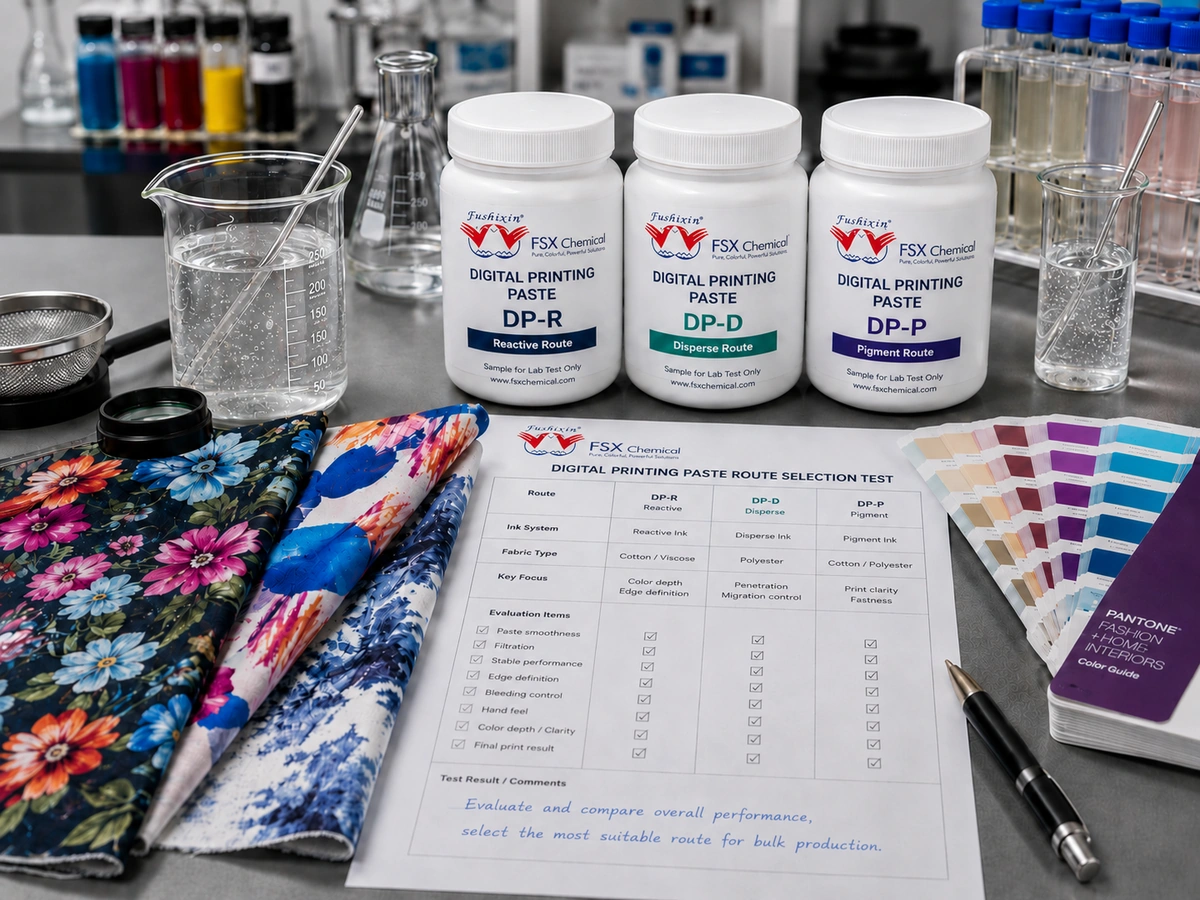
Digital Textile Printing Paste Selection: Reactive, Disperse and Pigment Systems
Why FSX Chemical’s Digital Printing Paste Is Your Best Choice
Digital Textile Printing Paste Stability: 10 Process Controls
Ürün İncelemesi: Yüksek Kaliteli Tekstil Mürekkepleri için FSX Dijital Baskı Macunu
Dijital Mürekkep Püskürtmeli Baskı İçin Yeni Tekstil Kimyasal Çözümlerinin Keşfi
2026 Yılı İçin Tekstil Baskı Kimyasallarında En Önemli 5 Yenilik
Hızlı Bağlantılar
İhtiyacınızı Bildirin
Ücretsiz numuneler · 24 saat içinde yanıt
Ürün İhtiyacınızı Bildirin
Ürün adını, kullanım alanını, miktarı, teslimat yerini ve elinizde bulunan TDS, örnek fotoğraf veya belgeleri bizimle paylaşın. FSX Chemical bu bilgileri inceleyerek fiyat teklifi, numune eşleştirme veya ürün seçimi için atılması gereken bir sonraki adımı önerecektir.