Ammonia vs. Sodium Hydroxide vs. Amines: How to Choose a Neutralizer for Acrylic Thickener
Ammonia, NaOH and organic amines can all neutralize selected acrylic thickeners, but they create different...
Ammonia, sodium hydroxide and organic amines can all neutralize acid-functional acrylic thickeners, but they do not create identical pigment-printing conditions. The neutralizer changes more than pH: it can affect activation speed, local pH during mixing, volatility, odor, ionic load, holding stability, binder compatibility, pigment dispersion and the final rheology of the complete paste. The correct choice should therefore be based on neutralization efficiency and complete-paste performance—not equal neutralizer weight or the highest viscosity reached in water. This guide explains how textile mills can compare ammonia, sodium hydroxide and amine neutralizers for acrylic thickener under controlled pigment-printing conditions.
Which Neutralizer Is Best for Acrylic Thickener?
There is no universal best neutralizer.
A suitable neutralizer is the one that reaches the acrylic thickener’s validated activation window while keeping the complete pigment-printing paste stable.
Ammonia is a common neutralization route in water-based acrylic systems because it can neutralize acid-functional polymers efficiently.
Potential advantages include:
Fast pH response
Established use in water-based acrylic formulations
Volatility that can reduce the amount of neutralizer remaining after drying
Potential disadvantages include:
Strong odor
Volatility during mixing and holding
Open-tank pH drift
Ventilation and worker-exposure considerations
If a pigment paste is held for a long period in an open or poorly covered tank, volatile ammonia loss can change pH and therefore change the viscosity of a pH-responsive thickener.
Do not assume the fresh pH will remain constant throughout the production shift.
Sodium Hydroxide
Sodium hydroxide is a strong inorganic base and can activate many acid-functional acrylic thickeners rapidly.
Potential advantages include:
Strong neutralization efficiency
No ammonia odor
Nonvolatile neutralization route
Stable alkalinity when properly controlled
Potential risks include:
Very high local pH if added too quickly
Rapid local polymer swelling
Gel-like zones or uneven activation
Additional sodium counterions / ionic load
Corrosive handling requirements
Because NaOH does not volatilize like ammonia, the neutralized sodium form remains in the formulation.
For an electrolyte-sensitive polyacrylate system, this can matter to rheology and compatibility.
Do not interpret “odorless neutralizer” as “chemically neutral to the formulation.”
Organic Amines and Amino Alcohols
Organic amines include a broad family of neutralizers.
Examples in water-based formulations can include amino alcohols and other amine-based pH-control agents.
Potential advantages of selected grades can include:
Efficient neutralization
Lower odor than ammonia
Lower volatility than ammonia for some amines
Improved pH stability in open systems
Co-dispersing or emulsion-stabilizing benefits in some formulations
Neutralizer selection should be tested over the real pigment-paste holding time.
Measure:
Fresh pH
Свіжа в’язкість
Intermediate pH / viscosity
End-of-shift pH / viscosity
Зовнішній вигляд
Піна
Ammonia-containing systems deserve particular attention in open tanks because volatilization can shift pH.
NaOH-containing systems deserve attention to ionic load and over-neutralization.
Amine-containing systems deserve attention to grade-specific compatibility and volatility.
Do not approve a neutralizer from a 10-minute beaker test.
Rheology: Same Final pH, Different Flow
After neutralization, compare the full printing rheology:
Low-Shear Body → Shear Thinning → Screen Transfer → Recovery
A neutralizer can change:
Low-shear viscosity
Еластичність
Відновлення
Holding behavior
especially when binder, surfactants and electrolytes are present.
Отже:
Same Final pH ≠ Same Brookfield Viscosity ≠ Same Screen Performance.
Foam and Defoamer Interaction
Neutralizer can influence foam indirectly through pH, surfactant behavior and mixing.
Check:
Foam generated during neutralization
Foam after pigment / binder addition
Defoamer dosage required
Viscosity after defoamer addition
In HASE systems, hydrophobic defoamer components can also influence associative rheology.
Do not optimize neutralizer without rechecking the final defoamer package.
Drying, Curing and Neutralizer Volatility
Pigment fixation depends primarily on binder film formation and curing.
Neutralizer can influence the drying environment through volatility.
Ammonia can leave more readily during drying.
NaOH does not leave as a volatile base.
Organic amines vary widely: some are deliberately less volatile, while others are more volatile.
Do not assume one volatility profile is automatically better.
Evaluate the cured fabric for:
K/S / відтінок
Сухе натирання
Вологе протирання
Тканина ручної роботи
Residual odor where relevant
Handling, EHS and SDS Control
Neutralizers require different handling controls.
Ammonia
Requires control of vapors, odor and ventilation according to the current SDS and local workplace requirements.
Sodium Hydroxide
Is strongly corrosive and requires appropriate chemical-handling controls, dilution procedures and PPE based on the current SDS.
Organic Amines
Have different flash points, vapor pressures and hazard classifications depending on the specific product.
Do not write one generic “amine is safer” rule.
The commercial neutralizer SDS is the controlling safety document.
How to Compare Neutralizers in the Laboratory
Use one acrylic thickener grade and one fixed pigment formula.
Step 1: Prepare Three Neutralizer Routes
Ammonia route
Sodium hydroxide route
Selected amine route
Only include a neutralizer if the thickener supplier confirms it is technically suitable.
Step 2: Reach the Same Validated Activation Window
Do not use equal neutralizer weight.
Step 3: Measure Fresh pH and Viscosity
Use the same temperature and instrument.
Step 4: Add Pigment / Binder / Fixer
Record pH and viscosity after critical additions.
Step 5: Hold
Measure pH and viscosity across the real production period.
Step 6: Screen Print and Cure
Evaluate the finished fabric.
Compare on a Neutralization-Equivalent Basis
The laboratory should compare neutralizers based on reaching the same technically relevant neutralization state, not equal product mass.
Запис:
Neutralizer product concentration
Amount added
Кінцеве значення рН
Thickener dosage
Total formula water
Do not let one route contain more added water simply because its commercial neutralizer is supplied at a lower active concentration.
Keep total formula mass constant.
Build a Neutralizer-Specific pH–Viscosity Curve
For each neutralizer, build several controlled points around the thickener’s validated activation range.
Plot:
pH → Viscosity
Потім порівняйте:
Activation onset
Steepness of viscosity build
Practical plateau
Holding-time drift
The objective is not to find which neutralizer creates the highest peak viscosity.
It is to find the most controllable operating region.
Repeat the Comparison in Complete Pigment Paste
Water-only curves are screening tools.
Repeat the useful neutralizer conditions in the real:
Pigment + Binder + Fixer + Thickener + Auxiliary
formula.
Порівняйте:
Свіжа в’язкість
Holding viscosity
pH drift
Піна
Перенесення зображення на екран
Визначення терміна «друк»
Колірна віддача
Сухе / вологе протирання
Рука
The complete-paste result determines production suitability.
Затвердження випробувального виробництва
Run the best neutralizer route on the actual machine.
Запис:
Neutralizer type / product
Neutralizer addition method
Кінцеве значення рН
Thickener dosage
В'язкість на початку / в середині / наприкінці циклу
Швидкість роботи верстата
Поведінка екрана
Час витримки
Отвердіння
Сухе / вологе протирання
Тканина ручної роботи
Operator / odor observations where relevant
Approve a neutralizer route only if process stability and finished fabric both pass.
Practical Neutralizer Selection Matrix
Область відбору
Ammonia
Sodium Hydroxide
Organic Amine
Neutralization efficiency
Високий
Високий
Залежно від класу
Volatility
Високий
Very low / nonvolatile in paste
Low to high, product-dependent
Запах
Сильний
No ammonia odor
Product-dependent
Local high-pH risk
Moderate
High if concentrated / poorly mixed
Product-dependent
Ionic contribution
Ammonium counterion
Sodium counterion
Amine counterion
Open-tank pH drift
Може мати велике значення
Usually lower from volatility
Product-dependent
Pigment co-dispersing potential
Limited
Limited
Possible for selected amino alcohols
Best decision basis
Complete-paste production trial
This matrix describes general tendencies, not universal product specifications.
When Does Ammonia Usually Make More Sense?
Ammonia can be attractive when:
The thickener supplier validates it.
Fast neutralization is useful.
The factory already has effective ventilation and ammonia-handling controls.
Some neutralizer volatility after application is acceptable or useful.
It may be less attractive where:
Low odor is a strong customer or workplace requirement.
Paste is stored for long periods in open tanks.
pH drift during holding is difficult to control.
When Does Sodium Hydroxide Usually Make More Sense?
NaOH can be attractive when:
The thickener grade is validated for strong inorganic alkali.
The plant already meters and handles caustic safely.
Low neutralizer volatility is desired.
Ammonia odor is unacceptable.
It requires especially strong control of:
Концентрація
Addition rate
Local mixing
Кінцеве значення рН
Ionic-load effects
A low-cost neutralizer can become expensive if it causes batch inconsistency or complete-paste viscosity loss.
When Does an Organic Amine Usually Make More Sense?
A selected organic amine can be attractive when the formulation needs:
Lower odor than ammonia
More stable pH in an open system
Specific pigment-dispersion or emulsion-stability benefits
A neutralizer with a particular volatility profile
But the amine must be selected with:
Thickener architecture
Binder chemistry
Fixer chemistry
Local VOC / EHS rules
Finished fabric requirements
in mind.
Do not substitute one amine for another on equal weight.
Common Neutralizer Selection Mistakes
1. Comparing Equal Weight
Different neutralizers have different concentration, molecular weight and neutralization capacity.
2. Choosing the Neutralizer That Gives the Highest Water Viscosity
The complete pigment-binder formula can respond differently.
3. Assuming NaOH Is Better Because It Has No Ammonia Odor
Local high pH, corrosivity and ionic load still matter.
4. Assuming Amine Automatically Means Low VOC
VOC classification and volatility are amine-specific and region-specific.
5. Ignoring Open-Tank Holding
Ammonia loss can shift pH and viscosity.
6. Adding Concentrated Alkali Too Quickly
Local over-neutralization can create gel-like regions and uneven activation.
7. Changing Neutralizer Without Rechecking Binder / Pigment
The complete ionic and surfactant environment changes.
Таблиця усунення несправностей
Виявлена проблема
Перші змінні, які слід перевірити
Не робіть припущень
Ammonia paste loses viscosity during holding
pH drift, tank cover, temperature, ventilation
The thickener batch is weak
NaOH route creates local gel
Concentration, addition rate, mixing, local pH
More mixing after the fact will always repair it
NaOH route gives lower complete-paste viscosity
Ionic load, binder/pigment compatibility, pH
Same pH guarantees same rheology
Amine route gives different viscosity from ammonia
Amine chemistry, binder, surfactants, pH
All bases behave the same after neutralization
Amine reduces odor but changes color paste
Pigment dispersion, pH, co-dispersancy, binder
Lower odor means better formulation compatibility
Same final pH gives different screen transfer
Rheology, ionic environment, recovery
pH alone defines printability
More neutralizer raises pH but not viscosity
Viscosity plateau, electrolyte effects, dosage
Higher pH must create higher viscosity
Neutralizer cost is lower but corrections increase
Загальна вартість експлуатації
Price/kg determines best neutralizer
Загальна вартість експлуатації
Neutralizer cost should include more than purchase price.
A useful model is:
Total Cost in Use = Neutralizer + Thickener Dosage + Mixing / Metering + Ventilation / Handling + Formula Adjustment + Machine Efficiency + Rework + Quality Loss
Ammonia Cost Drivers
Neutralizer price
Ventilation / odor control
Potential pH drift during holding
NaOH Cost Drivers
Neutralizer price
Metering and safe handling
Mixing control
Potential ionic-load effects
Organic Amine Cost Drivers
Higher or lower product cost depending on grade
Potential pH-stability benefit
Potential lower odor
Potential formulation multifunctionality
The lowest-cost neutralizer is the one that supports stable printing at the lowest practical total process cost.
Яку інформацію слід надіслати постачальнику загущувачів?
For neutralizer matching, provide:
Current acrylic thickener / TDS
Current neutralizer product and concentration
Neutralizer dosage
Кінцеве значення рН
В'язкість та повна методика випробувань
Pigment dispersion and dosage
Binder grade and dosage
Фіксатор / допоміжні пристрої
Water hardness / conductivity if available
Mixing sequence
Час витримки
Main problem: odor, pH drift, gel, viscosity loss, binder compatibility or cost
Компанія FSX Chemical може використовувати цю інформацію за допомогою Зразки та підбір to define a controlled neutralizer comparison around the current pigment-printing formula.
How Should a Mill Choose a Neutralizer for Acrylic Thickener?
A practical decision chain is:
Confirm Supplier-Approved Bases → Compare on Neutralization Basis → Build pH–Viscosity Curves → Add Pigment / Binder → Hold → Check Rheology → Screen Print → Cure → Compare EHS and Total Cost
Основними принципами є:
Ammonia, NaOH and organic amines can all neutralize selected acrylic thickeners, but they do not create identical formulation conditions.
Equal neutralizer weight is not a fair comparison.
Ammonia is volatile and odorous; NaOH is nonvolatile but strongly caustic and adds sodium ionic load; amines vary widely in volatility, odor and multifunctionality.
Same final pH does not guarantee the same rheology, binder compatibility or holding stability.
The real pigment, binder, fixer and water should be present before production approval.
The best neutralizer is the one that gives a repeatable production window at the lowest practical Total Cost in Use and acceptable EHS conditions.
Поширені запитання
1. Can ammonia neutralize acrylic thickener?
Yes, many acid-functional acrylic thickeners can be neutralized with ammonia, but the commercial grade TDS should confirm the approved neutralization route.
2. Can sodium hydroxide neutralize acrylic thickener?
Yes, selected ASE/HASE products can use NaOH. Control concentration, local mixing and final pH carefully because NaOH is a strong base.
3. Can organic amines neutralize acrylic thickener?
Yes, selected amines and amino alcohols can neutralize acid-functional acrylic polymers, but performance depends on the specific amine and complete formulation.
4. Which neutralizer gives the highest viscosity?
There is no universal answer. Compare the same thickener at equivalent activation conditions and then test the complete pigment paste.
5. Why does ammonia paste lose viscosity during holding?
Ammonia can volatilize from open systems, changing pH and the activation state of a pH-responsive thickener.
6. Why can NaOH cause acrylic thickener gel lumps?
Concentrated NaOH can create local high pH and very rapid swelling before the thickener is distributed uniformly.
7. Is NaOH better because it has no ammonia odor?
Not automatically. It removes ammonia odor but introduces strong-caustic handling requirements and a different ionic environment.
8. Are amines always low odor?
No. Odor and volatility vary widely between amines. Check the specific neutralizer TDS/SDS.
9. Does an amine improve pigment dispersion?
Some amino alcohols can provide co-dispersing benefits in water-based pigment systems, but this is product- and formulation-specific.
10. Should neutralizers be compared at the same dosage?
No. Compare them on a technically equivalent neutralization basis and keep total formula mass constant.
11. Does the same pH mean the paste will print the same?
No. Ionic load, binder interaction, rheology and holding stability can differ even at the same pH.
12. What should I send FSX Chemical for neutralizer troubleshooting?
Send the current thickener/TDS, neutralizer type and concentration, dosage, final pH, viscosity method, pigment, binder, fixer, water quality, mixing sequence and holding-time data.
Choose the Neutralizer That Stabilizes the Complete Pigment Paste
If your acrylic thickener gives different viscosity with ammonia, NaOH or an amine, or if the paste drifts during holding, develops gel, or becomes unstable after binder addition, FSX Chemical can help structure a controlled neutralizer comparison.
Щоб отримати корисний технічний огляд, надішліть:
Your current synthetic thickener sample, TDS or COA
Current neutralizer product and concentration
Neutralizer dosage and addition method
Кінцеве значення рН
В'язкість та повна методика випробувань
Пігментна дисперсія
Binder / fixer system
Water hardness / conductivity
Mixing sequence
Час витримки
Main problem: odor, pH drift, viscosity loss, gel, compatibility or cost
Почніть з Зразки та підбір для проведення контрольованого порівняльного дослідження «струм проти кандидата».
The best neutralizer is not simply the strongest base or the lowest-cost chemical. It is the neutralizer that activates the selected acrylic thickener predictably, remains compatible with pigment and binder, supports stable screen rheology through the production holding period, and fits the factory’s EHS and Total Cost in Use requirements.
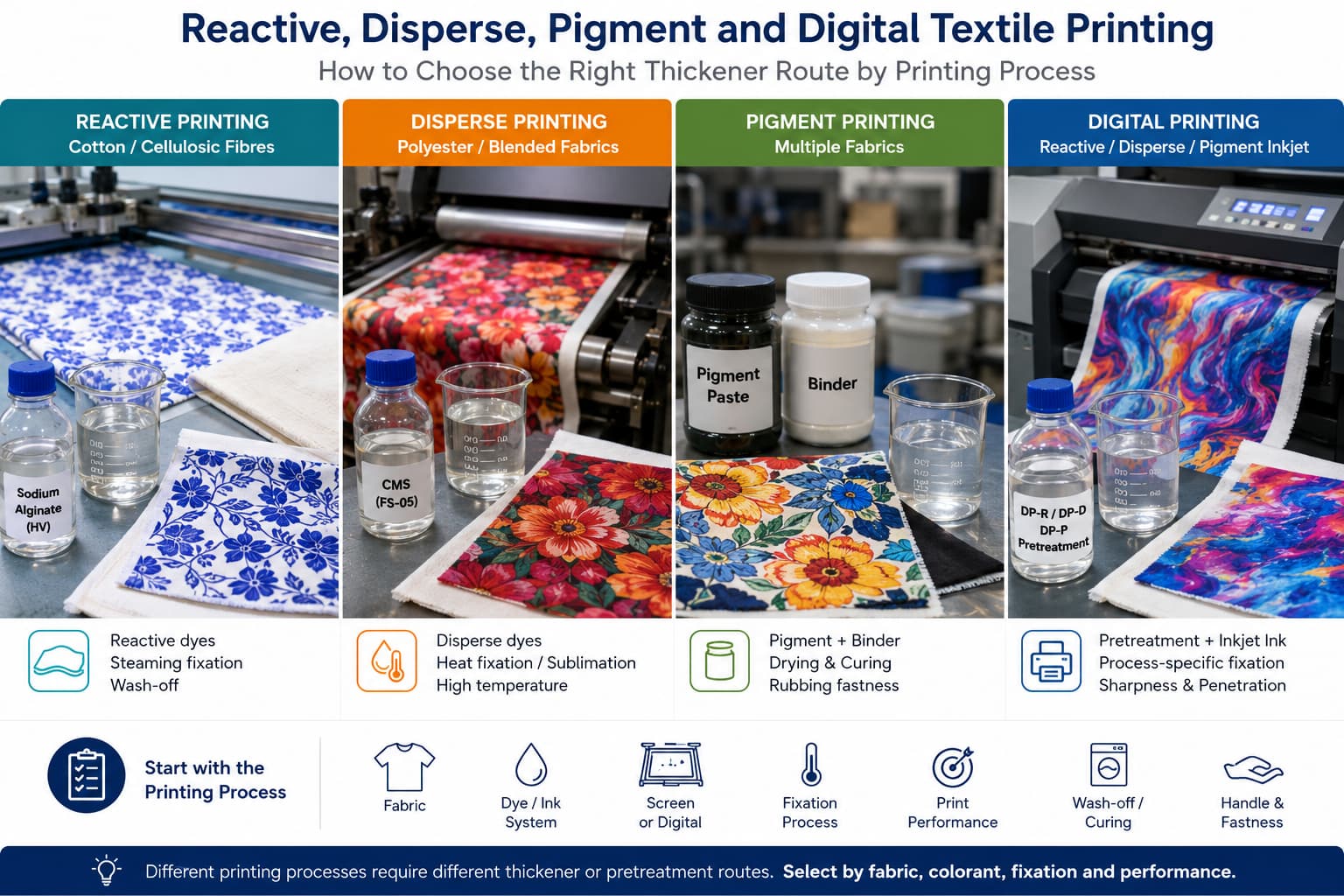
Дізнайтеся, як підібрати загущувач та методи попередньої обробки для реактивного, дисперсного, пігментного та цифрового друку на текстилі з урахуванням вимог до тканини, барвника або чорнила, фіксації, змивання та якості друку.
Друкарська паста на основі CMC використовується у пігментному, реактивному та цифровому текстильному друку. У цьому посібнику пояснюється, які параметри мають значення, як порівнювати постачальників та що слід уточнити перед тим, як оформити оптове замовлення.
І альгінат натрію, і КМК використовуються як загусники в текстильному друку, але вони підходять для різних систем фарбування та умов виробництва. У цьому посібнику пояснюються основні відмінності та випадки, коли слід застосовувати кожну з цих речовин.
The right textile printing thickener is determined by more than fabric type. Buyers should match the thickener to the dye or pigment system, printing method, target rheology, wash-off requirements and actual factory trial conditions.
Textile printing performance depends on a coordinated chemical system, not one universal additive. This guide explains ten important chemical groups, their functions, where they fit and what buyers should verify before production trials.
Textile printing thickeners differ in chemistry, rheology, dye compatibility and wash-off behavior. This guide compares the main thickener families, their common application directions and the parameters buyers should verify before production trials.
Digital printing pastes should be selected by ink chemistry, fabric, application method and post-treatment. This guide compares sodium alginate, CMC, CMS, synthetic polymer and compound pretreatment routes for textile inkjet printing.
FSX Chemical offers separate digital printing paste routes for reactive, disperse and pigment systems, supported by application review, sample matching and technical documentation. This guide explains how buyers can evaluate the right route before bulk purchasing.
Stable digital printing paste requires more than a target viscosity. This guide explains how product selection, water quality, addition sequence, mixing, pH, temperature, filtration, hygiene, storage and quality records influence pretreatment and production consistency.
This product review examines FSX Digital Printing Paste as a textile inkjet pretreatment and thickening route, focusing on ink-system matching, rheology, filtration, print definition, stability and real production testing.
Digital textile printing requires more than advanced ink and printheads. Explore process-specific chemical solutions for reactive, disperse and pigment inkjet printing, from pretreatment and rheology to filtration, fixation and production validation.
Textile printing chemistry is evolving beyond simple viscosity and price comparisons. Explore five innovation directions shaping 2026, including safer chemical inputs, hybrid biopolymer thickeners, advanced pigment binders, shorter digital processes and multifunctional formulations.
Надайте назву продукту, сферу застосування, кількість, місце призначення, а також будь-які технічні специфікації (TDS),
зразки фотографій або документів, які у вас вже є. Компанія FSX Chemical розгляне цю
інформацію та надасть рекомендації щодо подальших кроків: підготовки комерційної пропозиції, підбору зразків
або вибору продукту.
Інформація про товарНазва товару, сорт, модель, фото етикетки або код постачальника.
Доступні документиTDS, SDS, COA, фото зразка, перелік продукції або дані випробувань.
Деталі замовленняОрієнтовна кількість, упаковка, країна призначення, порт або умови торгівлі.
Заявка чи проблемаПроцес друку на текстилі, вимоги до складу, поточні проблеми або цільові показники ефективності.