Рідкий загущувач на акриловій основі для пігментного друку: як рН та нейтралізація впливають на в’язкість
Many acrylic liquid thickeners develop viscosity after neutralization, but the pH window is grade-specific. Evaluate...
Acrylic-based liquid thickeners used in textile pigment printing can develop very different viscosity depending on pH, neutralization method and the chemistry of the complete pigment-binder paste. Many alkali-swellable acrylic systems are supplied as relatively low-viscosity acidic emulsions; after neutralization, carboxylic acid groups ionize, the polymer expands and viscosity rises. But there is no universal “best pH” for every grade. Neutralizer type, addition order, as-supplied dose, grade composition, electrolyte load, pigment dispersion, binder, temperature and holding time can all shift the final viscosity. This guide shows how textile mills can build a controlled pH–viscosity activation curve and validate the thickener under real pigment-printing conditions rather than judging it from water viscosity alone.
How Do pH and Neutralization Control Acrylic Thickener Viscosity?
Many acrylic liquid thickeners used in water-based formulations are based on acid-functional polymers.
At lower pH, the polymer can remain relatively compact and the supplied product may have low viscosity.
Crosslinked polyacrylate / polyacrylic-acid systems
Application-specific acrylic compound thickeners
These product families can differ significantly in:
Initial pH
Nonvolatile content by the specified test method
Activation mechanism
Толерантність до електролітів
Associative thickening behavior
Low-shear / high-shear rheology
Сумісність з палітурками
Therefore, two products both called “acrylic thickener” should not be assumed to use the same neutralization procedure.
The Neutralization Mechanism: Why Viscosity Can Rise Rapidly
In an acid-functional acrylic polymer, carboxylic acid groups are less ionized at low pH.
The polymer chain is therefore relatively compact.
As the system is neutralized, more carboxyl groups become ionized.
The negative charges repel each other and the polymer structure becomes more expanded.
As polymer chains occupy more hydrodynamic volume and interact with surrounding water, viscosity can increase rapidly.
This explains why some alkali-swellable acrylic thickeners are supplied as easy-to-handle low-viscosity liquids but become highly effective rheology modifiers after neutralization.
For the mill, this creates an important handling advantage:
Some products are designed to be added after part of the formulation is already present.
Others may be supplied pre-neutralized.
The approved addition order should be treated as part of the product specification.
If the mill changes from one synthetic thickener to another, do not automatically keep the old addition sequence.
Local High pH vs. Final Average pH
One of the most common preparation errors is adding concentrated alkali too quickly.
The final tank may measure an acceptable pH, but the polymer can temporarily experience very high local pH near the addition point.
Це може призвести до:
Local over-swelling
Lumps or gel-like regions
Uneven viscosity development
Poor batch repeatability
Controls can include:
Diluting the neutralizer where the validated process allows
Adding gradually
Maintaining effective circulation
Avoiding dead zones
Allowing equilibration before final pH reading
The mill should control the neutralization process—not just the final pH number.
As-Supplied Dose, Nonvolatile Content and Dilution
Liquid acrylic thickeners can have different nonvolatile contents under a stated drying method. The residue can contain polymer and other nonvolatile components; it is not, by itself, an active-polymer assay.
Record the as-supplied product dose as a mass fraction of final paste. Calculate active-polymer addition only when the exact grade has a separately documented active-polymer fraction and definition; otherwise compare the product dose and measured nonvolatile content as different quantities.
A neutralizer solution also adds water or other carrier and dissolved neutralizer. Record its supplied strength and actual mass, and include the entire addition in the final formula mass and water balance.
Отже, порівняйте:
As-supplied thickener dosage
Nonvolatile content by the stated method; active-polymer fraction only if separately documented
Neutralizer solution amount
Total formula mass
If viscosity is lower than expected, check whether the paste has been diluted before assuming the pH is wrong.
A strong technical comparison keeps total formula mass constant while studying pH.
Electrolytes Can Reduce the Viscosity Built by Neutralization
Neutralization expands the acrylic polymer because charged carboxylate groups repel each other.
Electrolytes can partially screen those charges.
The polymer chain can become more compact, reducing hydrodynamic volume and apparent viscosity.
Electrolytes can enter the pigment paste from:
Пігментна дисперсія
Папка
Ремонтник
Water hardness
Other auxiliaries
Excess neutralizer salts
This creates an important practical point:
Acrylic Thickener + Correct pH does not guarantee stable viscosity after the complete formula is added.
Always check viscosity retention after pigment, binder and auxiliaries are added.
Binder Compatibility After Neutralization
The thickener and binder perform different functions but share the same paste.
Binder addition can change:
Концентрація електролітів
pH
Баланс поверхнево-активних речовин
В’язкість
Піна
A useful staged test is:
Етап
Measure
Purpose
1. Thickener + Water
pH / viscosity
Baseline
2. After Neutralization
pH / viscosity
Активація
3. After Pigment
pH / viscosity
Pigment compatibility
4. After Binder
pH / viscosity
Binder / electrolyte response
5. After Holding
pH / viscosity / appearance
Production stability
If viscosity drops sharply only after binder addition, changing the neutralization pH alone may not solve the problem.
Pigment Dispersion Compatibility
Pigment dispersions can contain different dispersants, surfactants, salts and pH-control ingredients.
Therefore, the same acrylic thickener can behave differently with:
Different colors
Different pigment suppliers
Different pigment concentrations
A good validation plan includes representative:
Light shade
Normal production shade
Heavy / dark shade
If dark shades cause a larger viscosity loss, investigate pigment-system electrolyte load before increasing thickener dosage.
Temperature and Holding Time
Viscosity measurements must be temperature-controlled.
Neutralization and mixing can change paste temperature.
During holding, the paste may cool or warm depending on the color kitchen.
Measure at a consistent temperature when comparing pH points.
Also check:
Свіжа в’язкість
2-hour viscosity
4-hour viscosity
End-of-shift viscosity
These are example study points rather than a universal pot-life requirement.
The approved holding window should match the mill’s real production schedule.
Neutralization Changes Rheology, Not Only One Viscosity Number
Acrylic thickener activation changes polymer conformation and therefore can change the full rheological profile.
For screen printing, evaluate:
Low-shear viscosity
Shear thinning
Відновлення конструкції
Elasticity / stringiness
The objective is:
Enough Low-Shear Body → Easy Flow Under Squeegee Shear → Controlled Recovery After Transfer
Two pH points can show similar Brookfield viscosity but different screen behavior if their rheology differs.
Machine testing remains necessary.
Build a pH–Viscosity Curve Without Confounding Dose and History
First confirm whether the actual grade needs neutralization or is already supplied in a usable activated form. Use only supplier-supported neutralizers and conditions. A generic acrylic product description does not authorize the same alkali treatment for every grade.
Distinguish a Sequential Titration from Independent Formulations
Adding neutralizer step by step to one cup is useful for exploring response, but each point also has more added liquid, longer aging and a different mixing history. Treat that curve as exploratory. Confirm promising points using separately prepared, mass-balanced formulations with the same final thickener concentration and defined equilibration time.
Змінна
Record or control
Reason
Нейтралізатор
Identity, supplied strength and actual mass added
Equal grams of different neutralizer solutions are not equivalent
Water balance
Include dilution water in the final recipe
Prevent dilution from masquerading as a pH effect
Measurement
Calibrated pH measurement, temperature, mixing and elapsed time
Make activation points comparable
Реологія
Specified viscosity method plus relevant flow and recovery observations
A peak single-point viscosity is not a complete process target
Avoid repeatedly adding acid and alkali to chase an overshot point. That changes the ionic composition and preparation history; prepare a fresh comparison when those changes would invalidate the trial.
Confirm the Window in the Complete Pigment Paste
Repeat the selected conditions with the actual pigment dispersion, binder and auxiliaries. Keep their final concentrations and the preparation sequence documented. A lower complete-paste viscosity can reflect several formulation effects; pH alone does not identify which ingredient caused the change.
Recheck after the intended holding period and assess screen release, print definition, cured hand and required fastness. Select a region that remains usable under realistic variation in addition and holding, rather than the highest point on the water-only curve. Record the grade, formula version, neutralizer and measurement method with the approved window.
Connect the pH Curve to Screen Printing Performance
After the laboratory curve identifies useful points, print them under matched conditions.
Keep constant:
Тканина
Сітка екрану / гравірування
Скребок
Швидкість роботи верстата
Pigment concentration
Binder concentration
Отвердіння
Evaluate:
Уривок з фільму
Pattern definition
Проникнення
Рівномірність по всій площі
K/S / відтінок
A pH point that gives the highest viscosity but poor screen transfer is not the best point.
The correct pH window is the one that provides stable printing rheology.
Why Curing and Finished Fabric Still Matter
Pigment printing relies on binder-film formation.
The thickener is not the main pigment-fixation polymer, but its dosage and rheology affect:
Відкладення пасти
Розподіл пігменту
Розподіл зв’язувальних речовин
Surface film
After curing, evaluate:
Color strength
Dry rubbing fastness
Wet rubbing fastness
Стійкість до прання (у відповідних випадках)
Тканина ручної роботи
Do not approve the pH/neutralization route from paste viscosity alone.
Fabric Hand, Product Residue and Paste Deposit
At unchanged paste consumption, increasing the dose of the same grade adds more of that product’s dry residue to the fabric. Actual residue on the print also depends on paste deposit, so record both dose and consumption before attributing a hand change to the thickener.
In pigment printing, the fabric already contains a cured binder film.
Depending on composition and deposit, more retained product residue can contribute to:
Stiffer hand
Heavier surface feel
Higher paste cost
This is another reason to optimize neutralization before simply increasing dosage.
Cost per accepted m² = total allocated monetary cost for the agreed preparation, printing and finishing boundary ÷ accepted finished-fabric area (m²).
A well-activated grade at lower dosage may be cheaper than a lower-priced product that requires more thickener and more corrections.
Price actual product and neutralizer consumption using delivered unit prices; convert labor, machine time and energy using stated rates in one currency. Compare the same finished-print requirements and production boundary. Keep unpriced stability or hand observations separate from cost. Count consumed material, rejected output and rework without adding the same material or overlapping time charge twice; report any estimated lost margin separately.
Яку інформацію слід надіслати постачальнику загущувачів?
For useful acrylic-thickener matching, provide:
Current thickener name / sample / TDS
As-supplied dosage
Тип нейтралізатора
Кінцевий рН пасти
В'язкість та повна методика випробувань
Пігментна дисперсія
Binder type and dosage
Фіксатор / допоміжні пристрої
Тканина
Плоске або обертове сито
Час витримки
Умови затвердіння
Main problem: low viscosity, viscosity collapse, screen running, rubbing, hand or cost
Компанія FSX Chemical може використовувати цю інформацію за допомогою Зразки та підбір to define a controlled activation and complete-paste comparison.
pH controls viscosity development in many alkali-swellable acrylic systems, but the target pH is grade-specific.
Neutralizer identity and addition order can change the result even at similar final pH.
Electrolytes can reduce the viscosity gained through neutralization.
The water activation curve and the complete pigment-paste curve should be treated separately.
Final selection must include screen behavior, curing, rubbing fastness and fabric hand.
The best neutralization point is the most stable operating window—not the highest viscosity point.
Поширені запитання
1. Why does acrylic liquid thickener become much thicker after adding alkali?
In many alkali-swellable acrylic systems, neutralization ionizes carboxylic acid groups, causing the polymer to expand and occupy more hydrodynamic volume, which increases viscosity.
2. What pH should an acrylic pigment-printing thickener reach?
There is no universal target. Start with the commercial grade’s TDS or supplier-defined activation window and validate it in the complete pigment-binder formula.
3. Can I use sodium hydroxide to neutralize every acrylic thickener?
No. Different grades may be designed for different neutralizers. Use the supplier-approved neutralization route and validate compatibility.
4. Why is viscosity still low even though the pH looks correct?
Check the as-supplied product dose, nonvolatile-content method, dilution, electrolyte load, pigment dispersion, binder and temperature. Use active-polymer content only if separately documented for that grade. pH is only one variable.
5. Why does viscosity drop after pigment is added?
Pigment dispersions can introduce salts, surfactants or pH changes that reduce the expanded polymer structure or alter the complete paste.
6. Why does viscosity drop after binder is added?
Binder can introduce electrolytes, surfactants and pH changes. Test the thickener and binder together rather than relying on water viscosity.
7. Does higher pH always give higher viscosity?
No. Many systems reach a useful plateau, and excessive neutralizer can increase ionic load or create formulation-compatibility problems.
8. Why should I add alkali gradually?
Gradual addition reduces local over-neutralization and helps the polymer swell more uniformly.
9. Should pH be measured immediately after neutralization?
Record the immediate value, but also allow the validated equilibration time before final adjustment because mixing and polymer swelling may continue.
10. Can two acrylic thickeners use the same pH but give different viscosity?
Yes. Polymer architecture, solids, crosslinking and hydrophobic modification can produce very different thickening efficiency at the same pH.
11. Should I choose the pH that gives the maximum Brookfield viscosity?
Not automatically. Choose the range that gives stable complete-paste rheology, screen transfer and finished-fabric performance.
12. What should I send FSX Chemical for pH/neutralization troubleshooting?
Send the current thickener or TDS, dosage, neutralizer, pH, viscosity method, pigment, binder, holding time, machine and the current viscosity or print problem.
Build a Stable pH–Viscosity Window for Your Acrylic Thickener
If your pigment-printing paste develops too little viscosity, over-thickens after neutralization or loses viscosity after pigment or binder addition, FSX Chemical can help structure a controlled pH and complete-paste comparison.
The right neutralization strategy is not the one that creates the highest viscosity in water. It is the one that gives a stable complete pigment paste, reliable screen rheology and the required fastness and fabric hand under real production conditions.
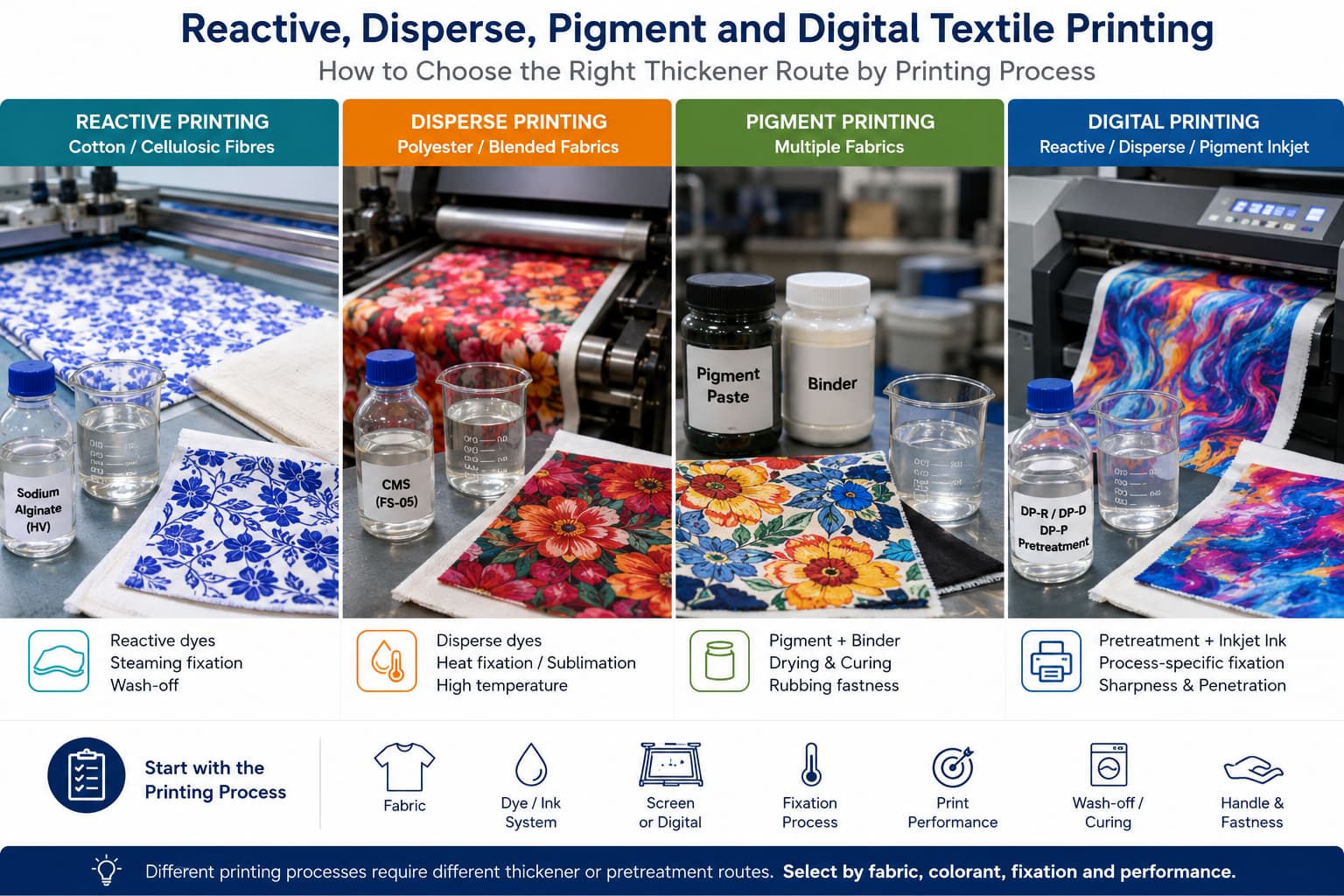
Дізнайтеся, як підібрати загущувач та методи попередньої обробки для реактивного, дисперсного, пігментного та цифрового друку на текстилі з урахуванням вимог до тканини, барвника або чорнила, фіксації, змивання та якості друку.
Друкарська паста на основі CMC використовується у пігментному, реактивному та цифровому текстильному друку. У цьому посібнику пояснюється, які параметри мають значення, як порівнювати постачальників та що слід уточнити перед тим, як оформити оптове замовлення.
І альгінат натрію, і КМК використовуються як загусники в текстильному друку, але вони підходять для різних систем фарбування та умов виробництва. У цьому посібнику пояснюються основні відмінності та випадки, коли слід застосовувати кожну з цих речовин.
The right textile printing thickener is determined by more than fabric type. Buyers should match the thickener to the dye or pigment system, printing method, target rheology, wash-off requirements and actual factory trial conditions.
Textile printing performance depends on a coordinated chemical system, not one universal additive. This guide explains ten important chemical groups, their functions, where they fit and what buyers should verify before production trials.
Textile printing thickeners differ in chemistry, rheology, dye compatibility and wash-off behavior. This guide compares the main thickener families, their common application directions and the parameters buyers should verify before production trials.
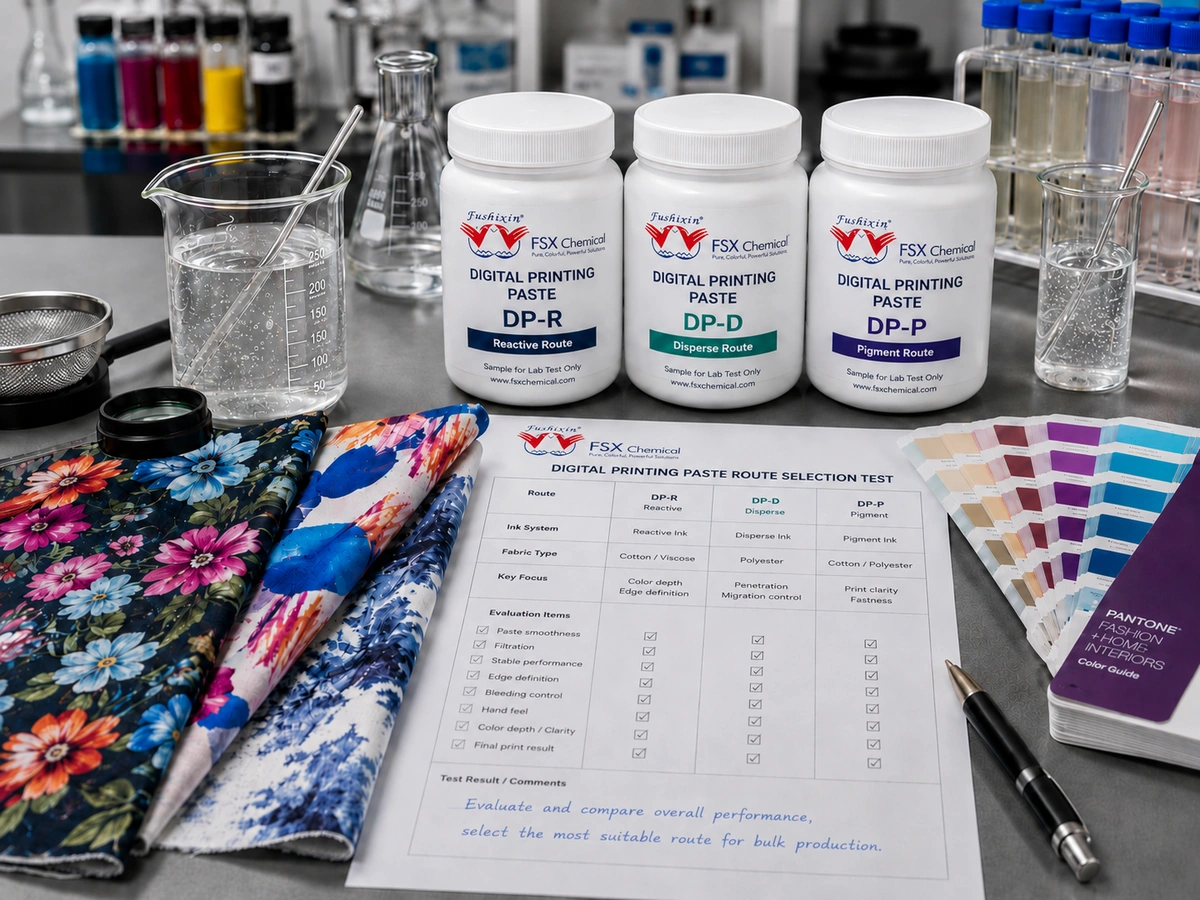
Digital printing pastes should be selected by ink chemistry, fabric, application method and post-treatment. This guide compares sodium alginate, CMC, CMS, synthetic polymer and compound pretreatment routes for textile inkjet printing.
An FSX-authored guide to checking digital pretreatment fit, trial evidence, product documents and sample-to-bulk traceability before supplier approval.
Stable digital printing paste requires more than a target viscosity. This guide explains how product selection, water quality, addition sequence, mixing, pH, temperature, filtration, hygiene, storage and quality records influence pretreatment and production consistency.
Evaluate FSX fabric pretreatment by confirmed grade, ink route, application architecture and measured add-on. Compare DG-20 or DP-P in a defined trial, and qualify any disperse candidate separately.
Digital textile printing requires more than advanced ink and printheads. Explore process-specific chemical solutions for reactive, disperse and pigment inkjet printing, from pretreatment and rheology to filtration, fixation and production validation.
Textile printing chemistry is evolving beyond simple viscosity and price comparisons. Explore five innovation directions shaping 2026, including safer chemical inputs, hybrid biopolymer thickeners, advanced pigment binders, shorter digital processes and multifunctional formulations.
Надайте назву продукту, сферу застосування, кількість, місце призначення, а також будь-які технічні специфікації (TDS),
зразки фотографій або документів, які у вас вже є. Компанія FSX Chemical розгляне цю
інформацію та надасть рекомендації щодо подальших кроків: підготовки комерційної пропозиції, підбору зразків
або вибору продукту.
Інформація про товарНазва товару, сорт, модель, фото етикетки або код постачальника.
Доступні документиTDS, SDS, COA, фото зразка, перелік продукції або дані випробувань.
Деталі замовленняОрієнтовна кількість, упаковка, країна призначення, порт або умови торгівлі.
Заявка чи проблемаПроцес друку на текстилі, вимоги до складу, поточні проблеми або цільові показники ефективності.