Acrylic-Based Liquid Thickener for Pigment Printing: How pH and Neutralization Control Viscosity

Many acrylic liquid thickeners develop viscosity after neutralization, but the correct pH is grade-specific. Pigment,...

Acrylic-based liquid thickeners used in textile pigment printing can develop very different viscosity depending on pH, neutralization method and the chemistry of the complete pigment-binder paste. Many alkali-swellable acrylic systems are supplied as relatively low-viscosity acidic emulsions; after neutralization, carboxylic acid groups ionize, the polymer expands and viscosity rises. But there is no universal “best pH” for every grade. Neutralizer type, addition order, active solids, electrolyte load, pigment dispersion, binder, temperature and holding time can all shift the final viscosity. This guide shows how textile mills can build a controlled pH–viscosity activation curve and validate the thickener under real pigment-printing conditions rather than judging it from water viscosity alone.

How Do pH and Neutralization Control Acrylic Thickener Viscosity?

Many acrylic liquid thickeners used in water-based formulations are based on acid-functional polymers.

At lower pH, the polymer can remain relatively compact and the supplied product may have low viscosity.

When a suitable base is added:

Acid Groups Neutralize → Carboxyl Groups Ionize → Electrostatic Repulsion Increases → Polymer Expands / Swells → Hydrodynamic Volume Increases → Viscosity Builds

This is the core reason an acrylic thickener can look almost water-like before activation and then develop strong viscosity after neutralization.

However, viscosity development is not controlled by pH alone.

The final result also depends on:

  • Polymer chemistry
  • Active solids
  • Neutralizer type
  • Neutralizer dosage
  • Addition order
  • Electrolyte level
  • Pigment dispersion
  • Binder chemistry
  • Temperature
  • Holding time

The practical objective is therefore not to reach the highest possible pH.

It is to reach the supplier-approved activation window that gives the required complete-paste rheology and finished printing result.

What Is an Acrylic-Based Liquid Thickener?

“Acrylic-based liquid thickener” is a broad term.

Commercial textile products may be based on:

  • Alkali-swellable acrylic emulsions
  • Alkali-soluble acrylic polymers
  • Hydrophobically modified alkali-swellable emulsions
  • Crosslinked polyacrylate / polyacrylic-acid systems
  • Application-specific acrylic compound thickeners

These product families can differ significantly in:

  • Initial pH
  • Solids content
  • Activation mechanism
  • Electrolyte tolerance
  • Associative thickening behavior
  • Low-shear / high-shear rheology
  • Binder compatibility

Therefore, two products both called “acrylic thickener” should not be assumed to use the same neutralization procedure.

The Neutralization Mechanism: Why Viscosity Can Rise Rapidly

In an acid-functional acrylic polymer, carboxylic acid groups are less ionized at low pH.

The polymer chain is therefore relatively compact.

As the system is neutralized, more carboxyl groups become ionized.

The negative charges repel each other and the polymer structure becomes more expanded.

As polymer chains occupy more hydrodynamic volume and interact with surrounding water, viscosity can increase rapidly.

This explains why some alkali-swellable acrylic thickeners are supplied as easy-to-handle low-viscosity liquids but become highly effective rheology modifiers after neutralization.

For the mill, this creates an important handling advantage:

Low-Viscosity Product for Dosing → Controlled Neutralization → High-Viscosity Printing Paste

But it also means that neutralization must be controlled.

Why There Is No Universal Target pH

It is tempting to ask:

“What pH gives maximum viscosity?”

There is no universal answer.

Different commercial acrylic thickeners can have different:

  • Acid-group content
  • Crosslink density
  • Hydrophobic modification
  • Molecular architecture
  • Degree of pre-neutralization

One product may begin thickening near neutral pH, while another may require a different range.

Some grades may already be partially or fully neutralized before shipment.

Therefore:

Use the product TDS / supplier instruction as the starting activation window, then validate that window in the mill’s complete pigment formula.

Do not copy the pH target from another brand or another acrylic polymer family.

What Happens When the Thickener Is Under-Neutralized?

If an alkali-swellable acrylic thickener is not neutralized enough, the polymer may not fully expand.

Possible symptoms include:

  • Unexpectedly low viscosity
  • High thickener dosage requirement
  • Poor low-shear body
  • Excessive spreading
  • Weak pattern definition

The common mistake is to respond by adding more thickener immediately.

Before increasing dosage, check:

  • Final pH
  • Neutralizer identity
  • Neutralizer addition method
  • Mixing time
  • Product solids

If the system is under-activated, adding more polymer may increase cost without solving the real preparation problem.

What Happens When the System Is Neutralized Too Far?

Higher pH does not mean viscosity will continue increasing indefinitely.

Depending on the grade and formulation, the viscosity response may reach a plateau.

Excess neutralizer can also change:

  • Total ionic strength
  • Binder compatibility
  • Pigment-dispersion stability
  • Final paste pH
  • Fabric / finishing compatibility

Some systems can even lose useful viscosity after excessive electrolyte loading despite having a high pH.

Therefore, the correct target is:

Minimum Neutralization Needed for Stable Target Rheology

not:

Maximum pH the Formula Can Tolerate.

Neutralizer Type: Ammonia, Sodium Hydroxide or Amines?

Different bases can neutralize acrylic acid groups, but they do not create identical formulation conditions.

Possible neutralizers include:

  • Ammonia / ammonium hydroxide
  • Sodium hydroxide
  • Volatile or non-volatile amines
  • Supplier-specific neutralizing systems

Differences can include:

  • Neutralization strength
  • Volatility
  • Added ionic load
  • Odor
  • Storage behavior
  • Compatibility with binder and auxiliaries

For example, a strong inorganic alkali can create a rapid local pH increase if added too quickly.

A volatile neutralizer may behave differently during drying and storage.

The mill should therefore use the neutralizer recommended or validated for the specific commercial grade.

Why Addition Order Matters

Two formulas with the same final composition can develop different viscosity if the addition order changes.

A practical sequence for some alkali-activated systems can be:

Water → Acrylic Thickener → Controlled Mixing → Gradual Neutralization → Pigment → Binder → Fixer / Auxiliaries → Final Adjustment

But this is not a universal recipe.

Some products are designed to be added after part of the formulation is already present.

Others may be supplied pre-neutralized.

The approved addition order should be treated as part of the product specification.

If the mill changes from one synthetic thickener to another, do not automatically keep the old addition sequence.

Local High pH vs. Final Average pH

One of the most common preparation errors is adding concentrated alkali too quickly.

The final tank may measure an acceptable pH, but the polymer can temporarily experience very high local pH near the addition point.

This can create:

  • Local over-swelling
  • Lumps or gel-like regions
  • Uneven viscosity development
  • Poor batch repeatability

Controls can include:

  • Diluting the neutralizer where the validated process allows
  • Adding gradually
  • Maintaining effective circulation
  • Avoiding dead zones
  • Allowing equilibration before final pH reading

The mill should control the neutralization process—not just the final pH number.

Active Solids and Dilution: pH Is Not the Only Variable

Liquid acrylic thickeners can have different solids content.

Two products used at the same as-supplied dosage may introduce different amounts of active polymer.

Likewise, a neutralizer solution introduces additional liquid into the paste.

Therefore, compare:

  • As-supplied thickener dosage
  • Active solids
  • Neutralizer solution amount
  • Total formula mass

If viscosity is lower than expected, check whether the paste has been diluted before assuming the pH is wrong.

A strong technical comparison keeps total formula mass constant while studying pH.

Electrolytes Can Reduce the Viscosity Built by Neutralization

Neutralization expands the acrylic polymer because charged carboxylate groups repel each other.

Electrolytes can partially screen those charges.

The polymer chain can become more compact, reducing hydrodynamic volume and apparent viscosity.

Electrolytes can enter the pigment paste from:

  • Pigment dispersion
  • Binder
  • Fixer
  • Water hardness
  • Other auxiliaries
  • Excess neutralizer salts

This creates an important practical point:

Acrylic Thickener + Correct pH does not guarantee stable viscosity after the complete formula is added.

Always check viscosity retention after pigment, binder and auxiliaries are added.

Binder Compatibility After Neutralization

The thickener and binder perform different functions but share the same paste.

Binder addition can change:

  • Electrolyte concentration
  • pH
  • Surfactant balance
  • Viscosity
  • Foam

A useful staged test is:

StageMeasurePurpose
1. Thickener + WaterpH / viscosityBaseline
2. After NeutralizationpH / viscosityActivation
3. After PigmentpH / viscosityPigment compatibility
4. After BinderpH / viscosityBinder / electrolyte response
5. After HoldingpH / viscosity / appearanceProduction stability

If viscosity drops sharply only after binder addition, changing the neutralization pH alone may not solve the problem.

Pigment Dispersion Compatibility

Pigment dispersions can contain different dispersants, surfactants, salts and pH-control ingredients.

Therefore, the same acrylic thickener can behave differently with:

  • Different colors
  • Different pigment suppliers
  • Different pigment concentrations

A good validation plan includes representative:

  • Light shade
  • Normal production shade
  • Heavy / dark shade

If dark shades cause a larger viscosity loss, investigate pigment-system electrolyte load before increasing thickener dosage.

Temperature and Holding Time

Viscosity measurements must be temperature-controlled.

Neutralization and mixing can change paste temperature.

During holding, the paste may cool or warm depending on the color kitchen.

Measure at a consistent temperature when comparing pH points.

Also check:

  • Fresh viscosity
  • 2-hour viscosity
  • 4-hour viscosity
  • End-of-shift viscosity

These are example study points rather than a universal pot-life requirement.

The approved holding window should match the mill’s real production schedule.

Neutralization Changes Rheology, Not Only One Viscosity Number

Acrylic thickener activation changes polymer conformation and therefore can change the full rheological profile.

For screen printing, evaluate:

  • Low-shear viscosity
  • Shear thinning
  • Structural recovery
  • Elasticity / stringiness

The objective is:

Enough Low-Shear Body → Easy Flow Under Squeegee Shear → Controlled Recovery After Transfer

Two pH points can show similar Brookfield viscosity but different screen behavior if their rheology differs.

Machine testing remains necessary.

How to Build a pH–Viscosity Activation Curve

Start with the supplier’s recommended activation range.

Do not invent a universal pH ladder.

Build several controlled points around the supplier-defined working window.

For example:

  • Below the recommended activation region
  • Lower edge of the recommended region
  • Middle of the recommended region
  • Upper edge of the recommended region
  • Slightly above the region only if technically safe and useful

At each point, keep constant:

  • Thickener dosage
  • Water
  • Neutralizer identity
  • Mixing
  • Temperature
  • Measurement method

Record:

  • pH
  • Viscosity
  • Appearance
  • Foam
  • Time after neutralization

Plot:

pH → Viscosity

The curve reveals:

  • Where viscosity begins to develop
  • Where the response becomes steep
  • Where the response reaches a practical plateau

The purpose is not to find maximum viscosity.

It is to identify the most controllable operating region.

Build a Second Curve in the Complete Pigment Paste

The water activation curve is only the first step.

Repeat the most useful pH points after adding the real pigment, binder and auxiliaries.

Now compare:

Activation Curve A: Thickener + Water

with:

Activation Curve B: Complete Pigment Paste

If Curve B shifts dramatically downward, the formulation is reducing thickening efficiency.

Possible causes include:

  • Electrolyte load
  • Binder interaction
  • Pigment dispersion chemistry
  • Additional dilution

This second curve is the one that should guide production dosage.

Connect the pH Curve to Screen Printing Performance

After the laboratory curve identifies useful points, print them under matched conditions.

Keep constant:

  • Fabric
  • Screen mesh / engraving
  • Squeegee
  • Machine speed
  • Pigment concentration
  • Binder concentration
  • Curing

Evaluate:

  • Screen passage
  • Pattern definition
  • Penetration
  • Solid-area uniformity
  • K/S / shade

A pH point that gives the highest viscosity but poor screen transfer is not the best point.

The correct pH window is the one that provides stable printing rheology.

Why Curing and Finished Fabric Still Matter

Pigment printing relies on binder-film formation.

The thickener is not the main pigment-fixation polymer, but its dosage and rheology affect:

  • Paste deposit
  • Pigment distribution
  • Binder distribution
  • Surface film

After curing, evaluate:

  • Color strength
  • Dry rubbing fastness
  • Wet rubbing fastness
  • Wash fastness where relevant
  • Fabric hand

Do not approve the pH/neutralization route from paste viscosity alone.

Fabric Hand and Polymer Solids

Over-correcting low viscosity by adding more thickener can increase polymer solids on the fabric.

In pigment printing, the fabric already contains a cured binder film.

More thickener solids can contribute to:

  • Stiffer hand
  • Heavier surface feel
  • Higher paste cost

This is another reason to optimize neutralization before simply increasing dosage.

The preferred route is:

Correct Activation + Lowest Practical Dosage + Stable Printing + Required Fastness + Acceptable Hand

Incoming QC for an Acrylic Liquid Thickener

After the product is approved, define incoming batch controls.

Typical parameters can include:

  • Batch identity / COA
  • Appearance
  • As-supplied pH
  • Solids content
  • Viscosity where specified

Periodic application verification can include:

  • Activation response
  • pH–viscosity curve
  • Electrolyte tolerance
  • Binder compatibility
  • Holding stability

Incoming QC should confirm the approved commercial grade remains consistent without repeating a full printing trial on every batch.

Troubleshooting Table

Observed ProblemFirst Variables to CheckDo Not Assume
Very low viscosity after additionActivation pH, neutralizer, dosage, solidsThe thickener is weak
Viscosity rises too rapidlyLocal pH, neutralizer concentration, mixingMore viscosity is better
Correct pH but viscosity still lowElectrolytes, binder, pigment, dilutionpH alone controls the system
Water paste is thick, pigment paste is thinPigment dispersion / electrolyte loadThe lab viscosity test is sufficient
Viscosity drops after binderBinder chemistry, ionic load, pH shiftAdding more alkali will fix it
Same pH gives different viscosity between batchesSolids, temperature, neutralizer addition, batch QCThe pH meter is the only variable
Good viscosity but poor screen releaseShear thinning, elasticity, recoveryBrookfield viscosity defines printability
Good printing but harsh handThickener dosage, binder solids, paste deposit, curingHigher viscosity should be maintained

Total Cost in Use

Neutralization strategy affects cost through:

  • Thickener dosage
  • Neutralizer consumption
  • Mixing time
  • Batch repeatability
  • Machine stability
  • Rework
  • Fabric hand

A useful model is:

Total Cost in Use = Thickener + Neutralizer + Preparation + Machine Efficiency + Curing + Rework + Quality Loss

A well-activated grade at lower dosage may be cheaper than a lower-priced product that requires more thickener and more corrections.

Compare the approved complete-paste dosage rather than supplier price per kilogram alone.

What Information Should You Send to a Thickener Supplier?

For useful acrylic-thickener matching, provide:

  • Current thickener name / sample / TDS
  • As-supplied dosage
  • Neutralizer type
  • Final paste pH
  • Viscosity and complete test method
  • Pigment dispersion
  • Binder type and dosage
  • Fixer / auxiliaries
  • Fabric
  • Flat or rotary screen
  • Holding time
  • Curing condition
  • Main problem: low viscosity, viscosity collapse, screen running, rubbing, hand or cost

FSX Chemical can use this information through Samples & Matching to define a controlled activation and complete-paste comparison.

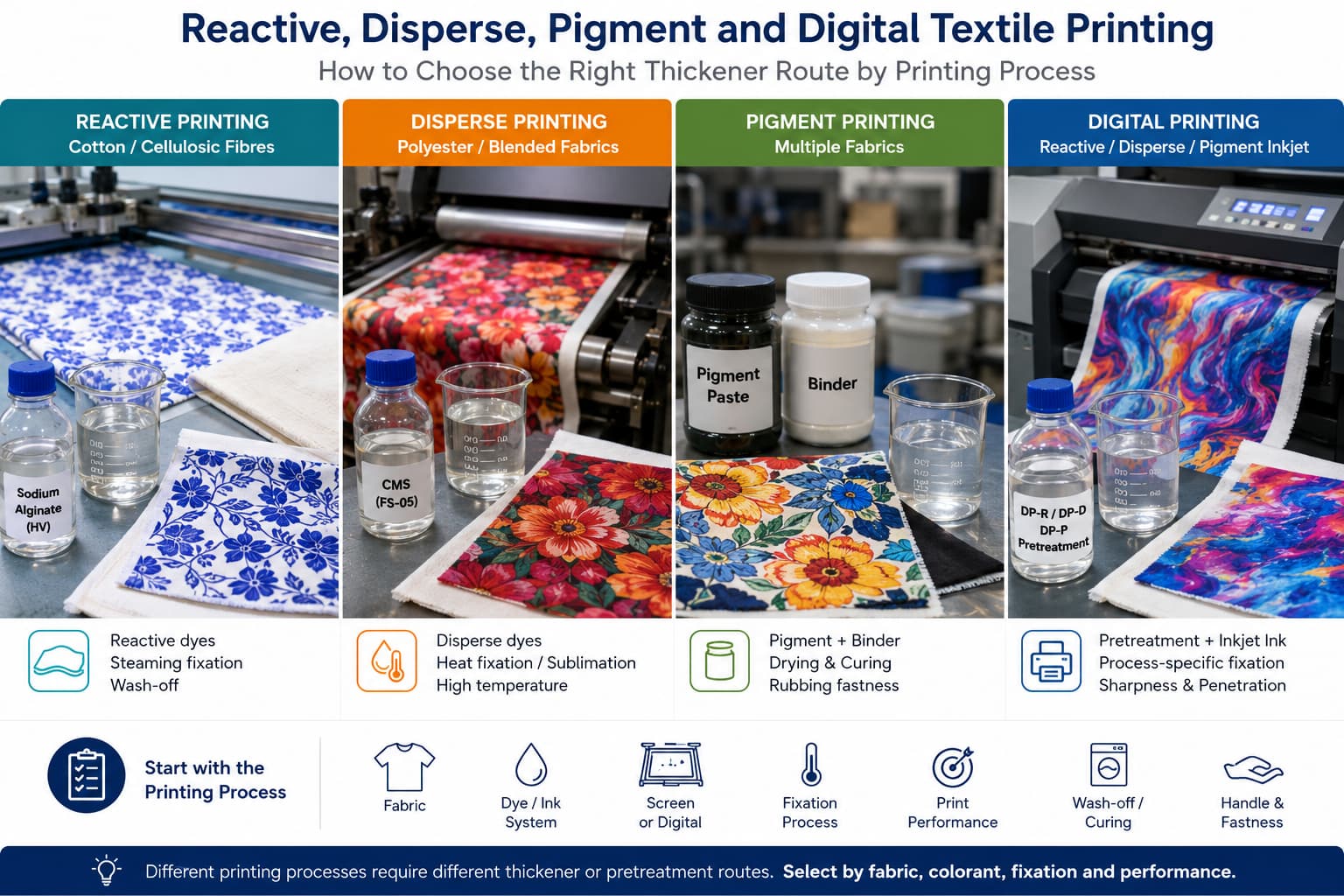
Review Textile Printing Thickener Applications for process-based thickener selection.

How Should a Mill Control Acrylic Thickener Neutralization?

A practical sequence is:

Review TDS → Confirm Neutralizer → Prepare Thickener → Neutralize Gradually → Build pH–Viscosity Curve → Add Pigment → Add Binder → Recheck Viscosity → Hold → Print → Cure → Approve Working Window

The key principles are:

  1. pH controls viscosity development in many alkali-swellable acrylic systems, but the target pH is grade-specific.
  2. Neutralizer identity and addition order can change the result even at similar final pH.
  3. Electrolytes can reduce the viscosity gained through neutralization.
  4. The water activation curve and the complete pigment-paste curve should be treated separately.
  5. Final selection must include screen behavior, curing, rubbing fastness and fabric hand.
  6. The best neutralization point is the most stable operating window—not the highest viscosity point.

Frequently Asked Questions

1. Why does acrylic liquid thickener become much thicker after adding alkali?

In many alkali-swellable acrylic systems, neutralization ionizes carboxylic acid groups, causing the polymer to expand and occupy more hydrodynamic volume, which increases viscosity.

2. What pH should an acrylic pigment-printing thickener reach?

There is no universal target. Start with the commercial grade’s TDS or supplier-defined activation window and validate it in the complete pigment-binder formula.

3. Can I use sodium hydroxide to neutralize every acrylic thickener?

No. Different grades may be designed for different neutralizers. Use the supplier-approved neutralization route and validate compatibility.

4. Why is viscosity still low even though the pH looks correct?

Check active solids, dilution, electrolyte load, pigment dispersion, binder and temperature. pH is only one variable.

5. Why does viscosity drop after pigment is added?

Pigment dispersions can introduce salts, surfactants or pH changes that reduce the expanded polymer structure or alter the complete paste.

6. Why does viscosity drop after binder is added?

Binder can introduce electrolytes, surfactants and pH changes. Test the thickener and binder together rather than relying on water viscosity.

7. Does higher pH always give higher viscosity?

No. Many systems reach a useful plateau, and excessive neutralizer can increase ionic load or create formulation-compatibility problems.

8. Why should I add alkali gradually?

Gradual addition reduces local over-neutralization and helps the polymer swell more uniformly.

9. Should pH be measured immediately after neutralization?

Record the immediate value, but also allow the validated equilibration time before final adjustment because mixing and polymer swelling may continue.

10. Can two acrylic thickeners use the same pH but give different viscosity?

Yes. Polymer architecture, solids, crosslinking and hydrophobic modification can produce very different thickening efficiency at the same pH.

11. Should I choose the pH that gives the maximum Brookfield viscosity?

Not automatically. Choose the range that gives stable complete-paste rheology, screen transfer and finished-fabric performance.

12. What should I send FSX Chemical for pH/neutralization troubleshooting?

Send the current thickener or TDS, dosage, neutralizer, pH, viscosity method, pigment, binder, holding time, machine and the current viscosity or print problem.

Build a Stable pH–Viscosity Window for Your Acrylic Thickener

If your pigment-printing paste develops too little viscosity, over-thickens after neutralization or loses viscosity after pigment or binder addition, FSX Chemical can help structure a controlled pH and complete-paste comparison.

For a useful technical review, send:

  • Your current acrylic thickener sample, TDS or COA
  • Current dosage
  • Neutralizer type and dosage
  • Final paste pH
  • Viscosity and complete test method
  • Pigment dispersion
  • Binder / fixer system
  • Fabric and screen-printing route
  • Holding time
  • Curing conditions
  • Current viscosity, fastness, hand or cost target

Start with Samples & Matching for controlled thickener evaluation.

Review Textile Printing Thickener Applications for process-based route selection.

You can also Request a Factory-Direct Quote after the suitable acrylic thickener and activation window are confirmed or Contact FSX Chemical for technical discussion📧 Email: Service@fsxchemical.com

The right neutralization strategy is not the one that creates the highest viscosity in water. It is the one that gives a stable complete pigment paste, reliable screen rheology and the required fastness and fabric hand under real production conditions.

Quick Contact

Send Your Requirement

or

Free samples · 24h response

Product Inquiry & Support

Send Your Product Requirement

Share the product name, application, quantity, destination and any TDS, sample photo or document you already have. FSX Chemical will review the information and recommend the next step for quotation, sample matching or product selection.

Product Information Product name, grade, model, label photo or supplier reference.
Available Documents TDS, SDS, COA, sample photo, product list or test data.
Order Details Estimated quantity, packaging, destination country, port or trade term.
Application or Issue Textile printing process, formulation need, current issue or target performance.