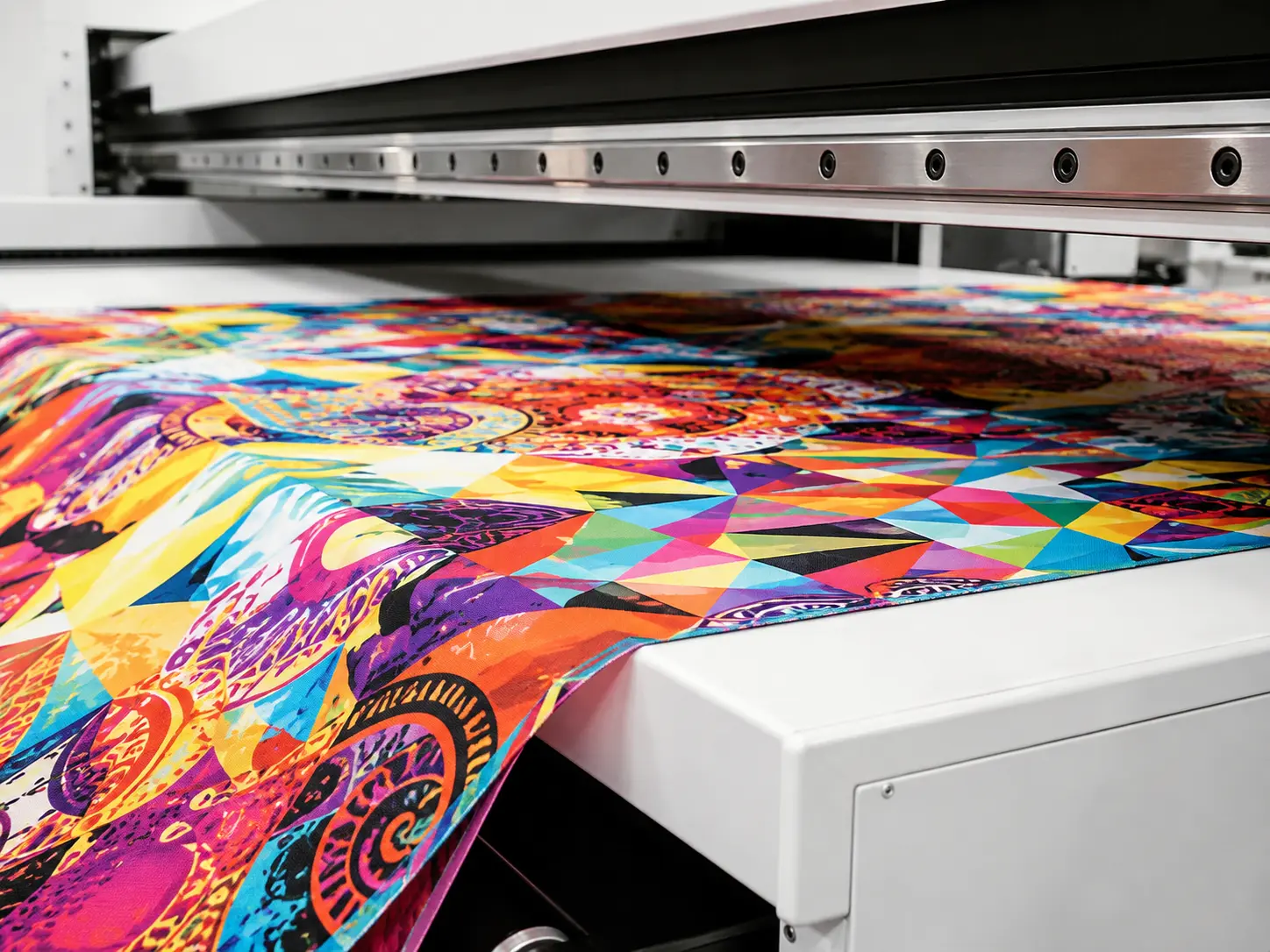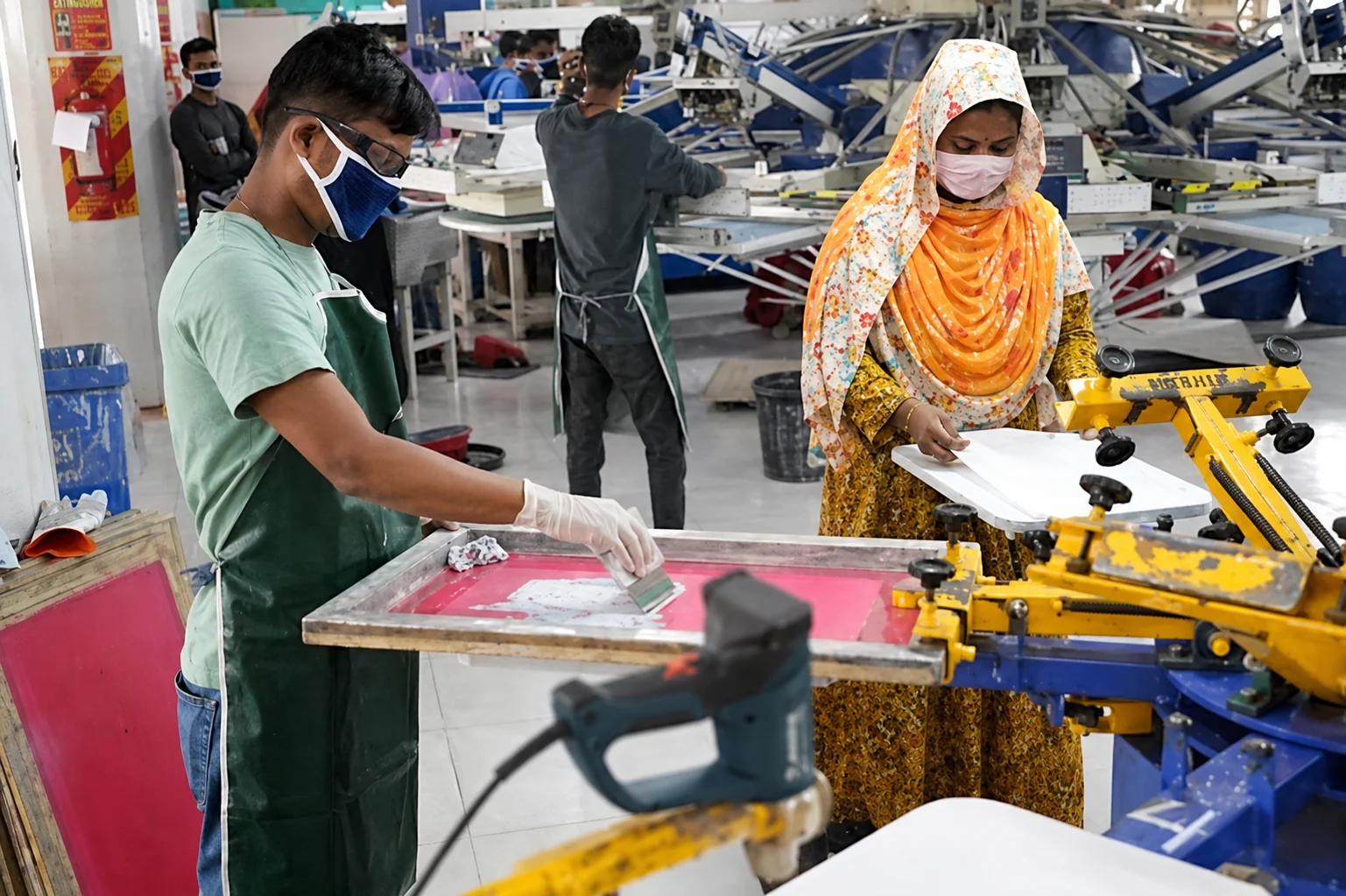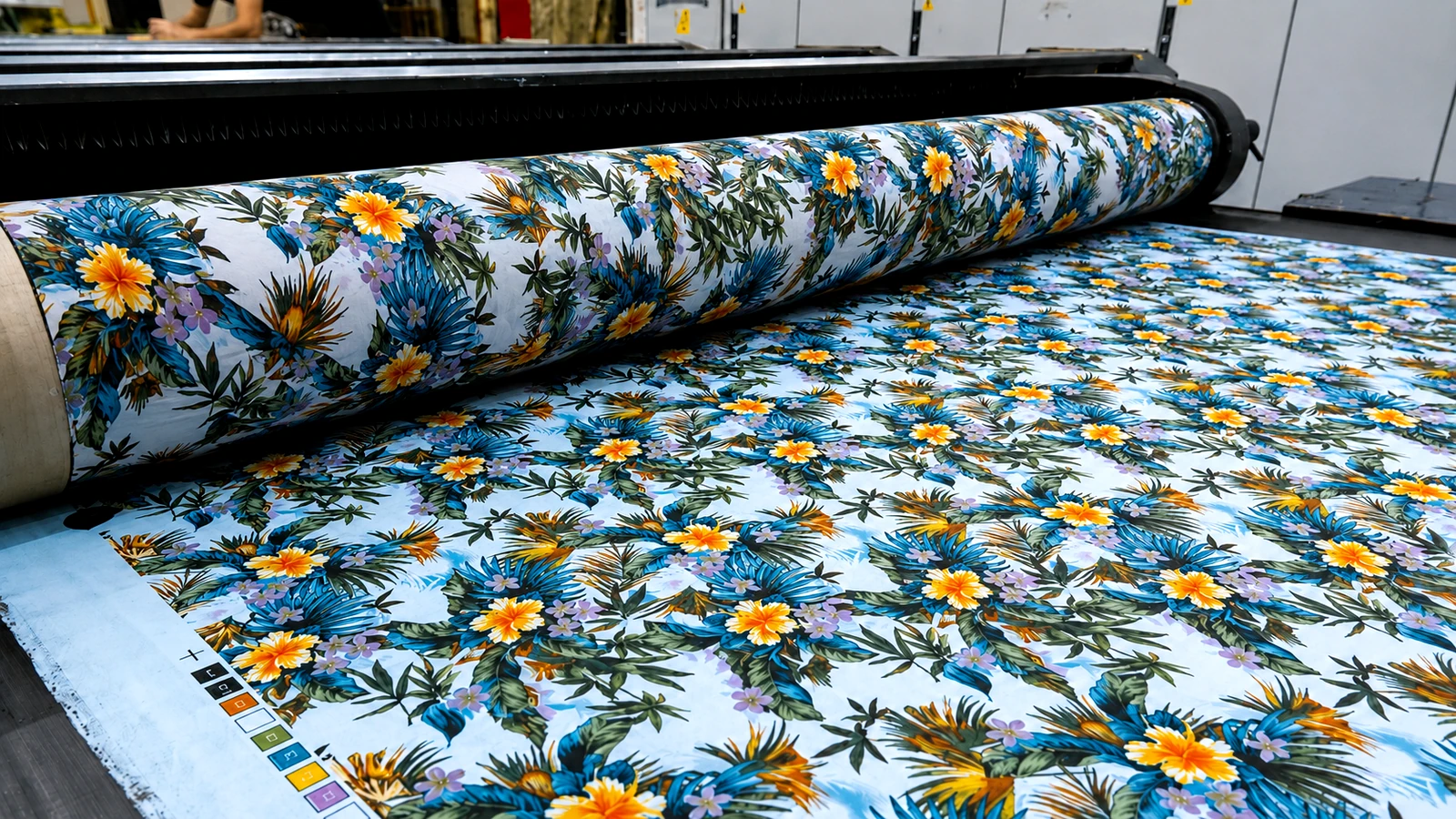















Direct answer: Textile printing performance depends on a coordinated chemical system, not one universal additive. The thickener controls flow and pattern retention; dyes or pigments create color; binders, alkalis, humectants, fixing agents and washing chemicals support the route-specific fixation and final fabric result.
A textile printing formula must be built around the fabric, colorant, printing method and fixation route. The chemical groups below are functional categories, not a recipe to combine in every paste.
The ten groups below are not a universal recipe, and they are not all used together. Their relevance depends on the fabric, dye or pigment, printing method, fixation route, customer specification and local production controls.
How to Use This List
Product names alone are not enough. A valid comparison should connect each chemical to the formula, fabric, machine and quality target in which it will be used.
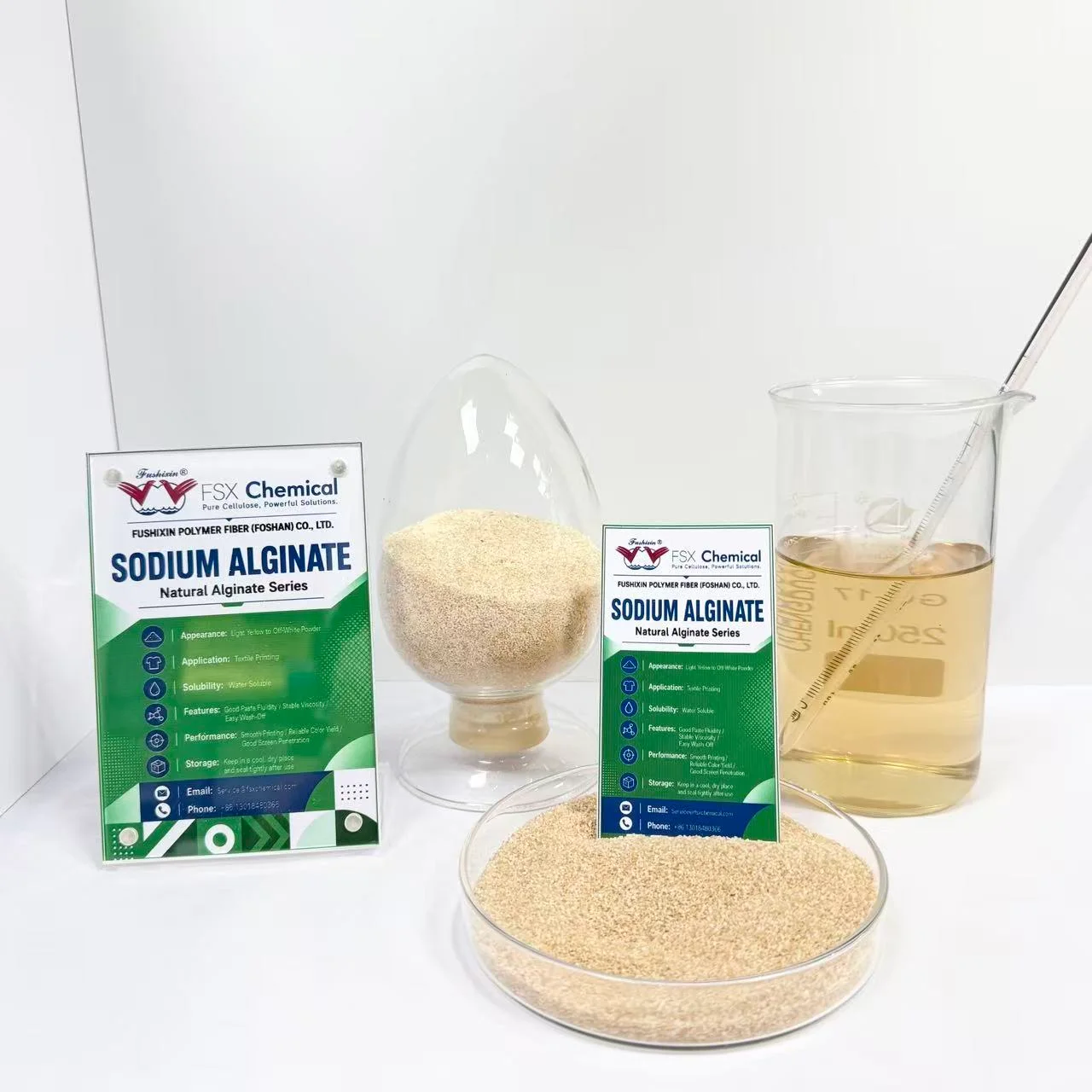
1. Sodium Alginate
Sodium alginate is widely used as a thickener in reactive textile printing, particularly on cotton and viscose. It helps create the viscosity and flow behavior required to transfer the paste and hold the printed pattern before fixation.
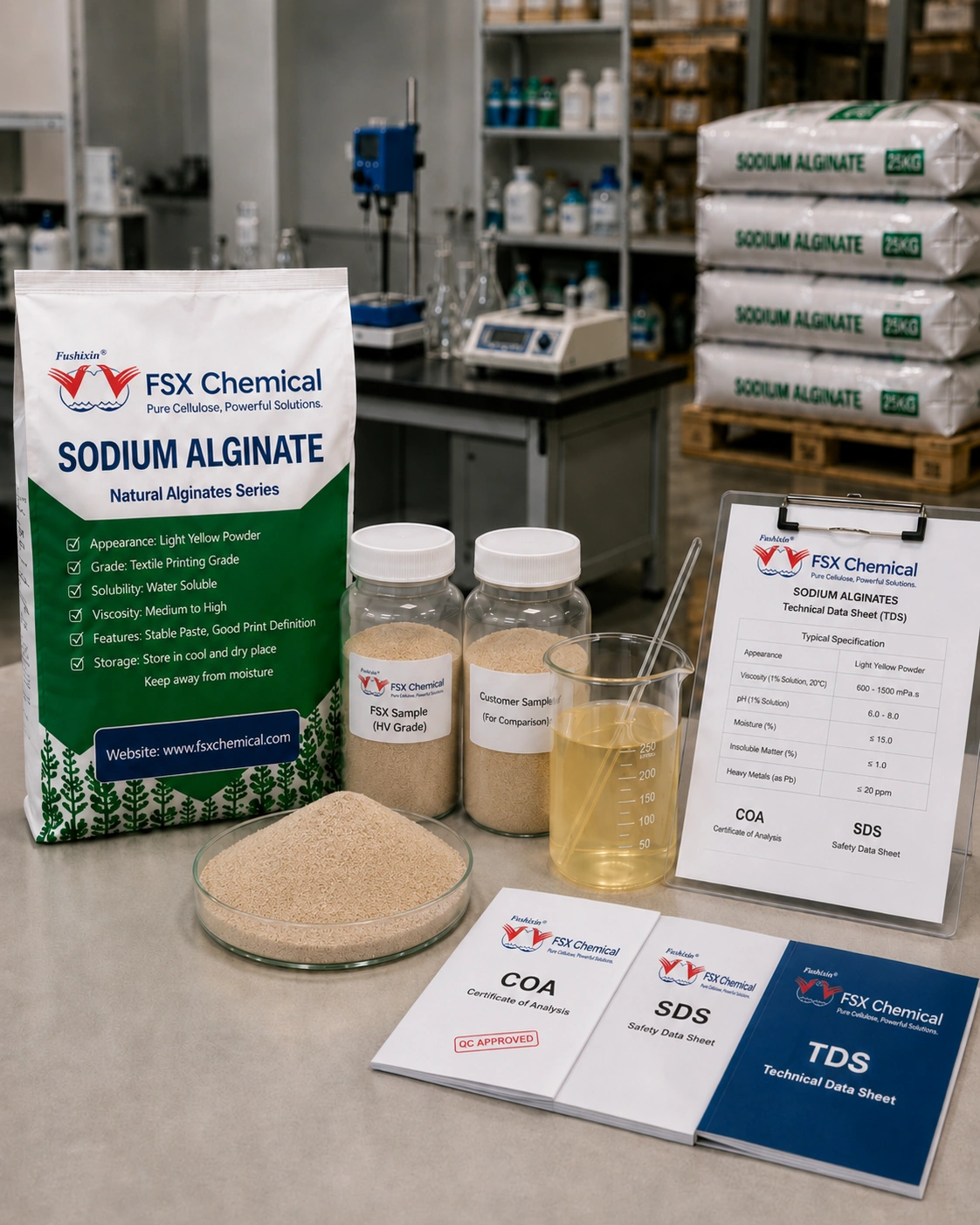
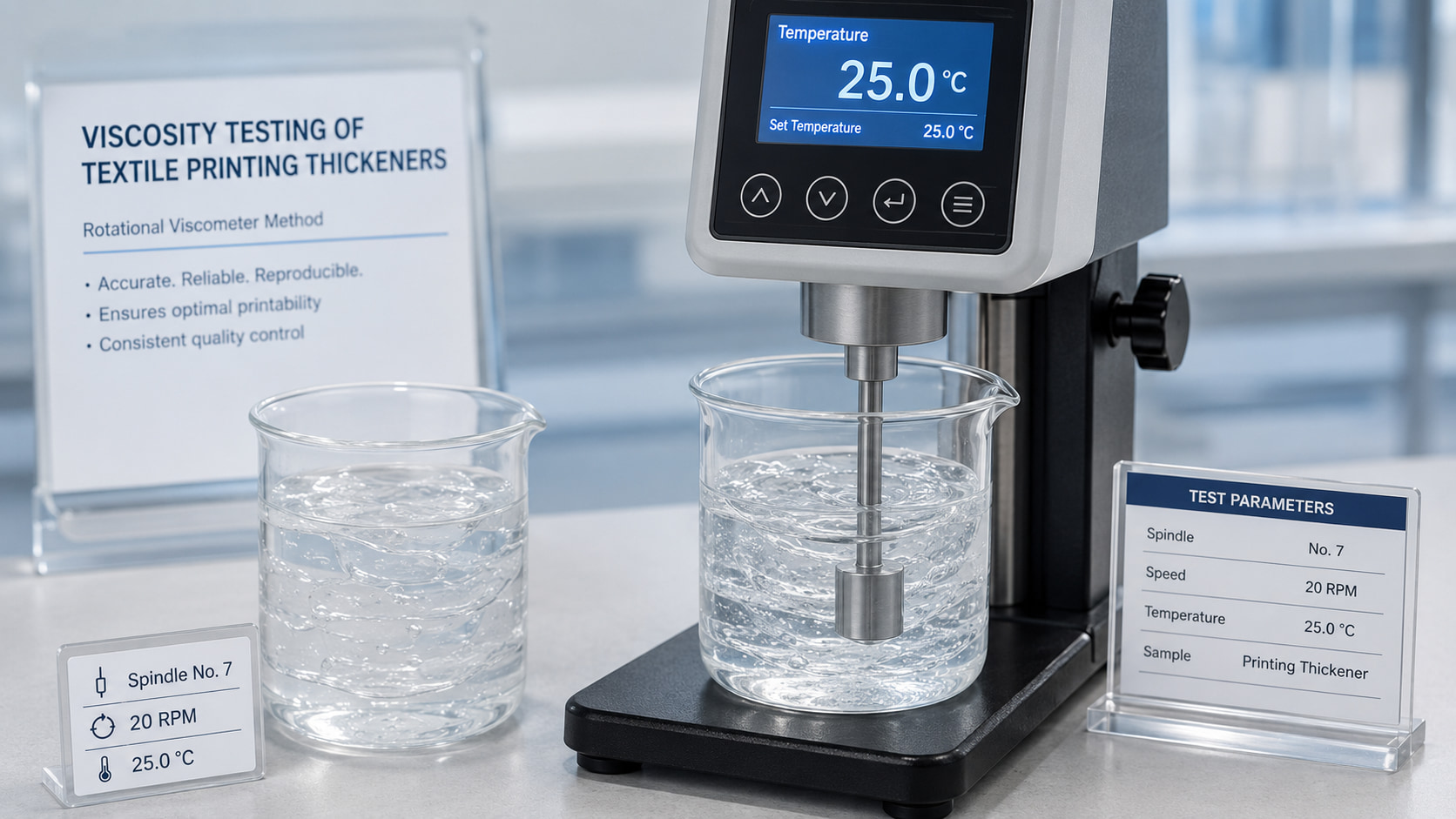
Buyers should compare viscosity using the same concentration and temperature, along with dissolution, filtration, moisture, pH, insoluble matter and batch consistency. Reactive printing performance must still be confirmed with the actual dye, alkali, auxiliaries and washing process.
Procurement focus: Request the TDS, confirm the viscosity test conditions and test the grade for paste preparation, screen behavior, outline and wash-off.
2. Carboxymethyl Starch (CMS)
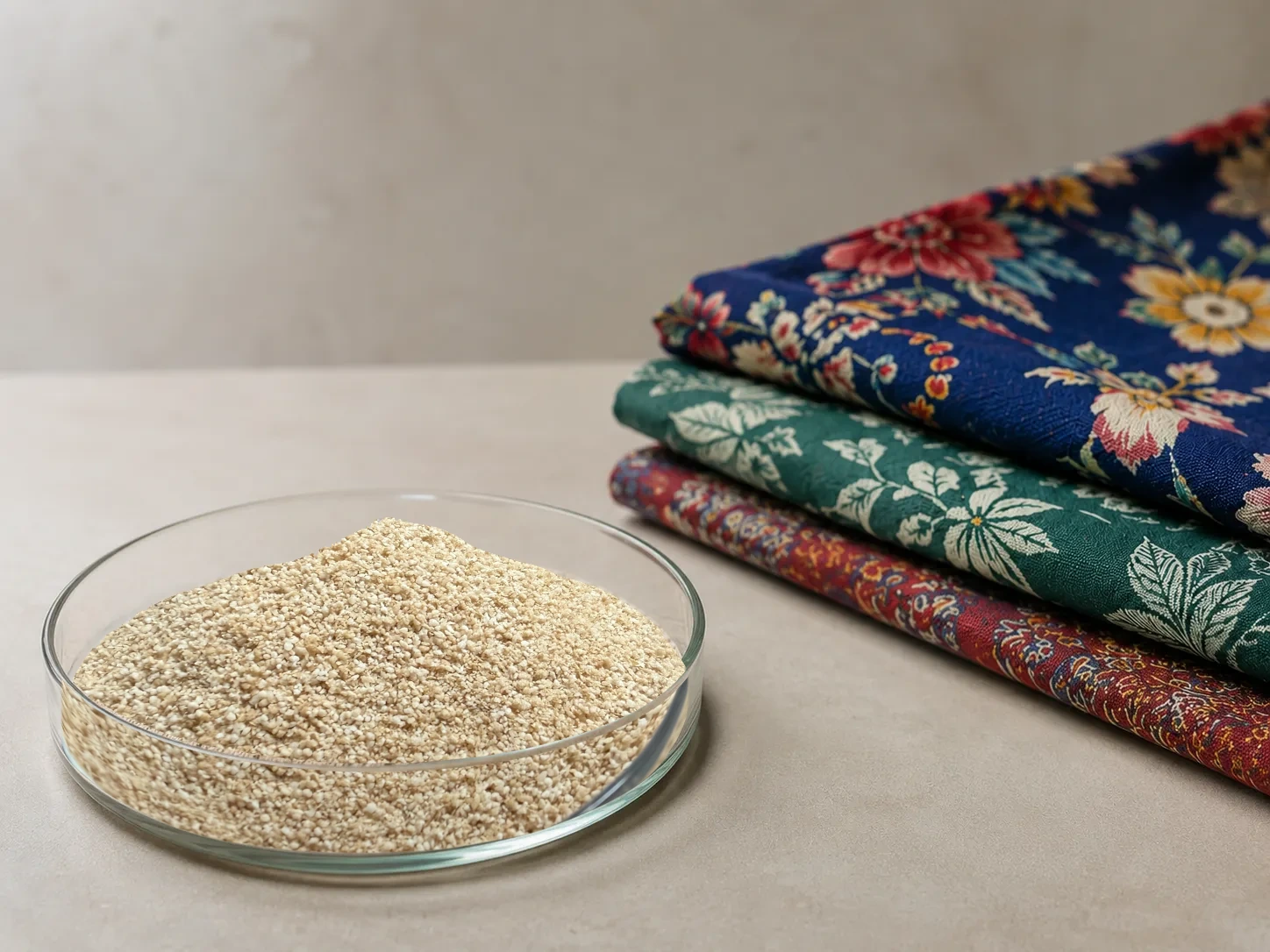
Carboxymethyl starch is a starch-derived thickener route used in selected textile printing systems. Depending on the grade and formulation, it may be evaluated for reactive, disperse, pigment, vat, discharge or compound paste applications.
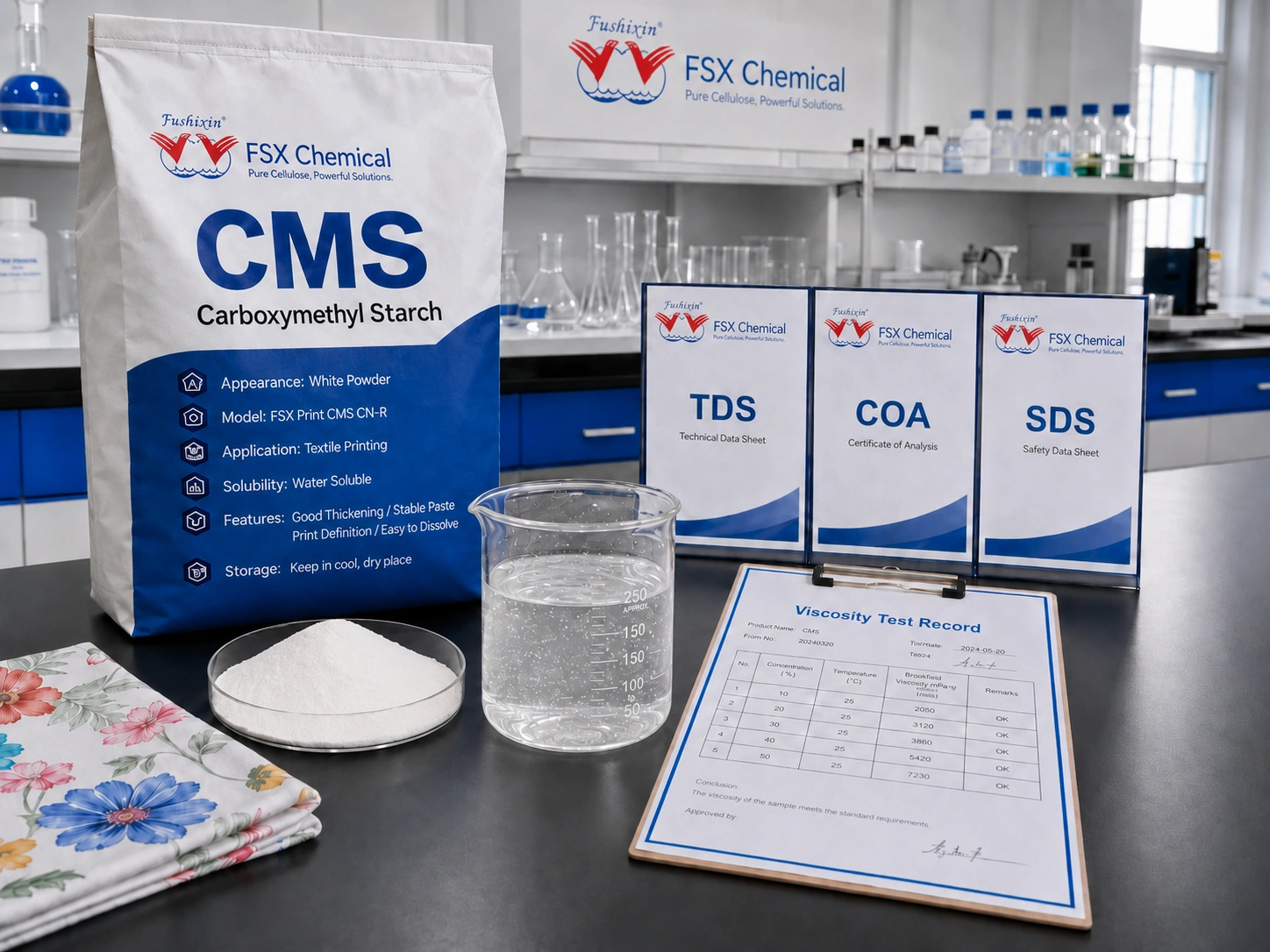
The product must be matched to the process rather than purchased under a generic CMS name. Check viscosity conditions, degree of substitution where specified, solubility or dispersion, paste stability, wash-off and compatibility with the complete formula.
Procurement focus: Ask the supplier to identify the intended printing route on the TDS and provide a grade-specific trial recommendation.
3. Carboxymethyl Cellulose (CMC)
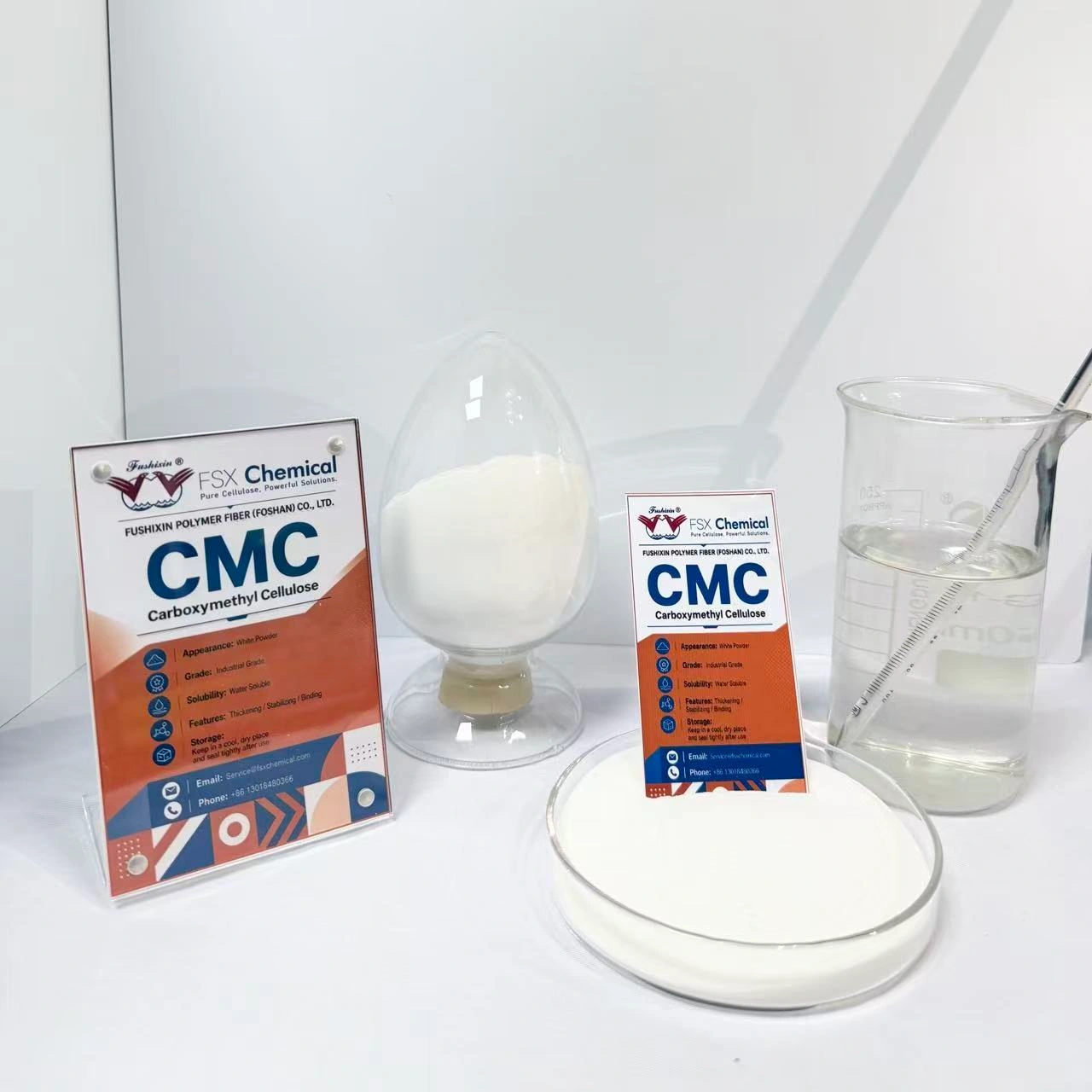
Carboxymethyl cellulose is a cellulose-based rheology modifier used in selected pigment printing formulations, supporting thickener systems, sizing and other industrial applications. It is available in different viscosity, substitution and purity directions.
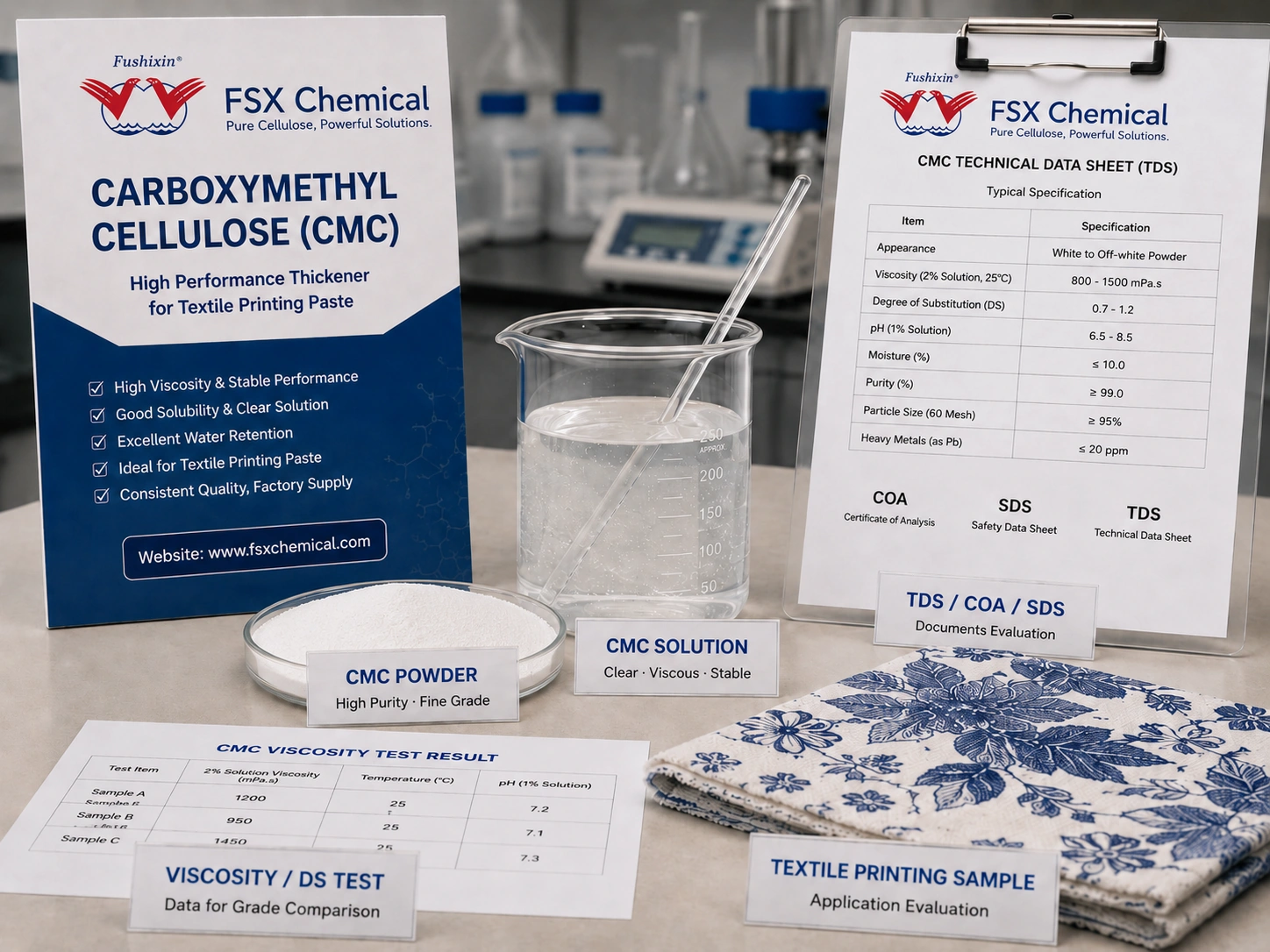
For printing applications, compare degree of substitution, viscosity test method, purity-related specifications, residual salts, dissolution and compatibility with binders, pigments or auxiliaries. Do not assume that a general-purpose CMC is a direct replacement for sodium alginate in reactive printing.
Procurement focus: Identify the exact application and test CMC in the full formula before selecting a bulk grade.
4. Synthetic and Compound Thickeners
Synthetic thickeners and compound systems are often selected for pigment printing and other process-specific applications. They may provide high thickening efficiency or tailored rheology, but their response can change with salts, pH, binders and other formulation components.
A compound thickener may combine materials to balance viscosity, print definition, wash-off or cost-in-use. The formulation and performance basis should be clear enough for the buyer to reproduce the supplier’s test.
Procurement focus: Compare performance at equivalent target paste behavior, not only at equal dosage or headline unit price.
5. Dyes and Pigments
The colorant defines much of the printing chemistry. Reactive dyes form chemical bonds with suitable fibres under controlled fixation conditions; disperse dyes are used mainly for polyester; acid dyes are used for selected protein and polyamide fibres; pigments require a binder because they do not have inherent fibre affinity.
Colorant selection affects pH, thickener compatibility, fixation, washing and the required auxiliaries. Buyers should confirm shade strength, dispersion or solubility, batch consistency and any customer-specific restricted-substance requirements.
Procurement focus: Never evaluate a thickener without identifying the actual dye or pigment system.
6. Pigment Binders
Binders form a film that holds pigment particles on the fabric surface after curing. Binder chemistry influences adhesion, rubbing performance, fabric handle, curing conditions and compatibility with the thickener and other auxiliaries.
A stronger film is not automatically better if it produces an unacceptable handle or requires unsuitable curing conditions. Compare the binder in the complete pigment paste and on the actual fabric.
Procurement focus: Request application guidance, storage information and evidence relevant to any restricted-substance or formaldehyde claim.
7. Fixing and Crosslinking Agents
Fixing or crosslinking agents may be used to support fixation, durability or binder-film performance in selected systems. The chemical type and requirement vary widely between reactive, pigment, acid and other printing routes.
Incorrect selection or curing can affect shade, handle, fastness and process safety. Any compliance, low-formaldehyde or formaldehyde-free statement should be supported by documentation that applies to the exact product and test method.
Procurement focus: Confirm the intended chemistry, addition point, curing conditions, storage and compatibility with the full formulation.
8. Alkalis and pH-Control Chemicals
Alkalis and pH-control chemicals create the chemical conditions required for selected dye reactions and paste stability. Sodium carbonate, bicarbonate and other pH-control materials may be used according to the dye class and fixation route.
The correct type and amount depend on the recipe. Excess or uneven alkali can contribute to paste instability, shade variation or unwanted reaction before printing, while insufficient alkali can limit the intended fixation response.
Procurement focus: Follow the dye and process recommendation, control purity and handling, and verify the paste pH under production conditions.
9. Humectants and Moisture-Control Agents
Humectants help manage moisture during paste storage, printing and fixation. Urea is used in some textile printing systems, particularly where moisture retention or dye solubility is important, but its use is process- and market-dependent.
Digital and conventional printing may require different moisture-control strategies. A change in humectant can affect viscosity, drying, print definition, fixation and wastewater characteristics, so substitutions should be trialled rather than assumed equivalent.
Procurement focus: Confirm function, purity, handling, dosage direction and any customer or environmental requirements before use.
10. Washing-Off and Soaping Agents
After fixation, washing-off and soaping agents help remove unfixed colorant, residual thickener and other paste components. The washing sequence has a direct influence on the final shade, handle and fastness result.
The right agent depends on the dye class, fabric, water quality, temperature and equipment. Evaluate cleaning efficiency, redeposition risk, foam, rinsing demand and compatibility with the mill’s wastewater process.
Procurement focus: Request a process-specific recommendation and validate it against the existing washing sequence before changing production.
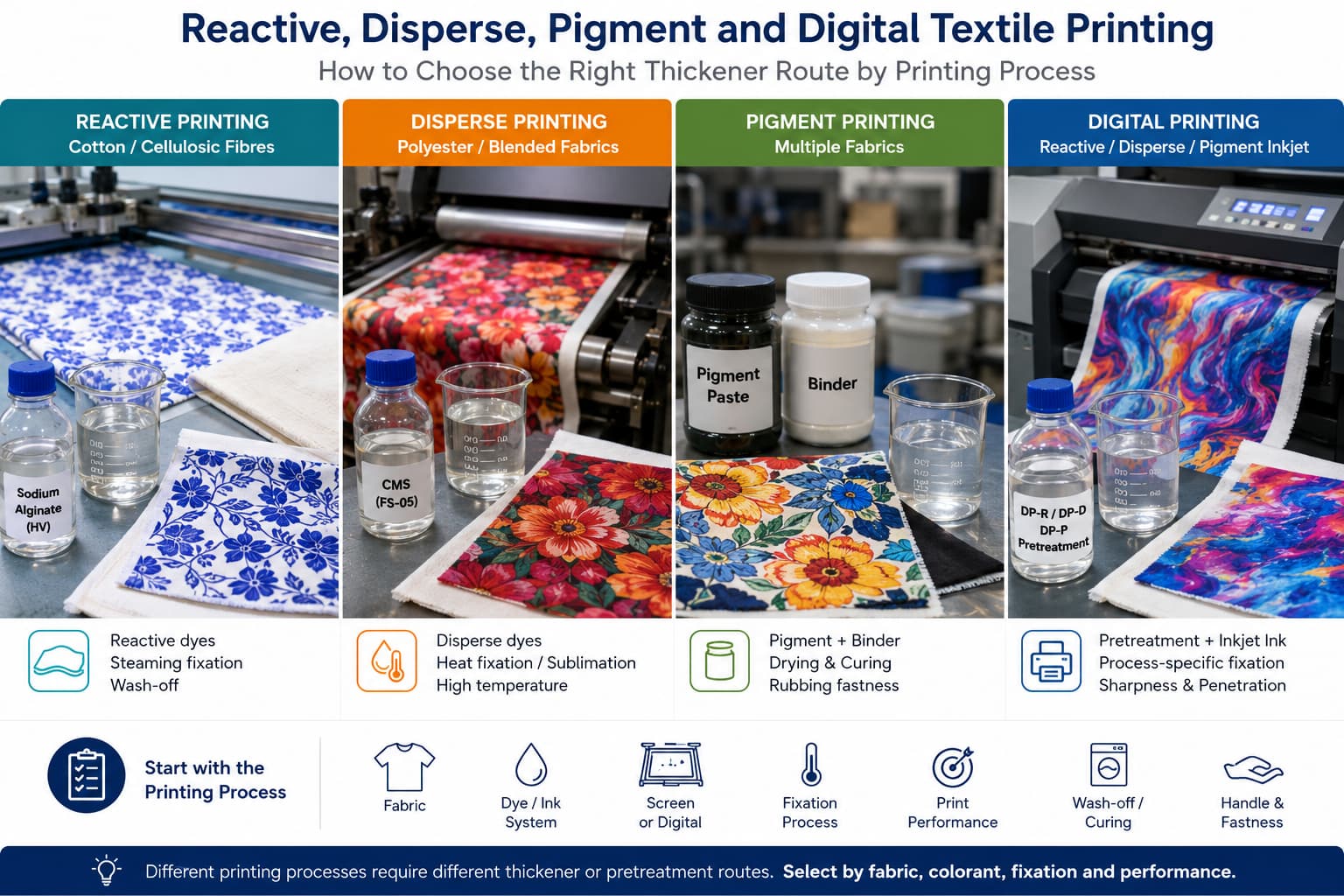
Process-Based Selection Map
| Printing route | Core chemical functions | Main purchasing questions |
|---|---|---|
| Reactive printing | Reactive dye, compatible thickener, alkali, moisture control and washing-off system | Are paste viscosity, dye compatibility, fixation and wash-off confirmed in the same process? |
| Pigment printing | Pigment, binder, thickener, optional crosslinker and supporting auxiliaries | Does the full system balance print definition, adhesion, rubbing performance, curing and handle? |
| Disperse printing | Disperse colorant, process-specific thickener and post-treatment system | Is the grade suitable for polyester, the fixation route and the required residue or handle result? |
| Acid printing | Acid dye, application-specific thickener, pH control and washing system | Are fibre type, dye class, pH, fixation and wash-off evaluated together? |
| Digital pretreatment | Dedicated pretreatment, moisture control and ink or fabric compatibility components | Are filtration, coating uniformity, storage stability, definition and ink response verified? |
Supporting Auxiliaries May Also Be Required
Wetting agents, penetrating agents, defoamers, sequestering agents, dispersants, preservatives and other auxiliaries can be important in specific formulations. They are not included as separate items in this top-ten overview because their need depends heavily on water quality, machine design, storage time and the other chemicals in the recipe.
Treat every auxiliary as part of the formulation system. A small change can alter foam, viscosity, dispersion, penetration or storage stability, so it should be introduced through a controlled comparison.
What Procurement Teams Should Request
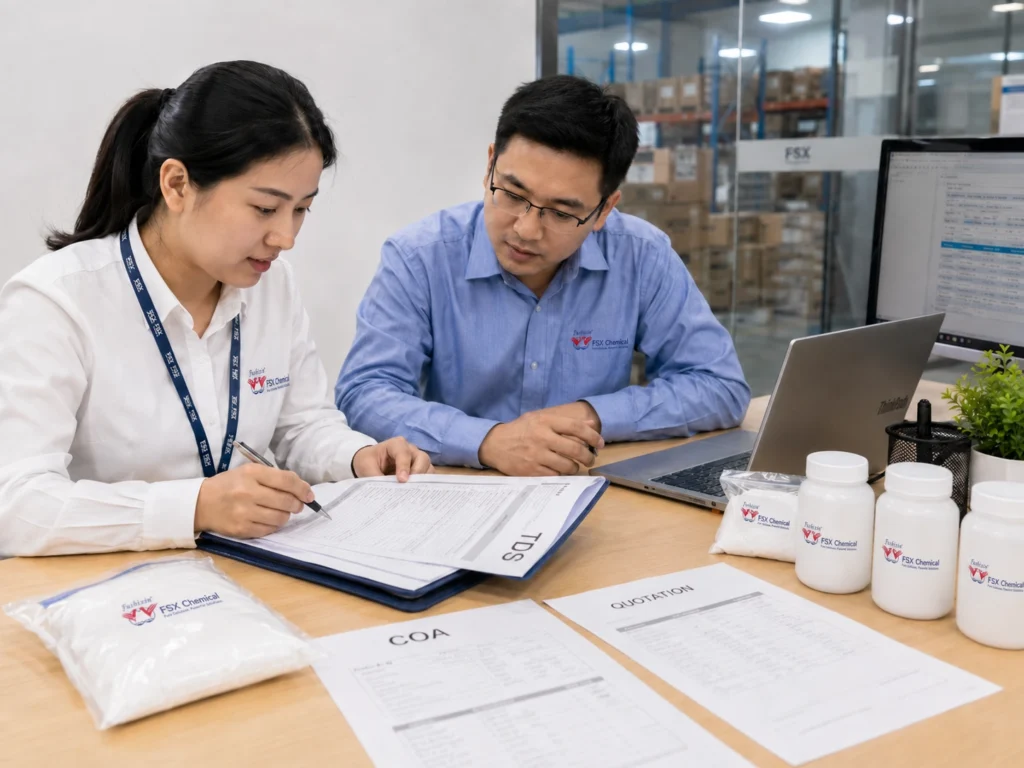
- TDS with application scope, specifications and test methods
- SDS with handling, storage and transport information
- Batch-specific COA for parameters agreed in the purchase specification
- Sample or trial quantity appropriate to the laboratory and pilot process
- Recommended preparation sequence and starting-use direction, clearly identified as a trial reference
- Compatibility information for the relevant dye, pigment, binder, alkali and auxiliaries
- Shelf-life, packaging, batch code and traceability information
- Supporting evidence for any certification, compliance or environmental claim
Evaluate the Formula as a System
Changing one textile printing chemical can affect several downstream results. A lower-cost thickener may require a different concentration, a binder change may alter rheology and handle, and an auxiliary substitution may change foam or storage stability.
For a fair comparison, define the current benchmark, keep preparation conditions controlled and change one variable at a time. Evaluate both the paste and the final printed fabric before approving the material for bulk production.
Textile Printing Chemicals FAQ
Are all ten chemical groups used in one printing formula?
No. The required functions depend on the dye or pigment, fabric, printing method, fixation and washing route. Adding an unnecessary auxiliary can increase incompatibility, cost, residues or process variability.
What is the difference between a thickener and a pigment binder?
A thickener controls paste rheology, transfer and pattern hold. A pigment binder forms the film that attaches insoluble pigment to the fabric after curing. They perform different functions, although both must be compatible in a pigment-printing formulation.
Why do reactive and pigment printing use different chemical systems?
Reactive dyes chemically bond with suitable fibres under controlled alkali, moisture and fixation conditions, followed by washing. Pigments do not react with the fibre and normally require a binder film and curing. Thickener and auxiliary selection must follow that different chemistry.
What should a buyer provide before requesting a chemical recommendation?
Provide the fabric, dye or pigment system, rotary, flat-screen or digital method, exact product addition point, current formula and dosage, viscosity test method, fixation and washing route, monthly quantity and the production problem to be solved.
How FSX Chemical Can Support Product Selection
Build a Chemical and Grade Shortlist
Send your printing process, fabric, dye or pigment system, current formula or TDS, target viscosity and main production issue. FSX Chemical can review which product family and trial route should be considered before you request a quotation or bulk order📧 Email: Service@fsxchemical.com