How Paste Age and Holding Time Affect Textile Printing Viscosity and Color Consistency
Printing paste can become thicker, thinner or rheologically different as it ages. Mills should track...
Printing paste does not remain chemically and rheologically unchanged after preparation. As holding time increases, viscosity may rise, fall or drift irregularly depending on thickener hydration, shear history, temperature, evaporation, electrolyte level, pH, microbial activity and the complete dye or pigment formulation. At the same time, color chemistry can age even when viscosity looks stable—for example, reactive dye can hydrolyze during alkaline holding, while disperse or pigment systems can develop dispersion, binder or compatibility changes. This guide shows textile mills how to build a controlled paste-age curve, define an approved working window, and separate rheological aging from color-chemistry aging before production consistency is lost.
Why Paste Age Matters in Textile Printing
Printing paste starts aging as soon as it is prepared.
The word “aging” does not automatically mean degradation. It simply means that the paste has spent more time after mixing, hydration or chemical activation.
During that time, several things can change:
Polymer hydration can continue.
Polymer structure can recover after mixing shear.
Temperature can move toward room or machine temperature.
Water can evaporate.
Dye or auxiliary chemistry can change.
Electrolyte and pH effects can continue to equilibrate.
Microbial activity can appear during longer storage.
Published reactive-printing rheology research shows that printing thickeners can have different transient and recovery behavior even when their steady viscosity looks similar. Some materials require more time to rebuild structure after shear, which means measurement timing itself can alter the result.
At the production level, this matters because viscosity stability affects paste transfer and color consistency from the beginning to the end of a run.
The correct question is therefore:
How long does this specific paste remain inside the mill’s approved rheology and color window?
Two Different Aging Paths: Rheology vs. Color Chemistry
A printing paste can age in two different ways.
Rheological Aging
This includes changes in:
В’язкість
Shear thinning
Еластичність
Відновлення конструкції
Частинки гелю
Phase separation
Color-Chemistry Aging
This includes changes in:
Reactive dye hydrolysis
Dye dispersion stability
Pigment/binder compatibility
pH-dependent color chemistry
Auxiliary activity
These two aging paths can occur independently.
A paste can keep nearly the same viscosity but give lower K/S after several hours.
Or a paste can change viscosity while the final shade remains acceptable.
Stable viscosity does not prove stable color chemistry.
Stable color does not prove stable rheology.
Paste Does Not Always Become Thinner with Time
A common assumption is:
Longer storage → lower viscosity.
This is not universally correct.
Some hydrocolloid systems can show an initial viscosity increase as hydration, swelling or molecular organization continues after preparation.
Published studies on reactive printing pastes have reported increasing apparent viscosity during storage for some natural and synthetic thickener systems, especially during the first part of the storage period.
Other systems can show progressive viscosity loss because of:
Polymer degradation
High temperature
Strong pH
Mechanical shear
Electrolyte interaction
Microbial activity
Отже:
The mill should measure the time curve instead of assuming its direction.
1. Continued Hydration and Structural Development
Some thickeners do not reach their final rheological state immediately after mixing.
Possible reasons include:
Slow water penetration into polymer particles
Continued chain expansion
Delayed dissolution
Structural rebuilding after mixing
If viscosity rises during the first one or two hours and then stabilizes, the initial reading may have been taken before full equilibration.
This can create a production problem if operators:
Prepare paste
Measure immediately
Add extra thickener because the first reading is low
Then discover the paste becomes too thick later
The correct solution is to define a standard hydration and rest time before the QC viscosity reading.
2. Shear History and Structural Recovery
Printing pastes are often shear-thinning and can also be thixotropic.
High-speed mixing, pumping or circulation can temporarily reduce apparent viscosity.
After shear stops, the paste may recover gradually.
Research comparing sodium alginate and xanthan printing pastes shows that different thickeners can recover at different rates after shear and can show very different viscoelastic behavior at the same concentration.
This means:
Record elapsed time from paste preparation and, for alkaline reactive paste, from alkali addition. Record the last major shear event and subsequent rest time separately when comparing rheology; mixing again does not reset chemical age.
For example, compare:
Immediately after high-speed mixing
After 10–15 minutes rest
After one hour
If the paste recovers, the first low reading was not necessarily chemical degradation.
3. Temperature Drift
Viscosity is temperature-sensitive.
A paste prepared with warm dye solution or strong mixing may initially be warmer than the QC laboratory.
During holding, the paste cools.
That cooling alone can make viscosity appear to increase with age.
The reverse can occur in a hot production area where the paste warms during the shift.
Always record:
Paste temperature
Температура вимірювання
Storage temperature
A holding-time curve without temperature control can mistake thermal drift for chemical aging.
4. Evaporation and Concentration Increase
Open tanks, warm rooms and long holding periods can allow water to evaporate.
This raises the effective concentration of:
Thickener
Dye
Salt
Alkali
Папка
Possible symptoms include:
Viscosity increase
Darker paste appearance
Higher conductivity
Different screen transfer
Rotary and continuous machine systems can also lose water during long circulation.
Keep paste covered where practical and compare mass before and after long holding if evaporation is suspected.
Do not automatically add water without recording the correction because that changes the formula.
5. Electrolyte, pH and Formula Interaction
Salt, alkali and dye packages can continue to influence polymer conformation after mixing.
Sodium alginate and CMC are anionic thickeners whose behavior can depend on the following conditions. For an FSX CMS commercial synthetic thickener, confirm the exact grade’s ionic character and compatibility in its current TDS rather than inferring chemistry from the family name:
Monovalent electrolytes
Calcium and magnesium
pH
Alkali identity
Dye-associated salts
Some viscosity changes occur immediately; others become more visible after equilibration.
A paste can remain printable in the beaker but change during long circulation on a rotary machine.
Therefore, evaluate:
Fresh paste
Паста «Held»
Mid-run paste
End-run paste
Then compare thermal fixation and final K/S after the same process.
Pigment Printing: Binder, Thickener and Dispersion Stability
Pigment printing is a multi-component system containing pigment dispersion, binder, thickener, fixer and auxiliaries.
Holding time can affect:
В’язкість
Neutralization state of synthetic thickener
Чутливість до електролітів
Пігментна дисперсія
Сумісність з палітурками
Піна
A paste that thickens during storage may deposit more binder and pigment than intended.
A paste that thins may penetrate differently or give poor definition.
Final evaluation should include:
K/S
Стійкість до тертя
Тканина ручної роботи
Отвердіння
not only stored viscosity.
Stock Paste Age vs. Complete Color Paste Age
These two storage questions should be kept separate.
Stock Thickening
Contains mainly thickener and water, sometimes preservation or supporting auxiliaries.
Its aging mainly reflects:
Гідратація
Polymer stability
Microbial stability
Температура
Complete Color Paste
Adds dye/pigment, salt, alkali, binder, dispersants and other chemicals.
Its aging reflects:
Stock-thickener behavior
Formula compatibility
Dye chemistry
Реакція електролітів
Holding-time reactions
A stock paste that is stable for days does not prove the completed color paste has the same usable life.
Build a Fresh-Paste Baseline First
Before studying age, establish a controlled fresh reference.
Запис:
Thickener grade and batch
Концентрація
Вода
Mixing method
Час гідратації
Formula
Температура
Viscosity method
pH
Fresh K/S / shade
Define the fresh-reference time zero explicitly and retain the actual preparation and alkali-addition timestamps. Taking a baseline reading does not reset chemical age.
Without this baseline, an old paste can only be compared with memory or a different batch.
How to Build a Timed Holding Curve
A practical holding study can use:
0 h
2 h
4 h
8 h
End of expected shift
Longer storage point only if the mill actually plans to hold paste longer
These are study-design examples, not universal paste-life limits.
Keep the samples under the real intended storage condition:
Covered or open
Room temperature
Controlled cooling
Production color kitchen
Do not store laboratory samples in ideal conditions if production paste is held in a hot open tank.
What to Measure at Every Time Point
Measurement
Why It Matters
В’язкість
Tracks rheological drift
Температура
Separates thermal effect from aging
pH
Tracks chemical drift
Зовнішній вигляд
Finds separation, gels, foam or contamination
Поведінка екрана
Shows application performance
K/S / відтінок
Tracks color consistency
Wash-off / fastness
Checks finished performance
For reactive systems, add:
Time since alkali addition
White-ground cleanliness
Wash-water color where useful
For pigment systems, add:
Стійкість до тертя
Тканина ручної роботи
How Paste Age Changes Screen Running
Even a moderate viscosity change can alter:
Paste feed
Уривок з фільму
Вимоги до тиску скребка
Pattern definition
Проникнення
Рівномірність по всій площі
If paste becomes thicker with age, operators may increase pressure or add water.
If paste becomes thinner, they may add thickener.
Both corrections change the approved formula.
A better approach is to define the viscosity band and maximum paste age before production starts.
How Paste Age Changes Color Consistency
Color consistency can change through two paths.
Rheology Path
Paste age changes deposit or penetration.
This changes the quantity and distribution of colorant on the fabric.
Chemistry Path
Dye or binder chemistry changes during holding.
This changes fixation, final K/S or fastness even if deposit stays similar.
Therefore, a useful color-aging test prints every time point on:
The same fabric lot
The same screen
The same machine setting
The same fixation
The same washing / curing process
This separates paste age from process variation.
Why Dark and Light Shades May Need Different Holding Limits
A color kitchen may use one base paste but prepare different dye loadings.
Dark shades can differ from light shades in:
Dye concentration
Salt load
Dissolution water
Auxiliary level
Heat introduced during dye dissolution
Therefore, one holding-time study on a light shade may not predict a heavy dark paste.
Use at least:
One representative light shade
One medium shade
One heavy/dark shade
when developing a general production window.
Paste Age During the Production Run
Paste age continues after the machine starts.
For continuous printing, the paste at the end of the run may be much older than the paste at the beginning.
It may also experience:
Зсувне навантаження насоса
Тираж
Air incorporation
Temperature rise
Evaporation
Sample at:
Machine start
Mid-run
End-run
Потім порівняйте:
В’язкість
Температура
Print appearance
K/S
Поведінка екрана
This determines whether the approved pot life survives the actual machine environment.
Can Leftover Printing Paste Be Reused?
There is no universal answer.
Leftover stock thickening and leftover complete color paste should not be treated the same.
Before reuse, check:
Age
Storage temperature
Whether alkali is already present
В’язкість
pH
Odor / contamination
Розлучення
Color performance
For reactive dye paste containing alkali, reuse risk can be higher because dye reactivity may already have declined.
For pigment or disperse systems, dispersion or binder compatibility may be the limiting factor.
Do not blend old paste into fresh paste without recording the ratio and validating the result.
How to Define the Mill’s Approved Working Window
Validate a working window that remains acceptable from the fresh baseline, using defined test intervals and representative holding and production conditions. Set its upper limit at or below the last validated passing time before the first failed criterion. Do not infer that untested intervals are safe or use an isolated later passing result to extend the window across a failure.
Define limits for:
В’язкість
pH
Зовнішній вигляд
Screen running
K/S / відтінок
Wash-off / fastness
The approved maximum paste age should be:
A validated upper limit within the passing window from the fresh baseline, at or below the last passing time before the first failed critical requirement.
It should not be:
“The paste still looks usable.”
Nor:
“The supplier says it can store for one day.”
Build the window from the mill’s own formula, temperature and production route.
Dye loading, salts, dissolution water, temperature
All shades share one pot life
Production QC and Traceability
A practical paste-aging record should include:
Paste batch ID
Preparation time
Thickener batch
Formula version
Dye/pigment lot
Alkali addition time
Storage temperature
Viscosity at defined time points
pH
Machine start time
Machine end time
End-run viscosity
Finished shade / K/S
Corrective additions
This record allows the mill to correlate shade complaints with actual paste age instead of guessing afterward.
Загальна вартість експлуатації
Paste age affects cost through:
Unused paste disposal
Rework
Shade correction
Extra thickener or water additions
Machine stoppage
Additional washing
Rejected fabric
A useful model is:
Cost per accepted m² = total allocated monetary cost of materials, preparation, storage and handling, printing, post-treatment and rework ÷ accepted finished-fabric area (m²). Compare batch sizes or holding schedules within the same production boundary, currency and finished-shade acceptance criteria.
Price actual as-supplied material consumption using delivered unit prices, and convert preparation, storage, handling and machine time using defined rates. Use measured energy consumption and its unit price where relevant. Keep batch size, paste age, machine efficiency and stoppage duration as separate operating metrics unless their monetary allocation is documented.
Avoid overlapping time charges. If discarded or rejected paste is already included in consumed materials, do not add its material value again; count any additional rework or disposal service charge once.
Large batches may reduce preparation labor yet increase aged-paste disposal or shade risk; small batches can reverse that trade-off. The target is a batch size inside the validated working window that meets final quality requirements at a stable cost per accepted m². Report any estimated lost-capacity or lost-margin effect separately from the production-cost calculation.
Яку інформацію слід надіслати постачальнику загущувачів?
If paste age is affecting viscosity or color consistency, send:
Current thickener grade/TDS/sample
Stock concentration
В'язкість та повна методика випробувань
Джерело води
Mixing/hydration method
Complete or simplified formula
Dye / pigment / binder system
Salt and alkali
Time of alkali addition
Storage temperature
Holding-time sequence
Viscosity at each time point
Machine type and run length
Fresh vs. aged K/S / shade result
Current defect
Компанія FSX Chemical може використовувати цю інформацію за допомогою Зразки та підбір to compare holding stability and determine whether the next trial should focus on thickener grade, formulation, mixing or paste-management procedure.
How Should a Mill Control Paste Age?
Практичний алгоритм дій такий:
Fresh Baseline → Timed Hold Curve → Rheology + Color Check → Machine-Run Check → Define Maximum Working Age → Record Every Production Batch
Основними принципами є:
Paste age can increase, decrease or destabilize viscosity depending on the system.
Rheological aging and color-chemistry aging must be measured separately.
Reactive paste can lose color performance even while viscosity remains stable.
Temperature, evaporation and shear history can imitate chemical aging.
Stock thickening and complete color paste need different holding limits.
The approved holding time should be the longest validated time that still passes viscosity, screen, shade and finished-fabric requirements.
Поширені запитання
1. Does printing paste always lose viscosity as it gets older?
No. Some pastes initially gain viscosity because hydration or structural recovery continues. Others lose viscosity because of heat, shear, chemical instability or microbial degradation.
2. Why does paste become thicker after standing?
Possible causes include continued hydration, structural recovery after shear, cooling or water evaporation.
3. Why does paste become thinner during storage?
Possible causes include polymer degradation, prolonged shear, high temperature, pH/electrolyte effects or microbial activity.
4. Can viscosity stay stable while reactive color strength drops?
Yes. Reactive dye can hydrolyze during alkaline holding even if the thickener rheology remains nearly unchanged.
5. How long can printing paste be stored?
There is no universal answer. The mill should establish a validated working window based on formula, thickener, dye chemistry, temperature and final print performance.
6. Should stock thickening and color paste have the same storage limit?
No. Complete color paste contains additional chemicals and may have a much shorter usable window than the stock thickening.
7. What time points should I test?
Use points that reflect the real workflow, such as fresh, 2 h, 4 h, 8 h and end-of-shift. Extend only if longer holding is actually planned.
8. Why does old paste print differently even if viscosity is similar?
Shear recovery, elasticity, dye chemistry, dispersion stability or pH can change without a large change in one-point viscosity.
9. Can leftover paste be mixed with fresh paste?
Only after the aged paste is verified and the blend ratio is controlled. Reactive paste containing alkali deserves particular caution because dye reactivity may have declined.
10. Does hot weather shorten paste life?
It can. Higher temperature can accelerate chemical aging, evaporation and microbial activity and can also lower measured viscosity.
11. Why do dark shades sometimes age differently from light shades?
They can contain more dye, salt, dissolution water or auxiliaries, which changes the chemical and rheological environment.
12. What should I send FSX Chemical for paste-age troubleshooting?
Send the thickener, formula, viscosity method, preparation time, storage temperature, alkali timing, timed viscosity data, machine run length and fresh-vs-aged color results.
Define a Working Paste-Age Window Before Color Consistency Drifts
If your printing paste changes viscosity, screen behavior or shade during storage or a long production run, FSX Chemical can help structure a controlled holding-time comparison.
The right question is not “How many hours can this paste sit?” It is “For how long does this exact paste remain inside the approved rheology, color and finished-fabric window under the mill’s real storage and production conditions?”
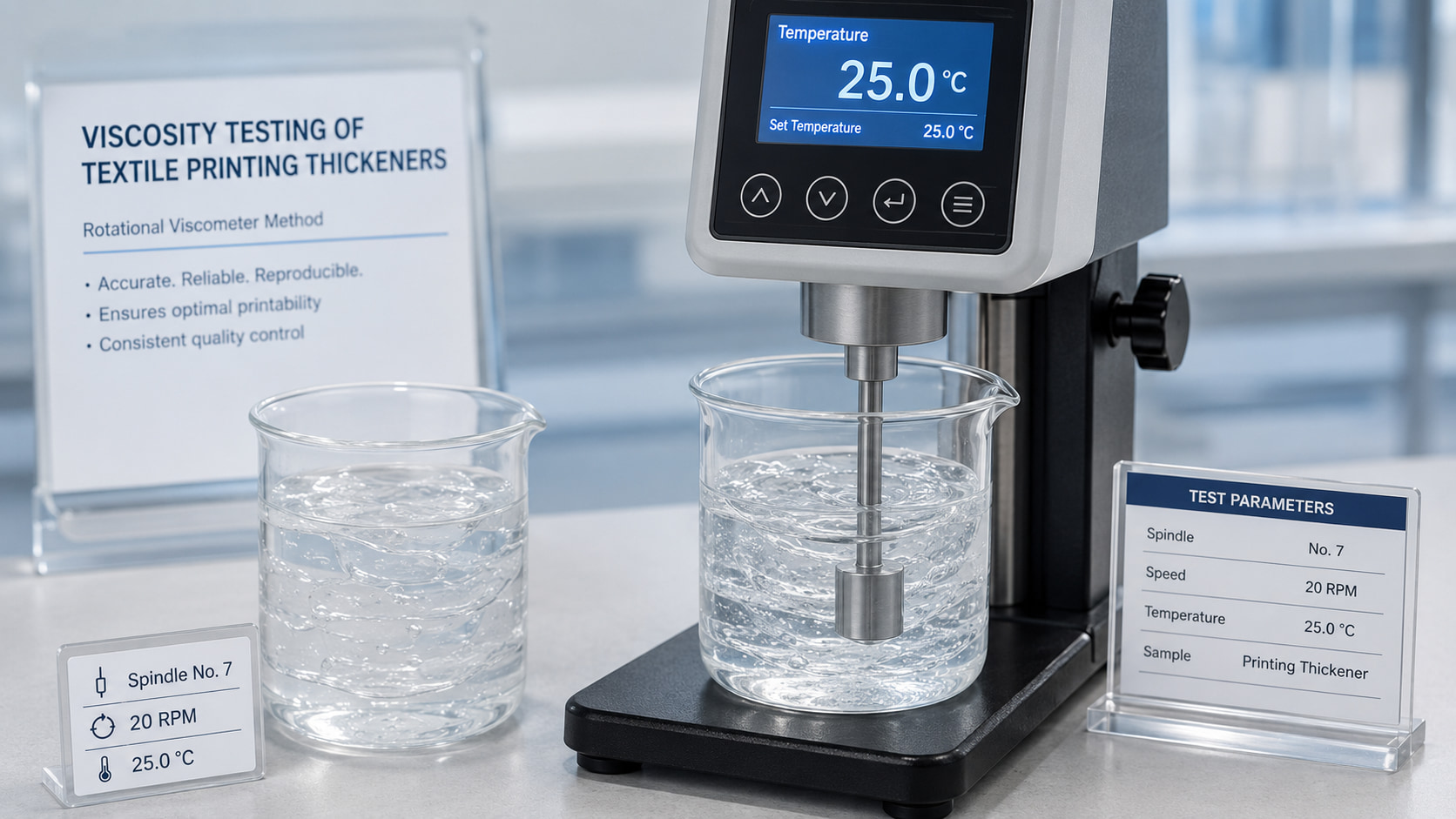
Дізнайтеся, чому показники в’язкості загущувачів для текстильного друку не можна порівнювати без урахування таких параметрів, як концентрація, температура, прилад, шпиндель, швидкість, метод підготовки та тривалість випробування.
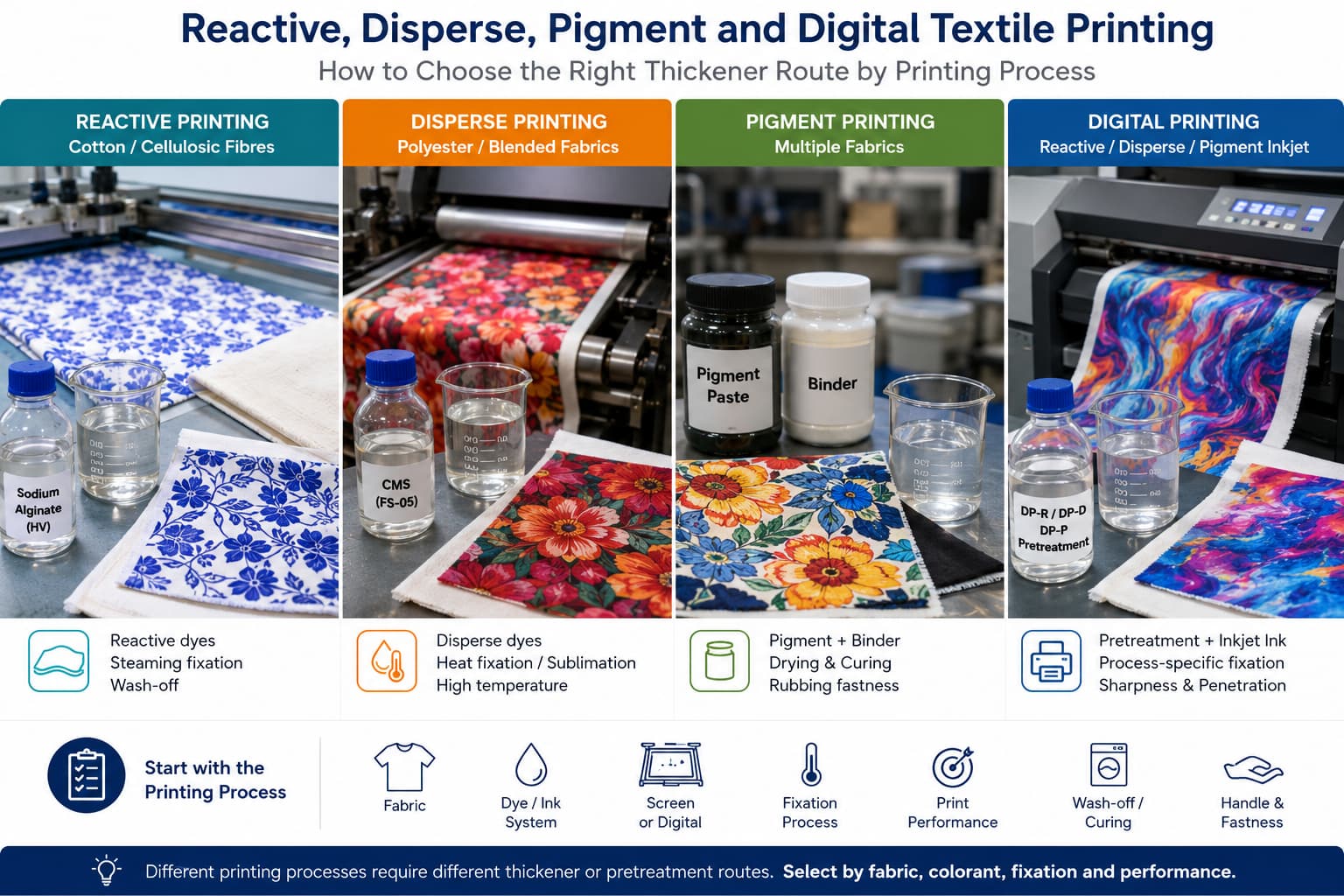
Дізнайтеся, як підібрати загущувач та методи попередньої обробки для реактивного, дисперсного, пігментного та цифрового друку на текстилі з урахуванням вимог до тканини, барвника або чорнила, фіксації, змивання та якості друку.
Порівняйте CMC, CMS, альгінат натрію та пасту для цифрового друку на текстилі. Дізнайтеся, як кожен із цих матеріалів підходить для реактивних, дисперсних, пігментних та цифрових технологій друку, а також на що покупцям слід звернути увагу перед тестуванням зразків, підбором сорту та оптовою закупівлею.
Альгінат натрію широко використовується у текстильному друці як стабільний та стійкий до прання загущувач для реактивних друкарських паст. Дізнайтеся, як перед придбанням оцінити клас в’язкості, ступінь чистоти та придатність продукту для конкретного застосування, а також як компанія FSX Chemical надає підтримку покупцям з усього світу, надаючи технічні дані та зразки.
І альгінат натрію, і КМК використовуються як загусники в текстильному друку, але вони підходять для різних систем фарбування та умов виробництва. У цьому посібнику пояснюються основні відмінності та випадки, коли слід застосовувати кожну з цих речовин.
Цифровий струменевий друк на текстилі має інші вимоги до пасти та попередньої обробки, ніж трафаретний друк. У цьому посібнику пояснюється, як альгінат натрію використовується в цифровому текстильному друці та які параметри якості повинні вказувати фахівці з закупівель.
Prepare sodium alginate printing paste with a grade-specific concentration and controlled powder dispersion. Validate hydration, viscosity, filtration, air removal and holding time before production.
Assess sodium alginate in reactive-printing wastewater using measured COD load, product-specific biodegradation evidence and controlled process comparisons. Includes a buyer checklist and illustrative load calculation.
Швидкість фіксації барвника безпосередньо впливає на колірну віддачу, стійкість до прання та навантаження стічних вод під час друку реактивними барвниками. У цьому посібнику пояснюється, як альгінат натрію сприяє фіксації барвника, які параметри пасти впливають на швидкість фіксації та як усунути проблеми, пов’язані з низькою фіксацією, у виробничому процесі.
Mesh size describes sodium alginate powder particle size, not final viscosity or print quality. Compare dispersion, hydration, retained matter and complete-paste performance under a defined method.
Evaluate sodium alginate for warp sizing through grade-specific bath, yarn and desizing trials. Compare dry size add-on, yarn protection and removal using appropriate residue methods and downstream fabric checks.
Sodium alginate purity specifications cover more than a single number. This guide explains what active content, NaCl, insoluble matter, and heavy metal data mean for textile printing paste performance — and when higher purity is worth specifying over a standard industrial grade.
Надайте назву продукту, сферу застосування, кількість, місце призначення, а також будь-які технічні специфікації (TDS),
зразки фотографій або документів, які у вас вже є. Компанія FSX Chemical розгляне цю
інформацію та надасть рекомендації щодо подальших кроків: підготовки комерційної пропозиції, підбору зразків
або вибору продукту.
Інформація про товарНазва товару, сорт, модель, фото етикетки або код постачальника.
Доступні документиTDS, SDS, COA, фото зразка, перелік продукції або дані випробувань.
Деталі замовленняОрієнтовна кількість, упаковка, країна призначення, порт або умови торгівлі.
Заявка чи проблемаПроцес друку на текстилі, вимоги до складу, поточні проблеми або цільові показники ефективності.