Direct answer: Prepare sodium alginate printing paste by creating stable water circulation, adding powder gradually, allowing the grade-specific hydration time, conditioning the sample to the test temperature and checking viscosity, filtration and holding stability before adding the full reactive-printing chemicals. There is no universal concentration or hydration time: the correct target depends on the alginate grade, viscosity method, fabric, screen or pretreatment route and the complete formulation.
Obtain a starting concentration from the current grade TDS or a documented supplier trial, then compare a controlled concentration series on the intended process. State whether concentration means as-supplied powder or dry alginate in stock paste, complete printing paste or final pretreatment bath. A fixed preparation procedure can screen incoming lots, but application comparisons should allow each grade to reach a verified hydration endpoint. Match the final concentration basis, temperature and viscosity method, and record any difference in preparation time or equipment.
Why Paste Preparation Affects Print Quality
The Link Between Dissolution Quality and Paste Performance
Sodium alginate powder hydrates and dissolves to form a viscous aqueous solution; calcium-induced gelation is a separate phenomenon and is not required for normal paste thickening. Disperse the powder evenly before hydration builds viscosity. Rapid surface hydration of poorly dispersed clumps can trap dry material inside, causing inconsistent viscosity, filtration and screen passage. See the sodium alginate application guide for process context.
Well-prepared paste has a smooth, homogeneous texture with stable viscosity throughout the batch. This consistency directly affects how the paste transfers through the screen, how the dye distributes across the fabric surface, and how evenly the paste washes out after steaming.
Common Problems Caused by Incorrect Preparation
Potential preparation-related defects and checks include the following. Similar print defects can also have fabric, screen, colorant or process causes:
- Undissolved lumps → screen blockage, uneven paste coverage, dye concentration variation across the print
- Air bubbles in paste → pinhole defects in the printed pattern, particularly visible on dense color areas
- Inconsistent viscosity between batches → color depth variation across production runs
- Paste degradation during storage → viscosity drop mid-run, pattern bleeding, reduced dye yield
Most of these problems are preventable with consistent preparation procedure and appropriate equipment.
Dissolution Methods: Cold and Controlled Warm Water
Cold Water Dissolution
Many sodium alginate grades can be dispersed and hydrated in unheated water. Use the exact grade’s preparation instructions and record the actual water temperature; below 25°C is not a universal dissolution requirement. Maintain circulation as viscosity develops, and confirm hydration under the agreed quality-control method.
Unheated preparation avoids an added heating-and-cooling step when it gives an acceptable result. A warmer paste can read lower in viscosity without permanent damage; separate this temperature effect from any irreversible change after prolonged heat or severe processing. Compare samples at the same final test temperature.
The key to successful cold water dissolution is controlling the powder addition rate. Adding powder too quickly causes clumping. The powder should be sifted or sprinkled gradually into the water while the agitator is running, rather than added all at once.
Controlled Warm-Water Preparation
Commercial sodium alginate grades can differ in particle size, viscosity grade, surface treatment and hydration behavior. Sodium alginate does not use the CMC-style degree of substitution specification. Use warm water only when the current grade instructions or a controlled comparison support it; do not assume that one temperature range suits every grade.
A warmer sample normally shows lower measured viscosity than the same paste at a cooler temperature. That temperature effect must be separated from permanent polymer change caused by excessive heat, time or mechanical shear. Condition reference and candidate pastes to the same final temperature before comparing viscosity.
For high-viscosity printing grades, uncontrolled heating can make hydration and viscosity results difficult to reproduce. Record the actual water temperature, mixing time and cooling period, then confirm the complete paste by filtration and printing rather than judging dissolution speed alone.
Which Method to Use for Your Grade
The appropriate dissolution method depends on the specific sodium alginate grade you are using. Your supplier’s technical datasheet should specify the recommended dissolution method and any relevant preparation conditions. If this information is not included in the TDS, request it before starting production trials.
If the grade hydrates adequately in unheated water, use that repeatable procedure as the reference. Investigate persistent particles before increasing temperature or mixing time: dry-core agglomerates, calcium-associated gels and contamination need different responses. Change one preparation variable at a time and recheck filtration and print performance.
Sodium Alginate Paste Preparation Control Table
| Control point | What to record | Why it matters |
|---|---|---|
| Вода | Source, hardness or conductivity, temperature and batch quantity | Water quality and temperature can change hydration and measured viscosity |
| Powder addition | Addition time, feed position and mixer condition | Rapid dumping can form surface-wet lumps with dry cores |
| Гідратація | Mixer type, speed, total mixing time and rest time | Visible dispersion does not prove complete hydration |
| В’язкість | Concentration, temperature, instrument, spindle, RPM and reading time | Results are comparable only under the same method |
| Фільтрація | Filter opening, sample quantity, time and retained residue | Identifies incomplete hydration, gels or contamination |
| Стабільність утримання | Covered storage time, temperature, pH and viscosity change | Shows whether the paste remains usable during the production window |
| Printing result | Screen passage, definition, penetration, color, wash-off and handle | Water-only testing cannot approve a printing grade |
Selecting Concentration by Application
Define concentration as a mass percentage with a named denominator: as-supplied powder or dry alginate mass divided by the total stock paste, complete printing paste or pretreatment bath mass, multiplied by 100. Use the same basis when comparing grades. The correct working concentration is selected from documented grade guidance and process trials, not a universal application range.
Flat Screen and Rotary Screen Printing
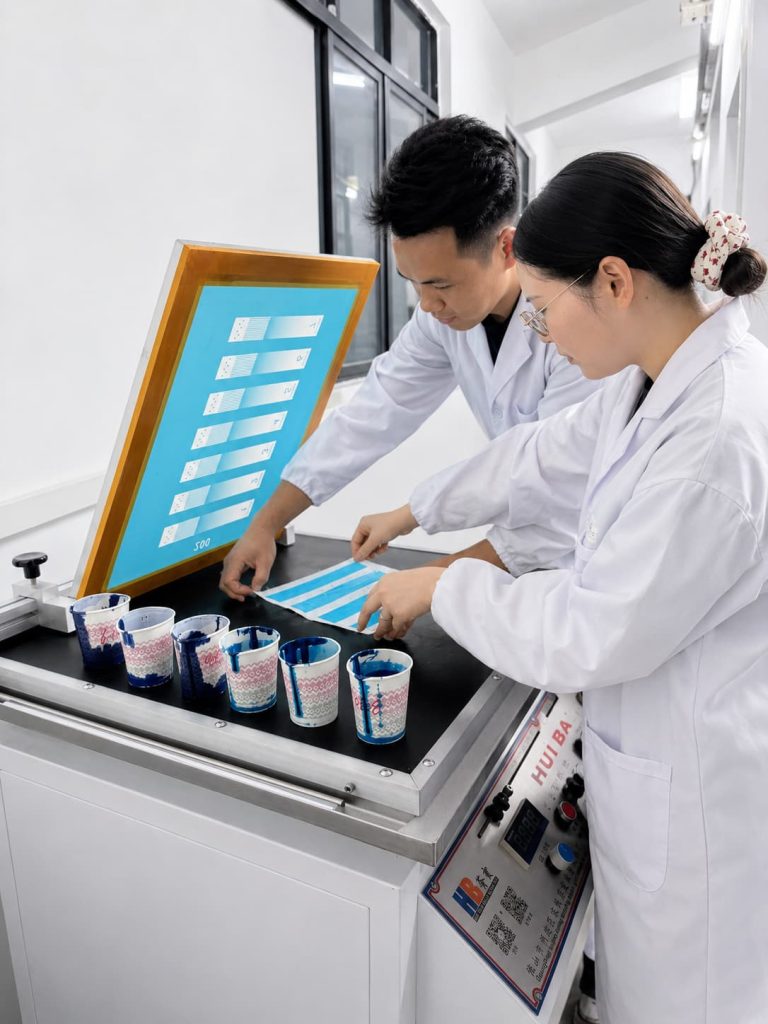
For conventional reactive flat-screen or rotary-screen stock paste, use the selected grade’s documented preparation guidance to set the initial trial range. Record dry alginate mass divided by total stock-paste mass for the stock concentration, then separately calculate its concentration after dye, water and auxiliaries are added. Select the working formulation from viscosity under a defined method and actual print performance.
Do not use a universal viscosity target without its measurement method. Record concentration, hydration, temperature, instrument, spindle, RPM and reading time, then relate the result to screen passage, paste transfer, definition, penetration and wash-off.
Digital Pre-Treatment
For reactive digital pretreatment on cotton or viscose, confirm a suitable grade and starting bath concentration from current product documentation and controlled trials. Apply the pretreatment to the fabric by padding, coating or another validated method; this guidance does not authorize adding the thickener to printhead ink. Record bath concentration and wet pickup separately so the deposited amount can be compared.
Select concentration from the required bath viscosity, wet pickup, fabric construction, alkali and humectant system, drying and final print result. A higher concentration is not automatically better; verify application uniformity, head-strike risk, definition, fixation and wash-off on the actual line.

Discharge Printing
Establish the usable holding window for that complete discharge formulation by checking viscosity, homogeneity and the final discharge result at planned intervals. Reactive and discharge pastes cannot be ranked for stability from the process names alone. Confirm chemical compatibility before a production trial.
Step-by-Step Paste Preparation Process
Equipment and Water Quality Considerations
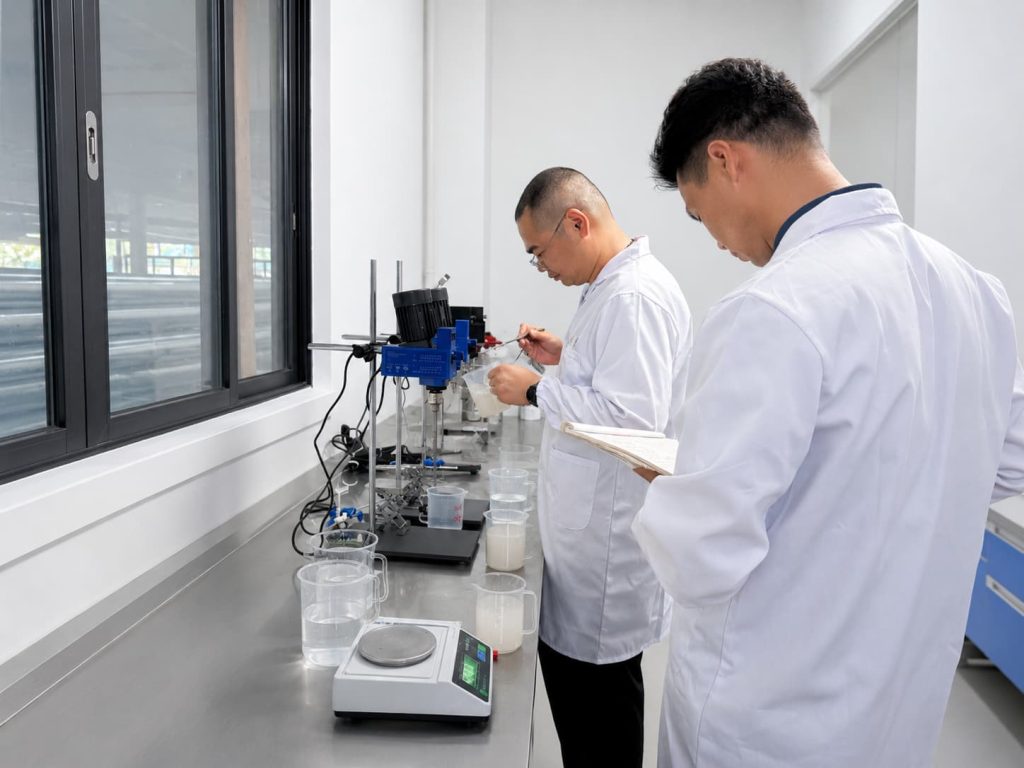
Size the vessel for the final batch, circulation and sufficient headspace for powder feeding and any entrained air. Select an agitator that can circulate the batch as viscosity rises. Mixer type and speed must be qualified for the vessel geometry, powder-feed rate and grade; control air entrainment and temperature rather than treating one mixer design as universally suitable.
Water ions can change alginate hydration and flow. Calcium can form cross-links, increasing apparent structure or producing gel particles; hardness does not simply cause a predictable viscosity decrease by replacing sodium. Magnesium and other ions need their own concentration- and grade-specific assessment. Compare the actual process water with a suitable low-hardness reference and check residue as well as viscosity; conductivity alone does not identify calcium hardness.
Weighing and Dispersing the Powder
Weigh powder and water with calibrated equipment. A fixed absolute powder-weighing error represents a larger relative dose error in a smaller powder addition, but the resulting viscosity change depends on the grade and concentration-response curve. Record as-supplied mass and any dry-basis correction instead of dosing by powder volume.
Start the agitator before adding powder. Add the powder gradually — in a steady stream or in small increments — while the agitator is running. This distributes the powder across the water surface and promotes individual particle wetting before hydration begins. Avoid adding large quantities of powder at once, which causes clumping.
Mixing Time and Hydration
After powder addition, continue the qualified mixing sequence until the batch is homogeneous. Validate hydration by repeatable viscosity at a fixed concentration and temperature, together with a defined filtration or residue check. Record the sampling intervals and mixing history; a clear appearance or a generic 30–60-minute mixing period does not by itself demonstrate complete hydration.
Set and record a conditioning/rest interval in the test method. Check whether continued hydration, sample temperature or entrained air explains any reading change. When recovery after shear matters, use a defined pre-shear and timed recovery sequence; do not identify time-dependent recovery merely from the difference between an immediate reading and a later reading.
Degassing Before Use
Validate air removal for the actual viscosity, vessel and application rather than imposing a universal standing time. Standing may be sufficient for some batches; others may need a qualified low-air mixing or deaeration procedure. Verify appearance, representative density if used, filtration and a print check before release. Avoid re-entraining air and keep the total holding time within the validated window.
Paste Storage and Stability
Storage Temperature and Container Requirements
Store prepared paste in a clean, covered container under the grade- and formula-specific temperature conditions. Control evaporation and contamination; viscosity drift can also reflect continuing hydration, temperature, ionic interactions or polymer change. Cool storage can reduce some deterioration risks but does not establish a microbial safety threshold or a universal below-25°C shelf life.
Use a clean, corrosion-resistant container whose materials and cleaning residues are compatible with the complete formulation. Suitable plastic or stainless steel may be evaluated; a food-grade label alone does not establish compatibility with a textile printing paste. Check closure, cleaning and contamination controls.
Shelf Life After Preparation
Prepared paste does not have one universal 24- or 48-hour shelf life. The usable window depends on water quality, preservation system, temperature, pH, contamination, container closure and the complete formulation. Establish an internal limit by comparing viscosity, filtration, odor or visible change and printing performance at defined time points.
For high-volume operations, prepare paste in batch sizes that can be used within one production shift where possible, rather than preparing large batches that will be stored for multiple days.
Signs That Paste Has Degraded
Unexpected viscosity change, odor, color change or skin formation should trigger a hold and investigation against a fresh reference under the same test conditions. These observations do not identify one cause or predict a specific fastness failure. Do not release suspect paste until its cause, handling requirements and final print performance have been assessed.
If paste repeatedly changes before its intended use time, review temperature history, water, container cleaning, closure, pH and the full recipe. Any preservative must be approved for the formulation, end use and local requirements, with a validated dose and handling procedure; do not use an unspecified small addition to rescue a suspect batch.
Common Preparation Problems and How to Address Them
Lumps and Undissolved Particles
Filtration can remove visible particles but does not establish their cause. Retained material may contain hydrated polymer, trapped liquid or contamination; its wet mass is not a direct measure of lost active alginate. Record the filter opening, processed quantity and retained material, then check the filtered paste’s viscosity and print result. Correct the preparation or contamination source rather than assuming straining alone restores the intended formulation.
Viscosity Lower Than Expected
For an unexpectedly low reading, first confirm the concentration basis, powder and water masses, temperature, hydration and instrument method against the reference. Then examine formulation, water and holding history with matched controls. Hardness or a different mixing time does not have one predictable effect on every alginate paste.
Match the reference concentration, hydration and rest history, temperature, instrument, geometry or spindle, rotational speed, reading time and valid operating range. RPM is a measurement setting, not a shear rate transferable between arbitrary spindles. Compare flow curves or recovery only under a suitable defined protocol.
Paste Thickening or Gelling During Storage
A viscosity rise during holding can result from continuing hydration or cooling; persistent gel particles can indicate calcium-associated structure or another incompatibility. Recheck at the agreed temperature and concentration, then assess filtration and controlled formulation comparisons. Do not diagnose cross-linking from one viscosity rise alone.
Sodium Alginate Paste Preparation FAQ
Does sodium alginate have a degree of substitution?
No. Degree of substitution is used for substituted derivatives such as CMC, not as a normal sodium alginate specification. Do not infer a degree of substitution or carboxymethyl-starch chemistry for the FSX CMS commercial synthetic-thickener family. Compare alginate by a complete viscosity method, composition and purity controls, particle profile, hydration, filtration and application performance.
Should sodium alginate be dissolved in hot water?
Do not use a universal hot-water rule. Moderate warming may help a specific grade or process, but temperature changes apparent viscosity and prolonged heat or severe shear can change the polymer. Follow the supplier’s preparation method and compare all samples at the same final temperature.
How long should sodium alginate paste hydrate?
Hydration time depends on particle profile, viscosity grade, concentration, water, mixer and temperature. Approve a repeatable endpoint using viscosity stability and filtration rather than assuming that a fixed number of minutes suits every grade.
How long can prepared paste be stored?
There is no universal 24- or 48-hour shelf life. Establish the usable window for the complete formula by recording temperature, container closure, preservation system, pH, odor, microbial risk, viscosity, filtration and printing performance. Same-shift use is the safer default until a longer window is validated.
What should I send FSX for grade matching?
Send the current product or TDS, concentration, preparation method, viscosity test conditions, fabric, reactive dye system, printing route and observed problem. Review the viscosity test guide, compare a candidate through Зразки та підбір, and confirm the commercial grade before bulk use.
How FSX Chemical Supports Your Paste Preparation Process
Наступні кроки:
- Request a TDS — includes dissolution method, recommended concentration range, and viscosity specification
- Замовити зразок — run preparation trials and viscosity checks before bulk ordering
- Ask for Grade Matching — share your application, water conditions, and mixing equipment for a specific recommendation
- Зверніться до нашої технічної служби — for paste preparation troubleshooting or formulation support: Service@fsxchemical.com