Direct answer: Prepare sodium alginate printing paste by creating stable water circulation, adding powder gradually, allowing the grade-specific hydration time, conditioning the sample to the test temperature and checking viscosity, filtration and holding stability before adding the full reactive-printing chemicals. There is no universal concentration or hydration time: the correct target depends on the alginate grade, viscosity method, fabric, screen or pretreatment route and the complete formulation.
Obtain a grade-specific starting concentration from the current TDS or a documented supplier trial, then compare a controlled concentration series on the intended process. Report whether concentration means dry alginate as a percentage of stock paste, complete printing paste or final pretreatment bath; these are different quantities. Keep water quality, mixer, addition rate, hydration time, temperature, instrument, spindle and speed identical when comparing grades.
Why Paste Preparation Affects Print Quality
The Link Between Dissolution Quality and Paste Performance
Sodium alginate powder hydrates and dissolves to form a viscous aqueous solution; calcium-induced gelation is a separate phenomenon and is not required for normal paste thickening. Disperse the powder evenly before hydration builds viscosity. Rapid surface hydration of poorly dispersed clumps can trap dry material inside, causing inconsistent viscosity, filtration and screen passage. See the sodium alginate application guide for process context.
Well-prepared paste has a smooth, homogeneous texture with stable viscosity throughout the batch. This consistency directly affects how the paste transfers through the screen, how the dye distributes across the fabric surface, and how evenly the paste washes out after steaming.
Common Problems Caused by Incorrect Preparation
The most frequent paste preparation problems — and their downstream consequences — include:
- Undissolved lumps → screen blockage, uneven paste coverage, dye concentration variation across the print
- Air bubbles in paste → pinhole defects in the printed pattern, particularly visible on dense color areas
- Inconsistent viscosity between batches → color depth variation across production runs
- Paste degradation during storage → viscosity drop mid-run, pattern bleeding, reduced dye yield
Most of these problems are preventable with consistent preparation procedure and appropriate equipment.
Dissolution Methods: Cold Water vs. Hot Water
Cold Water Dissolution
Cold water dissolution is the standard method for most industrial-grade sodium alginate used in textile printing. The procedure involves dispersing the sodium alginate powder in cold water (typically below 25°C) under continuous agitation, then allowing the mixture to hydrate with continued stirring until fully dissolved.
The advantage of cold water dissolution is that it avoids the viscosity reduction that can occur at elevated temperatures, and it does not require heating equipment. It is suitable for most medium and high viscosity grades used in screen printing paste.
The key to successful cold water dissolution is controlling the powder addition rate. Adding powder too quickly causes clumping. The powder should be sifted or sprinkled gradually into the water while the agitator is running, rather than added all at once.
Controlled Warm-Water Preparation
Commercial sodium alginate grades can differ in particle size, viscosity grade, surface treatment and hydration behavior. Sodium alginate does not use the CMC-style degree of substitution specification. Use warm water only when the current grade instructions or a controlled comparison support it; do not assume that one temperature range suits every grade.
A warmer sample normally shows lower measured viscosity than the same paste at a cooler temperature. That temperature effect must be separated from permanent polymer change caused by excessive heat, time or mechanical shear. Condition reference and candidate pastes to the same final temperature before comparing viscosity.
For high-viscosity printing grades, uncontrolled heating can make hydration and viscosity results difficult to reproduce. Record the actual water temperature, mixing time and cooling period, then confirm the complete paste by filtration and printing rather than judging dissolution speed alone.
Which Method to Use for Your Grade
The appropriate dissolution method depends on the specific sodium alginate grade you are using. Your supplier’s technical datasheet should specify the recommended dissolution method and any relevant preparation conditions. If this information is not included in the TDS, request it before starting production trials.
As a general guideline: if your grade dissolves cleanly in cold water within your standard mixing time, cold water dissolution is preferred. If you observe persistent undissolved particles after adequate cold water mixing, try warm water or extend the mixing time before concluding that the grade has a solubility problem.
Sodium Alginate Paste Preparation Control Table
| Control point | What to record | Why it matters |
|---|---|---|
| Eau | Source, hardness or conductivity, temperature and batch quantity | Water quality and temperature can change hydration and measured viscosity |
| Ajout de poudre | Addition time, feed position and mixer condition | Rapid dumping can form surface-wet lumps with dry cores |
| Hydratation | Mixer type, speed, total mixing time and rest time | Visible dispersion does not prove complete hydration |
| Viscosité | Concentration, temperature, instrument, spindle, RPM and reading time | Results are comparable only under the same method |
| Filtration | Filter opening, sample quantity, time and retained residue | Identifies incomplete hydration, gels or contamination |
| Stabilité de la prise | Covered storage time, temperature, pH and viscosity change | Shows whether the paste remains usable during the production window |
| Printing result | Screen passage, definition, penetration, color, wash-off and handle | Water-only testing cannot approve a printing grade |
Recommended Concentration Ranges by Application
Sodium alginate concentration in printing paste is expressed as a percentage of the total paste weight (w/w). The appropriate concentration depends on the application, the viscosity grade of the sodium alginate, and the specific fabric and printing equipment in use. The ranges below are starting orientations — adjust based on your own viscosity targets and trial results.
Flat Screen and Rotary Screen Printing
For conventional reactive flat-screen or rotary-screen stock paste, use the selected grade’s documented preparation guidance to set the initial trial range. Record dry alginate mass divided by total stock-paste mass for the stock concentration, then separately calculate its concentration after dye, water and auxiliaries are added. Select the working formulation from viscosity under a defined method and actual print performance.
Do not use a universal viscosity target without its measurement method. Record concentration, hydration, temperature, instrument, spindle, RPM and reading time, then relate the result to screen passage, paste transfer, definition, penetration and wash-off.
Digital Pre-Treatment
For reactive digital pretreatment on cotton or viscose, confirm a suitable grade and starting bath concentration from current product documentation and controlled trials. Apply the pretreatment to the fabric by padding, coating or another validated method; this guidance does not authorize adding the thickener to printhead ink. Record bath concentration and wet pickup separately so the deposited amount can be compared.
Select concentration from the required bath viscosity, wet pickup, fabric construction, alkali and humectant system, drying and final print result. A higher concentration is not automatically better; verify application uniformity, head-strike risk, definition, fixation and wash-off on the actual line.

Impression par décharge
Discharge printing pastes are generally less stable than reactive dye pastes and should be prepared closer to the time of use. Confirm with your supplier whether your sodium alginate grade is compatible with the specific discharge chemistry you are using.
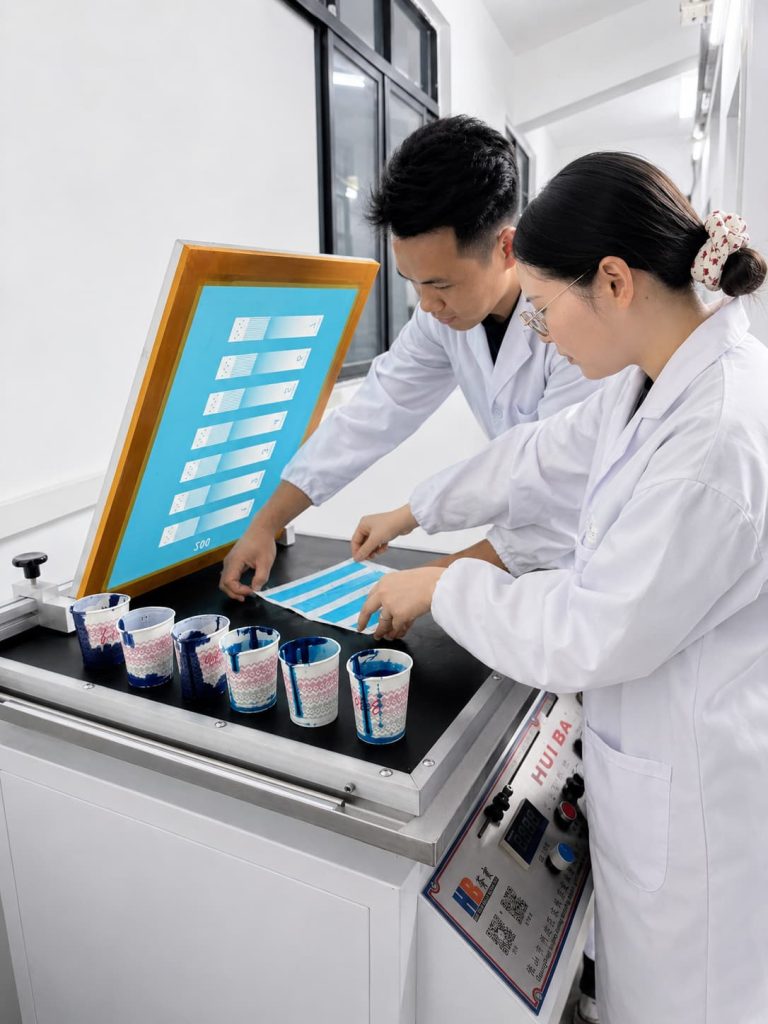
Step-by-Step Paste Preparation Process
Equipment and Water Quality Considerations
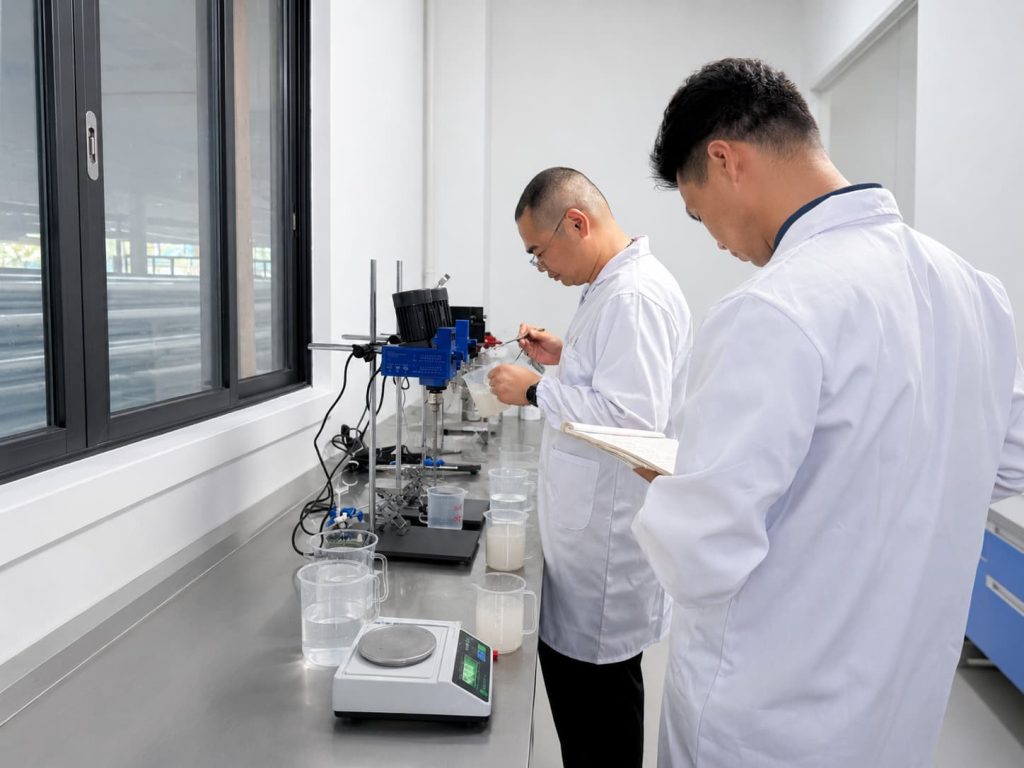
Use a mixing vessel with adequate capacity for your batch size — paste volume increases during hydration, so allow headspace above the initial water volume. A variable-speed agitator with a paddle or propeller blade suited to viscous fluids is preferable to a high-shear disperser, which can introduce excessive air into the paste.
Water quality affects paste performance. Hard water (high calcium or magnesium content) can reduce sodium alginate viscosity by displacing sodium ions from the alginate chain. If your local water supply is hard, use softened water or deionized water for paste preparation, particularly for high-viscosity applications where precise viscosity control is important.
Weighing and Dispersing the Powder
Weigh the sodium alginate powder accurately — small errors in powder weight at low concentrations have a proportionally larger effect on viscosity than at higher concentrations. Use a calibrated scale, not volume measurement, for consistent results.
Start the agitator before adding powder. Add the powder gradually — in a steady stream or in small increments — while the agitator is running. This distributes the powder across the water surface and promotes individual particle wetting before hydration begins. Avoid adding large quantities of powder at once, which causes clumping.
Mixing Time and Hydration
After all powder has been added, continue agitation until the paste is fully homogeneous and no dry or lumpy particles are visible. Total mixing time depends on the grade and water temperature — cold water dissolution of medium-viscosity grades typically requires 30 to 60 minutes of continuous agitation for complete hydration.
Do not assess paste quality immediately after mixing ends. Allow the paste to rest for at least 15 to 30 minutes after the agitator is stopped, then check consistency and viscosity. Some grades continue to hydrate after agitation ends, and viscosity may be lower immediately after mixing than after the full hydration period.
Degassing Before Use
Allow the prepared paste to stand undisturbed for at least 30 minutes to 1 hour before use to allow air bubbles to rise and dissipate. For high-viscosity paste, longer standing time may be needed. Do not stir the paste vigorously after degassing is complete.
Paste Storage and Stability
Storage Temperature and Container Requirements
Prepared sodium alginate paste should be stored in a covered container to prevent surface drying and contamination. Storage at cool temperatures (below 25°C) slows microbial growth, which is the primary cause of paste degradation during storage. Avoid direct sunlight and heat sources near storage containers.
Do not store prepared paste in metal containers that can corrode — use food-grade plastic or stainless steel containers. Corrosion products can affect paste ionic content and viscosity.
Shelf Life After Preparation
Prepared paste does not have one universal 24- or 48-hour shelf life. The usable window depends on water quality, preservation system, temperature, pH, contamination, container closure and the complete formulation. Establish an internal limit by comparing viscosity, filtration, odor or visible change and printing performance at defined time points.
For high-volume operations, prepare paste in batch sizes that can be used within one production shift where possible, rather than preparing large batches that will be stored for multiple days.
Signs That Paste Has Degraded
Paste that has degraded may show one or more of the following signs: significant viscosity reduction compared to the freshly prepared batch, off-odor (indicating microbial activity), color change, or surface skin formation. Degraded paste should not be used in production — the resulting print will show reduced color yield, pattern bleeding, or fastness problems that will be difficult to trace to the paste if the degradation is not identified first.
If your paste regularly degrades faster than expected, check storage temperature, container cleanliness, and water quality. Adding a small quantity of a compatible preservative may be appropriate in hot-climate operations — consult your supplier for recommendations specific to your paste formulation.
Common Preparation Problems and How to Address Them
Lumps and Undissolved Particles
Passing the paste through a fine mesh strainer before use can remove visible lumps, but this does not resolve the underlying preparation problem — the strained-out material represents lost thickener that will affect your actual paste concentration and viscosity. Address the root cause in the preparation procedure rather than relying on straining as a correction.
Viscosity Lower Than Expected
If measured paste viscosity is consistently lower than the value expected from the supplier’s TDS, check the following in order: powder weight accuracy, water hardness, water temperature during dissolution, and mixing time. Each of these factors can reduce effective viscosity below the theoretical value.
Also confirm that your viscosity measurement method matches the method used by the supplier to generate the TDS data — concentration, temperature, spindle selection, and shear rate all affect the measured value. A result that seems low may simply reflect a different measurement condition rather than a genuine performance shortfall.
Paste Thickening or Gelling During Storage
In some cases, prepared paste may thicken or partially gel during storage rather than maintaining stable viscosity. This can occur if the paste is exposed to temperature fluctuations, if calcium or other divalent ions are present in the water, or if the paste has been contaminated.
Sodium Alginate Paste Preparation FAQ
Does sodium alginate have a degree of substitution?
No. Degree of substitution is used for derivatives such as CMC and CMS, not as a normal sodium alginate specification. Alginate grades are better compared through viscosity with a complete test method, composition and purity controls, particle profile, hydration, filtration, rheology and application performance.
Should sodium alginate be dissolved in hot water?
Do not use a universal hot-water rule. Moderate warming may help a specific grade or process, but temperature changes apparent viscosity and prolonged heat or severe shear can change the polymer. Follow the supplier’s preparation method and compare all samples at the same final temperature.
How long should sodium alginate paste hydrate?
Hydration time depends on particle profile, viscosity grade, concentration, water, mixer and temperature. Approve a repeatable endpoint using viscosity stability and filtration rather than assuming that a fixed number of minutes suits every grade.
How long can prepared paste be stored?
There is no universal 24- or 48-hour shelf life. Establish the usable window for the complete formula by recording temperature, container closure, preservation system, pH, odor, microbial risk, viscosity, filtration and printing performance. Same-shift use is the safer default until a longer window is validated.
What should I send FSX for grade matching?
Send the current product or TDS, concentration, preparation method, viscosity test conditions, fabric, reactive dye system, printing route and observed problem. Review the viscosity test guide, compare a candidate through Échantillons et correspondances, and confirm the commercial grade before bulk use.
How FSX Chemical Supports Your Paste Preparation Process
Prochaines étapes :
- Demander un TDS — includes dissolution method, recommended concentration range, and viscosity specification
- Demander un échantillon — run preparation trials and viscosity checks before bulk ordering
- Demander l'alignement des notes — share your application, water conditions, and mixing equipment for a specific recommendation
- Contactez notre équipe technique — for paste preparation troubleshooting or formulation support: Service@fsxchemical.com