Sodium alginate mesh size describes a powder particle-size classification, not viscosity or printing quality. Finer particles may hydrate faster after effective dispersion, but rapid surface wetting can also create lumps. Select a grade using a defined sieve result, a repeatable preparation trial and complete-paste performance.
This guide explains what mesh size means, how it affects paste preparation and performance, and how to weigh it against other grade parameters when specifying sodium alginate for screen printing or other textile applications.
| Parameter | What it can help predict | What it cannot prove |
|---|---|---|
| Sieve or particle-size result | Powder handling, wetting and likely hydration behavior under a defined method | Final viscosity, rheology or print quality |
| Pause hydratation | Whether the preparation process reaches a stable solution | Suitability of the complete dye paste by itself |
| Method-controlled viscosity | Solution body under stated concentration, temperature, instrument and speed | Filtration, recovery after shear or color yield |
| Résidu de filtration | Undissolved material, insoluble matter or contamination under the stated filter method | Full machine performance without a production trial |
| Complete-paste printing trial | Transfer, definition, stability, wash-off and finished-fabric behavior | Future batch consistency without specifications and batch control |
What Mesh Size Means in Sodium Alginate Specifications
How Mesh Number Is Defined
A mesh designation must be interpreted with its sieve standard and nominal opening. Increasing the mesh count generally means a smaller opening within a specified system, but mesh count alone is not a complete aperture specification. Wire dimensions and the adopted standard matter.
Common Mesh Ranges for Textile Applications
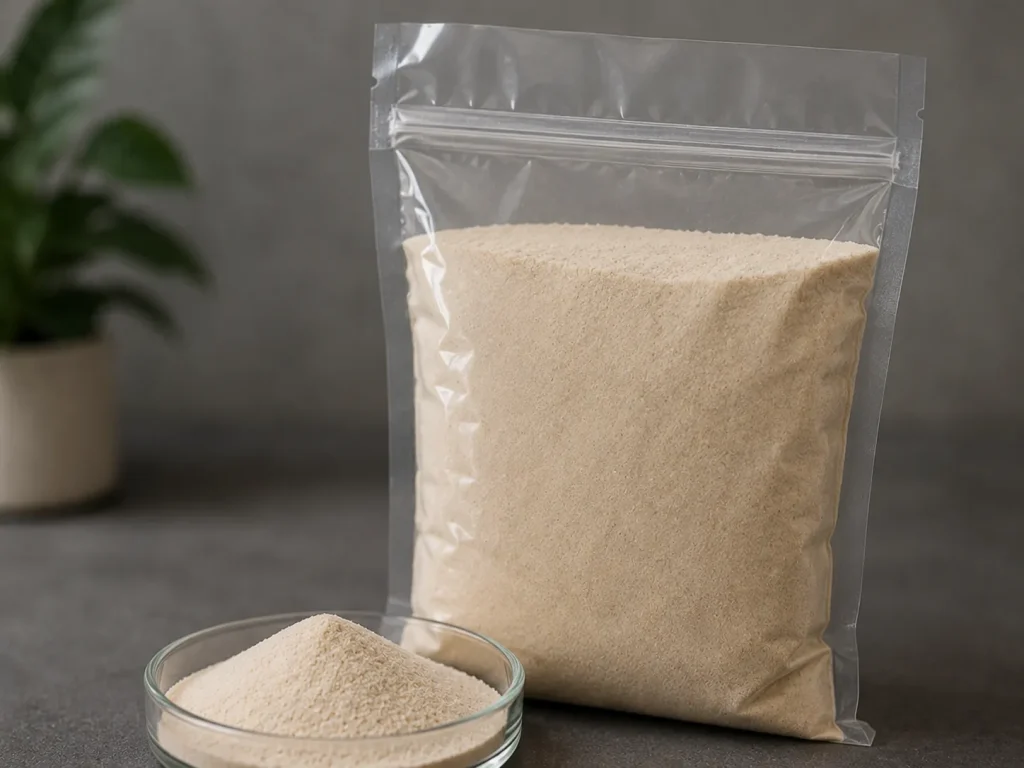
Suppliers may express particle size using mesh classification, or alternatively using micron ranges measured by laser diffraction or sieve analysis. When comparing specifications from different suppliers, confirm which measurement method is being used to ensure like-for-like comparison.
How Particle Size Affects Dissolution Behavior
Dissolution Rate and Mixing Time
Finer particle size generally means faster initial dissolution — smaller particles have a higher surface-area-to-volume ratio, which means more surface area is available for water contact per unit mass of powder. This allows water to penetrate and hydrate the sodium alginate more quickly compared to coarser particles.
A finer grade can shorten preparation only when the powder is dispersed without persistent agglomerates. Confirm the time to the agreed hydration endpoint in the actual mixing process; do not infer it from particle size alone.
Particle size is only one preparation variable. Molecular-weight distribution, polymer condition, moisture, water quality, addition rate, agitation and hydration time may have a larger practical effect on the final solution.
Risk of Lump Formation
Coarser particle sizes are generally less prone to lump formation during paste preparation, provided the powder is added to water correctly. Finer powders, because they hydrate quickly on contact with water, can form surface-hydrated clumps if added too rapidly or without adequate agitation — the outer layer of a clump hydrates and seals off the interior from further water contact.
Compare Preparation at the Intended Water Temperature
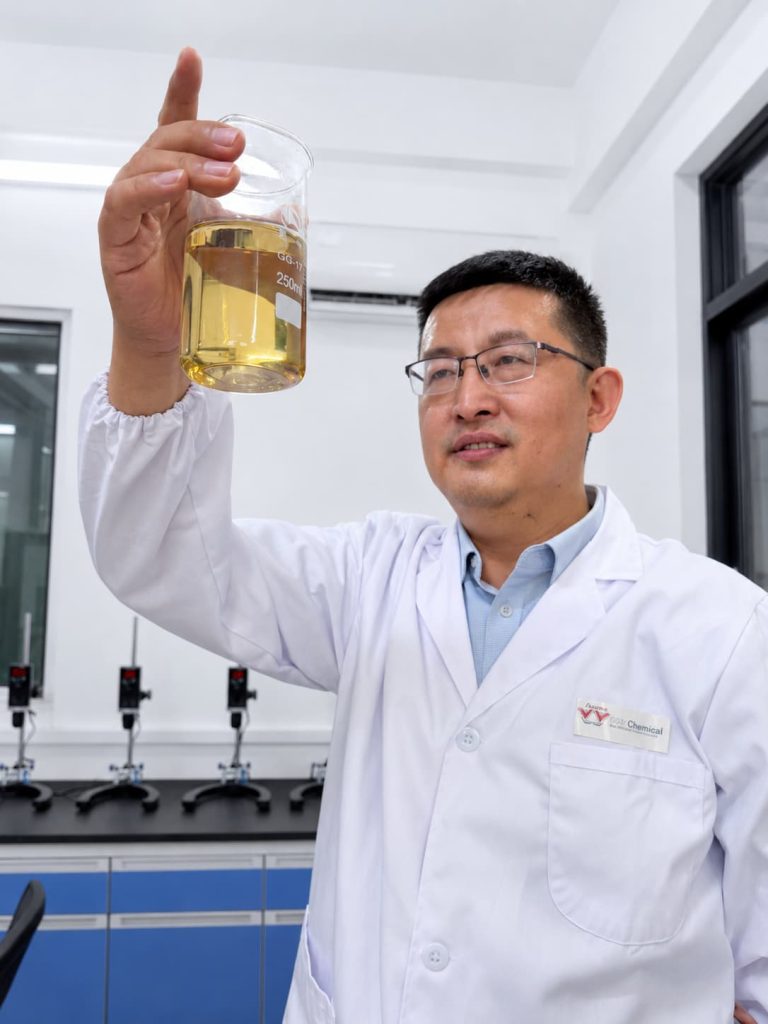
Use the grade supplier’s supported preparation conditions and record actual temperature throughout hydration. Warming changes wetting, solution viscosity and the measurement result, so a hot reading cannot be directly compared with a cold reading. A warmer process does not guarantee that every coarse grade will hydrate completely or that particle-size differences disappear.
For a fair comparison, hold concentration, water quality, powder addition and mixing geometry constant. Record lumps and filtration residue as well as viscosity development. Bring samples to the agreed test temperature before comparing final viscosity.
How Mesh Size Relates to Paste Viscosity and Stability
Does Finer Mesh Mean Higher Viscosity?
Mesh size does not directly determine fully hydrated viscosity. Sodium alginate viscosity is influenced mainly by polymer molecular weight, concentration, temperature, solution history and test method. Two grades with similar particle size can have very different viscosity, while different particle sizes may reach similar final viscosity after complete hydration.
The confusion between mesh size and viscosity sometimes arises because finer grades dissolve more completely in a given mixing time — if a coarser grade is not fully dissolved, the measured viscosity will be lower than the potential viscosity of a fully hydrated solution. The apparent “lower viscosity” of a coarser grade may simply reflect incomplete dissolution rather than a genuine difference in the product’s intrinsic viscosity.
This distinction matters for evaluation: if you are comparing paste viscosity between two grades of different mesh sizes, ensure both are fully dissolved before measuring, otherwise the comparison is not valid.
Paste Homogeneity and Screen Behavior
Finer mesh grades that dissolve more completely and evenly tend to produce more homogeneous paste — fewer undissolved particles, more consistent viscosity throughout the batch. In screen printing, paste homogeneity affects how consistently the paste transfers through the screen mesh across the full print run.
Undissolved particles or inconsistent viscosity within a batch can cause localized screen blockage, uneven paste deposit, or color variation within a production run. For fine-line or high-detail printing where paste consistency is critical, specifying a finer mesh grade may be worthwhile for the improved paste homogeneity it produces under your standard preparation conditions.
Practical Mesh Selection for Textile Printing Applications
Screen Printing: Validate Hydration Before Screen Passage
Do not choose a universal 30-, 40- or 80-mesh powder specification for every mill. Match preparation time, addition equipment and the working paste. Powder sieve size and printing-screen opening describe different stages: fully dissolved polymer does not pass through the printing screen as the original powder particles.
Digital Pretreatment: Test the Applied Bath
Evaluate hydration and filtration in the actual padding, coating or spray formulation. Lower polymer concentration does not by itself mean less driving force for dissolution. Persistent gel or contamination can remain even when a fine powder was purchased. For spray application, confirm the equipment supplier’s filtration requirements and the uniformity of the deposited treatment. Fabric pretreatment approval does not authorize the material for inkjet printhead ink.
Sizing: Use a Separate Application Trial
If sizing is the intended application, qualify concentration, preparation temperature, film behavior and desizing in that specific route. A powder mesh classification cannot establish a universal sizing dose or heating temperature.
Other Specifications That Matter More Than Mesh Alone
Mesh size is one specification parameter among several, and for most textile printing applications it is not the most critical one. When evaluating sodium alginate grades, these parameters typically have a greater impact on paste performance:
Classe de viscosité
A grade viscosity range is useful only with concentration, water, hydration, temperature, instrument, spindle or geometry, speed and reading time. One viscosity value does not describe the complete rheology or guarantee print behavior. Confirm the working paste in the intended dye and auxiliary system.
Polymer Molecular Weight and Condition
Polymer molecular weight and degradation history strongly influence viscosity and flow behavior. Confirm the viscosity method, storage condition and lot consistency; sodium alginate should not be specified using the degree of substitution parameter applied to cellulose or starch derivatives.
Pureté et solubilité
Composition and residual salts can affect preparation and formulation behavior. A water-insoluble-matter result is method-dependent and is not identical to how quickly a powder hydrates in the mill. Compare the stated laboratory method with the production preparation and filtration procedure.
Specify Particle Size and Verify It in Paste Preparation
A purchasing description should identify the test method and reporting basis. ASTM E11 addresses test sieves and woven-wire sieve cloth; it does not prescribe the right alginate particle size for textile printing.
| Specification item | Ask the supplier to state | Why it matters |
|---|---|---|
| Sieve result | Standard, nominal opening and mass percentage passing or retained | A mesh label alone does not describe the distribution |
| Particle-size analysis | Method, dispersion procedure and distribution basis for D50 or D90 | A laser result is not automatically equivalent to a dry-sieve result |
| Hydration trial | Water, concentration, addition rate, mixing and endpoint | Separates powder dispersion from final solution development |
| Application approval | Complete recipe, filtration and finished-print criteria | Connects powder handling with the intended use |
Prepare candidate and reference lots independently using the same procedure. Record observations at defined times, inspect any lumps before discarding them and measure viscosity at the agreed temperature. Approve the sieve specification only after its permitted variation works in the mill’s preparation window. Do not turn one successful sample into a guarantee for every future lot.
Foire aux questions
Does a higher mesh number mean higher sodium alginate viscosity?
No. Mesh number describes particle-size classification. Fully hydrated viscosity depends on polymer characteristics, concentration, temperature, preparation and measurement method.
Does finer sodium alginate always dissolve better?
Not automatically. Finer particles may hydrate faster, but rapid surface wetting can form lumps if powder addition and agitation are poorly controlled.
How should mesh size be written in a purchasing specification?
State the sieve or particle-size test method, applicable standard, mesh or opening and percentage passing or retained. Do not rely on an isolated mesh number.
Is degree of substitution a sodium alginate specification?
No. Degree of substitution is used for substituted cellulose derivatives such as CMC. Sodium alginate should be evaluated through its own composition, viscosity, purity, moisture, dissolution and application parameters.
Which tests matter more than mesh size for printing approval?
Use method-controlled viscosity, rheology, hydration, filtration, complete-paste stability, screen or machine trials, print definition, wash-off and batch comparison.
How FSX Chemical Supports Your Grade Selection
Ask FSX Chemical for the current particle-size specification, viscosity method and preparation guidance for the proposed sodium alginate grade. Confirm which fields are controlled specifications and which are application recommendations before ordering.
Prochaines étapes :
Demander un échantillon — run dissolution and paste preparation trials before bulk ordering
Demander l'alignement des notes — share your mixing conditions, application, and any dissolution problems for a specific recommendation: Service@fsxchemical.com