How Water Hardness Affects Acrylic Thickener Viscosity and Pigment Paste Stability
Water hardness can change acrylic-thickener activation, viscosity and complete pigment-paste stability through calcium, magnesium and...
Water hardness can change acrylic thickener viscosity and pigment-paste stability because calcium and magnesium ions alter the ionic environment around anionic acrylic and polyacrylate polymers. The result is not always a simple “harder water = lower viscosity” relationship. Depending on polymer architecture, pH, binder, pigment dispersion and auxiliary package, hard water can reduce thickening efficiency, shift activation behavior, change rheology, increase viscosity drift or destabilize the complete paste. The correct production approach is to qualify the thickener with the actual process water, separate total hardness from general conductivity, and build a controlled water-hardness–viscosity map before changing dosage or adding water-treatment chemicals.
How Does Water Hardness Affect Acrylic Thickener?
Water hardness can influence acrylic thickener through the calcium and magnesium ions dissolved in the process water.
For many anionic acrylic / polyacrylate thickeners, the polymer contains ionized carboxylate groups after neutralization.
Those charged groups help keep the polymer expanded in water.
When the ionic environment changes, polymer conformation and intermolecular interactions can also change.
Possible production effects include:
Lower thickening efficiency
Different pH–viscosity response
Viscosity drift during holding
Changes in shear thinning or recovery
Binder or pigment instability
Different print penetration and definition
The exact response is grade-specific.
Отже:
Hard Water ≠ Automatically Low Viscosity
та:
Soft Water ≠ Automatically Stable Pigment Paste.
The useful question is:
How does this commercial thickener behave in this mill’s actual water and complete pigment-binder formula?
What Does Water Hardness Mean in Textile Printing?
Water hardness mainly describes dissolved calcium and magnesium content.
Laboratories often report total hardness as:
mg/L as CaCO3
or an equivalent hardness unit.
For textile printing, it is useful to distinguish:
Total hardness
Calcium hardness
Magnesium hardness
Alkalinity
Conductivity
pH
These parameters describe different aspects of water chemistry.
A water sample can have moderate conductivity but problematic calcium concentration, or high conductivity dominated by ions that behave differently from Ca2+ and Mg2+.
Do not use one water-quality number as a substitute for the full process-water profile.
Water Hardness Is Not the Same as Conductivity
Conductivity measures the water’s overall ability to carry electrical current and therefore reflects total dissolved ionic content.
Hardness focuses mainly on calcium and magnesium.
Two waters can have similar conductivity but very different:
Ca2+
Mg2+
Na+
Cl−
HCO3−
For acrylic-thickener troubleshooting, record both:
Total Hardness + Conductivity
where practical.
If water hardness changes but conductivity does not change much, the ion composition may still have shifted enough to affect an anionic polymer system.
Why Acrylic / Polyacrylate Thickeners Respond to Ions
Many acrylic thickeners rely on negatively charged carboxylate groups after neutralization.
When ionic concentration increases, dissolved ions can reduce the effective repulsion between charged polymer segments.
This can allow the polymer structure to become more compact.
A simplified electrolyte response is:
Ions ↑ → Charge Screening ↑ → Polymer Expansion ↓ → Thickening Efficiency Can Fall
Recent polyacrylic-acid thickener research continues to identify electrolyte sensitivity as an important limitation and uses molecular modification to improve viscosity retention.
However, polymer architecture matters.
Hydrophobically modified or supramolecularly reinforced acrylic systems can behave differently from conventional PAA / ASE products.
Why Calcium and Magnesium Deserve Separate Attention
Calcium and magnesium are divalent ions.
They can influence anionic polymer systems differently from monovalent ions such as sodium.
Possible effects include:
Stronger local charge screening
Polymer-chain contraction
Interaction with anionic dispersants
Changes in pigment or binder colloidal stability
Polyacrylate research in mineral suspensions has shown that Mg2+ can affect rheological behavior more strongly than a monovalent ion under comparable experimental conditions.
But this does not mean calcium or magnesium will always reduce viscosity in every pigment paste.
Particle interactions, binder colloids and associative acrylic chemistry can produce more complex behavior.
The correct approach is:
Measure the complete formulation.
How Hard Water Can Change pH Activation
Many acrylic pigment-printing thickeners are alkali-activated or pH-responsive.
Hard water does not simply add calcium and magnesium; it can also change the buffering and alkalinity environment of the formulation.
This can alter:
Neutralizer demand
Time to reach stable pH
Activated viscosity
Batch-to-batch repeatability
When testing hard water, keep the final pH inside the same validated activation window.
Otherwise, a viscosity change caused by pH can be incorrectly blamed on hardness.
If the hard-water sample starts normally but drifts later, the problem may involve delayed colloidal interaction rather than immediate polymer charge screening.
Color Yield, Penetration and Print Definition
Water hardness affects the final print only if it changes the behavior of the complete paste or fixation system.
Possible indirect effects include:
Lower viscosity → more penetration
Different recovery → more spreading
Pigment flocculation → uneven color
Binder instability → uneven surface film
Evaluate:
K/S or agreed shade
Чітке окреслення контурів
Рівномірність по всій площі
Проникнення
after identical printing and curing.
Do not assume a laboratory viscosity difference automatically produces a visible color difference.
Стійкість до тертя та затвердіння
Acrylic thickener does not create pigment fixation by itself.
Binder and curing remain the main fixation variables.
Hard water can still affect rubbing indirectly if it changes:
Розподіл зв’язувальних речовин
Розподіл пігменту
Відкладення пасти
Colloidal stability
If rubbing fastness changes between water sources, check both:
Wet-paste stability
Cured binder film
Keep curing temperature and time identical during the comparison.
DI, RO, Softened and Plant Water: What Should You Compare?
Deionized / Very Low-Ion Water
Useful as a laboratory reference because it minimizes ionic interference.
RO Water
Usually much lower in hardness and dissolved ions than raw plant water, although actual quality depends on membrane performance and pretreatment.
Softened Water
Ion-exchange softening mainly replaces calcium and magnesium with sodium.
This reduces hardness but does not necessarily reduce conductivity or total dissolved ions as strongly as RO.
Plant Water
This is the water that matters most for actual production qualification.
Use low-ion water as a diagnostic reference, but approve the thickener on the real production water or on a controlled water specification the factory can consistently maintain.
Run this first with activated thickener and then with the complete pigment paste.
Do not convert the graph into a universal hardness limit unless production validation supports that limit.
Use Water Controls to Isolate the Root Cause
A good troubleshooting set can include:
Приклад
Вода
Formula
Question
A
Low hardness
Thickener only
Polymer baseline
B
Plant water
Thickener only
Water effect on polymer
C
Low hardness
Complete pigment paste
Formula baseline
D
Plant water
Complete pigment paste
Combined water + formula effect
This design helps separate:
Water-only thickener sensitivity
Binder/pigment compatibility
Combined hard-water effects
How to Run a Calcium / Magnesium Challenge Test
If the mill needs deeper root-cause data, separate total-hardness testing from controlled Ca2+ and Mg2+ challenges.
Keep constant:
Thickener dosage
Кінцеве значення рН
Температура
Total formula mass
Measurement method
Then add controlled, known levels of the relevant hardness salts.
Запис:
pH
В’язкість
Viscosity retention
Зовнішній вигляд
Стабільність утримання
Do not directly copy a challenge concentration from an unrelated industry.
Use the actual plant-water range or a technically justified worst-case process condition.
Should You Add a Chelating Agent?
A chelating or sequestrating agent can sometimes reduce the effect of calcium and magnesium by binding the ions.
But it should not be added automatically.
A chelator can also change:
Ionic balance
pH
Пігментна дисперсія
Binder behavior
Wastewater chemistry
Use this sequence:
Confirm Hardness Is the Root Cause → Select a Compatible Chelator → Test Dose Ladder → Recheck Binder / Pigment → Print → Cure
Do not use chelation to hide unstable water quality that the plant can control more effectively upstream.
Should You Soften or Use RO Water?
The best water-treatment route depends on the factory.
Softening
Useful when calcium and magnesium are the main problem.
But sodium concentration and conductivity can remain significant.
Reverse Osmosis
Can reduce a broader range of dissolved ions and often gives a more controlled laboratory-like water source.
But RO has:
Capital cost
Operating cost
Membrane maintenance
Reject-water management
Choose water treatment from:
Required Water Specification + Production Volume + Chemical Savings + Quality Risk
rather than assuming RO is always necessary.
Seasonal and Factory-to-Factory Water Variation
Plant water can change with:
Season
Municipal water source
Well-water ratio
Rainfall
Water-treatment operation
This can explain why:
Same Thickener + Same Formula + Same Operator
produces different viscosity at different times.
For multi-factory operations, each plant should record its own:
Total hardness
Conductivity
pH
rather than assuming one corporate recipe will behave identically everywhere.
Water QC for Pigment Printing
A practical water-control panel can include:
Total hardness
Calcium hardness where relevant
Magnesium hardness where relevant
Conductivity
pH
Alkalinity where process-sensitive
Trend results instead of recording only pass/fail.
A gradual hardness increase can explain viscosity drift before the paste reaches a formal rejection point.
The water specification should be based on validated production performance rather than a generic internet limit.
Incoming QC for the Thickener
Water hardness should not be used to excuse an inconsistent thickener batch.
Incoming thickener QC can still include:
Grade / batch
Зовнішній вигляд
pH
Solids
As-supplied viscosity where specified
Standardized activation viscosity
For periodic application verification, test the product in a controlled reference water.
This separates:
Thickener Batch Variation
from:
Process Water Variation.
Затвердження випробувального виробництва
After laboratory water screening, confirm the selected condition on the real machine.
Запис:
Water hardness / conductivity
Thickener grade and batch
Дозування
Кінцеве значення рН
Pigment / binder formula
В'язкість на початку / в середині / наприкінці циклу
Швидкість роботи верстата
Поведінка екрана
Pattern definition
Колірна стабільність
Отвердіння
Сухе / вологе протирання
Тканина ручної роботи
Approve a water/thickener combination as a production window, not from one beaker result.
Common Hard-Water Troubleshooting Mistakes
1. Assuming Hard Water Always Lowers Viscosity
The direction and magnitude depend on polymer and complete-formula interactions.
2. Using Conductivity as the Hardness Number
Conductivity measures all ions, not specifically calcium and magnesium.
3. Changing Thickener Dosage Before Checking Water
The root cause may be seasonal water variation.
4. Comparing Water Samples at Different pH
Activation differences can be mistaken for hardness effects.
5. Testing Thickener in Water Only
Binder and pigment can amplify or change the hard-water response.
6. Adding Chelator Without Root-Cause Testing
The chelator can alter the complete formula.
7. Assuming Softened Water Is the Same as RO Water
Softening replaces hardness ions; RO removes a broader range of dissolved ions.
8. Using One Universal Hardness Limit
The acceptable limit should be validated for the actual thickener and pigment formula.
Таблиця усунення несправностей
Виявлена проблема
Перші змінні, які слід перевірити
Не робіть припущень
Viscosity lower with plant water
Total hardness, pH, conductivity, Ca/Mg
The thickener batch is weak
Viscosity changes only after binder
Hard-water binder compatibility
Water-only thickener test is enough
Paste develops floc after pigment
Pigment dispersant + Ca/Mg interaction
The thickener alone caused it
Summer viscosity differs from winter
Water source, hardness, temperature
Seasonal change is only temperature
Softened water improves paste but conductivity stays high
Na+ replacement and total dissolved ions
Softening equals deionization
RO water gives higher viscosity
Hardness/electrolyte sensitivity
RO is automatically required for production
Same hardness, different viscosity
Ca/Mg ratio, conductivity, pH, formula
Total hardness fully describes the water
Chelator restores viscosity but print changes
Binder/pigment interaction, pH
Viscosity recovery proves full compatibility
Загальна вартість експлуатації
Water chemistry affects cost through:
Thickener dosage
Neutralizer adjustment
Chelating agents
Water treatment
Machine stability
Rework
Color variation
A useful model is:
Total Cost in Use = Thickener + Water Treatment + Formula Adjustment + Machine Efficiency + Rework + Quality Loss
A more hard-water-tolerant acrylic thickener can justify a higher purchase price if it reduces:
Water-treatment demand
Dosage correction
Batch variation
Production rejects
Conversely, investing in stable process water can be cheaper than continuously compensating with a more expensive thickener.
Compare the full system.
Яку інформацію слід надіслати постачальнику загущувачів?
For useful hard-water troubleshooting, provide:
Current thickener / TDS
Thickener dosage
Activation pH / neutralizer
В'язкість та повна методика випробувань
Total water hardness
Calcium / magnesium data if available
Conductivity
Water pH
Пігментна дисперсія
Binder grade and dosage
Фіксатор / допоміжні пристрої
Тканина
Плоске або обертове сито
Час витримки
Main problem: viscosity loss, flocculation, color variation or instability
Компанія FSX Chemical може використовувати цю інформацію за допомогою Зразки та підбір to compare the current process water with a controlled reference and select a more appropriate trial route.
How Should a Mill Control Water Hardness for Acrylic Thickener?
A practical decision chain is:
Measure Water → Standardize pH → Compare Low-Hardness vs. Plant Water → Build Hardness–Viscosity Map → Add Binder / Pigment → Hold → Screen Print → Decide on Thickener, Chelation or Water Treatment
Основними принципами є:
Water hardness mainly reflects calcium and magnesium; conductivity is a different measurement.
Polyacrylate thickeners can respond to ionic screening, but the direction and magnitude of complete-paste viscosity change are grade-specific.
Ca²⁺ and Mg²⁺ should be considered separately from simple sodium-salt tests when hard water is the suspected root cause.
Final pH must be controlled before hardness effects are compared.
The complete pigment-binder paste is more important than the water-only test.
The acceptable hardness range should be defined from production evidence, not a universal generic limit.
Поширені запитання
1. Does hard water reduce acrylic thickener viscosity?
It can, especially in electrolyte-sensitive anionic polyacrylate systems, but the exact response depends on polymer architecture, pH, binder, pigment and ionic composition.
2. Which ions cause water hardness?
Calcium and magnesium are the main hardness ions in most process-water discussions.
3. Is conductivity the same as water hardness?
No. Conductivity reflects total dissolved ionic content, while hardness mainly reflects calcium and magnesium.
4. Why are calcium and magnesium important for acrylic thickener?
They are divalent ions and can alter anionic-polymer interactions, pigment dispersants and binder colloidal stability differently from monovalent ions.
5. Can hard water affect pH activation?
Yes. Water chemistry and alkalinity can change neutralizer demand and the time needed to reach stable pH and viscosity.
6. Should acrylic thickener always be prepared with RO water?
No. Use the real production water if it stays inside the validated process window. RO is useful when broader dissolved-ion control is economically justified.
7. Is softened water the same as RO water?
No. Ion-exchange softening mainly replaces calcium and magnesium with sodium, while RO removes a broader range of dissolved ions.
8. Can I add EDTA or another chelator to solve hard-water problems?
Potentially, but first prove hardness is the root cause and verify the chelator does not disrupt pigment, binder, pH or wastewater performance.
9. Why does the thickener work in DI water but fail in plant water?
Plant water may add hardness ions, alkalinity and other dissolved salts that change polymer activation or complete-paste compatibility.
10. Why does the paste fail only after binder is added?
The water hardness may be interacting with binder colloids or surfactants, creating a combined compatibility problem rather than a water-only thickener problem.
11. What water tests should a pigment-printing mill record?
Total hardness, conductivity and pH are useful routine starting points; calcium, magnesium and alkalinity can be added when the process requires deeper control.
12. What should I send FSX Chemical for hard-water matching?
Send the current thickener/TDS, dosage, pH, viscosity method, water hardness/conductivity, pigment, binder, machine route, holding time and the observed stability problem.
Match Acrylic Thickener to Your Real Process Water
If an acrylic thickener gives different viscosity between laboratory water and factory water, or if your pigment paste changes with season, plant location or binder addition, FSX Chemical can help structure a controlled water-hardness comparison.
Щоб отримати корисний технічний огляд, надішліть:
Your current synthetic thickener sample, TDS or COA
Поточна доза
Activation pH and neutralizer
В'язкість та повна методика випробувань
Total water hardness
Conductivity and pH
Calcium / magnesium data if available
Пігментна дисперсія
Binder / fixer system
Fabric and screen-printing route
Час витримки
Current viscosity, flocculation or color-consistency problem
Почніть з Зразки та підбір для проведення контрольованого порівняльного дослідження «струм проти кандидата».
The right response to hard-water viscosity problems is not automatically more thickener or more chelator. First determine how the actual Ca²⁺/Mg²⁺ environment changes activation, complete-paste rheology and binder/pigment stability; then choose the lowest-cost control point in the full process.
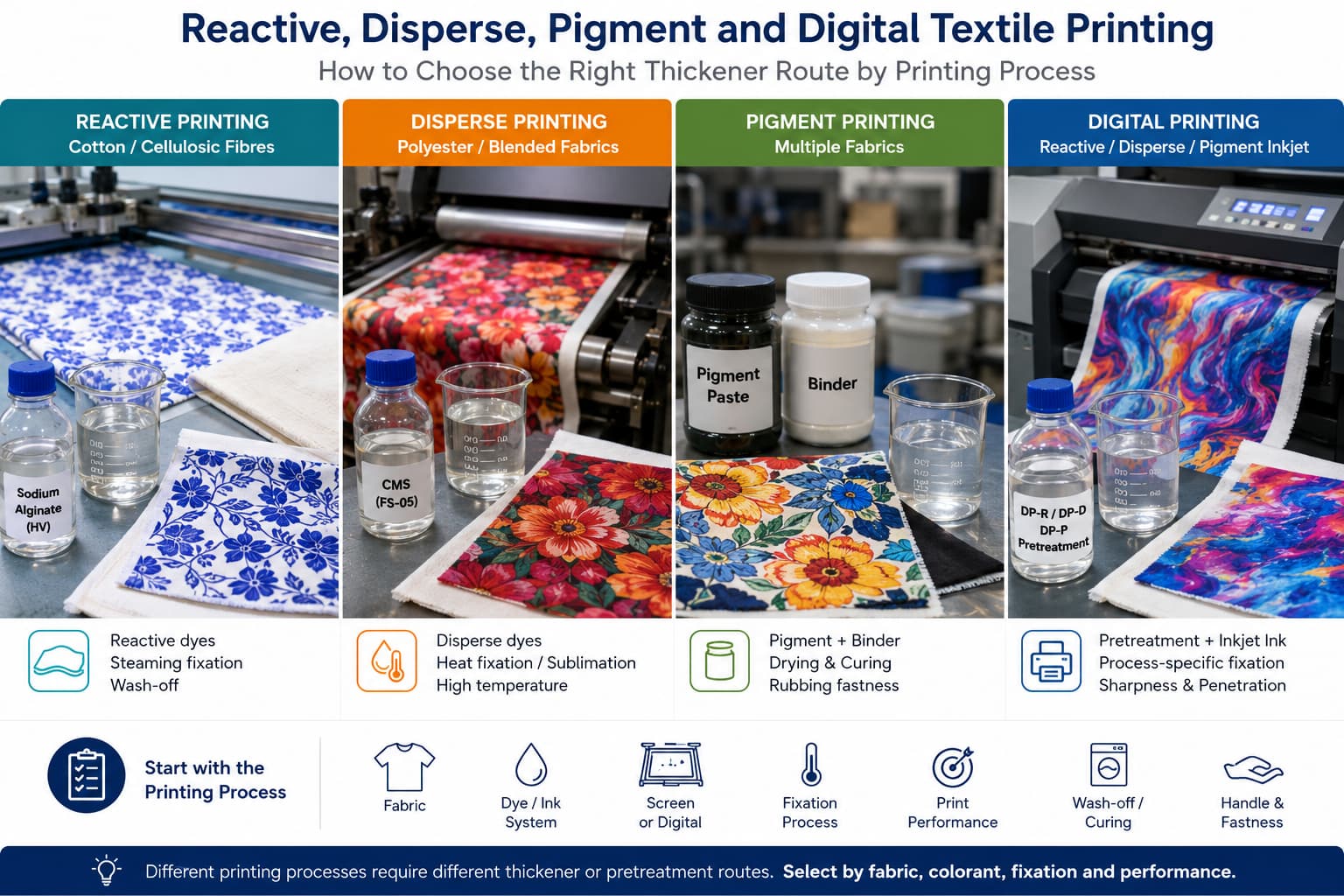
Дізнайтеся, як підібрати загущувач та методи попередньої обробки для реактивного, дисперсного, пігментного та цифрового друку на текстилі з урахуванням вимог до тканини, барвника або чорнила, фіксації, змивання та якості друку.
Друкарська паста на основі CMC використовується у пігментному, реактивному та цифровому текстильному друку. У цьому посібнику пояснюється, які параметри мають значення, як порівнювати постачальників та що слід уточнити перед тим, як оформити оптове замовлення.
І альгінат натрію, і КМК використовуються як загусники в текстильному друку, але вони підходять для різних систем фарбування та умов виробництва. У цьому посібнику пояснюються основні відмінності та випадки, коли слід застосовувати кожну з цих речовин.
The right textile printing thickener is determined by more than fabric type. Buyers should match the thickener to the dye or pigment system, printing method, target rheology, wash-off requirements and actual factory trial conditions.
Textile printing performance depends on a coordinated chemical system, not one universal additive. This guide explains ten important chemical groups, their functions, where they fit and what buyers should verify before production trials.
Textile printing thickeners differ in chemistry, rheology, dye compatibility and wash-off behavior. This guide compares the main thickener families, their common application directions and the parameters buyers should verify before production trials.
Digital printing pastes should be selected by ink chemistry, fabric, application method and post-treatment. This guide compares sodium alginate, CMC, CMS, synthetic polymer and compound pretreatment routes for textile inkjet printing.
FSX Chemical offers separate digital printing paste routes for reactive, disperse and pigment systems, supported by application review, sample matching and technical documentation. This guide explains how buyers can evaluate the right route before bulk purchasing.
Stable digital printing paste requires more than a target viscosity. This guide explains how product selection, water quality, addition sequence, mixing, pH, temperature, filtration, hygiene, storage and quality records influence pretreatment and production consistency.
This product review examines FSX Digital Printing Paste as a textile inkjet pretreatment and thickening route, focusing on ink-system matching, rheology, filtration, print definition, stability and real production testing.
Digital textile printing requires more than advanced ink and printheads. Explore process-specific chemical solutions for reactive, disperse and pigment inkjet printing, from pretreatment and rheology to filtration, fixation and production validation.
Textile printing chemistry is evolving beyond simple viscosity and price comparisons. Explore five innovation directions shaping 2026, including safer chemical inputs, hybrid biopolymer thickeners, advanced pigment binders, shorter digital processes and multifunctional formulations.
Надайте назву продукту, сферу застосування, кількість, місце призначення, а також будь-які технічні специфікації (TDS),
зразки фотографій або документів, які у вас вже є. Компанія FSX Chemical розгляне цю
інформацію та надасть рекомендації щодо подальших кроків: підготовки комерційної пропозиції, підбору зразків
або вибору продукту.
Інформація про товарНазва товару, сорт, модель, фото етикетки або код постачальника.
Доступні документиTDS, SDS, COA, фото зразка, перелік продукції або дані випробувань.
Деталі замовленняОрієнтовна кількість, упаковка, країна призначення, порт або умови торгівлі.
Заявка чи проблемаПроцес друку на текстилі, вимоги до складу, поточні проблеми або цільові показники ефективності.