Ảnh hưởng của độ cứng nước đến độ nhớt của chất làm đặc acrylic và độ ổn định của bột màu
Water hardness can change acrylic-thickener activation, viscosity and complete pigment-paste stability through calcium, magnesium and...
Water hardness can change acrylic thickener viscosity and pigment-paste stability because calcium and magnesium ions alter the ionic environment around anionic acrylic and polyacrylate polymers. The result is not always a simple “harder water = lower viscosity” relationship. Depending on polymer architecture, pH, binder, pigment dispersion and auxiliary package, hard water can reduce thickening efficiency, shift activation behavior, change rheology, increase viscosity drift or destabilize the complete paste. The correct production approach is to qualify the thickener with the actual process water, separate total hardness from general conductivity, and build a controlled water-hardness–viscosity map before changing dosage or adding water-treatment chemicals.
How Does Water Hardness Affect Acrylic Thickener?
Water hardness can influence acrylic thickener through the calcium and magnesium ions dissolved in the process water.
For many anionic acrylic / polyacrylate thickeners, the polymer contains ionized carboxylate groups after neutralization.
Those charged groups help keep the polymer expanded in water.
When the ionic environment changes, polymer conformation and intermolecular interactions can also change.
Possible production effects include:
Lower thickening efficiency
Different pH–viscosity response
Viscosity drift during holding
Changes in shear thinning or recovery
Binder or pigment instability
Different print penetration and definition
The exact response is grade-specific.
Do đó:
Hard Water ≠ Automatically Low Viscosity
và:
Soft Water ≠ Automatically Stable Pigment Paste.
The useful question is:
How does this commercial thickener behave in this mill’s actual water and complete pigment-binder formula?
What Does Water Hardness Mean in Textile Printing?
Water hardness mainly describes dissolved calcium and magnesium content.
Laboratories often report total hardness as:
mg/L as CaCO3
or an equivalent hardness unit.
For textile printing, it is useful to distinguish:
Total hardness
Calcium hardness
Magnesium hardness
Alkalinity
Conductivity
pH
These parameters describe different aspects of water chemistry.
A water sample can have moderate conductivity but problematic calcium concentration, or high conductivity dominated by ions that behave differently from Ca2+ and Mg2+.
Do not use one water-quality number as a substitute for the full process-water profile.
Water Hardness Is Not the Same as Conductivity
Conductivity measures the water’s overall ability to carry electrical current and therefore reflects total dissolved ionic content.
Hardness focuses mainly on calcium and magnesium.
Two waters can have similar conductivity but very different:
Ca2+
Mg2+
Na+
Cl−
HCO3−
For acrylic-thickener troubleshooting, record both:
Total Hardness + Conductivity
where practical.
If water hardness changes but conductivity does not change much, the ion composition may still have shifted enough to affect an anionic polymer system.
Why Acrylic / Polyacrylate Thickeners Respond to Ions
Many acrylic thickeners rely on negatively charged carboxylate groups after neutralization.
When ionic concentration increases, dissolved ions can reduce the effective repulsion between charged polymer segments.
This can allow the polymer structure to become more compact.
A simplified electrolyte response is:
Ions ↑ → Charge Screening ↑ → Polymer Expansion ↓ → Thickening Efficiency Can Fall
Recent polyacrylic-acid thickener research continues to identify electrolyte sensitivity as an important limitation and uses molecular modification to improve viscosity retention.
However, polymer architecture matters.
Hydrophobically modified or supramolecularly reinforced acrylic systems can behave differently from conventional PAA / ASE products.
Why Calcium and Magnesium Deserve Separate Attention
Calcium and magnesium are divalent ions.
They can influence anionic polymer systems differently from monovalent ions such as sodium.
Các tác dụng có thể xảy ra bao gồm:
Stronger local charge screening
Polymer-chain contraction
Interaction with anionic dispersants
Changes in pigment or binder colloidal stability
Polyacrylate research in mineral suspensions has shown that Mg2+ can affect rheological behavior more strongly than a monovalent ion under comparable experimental conditions.
But this does not mean calcium or magnesium will always reduce viscosity in every pigment paste.
Particle interactions, binder colloids and associative acrylic chemistry can produce more complex behavior.
The correct approach is:
Measure the complete formulation.
How Hard Water Can Change pH Activation
Many acrylic pigment-printing thickeners are alkali-activated or pH-responsive.
Hard water does not simply add calcium and magnesium; it can also change the buffering and alkalinity environment of the formulation.
This can alter:
Neutralizer demand
Time to reach stable pH
Activated viscosity
Batch-to-batch repeatability
When testing hard water, keep the final pH inside the same validated activation window.
Otherwise, a viscosity change caused by pH can be incorrectly blamed on hardness.
If the hard-water sample starts normally but drifts later, the problem may involve delayed colloidal interaction rather than immediate polymer charge screening.
Color Yield, Penetration and Print Definition
Water hardness affects the final print only if it changes the behavior of the complete paste or fixation system.
Possible indirect effects include:
Lower viscosity → more penetration
Different recovery → more spreading
Pigment flocculation → uneven color
Binder instability → uneven surface film
Đánh giá:
K/S or agreed shade
Fine-line definition
Độ đồng đều của vùng rắn
Độ thâm nhập
after identical printing and curing.
Do not assume a laboratory viscosity difference automatically produces a visible color difference.
Rubbing Fastness and Curing
Acrylic thickener does not create pigment fixation by itself.
Binder and curing remain the main fixation variables.
Hard water can still affect rubbing indirectly if it changes:
Phân phối bìa hồ sơ
Pigment distribution
Lớp lắng đọng dạng bột nhão
Colloidal stability
If rubbing fastness changes between water sources, check both:
Wet-paste stability
Cured binder film
Keep curing temperature and time identical during the comparison.
DI, RO, Softened and Plant Water: What Should You Compare?
Deionized / Very Low-Ion Water
Useful as a laboratory reference because it minimizes ionic interference.
RO Water
Usually much lower in hardness and dissolved ions than raw plant water, although actual quality depends on membrane performance and pretreatment.
Softened Water
Ion-exchange softening mainly replaces calcium and magnesium with sodium.
This reduces hardness but does not necessarily reduce conductivity or total dissolved ions as strongly as RO.
Plant Water
This is the water that matters most for actual production qualification.
Use low-ion water as a diagnostic reference, but approve the thickener on the real production water or on a controlled water specification the factory can consistently maintain.
Run this first with activated thickener and then with the complete pigment paste.
Do not convert the graph into a universal hardness limit unless production validation supports that limit.
Use Water Controls to Isolate the Root Cause
A good troubleshooting set can include:
Ví dụ
Nước
Formula
Question
A
Low hardness
Thickener only
Polymer baseline
B
Plant water
Thickener only
Water effect on polymer
C
Low hardness
Complete pigment paste
Formula baseline
D
Plant water
Complete pigment paste
Combined water + formula effect
This design helps separate:
Water-only thickener sensitivity
Binder/pigment compatibility
Combined hard-water effects
How to Run a Calcium / Magnesium Challenge Test
If the mill needs deeper root-cause data, separate total-hardness testing from controlled Ca2+ and Mg2+ challenges.
Keep constant:
Liều lượng chất làm đặc
Giá trị pH cuối cùng
Nhiệt độ
Total formula mass
Measurement method
Then add controlled, known levels of the relevant hardness salts.
Bản ghi:
pH
Độ nhớt
Khả năng duy trì độ nhớt
Hình thức
Duy trì sự ổn định
Do not directly copy a challenge concentration from an unrelated industry.
Use the actual plant-water range or a technically justified worst-case process condition.
Should You Add a Chelating Agent?
A chelating or sequestrating agent can sometimes reduce the effect of calcium and magnesium by binding the ions.
But it should not be added automatically.
A chelator can also change:
Cân bằng ion
pH
Dung dịch phân tán sắc tố
Binder behavior
Wastewater chemistry
Hãy thực hiện theo trình tự sau:
Confirm Hardness Is the Root Cause → Select a Compatible Chelator → Test Dose Ladder → Recheck Binder / Pigment → Print → Cure
Do not use chelation to hide unstable water quality that the plant can control more effectively upstream.
Should You Soften or Use RO Water?
The best water-treatment route depends on the factory.
Softening
Useful when calcium and magnesium are the main problem.
But sodium concentration and conductivity can remain significant.
Reverse Osmosis
Can reduce a broader range of dissolved ions and often gives a more controlled laboratory-like water source.
But RO has:
Capital cost
Operating cost
Membrane maintenance
Reject-water management
Choose water treatment from:
Required Water Specification + Production Volume + Chemical Savings + Quality Risk
rather than assuming RO is always necessary.
Seasonal and Factory-to-Factory Water Variation
Plant water can change with:
Season
Municipal water source
Well-water ratio
Rainfall
Water-treatment operation
This can explain why:
Same Thickener + Same Formula + Same Operator
produces different viscosity at different times.
For multi-factory operations, each plant should record its own:
Total hardness
Conductivity
pH
rather than assuming one corporate recipe will behave identically everywhere.
Water QC for Pigment Printing
A practical water-control panel can include:
Total hardness
Calcium hardness where relevant
Magnesium hardness where relevant
Conductivity
pH
Alkalinity where process-sensitive
Trend results instead of recording only pass/fail.
A gradual hardness increase can explain viscosity drift before the paste reaches a formal rejection point.
The water specification should be based on validated production performance rather than a generic internet limit.
Incoming QC for the Thickener
Water hardness should not be used to excuse an inconsistent thickener batch.
Incoming thickener QC can still include:
Loại / lô
Hình thức
pH
Chất rắn
As-supplied viscosity where specified
Standardized activation viscosity
For periodic application verification, test the product in a controlled reference water.
This separates:
Thickener Batch Variation
from:
Process Water Variation.
Phê duyệt thử nghiệm sản xuất
After laboratory water screening, confirm the selected condition on the real machine.
Bản ghi:
Độ cứng của nước / Độ dẫn điện
Thickener grade and batch
Liều lượng
Giá trị pH cuối cùng
Pigment / binder formula
Độ nhớt khi bắt đầu / giữa / kết thúc quá trình chạy
Tốc độ máy
Hành vi trên màn hình
Pattern definition
Độ đồng nhất về màu sắc
Quá trình làm cứng
Chà khô / chà ướt
Vải dệt tay
Approve a water/thickener combination as a production window, not from one beaker result.
Common Hard-Water Troubleshooting Mistakes
1. Assuming Hard Water Always Lowers Viscosity
The direction and magnitude depend on polymer and complete-formula interactions.
2. Using Conductivity as the Hardness Number
Conductivity measures all ions, not specifically calcium and magnesium.
3. Changing Thickener Dosage Before Checking Water
The root cause may be seasonal water variation.
4. Comparing Water Samples at Different pH
Activation differences can be mistaken for hardness effects.
5. Testing Thickener in Water Only
Binder and pigment can amplify or change the hard-water response.
6. Adding Chelator Without Root-Cause Testing
The chelator can alter the complete formula.
7. Assuming Softened Water Is the Same as RO Water
Softening replaces hardness ions; RO removes a broader range of dissolved ions.
8. Using One Universal Hardness Limit
The acceptable limit should be validated for the actual thickener and pigment formula.
Bảng khắc phục sự cố
Vấn đề được ghi nhận
Các biến cần kiểm tra trước tiên
Đừng vội kết luận
Viscosity lower with plant water
Total hardness, pH, conductivity, Ca/Mg
Mẻ chất làm đặc này không đạt yêu cầu
Viscosity changes only after binder
Hard-water binder compatibility
Water-only thickener test is enough
Paste develops floc after pigment
Pigment dispersant + Ca/Mg interaction
The thickener alone caused it
Summer viscosity differs from winter
Water source, hardness, temperature
Seasonal change is only temperature
Softened water improves paste but conductivity stays high
Na+ replacement and total dissolved ions
Softening equals deionization
RO water gives higher viscosity
Hardness/electrolyte sensitivity
RO is automatically required for production
Same hardness, different viscosity
Ca/Mg ratio, conductivity, pH, formula
Total hardness fully describes the water
Chelator restores viscosity but print changes
Binder/pigment interaction, pH
Viscosity recovery proves full compatibility
Tổng chi phí trong quá trình sử dụng
Water chemistry affects cost through:
Liều lượng chất làm đặc
Neutralizer adjustment
Chelating agents
Water treatment
Machine stability
Sửa lại
Color variation
Một mô hình hữu ích là:
Total Cost in Use = Thickener + Water Treatment + Formula Adjustment + Machine Efficiency + Rework + Quality Loss
A more hard-water-tolerant acrylic thickener can justify a higher purchase price if it reduces:
Water-treatment demand
Dosage correction
Batch variation
Production rejects
Conversely, investing in stable process water can be cheaper than continuously compensating with a more expensive thickener.
Compare the full system.
Bạn nên cung cấp những thông tin nào cho nhà cung cấp chất làm đặc?
For useful hard-water troubleshooting, provide:
Chất làm đặc hiện tại / TDS
Liều lượng chất làm đặc
Activation pH / neutralizer
Độ nhớt và phương pháp thử nghiệm toàn diện
Total water hardness
Calcium / magnesium data if available
Conductivity
Water pH
Dung dịch phân tán sắc tố
Loại chất kết dính và liều lượng
Thiết bị cố định / thiết bị phụ trợ
Vải
Rây phẳng hoặc rây quay
Thời gian giữ
Main problem: viscosity loss, flocculation, color variation or instability
FSX Chemical có thể sử dụng thông tin này thông qua Mẫu và việc kết hợp to compare the current process water with a controlled reference and select a more appropriate trial route.
How Should a Mill Control Water Hardness for Acrylic Thickener?
Một chuỗi quyết định thực tiễn là:
Measure Water → Standardize pH → Compare Low-Hardness vs. Plant Water → Build Hardness–Viscosity Map → Add Binder / Pigment → Hold → Screen Print → Decide on Thickener, Chelation or Water Treatment
Các nguyên tắc chính là:
Water hardness mainly reflects calcium and magnesium; conductivity is a different measurement.
Polyacrylate thickeners can respond to ionic screening, but the direction and magnitude of complete-paste viscosity change are grade-specific.
Ca²⁺ and Mg²⁺ should be considered separately from simple sodium-salt tests when hard water is the suspected root cause.
Final pH must be controlled before hardness effects are compared.
The complete pigment-binder paste is more important than the water-only test.
The acceptable hardness range should be defined from production evidence, not a universal generic limit.
Các câu hỏi thường gặp
1. Does hard water reduce acrylic thickener viscosity?
It can, especially in electrolyte-sensitive anionic polyacrylate systems, but the exact response depends on polymer architecture, pH, binder, pigment and ionic composition.
2. Which ions cause water hardness?
Calcium and magnesium are the main hardness ions in most process-water discussions.
3. Is conductivity the same as water hardness?
No. Conductivity reflects total dissolved ionic content, while hardness mainly reflects calcium and magnesium.
4. Why are calcium and magnesium important for acrylic thickener?
They are divalent ions and can alter anionic-polymer interactions, pigment dispersants and binder colloidal stability differently from monovalent ions.
5. Can hard water affect pH activation?
Yes. Water chemistry and alkalinity can change neutralizer demand and the time needed to reach stable pH and viscosity.
6. Should acrylic thickener always be prepared with RO water?
No. Use the real production water if it stays inside the validated process window. RO is useful when broader dissolved-ion control is economically justified.
7. Is softened water the same as RO water?
No. Ion-exchange softening mainly replaces calcium and magnesium with sodium, while RO removes a broader range of dissolved ions.
8. Can I add EDTA or another chelator to solve hard-water problems?
Potentially, but first prove hardness is the root cause and verify the chelator does not disrupt pigment, binder, pH or wastewater performance.
9. Why does the thickener work in DI water but fail in plant water?
Plant water may add hardness ions, alkalinity and other dissolved salts that change polymer activation or complete-paste compatibility.
10. Why does the paste fail only after binder is added?
The water hardness may be interacting with binder colloids or surfactants, creating a combined compatibility problem rather than a water-only thickener problem.
11. What water tests should a pigment-printing mill record?
Total hardness, conductivity and pH are useful routine starting points; calcium, magnesium and alkalinity can be added when the process requires deeper control.
12. What should I send FSX Chemical for hard-water matching?
Send the current thickener/TDS, dosage, pH, viscosity method, water hardness/conductivity, pigment, binder, machine route, holding time and the observed stability problem.
Match Acrylic Thickener to Your Real Process Water
If an acrylic thickener gives different viscosity between laboratory water and factory water, or if your pigment paste changes with season, plant location or binder addition, FSX Chemical can help structure a controlled water-hardness comparison.
Để nhận được bài đánh giá kỹ thuật hữu ích, vui lòng gửi:
Mẫu chất làm đặc tổng hợp hiện tại của quý khách, TDS hoặc COA
Liều lượng hiện tại
Activation pH and neutralizer
Độ nhớt và phương pháp thử nghiệm toàn diện
Total water hardness
Conductivity and pH
Calcium / magnesium data if available
Dung dịch phân tán sắc tố
Hệ thống chất kết dính / chất cố định
Fabric and screen-printing route
Thời gian giữ
Current viscosity, flocculation or color-consistency problem
Bắt đầu bằng Mẫu và việc kết hợp để tiến hành một thử nghiệm có đối chứng so sánh giữa nhóm đối chứng và nhóm thí nghiệm.
The right response to hard-water viscosity problems is not automatically more thickener or more chelator. First determine how the actual Ca²⁺/Mg²⁺ environment changes activation, complete-paste rheology and binder/pigment stability; then choose the lowest-cost control point in the full process.
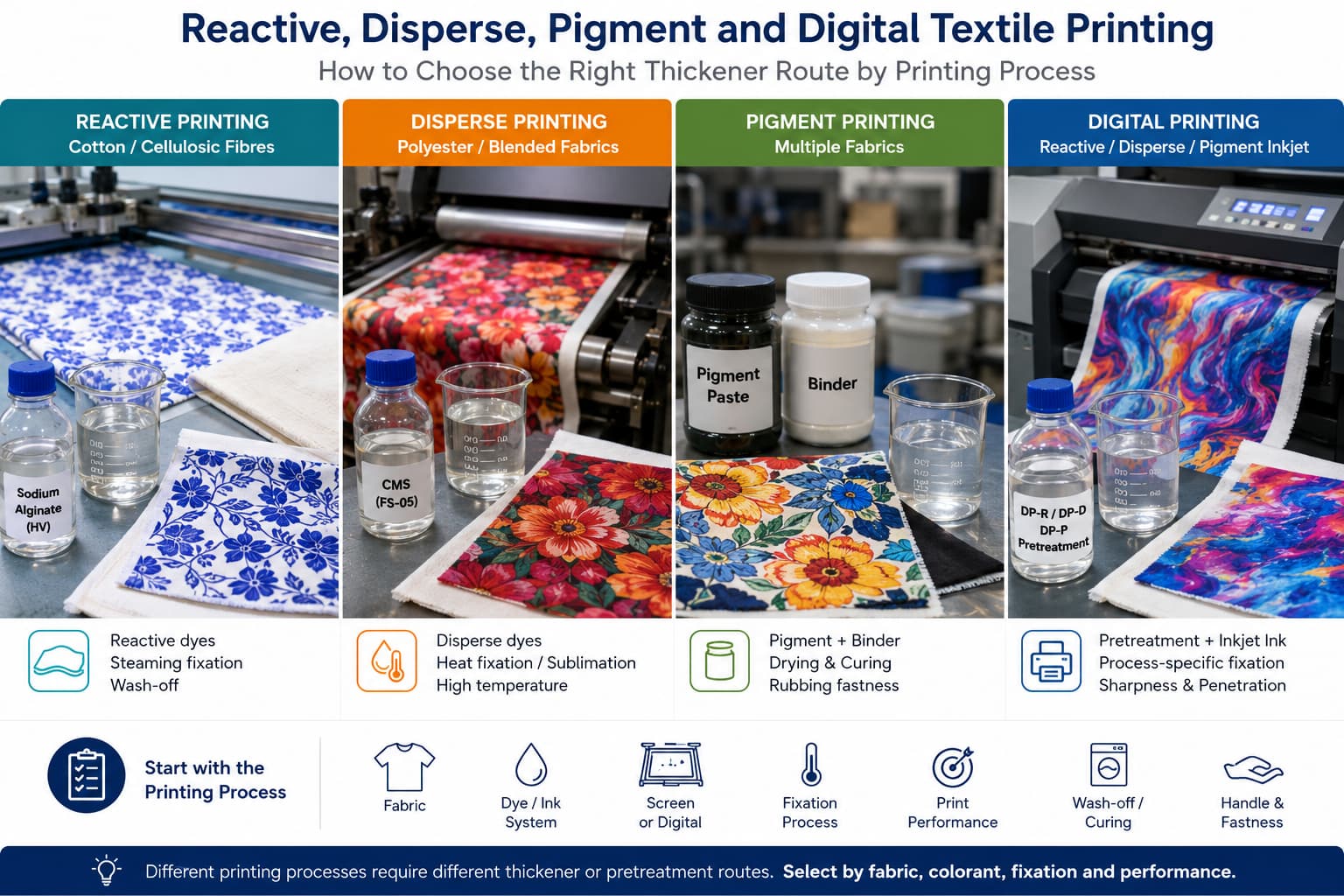
Tìm hiểu cách lựa chọn chất làm đặc và quy trình tiền xử lý cho các phương pháp in dệt phản ứng, in phân tán, in sắc tố và in kỹ thuật số, dựa trên các yêu cầu về vải, thuốc nhuộm hoặc mực in, quá trình cố định màu, khả năng rửa trôi và chất lượng in.
Hỗn hợp in dựa trên CMC được sử dụng rộng rãi trong in vải bằng bột màu, in phản ứng và in kỹ thuật số. Hướng dẫn này giải thích các thông số quan trọng, cách so sánh các nhà cung cấp và những yêu cầu cần đưa ra trước khi đặt hàng số lượng lớn.
Cả natri alginat và CMC đều được sử dụng làm chất làm đặc trong in vải, nhưng chúng phù hợp với các hệ thống thuốc nhuộm và điều kiện quy trình khác nhau. Hướng dẫn này giải thích những điểm khác biệt chính và thời điểm nên sử dụng từng loại.
Việc lựa chọn chất làm đặc phù hợp cho in ấn trên vải không chỉ phụ thuộc vào loại vải. Người mua nên lựa chọn chất làm đặc sao cho phù hợp với hệ thống thuốc nhuộm hoặc bột màu, phương pháp in, tính lưu biến mong muốn, yêu cầu về khả năng rửa trôi và các điều kiện thử nghiệm thực tế tại nhà máy.
Hiệu quả in trên vải phụ thuộc vào một hệ thống hóa học phối hợp nhịp nhàng, chứ không phải chỉ dựa vào một chất phụ gia duy nhất. Cẩm nang này giải thích về mười nhóm hóa chất quan trọng, chức năng của chúng, vị trí ứng dụng cũng như những điều người mua cần kiểm tra trước khi tiến hành thử nghiệm sản xuất.
Các chất làm đặc dùng trong in vải có sự khác biệt về thành phần hóa học, tính lưu biến, khả năng tương thích với thuốc nhuộm và đặc tính phai màu khi giặt. Hướng dẫn này so sánh các nhóm chất làm đặc chính, các hướng ứng dụng phổ biến của chúng và các thông số mà người mua cần kiểm tra trước khi tiến hành thử nghiệm sản xuất.
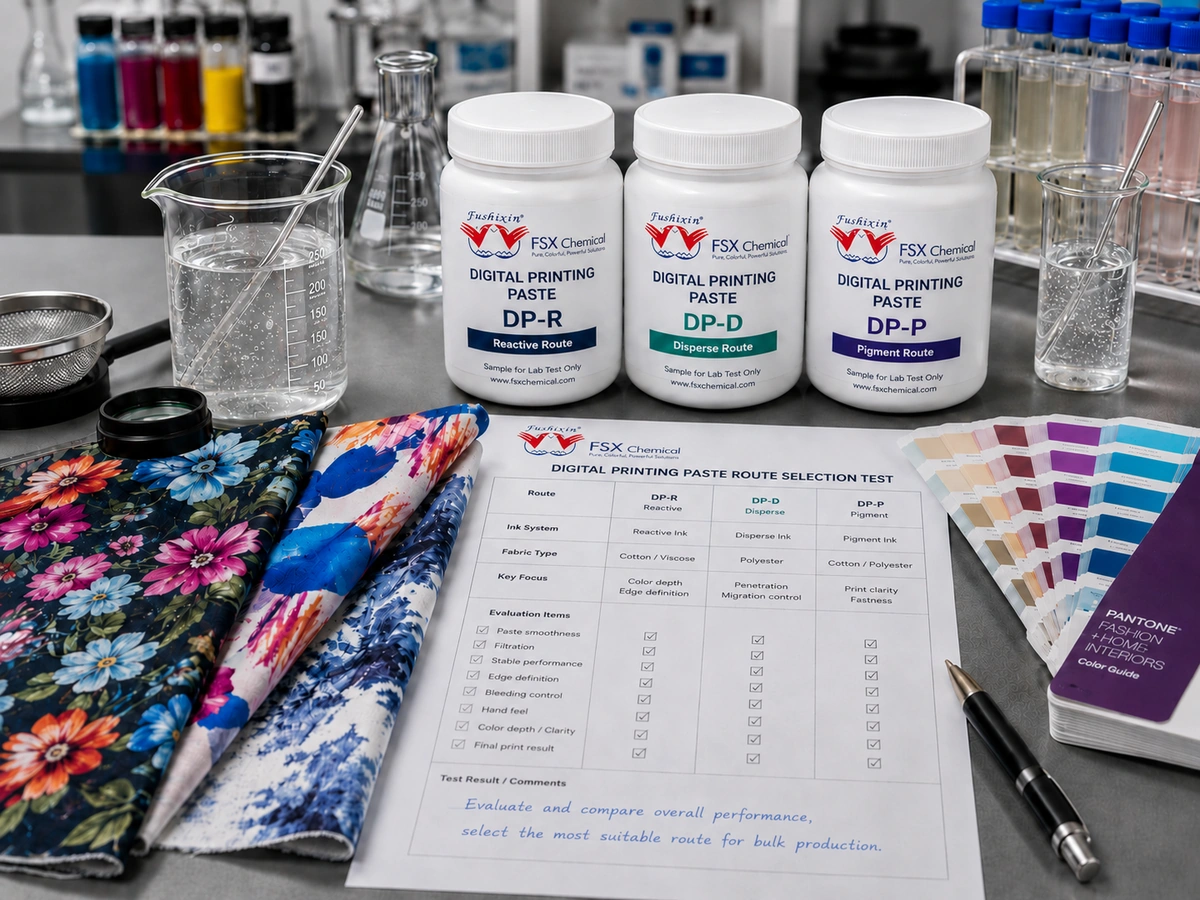
Việc lựa chọn chất nhão in kỹ thuật số cần dựa trên thành phần hóa học của mực, loại vải, phương pháp in và quy trình xử lý sau in. Hướng dẫn này so sánh các phương pháp tiền xử lý sử dụng alginat natri, CMC, CMS, polymer tổng hợp và hỗn hợp trong in phun trên vải.
FSX Chemical cung cấp các quy trình sản xuất bột in kỹ thuật số riêng biệt dành cho các hệ thống mực phản ứng, mực phân tán và mực sắc tố, kèm theo dịch vụ đánh giá ứng dụng, đối chiếu mẫu và tài liệu kỹ thuật. Hướng dẫn này giải thích cách người mua có thể đánh giá quy trình phù hợp trước khi đặt hàng số lượng lớn.
Để có được hỗn hợp in kỹ thuật số ổn định, không chỉ cần đạt được độ nhớt mục tiêu. Hướng dẫn này giải thích cách thức mà việc lựa chọn sản phẩm, chất lượng nước, thứ tự pha trộn, quá trình trộn, độ pH, nhiệt độ, quá trình lọc, vệ sinh, bảo quản và hồ sơ chất lượng ảnh hưởng đến quá trình tiền xử lý và tính nhất quán trong sản xuất.
Bài đánh giá sản phẩm này phân tích sản phẩm FSX Digital Printing Paste với vai trò là giải pháp tiền xử lý và làm đặc mực in phun trên vải, tập trung vào các khía cạnh như sự tương thích với hệ thống mực, tính lưu biến, quá trình lọc, độ sắc nét của bản in, độ ổn định và các thử nghiệm trong điều kiện sản xuất thực tế.
In kỹ thuật số trên vải không chỉ đòi hỏi mực in và đầu in tiên tiến. Hãy khám phá các giải pháp hóa học chuyên biệt cho từng quy trình in phun mực phản ứng, mực phân tán và mực pigment, từ xử lý tiền in và tính lưu biến đến lọc, cố định và xác nhận quy trình sản xuất.
Hóa học in trên dệt may đang phát triển vượt ra ngoài những so sánh đơn thuần về độ nhớt và giá cả. Hãy cùng khám phá năm hướng đi đổi mới định hình xu hướng năm 2026, bao gồm các nguyên liệu hóa học an toàn hơn, chất làm đặc sinh học lai, chất kết dính sắc tố tiên tiến, quy trình in kỹ thuật số rút ngắn và các công thức đa chức năng.
Vui lòng cung cấp tên sản phẩm, ứng dụng, số lượng, điểm đến và bất kỳ tài liệu kỹ thuật (TDS),
hình ảnh mẫu hoặc tài liệu nào mà quý khách đã có. FSX Chemical sẽ xem xét
thông tin này và đề xuất bước tiếp theo liên quan đến báo giá, đối chiếu mẫu
hoặc lựa chọn sản phẩm.
Thông tin sản phẩmTên sản phẩm, cấp loại, mẫu mã, ảnh nhãn mác hoặc mã tham chiếu của nhà cung cấp.
Các tài liệu có sẵnTDS, SDS, COA, ảnh mẫu, danh mục sản phẩm hoặc dữ liệu thử nghiệm.
Chi tiết đơn hàngSố lượng dự kiến, hình thức đóng gói, nước nhập khẩu, cảng hoặc điều kiện thương mại.
Yêu cầu hoặc Vấn đềQuy trình in trên vải, yêu cầu về công thức, vấn đề hiện tại hoặc chỉ tiêu hiệu suất.