Chất làm đặc dệt may giá rẻ so với cao cấp: Các nhà máy nên đánh giá chi phí tổng thể như thế nào
Affordable and premium textile thickeners should not be compared by price per kilogram alone. This...
Compare textile thickeners at the dosage needed to produce acceptable fabric, then calculate delivered chemical cost and the associated preparation, cleaning and quality costs. A higher price is justified only when its measured benefit exceeds the extra cost. Neither “affordable” nor “premium” establishes a technical grade or a performance advantage.
Textile printing thickeners are available across a wide price range. Some products are positioned as economical alternatives, while others are sold as premium grades with tighter specifications, specialized performance or additional technical support.
The lowest-priced product is not automatically the most economical, and the highest-priced grade is not automatically the best. A thickener creates value only when it performs reliably in the buyer’s actual fabric, colorant system, formulation, equipment and post-treatment process.
A low-cost product may stand out when it provides stable performance at a practical dosage in a standard application. A premium product may justify its price when it reduces preparation problems, improves machine reliability, controls a demanding formulation or provides stronger sample-to-batch consistency.
The correct comparison is therefore based on total cost in use rather than the quotation price alone. Buyers should include dosage, preparation, filtration, machine interruptions, rejected paste, reprocessing and final textile quality when evaluating different grades.
What Do Affordable and Premium Actually Mean?
Affordable and premium are commercial descriptions rather than defined technical grades. Two suppliers may use these terms differently, and a premium price does not reveal which performance features are included.
Affordable textile thickeners
An affordable thickener is generally positioned around competitive purchase price and practical performance for a defined application. It may be a standard commercial grade, a locally available material or a product with a simplified service package.
Affordable does not necessarily mean low quality. A stable standard grade can be the most economical choice when the formulation is not highly demanding and the buyer has sufficient laboratory and production-control capability.
Premium textile thickeners
A premium thickener may be positioned around specialized rheology, higher purity, tighter batch limits, improved filtration, faster preparation, application-specific formulation or additional technical support.
These features may justify a higher price when they solve a measurable production problem. They do not justify the price when the supplier cannot explain or demonstrate the relevant advantage.
Mid-range products
Many industrial products fall between these two categories. They may combine competitive factory pricing with controlled specifications, samples, technical documents and application support.
For many buyers, a well-matched mid-range grade provides a better risk-to-cost balance than either the cheapest available product or the most expensive branded option.
Compare Evidence, Not Price Labels
Purchase question
Measure for each candidate
Do not infer from price
What is the delivered cost?
Same currency, delivery point, packing basis and relevant purchase costs
That a cheaper quotation has a lower landed cost
How much is required?
As-supplied kilograms in the final working paste at acceptable print quality
That a premium grade needs less material
Can it run reliably?
Preparation, filterability, holding, screen or application behavior
That either price tier has better process stability
Is supply consistent?
Identified grade, agreed method-linked limits and commercial-lot verification
That high price proves tighter batch control
Does support create value?
Useful trial guidance, documented responses and resolution of relevant problems
That more sales claims mean stronger technical support
Apply the same evidence requirements to FSX and other suppliers. Compare only candidates that pass the required finished-fabric and operating limits.
1. Price per Kilogram vs Cost in Use
Price per kilogram is the easiest number to compare, but it is only one part of the commercial result.
A lower-priced product can become more expensive when it requires higher dosage, longer mixing, additional filtration or more frequent machine cleaning. A premium product can also be poor value when its claimed advantages do not improve production.
Direct material cost
Direct material cost depends on the delivered product price and the quantity used per paste batch. Freight, duty, handling and payment terms may also affect the actual landed cost.
Chi phí chuẩn bị
Include mixing time, heating or cooling, labor, filtration and material remaining in tanks or filters.
Chi phí sản xuất
Include machine interruptions, screen cleaning, viscosity correction, unused paste, design defects and production speed.
Quality cost
Include reprinting, additional washing, rejected fabric, customer claims and laboratory investigation.
Supply-risk cost
Product shortages, unidentified grade changes and inconsistent batches can create emergency purchasing, extra inventory and production delays.
2. Thickening Efficiency and Dosage
Thickening efficiency describes how much product is required to reach a useful paste condition. Buyers often assume a premium product should require less material, but this must be confirmed in the complete formulation.
High water viscosity does not prove low dosage
A product may produce high viscosity in water but lose structure after dyes, salts, alkalis or binders are added.
Another product with a lower water viscosity may provide better formulation stability and require a similar or lower practical dosage.
Compare at equal concentration first
An equal-concentration screen can help compare similar product forms when both grades support the same preparation conditions. Follow each grade’s required activation or hydration method and record differences. Do not force a liquid concentrate and a powder, or two different chemistries, into one preparation method and call the result a fair production comparison.
Optimize each product separately
After the first comparison, adjust dosage in controlled steps. The final dosage should meet the same printing and fabric-quality requirements.
Consider supplied-product moisture or solids
Equal product weight does not always mean equal dry polymer or active content. Review moisture or solids data where relevant.
3. Rheology and Print Definition
A premium thickener may stand out when it provides a rheological profile that is difficult to achieve with a standard product. However, higher viscosity alone is not sufficient.
Flow under printing shear
The paste must flow when it is exposed to mixing, pumping, screen pressure or coating shear. Insufficient flow can reduce transfer and create uneven prints.
Recovery after application
After reaching the fabric, the paste should recover enough structure to control spreading and penetration. The preferred recovery depends on the machine, design and textile.
Print edge and fine-detail control
Premium pricing may be justified for fine designs, high-speed printing or demanding fabrics when the product produces repeatably sharper results.
The advantage should be demonstrated using fine lines, small text, sharp corners, solid areas and representative production designs.
Standard production may not require specialized rheology
For simple designs and stable machine conditions, an affordable standard grade may produce acceptable quality without the cost of a specialized rheological system.
4. Dispersion, Hydration and Preparation Time
Preparation performance can create a meaningful difference between two products even when their final viscosity is similar.
Powder addition
A product that forms persistent lumps may require slower addition, stronger mixing or repeated filtration.
Thời gian bù nước
A faster-hydrating grade may reduce waiting time and improve production flexibility. The benefit depends on the factory’s batch schedule and available mixing capacity.
Mixing-energy requirement
Some grades need high mechanical input, while others disperse under more moderate conditions. Compare the products using production-relevant mixers.
Preparation consistency
A premium grade may justify its price when it is less sensitive to minor operator or temperature variation. This benefit should be established through repeated batches rather than one ideal laboratory preparation.
Affordable products can still prepare efficiently
Factory-direct or standard grades may provide reliable dispersion when the correct addition method is used. Poor preparation should not automatically be attributed to price category.
5. Chemical Compatibility
Chemical compatibility is often more important than nominal price. A product that cannot tolerate the required dyes, salts, alkalis, binders or auxiliaries is not economical at any price.
In phản ứng
Alginat natri is an important reference route for reactive printing on cellulosic textiles. Affordable and premium alginate grades should be compared by dye compatibility, rheology, filtration, print result and wash-off.
Their suitability depends on confirmed chemistry, commercial grade, preparation, electrolyte response and the complete application. Substitution criteria apply only where relevant to that chemistry; the FSX CMS commercial series must be checked by exact grade and current documentation, rather than assumed to share one starch composition.
Pigment and binder systems
In pigment printing, compatibility with the binder and curing system is essential. A lower-priced thickener that destabilizes the binder can create higher total production cost.
Digital printing
A dedicated Hỗn hợp in kỹ thuật số should be selected according to reactive, disperse or pigment ink, fabric, pretreatment method and fixation process.
6. Filtration and Machine Reliability
Filtration and machine behavior are common areas where an apparently cheap product can create hidden cost.
Undissolved material
Lumps, coarse particles and gels can remain after preparation and interfere with screens, pumps, filters or coating equipment.
Use a process-relevant filter
Compare samples using the same filter opening, quantity and procedure. The method should reflect the actual production equipment.
Measure cleaning and interruption frequency
Record how often screens, filters or lines require cleaning during the trial. The cost of lost machine time can exceed a small difference in material price.
A premium grade should demonstrate the advantage
Claims such as excellent filtration or smooth paste should be verified by actual residue, pressure, cleaning or machine-trial data.
Do not reject an affordable grade from appearance alone
Powder color or visual texture may differ without affecting performance. Filtration and application testing provide a more reliable basis.
7. Paste Stability and Holding Time
Printing paste may remain in a tank or container for several hours before use. Stability during this period can influence both quality and cost.
Check viscosity drift
Measure immediately after preparation, after complete hydration and after the normal factory holding period.
Check physical stability
Sự tách biệt
Thanh toán
Quá trình hình thành lớp biểu bì
Khả năng giữ bọt
Phát triển gel
Khả năng lọc sau khi bảo quản
Premium stability may reduce correction work
A more stable grade may reduce water addition, thickener correction and rejected paste in factories with long holding periods.
Short-use formulations may not need extended stability
When paste is prepared and consumed quickly under controlled conditions, paying for unusually long stability may provide limited benefit.
8. Batch-to-Batch Consistency
Batch consistency is one of the strongest potential differences between a basic product and a more controlled commercial grade.
Specification range
Premium products may offer tighter limits for selected parameters. However, tighter limits are useful only when they control properties that affect the application.
Permanent commercial grade
The approved sample, TDS, quotation, package label and COA should use the same permanent grade code.
Batch-specific information
Buyers should review which parameters are reported on the COA and whether the test methods match the agreed specification.
First-batch verification
Even a premium product should be checked when the first commercial batch arrives. Brand reputation does not replace incoming inspection.
Affordable factory-direct grades can still be controlled
A competitive price may come from direct manufacturing, efficient distribution or standardization rather than reduced quality control.
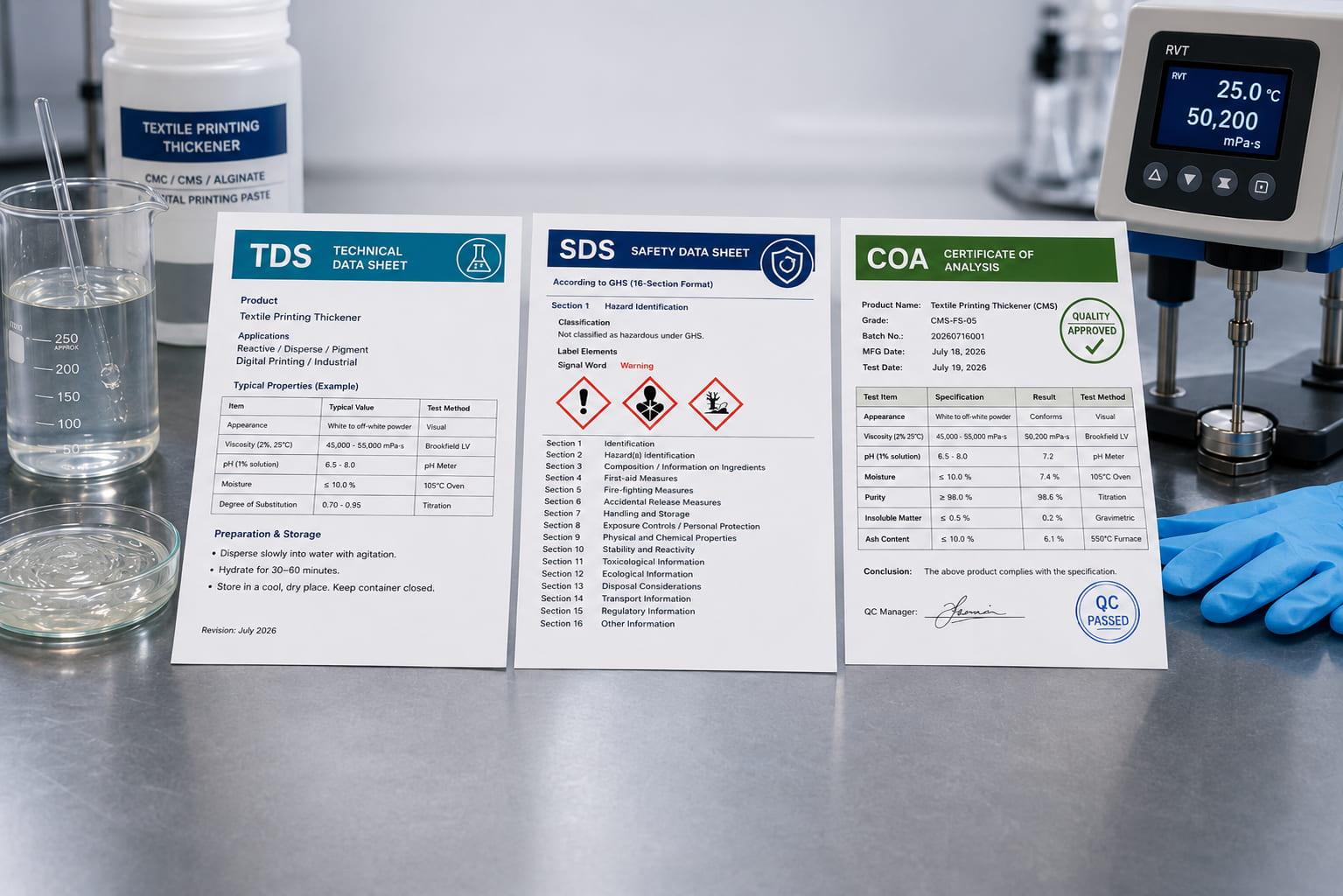
Documentation is part of the commercial value of a textile thickener. Buyers need enough information to approve, receive and trace the product.
Bảng dữ liệu kỹ thuật
The TDS should identify the product, application direction, relevant properties and preparation information.
Bảng dữ liệu an toàn
The SDS supports handling, storage, transport and workplace-safety review.
Giấy chứng nhận phân tích
A batch-specific COA should identify the relevant product and batch and report agreed control parameters where applicable.
Certificates and test reports
Premium pricing is sometimes supported by certification or third-party testing. Buyers should confirm that the document applies to the exact supplier, grade, scope and validity period.
More documents do not automatically mean better performance
Documentation supports procurement control, but it does not replace the buyer’s formulation and production trial.
10. Technical Support and Grade Matching
Technical support can justify a higher product price when it reduces testing time, prevents incorrect grade selection or helps solve a production problem.
Application review
A capable supplier should ask about the fabric, dye or ink system, equipment, current dosage, viscosity method and main problem.
Current-product matching
Buyers may provide the current TDS, sample, label, COA or test results for a more targeted comparison.
Sample support
Representative samples allow the buyer to compare the product before a bulk commitment.
Trial-result review
Useful support should help determine whether a problem comes from grade mismatch, preparation, dosage, chemical compatibility, water or machine conditions.
Do not pay a premium for sales language alone
Terms such as technical service or customized support should be connected to clear actions, documents and response procedures.
How Product Families Compare
Dòng sản phẩm
Affordable Grade May Stand Out When
Premium Grade May Stand Out When
Alginat natri
Standard reactive printing requires reliable viscosity and acceptable wash-off at a competitive dosage
High-speed, fine-detail or sensitive reactive printing requires tighter filtration, rheology or batch limits
Tinh bột carboxymethyl
CMS is used in a standard mixed thickener or sizing formulation with controlled factory conditions
A specialized substitution, purity or film-property profile is needed
Carboxymethyl cellulose
A standard viscosity and purity grade meets the printing, sizing or coating requirement
Tight substitution, purity, electrolyte tolerance or particle requirements affect production
Synthetic thickener
A standard pigment formulation is stable and the buyer can control neutralization and dosage
Specialized shear response, electrolyte tolerance or binder compatibility is required
Compound thickener
A standard supplier formulation meets the production target
The formulation is tailored for a specific machine, colorant or production problem
Digital printing paste
A standard pretreatment works with the existing ink and fabric system
Fine definition, difficult fabrics, filtration or handle requires application-specific optimization
The commercial category should never replace grade-specific testing. One affordable grade may outperform a premium product when it is better matched to the process.
When an Affordable Thickener Can Be the Better Choice
The process is standardized
Stable recipes, controlled water, experienced operators and consistent equipment reduce the need for an unusually tolerant grade.
The print design is not highly demanding
Simple patterns or solid areas may not require premium fine-detail rheology.
The product passes all critical tests
An affordable grade is a strong choice when it meets filtration, stability, printing, wash-off and final fabric requirements.
The supplier provides an identifiable commercial grade
Competitive price is less risky when the product has a permanent code, defined specification and batch documentation.
The buyer has strong internal technical capability
Factories with capable laboratories may successfully optimize a standard grade without paying for an extensive supplier service package.
The price advantage remains after cost-in-use calculation
The product should still be less expensive after dosage, preparation, cleaning, waste and quality costs are included.
When a Premium Grade May Be Worth the Cost
Production downtime is expensive
High-capacity lines may justify paying more for filtration, stability and batch consistency when a short interruption creates substantial loss.
The design requires high precision
Fine lines, gradients and detailed patterns may benefit from more application-specific rheology.
The formulation has high chemical stress
High salt, alkali, binder or pigment loading may require a grade with proven tolerance.
The fabric is difficult to control
Lightweight, highly absorbent or technically specialized fabrics may require tighter paste or pretreatment behavior.
The factory has limited technical resources
Grade matching, documented preparation and responsive support may reduce the buyer’s internal development burden.
The supply program requires tighter documentation
Brand or export programs may require clearer product identity, COA, certificates or traceability.
The performance advantage is repeatable
Premium pricing is justified only when the benefit appears consistently across representative laboratory and production trials.
Warning Signs of a False Economy
The product requires substantially higher dosage.
Operators repeatedly add water or more thickener to correct the paste.
Preparation creates persistent lumps or excessive filter residue.
Viscosity changes significantly during normal holding time.
Screen or machine cleaning becomes more frequent.
Different batches require recipe adjustment.
Print definition or color response becomes less consistent.
Wash-off, desizing or curing requires additional processing.
Fabric rejection or reprocessing increases.
The supplier cannot connect the sample to a permanent commercial grade.
When several of these problems appear, the lower purchase price may no longer represent a genuine saving.
Warning Signs of an Overpriced Product
The supplier cannot explain which technical feature creates the premium.
Only the brand name and packaging differ from a standard grade.
The TDS provides no meaningful test method or specification detail.
The product does not reduce dosage, preparation or production risk.
Print performance is equivalent to lower-priced candidates.
Technical support is limited to general sales statements.
Certificates do not apply to the specific grade being purchased.
Batch COA parameters are no stronger than standard alternatives.
The product is recommended for every application without qualification.
The supplier discourages controlled side-by-side testing.
A premium product should provide measurable or documentable value. Higher price alone is not a technical feature.
How to Compare Suppliers Fairly
Compare the same application
Do not compare a standard reactive grade with a specialized digital or pigment product.
Compare the same product basis
Confirm whether the quotation refers to powder, liquid, active content or supplied-product weight.
Use the same viscosity method
Concentration, water, preparation, temperature, instrument, spindle and speed must be aligned.
Use equal laboratory conditions
Prepare all samples with the same mixer, containers, hydration time and chemical-addition sequence.
Compare complete formulations
Test the actual dyes, pigments, salts, alkalis, binders and auxiliaries.
Compare commercial supply conditions
Include packaging, freight, payment term, minimum quantity, technical documents and sample-to-bulk control.
Compare more than one batch where practical
One successful sample cannot demonstrate long-term consistency.
Cách tính tổng chi phí sử dụng
1. Set the comparison unit
Use one final-paste batch for material screening and one unit of accepted fabric for the production decision. Keep fabric construction, width or area basis, design coverage, color target and finished specification comparable. One tonne of paste is not automatically the same number of printed meters.
If the as-supplied thickener dosage is D% by mass of final paste, then a 1,000 kg final batch contains 10 × D kg of thickener. At delivered price P per kg, its thickener cost is 10 × D × P. State the currency and use final-paste dosage, not the concentration of a stock solution.
If a stock solution contains S% supplied thickener and represents F% of the final paste, the supplied-thickener dosage in final paste is D = S × F / 100. This is a mass-balance calculation; it does not establish a suitable printing recipe.
2. Test the price premium against the actual dosage
Illustrative arithmetic only: the following prices and dosages are hypothetical, not FSX quotations or trial results. Assume both candidates produce equivalent acceptable fabric at the stated dosage.
Input or result
Candidate A
Candidate B
Delivered price, USD/kg
2.00
3.00
Supplied product in final paste, mass %
3.0%
1.8%
Product per 1,000 kg final paste
30 kg
18 kg
Thickener cost per batch
USD 60
USD 54
In this example B costs USD 6 less per batch for thickener alone. If B instead needs 2.2%, its cost becomes USD 66. The conclusion changes with the qualified dosage, so repeat the comparison at the observed working range rather than only at the best trial point.
For material cost alone, B’s break-even delivered price is PB = PA × DA / DB. Here it is approximately USD 3.33/kg at 1.8% dosage. This threshold excludes other process changes and is not a recommended purchase price.
3. Connect paste cost to accepted production
Relevant process cost per accepted unit = consistently defined cost for the trial or production period / accepted fabric output in the same period. Use kg, m² or meters at a fixed fabric width, and keep the denominator identical between candidates.
Cost component
Record
Avoid double counting
Materials consumed
Thickener, changed auxiliaries and relevant wasted materials
Do not charge rejected paste again if its materials are already included in consumption.
Preparation and operation
Labor, energy, filtration and cleaning on one agreed costing basis
Do not add the same labor and energy separately when a machine rate already includes them.
Rework and rejects
Actual extra processing and unrecovered material costs
Count accepted fabric once; include rework costs without duplicating the original material charge.
Downtime and supply exposure
Observed interruptions and separately identified scenarios
Do not automatically add lost sales to a machine-time rate or present assumed future savings as measured savings.
Compare a matched reference run and candidate run, including relevant start-up and cleaning effects. Label estimates separately from measured costs. If a benefit depends on fewer rejects or faster running, require repeated production evidence before including it as a routine saving.
A grade that fails the required print definition, color, handle or fastness is not an economical alternative merely because its calculated material cost is lower.
Quy trình đánh giá mẫu
Step 1: Select the current approved reference
Use a representative sample of the product currently used in production.
Step 2: Define critical acceptance criteria
Identify the required viscosity, filtration, holding stability, machine behavior and final fabric performance.
Bước 3: Tiêu chuẩn hóa quy trình chuẩn bị
Use the same water source
Sử dụng cùng một cơ sở nồng độ
Use identical mixers and containers
Kiểm soát thời gian bổ sung bột
Control mixing and hydration time
Measure all samples at the same temperature
Step 4: Complete basic laboratory checks
Dispersion and lump formation
Thời gian bù nước
Viscosity under the agreed method
Filtration and residue
Foam, settling and separation
Stability after the normal holding period
Step 5: Test the complete formulation
Add the actual dyes, pigments, salts, alkalis, binders and auxiliaries.
Step 6: Conduct a printing or application trial
Use representative fabric, machine conditions, fixation and washing.
Step 7: Evaluate final performance
Định nghĩa về in ấn
Spreading and penetration
Shade and levelness
Wash-off or curing
Tay cầm bằng vải
Relevant fastness or durability
Step 8: Calculate cost in use
Use the actual optimized dosage and recorded production data.
Step 9: Verify the commercial grade
Confirm the permanent product code, TDS, specification and proposed COA.
Step 10: Test the first bulk batch
Repeat the approved method before releasing the full shipment to routine production.
Procurement Checklist
Technical information to request
Permanent product and grade code
Current Technical Data Sheet
Current Safety Data Sheet
Complete viscosity test method
Recommended dosage and preparation procedure
Relevant purity, moisture, pH or substitution data
Representative sample
Proposed batch COA parameters
Known application limitations
Commercial information to compare
Product price and quotation validity
Packaging and net weight
Minimum order quantity
Freight and trade term
Payment conditions
Production and delivery schedule
Sample and courier arrangements
Required export documents
Application information to provide
Thành phần vải và sợi
Printing, sizing, coating or digital process
Hệ thống thuốc nhuộm, bột màu hoặc mực in
Current thickener and dosage
Target viscosity and test method
Preparation and holding conditions
Machine and post-treatment process
Main production or cost problem
Textile Thickener Cost FAQ
Is a premium textile thickener automatically better?
No. Premium is a commercial position, not a standardized technical grade. A higher-priced product is justified only when its dosage, rheology, preparation, consistency, documentation or technical support creates measurable value in the buyer’s actual process.
How should a printing mill compare thickener cost?
Compare the cost per prepared paste or per unit of acceptable printed fabric, not price per kilogram alone. Include effective dosage, preparation labor, filtration, washing demand, machine interruption, rejected paste, reprinting and shade or quality losses.
When does a low purchase price become a false economy?
It becomes a false economy when higher dosage, inconsistent batches, slow hydration, filtration loss, print defects, downtime or reprocessing outweigh the quotation saving. Record these costs during a controlled side-by-side trial.
What evidence should be reviewed before bulk purchase?
Review the TDS, SDS, agreed specification and recent batch COAs, then test representative samples under one documented method. Confirm the complete printing result and repeatability before approving a bulk shipment; identical viscosity alone is not sufficient.
How FSX Chemical Positions Its Products
FSX Chemical supplies sodium alginate, CMC, CMS and digital printing paste for different textile applications. The product-selection approach is based on identifying a suitable commercial grade rather than promoting one universal premium product.
The objective is to provide a practical balance of application performance, factory-direct pricing, technical documentation and sample-to-bulk control.
Application-based grade selection
The starting grade can be selected according to the fabric, dye or ink system, formulation, equipment and required viscosity method.
Current-product comparison
Buyers can provide an existing TDS, sample, label, dosage or test result for a more direct comparison.
Representative samples
Candidate samples allow buyers to compare performance and cost before commercial approval.
Tài liệu kỹ thuật
Relevant TDS and SDS information can support technical and safety review. Batch-level quality information can be connected to the confirmed commercial grade and order stage.
Factory-direct value
Competitive pricing does not need to depend on removing technical controls. Direct manufacturing and focused product matching can create an alternative to both low-documentation budget products and expensive branded grades.
Buyers can submit their current product through Mẫu hóa chất FSX và việc so sánh for a side-by-side technical and cost evaluation. Start with the current product or TDS, application and current final-paste dosage; commercial quantities and delivery details can follow after a candidate is identified.
Tìm hiểu lý do tại sao không thể so sánh các giá trị độ nhớt của chất làm đặc trong in ấn dệt may nếu không đảm bảo các yếu tố như nồng độ, nhiệt độ, thiết bị, trục quay, tốc độ, phương pháp chuẩn bị và thời gian thử nghiệm đều giống nhau.
Tìm hiểu cách lựa chọn chất làm đặc và quy trình tiền xử lý cho các phương pháp in dệt phản ứng, in phân tán, in sắc tố và in kỹ thuật số, dựa trên các yêu cầu về vải, thuốc nhuộm hoặc mực in, quá trình cố định màu, khả năng rửa trôi và chất lượng in.
Tìm hiểu sự khác biệt giữa các tài liệu TDS, SDS và COA, những nội dung mà người mua sản phẩm in trên vải cần kiểm tra, cũng như cách xác minh các thông số kỹ thuật, dữ liệu an toàn, phương pháp thử nghiệm, kết quả kiểm tra từng lô và đơn vị cấp phát tài liệu.
So sánh CMC, CMS, natri alginat và mực in kỹ thuật số trong in ấn dệt may. Tìm hiểu cách thức từng loại nguyên liệu phù hợp với các quy trình in phản ứng, in phân tán, in sắc tố và in kỹ thuật số, cũng như những yếu tố mà người mua cần xem xét trước khi thử mẫu, đối chiếu chất lượng và mua số lượng lớn.
Natri alginat được sử dụng rộng rãi trong in ấn dệt may với vai trò là chất làm đặc ổn định và có thể giặt được cho hỗn hợp in phản ứng. Tìm hiểu cách đánh giá cấp độ độ nhớt, độ tinh khiết và tính phù hợp trong ứng dụng trước khi mua hàng, cũng như cách FSX Chemical hỗ trợ người mua trên toàn cầu thông qua dữ liệu kỹ thuật và mẫu sản phẩm.
Carboxymethyl cellulose (CMC) được sử dụng rộng rãi trong các quy trình in ấn, xử lý chất làm cứng và nhuộm vải. Hướng dẫn này sẽ giải thích cách đánh giá các loại CMC, những thông số nào là quan trọng nhất, cũng như cách FSX Chemical có thể hỗ trợ các quyết định mua hàng.
Carboxymethyl cellulose được sử dụng làm chất làm đặc và chất ổn định trong mực in gốc nước, in ống đồng và quá trình tiền xử lý cho in phun. Hướng dẫn này trình bày các thông số kỹ thuật chính của sản phẩm và các yếu tố cần xem xét khi lựa chọn nhà cung cấp dành cho các đội ngũ mua hàng.
Cả natri alginat và CMC đều được sử dụng làm chất làm đặc trong in vải, nhưng chúng phù hợp với các hệ thống thuốc nhuộm và điều kiện quy trình khác nhau. Hướng dẫn này giải thích những điểm khác biệt chính và thời điểm nên sử dụng từng loại.
In phun kỹ thuật số trên vải có các yêu cầu về hỗn hợp mực và xử lý sơ bộ khác so với in lụa. Hướng dẫn này giải thích cách sử dụng natri alginat trong in kỹ thuật số trên vải cũng như các thông số về cấp độ chất lượng mà các đội ngũ mua hàng cần quy định.
CMC loại thực phẩm và loại công nghiệp có cùng cơ sở hóa học nhưng lại khác biệt đáng kể về độ tinh khiết, dải DS và các yêu cầu quy định. Hướng dẫn này giải thích những điểm khác biệt chính và lý do tại sao việc sử dụng loại không phù hợp lại gây ra các vấn đề trong sản xuất.
Việc chuẩn bị hỗn hợp dán đúng cách cũng quan trọng không kém việc lựa chọn loại thuốc nhuộm trong in vải bằng thuốc nhuộm phản ứng. Hướng dẫn này đề cập đến các phương pháp hòa tan natri alginat, phạm vi nồng độ tùy theo mục đích sử dụng, điều kiện bảo quản, cũng như cách khắc phục các sự cố thường gặp trong quá trình chuẩn bị.
Assess sodium alginate in reactive-printing wastewater using measured COD load, product-specific biodegradation evidence and controlled process comparisons. Includes a buyer checklist and illustrative load calculation.
Vui lòng cung cấp tên sản phẩm, ứng dụng, số lượng, điểm đến và bất kỳ tài liệu kỹ thuật (TDS),
hình ảnh mẫu hoặc tài liệu nào mà quý khách đã có. FSX Chemical sẽ xem xét
thông tin này và đề xuất bước tiếp theo liên quan đến báo giá, đối chiếu mẫu
hoặc lựa chọn sản phẩm.
Thông tin sản phẩmTên sản phẩm, cấp loại, mẫu mã, ảnh nhãn mác hoặc mã tham chiếu của nhà cung cấp.
Các tài liệu có sẵnTDS, SDS, COA, ảnh mẫu, danh mục sản phẩm hoặc dữ liệu thử nghiệm.
Chi tiết đơn hàngSố lượng dự kiến, hình thức đóng gói, nước nhập khẩu, cảng hoặc điều kiện thương mại.
Yêu cầu hoặc Vấn đềQuy trình in trên vải, yêu cầu về công thức, vấn đề hiện tại hoặc chỉ tiêu hiệu suất.