CMC trong in màu: Cách đánh giá tính tương thích của chất kết dính, tính lưu biến và cảm giác khi chạm vào vải
CMC can be evaluated as a rheology modifier or thickener in selected pigment printing formulations,...
CMC can be evaluated as a rheology modifier, thickener or supporting component in selected pigment printing formulations, but successful use depends on much more than pure-water viscosity. Pigment printing pastes contain pigments, binders, wetting agents, fixers, defoamers and other auxiliaries that can change CMC viscosity, ionic compatibility and film behavior. At the same time, the binder needed to anchor insoluble pigment can increase fabric stiffness, while excessive CMC or other paste solids may add further residue and hand-feel penalties. This guide explains how textile mills should evaluate CMC for pigment printing through binder compatibility, complete-paste rheology, print definition, curing, rubbing fastness and finished fabric hand rather than selecting a grade from viscosity alone.
What Role Can CMC Play in Pigment Printing?
Carboxymethyl cellulose (CMC) is a water-soluble cellulose derivative that can build viscosity, modify flow, retain water and support paste stability.
In selected pigment printing formulations, CMC may be evaluated as:
A primary thickener in a specifically matched formula
A viscosity modifier
A supporting component in a compound thickener
A paste-body adjustment tool
A water-retention component
Its practical job is to help control the movement of the pigment printing paste during application.
Depending on the printing process, the desired result may include:
Stable paste transfer
Clean edges
Controlled penetration
Reduced lateral spreading
Uniform solid areas
FSX Chemical’s current CMC guidance positions CMC in selected pigment-printing and compound-thickener systems, with final suitability confirmed through the complete formula and printing trial rather than from viscosity alone.
Binder → Pigment Anchorage, Rubbing Fastness and Wash Durability
CMC may contribute some film-forming behavior, but it should not be assumed to replace the dedicated pigment binder.
If a print has excellent edge definition but poor rubbing fastness, increasing CMC is not necessarily the correct solution.
Why Binder Compatibility Must Be Tested
Pigment printing paste is a multicomponent system.
It may contain:
Dung dịch phân tán sắc tố
Acrylic or other polymer binder
CMC or another thickener
Fixer/crosslinking chemistry
Chất làm ướt
Chất khử bọt
Softener/plasticizer
Other process auxiliaries
Each component can affect the others.
A CMC solution that looks perfectly smooth in water may behave differently after binder is added.
Possible incompatibility symptoms include:
Sudden viscosity loss
Excessive viscosity increase
Flocculation
Gel particles
Phase separation
Foam changes
Poor screen release
Textile printing literature consistently emphasizes that thickener compatibility with binders and auxiliaries is a key condition for stable pigment printing paste.
Therefore, binder compatibility should be checked before production scaling.
Ionicity, pH and Electrolytes: Where Compatibility Problems Begin
CMC is an anionic polymer under typical aqueous conditions.
Many pigment printing binders are anionic or nonionic acrylic dispersions, but fixation packages and specialty auxiliaries may introduce other ionic components.
Compatibility can change with:
Binder ionicity
Fixer ionicity
pH
Electrolyte concentration
Độ cứng của nước
Pigment dispersion chemistry
Strong ionic mismatch can create flocculation or paste instability.
Even without visible precipitation, electrolytes can change CMC chain expansion and viscosity.
A useful formulation check therefore records:
CMC grade and dosage
Binder type and ionicity
Fixer/crosslinker
pH before and after formulation
Conductivity where relevant
Viscosity after complete mixing
Do not assume compatibility because all individual raw materials are water-dispersible.
Why Complete-Paste Rheology Matters More Than CMC Solution Viscosity
Pure-water viscosity is useful for incoming CMC QC, but it does not represent the complete pigment printing paste.
Actual paste rheology changes after the addition of:
Binder
Dung dịch phân tán sắc tố
Chất điện giải
Chất làm ướt
Fixer
Defoamer
For printing, useful rheology must balance two competing requirements:
High enough structure at rest → limit spreading and maintain pattern definition
Enough flow under shear → transfer smoothly through the screen, roller or application system
This is why one-point Brookfield viscosity alone cannot completely describe printing behavior.
Research on textile printing thickeners has shown that steady-shear and viscoelastic properties can correlate with important printing quality parameters.
The correct CMC trial therefore measures the complete pigment paste, not only the CMC stock solution.
Shear Thinning, Screen Release and Print Definition
Many textile printing pastes show shear-thinning behavior.
The apparent viscosity decreases when shear rate increases during:
Trộn
Pumping
Squeegee movement
Rotary-screen transfer
After the applied shear decreases, the paste should recover enough structure to limit uncontrolled spreading.
If the paste is too resistant to flow, possible problems include:
Poor screen transfer
Incomplete pattern filling
Heavy paste deposits
If structure is too weak, possible problems include:
Bleeding
Wicking
Reduced fine-line definition
Excess penetration
Do đó:
Higher viscosity is not automatically better rheology.
The target is the right flow curve for the actual printing equipment.
CMC, Binder and Total Solids
Pigment printing differs from many dye-printing systems because the binder deliberately remains as a polymer film on the textile.
This makes total formulation solids important.
CMC is also a polymer solid.
Increasing CMC dosage may improve paste body, but it can also increase:
Total deposited solids
Surface residue
Dry-film build
Potential stiffness
This is one reason low-solids synthetic thickeners are widely used in conventional pigment printing.
CMC can still be useful in selected formulations, especially as a rheology modifier or compound-thickener component, but its required dosage should be evaluated against:
Chất rắn trong chất kết dính
Pigment solids
Fixer solids
Required hand feel
Do not optimize CMC concentration independently from total paste solids.
How CMC and Binder Can Affect Fabric Hand Feel
Fabric hand is a system result.
The binder is often the strongest contributor because it creates a durable polymer film around fibers and pigment particles.
Research on acrylic pigment binders has shown that increasing binder concentration can improve rubbing fastness while also increasing fabric stiffness.
CMC can add another hand-feel variable if excessive polymer remains on the fabric.
Possible contributors to a harsh or boardy hand include:
High binder dosage
Hard binder modulus
Excess CMC or thickener solids
Heavy pigment loading
Over-curing
Insufficient softening/finishing
This means:
Do not diagnose stiff hand from CMC alone.
And:
Do not assume a low-viscosity CMC automatically gives a softer print.
The correct evaluation is the finished fabric after curing and any intended washing/finishing.
Rubbing Fastness: Do Not Blame the Thickener First
Rubbing fastness is strongly connected to binder film performance.
If dry or wet rubbing fastness is poor, check:
Binder dosage
Hóa học chất kết dính
Pigment-to-binder ratio
Curing temperature
Dwell time
Substrate adhesion
Pretreatment or thickener compatibility
CMC can indirectly affect fastness if it interferes with binder film formation or creates excessive surface solids.
However, adding more CMC is not a direct fastness correction.
A useful troubleshooting principle is:
Print-definition failure → investigate rheology and paste transfer first.
Fastness failure → investigate binder and curing first.
Curing Conditions and Binder Film Formation
Binder must form a continuous and sufficiently durable film.
This process depends on actual fabric temperature and time, not only the oven set-point.
Important variables include:
Drying before curing
Curing temperature
Dwell time
Airflow
Binder minimum film-forming behavior
Crosslinker/fixer chemistry
Insufficient curing can create poor rubbing and washing durability.
Excessive curing can create:
Harder hand
Yellowing
Energy waste
Damage to heat-sensitive fabrics
CMC selection should therefore be validated under the intended production curing route, because the final hand and surface condition are evaluated after binder film formation.
Cotton, Polyester and Blends
Bông
Cotton is hydrophilic and can absorb the water phase of the pigment paste readily.
The formulation must balance:
Độ thâm nhập
Surface color
Binder adhesion
Softness
Polyester
Polyester is more hydrophobic.
Surface finish, silicone, oils and previous thermal history can affect wetting and binder adhesion.
Cotton/Polyester Blends
Blends combine two different surface behaviors.
A CMC/binder system optimized on cotton should not automatically be approved for a polyester-rich CVC or TC fabric.
Validate:
Định nghĩa về in ấn
Color strength
Độ bền khi cọ xát
Wash durability
Hand feel
Water Quality and CMC-Binder Stability
CMC hydration and viscosity can respond to calcium, magnesium and overall ionic strength.
Water quality can therefore affect the pigment paste before binder compatibility is even evaluated.
If a formulation works in the laboratory but not in production, compare:
Plant water hardness
pH
Conductivity
Reference-water result
Hard water can also interact with other anionic or ionic formulation components.
A practical trial should therefore use the actual plant water whenever possible.
Paste Holding Time and Storage Stability
A pigment paste may look stable immediately after preparation and change several hours later.
Possible changes include:
Sự thay đổi độ nhớt
Phase separation
Flocculation
Bọt
Skin formation
Holding stability should be tested over the realistic color-kitchen and printing window.
Record viscosity:
After formula completion
After the expected waiting time
Near the end of the intended working period
If the binder/CMC system changes with time, the first viscosity reading is not enough for production approval.
Run a Mass-Balanced CMC–Binder Compatibility Test
Start with the production binder, pigment and auxiliary package. A binary CMC–binder jar test can reveal an interaction, but only the complete paste and cured print can establish suitability for the intended pigment-printing route.
So sánh
How to prepare it
Question answered
Hydrated CMC control
Same CMC concentration and final mass as the relevant comparison, with replacement water
Is the CMC preparation itself stable?
Binder control
Same supplied binder concentration in matched water and relevant conditions
Does the binder show instability independently?
CMC plus binder
Use the planned ratio and supplier-supported addition sequence
Does combining the two create a new visible or rheological change?
Complete paste and production reference
Include pigment and intended auxiliaries at documented levels
Does the candidate work in the actual formulation?
Balance water and report the dose basis
Keep final mass and comparison concentrations consistent. Water used to pre-dilute an ingredient must be subtracted elsewhere in the recipe. Record both as-supplied binder dosage and verified solids information where available; do not assume that all reported emulsion solids are film-forming polymer. Label CMC dosage as supplied or on a verified dry/active basis, rather than silently switching between them.
Separate screening from performance approval
At defined initial and working-age points, record pH, temperature, viscosity method, foam, flocs, gel, sediment and separation. When changing CMC in the first trial, hold binder and pigment levels constant so that their changes do not hide the effect. Formula optimization can follow as a separate, explicitly documented comparison.
Print and cure using the binder supplier’s supported conditions, then assess hand, detail and the required fastness. A stable jar does not prove a sound binder film. Conversely, an unstable sample should not be rescued for comparison merely by adding more thickener. CMC remains a rheology component in this evaluation; it is not evidence that the pigment binder can be removed or universally reduced.
How to Compare Rheology in the Laboratory
At minimum, standardize:
CMC concentration
Binder/pigment formula
Nước
Nhiệt độ
Bổ sung nước
Viscometer
Spindle/rotor
RPM
Thời gian đọc
If rheometry is available, compare viscosity across a useful shear-rate range rather than using only one point.
For production screening, also observe:
Paste pickup by the screen
Squeegee flow
Phát hành phim
Stringiness
Khả năng phục hồi sau khi chịu lực cắt
The goal is to connect laboratory rheology with actual print behavior.
How to Run a Controlled Pigment Printing Trial
Step 1: Select One Fabric Lot
Avoid fabric variation during the first comparison.
Step 2: Keep Binder and Pigment Constant
Change only the CMC grade or dosage initially.
Step 3: Prepare the Complete Paste
Use the actual formulation and mixing sequence.
Step 4: Print the Same Diagnostic Pattern
Include fine lines, text, solids and high-coverage areas.
Step 5: Dry and Cure Identically
Use the same actual process conditions.
Step 6: Evaluate Print Formation
So sánh:
Độ sắc nét
Bleeding
Độ thâm nhập
Độ đồng đều của vùng rắn
Color strength
Step 7: Evaluate Finished Fabric
So sánh:
Xoa khô
Chà ướt
Wash durability
Hand feel
Surface residue
Step 8: Repeat with Binder Optimization if Needed
If the CMC route improves printability but fastness or hand is not balanced, optimize binder/cure separately rather than changing every component at once.
Pigment Printing Troubleshooting Table
Vấn đề được ghi nhận
Các biến cần kiểm tra trước tiên
Đừng vội kết luận
Viscosity drops after binder addition
Ionicity, electrolyte load, pH, CMC grade
The original CMC viscosity was wrong
Gel/flocs after fixer addition
Ionic compatibility, addition order, local concentration
But CMC should not automatically replace a low-solids synthetic pigment thickener if the existing system already delivers excellent:
Khả năng tương thích của chất kết dính
Rheology
Soft hand
Fastness
A good CMC trial should prove value in the complete system.
The decision framework is:
CMC Grade → Complete Paste Rheology → Binder Compatibility → Print Definition → Curing/Fastness → Fabric Hand → Total Cost in Use
What Information Should You Send to a CMC Supplier?
For useful pigment-printing CMC matching, provide:
Pigment printing method: rotary, flat screen, coating or other
Fabric composition and construction
Current thickener product or TDS
Current CMC grade if used
CMC dosage
Binder type/brand or TDS
Binder ionicity where known
Binder dosage
Fixer/crosslinker
Pigment concentration
Complete or simplified formula
Viscosity and test method
Plant-water hardness where relevant
Drying and curing conditions
Required rubbing/washing fastness
Hand-feel target
Current viscosity, bleeding, fastness or stiffness problem
FSX Chemical có thể sử dụng thông tin này thông qua Mẫu và việc kết hợp to select a CMC candidate or determine whether a CMC route is appropriate at all.
CMC is primarily a thickener/rheology modifier, not the pigment binder.
Pure-water viscosity does not predict complete pigment-paste behavior.
Binder ionicity, electrolyte load and pH can change CMC viscosity and stability.
Higher viscosity is not automatically better printing rheology.
Binder and total polymer solids can both affect fabric hand.
Final approval should balance printability, fastness, hand feel and Total Cost in Use.
Các câu hỏi thường gặp
1. Can CMC be used in pigment printing?
CMC can be evaluated as a thickener, rheology modifier or blend component in selected pigment printing formulations. Suitability depends on binder compatibility and the complete formula.
2. Is CMC a pigment binder?
No. CMC mainly controls paste rheology. A dedicated binder normally provides the durable polymer film that anchors pigment particles after curing.
3. Why does CMC viscosity change after binder is added?
Binder ionicity, electrolytes, pH and other auxiliaries can change CMC chain behavior and apparent viscosity.
4. Can CMC react badly with cationic additives?
It can. CMC is anionic, so strong ionic incompatibility with cationic components can cause flocculation or instability. Test the actual fixer or auxiliary package.
5. Does higher CMC viscosity improve print sharpness?
Not automatically. Printing depends on the full rheological profile, including flow under shear and structural recovery after application.
6. Can CMC make pigment-printed fabric stiff?
Excess CMC solids can contribute to surface residue or stiffness, but binder dosage, binder modulus, pigment loading and curing often have major effects as well.
7. Does more binder improve rubbing fastness?
It can improve fastness within a suitable range, but excessive binder can increase stiffness. Binder chemistry and curing also matter.
8. Why is pure-water CMC viscosity not enough for selection?
The complete pigment paste contains binder, pigment, fixer and auxiliaries that can change viscosity and rheology.
9. Should I use low-viscosity CMC for softer hand?
Not as a universal rule. Hand feel depends on required dosage, total polymer solids, binder film and curing, not only the CMC viscosity grade.
10. How should binder compatibility be tested?
Prepare fully hydrated CMC, add binder and the critical production auxiliaries in the real ratio, then observe viscosity, pH, flocculation and holding stability before printing.
11. Is CMC better than a synthetic pigment thickener?
Neither is universally better. Low-solids synthetic thickeners are widely used in pigment printing, while CMC can add value in selected rheology or compound-thickener routes. Compare the complete system.
12. What should I send FSX Chemical for CMC pigment-printing matching?
Send the current thickener, CMC requirement, binder/fixer system, fabric, full or simplified formula, viscosity method, curing conditions, fastness target and hand-feel requirement.
Evaluate CMC and Binder Compatibility with FSX Chemical
If you are considering CMC in a pigment printing paste, FSX Chemical can help determine whether the next trial should focus on CMC grade, compound-thickener design, binder compatibility or a different thickener route.
CMC should earn its place in a pigment printing formula through binder compatibility, useful rheology and acceptable finished-fabric hand—not through a high viscosity number alone.
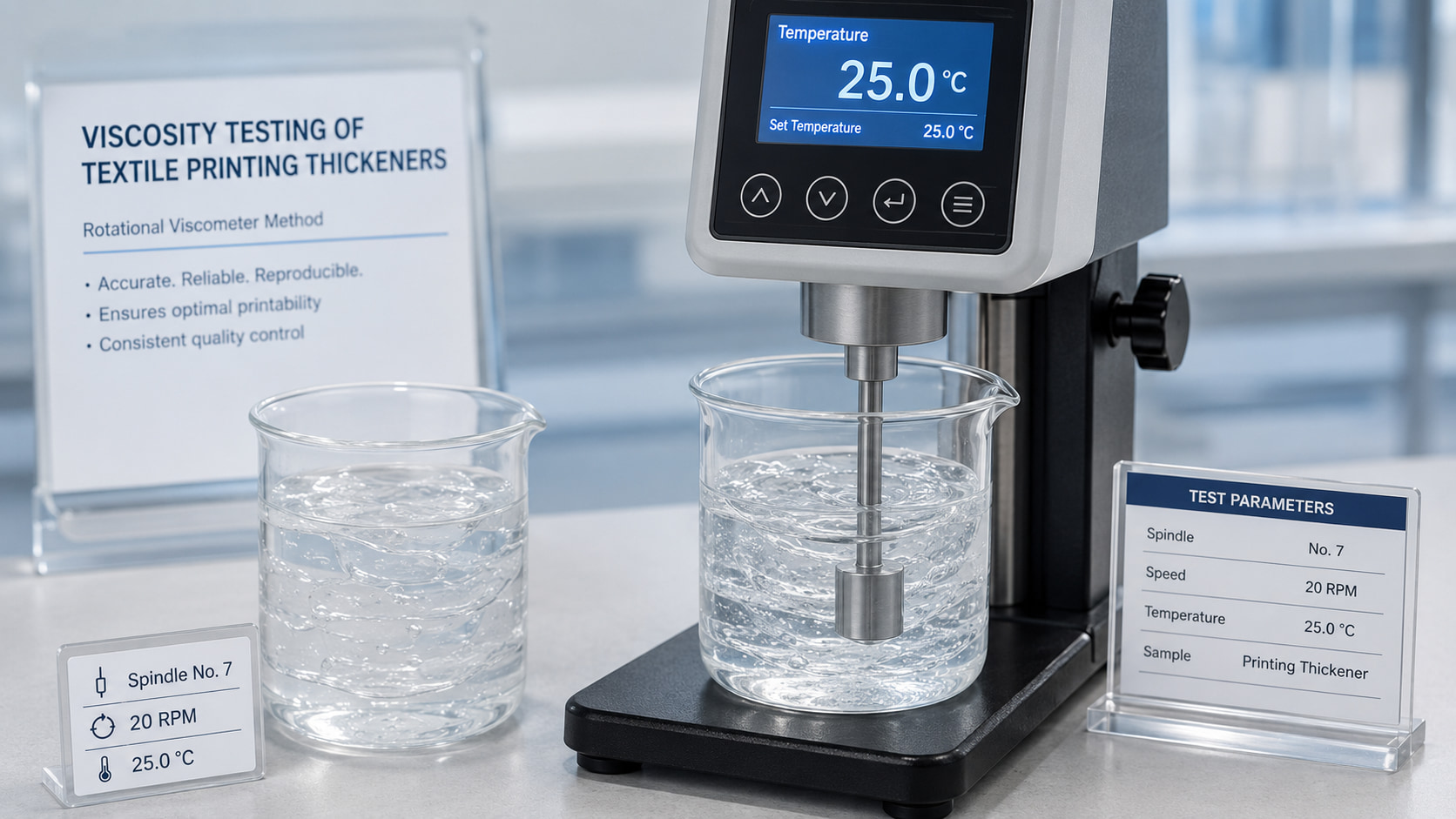
Tìm hiểu lý do tại sao không thể so sánh các giá trị độ nhớt của chất làm đặc trong in ấn dệt may nếu không đảm bảo các yếu tố như nồng độ, nhiệt độ, thiết bị, trục quay, tốc độ, phương pháp chuẩn bị và thời gian thử nghiệm đều giống nhau.
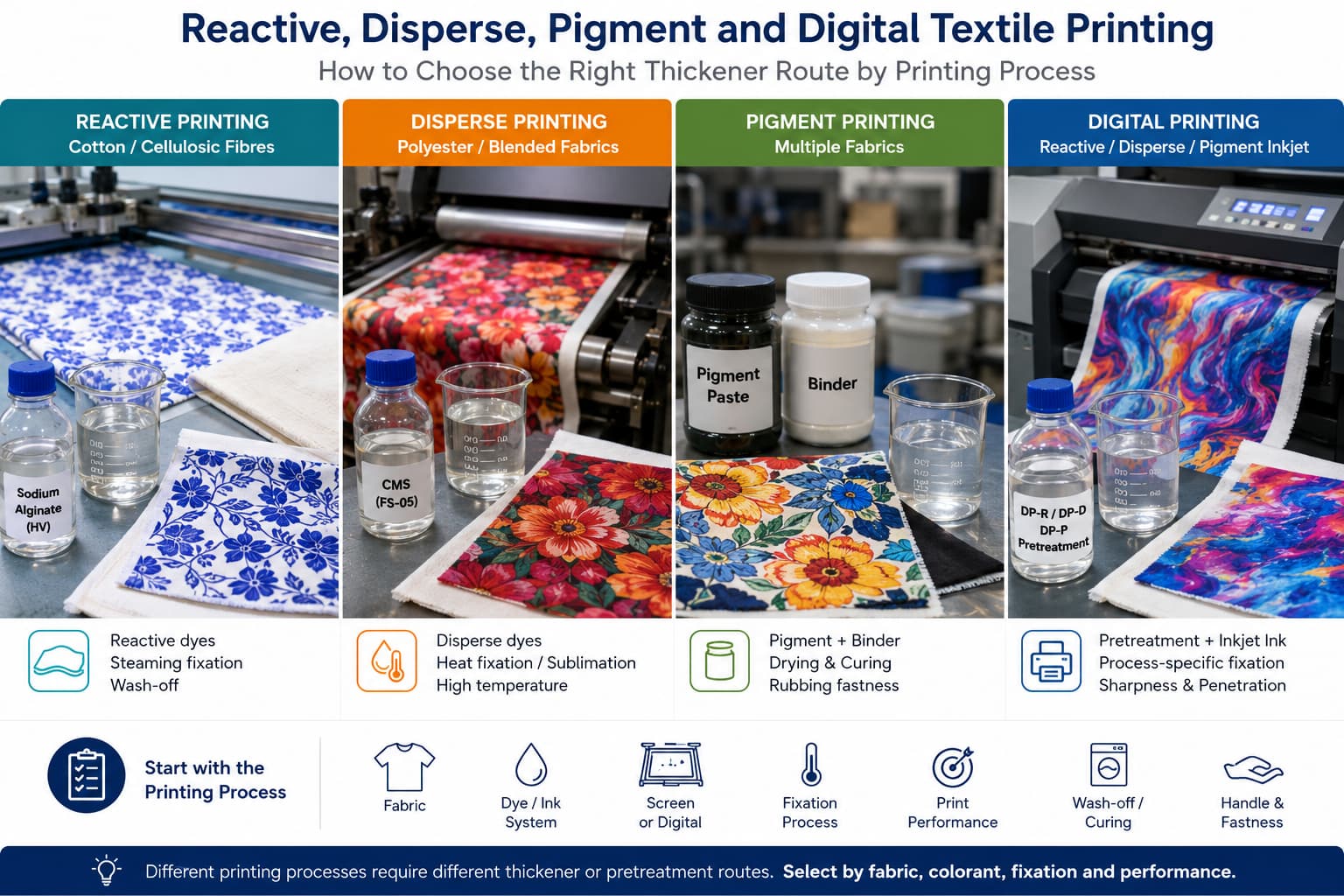
Tìm hiểu cách lựa chọn chất làm đặc và quy trình tiền xử lý cho các phương pháp in dệt phản ứng, in phân tán, in sắc tố và in kỹ thuật số, dựa trên các yêu cầu về vải, thuốc nhuộm hoặc mực in, quá trình cố định màu, khả năng rửa trôi và chất lượng in.
So sánh CMC, CMS, natri alginat và mực in kỹ thuật số trong in ấn dệt may. Tìm hiểu cách thức từng loại nguyên liệu phù hợp với các quy trình in phản ứng, in phân tán, in sắc tố và in kỹ thuật số, cũng như những yếu tố mà người mua cần xem xét trước khi thử mẫu, đối chiếu chất lượng và mua số lượng lớn.
Carboxymethyl cellulose (CMC) được sử dụng rộng rãi trong các quy trình in ấn, xử lý chất làm cứng và nhuộm vải. Hướng dẫn này sẽ giải thích cách đánh giá các loại CMC, những thông số nào là quan trọng nhất, cũng như cách FSX Chemical có thể hỗ trợ các quyết định mua hàng.
Carboxymethyl cellulose được sử dụng làm chất làm đặc và chất ổn định trong mực in gốc nước, in ống đồng và quá trình tiền xử lý cho in phun. Hướng dẫn này trình bày các thông số kỹ thuật chính của sản phẩm và các yếu tố cần xem xét khi lựa chọn nhà cung cấp dành cho các đội ngũ mua hàng.
Hỗn hợp in dựa trên CMC được sử dụng rộng rãi trong in vải bằng bột màu, in phản ứng và in kỹ thuật số. Hướng dẫn này giải thích các thông số quan trọng, cách so sánh các nhà cung cấp và những yêu cầu cần đưa ra trước khi đặt hàng số lượng lớn.
Cả natri alginat và CMC đều được sử dụng làm chất làm đặc trong in vải, nhưng chúng phù hợp với các hệ thống thuốc nhuộm và điều kiện quy trình khác nhau. Hướng dẫn này giải thích những điểm khác biệt chính và thời điểm nên sử dụng từng loại.
CMC loại thực phẩm và loại công nghiệp có cùng cơ sở hóa học nhưng lại khác biệt đáng kể về độ tinh khiết, dải DS và các yêu cầu quy định. Hướng dẫn này giải thích những điểm khác biệt chính và lý do tại sao việc sử dụng loại không phù hợp lại gây ra các vấn đề trong sản xuất.
Nguyên liệu thô có nguồn gốc từ cellulose được sử dụng trong in ấn dệt may, pha chế hỗn hợp in, làm đặc và hỗ trợ công thức. Hướng dẫn này giải thích cách người mua có thể đánh giá các sản phẩm như CMC, CMS, alginat natri, chất làm đặc trong in ấn dệt may và các sản phẩm hỗn hợp in thông qua thông số kỹ thuật, tài liệu kỹ thuật, thử nghiệm mẫu và sự hỗ trợ từ nhà cung cấp.
Các dẫn xuất cellulose được ứng dụng rộng rãi trong in ấn dệt may, pha chế bột in, làm đặc và hỗ trợ công thức. Hướng dẫn này giải thích cách các nhà mua hàng nước ngoài có thể nhập khẩu CMC, CMS, natri alginat, chất làm đặc dùng trong in ấn dệt may và các sản phẩm bột in từ FSX Chemical, kèm theo các dịch vụ hỗ trợ như bảng dữ liệu kỹ thuật (TDS), chứng nhận phân tích (COA), thử nghiệm mẫu, đối chiếu tiêu chuẩn chất lượng và hỗ trợ thủ tục xuất khẩu.
Việc lựa chọn hóa chất trong ngành dệt may không chỉ đơn thuần là so sánh tên sản phẩm. Hướng dẫn này giải thích cách người mua hóa chất in dệt may có thể lựa chọn các sản phẩm như CMC, CMS, natri alginat, chất làm đặc trong in dệt may và bột in phù hợp dựa trên ứng dụng, thông số kỹ thuật, TDS, COA, thử nghiệm mẫu và tính đồng nhất giữa các lô sản phẩm.
Việc hỗ trợ xây dựng công thức hóa chất cho in ấn dệt may cần bắt đầu từ việc cung cấp thông tin ứng dụng rõ ràng. Hướng dẫn này giải thích những thông tin mà người mua cần cung cấp khi yêu cầu đối chiếu sản phẩm, điều chỉnh công thức, thử nghiệm mẫu, TDS, COA, SDS và hỗ trợ kỹ thuật liên quan đến CMC, CMS, natri alginat, chất làm đặc trong in ấn dệt may và các sản phẩm bột in.
Vui lòng cung cấp tên sản phẩm, ứng dụng, số lượng, điểm đến và bất kỳ tài liệu kỹ thuật (TDS),
hình ảnh mẫu hoặc tài liệu nào mà quý khách đã có. FSX Chemical sẽ xem xét
thông tin này và đề xuất bước tiếp theo liên quan đến báo giá, đối chiếu mẫu
hoặc lựa chọn sản phẩm.
Thông tin sản phẩmTên sản phẩm, cấp loại, mẫu mã, ảnh nhãn mác hoặc mã tham chiếu của nhà cung cấp.
Các tài liệu có sẵnTDS, SDS, COA, ảnh mẫu, danh mục sản phẩm hoặc dữ liệu thử nghiệm.
Chi tiết đơn hàngSố lượng dự kiến, hình thức đóng gói, nước nhập khẩu, cảng hoặc điều kiện thương mại.
Yêu cầu hoặc Vấn đềQuy trình in trên vải, yêu cầu về công thức, vấn đề hiện tại hoặc chỉ tiêu hiệu suất.