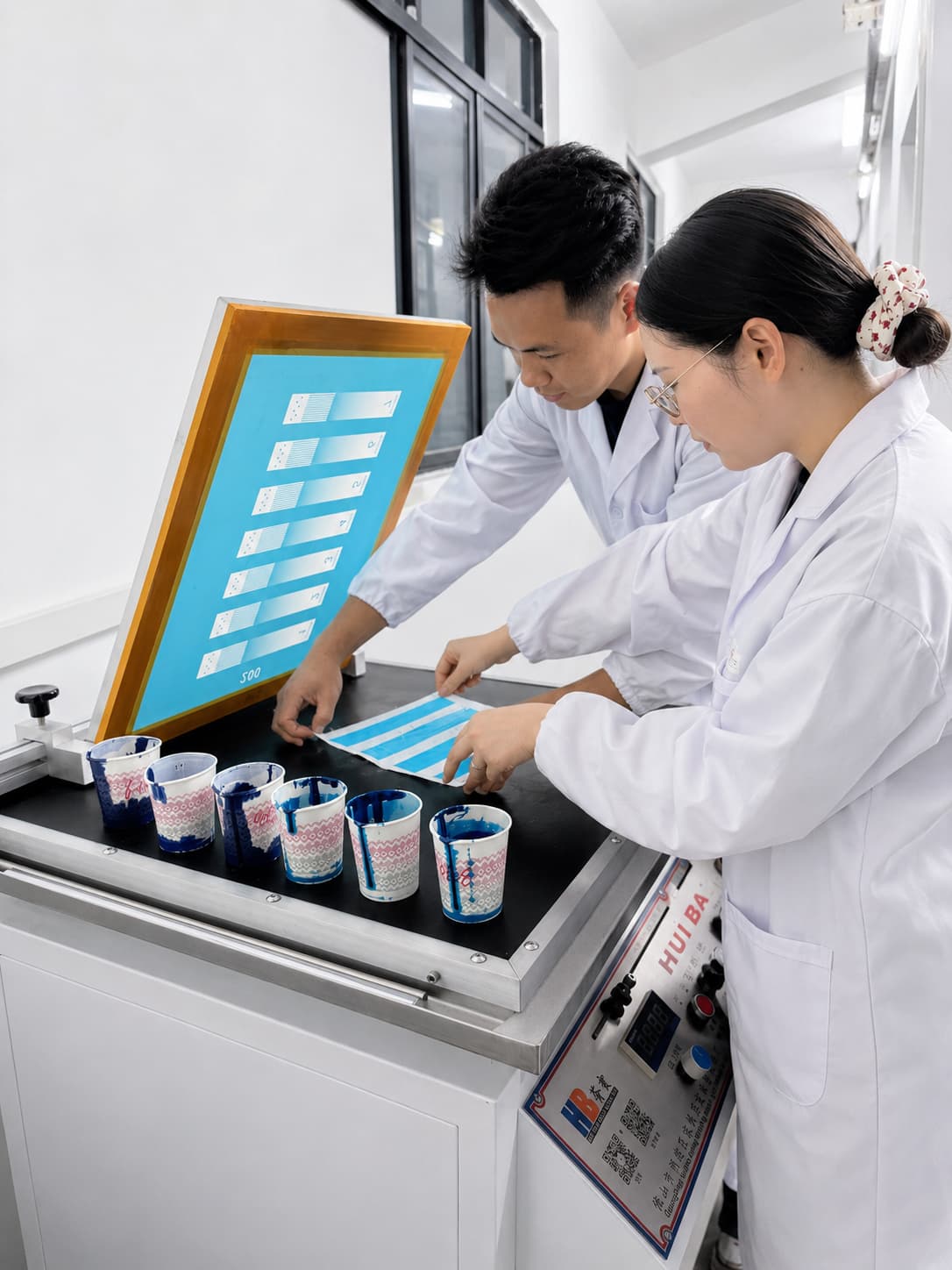
So sánh natri bicacbonat và natri cacbonat trong quá trình tiền xử lý kỹ thuật số phản ứng: Cách lựa chọn kiềm ảnh hưởng đến quá trình cố định và độ ổn định
Sodium bicarbonate and sodium carbonate can both provide the alkaline environment required for reactive digital...
Cả natri bicacbonat và natri cacbonat đều có thể tạo ra môi trường kiềm cần thiết cho quá trình in kỹ thuật số trên vải phản ứng, nhưng chúng không phải là các chất kiềm có thể thay thế cho nhau. Natri bicacbonat là phương pháp nhẹ nhàng hơn, có khả năng đệm tốt hơn và được sử dụng rộng rãi trong quá trình tiền xử lý vì nó có thể duy trì độ kiềm thấp hơn trong hệ thống vải lạnh trước khi các điều kiện cố định mạnh hơn xuất hiện trong quá trình gia nhiệt. Natri cacbonat cung cấp độ kiềm mạnh hơn ngay lập tức và có thể đẩy nhanh quá trình kích hoạt cellulose và cố định thuốc nhuộm, nhưng độ kiềm quá cao cũng có thể làm tăng quá trình thủy phân thuốc nhuộm, gây mất ổn định trong quá trình tiền xử lý và làm tăng độ nhạy cảm của quy trình. Do đó, việc lựa chọn kiềm phù hợp phụ thuộc vào hóa học của mực phản ứng, loại vải, polymer tiền xử lý, khả năng hấp thụ ướt, sấy khô, hấp hơi và quá trình rửa trôi — chứ không phải dựa trên trọng lượng sản phẩm bằng nhau hay một mục tiêu pH chung duy nhất.
Sodium Bicarbonate vs. Sodium Carbonate: What Changes in Reactive Digital Pretreatment?
Both sodium bicarbonate (NaHCO3) and sodium carbonate (Na2CO3) can support reactive dye fixation on cellulosic fabrics, but their process behavior is different.
The simplified comparison is:
Sodium Bicarbonate → Milder Cold Alkalinity + More Buffered Pretreatment Behavior + Stronger Alkalinity Develops During Heating
Sodium Carbonate → Stronger Immediate Alkalinity + Faster Cellulose Activation + Greater Need to Control Hydrolysis and Pretreatment Stability
The practical decision should therefore be based on reactive ink reactivity, pretreatment polymer chemistry, fabric type, wet pick-up, drying, steaming temperature/time/moisture and wash-off performance.
Do not replace NaHCO3 with Na2CO3 on an equal-weight basis and assume the process remains equivalent.
Why Reactive Digital Printing Needs Alkali
Reactive dyes form covalent bonds with cellulose under alkaline fixation conditions.
Alkali increases the reactivity of cellulose hydroxyl groups and supports the dye–fiber reaction during steaming.
In reactive digital printing, alkali is commonly placed in the fabric pretreatment rather than loaded into the reactive ink at conventional printing levels.
This separation helps the ink remain compatible with printhead requirements while the fabric carries the fixation chemistry.
The alkali therefore has two requirements:
It must provide enough alkalinity during fixation.
It should not create unnecessary instability before fixation.
This second requirement explains why alkali type matters—not only final pH.
How NaHCO₃ and Na₂CO₃ Differ Chemically
Sodium bicarbonate is a weaker alkaline salt than sodium carbonate.
In water at ordinary temperature, a bicarbonate-containing pretreatment normally creates a milder alkaline environment than a comparable carbonate-containing system.
When bicarbonate is heated, part of it can convert toward carbonate chemistry, increasing available alkalinity during drying and steaming.
This thermal behavior has historically made NaHCO3 useful in reactive printing because it helps separate cold pretreatment stability from hot fixation alkalinity.
Sodium carbonate does not depend on the same thermal conversion route to deliver carbonate alkalinity. It provides a stronger alkaline environment from the beginning.
That can be useful when stronger immediate alkalinity is required, but it also increases the importance of dosage, pH, polymer compatibility and dye-hydrolysis control.
Why Equal Weight Is Not a Fair Comparison
NaHCO3 and Na2CO3 have different molecular weights, acid-neutralizing capacity, buffer behavior, cold-solution pH response and thermal behavior.
Do đó:
1 kg NaHCO₃ ≠ 1 kg Na₂CO₃ in Alkalinity Effect.
A technically useful comparison should record:
Product dosage
Bath pH
Fabric wet pick-up
Actual alkali add-on
Post-drying / process pH where the mill uses that measurement
Post-wash color / fixation
The target is equivalent or intentionally different process performance—not equal product weight.
What Sodium Bicarbonate Does Well
Sodium bicarbonate is widely used in reactive textile printing pretreatments because its milder cold alkalinity can support better stability before steaming.
Useful thermal increase in alkalinity during fixation
Well-established compatibility with many traditional alginate / urea pretreatment recipes
This does not mean NaHCO3 is always the safer or better option.
If applied bicarbonate is too low, or if steaming/moisture conditions do not develop an adequate alkaline fixation environment, color yield and fixation can remain below target.
This can be useful when the system requires stronger cellulose activation, faster fixation response or a different steaming window.
Reactive-dye studies commonly use sodium carbonate because its alkalinity can support effective cellulose activation without the extreme strength of sodium hydroxide.
However, stronger immediate alkalinity also means the pretreatment process can become more sensitive to polymer pH tolerance, hard-water chemistry, storage/holding and dye hydrolysis after ink contact.
Na2CO3 should therefore be evaluated as a different fixation strategy, not as a drop-in mass replacement for NaHCO3.
Cold Pretreatment Stability Before Printing
Reactive pretreatment can spend time in mixing tanks, storage tanks, padding/coating lines and pretreated fabric rolls before the printed fabric reaches the steamer.
A more strongly alkaline cold pretreatment can change polymer hydration, viscosity, gel/floc tendency and fabric surface chemistry depending on the thickener grade.
NaHCO3 can be attractive where the mill wants a milder cold condition and stronger alkalinity mainly during heating.
Na2CO3 can still work well, but the holding/storage stability test becomes more important.
Thermal Response During Drying and Steaming
The bicarbonate route is particularly linked to thermal processing.
As the fabric is heated, bicarbonate chemistry shifts toward carbonate, increasing alkalinity.
This means NaHCO3 performance is influenced not only by pretreatment concentration but also by drying condition, steaming temperature, steaming time and steam moisture.
By contrast, Na2CO3 already provides strong carbonate alkalinity before the fabric reaches the steamer.
This can make fixation less dependent on thermal conversion of the alkali, but not independent from temperature, moisture or time.
Alkali Strength and Reactive Dye Fixation
Increasing useful alkalinity generally increases cellulose activation and can accelerate reactive dye fixation.
But fixation efficiency is not determined by alkali alone. It also requires dye mobility, moisture, fabric accessibility, heat and sufficient time.
A stronger carbonate pretreatment can outperform a weaker bicarbonate condition if the bicarbonate route is under-alkalized.
Conversely, a correctly designed bicarbonate route can provide excellent fixation while maintaining a more stable cold pretreatment condition.
Compare the full process rather than alkali strength in isolation.
Alkali Strength and Reactive Dye Hydrolysis
Reactive dyes can react with water under alkaline conditions as well as with cellulose.
This competing hydrolysis reaction produces dye that no longer forms the intended bond with the fiber.
As alkalinity becomes excessive, hydrolysis risk generally increases.
Possible consequences include:
More unfixed dye
Higher wash-off load
White-ground staining risk
Lower effective dye utilization
This is why stronger alkali does not automatically mean higher post-wash color yield.
The target is enough alkalinity for cellulose fixation without unnecessary hydrolysis.
Effect on Color Yield
Alkali choice can change post-wash K/S through fixation rate, dye hydrolysis, ink penetration, pretreatment stability and steaming response.
If a bicarbonate pretreatment gives low color, investigate insufficient alkali add-on, insufficient steaming severity, low steam moisture or excess penetration.
If a carbonate pretreatment gives unexpectedly weak post-wash color, investigate excess alkalinity, dye hydrolysis, pretreatment polymer instability or wash-off loss.
Do not rank the alkalis from unwashed color only.
Effect on Wash-Off and Unfixed Dye
The best alkali route should be judged after washing.
Two samples can look similarly dark before washing but show different post-wash K/S, white-ground cleanliness, wash-water color and fastness.
A stronger alkali that creates more hydrolyzed dye may require more washing without producing higher usable color.
Always compare the final washed print.
Pretreatment Polymer Stability
Pretreatment polymers have their own pH and electrolyte windows.
Changing from NaHCO3 to Na2CO3 changes both alkalinity and ionic environment.
Depending on the polymer, this can change hydration, viscosity, holding stability, gel/floc formation and filtration.
Therefore, alkali substitution should always be tested in the complete pretreatment formula.
Sodium Alginate-Based Pretreatment
Sodium alginate has a long history in reactive printing because it provides good rheology and generally does not react strongly with reactive dyes under normal printing conditions.
Published reactive digital cotton formulations frequently use Sodium Alginate + Urea + Sodium Bicarbonate as the pretreatment basis.
If NaHCO3 is replaced by Na2CO3, recheck bath viscosity, pH, holding stability, hard-water sensitivity, fabric pick-up and wash-off.
Do not assume the alginate component makes both alkalis automatically equivalent.
CMC / Cellulose-Ether Pretreatment
CMC and other cellulose-derived pretreatment polymers can have different pH and salt responses from alginate.
For an anionic CMC system, increasing ionic load can change chain expansion, hydration and viscosity.
Nonionic cellulose ethers avoid the same carboxylate charge response but can still show salt- and temperature-dependent rheology.
Therefore, if the pretreatment uses CMC, HEC, HPMC or a compound cellulose system, alkali choice should be verified experimentally rather than transferred from an alginate recipe.
Synthetic / Compound Pretreatment Systems
Commercial digital pretreatment products may contain cellulose derivatives, synthetic polymers, compound thickener systems and functional salts/auxiliaries.
The polymer identity may not be fully visible from the product name.
Use the supplier’s TDS and actual performance tests.
For a compound pretreatment, compare NaHCO3 and Na2CO3 under identical water, polymer dosage, pick-up, drying and steaming conditions before changing the commercial formula.
Pretreatment Viscosity and Rheology
Alkali selection can change measured pretreatment viscosity even when polymer dosage remains constant.
Possible causes include pH-dependent polymer expansion, ionic-strength effects, hard-water interaction and different holding behavior.
Record viscosity under one standardized method: same temperature, instrument, spindle/rotor, speed and reading time.
Do not interpret a viscosity change until pH and water quality are recorded.
Ionic Load and Conductivity
NaHCO3 and Na2CO3 both contribute dissolved ions.
Changing alkali type and dosage can therefore change conductivity, the polymer electrolyte environment and water-retention behavior.
Conductivity is useful as a formulation-monitoring parameter, but it does not replace pH or alkali-add-on measurement.
Two formulas can have similar conductivity but different alkalinity and fixation behavior.
Hard Water and Alkali Choice
Plant water can contain Ca²⁺ and Mg²⁺. These ions can interact with anionic thickeners, carbonate chemistry and other pretreatment components.
A higher-pH carbonate environment can make hard-water compatibility more important.
When changing alkali, compare plant water with validated reference water and record total hardness, conductivity, pretreatment clarity/residue and viscosity.
For detailed water-quality control, use the FSX hard-water article in the reactive digital cluster.
Wet Pick-Up and Actual Alkali Add-On
Bath concentration alone does not define how much alkali reaches the fabric.
If the padder or coating route changes wet pick-up, the same pretreatment bath can deliver a different alkali load.
This is particularly important when comparing NaHCO3 and Na2CO3.
Record both bath dosage and fabric pick-up before interpreting fixation differences.
Pretreatment Drying
Drying changes chemical distribution before printing.
For bicarbonate, drying also begins the thermal pathway that can increase carbonate alkalinity.
For carbonate, the fabric already carries stronger alkalinity before heating.
Therefore, compare dryer temperature/dwell, residual moisture, fabric pH where relevant and post-drying storage stability when changing alkali type.
The same dryer condition can produce a different chemical state.
Residual Moisture Before Printing
Residual moisture influences ink wetting, alkali mobility and dye diffusion during steaming.
Alkali choice should therefore not be optimized independently from drying.
A very dry bicarbonate-treated fabric may rely more strongly on steam moisture for effective fixation.
A carbonate-treated fabric may already have strong alkalinity, but moisture is still required for dye movement.
Heat without sufficient moisture is not enough.
Steaming and Fixation Window
Steaming provides the heat and moisture needed for reactive dye diffusion and fixation.
The useful steaming window can differ between bicarbonate and carbonate pretreatments because their alkalinity develops differently.
A controlled comparison should record steaming temperature, time, steam moisture/humidity where available, post-wash K/S and fixation/fastness.
Do not compensate for a poor alkali choice by indefinitely increasing steaming severity.
Optimize the alkali and steaming system together.
Bông
Cotton is the best-established substrate for both bicarbonate- and carbonate-based reactive printing research.
But cotton itself varies with mercerization, scouring, knit/woven structure and GSM.
Use the current successful production alkali as the reference and compare the alternative on the same cotton lot.
Do not generalize a laboratory result from one mercerized woven cotton to every cotton fabric.
Viscose
Viscose generally has higher swelling and water retention than cotton.
This can change alkali distribution, dye diffusion and fixation response.
A stronger carbonate route may therefore behave differently on viscose than on cotton.
Likewise, a bicarbonate route that works on cotton may require a different pick-up or steaming window on viscose.
Validate independently.
Lyocell
Lyocell should be treated as an independent regenerated-cellulose substrate.
Its swelling, pore structure and finishing history can change reactive dye accessibility and moisture behavior.
When comparing NaHCO3 and Na2CO3, record lyocell type, fabric construction, pick-up, drying, steaming and post-wash color rather than assuming the cotton result will transfer directly.
NaHCO₃ vs. Na₂CO₃ Practical Comparison
Evaluation Area
Natri bicacbonat
Sodium Carbonate
Cold alkalinity
Milder
Stronger
Thermal behavior
Can develop stronger carbonate alkalinity during heating
Strong carbonate alkalinity already present
Cold pretreatment stability
Often easier to maintain in traditional reactive-printing recipes
This table describes typical process tendencies rather than a universal winner.
Build an Alkali-Selection Ladder
Do not move directly from the current bicarbonate dose to an equal carbonate dose.
Build controlled candidate conditions around the existing production reference, such as current NaHCO3, adjusted NaHCO3, low Na2CO3 candidate and intermediate Na2CO3 candidate.
The exact levels should be selected according to ink, fabric, product TDS and existing process.
For every point, record bath pH, viscosity, conductivity, pick-up, residual moisture, post-wash K/S and fixation/fastness.
Compare by Process Response, Not Equal Grams
The purpose of the experiment is not to prove which alkali produces the same pH at the same product weight.
The purpose is to identify which system gives the best complete production response.
A useful comparison can target similar final post-wash color, similar fixation and similar pretreatment stability, then compare required alkali dosage, wash-off demand, drying/steaming requirement and cost.
This is more meaningful than equal-weight substitution.
Build an Alkali × Steaming Matrix
Alkali Route
Reference Steaming
Lower Severity
Higher Controlled Severity
NaHCO₃ reference
Kiểm soát
Optional
Kiểm tra
Adjusted NaHCO₃
Kiểm tra
Optional
Kiểm tra
Na₂CO₃ candidate
Kiểm tra
Kiểm tra
Diagnostic
For each sample, evaluate post-wash K/S, fixation/dye loss, bleeding, penetration and fastness.
The best alkali route is the one with the widest stable process window—not necessarily the highest peak K/S.
Holding / Storage Stability Test
Prepare each pretreatment candidate and measure fresh pH, fresh viscosity, appearance and filtration, then repeat after the normal production holding period.
If pretreated fabric is stored before printing, also compare immediately printed fabric with stored pretreated fabric under the same ink and steaming process.
This reveals whether stronger carbonate alkalinity creates a cold-storage or pretreatment-holding penalty that is not visible in a short laboratory trial.
Alkali price alone is a poor basis for choosing NaHCO3 or Na2CO3.
Total Cost in Use = Alkali + Pretreatment + Drying + Ink + Steaming + Washing + Rework + Quality Loss
A stronger carbonate route may use a different alkali dosage but create more wash-off demand, more sensitivity to water quality or more process correction if over-alkalized.
A bicarbonate route may require a different steaming/moisture window but offer better cold-process robustness.
Compare cost per acceptable printed meter after washing, not alkali price per kilogram.
Bạn nên gửi những thông tin nào cho nhà cung cấp?
Reactive ink / dye system
Fabric composition / construction / GSM
Current pretreatment product / TDS
Current alkali identity / dosage
Urea / moisture-management chemistry
Pretreatment polymer dosage
Other salts / auxiliaries
Bath pH and conductivity
Viscosity and test method
Plant-water hardness
Wet pick-up
Drying / residual-moisture condition
Steaming temperature / time / moisture
Wash-off route
Main target: higher fixation, better stability, lower wash-off loss or broader process window
FSX Chemical có thể sử dụng thông tin này thông qua Mẫu và việc kết hợp to structure a controlled bicarbonate-vs.-carbonate pretreatment comparison.
How Should a Mill Choose Between Sodium Bicarbonate and Sodium Carbonate?
Freeze Ink / Polymer / Fabric → Use Current Alkali as Reference → Build Controlled Alkali Candidates → Measure pH / Viscosity / Conductivity → Apply at Controlled Pick-Up → Dry → Print → Steam → Wash → Compare Fixation / Color / Stability → Optimize the Best Route
Sodium bicarbonate and sodium carbonate are both useful reactive-printing alkalis but are not weight-for-weight substitutes.
Bicarbonate generally provides milder cold alkalinity and develops stronger carbonate alkalinity during heating.
Carbonate provides stronger immediate alkalinity and can accelerate fixation, but excessive alkalinity can increase dye hydrolysis and formulation sensitivity.
Alkali selection must include pretreatment polymer stability, plant water, pick-up, drying and steaming—not pH alone.
Post-wash color and fixation are more meaningful than unwashed color when comparing the two alkalis.
The best alkali is the route that delivers the required fixation and color with the widest stable production window and lowest practical Total Cost in Use.
Các câu hỏi thường gặp
1. Which is better for reactive digital pretreatment: sodium bicarbonate or sodium carbonate?
Neither is universally better. Bicarbonate gives milder cold alkalinity and thermally develops stronger carbonate alkalinity, while carbonate provides stronger alkalinity immediately. The best choice depends on ink, fabric, polymer, pick-up and steaming.
2. Can I replace sodium bicarbonate with the same weight of sodium carbonate?
No. They have different molecular weights, alkalinity and buffering/thermal behavior. Use controlled process trials rather than equal-weight substitution.
3. Why is sodium bicarbonate commonly used in reactive printing pretreatment?
Its milder cold alkalinity can improve pretreatment stability before heating, while stronger fixation alkalinity develops during the thermal process.
4. Why would a mill use sodium carbonate instead?
Carbonate provides stronger immediate alkaline activation and may suit an ink/fabric/process that needs a different fixation window.
5. Does sodium carbonate always give higher color yield?
No. If alkalinity becomes excessive, dye hydrolysis or pretreatment instability can increase and post-wash color may not improve.
6. Does bicarbonate always give better stability?
Not universally. It often gives a milder cold environment, but stability still depends on polymer chemistry, water quality, dosage and holding conditions.
7. Should the comparison use the same pH?
pH is one useful parameter, but it is not sufficient. The two alkalis have different buffering and thermal behavior. Compare complete process performance after drying, steaming and washing.
8. How does alkali choice affect thickener viscosity?
Changing pH and ionic load can change polymer hydration and rheology. The effect is grade-specific and should be measured in the complete pretreatment.
9. Why can hard water matter more with carbonate?
Calcium and magnesium interact with pretreatment polymers and carbonate chemistry. Check plant water, residue, viscosity and filtration when changing alkali.
10. Should cotton, viscose and lyocell use the same alkali system?
Not automatically. Their swelling, pick-up and fixation responses differ, so each important substrate should be validated.
11. Which result should decide the alkali choice?
Use post-wash K/S, fixation/fastness, bleeding, penetration, pretreatment stability and production repeatability—not one bath pH or unwashed color value.
12. What should I send FSX Chemical for bicarbonate-vs.-carbonate matching?
Send the ink, fabric, current pretreatment/TDS, alkali type/dose, polymer, urea, auxiliaries, pH, viscosity, water hardness, pick-up, drying, steaming and wash-off conditions.
Choose Reactive Pretreatment Alkali by the Complete Fixation Window
If your current reactive digital pretreatment uses sodium bicarbonate but you are considering sodium carbonate—or if a carbonate-based formula gives fast fixation but unstable viscosity or wash-off—FSX Chemical can help structure a controlled side-by-side trial.
Bắt đầu bằng Mẫu và việc kết hợp using your current fabric, ink and pretreatment process.
The correct alkali is not simply the stronger one. It is the alkali system that provides enough reactive-dye fixation during heating while keeping the pretreatment stable before printing and maintaining post-wash color, fastness and process repeatability.
Tỷ lệ cố định thuốc nhuộm ảnh hưởng trực tiếp đến hiệu suất màu, độ bền màu khi giặt và lượng chất thải trong quá trình in bằng thuốc nhuộm phản ứng. Hướng dẫn này giải thích cách natri alginat hỗ trợ quá trình cố định thuốc nhuộm, các thông số của hỗn hợp thuốc nhuộm nào ảnh hưởng đến tỷ lệ cố định, cũng như cách khắc phục tình trạng tỷ lệ cố định thấp trong quá trình sản xuất.
Loại bột in kỹ thuật số tốt nhất là loại phù hợp với thành phần hóa học của mực, chất liệu vải và quy trình cố định màu. Hướng dẫn này so sánh các yêu cầu về xử lý trước đối với công nghệ in phun phản ứng trên vải cellulose và công nghệ in phun phân tán trực tiếp trên polyester, sau đó giải thích cách người mua nên đánh giá mẫu thử trước khi đặt hàng số lượng lớn.
FSX Chemical cung cấp các quy trình sản xuất bột in kỹ thuật số riêng biệt dành cho các hệ thống mực phản ứng, mực phân tán và mực sắc tố, kèm theo dịch vụ đánh giá ứng dụng, đối chiếu mẫu và tài liệu kỹ thuật. Hướng dẫn này giải thích cách người mua có thể đánh giá quy trình phù hợp trước khi đặt hàng số lượng lớn.
Việc kiểm soát độ nhớt trong in kỹ thuật số trên vải không chỉ đơn thuần là đạt được một con số cụ thể. Để đảm bảo hiệu suất ổn định, cần phải có các yếu tố phù hợp như tính lưu biến trong quá trình tiền xử lý, phương pháp thử nghiệm, nhiệt độ, tính tương thích hóa học, quá trình lọc, khả năng thấm mực của vải và độ ổn định khi giữ màu.
Bài đánh giá sản phẩm này phân tích sản phẩm FSX Digital Printing Paste với vai trò là giải pháp tiền xử lý và làm đặc mực in phun trên vải, tập trung vào các khía cạnh như sự tương thích với hệ thống mực, tính lưu biến, quá trình lọc, độ sắc nét của bản in, độ ổn định và các thử nghiệm trong điều kiện sản xuất thực tế.
Một loại mực in kỹ thuật số chất lượng cao không chỉ được xác định bởi độ nhớt. Các loại mực in dệt may phản ứng, mực phân tán và mực pigment đòi hỏi các quy trình hóa học tiền xử lý, tính lưu biến và điều kiện hậu xử lý khác nhau. Hướng dẫn này giải thích cách lựa chọn mực in kỹ thuật số dựa trên hệ thống mực, loại vải, độ chi tiết in, hiệu suất màu, độ bền màu và hiệu suất sản xuất tổng thể.
Việc lựa chọn mực in kỹ thuật số để in trên vải thân thiện với môi trường không chỉ đơn thuần là chọn một sản phẩm được mô tả là “tự nhiên” hay “liều lượng thấp”. Một so sánh chính xác cần phải bao gồm các yếu tố như liều lượng hiệu quả, lượng chất thải, độ ổn định khi in, quá trình sấy khô, quá trình cố định màu, quá trình giặt và chất lượng vải thành phẩm.
Padding and stenter are often discussed as alternative reactive digital pretreatment methods, but technically they perform different functions. Padding controls liquor application and wet pick-up, while the stenter controls open-width drying, tension and fabric condition. This guide explains which route to test according to fabric, equipment and production requirements.
Công nghệ in kỹ thuật số phản ứng “ướt trên ướt” có thể giảm bớt hoặc loại bỏ giai đoạn sấy tiền xử lý, nhưng đòi hỏi phải kiểm soát chặt chẽ hơn độ ẩm của vải, quá trình khuếch tán mực và quá trình vận chuyển trên máy. Hướng dẫn này so sánh phương pháp in ở trạng thái ướt có kiểm soát với phương pháp tiền xử lý khô truyền thống dựa trên các tiêu chí: chất lượng in, độ bám dính, khả năng giặt, độ ổn định sản xuất và Tổng chi phí sử dụng.
Fabric pick-up determines how much pretreatment chemistry and water actually remain on the fabric after application. Too little or excessive pick-up can change color yield, bleeding, penetration, drying and fixation. This guide explains how to measure and optimize a stable working window for reactive inkjet printing.
Pretreatment pH affects reactive dye fixation, hydrolysis, thickener stability and finished color performance. Cotton and viscose should not automatically use the same alkaline window because pick-up, absorbency and penetration can differ.
Urea, alkali and anti-reducing salt perform different functions in reactive digital pretreatment. Urea supports moisture and dye mobility, alkali creates the fixation environment, and anti-reducing salt helps protect selected dye systems from reducing conditions during steaming.
Vui lòng cung cấp tên sản phẩm, ứng dụng, số lượng, điểm đến và bất kỳ tài liệu kỹ thuật (TDS),
hình ảnh mẫu hoặc tài liệu nào mà quý khách đã có. FSX Chemical sẽ xem xét
thông tin này và đề xuất bước tiếp theo liên quan đến báo giá, đối chiếu mẫu
hoặc lựa chọn sản phẩm.
Thông tin sản phẩmTên sản phẩm, cấp loại, mẫu mã, ảnh nhãn mác hoặc mã tham chiếu của nhà cung cấp.
Các tài liệu có sẵnTDS, SDS, COA, ảnh mẫu, danh mục sản phẩm hoặc dữ liệu thử nghiệm.
Chi tiết đơn hàngSố lượng dự kiến, hình thức đóng gói, nước nhập khẩu, cảng hoặc điều kiện thương mại.
Yêu cầu hoặc Vấn đềQuy trình in trên vải, yêu cầu về công thức, vấn đề hiện tại hoặc chỉ tiêu hiệu suất.