Pigment Binder and Acrylic Thickener Compatibility: How to Prevent Viscosity Loss and Paste Instability
Pigment binder can change acrylic thickener viscosity through dilution, electrolyte load, pH shift, surfactant interaction...
Pigment binder and acrylic thickener must be evaluated as one formulation system because both can change the rheology, ionic environment, solids balance and final film behavior of the printing paste. A thickener that develops excellent viscosity in water can lose body after binder is added, while a paste that looks stable immediately can drift during holding or fail after curing through poor rubbing fastness or excessive fabric stiffness. The correct compatibility test therefore goes beyond one viscosity reading: mills should separate dilution from electrolyte effects, track pH before and after binder addition, measure viscosity retention over time, evaluate screen transfer, then confirm the cured fabric. This guide shows how to build that binder–thickener compatibility test without over-correcting the formula.
What Does Binder–Thickener Compatibility Mean?
Binder–thickener compatibility means the acrylic thickener can maintain the required rheology after the real pigment binder is added and the resulting paste remains stable through mixing, holding, screen printing, drying and curing.
A compatible system should provide:
Predictable viscosity after binder addition
Stable pH
No visible flocculation or gel formation
Useful low-shear body
Good flow through the screen
Acceptable structural recovery
Stable holding-time behavior
Required rubbing fastness after curing
Acceptable fabric hand
The correct question is not:
“Does the binder mix into the paste?”
It is:
“Does the binder–thickener system remain rheologically and functionally stable from color kitchen to finished fabric?”
Binder and Thickener Have Different Jobs
In pigment printing, binder and thickener work together but do not perform the same function.
Acrylic Thickener
Builds printing-paste body
Controls shear flow
Limits spreading
Supports screen transfer
Controls deposit and penetration
Pigment Binder
Forms a film during drying and curing
Anchors pigment particles to the textile
Builds rubbing and washing resistance
Influences softness, penetration and film durability
Published pigment-printing work shows that increasing acrylic binder concentration can improve rubbing fastness and penetration while also increasing fabric stiffness. It also shows that binder addition can reduce pigment-paste viscosity in some formulations.
This is why compatibility has to be judged on both wet paste and cured fabric.
Why Binder Addition Can Change Acrylic Thickener Viscosity
A binder emulsion changes more than the amount of solids in the paste.
It can also introduce:
Water
Electrolytes
Surfactants
Protective colloids
pH-control chemicals
Polymer particles
When binder is added, the acrylic thickener is therefore exposed to a new chemical environment.
The extent of this effect depends on the thickener architecture.
Conventional polyacrylate systems can be strongly electrolyte-sensitive, while some hydrophobically modified systems are designed to improve viscosity retention under ionic stress.
3. pH Shift: Does the Binder Move the Thickener Outside Its Working Window?
Some acrylic liquid thickeners develop viscosity only after correct neutralization.
If binder addition changes the pH, the thickener can move away from its most effective operating range.
Record:
pH after thickener activation
pH after pigment
pH after binder
pH after fixer / auxiliaries
pH after holding
If viscosity drops at the same point that pH shifts, the next trial should separate pH from electrolyte effects.
Acrylic binders are usually polymer emulsions stabilized by a surfactant or colloidal system.
Those components can change:
Wetting
Foam
Particle interaction
Associative thickening behavior
Paste flow
Some synthetic thickeners—especially associative acrylic systems—can respond strongly to surfactant concentration and type.
Therefore, a binder that works with one thickener may give a different rheological profile with another.
Compatibility should be measured, not assumed from chemical family names.
5. Ionic Compatibility: Anionic, Nonionic and Cationic Components
Many pigment-printing acrylic thickeners are anionic.
They are often more comfortable in systems dominated by anionic or nonionic auxiliaries.
Strongly cationic components can create a higher risk of:
Flocculation
Viscosity change
Local gel formation
Poor storage stability
But ionicity alone does not predict the full result.
Concentration, molecular architecture, pH and addition order still matter.
If a binder or fixer contains cationic chemistry, evaluate it explicitly with the chosen thickener rather than assuming universal incompatibility.
6. Binder Solids and Total Paste Balance
Binder concentration affects more than fastness.
Higher binder dosage changes:
Total solids
Water fraction
Polymer-particle concentration
Paste penetration
Cured film mass
Published pigment-printing studies show that increasing acrylic binder concentration can increase penetration and rubbing fastness while also increasing stiffness.
Therefore, binder level should be chosen for the required fastness and hand first.
The thickener should then be optimized around that binder level.
Do not reduce binder only to protect viscosity if fastness becomes inadequate.
7. Addition Order and Local Concentration
A compatible formula can still become unstable if binder is added incorrectly.
Possible problems include:
Binder added before the thickener has fully activated
Binder dumped into a poorly mixed region
Fixer added directly into a high-binder zone
Concentrated neutralizer added after binder without controlled mixing
Local chemical conditions can temporarily be much more extreme than the final average formulation.
A controlled sequence might be:
Water → Thickener → Activation / Neutralization → Pigment → Binder → Fixer → Remaining Auxiliaries → Final Adjustment
This is a starting logic, not a universal recipe.
The commercial grade should be validated using its supplier-recommended addition procedure.
8. Holding-Time Instability
A binder–thickener pair may look stable immediately after mixing but drift during production holding.
Possible patterns include:
Immediate Drop, Then Stable
Often consistent with dilution or fast electrolyte response.
Slow Viscosity Loss
Investigate delayed polymer interaction, pH drift or colloidal instability.
Initial Stability, Then Floc / Gel
Investigate ionic incompatibility and addition sequence.
Viscosity Increase
Check evaporation, delayed swelling, temperature and solids balance.
Measure at realistic points such as fresh, 2 hours, 4 hours and end-of-shift, adjusted to the real production window.
Compatibility Changes Rheology, Not Only Viscosity
Two binder–thickener systems can show the same Brookfield viscosity but print differently.
Evaluate:
Low-shear body
Shear thinning
Structural recovery
Elasticity / stringiness
The target is:
Stable Rest Structure → Easy Flow Under Squeegee Shear → Controlled Recovery After Transfer
A binder can alter this profile even when the single viscosity number changes only slightly.
This is why complete-paste screen trials are essential.
Build a Binder–Thickener Compatibility Map
A practical laboratory map can use one thickener and several binder conditions.
Sample
Formula
Main Question
A
Activated thickener base
Reference rheology
B
Base + water dilution control
How much change is dilution?
C
Base + Binder Level 1
Low binder compatibility
D
Base + Binder Level 2
Normal production condition
E
Base + Binder Level 3
High binder stress test
At every stage, record:
pH
Temperature
Viscosity
Appearance
Foam
Holding stability
This creates a binder-response profile rather than a single yes/no compatibility result.
Use Control Samples to Separate Binder Chemistry from Dilution
The water control is one of the most important tests in this article.
Without it, the mill can misdiagnose a simple concentration change as chemical incompatibility.
Use:
Binder Effect = Real Binder Sample − Equivalent Water Control
The exact numerical difference depends on the measurement method, but the logic is powerful.
If real binder causes a much greater viscosity drop than the water control, the next investigation should focus on:
Electrolyte level
pH
Surfactant package
Ionic compatibility
Build a Binder-Level vs. Viscosity-Retention Curve
This is more useful than testing one arbitrary binder concentration.
It also helps compare two candidate thickeners under the same binder package.
Repeat the Test with Pigment Present
Binder-only testing is useful, but final qualification requires the actual pigment dispersion.
Pigment can add its own:
Electrolytes
Dispersants
Surfactants
Water
pH effect
Therefore, repeat the most relevant binder/thickener points with:
Representative light shade
Normal production shade
Heavy / dark shade if pigment loading varies widely
A binder–thickener combination that is stable without pigment may still fail in a heavy shade.
Connect Compatibility to Screen Printing
After the lab map identifies stable candidates, print them under matched conditions.
Record:
Screen passage
Squeegee transfer
Pattern definition
Penetration
Solid-area uniformity
Beginning-to-end consistency
If viscosity is lower but screen running remains clean and definition remains acceptable, the original viscosity target may have been unnecessarily high.
If lower viscosity causes spreading or excess penetration, the binder–thickener pair needs correction.
Binder Level, Penetration and Surface Color
Increasing binder concentration can change pigment penetration.
More penetration is not automatically better.
It can influence:
Surface color strength
Fabric-side penetration
Pattern edge definition
Fabric stiffness
The thickener should help keep paste deposit and penetration inside the intended printing window.
Do not use extra thickener simply to stop a penetration change created by an over-high binder level without checking fastness and hand.
Why Curing Must Be Included in Compatibility Testing
The binder does not complete its job until film formation occurs during drying and curing.
Therefore, a compatible wet paste can still produce an unacceptable finished fabric if:
Curing is insufficient
Binder level is too low
Binder film becomes too hard
Pigment / binder distribution is uneven
Use the same:
Drying condition
Curing temperature
Curing time
for all candidate comparisons.
Otherwise, curing differences can be mistaken for thickener compatibility differences.
Rubbing Fastness: Binder Benefit vs. Rheology Trade-Off
Binder concentration often improves dry and wet rubbing resistance up to the useful formulation range because more polymer film is available to retain pigment particles.
But a higher binder level can also:
Reduce viscosity
Increase penetration
Increase stiffness
This creates a practical optimization problem:
Binder High Enough for Fastness + Thickener Compatible Enough for Rheology + Solids Low Enough for Hand
Do not solve a rubbing-fastness problem only by increasing binder if fabric hand or paste stability becomes unacceptable.
Fabric Hand: Why “More Binder + More Thickener” Can Be the Wrong Fix
A common correction sequence is:
Binder ↑ → Viscosity ↓ → Thickener ↑
This can solve the viscosity number but increase total polymer solids on the fabric.
The result can be:
Harder hand
Heavier surface film
Higher chemical cost
A better correction can be:
Use a more binder-compatible thickener
Improve electrolyte tolerance
Optimize pH
Adjust addition order
Re-evaluate the binder level
Always compare finished hand after curing.
When Should You Change Thickener Grade?
Consider another acrylic / polyacrylate grade when:
Viscosity retention remains poor at the required binder dosage.
pH optimization does not stabilize the complete paste.
Holding stability is too short for production.
Screen rheology is poor despite correct viscosity.
The required dosage produces excessive stiffness or cost.
A more electrolyte-tolerant or differently modified synthetic thickener may be more effective than repeatedly correcting the current grade.
When Should You Change Binder Instead?
The thickener should not always be blamed.
Consider a binder change or binder reformulation when:
Several thickener grades all collapse with the same binder.
The binder introduces unusually high electrolyte load.
Rubbing fastness remains poor even with stable paste rheology.
The binder creates excessive stiffness at the dosage required for fastness.
Another binder provides equivalent fixation with better paste compatibility.
The decision should be based on the complete pigment-printing system, not on which component is easier to replace.
Recommended Laboratory Workflow
Prepare and activate one standardized thickener base.
Record pH, temperature and viscosity.
Prepare a water-dilution control.
Build three binder levels around the production condition.
Measure pH and viscosity after each binder level.
Hold the samples for the real production time.
Repeat the best conditions with pigment present.
Run screen-printing trials.
Cure all samples under identical conditions.
Compare K/S, rubbing fastness and fabric hand.
For a controlled current-vs-candidate comparison, FSX Chemical can review the existing thickener, binder route and production conditions through Samples & Matching.
Production Trial Approval
The selected binder–thickener combination should be confirmed on the real machine.
Record:
Thickener batch and dosage
Binder batch and dosage
Pigment / shade
Final pH
Start viscosity
Mid-run viscosity
End-run viscosity
Machine speed
Screen behavior
Beginning-to-end shade
Dry / wet rubbing fastness
Fabric hand
Approve the formulation only when the wet paste and the cured fabric both pass.
Immediate compatibility means shift-long stability
Several thickeners collapse with one binder
Binder ionic load / surfactant system
Every thickener is unsuitable
One thickener remains stable, another collapses
Grade-specific electrolyte / surfactant response
Both acrylic grades are equivalent
Good viscosity but poor screen release
Elasticity, shear thinning, recovery
Viscosity alone defines compatibility
Higher binder improves rubbing but fabric hardens
Binder film, total polymer solids, curing
More binder is always better
Adding more thickener restores viscosity but hand worsens
Polymer solids and paste deposit
Original water viscosity must be restored
Lab paste stable but machine run drifts
Shear, temperature, holding time, foam
Lab compatibility guarantees production stability
Total Cost in Use
Compatibility problems create cost through:
Extra thickener
Excess binder
Formula corrections
Longer mixing
Machine adjustments
Rework
Harsh fabric
A useful model is:
Total Cost in Use = Thickener + Binder + Fixer + Preparation + Machine Efficiency + Curing + Rework + Quality Loss
A more compatible thickener can justify a higher purchase price if it:
Maintains viscosity at the required binder level
Reduces correction additions
Improves machine stability
Allows lower total polymer solids
Compare the complete formula cost, not thickener price per kilogram alone.
What Information Should You Send to a Supplier?
For useful binder–thickener matching, provide:
Current synthetic thickener name, sample or TDS
Thickener dosage
Activation pH / neutralizer
Binder product / type
Binder dosage
Pigment dispersion
Fixer / auxiliaries
Viscosity before and after binder
Complete viscosity test method
Holding time
Fabric
Flat or rotary screen
Curing condition
Main problem: viscosity loss, instability, rubbing or hand
A full confidential formula is not always required for the first review, but binder identity, thickener route, dosage range and the stage where the paste first changes are important.
How Should a Mill Prevent Binder–Thickener Compatibility Problems?
A practical sequence is:
Activate Thickener → Run Water Control → Add Binder in Levels → Measure pH & Viscosity Retention → Hold → Add Pigment → Screen Print → Cure → Test Fastness & Hand → Approve Production Window
The key principles are:
Binder addition can change viscosity through dilution, electrolyte load, pH and surfactant interaction.
Compatibility should be tested over the real binder dosage range, not at one arbitrary point.
The water-dilution control is essential for separating concentration effects from chemistry.
Stable Brookfield viscosity does not guarantee correct screen rheology.
Curing, rubbing fastness and fabric hand are part of compatibility approval.
The best binder–thickener pair is the one that balances paste stability, fastness, hand and Total Cost in Use.
Frequently Asked Questions
1. Why does acrylic thickener lose viscosity after pigment binder is added?
Binder can dilute the paste and introduce electrolytes, surfactants or pH changes that reduce thickening efficiency.
2. Is viscosity loss after binder always an electrolyte problem?
No. Dilution, pH shift, surfactant interaction, ionicity and temperature can also contribute.
3. How can I tell whether binder dilution is the main cause?
Add the same amount of plain water to a control sample. If the viscosity drop is similar to the real binder sample, dilution is a major contributor.
4. Can two acrylic binders behave differently with the same thickener?
Yes. Binder emulsifier systems, ionic load, solids and pH can differ significantly.
5. Can two acrylic thickeners behave differently with the same binder?
Yes. Polymer architecture, electrolyte tolerance and associative behavior can create different viscosity retention and rheology.
6. Does more binder always improve pigment printing?
No. Higher binder can improve rubbing resistance but can also increase stiffness, penetration and formulation stress.
7. Should I increase thickener whenever binder lowers viscosity?
Not immediately. Identify dilution, pH and electrolyte effects first, then confirm whether the lower viscosity actually harms printing.
8. Why is the paste stable when fresh but thin after several hours?
Delayed binder–polymer interaction, pH drift, temperature or colloidal instability can develop during holding.
9. Can a binder be incompatible even if there is no visible flocculation?
Yes. Compatibility problems can appear as viscosity drift, poor rheology or unstable printing without obvious precipitation.
10. What should be tested after curing?
Evaluate shade or K/S, dry and wet rubbing fastness, wash fastness where relevant and fabric hand.
11. When should I change the binder rather than the thickener?
Consider changing the binder when several suitable thickeners all show poor stability or when the binder requires excessive dosage, gives poor fastness or creates unacceptable stiffness.
12. What should I send FSX Chemical for binder–thickener compatibility troubleshooting?
Send the current thickener or TDS, binder, dosage, pH, viscosity method, pigment system, holding time, machine route and the stage where paste instability first appears.
Build a Stable Pigment Binder–Thickener System
If your pigment-printing paste loses viscosity after binder addition, drifts during holding or gives unstable rubbing fastness and fabric hand, FSX Chemical can help structure a controlled binder–thickener comparison.
For a useful technical review, send:
Your current synthetic thickener sample, TDS or COA
Thickener dosage and activation pH
Binder product and dosage
Pigment dispersion
Fixer / auxiliary route
Viscosity before and after binder
Complete viscosity test method
Holding time
Fabric and machine route
Curing condition
Current viscosity, rubbing or hand problem
Start with Samples & Matching for a controlled current-vs-candidate evaluation.
A stable pigment-printing paste is not created by choosing the strongest binder or the highest-viscosity thickener independently. It comes from a compatible binder–thickener pair that maintains useful rheology during printing and produces the required fastness and hand after curing.
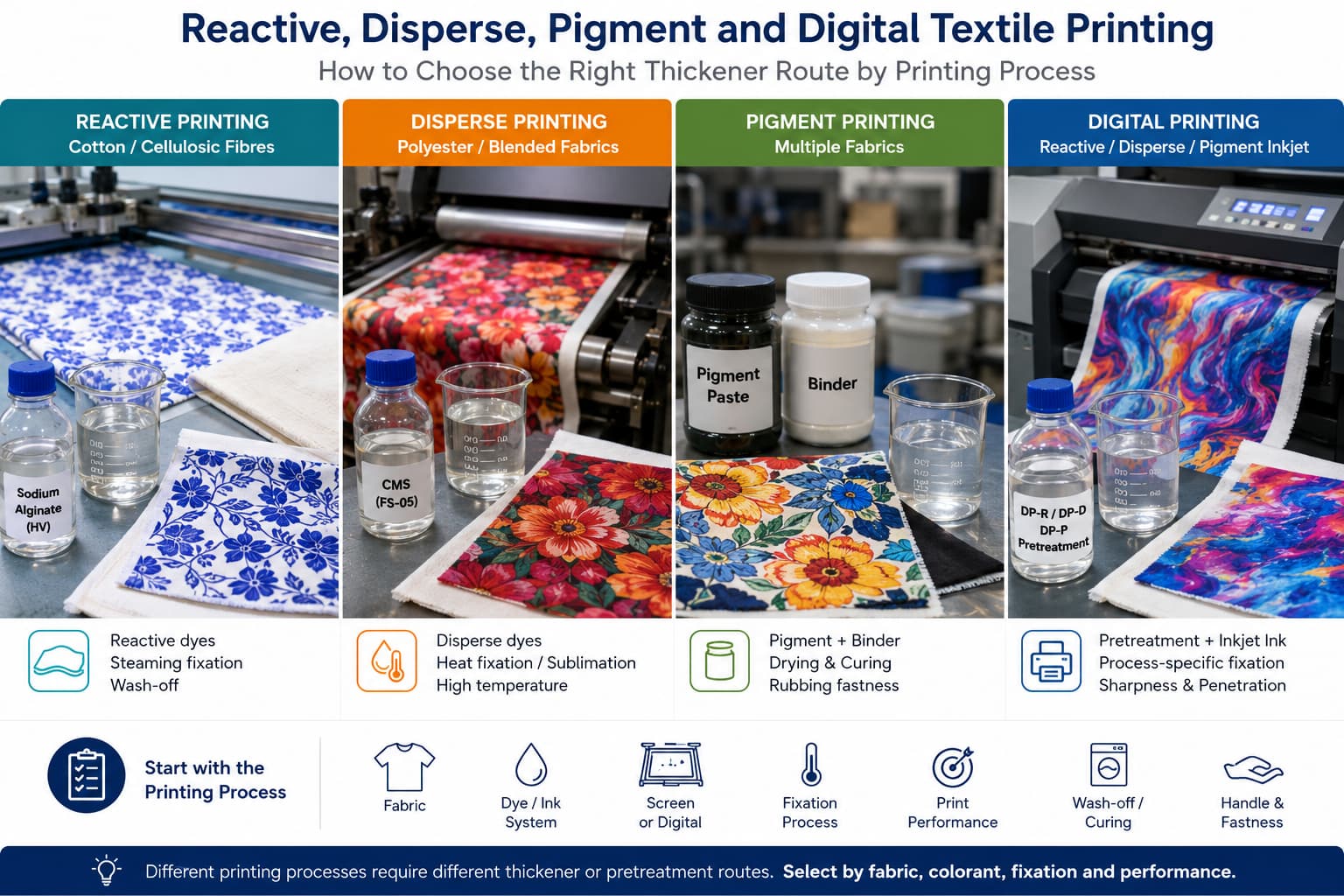
Learn how to choose thickener and pretreatment routes for reactive, disperse, pigment and digital textile printing based on fabric, dye or ink, fixation, wash-off and print-quality requirements.
CMC-based printing paste is used across pigment, reactive, and digital textile printing. This guide explains what parameters matter, how to compare suppliers, and what to request before placing a bulk order.
Both sodium alginate and CMC are used as thickeners in textile printing, but they suit different dye systems and process conditions. This guide explains the key differences and when to use each.
The right textile printing thickener is determined by more than fabric type. Buyers should match the thickener to the dye or pigment system, printing method, target rheology, wash-off requirements and actual factory trial conditions.
Textile printing performance depends on a coordinated chemical system, not one universal additive. This guide explains ten important chemical groups, their functions, where they fit and what buyers should verify before production trials.
Textile printing thickeners differ in chemistry, rheology, dye compatibility and wash-off behavior. This guide compares the main thickener families, their common application directions and the parameters buyers should verify before production trials.
Digital printing pastes should be selected by ink chemistry, fabric, application method and post-treatment. This guide compares sodium alginate, CMC, CMS, synthetic polymer and compound pretreatment routes for textile inkjet printing.
FSX Chemical offers separate digital printing paste routes for reactive, disperse and pigment systems, supported by application review, sample matching and technical documentation. This guide explains how buyers can evaluate the right route before bulk purchasing.
Stable digital printing paste requires more than a target viscosity. This guide explains how product selection, water quality, addition sequence, mixing, pH, temperature, filtration, hygiene, storage and quality records influence pretreatment and production consistency.
Textile printing chemical innovation in 2026 is moving beyond higher viscosity and stronger color. The leading developments focus on safer inputs, renewable polymers, waterborne nano-binders, stable pigment dispersions, lower-energy fixation and multifunctional printing systems.
This product review examines FSX Digital Printing Paste as a textile inkjet pretreatment and thickening route, focusing on ink-system matching, rheology, filtration, print definition, stability and real production testing.
Digital textile printing requires more than advanced ink and printheads. Explore process-specific chemical solutions for reactive, disperse and pigment inkjet printing, from pretreatment and rheology to filtration, fixation and production validation.
Share the product name, application, quantity, destination and any TDS,
sample photo or document you already have. FSX Chemical will review the
information and recommend the next step for quotation, sample matching
or product selection.
Product InformationProduct name, grade, model, label photo or supplier reference.
Available DocumentsTDS, SDS, COA, sample photo, product list or test data.
Order DetailsEstimated quantity, packaging, destination country, port or trade term.
Application or IssueTextile printing process, formulation need, current issue or target performance.