CMC for Pigment Printing: How to Evaluate Binder Compatibility, Rheology and Fabric Hand Feel
CMC can be evaluated as a rheology modifier or thickener in selected pigment printing formulations,...
CMC can be evaluated as a rheology modifier, thickener or supporting component in selected pigment printing formulations, but successful use depends on much more than pure-water viscosity. Pigment printing pastes contain pigments, binders, wetting agents, fixers, defoamers and other auxiliaries that can change CMC viscosity, ionic compatibility and film behavior. At the same time, the binder needed to anchor insoluble pigment can increase fabric stiffness, while excessive CMC or other paste solids may add further residue and hand-feel penalties. This guide explains how textile mills should evaluate CMC for pigment printing through binder compatibility, complete-paste rheology, print definition, curing, rubbing fastness and finished fabric hand rather than selecting a grade from viscosity alone.
What Role Can CMC Play in Pigment Printing?
Carboxymethyl cellulose (CMC) is a water-soluble cellulose derivative that can build viscosity, modify flow, retain water and support paste stability.
In selected pigment printing formulations, CMC may be evaluated as:
A primary thickener in a specifically matched formula
A viscosity modifier
A supporting component in a compound thickener
A paste-body adjustment tool
A water-retention component
Its practical job is to help control the movement of the pigment printing paste during application.
Depending on the printing process, the desired result may include:
Stable paste transfer
Clean edges
Controlled penetration
Reduced lateral spreading
Uniform solid areas
FSX Chemical’s current CMC guidance positions CMC in selected pigment-printing and compound-thickener systems, with final suitability confirmed through the complete formula and printing trial rather than from viscosity alone.
Binder → Pigment Anchorage, Rubbing Fastness and Wash Durability
CMC may contribute some film-forming behavior, but it should not be assumed to replace the dedicated pigment binder.
If a print has excellent edge definition but poor rubbing fastness, increasing CMC is not necessarily the correct solution.
Why Binder Compatibility Must Be Tested
Pigment printing paste is a multicomponent system.
It may contain:
রঞ্জক ছড়িয়ে পড়া
Acrylic or other polymer binder
CMC or another thickener
Fixer/crosslinking chemistry
আর্দ্রকারী পদার্থ
ডিফোমার
Softener/plasticizer
Other process auxiliaries
Each component can affect the others.
A CMC solution that looks perfectly smooth in water may behave differently after binder is added.
Possible incompatibility symptoms include:
Sudden viscosity loss
Excessive viscosity increase
Flocculation
জেল কণা
Phase separation
Foam changes
Poor screen release
Textile printing literature consistently emphasizes that thickener compatibility with binders and auxiliaries is a key condition for stable pigment printing paste.
Therefore, binder compatibility should be checked before production scaling.
Ionicity, pH and Electrolytes: Where Compatibility Problems Begin
CMC is an anionic polymer under typical aqueous conditions.
Many pigment printing binders are anionic or nonionic acrylic dispersions, but fixation packages and specialty auxiliaries may introduce other ionic components.
Compatibility can change with:
Binder ionicity
Fixer ionicity
পিএইচ
Electrolyte concentration
জলের কঠোরতা
Pigment dispersion chemistry
Strong ionic mismatch can create flocculation or paste instability.
Even without visible precipitation, electrolytes can change CMC chain expansion and viscosity.
A useful formulation check therefore records:
CMC grade and dosage
Binder type and ionicity
Fixer/crosslinker
pH before and after formulation
Conductivity where relevant
Viscosity after complete mixing
Do not assume compatibility because all individual raw materials are water-dispersible.
Why Complete-Paste Rheology Matters More Than CMC Solution Viscosity
Pure-water viscosity is useful for incoming CMC QC, but it does not represent the complete pigment printing paste.
Actual paste rheology changes after the addition of:
বাইন্ডার
রঞ্জক ছড়িয়ে পড়া
ইলেক্ট্রোলাইটসমূহ
আর্দ্রকারী পদার্থ
ফিক্সার
Defoamer
For printing, useful rheology must balance two competing requirements:
High enough structure at rest → limit spreading and maintain pattern definition
Enough flow under shear → transfer smoothly through the screen, roller or application system
This is why one-point Brookfield viscosity alone cannot completely describe printing behavior.
Research on textile printing thickeners has shown that steady-shear and viscoelastic properties can correlate with important printing quality parameters.
The correct CMC trial therefore measures the complete pigment paste, not only the CMC stock solution.
Shear Thinning, Screen Release and Print Definition
Many textile printing pastes show shear-thinning behavior.
The apparent viscosity decreases when shear rate increases during:
মিশ্রণ
Pumping
Squeegee movement
Rotary-screen transfer
After the applied shear decreases, the paste should recover enough structure to limit uncontrolled spreading.
If the paste is too resistant to flow, possible problems include:
Poor screen transfer
Incomplete pattern filling
Heavy paste deposits
If structure is too weak, possible problems include:
রক্তক্ষরণ
Wicking
Reduced fine-line definition
Excess penetration
অতএব:
Higher viscosity is not automatically better rheology.
The target is the right flow curve for the actual printing equipment.
CMC, Binder and Total Solids
Pigment printing differs from many dye-printing systems because the binder deliberately remains as a polymer film on the textile.
This makes total formulation solids important.
CMC is also a polymer solid.
Increasing CMC dosage may improve paste body, but it can also increase:
মোট জমাটবাঁধা পদার্থ
Surface residue
Dry-film build
Potential stiffness
This is one reason low-solids synthetic thickeners are widely used in conventional pigment printing.
CMC can still be useful in selected formulations, especially as a rheology modifier or compound-thickener component, but its required dosage should be evaluated against:
বাঁধাই কঠিন পদার্থ
রঞ্জক কঠিন পদার্থ
Fixer solids
Required hand feel
Do not optimize CMC concentration independently from total paste solids.
How CMC and Binder Can Affect Fabric Hand Feel
Fabric hand is a system result.
The binder is often the strongest contributor because it creates a durable polymer film around fibers and pigment particles.
Research on acrylic pigment binders has shown that increasing binder concentration can improve rubbing fastness while also increasing fabric stiffness.
CMC can add another hand-feel variable if excessive polymer remains on the fabric.
Possible contributors to a harsh or boardy hand include:
High binder dosage
Hard binder modulus
Excess CMC or thickener solids
Heavy pigment loading
Over-curing
Insufficient softening/finishing
This means:
Do not diagnose stiff hand from CMC alone.
And:
Do not assume a low-viscosity CMC automatically gives a softer print.
The correct evaluation is the finished fabric after curing and any intended washing/finishing.
Rubbing Fastness: Do Not Blame the Thickener First
Rubbing fastness is strongly connected to binder film performance.
If dry or wet rubbing fastness is poor, check:
Binder dosage
Binder chemistry
Pigment-to-binder ratio
Curing temperature
Dwell time
Substrate adhesion
Pretreatment or thickener compatibility
CMC can indirectly affect fastness if it interferes with binder film formation or creates excessive surface solids.
However, adding more CMC is not a direct fastness correction.
A useful troubleshooting principle is:
Print-definition failure → investigate rheology and paste transfer first.
Fastness failure → investigate binder and curing first.
Curing Conditions and Binder Film Formation
Binder must form a continuous and sufficiently durable film.
This process depends on actual fabric temperature and time, not only the oven set-point.
গুরুত্বপূর্ণ ভেরিয়েবলগুলির মধ্যে রয়েছে:
Drying before curing
Curing temperature
Dwell time
Airflow
Binder minimum film-forming behavior
Crosslinker/fixer chemistry
Insufficient curing can create poor rubbing and washing durability.
Excessive curing can create:
কঠিন হাত
Yellowing
Energy waste
Damage to heat-sensitive fabrics
CMC selection should therefore be validated under the intended production curing route, because the final hand and surface condition are evaluated after binder film formation.
Cotton, Polyester and Blends
সুতি
Cotton is hydrophilic and can absorb the water phase of the pigment paste readily.
The formulation must balance:
প্রবেশ
Surface color
Binder adhesion
Softness
পলিয়েস্টার
Polyester is more hydrophobic.
Surface finish, silicone, oils and previous thermal history can affect wetting and binder adhesion.
Cotton/Polyester Blends
Blends combine two different surface behaviors.
A CMC/binder system optimized on cotton should not automatically be approved for a polyester-rich CVC or TC fabric.
Validate:
সংজ্ঞা মুদ্রণ করুন
Color strength
ঘর্ষণ স্থায়িত্ব
Wash durability
Hand feel
Water Quality and CMC-Binder Stability
CMC hydration and viscosity can respond to calcium, magnesium and overall ionic strength.
Water quality can therefore affect the pigment paste before binder compatibility is even evaluated.
If a formulation works in the laboratory but not in production, compare:
Plant water hardness
পিএইচ
পরিবাহকতা
Reference-water result
Hard water can also interact with other anionic or ionic formulation components.
A practical trial should therefore use the actual plant water whenever possible.
Paste Holding Time and Storage Stability
A pigment paste may look stable immediately after preparation and change several hours later.
Possible changes include:
Viscosity drift
Phase separation
Flocculation
ফেনা
Skin formation
Holding stability should be tested over the realistic color-kitchen and printing window.
Record viscosity:
After formula completion
After the expected waiting time
Near the end of the intended working period
If the binder/CMC system changes with time, the first viscosity reading is not enough for production approval.
Run a Mass-Balanced CMC–Binder Compatibility Test
Start with the production binder, pigment and auxiliary package. A binary CMC–binder jar test can reveal an interaction, but only the complete paste and cured print can establish suitability for the intended pigment-printing route.
তুলনা
How to prepare it
Question answered
Hydrated CMC control
Same CMC concentration and final mass as the relevant comparison, with replacement water
Is the CMC preparation itself stable?
Binder control
Same supplied binder concentration in matched water and relevant conditions
Does the binder show instability independently?
CMC plus binder
Use the planned ratio and supplier-supported addition sequence
Does combining the two create a new visible or rheological change?
Complete paste and production reference
Include pigment and intended auxiliaries at documented levels
Does the candidate work in the actual formulation?
Balance water and report the dose basis
Keep final mass and comparison concentrations consistent. Water used to pre-dilute an ingredient must be subtracted elsewhere in the recipe. Record both as-supplied binder dosage and verified solids information where available; do not assume that all reported emulsion solids are film-forming polymer. Label CMC dosage as supplied or on a verified dry/active basis, rather than silently switching between them.
Separate screening from performance approval
At defined initial and working-age points, record pH, temperature, viscosity method, foam, flocs, gel, sediment and separation. When changing CMC in the first trial, hold binder and pigment levels constant so that their changes do not hide the effect. Formula optimization can follow as a separate, explicitly documented comparison.
Print and cure using the binder supplier’s supported conditions, then assess hand, detail and the required fastness. A stable jar does not prove a sound binder film. Conversely, an unstable sample should not be rescued for comparison merely by adding more thickener. CMC remains a rheology component in this evaluation; it is not evidence that the pigment binder can be removed or universally reduced.
How to Compare Rheology in the Laboratory
At minimum, standardize:
CMC concentration
Binder/pigment formula
জল
তাপমাত্রা
জলসঞ্চার
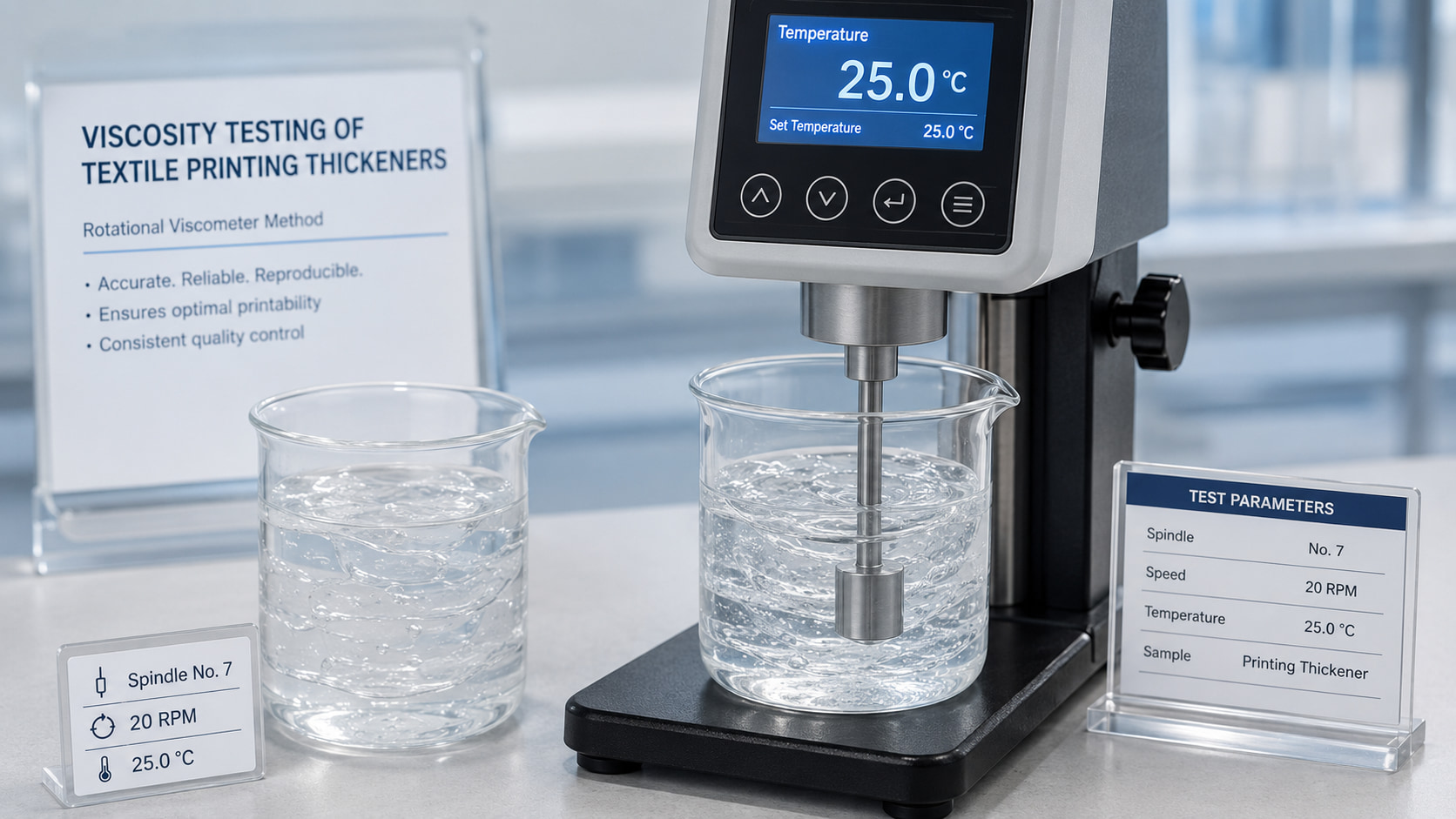
Viscometer
Spindle/rotor
RPM
পড়ার সময়
If rheometry is available, compare viscosity across a useful shear-rate range rather than using only one point.
For production screening, also observe:
Paste pickup by the screen
Squeegee flow
স্ক্রিন রিলিজ
Stringiness
Recovery after shear
The goal is to connect laboratory rheology with actual print behavior.
How to Run a Controlled Pigment Printing Trial
Step 1: Select One Fabric Lot
Avoid fabric variation during the first comparison.
Step 2: Keep Binder and Pigment Constant
Change only the CMC grade or dosage initially.
Step 3: Prepare the Complete Paste
Use the actual formulation and mixing sequence.
Step 4: Print the Same Diagnostic Pattern
Include fine lines, text, solids and high-coverage areas.
Step 5: Dry and Cure Identically
Use the same actual process conditions.
Step 6: Evaluate Print Formation
তুলনা করুন:
তীক্ষ্ণতা
রক্তক্ষরণ
প্রবেশ
ঘন-ক্ষেত্রের সমতা
Color strength
Step 7: Evaluate Finished Fabric
তুলনা করুন:
Dry rubbing
Wet rubbing
Wash durability
Hand feel
Surface residue
Step 8: Repeat with Binder Optimization if Needed
If the CMC route improves printability but fastness or hand is not balanced, optimize binder/cure separately rather than changing every component at once.
Pigment Printing Troubleshooting Table
পর্যবেক্ষিত সমস্যা
প্রথমে যাচাই করার ভেরিয়েবলসমূহ
অনুমান করবেন না
Viscosity drops after binder addition
Ionicity, electrolyte load, pH, CMC grade
The original CMC viscosity was wrong
Gel/flocs after fixer addition
Ionic compatibility, addition order, local concentration
CMC is primarily a thickener/rheology modifier, not the pigment binder.
Pure-water viscosity does not predict complete pigment-paste behavior.
Binder ionicity, electrolyte load and pH can change CMC viscosity and stability.
Higher viscosity is not automatically better printing rheology.
Binder and total polymer solids can both affect fabric hand.
Final approval should balance printability, fastness, hand feel and Total Cost in Use.
প্রায়শই জিজ্ঞাসিত প্রশ্নাবলী
1. Can CMC be used in pigment printing?
CMC can be evaluated as a thickener, rheology modifier or blend component in selected pigment printing formulations. Suitability depends on binder compatibility and the complete formula.
2. Is CMC a pigment binder?
No. CMC mainly controls paste rheology. A dedicated binder normally provides the durable polymer film that anchors pigment particles after curing.
3. Why does CMC viscosity change after binder is added?
Binder ionicity, electrolytes, pH and other auxiliaries can change CMC chain behavior and apparent viscosity.
4. Can CMC react badly with cationic additives?
It can. CMC is anionic, so strong ionic incompatibility with cationic components can cause flocculation or instability. Test the actual fixer or auxiliary package.
5. Does higher CMC viscosity improve print sharpness?
Not automatically. Printing depends on the full rheological profile, including flow under shear and structural recovery after application.
6. Can CMC make pigment-printed fabric stiff?
Excess CMC solids can contribute to surface residue or stiffness, but binder dosage, binder modulus, pigment loading and curing often have major effects as well.
7. Does more binder improve rubbing fastness?
It can improve fastness within a suitable range, but excessive binder can increase stiffness. Binder chemistry and curing also matter.
8. Why is pure-water CMC viscosity not enough for selection?
The complete pigment paste contains binder, pigment, fixer and auxiliaries that can change viscosity and rheology.
9. Should I use low-viscosity CMC for softer hand?
Not as a universal rule. Hand feel depends on required dosage, total polymer solids, binder film and curing, not only the CMC viscosity grade.
10. How should binder compatibility be tested?
Prepare fully hydrated CMC, add binder and the critical production auxiliaries in the real ratio, then observe viscosity, pH, flocculation and holding stability before printing.
11. Is CMC better than a synthetic pigment thickener?
Neither is universally better. Low-solids synthetic thickeners are widely used in pigment printing, while CMC can add value in selected rheology or compound-thickener routes. Compare the complete system.
12. What should I send FSX Chemical for CMC pigment-printing matching?
Send the current thickener, CMC requirement, binder/fixer system, fabric, full or simplified formula, viscosity method, curing conditions, fastness target and hand-feel requirement.
Evaluate CMC and Binder Compatibility with FSX Chemical
If you are considering CMC in a pigment printing paste, FSX Chemical can help determine whether the next trial should focus on CMC grade, compound-thickener design, binder compatibility or a different thickener route.
For a relevant comparison, send:
Your current thickener TDS or sample
Current or target CMC grade
Binder TDS or basic chemistry
Binder and fixer dosage
Pigment type/concentration
বস্ত্রের গঠন ও নির্মাণ
সম্পূর্ণ বা সরলীকৃত সূত্র
Viscosity and full test method
Plant water information where relevant
Printing method
Drying and curing conditions
Dry/wet rubbing results
Hand-feel target
দিয়ে শুরু করুন নমুনা ও মিলान for a controlled formulation comparison.
CMC should earn its place in a pigment printing formula through binder compatibility, useful rheology and acceptable finished-fabric hand—not through a high viscosity number alone.
জানুন কেন টেক্সটাইল প্রিন্টিং থিকেনার সান্দ্রতা (ভিসকোসিটি) মানগুলো তুলনা করা যায় না যদি না সেগুলোর ঘনত্ব, তাপমাত্রা, যন্ত্র, স্পিন্ডল, গতি, প্রস্তুতি পদ্ধতি এবং পরীক্ষার সময় মিল থাকে।.
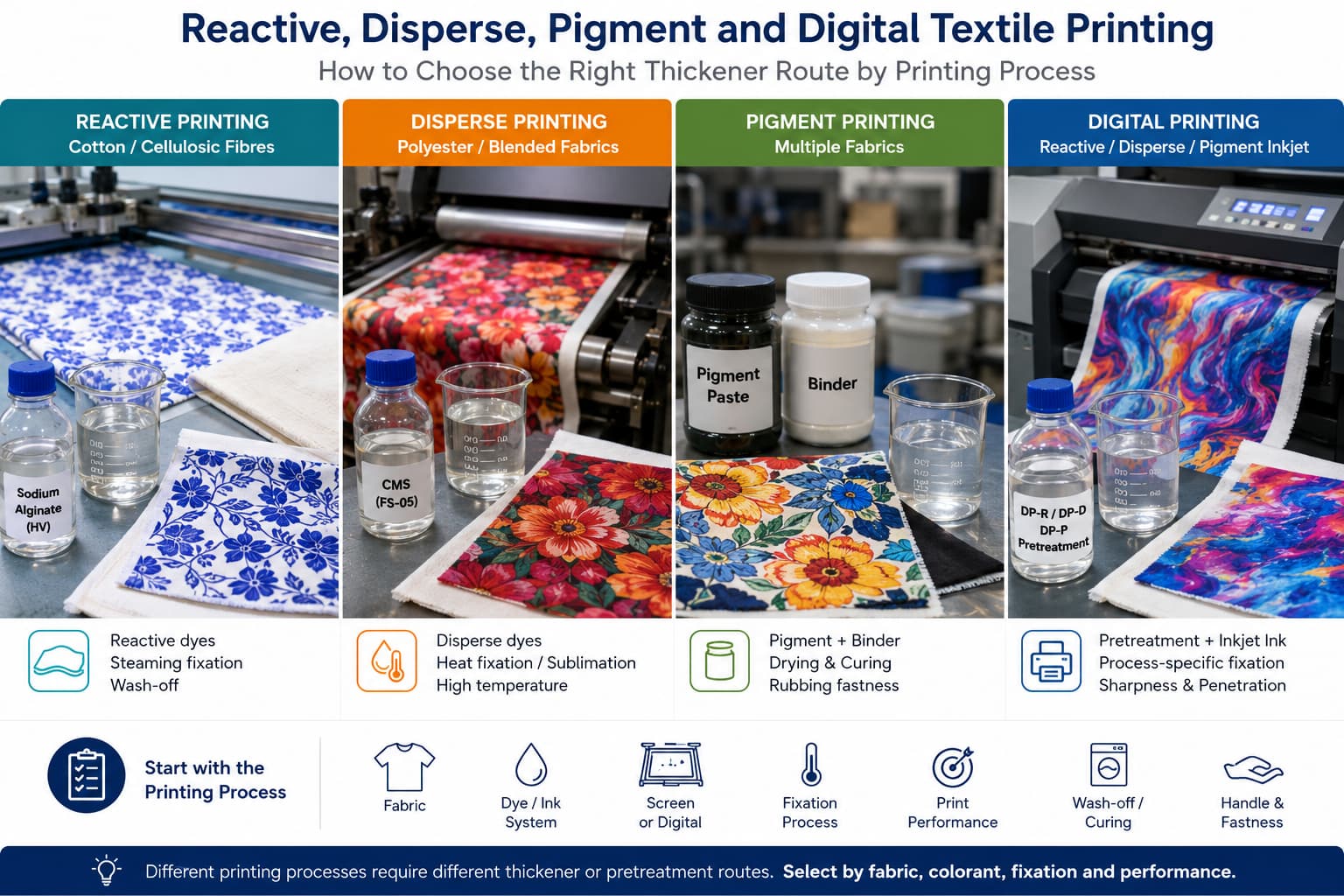
কাপড়, রঞ্জক বা কালি, স্থিরীকরণ, ধুয়ে ফেলার এবং মুদ্রণ-মানের প্রয়োজনীয়তার ভিত্তিতে প্রতিক্রিয়াশীল, বিচ্ছুরিত, পিগমেন্ট এবং ডিজিটাল টেক্সটাইল প্রিন্টিংয়ের জন্য ঘনকারী ও প্রিট্রিটমেন্ট পদ্ধতি কীভাবে নির্বাচন করবেন তা শিখুন।.
টেক্সটাইল প্রিন্টিংয়ের জন্য CMC, CMS, সোডিয়াম অ্যালজিনেট এবং ডিজিটাল প্রিন্টিং পেষ্টের তুলনা করুন। প্রতিটি পদ্ধতি কীভাবে রিয়্যাক্টিভ, ডিসপার্স, পিগমেন্ট এবং ডিজিটাল প্রক্রিয়ার সঙ্গে খাপ খায় এবং নমুনা পরীক্ষা, গ্রেড মিলान ও বৃহৎ পরিমাণে ক্রয়ের আগে ক্রেতাদের কী কী বিষয় পর্যালোচনা করা উচিত তা শিখুন।.
কার্বক্সিমেথাইল সেলুলোজ (CMC) বস্ত্রের মুদ্রণ, সাইজিং এবং রঙ করার প্রক্রিয়ায় ব্যাপকভাবে ব্যবহৃত হয়। এই গাইডে CMC গ্রেডগুলো কীভাবে মূল্যায়ন করবেন, কোন প্যারামিটারগুলো সবচেয়ে গুরুত্বপূর্ণ এবং FSX Chemical কীভাবে ক্রয় সিদ্ধান্তে সহায়তা করতে পারে তা ব্যাখ্যা করা হবে।.
কার্বক্সিমেথাইল সেলুলোজ জল-ভিত্তিক ইঙ্ক, গ্র্যাভুর প্রিন্টিং এবং ইঙ্কজেট প্রি-ট্রিটমেন্টে ঘনকারী ও স্থিতিশীলকারী হিসেবে ব্যবহৃত হয়। এই গাইডে ক্রয় দলের জন্য মূল গ্রেড পরামিতি এবং উৎস নির্ধারণ সংক্রান্ত বিবেচনাসমূহ অন্তর্ভুক্ত রয়েছে।.
CMC-ভিত্তিক প্রিন্টিং পেষ্ট পিগমেন্ট, রিঅ্যাক্টিভ এবং ডিজিটাল টেক্সটাইল প্রিন্টিংয়ে ব্যবহৃত হয়। এই গাইডে কোন প্যারামিটারগুলো গুরুত্বপূর্ণ, সরবরাহকারীদের কীভাবে তুলনা করবেন এবং বড় অর্ডার দেওয়ার আগে কী জানতে হবে তা ব্যাখ্যা করা হয়েছে।.
টেক্সটাইল প্রিন্টিং-এ ঘনকারী হিসেবে সোডিয়াম অ্যালজিনেট এবং CMC উভয়ই ব্যবহৃত হয়, তবে এগুলো ভিন্ন রঞ্জক ব্যবস্থা ও প্রক্রিয়া শর্তের জন্য উপযুক্ত। এই গাইডে মূল পার্থক্যগুলো এবং কখন কোনটি ব্যবহার করতে হবে তা ব্যাখ্যা করা হয়েছে।.
খাদ্য-গ্রেড এবং শিল্প-গ্রেড CMC একই মৌলিক রাসায়নিক গঠন ভাগ করে, তবে বিশুদ্ধতা, DS পরিসর এবং নিয়ন্ত্রক প্রয়োজনীয়তায় এদের মধ্যে উল্লেখযোগ্য পার্থক্য রয়েছে। এই গাইডে মূল পার্থক্যগুলো এবং ভুল গ্রেড ব্যবহার করলে কেন উৎপাদন সমস্যা সৃষ্টি হয় তা ব্যাখ্যা করা হয়েছে।.
সেলুলোজ-ভিত্তিক কাঁচামাল টেক্সটাইল প্রিন্টিং, প্রিন্টিং পেষ্ট প্রস্তুতি, ঘনত্ব বৃদ্ধি এবং ফর্মুলেশন সমর্থনে ব্যবহৃত হয়। এই গাইডে ব্যাখ্যা করা হয়েছে কীভাবে ক্রেতারা স্পেসিফিকেশন, ডকুমেন্টেশন, নমুনা পরীক্ষা এবং সরবরাহকারীর সহায়তার মাধ্যমে CMC, CMS, সোডিয়াম অ্যালজিনেট, টেক্সটাইল প্রিন্টিং থিকেনার এবং প্রিন্টিং পেষ্ট পণ্যগুলি মূল্যায়ন করতে পারেন।.
সেলুলোজ ডেরিভেটিভস বস্ত্র মুদ্রণ, মুদ্রণ পেস্ট প্রস্তুতি, ঘনত্ব বৃদ্ধি এবং ফর্মুলেশন সহায়তায় ব্যাপকভাবে ব্যবহৃত হয়। এই গাইডে ব্যাখ্যা করা হয়েছে কীভাবে বিদেশি ক্রেতারা FSX Chemical থেকে TDS, COA, নমুনা পরীক্ষা, গ্রেড মিলान এবং রপ্তানি নথি সহায়তার সাথে CMC, CMS, সোডিয়াম অ্যালজিনেট, বস্ত্র মুদ্রণ ঘনকারী এবং মুদ্রণ পেস্ট পণ্য সংগ্রহ করতে পারেন।.
টেক্সটাইল শিল্পের রাসায়নিক নির্বাচন করতে শুধুমাত্র পণ্যের নাম তুলনা করলেই চলে না। এই গাইডে ব্যাখ্যা করা হয়েছে কীভাবে টেক্সটাইল প্রিন্টিং ক্রেতারা CMC, CMS, সোডিয়াম অ্যালজিনেট, টেক্সটাইল প্রিন্টিং থিকেনার এবং প্রিন্টিং পেস্ট পণ্যগুলোকে প্রয়োগ, স্পেসিফিকেশন, TDS, COA, নমুনা পরীক্ষা এবং ব্যাচ সামঞ্জস্যতার ভিত্তিতে মিলিয়ে নিতে পারেন।.
টেক্সটাইল প্রিন্টিংয়ের জন্য রাসায়নিক ফর্মুলেশন সহায়তা পরিষ্কার প্রয়োগ সংক্রান্ত তথ্যের মাধ্যমে শুরু হওয়া উচিত। এই গাইডটি ব্যাখ্যা করে যে পণ্য মিলान, ফর্মুলেশন সামঞ্জস্য, নমুনা পরীক্ষা, TDS, COA, SDS এবং CMC, CMS, সোডিয়াম অ্যালজিনেট, টেক্সটাইল প্রিন্টিং থিকেনার ও প্রিন্টিং পেস্ট পণ্যের জন্য প্রযুক্তিগত সহায়তা অনুরোধ করার সময় ক্রেতাদের কী তথ্য প্রদান করতে হবে।.
পণ্যের নাম, ব্যবহার, পরিমাণ, গন্তব্য এবং আপনার কাছে থাকা যেকোনো TDS, নমুনা ছবি বা ডকুমেন্ট শেয়ার করুন। FSX Chemical এই তথ্য পর্যালোচনা করবে এবং কোটেশন, নমুনা মিলানো বা পণ্য নির্বাচনের পরবর্তী ধাপের জন্য পরামর্শ দেবে।.
পণ্যের তথ্যপণ্যের নাম, গ্রেড, মডেল, লেবেলের ছবি বা সরবরাহকারীর রেফারেন্স।.