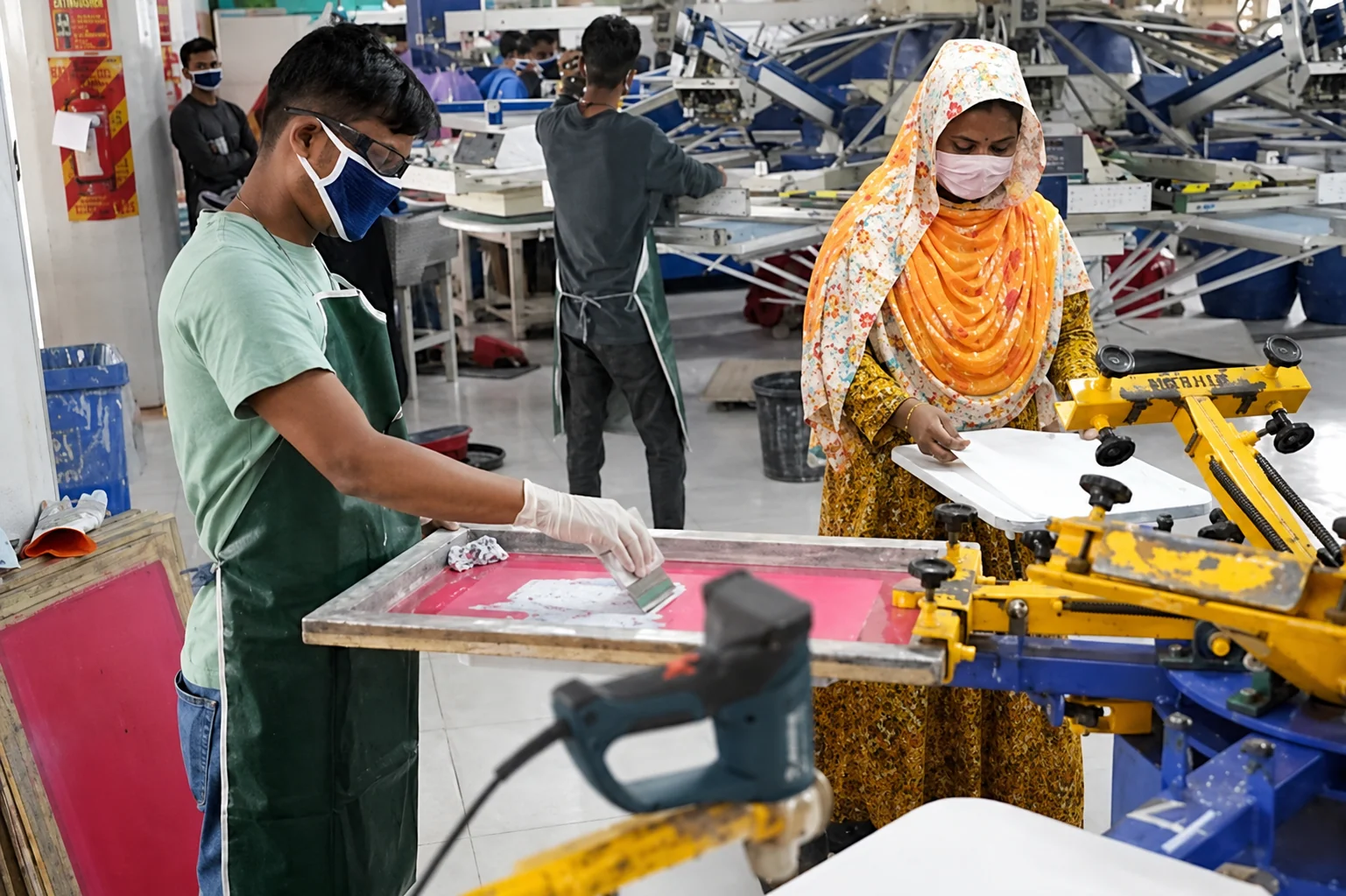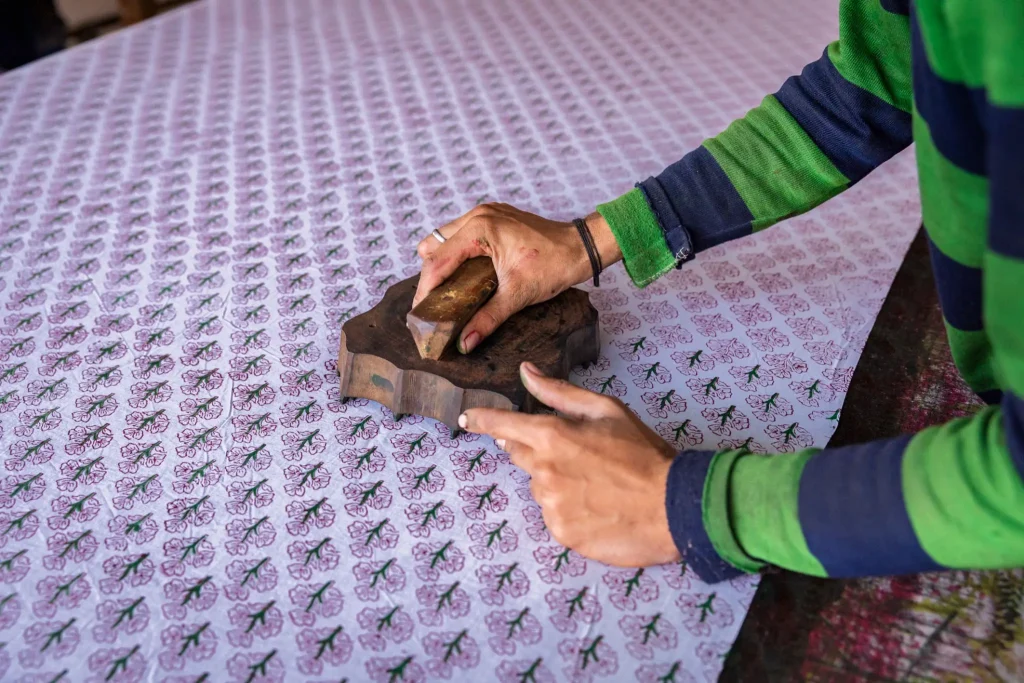
Sodium alginate is a practical thickener for reactive-dye hand block printing on cellulosic fabrics when the paste requires clean transfer, controlled penetration and reliable wash-off. It should not be treated as a universal thickener for every traditional, natural-dye, mordant or resist process; suitability depends on the actual dye chemistry, alkali, salts, fabric and fixation route.
This guide explains how to qualify textile-grade sodium alginate for hand block printing, including route screening, grade selection, small-batch preparation, workshop flow checks and production troubleshooting.
Is Sodium Alginate Suitable for This Hand-Printing Route?
| Process route | Alginate decision | Minimum trial |
|---|---|---|
| Reactive dye on cotton or viscose | Strong candidate | Paste rheology, outline, fixation, wash-off |
| Pigment plus binder | Not the default choice | Binder compatibility and handle |
| Natural dye or mordant route | Do not assume suitability | Exact recipe and full process sequence |
| Wax/resist plus printed reactive stage | Evaluate only the color-paste stage | Boundary control and post-wash result |
En qué se diferencia la impresión con bloques de la serigrafía en cuanto a los requisitos de la pasta
Aplicación manual y cuerpo de la pasta
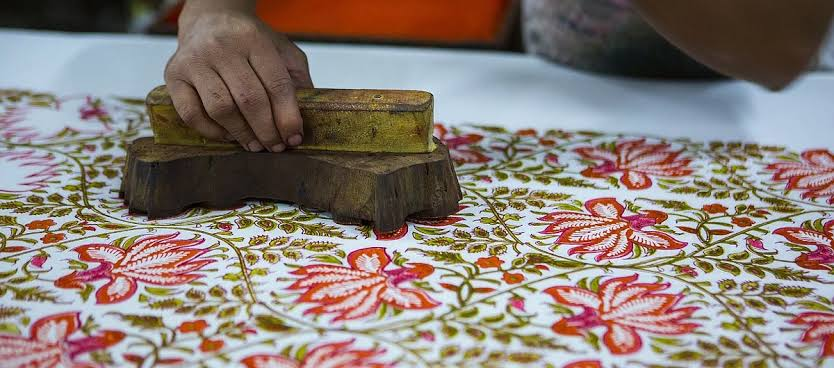
La pasta debe ser lo suficientemente espesa como para cubrir la superficie del bloque de manera uniforme sin gotear, mantener su forma sobre la superficie del bloque entre la bandeja de pasta y la tela, y desprenderse limpiamente sobre la tela cuando se presione y se levante el bloque. Si la pasta es demasiado líquida, goteará del bloque, se esparcirá de manera desigual y se correrá sobre la tela. Si la pasta es demasiado espesa, no cubrirá el bloque de manera uniforme y podría dejar espacios en el diseño.
Block printing and rotary screen printing impose different transfer forces and dwell times. Set paste body from the actual block depth, tray or pad, fabric construction and required penetration; do not assume block printing always needs a higher viscosity.
Definición de patrones y control de la migración del colorante
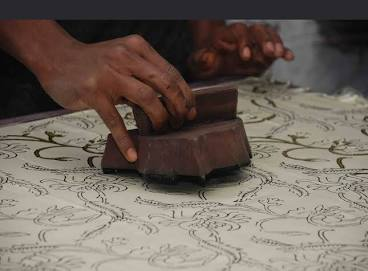
After stamping, the color paste must limit unwanted lateral spread while allowing the required penetration. Alginate systems can show shear thinning, but lower apparent viscosity at higher shear rate does not prove immediate recovery or guarantee edge definition when the block lifts. Test actual block loading, dwell, lift, fabric absorbency and the interval before fixation. Measure time-dependent recovery separately if it is part of the grade-selection criterion.
Tamaño del lote y escala de preparación
Las operaciones de impresión en bloque —ya sean talleres artesanales tradicionales o pequeñas empresas comerciales— suelen preparar la pasta en lotes pequeños en comparación con la serigrafía industrial. Las cantidades de pasta por color a menudo se miden en litros en lugar de en cientos de litros, y la preparación de la pasta se realiza manualmente o con equipos de mezcla a pequeña escala.
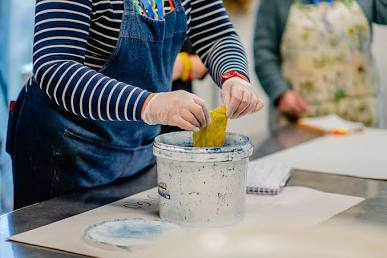
Small batches make preparation variables more visible. Add powder gradually to controlled-temperature water under adequate agitation, allow full hydration, then filter and rest the paste according to the approved method. Mesh size can affect wetting and dispersion, but it does not by itself predict hydration speed, viscosity or print quality.
Alginato de sodio en la pasta de impresión con bloques de tintes reactivos
Typical Components to Validate in a Reactive-Dye Block Paste
Depending on the selected reactive-dye process, a block-printing paste may contain sodium alginate, dye, alkali and specified auxiliaries such as urea or an anti-reducing agent. These are recipe components to confirm, not mandatory ingredients for every reactive system. Follow the dye supplier’s fixation route and test the complete paste; manual application alone does not establish a higher viscosity requirement.
Choose concentration by a controlled working trial rather than a presumed relationship to screen-printing dosage. Compare candidates first on a stated as-supplied powder basis with the same water, preparation, temperature and test method. Then optimize each complete recipe to achieve accepted transfer, penetration, outline, fixation and wash-off. Keep dye and auxiliary levels on the same final-recipe basis when changing thickener dosage.
En entornos artesanales tradicionales, la formulación de la pasta suele desarrollarse de manera empírica: el impresor la ajusta basándose en una evaluación visual y táctil del comportamiento de la pasta, en lugar de en mediciones con viscosímetro. Para las operaciones que están pasando de una formulación empírica a una basada en mediciones, un primer paso útil es establecer un rango de viscosidad objetivo mediante mediciones y correlacionarlo con un comportamiento conocido y adecuado de la pasta.
Control de los álcalis en la impresión en bloque de lotes pequeños
En la serigrafía industrial, la pasta que contiene álcalis se prepara en grandes lotes y se utiliza dentro de un plazo definido. En la impresión en bloque de lotes pequeños, se aplica el mismo principio, pero con diferentes limitaciones prácticas: los lotes pequeños pueden prepararse y utilizarse de manera intermitente a lo largo del día, y la pasta puede dejarse en la bandeja entre una sesión de impresión y otra.
Adding alkali changes the ionic and pH environment of the complete reactive paste and also starts a limited dye-use window. Alginate can degrade under sufficiently alkaline conditions during storage, but an immediate or later viscosity change does not establish that mechanism. Qualify both paste behavior and final color over the intended workshop holding period at the actual temperature. Practical controls include:
- Where the approved dye procedure permits, hydrate the stock first and add the specified alkali close to use. Label the addition time and use the paste within its qualified holding window.
- Use the alkali identity and amount specified for the dye and fixation route. Bicarbonate and carbonate are not universal substitutes; any change requires fresh compatibility, holding and final-color trials.
- Keep the paste covered under the temperature conditions qualified for the recipe. Recondition and test it by the same procedure before comparing later readings.
If paste behavior changes during printing, compare temperature, final concentration, accidental dilution, pH, ionic additions and shear/rest history with the approved reference. Include dye age and sanitation in the investigation. Holding temperature constant does not isolate alkali degradation, and acceptable viscosity does not by itself confirm usable dye fixation.
Tradiciones de los tintes naturales y compatibilidad con el alginato de sodio
Natural-dye, mordant and resist traditions use many process routes. Before introducing sodium alginate, run a small compatibility trial with the exact colorant, mordant, alkali, water quality, fabric and fixation sequence. Evaluate shade, outline, penetration and wash-off rather than assuming transfer from a reactive-dye recipe.
Where a mordant or auxiliary is part of the paste, add it only after confirming compatibility and holding stability. Compare a fresh paste with the intended workshop holding time and check for viscosity drift, separation or loss of print definition.
Control pH using the dye supplier’s process window. Sodium alginate tolerates many reactive-printing conditions, but the complete paste—not the thickener alone—must be tested after alkali and electrolyte addition.
El ajrak y las tradiciones relacionadas de estampado en bloque del sur de Asia
Impresión en ajrak: Requisitos del proceso y de la pasta
Ajrak is a multistage resist, mordant and dyeing tradition with workshop-specific recipes. The process should be documented before recommending any thickener; sodium alginate is relevant only when a compatible printed color or reactive-dye stage is actually used.
If a workshop uses a reactive-dye paste on cotton within an Ajrak-inspired or mixed production route, sodium alginate can be screened for outline control and wash-off. This is an application-specific trial, not a general prescription for traditional Ajrak.
For multistage work, test the alginate paste through the complete sequence—including drying, steaming or curing, washing and any later resist or mordant steps—to detect interactions that a single stamp test will miss.
Estampado en bloque de Bagru y Sanganer (India)
Bagru and Sanganer workshops use diverse natural, pigment and reactive color systems. Identify the actual route first. For reactive-dye printing on cellulosic fabric, sodium alginate may be evaluated; other systems need a thickener selected for their own binder, mordant and fixation chemistry.
Do not select a “medium-viscosity” grade by label alone. Compare samples at equal solids and a defined test method, then adjust concentration to the block depth, fabric absorbency and desired penetration. Approve the grade only after print, fixation and wash-off trials.
Batik y estampado con cera
In batik and other resist processes, the wax or resist stage and the color-application stage should be evaluated separately. Sodium alginate may be considered only for a compatible reactive-dye printing stage.
Where an alginate paste is used alongside a resist, choose rheology from trial results: the paste must transfer without flooding fine resist boundaries, while still wetting the exposed fabric. A universal low-, medium- or high-viscosity recommendation is not reliable.
Selección de calidades para la impresión artesanal y a pequeña escala con bloques
Consideraciones sobre el grado de viscosidad
Low-, medium- and high-viscosity labels describe supplier grades under specified solution tests, not a universal block-printing ranking. A lower-viscosity grade at one concentration may produce a workable paste, while a higher-viscosity grade may give poor loading or release. Select the grade and concentration together using the actual block, tray or pad, fabric and complete recipe.
Record the viscosity of an accepted reference paste with concentration basis, temperature, instrument, spindle, speed, hydration and rest time. Use it as a comparison checkpoint, not as proof that a new grade will print identically. Approve the new grade only after side-by-side transfer, edge, penetration, fixation and wash-off tests on the production fabric.
Método de disolución para la preparación a pequeña escala
Cold-water preparation can be practical when the grade and mixing procedure allow it. Add powder gradually to water with enough agitation to disperse it without persistent dry centers, then allow the defined hydration period. Qualify the mixer or clean paddle for the actual batch size and paste body; small volume alone does not prove that manual stirring is adequate.
Fine particles may hydrate faster once individually wetted, but can also clump more readily; a finer sieve label does not guarantee easier preparation. Compare the actual grade using the workshop’s addition rate, agitation, water and hydration procedure, then inspect filtered residue and stamp performance. The FAO alginate properties reference distinguishes particle hydration from dispersion; it does not set a universal mesh threshold for textile workshops.
Pureza y solubilidad para una definición nítida del patrón
For procurement, specify the supplier’s test method and acceptance range for viscosity, moisture, pH and insoluble matter. Compare certificate results with an incoming-lot hydration and filtration check; do not rely on one generic insoluble-matter limit across all grades.
El contenido de metales pesados en el alginato de sodio puede ser relevante si la tela impresa debe cumplir con las especificaciones del comprador respecto al contenido de metales pesados en los productos químicos textiles —algo cada vez más común en los pedidos de exportación procedentes de los principales mercados minoristas—. Solicita a tu proveedor la información sobre metales pesados si este es un requisito para tu mercado final.
Evaluación práctica de la pasta para la impresión en bloque
Workshop Flow Checks (Not a Substitute for Viscosity Testing)
When a viscometer is unavailable, use drip, block-face and stamp checks to compare a new batch against an approved reference paste. Record water temperature, mixing time, rest time and concentration so the comparison is repeatable.
- Drip comparison — use the same clean paddle, loading, lift height, temperature and elapsed time as the accepted reference. Record the observed behavior alongside the stamp result; there is no universal seconds-to-first-drip acceptance limit.
- Prueba de cara de bloque — Presiona el bloque contra la bandeja de pasta y levántalo; la pasta debe cubrir uniformemente la superficie del bloque sin gotear por los puntos más bajos del diseño tallado.
- Prueba del sello — Estampa el bloque con la pasta sobre una muestra de tu tela de producción y evalúa si los bordes del diseño son nítidos o si se difuminan
These workshop checks show transfer behavior but do not produce a procurement-grade viscosity value. Supplier and incoming QC comparisons should use the same instrument, spindle, speed, temperature, solution concentration and hydration time.
Preparación de una pasta de referencia para garantizar la consistencia
En el caso de las operaciones en las que la pasta se prepara de manera empírica, preparar un lote de referencia con parámetros de trabajo confirmados —concentración medida, viscosidad medida, grado y número de lote del alginato de sodio documentados— y conservarlo como referencia de calidad te brinda un estándar repetible con el que comparar lotes futuros. Esto resulta particularmente útil al cambiar de lote o de proveedor de alginato de sodio, ya que una comparación directa con el lote de referencia permite identificar cualquier diferencia de rendimiento antes de que afecte la producción.
Preguntas frecuentes
Is sodium alginate suitable for every hand block printing process?
No. It is primarily evaluated for compatible reactive-dye pastes on cellulosic fabric. Natural-dye, pigment, mordant and resist systems require separate compatibility trials.
How should a workshop choose sodium alginate viscosity?
Compare candidate grades at controlled solids, then adjust concentration against block depth, fabric absorbency, outline and penetration. Confirm the value using a documented viscosity method.
Can a drip test replace a viscometer?
No. A drip or stamp test is useful for daily comparison with an approved paste, but supplier qualification and incoming QC require method-controlled viscosity measurement.
When should alkali be added to a reactive block-printing paste?
Follow the dye-system procedure and add alkali as late as practical when limited paste stability is a concern. Validate the intended holding time under actual workshop temperature.
What should be recorded during a sample trial?
Record grade and lot, solids, water temperature, mixing and rest time, additives, fabric, block geometry, fixation, wash-off, outline and final shade. For a supplier comparison, use Muestras y combinación.
Cómo FSX Chemical apoya a las imprentas artesanales y de pequeña escala
Request the current grade TDS and available batch COA, including the viscosity method, moisture, pH, insoluble matter and particle-size information where specified. Sodium alginate is not selected by the CMC degree-of-substitution (DS) parameter. Share the actual block, fabric, dye route and preparation method with FSX for a relevant sample comparison.
Próximos pasos:
- Solicitar un TDS — Revisar las especificaciones de viscosidad, malla y disolución para aplicaciones de impresión en bloque
- Solicitar una muestra — evalúa cómo se comporta la pasta en tus bloques y en la tela antes de hacer un pedido al por mayor
- Solicita la equiparación de calificaciones — Comparte tu tradición de impresión con bloques, tu sistema de teñido y tu método de preparación de la pasta para que podamos darte una recomendación específica.
- Póngase en contacto con nuestro equipo técnico — para recibir apoyo en la formulación o la resolución de problemas en aplicaciones de impresión artesanalcomunicaciones📧 Correo electrónico: Service@fsxchemical.com