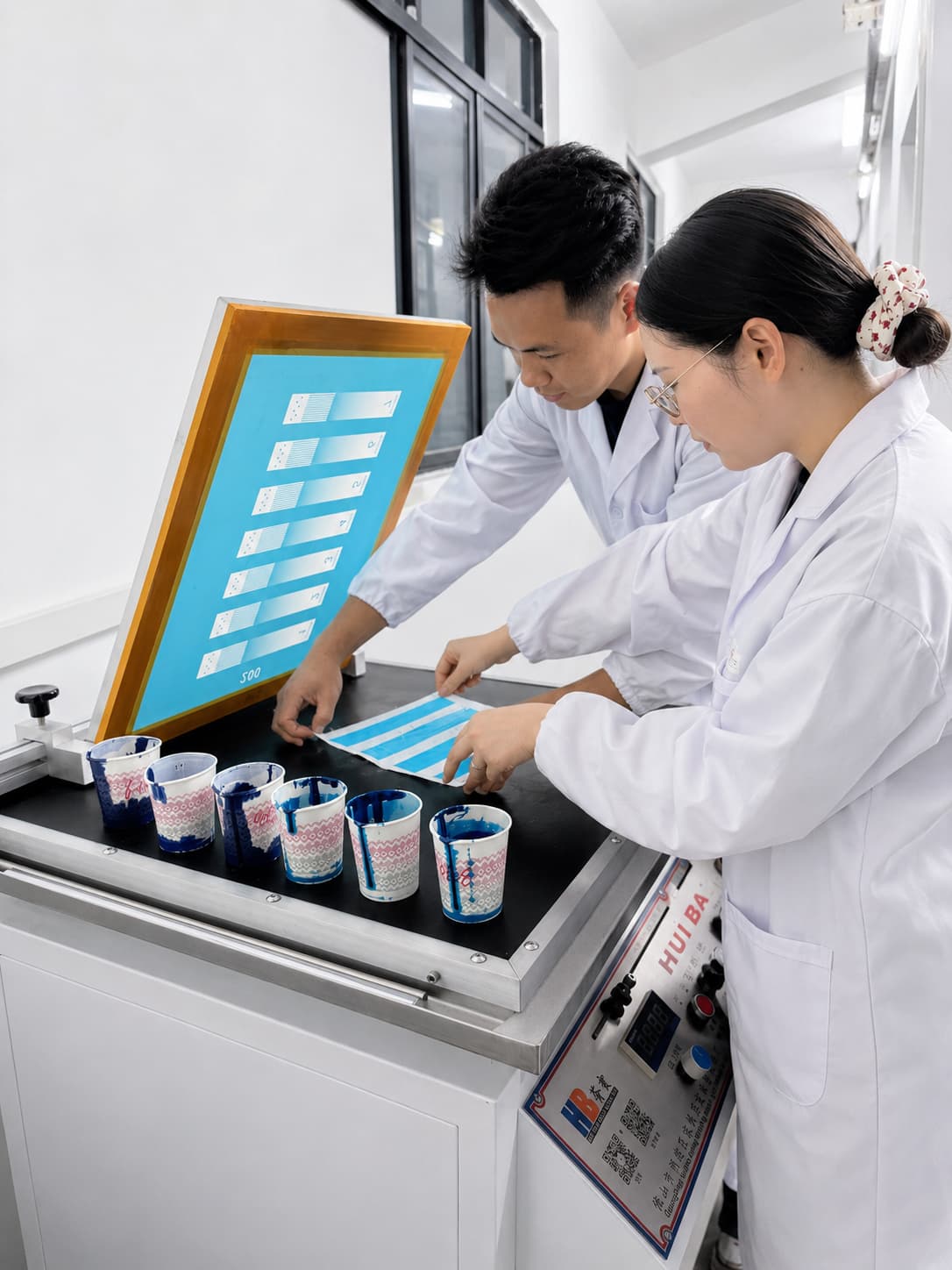
Fabric pick-up is one of the most important but often under-recorded variables in reactive inkjet pretreatment. The same pretreatment formula can produce different color yield, bleeding, penetration and drying behavior when the fabric retains different amounts of liquor after padding or application. This guide explains how wet pick-up changes the actual chemical add-on on cotton and viscose fabrics, why both low and excessive pick-up can reduce print quality, and how textile mills can build a controlled pick-up window through laboratory and production trials.
What Is Fabric Pick-Up in Reactive Digital Pretreatment?
Fabric pick-up describes how much pretreatment liquor remains on the textile after an application step such as padding.
For a simple gravimetric check:
Wet Pick-Up (%) = (Wet Fabric Weight − Dry Fabric Weight) ÷ Dry Fabric Weight × 100
This number is important because the pretreatment formula in the tank does not directly tell the mill how much thickener, alkali, urea, salt or other auxiliary is actually carried by the fabric.
The real chemical add-on depends on both:
Pretreatment Liquor Concentration + Fabric Pick-Up
Two fabric rolls can pass through the same pretreatment bath but receive different chemical add-on if their pick-up differs.
This can happen because of changes in:
- Capacité d'absorption du tissu
- Nip pressure
- Roll hardness
- Vitesse de la machine
- Tension du tissu
- Fabric weight
- Construction
- Bath viscosity
- Température
For reactive digital printing, pick-up should therefore be recorded as a process parameter rather than treated as an incidental machine setting.
Why Pick-Up Matters More Than Padder Pressure Alone
Operators often record padder pressure because it is visible on the machine.
However, the same nominal pressure does not guarantee the same wet pick-up.
Actual pick-up can change when:
- The fabric lot changes
- Fabric moisture entering the bath changes
- Roller condition changes
- Bath viscosity changes
- Line speed changes
- Fabric width or tension changes
This is why a digital printing pretreatment trial should record the measured fabric weight before and immediately after padding.
Pressure is a machine input.
Pick-up is the process result that determines how much pretreatment reaches the fabric.
When mills compare two pretreatment products without controlling pick-up, they may incorrectly attribute differences in color or bleeding to the chemistry when the real cause is different chemical add-on.
How Pick-Up Changes the Actual Chemical Add-On
Consider a pretreatment bath containing a thickener, alkali, moisture-management component and other auxiliaries.
If the fabric retains more liquor, it generally carries more of every dissolved or dispersed component in that bath, assuming the bath remains uniform.
This means changing pick-up can change several variables at the same time:
- Polymer add-on
- Alkali add-on
- Urea or moisture-control add-on
- Salt or migration-control add-on
- Total water carried into drying or printing
This is one reason pick-up optimization cannot be reduced to a simple statement such as “higher pick-up gives more color.”
Higher pick-up changes the complete chemical and moisture environment of the fabric.
Published studies on reactive inkjet pretreatment have repeatedly shown that pretreatment composition—including sodium alginate, alkali and urea—can materially influence color yield, dye fixation, penetration and boundary clarity. This reinforces the need to control how much of that formulation is actually applied to the fabric.
For research context, see studies on factors affecting reactive inkjet color yield et pretreatment effects on reactive ink-drop spreading and color performance.
How Pick-Up Can Affect Color Yield
Color yield in reactive inkjet printing depends on more than the amount of ink deposited.
The pretreatment must provide a suitable environment for:
- Ink localization
- Reactive dye diffusion
- Alkali availability
- Moisture during fixation
- Dye-fiber reaction
If pick-up is below the useful process window, the fabric may carry insufficient pretreatment chemicals to control the ink and support fixation.
If pick-up is increased into an appropriate range, color yield may improve because the pretreatment environment becomes more effective.
However, increasing pick-up beyond the useful range does not guarantee continued improvement.
Excessive chemical and water add-on can alter:
- Ink spreading
- Pénétration
- Surface film thickness
- Séchage
- Chemical migration
- Wash-off load
Therefore, the relationship between pick-up and color yield is better treated as an optimization curve rather than a straight line.
More pick-up is not automatically more color.
How Pick-Up Can Affect Bleeding and Edge Sharpness
Bleeding occurs when ink spreads laterally beyond the intended printed boundary.
Pretreatment helps control this by changing the way the fabric surface absorbs and retains the ink droplets.
Pick-up influences bleeding because it changes:
- Polymer amount on the fabric
- Surface moisture
- Fiber swelling
- Ink absorption rate
- Lateral liquid movement
At insufficient pick-up, there may not be enough polymer or functional chemistry to control ink movement.
At excessive pick-up, the fabric may contain too much moisture or an overly heavy surface layer, which can create a different diffusion environment.
The correct result depends on the balance between:
Surface Retention ↔ Lateral Spreading ↔ Through-Fabric Penetration
Published research has identified pretreatment as a major factor controlling reactive ink-droplet spreading and final color performance on cotton fabrics.
This supports using edge sharpness together with color yield when optimizing pick-up.
What Happens When Pick-Up Is Too Low?
Possible symptoms of insufficient pick-up include:
- Lower chemical add-on
- Weak ink-spreading control
- Lower apparent color depth
- Uneven fixation
- Variable solid-area color
- Greater sensitivity to fabric absorbency differences
However, a low color result should not automatically be corrected by increasing pick-up.
First verify:
- Pretreatment formula
- Concentration en polymère
- Alkali level
- Ink loading
- Cuisson à la vapeur
- À rincer
If these variables are not controlled, increasing pick-up can hide the real problem rather than solve it.
What Happens When Pick-Up Is Too High?
Excessive pick-up can create its own production problems.
Potential effects include:
- Higher chemical consumption
- Longer drying
- Higher drying energy
- Greater residual moisture variation
- Heavier polymer deposition
- Possible chemical migration during drying
- Different fabric hand
- Higher washing load
If the fabric is printed in a wet or partially wet state, excessive pick-up can also increase the risk of uncontrolled ink diffusion.
The best pick-up is therefore the lowest level that reliably supports the required print and fixation performance within a stable production window.
That level must be established experimentally for the specific process.
Cotton, Viscose, Woven and Knitted Fabrics Do Not Behave the Same
Woven Cotton
Woven cotton often provides relatively stable open-width handling, but pick-up can still change with fabric weight, weave density and pretreatment history.
Viscose
Viscose can absorb water rapidly and may show stronger response to changes in wet pick-up.
Monitor:
- Rapid liquor absorption
- Face-to-back penetration
- Dimensional stability
- Moisture before printing
Knitted Cellulosic Fabrics
Knitted fabrics can change width and weight under tension and moisture.
Measured pick-up may therefore be affected by:
- Stretch
- Overfeed
- Fabric deformation
- Width setting
A target developed on woven cotton should not automatically be transferred to knit fabric.
The viscosity of the pretreatment liquor can influence how it wets, penetrates and remains on the fabric during application.
However:
Same viscosity does not mean the same pick-up or printing performance.
Two pretreatment polymers can have similar measured viscosity but different:
- Shear thinning
- Wet-film behavior
- Fiber affinity
- Water retention
- Surface distribution
The measurement method should therefore be defined, including concentration, temperature, instrument and rotational speed.
For production, evaluate both the bath properties and the actual treated fabric.
Pick-Up, Drying and Chemical Migration
Higher pick-up means the fabric enters the dryer carrying more water.
This can influence:
- Required drying energy
- Residence time
- Fabric temperature
- Residual moisture
- Migration of soluble components
During drying, water movement can redistribute dissolved chemicals.
If drying is too rapid or uneven, the final distribution of alkali, urea and polymer may differ across the fabric or through its thickness.
Therefore, when pick-up is changed, the mill should also review the drying conditions.
Changing pick-up while keeping an unsuitable dryer setting constant can create a misleading trial.
Pick-Up in Wet-on-Wet Reactive Inkjet Printing
Pick-up becomes even more critical in wet-on-wet or controlled wet-state printing because part of the pretreatment water remains on the fabric when inkjet printing begins.
In this route, pick-up influences both:
- Chemical add-on
- Pre-print moisture state
This means the same pick-up can behave differently depending on the delay between pretreatment and printing.
A wet-on-wet trial should therefore record:
- Initial wet pick-up
- Time before printing
- Fabric moisture immediately before printing
- Ambient conditions where relevant
- Printer transport stability
The correct target is not “maximum wetness.”
It is a reproducible wet-state window that maintains ink control and machine stability.
How to Measure Fabric Pick-Up Correctly
Step 1: Condition and Weigh the Dry Fabric
Use a representative fabric sample and record its dry weight.
Step 2: Apply the Pretreatment
Use the defined padder, coating or pretreatment method.
Avoid unnecessary delay because evaporation changes the result.
Step 4: Calculate Wet Pick-Up
Wet Pick-Up (%) = (Wet Weight − Dry Weight) ÷ Dry Weight × 100
Step 5: Repeat Across the Fabric
Where practical, sample:
- Left side
- Center
- Right side
This can reveal uneven nip pressure or fabric absorption.
Step 6: Repeat During the Production Run
A single measurement at startup may not represent the full batch.
How to Build a Pick-Up Working Curve
Rather than adopting a universal target, build a working curve for the actual fabric and formula.
Step 1: Select Several Practical Pick-Up Levels
Choose a controlled range that the machine can reproduce safely.
This allows the effect of pick-up to be isolated.
Step 3: Keep Fabric and Ink Constant
Use the same fabric lot, ink lot and printer settings.
Step 4: Dry or Condition Each Sample Consistently
If testing a dry route, record the final moisture condition.
Step 5: Print a Diagnostic Pattern
Include:
- Rides fines
- Petit texte
- Color boundaries
- Dégradés
- Solid areas
Step 6: Steam and Wash Identically
Finished reactive print performance must be compared after fixation and wash-off.
Step 7: Plot the Result
Record each pick-up level against:
- Color strength
- Bleeding or edge definition
- Pénétration
- Uniformité de la zone solide
- À rincer
- Fabric hand
The useful operating window is the range that balances these properties rather than maximizing only one response.
How to Control Pick-Up in Production
Once the working window is defined, production control should focus on repeatability.
Monitor:
- Nip pressure
- Roller condition
- Line speed
- Bath level
- Bath viscosity
- Fabric temperature
- Fabric moisture before padding
- Fabric width and tension
- Actual measured pick-up
If the target print result begins to drift, compare actual pick-up before changing the chemical formula.
This is especially important after:
- A new fabric lot
- A machine maintenance event
- A roller change
- A large line-speed change
- A change in pretreatment viscosity
Troubleshooting Color Yield and Bleeding Problems
Problem: Low Color Yield and Low Pick-Up
Check whether chemical add-on is below the validated process window.
Also verify steaming and pretreatment chemistry before increasing pick-up.
Problem: Strong Color but Excessive Bleeding
Check:
- Pick-up is too high
- Residual moisture is excessive
- Pretreatment polymer does not provide enough surface control
- Ink loading is too high
- Fabric absorbency has changed
Problem: Uneven Color Across the Width
Compare left-center-right pick-up.
Also review:
- Nip pressure
- Roll alignment
- Bath circulation
- Tension du tissu
- Dryer airflow
Problem: Pick-Up Is Stable but Color Still Changes
Then investigate:
- Ink lot
- Pretreatment concentration
- Alkali
- Capacité d'absorption du tissu
- Cuisson à la vapeur
- Lavage
Pick-up is important, but it is not the only variable affecting reactive inkjet color yield.
Problem: Lab Pick-Up Works but Production Fails
Compare:
- Production line speed
- Actual machine-scale pick-up
- Séchage
- Tension du tissu
- Time before printing
- Production moisture conditions
How Pick-Up Affects Total Cost in Use
Pick-up is also a commercial variable because it changes the amount of chemistry and water carried by the fabric.
Higher pick-up can increase:
- Pretreatment consumption
- Drying energy
- Drying time
- Wash-off load
Insufficient or unstable pick-up can increase:
- Rejected fabric
- Reprinting
- Color correction
- Process adjustment
A useful evaluation is:
Total Cost in Use = Pretreatment Add-On + Drying Cost + Printing Yield + Rework + Post-Treatment + Quality Loss
The most economical pick-up is therefore not automatically the lowest possible value.
It is the lowest stable value that delivers the required finished textile quality within a controllable production window.
For a useful reactive digital pretreatment recommendation, provide:
- Reactive ink system
- Fabric fiber composition
- Woven or knitted construction
- Fabric weight
- Current pretreatment product or TDS
- Current pretreatment formula
- Viscosité actuelle et méthode d'essai
- Application method
- Current or target wet pick-up
- Dry or wet-on-wet process
- Conditions de séchage
- Printer type
- Steaming conditions
- Washing process
- Current color-yield or bleeding problem
FSX Chemical can use this information through its Échantillons et correspondances process to select a relevant reactive digital printing paste candidate for controlled evaluation.
How Should a Mill Optimize Fabric Pick-Up?
The most reliable sequence is:
Current Formula → Measured Pick-Up → Same-Fabric Trial Range → Digital Printing → Steaming → Washing → Color and Bleeding Evaluation → Production Verification
The key principles are:
- Measure actual pick-up instead of assuming machine pressure equals chemical add-on.
- Do not optimize color yield without also checking bleeding and penetration.
- Do not transfer a pick-up target blindly between different fabrics.
- When pick-up changes, review drying or wet-state moisture as well.
- Approve a working window rather than one theoretical perfect number.
This approach turns fabric pick-up from an operator setting into a controlled reactive digital printing parameter.
Foire aux questions
1. What is fabric pick-up in reactive digital printing?
It is the amount of pretreatment liquor retained by the fabric after application relative to its dry weight. It determines the actual chemical and water add-on before printing.
2. How do you calculate wet pick-up?
Wet pick-up is calculated as the wet fabric weight after application minus the dry fabric weight, divided by the dry fabric weight, multiplied by 100.
3. Does higher pick-up increase color yield?
It can improve color within some process ranges because more pretreatment chemistry is applied, but higher pick-up does not guarantee higher color indefinitely. Excessive add-on can change spreading, drying and wash-off.
4. Can high pick-up cause bleeding?
It can contribute, especially when excessive moisture or unsuitable pretreatment rheology increases lateral ink diffusion. Ink loading and fabric absorbency must also be checked.
5. Can low pick-up cause weak color?
Yes, if the fabric receives insufficient thickener, alkali or other required pretreatment components. However, steaming and formulation should also be checked.
6. Is padder pressure the same as pick-up?
No. Pressure influences pick-up, but actual retained liquor also depends on fabric, rollers, speed, bath properties and tension. Pick-up should be measured.
7. What is the best pick-up percentage for cotton reactive inkjet printing?
There is no universal percentage. The correct range depends on fabric weight and absorbency, pretreatment formula, application equipment, drying or wet-state route, ink and fixation conditions.
8. Does viscose need the same pick-up as cotton?
Not necessarily. Viscose can have different absorbency and swelling behavior, so the working window should be validated separately.
9. Why does pick-up change after changing the pretreatment paste?
Different viscosity, rheology, wetting and fiber interaction can change liquor retention even when the padder settings remain the same.
10. How often should pick-up be checked in production?
It should be checked often enough to confirm the process remains within the validated window, especially after startup, fabric-lot changes, speed changes or machine adjustments.
11. Is pick-up more important in wet-on-wet printing?
It becomes particularly important because it influences both chemical add-on and the fabric moisture state at printing.
12. What data should I send FSX Chemical if I have a bleeding problem?
Send the fabric type, pretreatment formula, viscosity method, measured pick-up, dry or wet printing route, ink system, printer settings, steaming and washing conditions, plus photos or samples where available.
Optimize Reactive Digital Pretreatment Pick-Up with FSX Chemical
If your reactive inkjet production shows unstable color yield, bleeding or inconsistent pretreatment performance, FSX Chemical can help evaluate whether the problem is related to pretreatment chemistry, pick-up, fabric or process conditions.
For a more relevant comparison, send:
- Your current pretreatment product or TDS
- Reactive ink system
- Fabric composition and construction
- Fabric weight
- Current pretreatment formula
- Viscosité et méthode d'essai
- Application equipment
- Measured or target pick-up
- Drying or wet-on-wet conditions
- Printer
- Steaming and washing conditions
- Current color-yield, bleeding or cost target
Commencez par Échantillons et correspondances to establish a controlled candidate and process comparison.
You can also review the FSX Chemical Digital Printing Paste route or Demander un devis directement auprès du fabricant once the technically suitable direction is clear.
For technical discussion, Contacter FSX Chemical with your current TDS, fabric information and pretreatment data📧 E-mail: Service@fsxchemical.com
Fabric pick-up should not be treated as a hidden machine setting. It is the link between the pretreatment formula in the tank and the actual chemical environment seen by every reactive ink droplet on the fabric.

 FR
FR  EN
EN  BN
BN  ES
ES  TR
TR  ID
ID  RU
RU  AR
AR  UR
UR  VI
VI  TL
TL  HI
HI