Filtration dans le prétraitement textile numérique : comment contrôler les résidus avant l'application sur le tissu
Digital textile pretreatment residue can come from incomplete polymer hydration, formula incompatibility, water hardness, foreign...
Digital textile pretreatment filtration is not simply a housekeeping step. Residue can come from incompletely hydrated polymer, agglomeration after salts or alkali are added, insoluble contamination, hard-water deposits or material introduced during mixing and storage. If these particles reach the fabric, they can create streaks, specks, uneven chemical add-on and inconsistent print definition. This guide explains how to control residue before padding, coating or other fabric application without relying on one universal filter mesh or micron rating.
What Does Pretreatment Filtration Mean in Digital Textile Printing?
In many digital textile printing systems, the thickener and functional auxiliaries are applied to the fabric before inkjet printing rather than being placed inside the ink itself.
A typical route may be:
Pretreatment Preparation → Hydration / Dispersion → Formula Completion → Filtration → Fabric Application → Drying or Controlled Wet State → Digital Printing → Fixation → Washing or Curing
Filtration is the point where the mill removes unwanted particles or agglomerates before they reach the application equipment and fabric.
The goal is not to make the solution visually “perfect.”
The goal is to remove material that can create:
Uneven pretreatment application
Surface specks
Streaks
Roller contamination
Nozzle or spray blockage in applicable pretreatment equipment
Local changes in ink spreading
Production instability
The correct filtration procedure depends on the pretreatment chemistry, viscosity, product form and application equipment.
Pretreatment Filtration Is Not the Same as Ink Filtration
This distinction is important.
Inkjet ink must pass through very small fluid channels and printhead nozzles, so ink manufacturing requires extremely strict particle control.
Fabric pretreatment normally does not pass through the inkjet printhead.
Instead, it may be applied through:
Padding
Coating
Screen application
Spray application
Foam application
Other fabric pretreatment equipment
Therefore, the filtration target for a viscous textile pretreatment should not simply copy an ink filter specification.
An unnecessarily fine filter may create:
Excessive pressure drop
Slow throughput
Rapid filter blockage
Loss of production efficiency
Meanwhile, a filter that is too coarse may allow defects to pass through.
The practical requirement is:
Remove process-relevant residue without creating an impractical filtration load.
Why Residue Matters Before Fabric Application
Once residue reaches the fabric, even small local defects can become visible after printing.
Possible effects include:
Uneven polymer add-on
Local areas with higher or lower alkali
Different wetting behavior
Ink spreading around particles
White or dark specks
Uneven color after fixation
Surface contamination
The problem can be especially difficult to diagnose because the defect may appear only after digital printing, steaming or washing.
This can lead operators to suspect:
The ink
The printer
The fabric
The thickener batch
when the actual cause was incomplete pretreatment preparation or filtration.
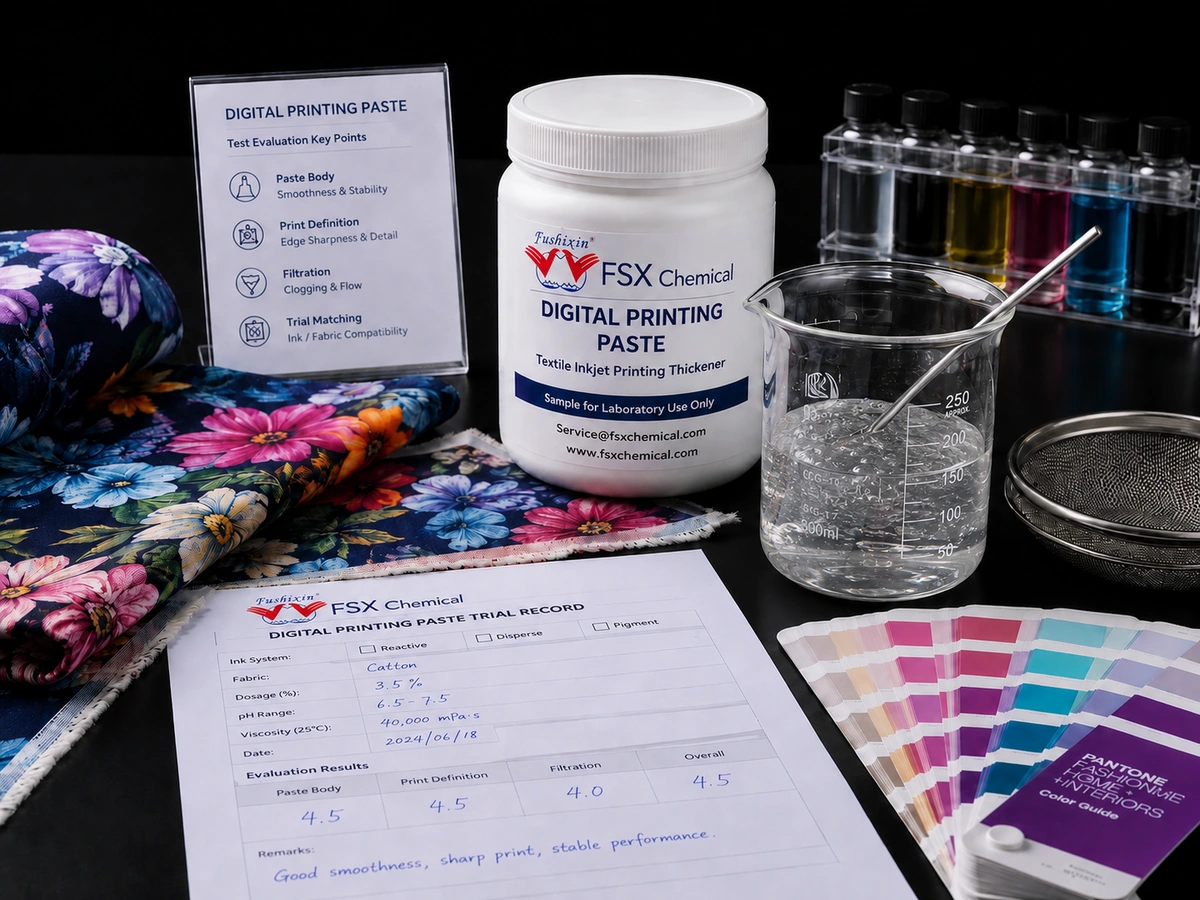
FSX Chemical’s digital printing product guidance also treats dissolution/dispersion behavior, filtration suitability and residue as part of pretreatment evaluation rather than judging a product from viscosity alone. citeturn591004view0
Five Main Sources of Pretreatment Residue
Residue should first be classified by origin.
Residue Source
Typical Appearance
First Check
Hydratation insuffisante
Soft gel particles, fish-eyes, swollen lumps
Mixing order, powder addition, hydration time
Formula incompatibility
Flocs, coagulated particles, precipitate
Salt, alkali, pH, additive sequence
Qualité de l'eau
Fine mineral haze, precipitate, instability
Hardness, calcium/magnesium, suspended solids
Contamination par des corps étrangers
Fibers, dust, bag fragments, rust, tank debris
Equipment and housekeeping
Storage instability
Skin, settled solids, gel fragments
Holding time, temperature, tank cover and agitation
The correct corrective action depends on the source.
Replacing the filter alone will not solve residue that is continuously generated by poor hydration or formula incompatibility.
1. Incomplete Polymer Hydration and Fish-Eyes
Powder thickeners can form lumps when the outer surface hydrates too quickly and traps dry powder inside.
These partially hydrated particles are often called:
Fish-eyes
Gel lumps
Undissolved polymer
They can survive mixing and then accumulate on a filter.
Common causes include:
Adding powder too quickly
Adding powder into a low-turbulence zone
Insufficient dispersion before hydration
Insufficient hydration time
Incorrect water temperature
Adding electrolyte or alkali before the polymer is sufficiently hydrated
The best filtration strategy is therefore not to create fish-eyes in the first place.
A good preparation process should produce a uniform hydrated base before the complete formula is finalized.
2. Formula Incompatibility, Salt and Alkali Agglomeration
A pretreatment can appear smooth before additives are introduced and then form residue after the full formula is prepared.
This can happen because polymer behavior changes with:
Electrolyte concentration
pH
Alkali type
Urea level
Autres auxiliaires
For reactive digital pretreatment, the complete system can contain polymer, alkali, urea and anti-reducing or process-control components.
These ingredients should be evaluated together.
If residue appears only after alkali or salt is added, investigate:
Polymer electrolyte tolerance
Addition order
Local high concentration during dosing
Mixing intensity
pH change
Do not approve filtration from the polymer stock solution alone if the production formula contains additional electrolytes and alkali.
3. Water Quality and Mineral Contamination
Water is a major raw material in textile pretreatment.
Hard water can contain calcium and magnesium ions, while plant water may also carry suspended particles or treatment residues.
Depending on the polymer and auxiliaries, these ions can influence:
Hydratation
Viscosité
Solubilité
Precipitation
Long-term stability
If one factory repeatedly sees fine residue while another factory does not, compare water quality before assuming the chemical batch is different.
Useful checks can include:
Water hardness
Conductivity
pH
Visible suspended solids
Water-treatment consistency
Where mineral-related instability is suspected, laboratory comparison using the actual plant water and a controlled reference water can help identify the cause.
4. Foreign Material from Tanks, Bags and Equipment
Not all filtration residue comes from the chemistry.
Common mechanical contamination includes:
Fibers from bags
Dust
Packaging fragments
Dried material from tank walls
Rust or scale
Old formulation residue from hoses
Damaged seals
If the filter contains obviously foreign particles, increasing hydration time will not solve the problem.
Review:
Tank cleaning
Bag-opening practice
Transfer hoses
Pump cleanliness
Tank covers
Previous product contamination
A clean process line reduces filtration load and makes chemical troubleshooting more reliable.
5. Holding Time, Skin Formation and Storage Instability
Pretreatment that filters well immediately after preparation may behave differently after several hours or longer storage.
Possible changes include:
Formation de la couche superficielle de la peau
Régularisation
Gel fragments
Viscosity drift
Microbial-related deterioration in susceptible water-based systems
Contamination from open tanks
The intended working time should therefore be included in filtration testing.
For example, if production normally uses a prepared batch over one shift, the mill should evaluate the pretreatment at:
Initial preparation
Mid-holding period
End of intended working time
This creates a more realistic stability picture than filtering only a freshly prepared laboratory sample.
How to Select a Filtration Method Without Using a Universal Mesh Number
There is no responsible universal filter mesh or micron value for every digital textile pretreatment.
The selection depends on:
Pretreatment viscosity
Polymer type
Forme du produit
Équipement d'application
Flow rate
Pump capacity
Residue size and type
Required production throughput
A useful development method is to compare several filtration levels under the same preparation conditions.
For each level, record:
Filtration time
Pressure or pumping difficulty
Residue amount
Residue appearance
Filtered viscosity
Application uniformity
Finished print result
The correct filter is not necessarily the finest available.
It is the filtration level that removes process-relevant residue while keeping throughput practical and leaving the intended pretreatment behavior intact.
Viscosity, Flow Rate and Filter Pressure Drop
High-viscosity pretreatments require more pressure to pass through a filter than low-viscosity liquids.
If the filter is too fine for the viscosity and available pump system, possible symptoms include:
Very slow filtration
Rapid filter blinding
Excessive pump load
Bypass risk
Operator removal of the filter to maintain production speed
This last problem is particularly important.
A technically perfect filtration specification that operators cannot run reliably is not a good production specification.
The filtration system should therefore balance:
Residue Removal ↔ Pressure Drop ↔ Throughput ↔ Cleaning Frequency
Viscosity should always be compared using a defined method because the same nominal viscosity can behave differently under pumping shear.
Mixing Sequence Before Filtration
Filtration should normally be treated as the final control step after the pretreatment has reached the intended state for application.
A general development sequence is:
Prepare the required water.
Disperse and hydrate the polymer under the defined method.
Allow sufficient hydration time.
Add compatible auxiliaries in the validated order.
Add alkali/electrolytes under controlled mixing where relevant.
Adjust to final batch weight or concentration.
Allow the formula to reach the defined condition.
Measure pH and viscosity.
Filter before fabric application.
The exact sequence depends on the product and formula.
The important principle is to avoid filtering an incomplete intermediate and then allowing residue to form after the remaining additives are added.
Reactive Digital Pretreatment: What Should Be Checked?
Reactive digital pretreatment is commonly used on cotton, viscose, lyocell, modal and other suitable cellulosic fabrics.
Published technical reviews note that digital pretreatment commonly carries auxiliaries on the fabric because the ink itself must remain within strict viscosity, stability and conductivity limits. citeturn257915search0turn257915search9
In reactive systems, filtration testing should consider the complete formulation, including where relevant:
Thickener/polymer
Urée
Alcalin
Anti-reducing salt
Autres auxiliaires
After filtration, evaluate:
Uniformité du prétraitement
Padding or coating behavior
Fabric pick-up
Bleeding
Print edge definition
Color after steaming and washing
Residue should therefore be treated as one part of the complete reactive printing system rather than as a standalone laboratory number.
Disperse Digital Pretreatment: What Should Be Checked?
Disperse digital printing on polyester uses different dye chemistry and fixation conditions from reactive printing.
A disperse pretreatment may involve liquid or dispersed components whose stability should be evaluated under the actual preparation and application route.
Important checks include:
Stabilité de la dispersion
Visible sediment
Résidu de filtration
Stabilité au stockage
Fabric pick-up
Séchage
Thermal fixation compatibility
FSX Chemical’s current digital printing product page also lists dispersion and filtration as key trial factors for the disperse route. citeturn591004view0
Do not automatically copy a reactive pretreatment filter specification to a disperse system.
Pigment Digital Pretreatment: What Should Be Checked?
Pigment digital printing introduces binder compatibility and curing into the evaluation.
Depending on the pretreatment, residue can come from:
Polymer agglomeration
Binder incompatibility
Dispersion instability
Auxiliary interaction
Filtration should therefore be evaluated together with:
Pigment ink compatibility
Binder system
Application uniformity
Durcissement
Résistance au frottement
Toucher du tissu
A filtered liquid is not automatically a technically successful pigment pretreatment if the complete binder/curing system is unstable.
How to Measure Filtration Performance Without Misreading Residue
Compare filters using a defined procedure and the complete pretreatment bath. A clean filtrate is useful only if filtration also preserves the intended formulation and provides an acceptable production flow rate.
Define the filter and operating conditions
Record filter material, effective area, opening or pore specification, rating basis, sample mass, temperature, elapsed holding time and applied pressure or liquid head. Mesh count is not a unique micron opening without the screen geometry, including wire diameter. Nominal and absolute micron labels are not interchangeable without the manufacturer’s efficiency and test information; Donaldson’s filtration terminology overview provides background on that distinction, not an approval specification for textile pretreatment.
Keep diagnostic residue separate from a gravimetric result
Observation
Suggested record
Interpretation limit
Wet retained material
Photograph and describe soft gel, grit, skin or fibers before washing
Wet mass includes retained liquid and cannot be called insoluble-solids content
Defined dry residue
Use a documented filter blank, washing and drying procedure where appropriate
Washing may dissolve or disperse diagnostic gel; the result is method-dependent
Filtration throughput
Mass passed over time at the specified head or pressure
Different viscosity, area or pressure can explain a flow difference
Use separate portions when both visual diagnosis and a residue assay are needed. Do not wash away the evidence before recording it. A soft lump that disperses under a defined check is different from persistent grit, but appearance alone does not identify its chemical composition.
Check what passes through and what is lost
Compare before-and-after viscosity using the same method, appearance and relevant solids or component measurements. A filter can remove intended formulation material as well as unwanted residue. Verify fabric application, add-on uniformity and finished-print performance after filtration. Repeated blockage should trigger investigation of hydration, compatibility, storage or contamination rather than an automatic move to a finer filter.
Production Filtration Workflow
A practical production workflow can be organized as:
Raw Water Check → Tank Inspection → Controlled Mixing → Full Hydration → Formula Completion → pH/Viscosity Check → Filtration → Clean Holding Tank → Fabric Application → Production Monitoring
Before Mixing
Confirm tank cleanliness.
Check water quality when variation is suspected.
Inspect powder bags and liquid containers.
During Preparation
Follow the validated addition sequence.
Avoid dumping powder too quickly.
Record mixing and hydration time.
Before Filtration
Confirm the complete formula is finished.
Measure pH and viscosity.
Inspect for visible gel or sediment.
During Filtration
Record filtration time or pressure trend.
Inspect residue.
Replace or clean the filter according to actual loading.
After Filtration
Use a clean receiving tank.
Avoid recontamination through dirty hoses.
Apply within the validated holding time.
Residue Troubleshooting by Symptom
Symptom
First Causes to Check
Do Not Assume
Soft gel lumps on filter
Hydration, powder addition, mixing time
The filter is too fine
Residue appears only after alkali
Electrolyte tolerance, local concentration, pH
The raw polymer is contaminated
Fine mineral-like sediment
Water hardness, tank scale, mineral contamination
More mixing will solve it
Fibers or dark particles
Bags, tanks, hoses, rust, housekeeping
The formulation is chemically unstable
Filter blocks rapidly but liquid looks smooth
Filter rating, viscosity, flow rate, fine gel load
Filtration has a cost, but poor filtration can cost more.
Possible hidden losses include:
Discarded pretreatment
Application-line cleaning
Roller or screen cleaning
Production stops
Fabric defects
Réimpression
Tissu rejeté
Extra labor
At the same time, over-filtration can increase:
Filter consumption
Pump energy
Filtration time
Operator workload
A useful commercial framework is:
Total Cost in Use = Pretreatment Cost + Filtration Cost + Downtime + Cleaning + Rework + Quality Loss
The best filtration procedure is therefore the one that reliably removes relevant residue at a practical production throughput.
Quelles informations devez-vous transmettre à un prestataire de services de prétraitement ?
If your digital textile pretreatment shows filtration residue, send:
Ink system: reactive, disperse or pigment
Type de tissu
Produit de prétraitement actuel ou TDS
Complete pretreatment formula
Polymer/thickener dosage
Water source or hardness information where available
Mixing sequence
Mixing time
Pause hydratation
pH
Viscosité et méthode d'essai
Filter type or rating currently used
Photos of the residue
Holding time before application
Équipement d'application
Current print-quality problem
FSX Chemical can use this information through Échantillons et correspondances to determine whether the next test should focus on hydration, formulation compatibility, filtration or the product grade.
What Is the Best Way to Control Pretreatment Residue?
La séquence la plus fiable est la suivante :
Prevent Residue Formation → Complete Hydration → Verify Formula Compatibility → Filter the Final Working Pretreatment → Protect Against Recontamination → Confirm Fabric Application
Les principes fondamentaux sont les suivants :
Filtration should not be used to hide poor hydration.
Test the complete formulation, not only the stock polymer.
Do not copy an ink filtration rating directly to a viscous fabric pretreatment.
There is no universal filter mesh or micron value for every digital pretreatment.
Identify what the residue actually is before changing the product.
Judge filtration by production stability and finished print performance, not by filter appearance alone.
Foire aux questions
1. Why should digital textile pretreatment be filtered?
Filtration removes process-relevant particles and agglomerates that can cause uneven fabric application, specks, streaks and production instability.
2. Is pretreatment filtration the same as ink filtration?
No. Ink must pass through printhead nozzles and normally requires much stricter particle control. Fabric pretreatment is applied separately and should use a filtration level appropriate to its viscosity and application equipment.
3. What causes gel lumps in digital printing pretreatment?
Common causes include rapid powder addition, incomplete hydration, insufficient mixing or adding salt/alkali before the polymer is fully hydrated.
4. Can hard water cause filtration residue?
It can contribute in some polymer and auxiliary systems because calcium, magnesium or suspended solids can influence hydration, stability and precipitation.
5. Should I filter before or after adding alkali and auxiliaries?
For final production control, the complete working pretreatment should be evaluated after all intended components are added, because residue can form only after formula completion.
6. What filter mesh should I use for reactive digital pretreatment?
There is no universal mesh number. Select the filtration level according to product viscosity, residue size, application equipment, flow rate and production throughput.
7. Is the finest possible filter always best?
No. An unnecessarily fine filter can create high pressure drop, rapid blockage and impractical production speed without improving the final fabric result.
8. Why does a fresh batch filter well but an aged batch leave residue?
Possible causes include skin formation, settling, viscosity drift, contamination or holding-time instability.
9. Can filtration change pretreatment viscosity?
It should be checked. Heavy gel removal or high-shear pumping can affect the measured result in some systems, so compare viscosity before and after filtration under the same method.
10. Can residue cause digital print bleeding?
Residue can create local nonuniform pretreatment, which may alter ink spreading. However, bleeding can also come from fabric, pick-up, moisture, drying and ink loading.
11. Should reactive, disperse and pigment pretreatments use the same filter?
Not automatically. The product form, viscosity, dispersion behavior, auxiliaries and application equipment differ, so each route should be qualified separately.
12. What should I send FSX Chemical if my pretreatment has filtration residue?
Send your current TDS or sample, complete formula, water source, mixing/hydration method, pH, viscosity, current filter method, photos of residue and application conditions.
Evaluate Digital Pretreatment Filtration with FSX Chemical
If your digital textile pretreatment shows gel particles, sediment, rapid filter blockage or fabric specks, FSX Chemical can help review whether the issue is related to hydration, water quality, formula compatibility, filtration or product selection.
For a more useful technical comparison, send:
Votre produit de prétraitement actuel ou votre TDS
Good filtration begins before the filter. The most stable digital pretreatment process prevents unnecessary residue during hydration and formulation, removes remaining process-relevant particles before fabric application, and protects the filtered batch from recontamination.
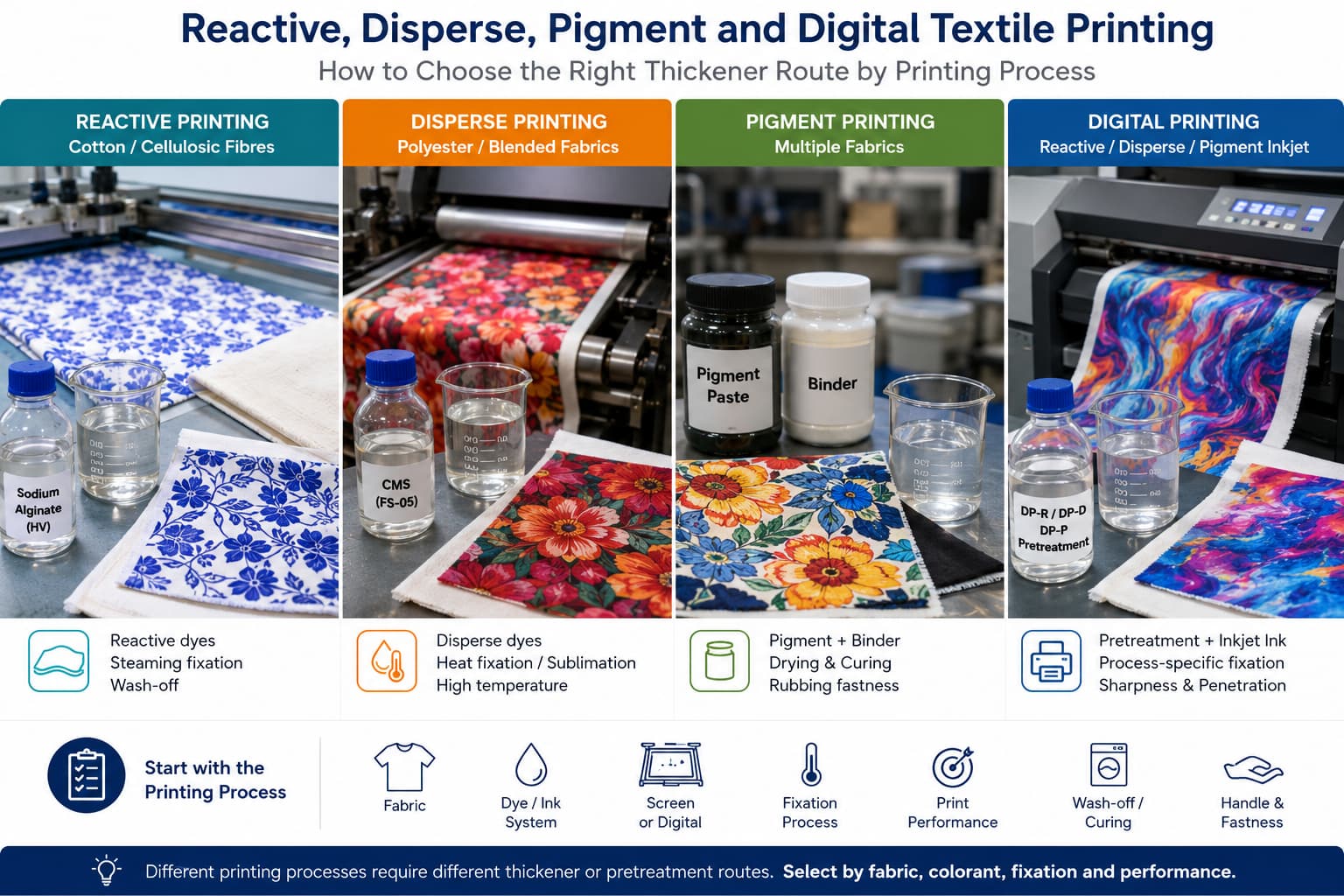
Découvrez comment choisir les agents épaississants et les procédés de prétraitement adaptés à l'impression textile réactive, dispersée, pigmentée et numérique, en fonction des exigences liées au tissu, à la teinture ou à l'encre, à la fixation, à l'élimination au lavage et à la qualité d'impression.
Comparez le CMC, le CMS, l'alginate de sodium et la pâte d'impression numérique pour l'impression textile. Découvrez comment chaque solution s'adapte aux procédés réactifs, dispersés, pigmentés et numériques, et ce que les acheteurs doivent vérifier avant de procéder à des tests d'échantillons, à la mise en correspondance des qualités et à l'achat en gros.
La pâte d'impression à base de CMC est utilisée dans l'impression textile pigmentaire, réactive et numérique. Ce guide explique quels sont les paramètres importants, comment comparer les fournisseurs et ce qu'il faut demander avant de passer une commande en gros.
L'alginate de sodium et la CMC sont tous deux utilisés comme épaississants dans l'impression textile, mais ils conviennent à des systèmes de teinture et à des conditions de traitement différents. Ce guide explique les principales différences entre ces deux produits et précise dans quels cas il convient d'utiliser l'un ou l'autre.
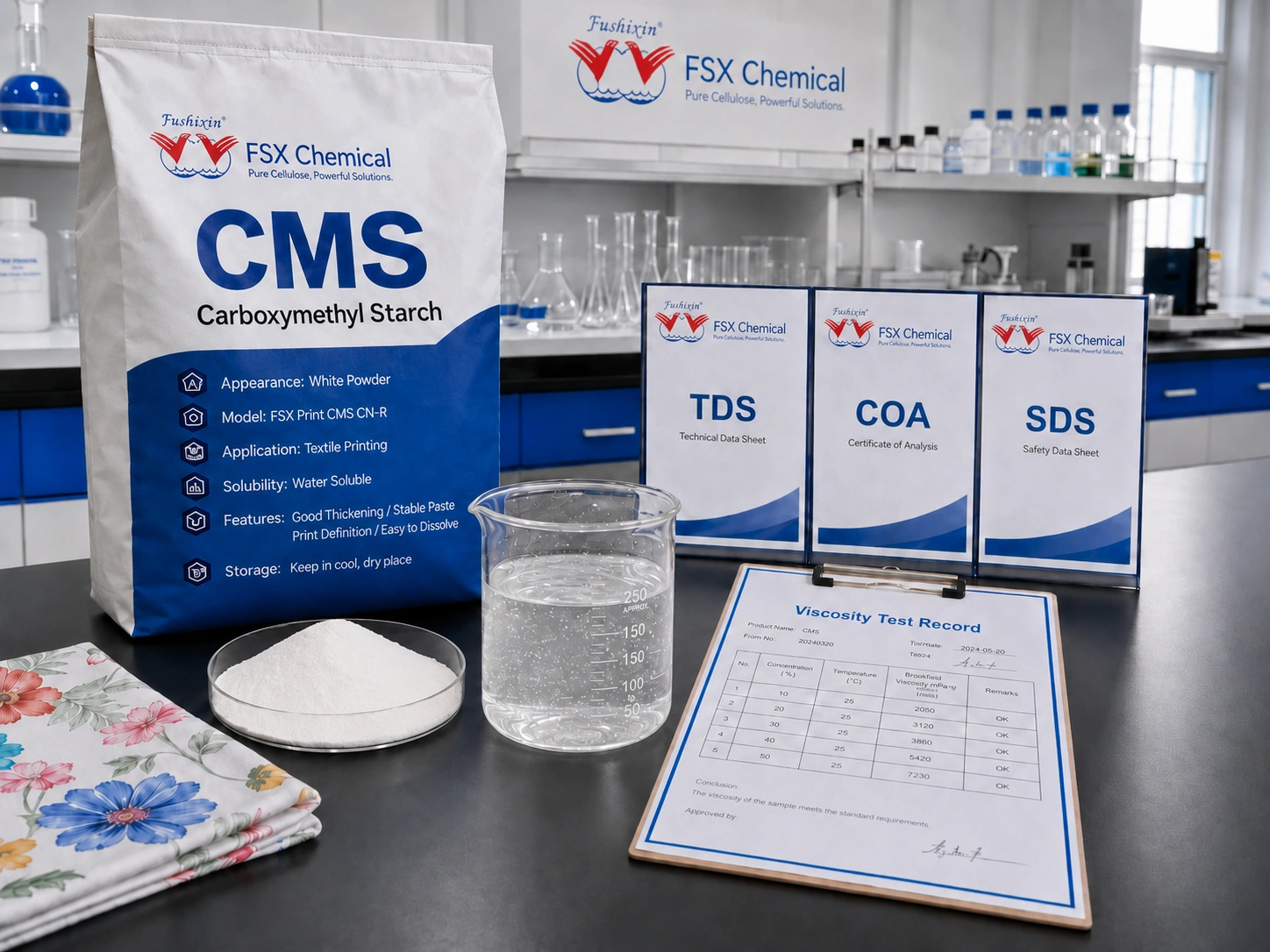
L'amidon carboxyméthylé (CMS) peut être évalué pour certaines applications telles que l'encollage textile, les pâtes d'impression et les formulations destinées à l'impression numérique. Ce guide explique comment les acheteurs doivent examiner la classe de viscosité, le comportement à la dissolution, le pH, la teneur en humidité, le comportement du film, la compatibilité avec les formulations, la fiche technique (TDS), le certificat d'analyse (COA), la fiche de données de sécurité (FDS), les essais sur échantillons et l'uniformité des lots avant tout achat en gros.
Le choix d'un épaississant adapté à l'impression textile ne dépend pas uniquement du type de tissu. Les acheteurs doivent choisir l'épaississant en fonction du système de colorants ou de pigments utilisé, de la méthode d'impression, des propriétés rhéologiques recherchées, des exigences en matière de lavabilité et des conditions réelles d'essai en usine.
Les performances de l'impression textile dépendent d'un système chimique coordonné, et non d'un additif universel. Ce guide présente dix groupes chimiques importants, leurs fonctions, leur rôle dans le processus et les éléments que les acheteurs doivent vérifier avant de procéder à des essais de production.
Les épaississants utilisés dans l'impression textile se distinguent par leurs propriétés chimiques, rhéologiques, leur compatibilité avec les colorants et leur comportement au lavage. Ce guide compare les principales familles d'épaississants, leurs modes d'application courants et les paramètres que les acheteurs doivent vérifier avant de procéder à des essais de production.
Le contrôle de la viscosité dans l'impression textile numérique repose sur deux systèmes distincts : l'encre d'impression et la formulation du prétraitement du tissu. Ce guide explique comment la température, la formulation, les méthodes de mesure et les conditions de processus influencent la stabilité de l'éjection d'encre et la qualité d'impression.
Le choix des pâtes d'impression numérique doit tenir compte de la composition chimique de l'encre, du tissu, de la méthode d'application et du post-traitement. Ce guide compare différentes méthodes de prétraitement pour l'impression textile à jet d'encre : l'alginate de sodium, le CMC, le CMS, les polymères synthétiques et les composés.
La meilleure pâte d'impression numérique est celle qui est adaptée à la composition chimique de l'encre, au tissu et au procédé de fixation. Ce guide compare les exigences en matière de prétraitement pour l'impression jet d'encre réactive sur des tissus cellulosiques et l'impression jet d'encre à dispersion directe sur du polyester, puis explique comment les acheteurs doivent évaluer les échantillons avant de passer commande en gros.
Pour améliorer la qualité de l'impression textile, il ne suffit pas de changer un seul produit chimique. Ce guide explique comment FSX Chemical facilite la sélection, en fonction des procédés, de l'alginate de sodium, du CMC, du CMS et de la pâte d'impression numérique, puis les essais sur échantillons, la validation en production et l'examen de la documentation relative aux lots.
Veuillez nous communiquer le nom du produit, son application, la quantité, la destination, ainsi que toute fiche technique (TDS),
photo ou document dont vous disposez déjà. FSX Chemical examinera ces
informations et vous recommandera la marche à suivre pour obtenir un devis, trouver un échantillon correspondant
ou choisir un produit.
Informations sur le produitNom du produit, référence, modèle, photo de l'étiquette ou référence du fournisseur.
Documents disponiblesFiche technique (TDS), fiche de données de sécurité (SDS), certificat d'analyse (COA), photo d'exemple, liste des produits ou données d'essai.
Détails de la commandeQuantité estimée, conditionnement, pays de destination, port ou conditions commerciales.
Demande ou problèmeProcédé d'impression textile, besoins en matière de formulation, problème actuel ou performances visées.