Sodium Alginate, CMC and FSX CMS: Cost and Performance Comparison
The cheapest textile printing thickener is not necessarily the lowest-cost option in production. This guide...
Choosing a textile printing thickener by price per kilogram can lead to the wrong purchasing decision. Sodium alginate, CMC and CMS can differ substantially in effective dosage, rheology, filtration, print definition, dye compatibility and downstream processing. This guide compares the three routes from both technical and commercial perspectives, with one objective: identifying the technically suitable thickener that delivers the required printing result at a competitive total cost in use.
Why Thickener Cost Cannot Be Compared by Price per Kilogram Alone
For a purchasing manager, the starting quotations may cover sodium alginate, CMC and an FSX CMS commercial grade. Comparing only their price per kilogram leaves product identity, dosage basis and application suitability unresolved.
In actual textile production, this calculation is incomplete.
A printing thickener is not purchased simply to create viscosity in water. Its purpose is to control the complete printing paste during preparation, storage, transfer to the fabric, printing, fixation and washing. Two products with different prices can therefore generate very different production economics.
A practical comparison should include:
पहुँचाए गए उत्पाद की कीमत
Effective thickener dosage
Stock-paste concentration
हाइड्रेशन का समय
Mixing requirements
छनन हानि
पेस्ट की स्थिरता
स्क्रीन अंश
Printing speed and continuity
परिभाषा प्रिंट करें
प्रवेश
रंग उपज
Fixation performance
धुल जाने वाला व्यवहार
Cleaning frequency
Machine downtime
कचरा चिपकाएँ
Rejected or reprocessed fabric
This is why a lower product price does not automatically mean a lower production cost.
The more useful purchasing question is:
Which technically suitable thickener achieves the required printing performance at the lowest stable total cost in use?
Quick Comparison: Sodium Alginate, CMC and CMS
This guide compares three commercial selection routes: sodium alginate, CMC and FSX CMS. Sodium alginate and CMC are polysaccharide-derived materials; FSX CMS is a commercial synthetic printing-thickener family whose exact grade identity must be confirmed. These are not universally interchangeable products.
तुलना क्षेत्र
सोडियम अल्गीनेट
सीएमसी
सीएमएस
Polymer origin
Alginate derived from brown algae
Cellulose-derived polymer
Commercial synthetic printing-thickener family; confirm the current grade
Typical evaluation position
Common benchmark for conventional reactive printing
Candidate for selected textile printing and compound systems
Candidate for selected disperse, specialty and compound systems; selected reactive applications require validation
Important grade variables
Viscosity, concentration, rheology, hydration and filtration
DS, viscosity, concentration, hydration, electrolyte response and filtration
Viscosity efficiency, hydration, filtration, paste stability and formulation compatibility
Cost evaluation
Compare benchmark reliability with actual dosage and processing cost
Compare effective dosage and complete-paste performance, not price alone
Often evaluated where formulation economics are important, but actual cost advantage must be demonstrated in trials
Replacement logic
Often used as the reference product
Not a universal 1:1 substitute for sodium alginate
Not a universal 1:1 substitute for sodium alginate
Best decision method
Standardized laboratory comparison followed by printing, fixation/washing and production validation
The table provides a starting point, not a universal ranking. The correct decision changes with the dye system, fabric, printing equipment, paste recipe and production target.
1. Sodium Alginate: The Reactive Printing Benchmark
सोडियम अल्गीनेट remains an important reference thickener in conventional reactive printing on suitable cellulosic fabrics.
Its value is not simply that it produces a high viscosity. Buyers usually evaluate sodium alginate because of the overall balance it can provide in an established reactive printing process.
Where Sodium Alginate Can Offer Strong Value
Conventional reactive printing on cotton and suitable cellulosic fabrics
Production lines where the existing recipe has already been optimized around alginate
Applications where print definition and controlled penetration are critical
Operations where predictable fixation and wash-off are important
Factories that prefer a proven benchmark before testing alternative thickener routes
For a factory with a stable sodium alginate process, changing to another polymer only because its quotation is lower may create hidden costs. A new thickener can change paste rheology, screen behavior, color development, penetration or washing requirements.
What Buyers Should Compare Between Sodium Alginate Grades
The words “high viscosity,” “medium viscosity” or “low viscosity” are not sufficient specifications by themselves.
Request the supplier’s test conditions, including:
Polymer concentration used for viscosity testing
जल गुणवत्ता
Hydration procedure
Testing temperature
Viscometer type
स्पिंडल या रोटर
घूर्णन गति
पढ़ने का समय
A 1% viscosity result cannot be compared directly with a 2% result, and even two values measured at the same concentration can be misleading if the instruments or measurement conditions differ.
Cost Consideration
Sodium alginate should therefore be evaluated as a production benchmark rather than classified automatically as either the cheapest or most expensive option.
If an established alginate provides consistent printing with low waste, good screen performance and predictable washing, its higher purchase price relative to another candidate may still produce a competitive total production cost.
2. CMC: A Flexible Route for Selected Printing Systems
कार्बोक्सीमेथिल सेलुलोज (सीएमसी) is a cellulose-derived water-soluble polymer available in a wide range of viscosity and substitution levels.
In textile applications, CMC should be selected by commercial grade rather than simply by polymer name. Two CMC products can behave differently because of differences in degree of substitution, molecular characteristics, purity, hydration and salt response.
Important CMC Selection Parameters
Degree of substitution (DS)
संधानशीलता और परीक्षण एकाग्रता
जलसंतृप्ति दर
समाधान की एकरूपता
छानन
इलेक्ट्रोलाइट प्रतिक्रिया
Shear behavior
Complete-paste compatibility
For selected textile printing systems, CMC can be evaluated as part of a cost-performance optimization project or as a component of a compound thickener formulation.
However, this does not mean that a CMC grade with the same measured viscosity as sodium alginate will automatically deliver the same printing result.
Where CMC Can Become Commercially Interesting
CMC becomes worth evaluating when a buyer is trying to improve one or more of the following:
Effective formulation cost
स्यानता दक्षता
Paste preparation
Rheology control
Selected electrolyte-response requirements
Compound-thickener formulation flexibility
Supplier diversification
The technically correct approach is to identify a candidate grade and test it in the buyer’s real formulation rather than promise a universal sodium alginate replacement.
This distinction matters commercially. A cheaper CMC that requires a substantially higher dosage or produces more filtration loss may provide no real saving. Conversely, a properly selected CMC grade or compound system can be commercially attractive when the dosage and printing performance are optimized for the specific process.
3. CMS: A Cost-Performance Candidate for Selected Applications
FSX CMS is a commercial synthetic printing-thickener family. Confirm the grade, product form and intended process in the current TDS; the abbreviation is not a composition certificate for carboxymethyl starch.
Its potential should be assessed using the complete printing formula rather than by comparing dry-powder price or stock viscosity alone.
Important CMS Evaluation Points
स्यानता दक्षता
जलपूरकता
छानन
पेस्ट की स्थिरता
स्क्रीन अंश
प्रभावी खुराक
Dye-system compatibility
परिभाषा प्रिंट करें
Finished fabric performance
CMS can be commercially interesting in selected disperse printing, specialty printing and compound-thickener systems. Selected reactive systems can also be investigated, but they require formulation-specific validation.
This is particularly important because thickener performance can be dye-dependent. A system that works well with one dye or recipe may behave differently after the dye concentration or chemistry changes.
CMS and Compound Thickener Systems
CMS can also be evaluated as one component in a compound formulation.
A compound system may combine different rheology-control components to target a balance between:
आधार चिपचिपापन
Shear thinning
संरचनात्मक सुधार
छानन
पेस्ट की स्थिरता
परिभाषा प्रिंट करें
Electrolyte tolerance
Cost in use
This does not mean that a compound product is automatically better than a single-polymer thickener. It simply provides another formulation route when one polymer alone does not achieve the required balance.
Why the Same Viscosity Does Not Mean the Same Printing Performance
This is one of the most important principles when comparing textile printing thickeners:
Same viscosity does not mean the same printing performance.
Viscosity is only one measurable property of a printing paste.
Consider three thickener solutions that all produce a laboratory reading of 20,000 mPa·s under a specific test method. They can still behave differently during printing because their flow curves, shear response and structural recovery may not be the same.
During actual printing, the paste experiences different shear conditions as it moves through pumps, pipes, screens, squeegees and the fabric surface.
Performance can therefore differ in:
शीयर के अधीन प्रवाह
Recovery after shear
Screen release
सूक्ष्म परिभाषा
किनारों की तीक्ष्णता
प्रवेश
ठोस-क्षेत्र एकरूपता
पेस्ट की स्थिरता
Polymer chemistry also affects interactions with dyes, salts, alkalis, binders and other auxiliaries.
For this reason, viscosity should be treated as a controlled QC parameter, not as the sole predictor of production performance.
How to Calculate Total Cost in Use
Price per kilogram is still relevant, but it should be placed inside a larger cost model.
Step 1: Calculate the Direct Thickener Cost
The first calculation is straightforward:
Direct thickener cost for one paste batch = delivered price (currency/kg product) × product consumed (kg for that batch). State the final paste mass and whether dosage is as received or on a defined dry basis. The result is a currency amount for the batch, not yet a cost per unit of fabric.
Consider this simplified illustration. The figures below are hypothetical and are not market quotations.
Candidate
Illustrative Price
Illustrative Effective Dosage per 1,000 kg Paste
Direct Thickener Cost
Grade A
USD 3.20/kg
35 kg
USD 112
Grade B
USD 2.40/kg
45 kg
USD 108
Grade C
USD 1.80/kg
60 kg
USD 108
Grade C is 43.75% cheaper per kilogram than Grade A in this illustration, but the direct thickener cost per 1,000 kg of paste is almost the same because the effective dosage is different.
This is why quotation comparison without dosage information can be misleading.
Step 2: Add Preparation Cost
Evaluate:
Mixing time
हाइड्रेशन का समय
Energy consumption
Labor
Need for additional filtration
Undissolved material or gel loss
Step 3: Add Printing-Line Cost
Check whether the candidate changes:
Screen cleaning frequency
Machine speed
पेस्ट स्थानांतरण
Printing interruptions
Foam formation
कचरा चिपकाएँ
Step 4: Add Finished-Quality Cost
A thickener should ultimately be evaluated on the finished textile, not only in the mixing tank.
Compare:
रंग उपज
तीक्ष्णता
प्रवेश
Levelness
स्थिरीकरण
धुलकर उतर जाने वाला
पृष्ठभूमि की सफ़ाई
Fabric handle where relevant
Reject rate
Reprinting or corrective processing
A small reduction in chemical cost is not attractive if it increases rejected fabric or machine downtime.
A Better Commercial Formula
A more realistic model is:
Cost per accepted m² = total in-scope cost for comparable runs ÷ accepted finished printed area (m²). Put material, preparation, conversion and any additional quality or disposal costs into the same currency and run boundary. Each expense belongs in the numerator once.
Not every factory needs to assign an exact monetary value to every item. Even a relative score can make supplier comparisons much more accurate.
Reconcile the Cost Ledger Before Ranking Candidates
First exclude candidates that fail the required finished-print quality. For the remaining candidates, compare representative runs on comparable fabric and designs. State fabric construction, width or area basis and required quality; a cost per metre on different widths or fabric weights is not a like-for-like comparison.
Cost line
Record on the same run basis
Avoid counting twice
Material consumed
Delivered currency/kg multiplied by actual kilograms consumed, including material used in rejects and rework.
Freight already in the delivered price, or the same discarded chemical again under quality loss.
Preparation and conversion
In-scope labour, utilities, cleaning and line time, using a stated allocation method.
Downtime already charged through total line time plus the same line-time charge again.
Additional quality and disposal
Costs not already in the material or conversion entries; state the treatment of rejected fabric and credits.
The full value of a rejected item plus the same underlying material and processing costs again.
Accepted output
Accepted finished area for the same quality requirement, with rejects excluded from that denominator.
Using total input area as though all output passed, or excluding rework resources from the numerator.
The illustrative Grade A, B and C prices above demonstrate arithmetic only. They are not FSX quotations, actual product dosages or evidence that any candidate meets a printing specification. Keep a fixed-recipe trial separate from an optimised-recipe trial, and compare total cost only within a defined accepted application.
Which Thickener Fits Which Printing Process?
The best thickener cannot be selected without first identifying the printing chemistry.
प्रिंटिंग मार्ग
Recommended Evaluation Logic
Conventional reactive printing
Sodium alginate is a common benchmark. CMC, CMS or compound candidates should be tested through the complete paste, printing, fixation and washing sequence.
Disperse printing
Focus on paste stability, filtration, screen passage, transfer, solid-area uniformity, print definition and thermal fixation. Do not automatically apply reactive-printing selection rules.
Pigment printing
Evaluate the thickener together with binder and pigment-dispersion chemistry, including compatibility, rheology, curing and fabric handle.
Digital textile processes
Evaluate the exact digital route separately. Pretreatment rheology, filtration, fabric wetting, ink control and machine requirements can differ significantly from conventional screen-printing paste.
प्रतिक्रियाशील मुद्रण
For conventional reactive printing, the comparison should include:
Complete-paste viscosity
रियोलॉजी
प्रतिक्रियाशील रंगत की अनुकूलता
स्क्रीन अंश
सूक्ष्म परिभाषा
Solid-area performance
प्रवेश
स्थिरीकरण
धुलकर उतर जाने वाला
पृष्ठभूमि की सफ़ाई
A candidate should not be approved only because the stock paste looks similar to the current sodium alginate.
विखुरित मुद्रण
For polyester disperse printing, the technical priorities change.
Important parameters can include:
पेस्ट की स्थिरता
छानन
स्क्रीन अंश
Transfer characteristics
ठोस-क्षेत्र एकरूपता
Edge definition
Thermal fixation
प्रभावी खुराक
The thickener route that performs best in reactive cotton printing should not automatically be transferred to disperse polyester printing.
वर्णक मुद्रण
Pigment printing requires another evaluation approach because the thickener operates inside a formulation containing pigment dispersion and binder.
Check:
बाइंडर अनुकूलता
Pigment dispersion compatibility
इलेक्ट्रोलाइट प्रतिक्रिया
पेस्ट की स्थिरता
रियोलॉजी
परिभाषा प्रिंट करें
Curing behavior
Finished fabric hand feel
Comparing pigment-printing thickeners without the actual binder system can therefore produce misleading conclusions.
How to Compare Sodium Alginate, CMC and CMS in the Laboratory
A controlled comparison is more valuable than comparing three supplier TDS sheets.
Step 1: Define the Printing Process
Identify whether the application is reactive, disperse, pigment, digital or another process.
Step 2: Define the Fabric
Record:
Fiber composition
Fabric construction
कपड़ा तैयारी
Relevant pretreatment conditions
Step 3: Define the Existing Benchmark
Record the current:
निर्माता
Commercial grade
टीडीएस
खुराक
Viscosity test method
Printing formula
Step 4: Standardize the Laboratory Method
Use the same:
Polymer calculation basis
जल स्रोत
Mixing equipment
Powder addition procedure
Mixing time
हाइड्रेशन का समय
तापमान
Viscometer settings
Step 5: Compare Stock Properties
Evaluate:
दृश्यमानता
संधानशीलता
जलपूरकता
छानन
pH जहाँ प्रासंगिक हो
Step 6: Compare Rheology
If equipment is available, use multi-speed viscosity measurements or a rheometer rather than relying on one single-speed viscosity value.
The objective is to understand how each paste behaves under different shear conditions.
Step 7: Prepare the Complete Printing Paste
Add the actual production chemicals, including the relevant:
रंजक या वर्णक
Binder
Alkali
Salt
यूरिया
Auxiliaries
Only at this stage can formulation compatibility be evaluated properly.
Step 8: Test Holding Stability
Monitor:
Viscosity change
विभाजन
फोम
दृश्यमानता
छनन व्यवहार
Step 9: Print the Actual Fabric
A useful test design should contain both difficult and easy printing areas, such as:
बारीक रेखाएँ
Sharp edges
Small details
Solid areas
Large coverage areas
Step 10: Complete the Real Post-Treatment
Depending on the process, complete the actual:
सुखाना
भाप देना
Thermal fixation
उपचार
धोना
अंतिम परिष्करण
Step 11: Optimize Dosage
Do not assume that the new candidate should be used at exactly the same dosage as the current product.
Each candidate should be optimized until it reaches its technically appropriate dosage range. Only then should the commercial comparison be finalized.
Buyer Decision Matrix: Cost vs Performance
The following matrix can help purchasing and technical teams organize the decision.
Buyer Priority
What to Evaluate
यह क्यों मायने रखता है
Lowest product price
Price plus actual dosage
Low price per kg may disappear after dosage adjustment
Stable reactive printing
Alginate benchmark plus qualified alternatives
Changing polymer chemistry can affect the complete process
Cost optimization
CMC, CMS and compound candidates where technically relevant
Alternative routes may provide useful cost-performance options after validation
Sharp patterns
Rheology, shear behavior, penetration and structural recovery
A single viscosity value cannot predict print definition
High production reliability
Filtration, screen passage, paste stability and batch consistency
Production interruptions can cost more than chemical savings
Lower total manufacturing cost
उपयोग में कुल लागत
Includes dosage, waste, downtime, washing and reject risk
Supplier change
नमूना-से-बल्क सत्यापन
Prevents the approved laboratory sample from becoming disconnected from commercial shipments
How to Compare Textile Thickener Suppliers Correctly
A technically meaningful supplier comparison requires more than three quotations.
Ask each supplier for:
Exact commercial grade
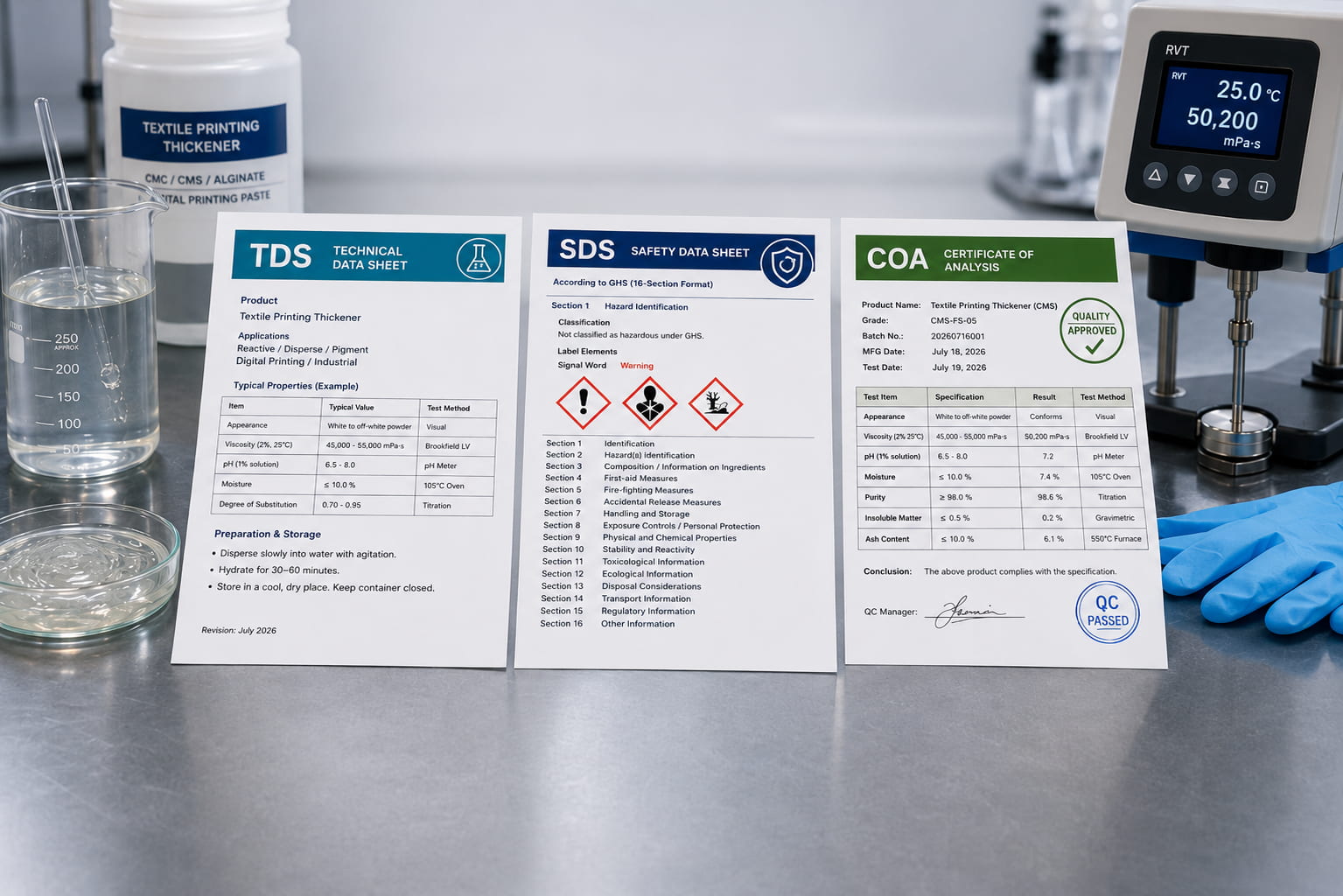
तकनीकी डेटा शीट
सुरक्षा डेटा शीट
Batch-specific COA or quality data where applicable
Viscosity test method
Recommended preparation conditions
Recommended dosage range
Relevant application guidance
When requesting technical matching, provide the supplier with enough information to identify a relevant candidate.
उपयोगी जानकारी में शामिल हैं:
वर्तमान आपूर्तिकर्ता और वाणिज्यिक ग्रेड
वर्तमान टीडीएस
Physical sample if available
Current viscosity method
वर्तमान खुराक
Complete printing formula
कपड़े का प्रकार
Printing machine
स्थिरीकरण या क्योरिंग प्रक्रिया
वर्तमान तकनीकी समस्या
Commercial cost target
A responsible supplier should not promise a guaranteed identical replacement based only on a product name and viscosity value.
A better approach is to select a technically relevant candidate for controlled side-by-side testing.
अनुमोदित नमूने से वाणिज्यिक बैच तक
The commercial comparison is not complete when the laboratory sample passes.
For industrial buyers, the approved sample should remain connected to the commercial product supplied later.
A practical workflow is:
Select the candidate commercial grade.
Confirm its TDS and test method.
एक प्रतिनिधि नमूना प्राप्त करें।.
Run laboratory testing.
Complete printing and post-treatment trials.
Optimize and approve the working dosage.
Compare the commercial quotation based on the approved dosage.
Confirm the production batch specification.
Obtain batch-specific quality documentation where appropriate.
Verify the first commercial shipment against the approved benchmark.
This process reduces the risk of selecting an attractive laboratory sample that does not represent routine commercial production.
FSX Chemical supports this type of comparison through its नमूने और मिलान process.
So Which of the Top 3 Textile Printing Thickeners Offers the Best Cost and Performance?
There is no technically responsible universal ranking of sodium alginate, CMC and CMS.
For conventional reactive printing, sodium alginate remains an important benchmark and may provide a strong balance of process compatibility and production reliability.
CMC can be evaluated in selected textile printing and compound-thickener systems where its grade characteristics match the actual formulation and process requirements.
CMS can be an important candidate in selected disperse, specialty and compound systems, while selected reactive applications should be validated through complete formulation testing.
The final decision should therefore follow this sequence:
Printing Process → Fabric → Current Benchmark → Candidate Grade → Standardized Laboratory Test → Complete Paste → Printing Trial → Fixation/Washing → Dosage Optimization → Total Cost in Use
This approach prevents two common purchasing mistakes:
Choosing a product only because its price per kilogram is lower
Assuming that equal viscosity means equal production performance
The best-value thickener is the one that provides the required technical result with stable production economics under your actual factory conditions.
अक्सर पूछे जाने वाले प्रश्न
1. Which textile printing thickener is the cheapest?
There is no universal cheapest option. Compare delivered price together with effective dosage, preparation loss, printing stability, machine downtime, washing requirements and rejected fabric. The lowest price per kilogram may not produce the lowest total production cost.
2. Is sodium alginate better than CMC for textile printing?
Not in every application. Sodium alginate is a common benchmark for conventional reactive printing, while selected CMC grades can be evaluated in appropriate textile printing and compound-thickener systems. The correct choice depends on the printing chemistry, fabric, formulation and production conditions.
3. Can CMC replace sodium alginate 1:1?
A universal 1:1 replacement should not be assumed. CMC and sodium alginate have different polymer characteristics and rheological behavior. Candidate grades should be compared using the complete printing formula and optimized dosage.
4. Can CMS replace sodium alginate?
CMS can be evaluated in selected applications and compound systems, but it should not be treated as a universal sodium alginate substitute. Reactive printing requires particular attention to dye compatibility, fixation and finished fabric performance.
5. Does higher viscosity mean better printing performance?
No. Higher viscosity does not automatically mean better print definition or production performance. Rheology, shear response, structural recovery, filtration, dye compatibility and penetration are also important.
6. If two thickeners have the same viscosity, are they equivalent?
No. The same viscosity reading can be produced by materials with different flow behavior and formulation compatibility. Viscosity is meaningful only when concentration, water, hydration, temperature, instrument and measurement conditions are clearly defined.
7. Which thickener is best for reactive textile printing?
Sodium alginate is commonly used as a benchmark for conventional reactive printing on suitable cellulosic fabrics. Alternative CMC, CMS or compound routes should be evaluated through controlled complete-paste, printing, fixation and washing tests.
8. Which thickener should be evaluated for disperse printing?
The selection should focus on paste stability, filtration, screen passage, print definition, solid-area uniformity, thermal fixation and effective dosage. Selected CMS and compound-thickener systems can be relevant candidates, but the exact grade requires production-specific testing.
9. How should I compare quotations from three thickener suppliers?
Do not compare quotation price alone. Request the exact grade, TDS, viscosity test method, recommended dosage and representative sample. Standardize laboratory testing and compare the commercial cost only after the effective dosage has been optimized.
10. What information should I send for thickener grade matching?
Begin with the current product TDS, printing route and main technical or cost issue. Then align dosage basis, method and trial scope; share detailed formulation or commercial information only when needed and authorised. A reference sample can support a more relevant comparison.
11. How much sample is needed before changing suppliers?
The appropriate quantity depends on your laboratory and production equipment. A laboratory screening quantity may be sufficient for initial comparison, but a larger sample is normally required before an industrial machine trial. The objective is to complete both formulation and production validation before approving a supplier change.
12. What is the best way to reduce textile printing thickener cost?
Optimize total cost rather than simply purchasing a cheaper polymer. Compare effective dosage, preparation efficiency, filtration, printing stability, machine downtime, fixation, washing and reject rate. A technically stable formulation often creates more meaningful savings than a small reduction in chemical price.
Compare Your Current Textile Printing Thickener with FSX Chemical
If you are currently using sodium alginate, CMC, CMS or another textile printing thickener, FSX Chemical can help select a technically relevant candidate for controlled comparison.
For more accurate matching, send us:
Your current product TDS or commercial grade
वर्तमान खुराक
संधानशीलता और परीक्षण विधि
मुद्रण प्रक्रिया
कपड़े का प्रकार
Complete or simplified printing formula
वर्तमान तकनीकी समस्या या लागत लक्ष्य
ग्रेड मिलान का अनुरोध करें or send your current product information for a side-by-side technical evaluation.
The objective is not to replace one polymer name with another. The objective is to identify the thickener system that provides the required printing performance at a competitive and controllable total cost in use.
जानें कि कपड़ा मुद्रण के लिए थिकनर की विस्कोसीटी मानों की तुलना बिना समान सांद्रता, तापमान, उपकरण, स्पिंडल, गति, तैयारी विधि और परीक्षण समय के नहीं की जा सकती।.
कपड़े, रंग या स्याही, स्थिरीकरण, धोने पर छूटना और मुद्रण गुणवत्ता की आवश्यकताओं के आधार पर प्रतिक्रियाशील, डिस्पर्स, पिगमेंट और डिजिटल टेक्सटाइल प्रिंटिंग के लिए गाढ़ा करने वाले पदार्थ और पूर्व-उपचार मार्ग चुनने का तरीका जानें।.
TDS, SDS और COA दस्तावेज़ों में अंतर जानें, वस्त्र मुद्रण खरीदारों को क्या सत्यापित करना चाहिए, और विनिर्देश, सुरक्षा डेटा, परीक्षण विधियाँ, बैच परिणाम और दस्तावेज़ जारीकर्ताओं की जाँच कैसे करें।.
टेक्सटाइल प्रिंटिंग के लिए CMC, CMS, सोडियम अल्जिनेट और डिजिटल प्रिंटिंग पेस्ट की तुलना करें। जानें कि प्रत्येक माध्यम प्रतिक्रियाशील, विसरणीय, वर्णक और डिजिटल प्रक्रियाओं के लिए कैसे उपयुक्त है, और नमूना परीक्षण, ग्रेड मिलान और थोक खरीद से पहले खरीदारों को किन बातों की समीक्षा करनी चाहिए।.
सोडियम अल्गीनेट का उपयोग प्रतिक्रियाशील प्रिंटिंग पेस्ट के लिए एक स्थिर और धोने योग्य गाढ़ा करने वाले पदार्थ के रूप में वस्त्र मुद्रण में व्यापक रूप से किया जाता है। खरीदने से पहले चिपचिपापन ग्रेड, शुद्धता और अनुप्रयोग उपयुक्तता का मूल्यांकन कैसे करें, और FSX केमिकल तकनीकी डेटा और नमूनों के साथ वैश्विक खरीदारों का समर्थन कैसे करता है, यह जानें।.
Choose CMC for textile printing by application, DS, viscosity method and formulation trials. Use a practical checklist to compare grades before bulk purchase.
कार्बोक्सिमीथाइल सेलुलोज़ का उपयोग जल-आधारित स्याही, ग्रावुर मुद्रण और इंकजेट पूर्व-उपचार में गाढ़ा करने वाले और स्थिरीकरणकर्ता के रूप में किया जाता है। यह मार्गदर्शिका खरीद टीमों के लिए प्रमुख ग्रेड पैरामीटर और स्रोत चयन संबंधी विचारों को कवर करती है।.
CMC-आधारित प्रिंटिंग पेस्ट का उपयोग पिगमेंट, रिएक्टिव और डिजिटल टेक्सटाइल प्रिंटिंग में किया जाता है। यह मार्गदर्शिका बताती है कि किन मापदंडों का महत्व है, आपूर्तिकर्ताओं की तुलना कैसे करें, और थोक ऑर्डर देने से पहले क्या अनुरोध करना चाहिए।.
सोडियम अल्जिनेट और सीएमसी दोनों का उपयोग वस्त्र मुद्रण में गाढ़ा करने वाले पदार्थ के रूप में किया जाता है, लेकिन ये विभिन्न रंग प्रणाली और प्रक्रिया की शर्तों के लिए उपयुक्त होते हैं। यह मार्गदर्शिका प्रमुख अंतर और प्रत्येक का उपयोग कब करना चाहिए, यह बताती है।.
टेक्सटाइल पर डिजिटल इंकजेट प्रिंटिंग में स्क्रीन प्रिंटिंग की तुलना में अलग पेस्ट और पूर्व-उपचार की आवश्यकताएँ होती हैं। यह मार्गदर्शिका बताती है कि डिजिटल टेक्सटाइल प्रिंटिंग में सोडियम अल्जिनेट का उपयोग कैसे किया जाता है और खरीद टीमें किन ग्रेड पैरामीटरों को निर्दिष्ट करें।.
खाद्य-ग्रेड और औद्योगिक-ग्रेड सीएमसी की मूल रासायनिक संरचना समान होती है, लेकिन शुद्धता, डीएस रेंज और नियामक आवश्यकताओं में इनमें काफी भिन्नता होती है। यह मार्गदर्शिका प्रमुख अंतरों को समझाती है और बताती है कि गलत ग्रेड का उपयोग उत्पादन में समस्याएँ क्यों उत्पन्न करता है।.
Prepare sodium alginate printing paste with a grade-specific concentration and controlled powder dispersion. Validate hydration, viscosity, filtration, air removal and holding time before production.
उत्पाद का नाम, उपयोग, मात्रा, गंतव्य और आपके पास पहले से मौजूद कोई भी टीडीएस, नमूना फोटो या दस्तावेज़ साझा करें। FSX केमिकल इस जानकारी की समीक्षा करेगा और कोटेशन, नमूना मिलान या उत्पाद चयन के लिए अगले कदम की सिफारिश करेगा।.
उत्पाद की जानकारीउत्पाद का नाम, ग्रेड, मॉडल, लेबल की तस्वीर या आपूर्तिकर्ता संदर्भ।.
उपलब्ध दस्तावेज़टीडीएस, एसडीएस, सीओए, नमूना फोटो, उत्पाद सूची या परीक्षण डेटा।.
आदेश विवरणअनुमानित मात्रा, पैकेजिंग, गंतव्य देश, बंदरगाह या व्यापारिक शर्त।.
आवेदन या समस्याटेक्सटाइल मुद्रण प्रक्रिया, सूत्रीकरण आवश्यकता, वर्तमान समस्या या लक्षित प्रदर्शन।.