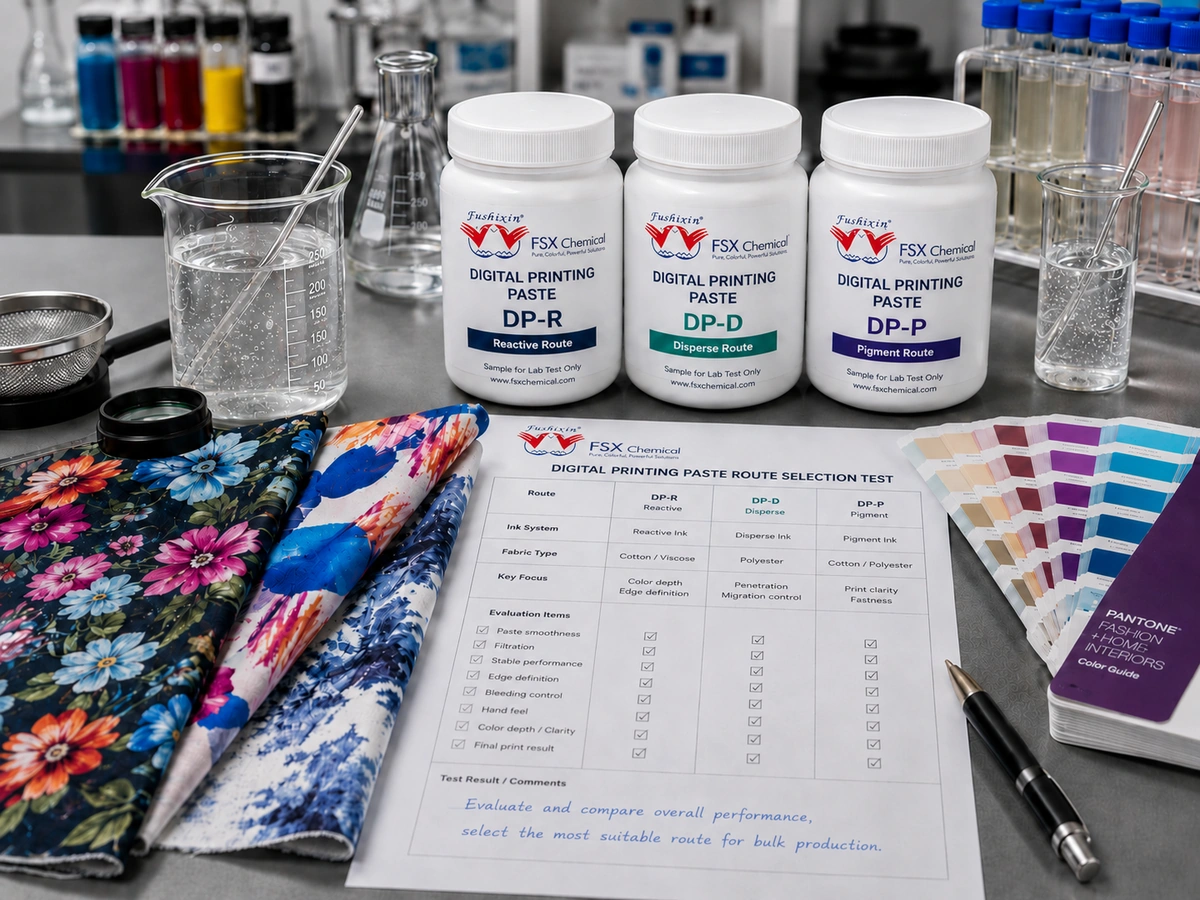
Product Review: FSX Digital Printing Paste for High-Quality Textile Inks
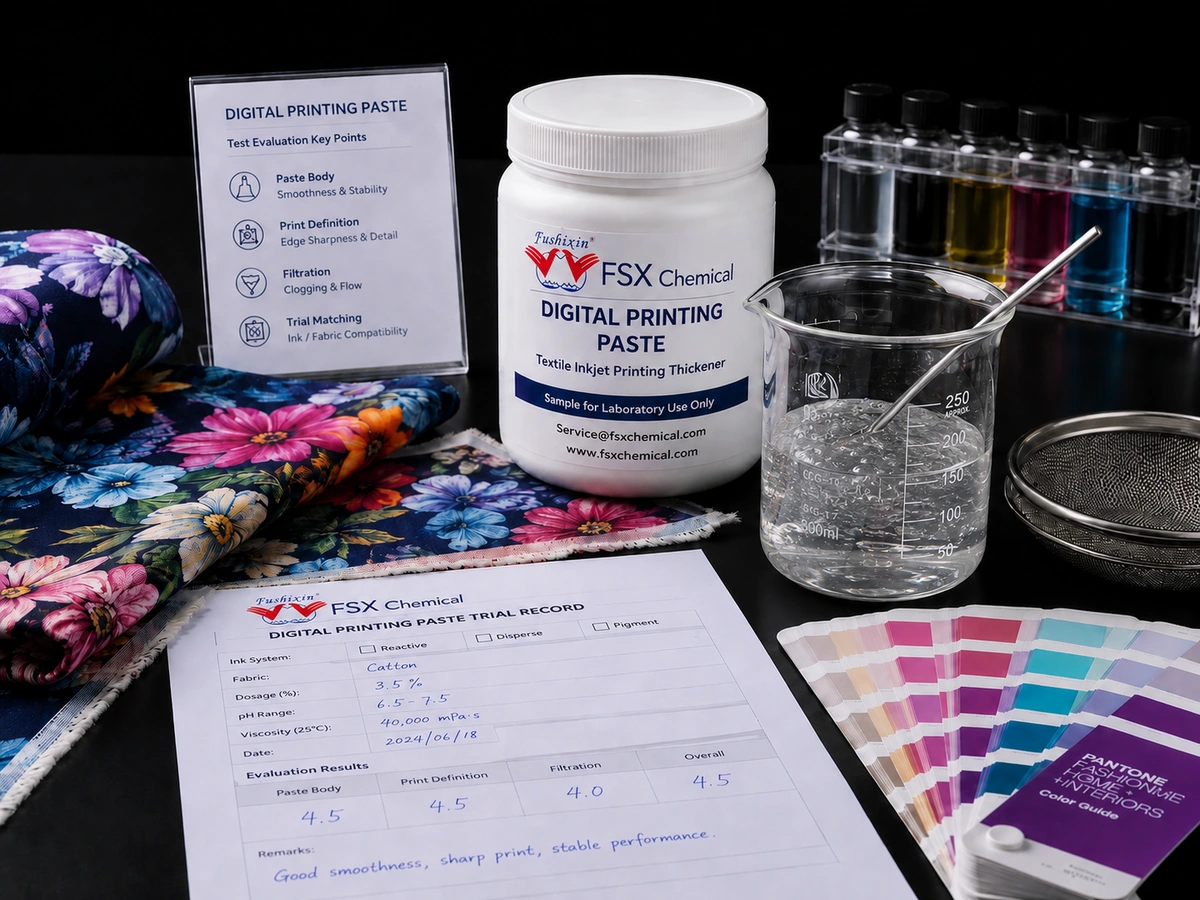
This product review examines FSX Digital Printing Paste as a textile inkjet pretreatment and thickening...
Digital textile printing demands more than a high-quality ink. The fabric surface, pretreatment chemistry, moisture control, fixation conditions and washing process all influence whether an inkjet design develops into a sharp, uniform and commercially acceptable printed textile.
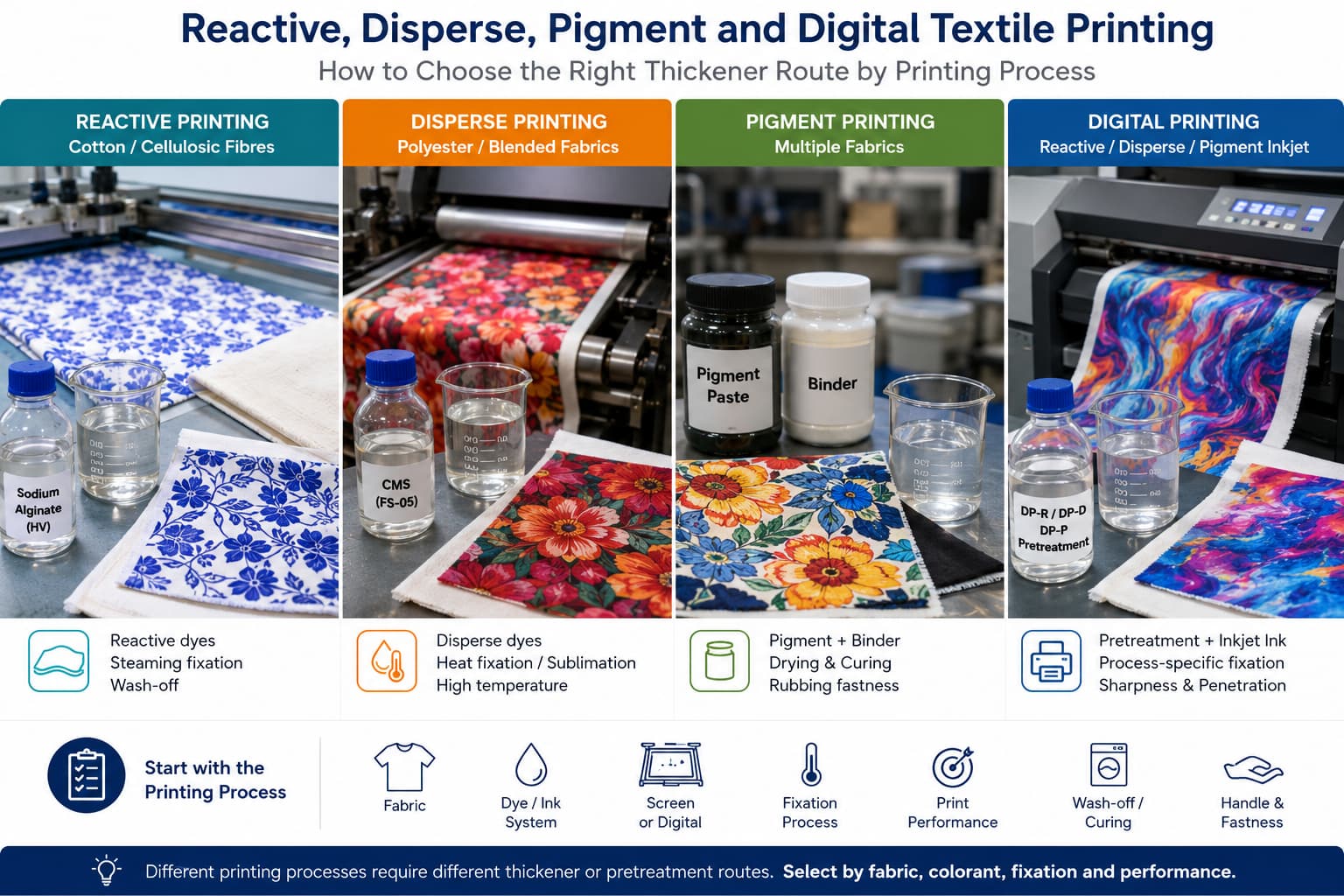
FSX Digital Printing Paste is designed as a textile pretreatment and thickening route for digital printing applications. Rather than offering one universal product for every ink system, the FSX range separates reactive, disperse and pigment printing into different evaluation routes.
This distinction is important. Reactive ink on cotton, disperse ink on polyester and pigment ink on blended fabrics operate through different chemical and fixation mechanisms. A digital printing paste should therefore be matched to the actual ink, fibre, pretreatment process and final quality target.
In this review, we examine the FSX product structure, the practical role of pretreatment paste, the strengths of the DP-R, DP-D and DP-P approach, the technical points buyers still need to verify and the most reliable way to test the product before bulk purchasing.
What Is FSX Digital Printing Paste?
FSX Digital Printing Paste is a textile printing auxiliary route developed for pretreatment and related paste systems used before or around digital inkjet printing.
Its main purpose is not to replace the ink itself. The paste helps prepare the textile surface so that the selected ink can be evaluated under more controlled conditions of absorption, migration, moisture and surface rheology.
The product structure is divided according to printing chemistry: DP-R for reactive digital printing, DP-D for disperse digital printing and DP-P for pigment digital printing.
Important Clarification: Printing Paste Is Not Digital Ink
The phrase “digital printing paste for textile inks” can easily be misunderstood. A pretreatment thickener and an inkjet ink perform different functions.
The ink travels through the printhead
Digital textile ink must meet the physical and chemical requirements of the ink delivery and printhead system.
The pretreatment is normally applied to the fabric
Digital printing paste is used to prepare the textile surface before printing or as part of an application-specific pretreatment system.
Why this distinction matters
High-molecular-weight thickeners should not simply be added to inkjet ink in an attempt to improve print definition. Doing so can change ink rheology and filtration requirements in a system designed around tightly controlled fluid properties.
The correct evaluation route is therefore: pretreat the fabric, dry it appropriately, print with the selected ink, complete fixation or curing, then evaluate the finished textile.
Quick Product Review
Review Area
FSX Approach
Buyer Evaluation
Product Structure
Separate reactive, disperse and pigment routes
Strong starting logic because ink chemistry is identified first
Aplikasi
Textile pretreatment and paste systems
Appropriate distinction from digital ink itself
Pemilihan
Ink, fabric, dosage, pH and process-based
More useful than choosing only by viscosity
Performance Focus
Definition, stability, filtration and final printing result
Requires side-by-side customer testing
Pemilihan Produk Berdasarkan Sampel
Current TDS or sample can be reviewed
Useful for alternative-supplier qualification
Bulk Decision
Trial before commercial conversion
Recommended for reducing supplier-change risk
The strongest feature of the FSX structure is not a single numerical specification. It is the decision to separate product selection by ink system and then require application validation.
Three FSX Digital Printing Paste Routes
Digital textile printing should not be treated as one chemical process. The FSX portfolio reflects this by separating the three major ink routes.
Rute FSX
Sistem Tinta
Typical Fabric Direction
Priority Trial Focus
DP-R
Reactive Ink
Cotton, viscose and suitable cellulosic or natural-fibre systems
Paste stability, definition and final color result
DP-D
Disperse Ink
Polyester and suitable polyester blends
Dispersi, filtrasi, dan kompatibilitas proses
DP-P
Pigment Ink
Various fabrics according to pigment and binder system
Binder compatibility, definition, fastness and hand feel
These routes are starting points rather than automatic approvals. Fabric construction, ink chemistry, printer, pretreatment equipment, fixation and washing still need to be considered.
DP-R for Reactive Digital Printing
DP-R is the FSX starting route for reactive textile inkjet printing. Reactive printing is commonly associated with cellulosic fabrics such as cotton and viscose, although the complete fibre and dye system must always be confirmed.
Why pretreatment is important in reactive printing
Reactive inkjet droplets can spread along an absorbent textile surface before fixation if the pretreatment does not provide enough control.
A suitable pretreatment can help manage moisture movement and keep the printed boundary closer to the intended design.
Important DP-R trial criteria
Ease of pretreatment preparation
Uniform fabric application
Stabilitas pasta
Pola pengeringan
Definisi garis halus
Pengendalian perdarahan
Shade depth after fixation
Kinerja pembilasan
Pegangan kain akhir
The final decision should be made after steaming or the specified fixation route and complete washing, not immediately after printing.
DP-D for Disperse Digital Printing
DP-D is the starting FSX route for selected disperse digital printing systems on polyester and suitable polyester blends.
Polyester printing differs substantially from reactive printing on cellulosic fabrics. Thermal conditions, disperse colorants, fabric preparation and the specific digital process influence the required pretreatment behavior.
Important DP-D evaluation areas
Paste dispersion
Penyaringan
Keseragaman prapengolahan
Compatibility with the selected polyester fabric
Print edge definition
Large-area uniformity
Perilaku fiksasi termal
Tingkat kebersihan permukaan akhir
A product that performs well in a reactive process should not automatically be transferred to a disperse line. The chemistry and thermal process are different.
DP-P for Pigment Digital Printing
DP-P is the FSX route for pigment digital printing trials. Pigment systems require particular attention because the printed colorant typically relies on binder-film formation rather than dye-fibre chemistry alone.
The pretreatment must work with the binder system
A pigment digital printing paste should be evaluated together with the actual pigment ink, binder and curing process.
Important DP-P trial criteria
Keseragaman prapengolahan
Ink migration control
Definisi cetak
Kompatibilitas pengikat
Dry and wet rubbing performance
Kondisi pengeringan
Color appearance
Tekstur kain saat disentuh
A formulation that produces strong color but an excessively stiff surface may not be commercially acceptable. Pigment printing therefore requires a balance rather than optimization of one property alone.
How Pretreatment Influences Textile Ink Performance
High-quality digital ink cannot achieve its full printing potential if the fabric surface is poorly prepared.
Textile fibres contain capillary structures and surface features that influence how a liquid droplet spreads, penetrates and dries.
A matched pretreatment can help control
Migrasi tinta
Lateral spreading
Surface absorption
Moisture distribution
Colorant concentration near the intended print area
The objective is not to stop all penetration. It is to achieve the level of surface control required by the fabric and design without creating undesirable stiffness or excessive surface residue.
Print Definition and Bleeding Control
Print definition is one of the most important criteria when reviewing a digital textile pretreatment paste.
Use a diagnostic test image
A useful print trial should include more than large blocks of color. Include:
Fine horizontal and vertical lines
Small text
Sharp corners
Fine dots
Multi-color boundaries
Black or dark solid areas
Gradients where relevant
Check after fixation
Edge definition can change during steaming, heat fixation, curing or washing. The wet print should therefore not be the final acceptance point.
Do not solve every definition problem with more thickener
Excessive pretreatment solids can create other problems, including surface buildup, difficult washing or undesirable fabric handle.
Color Yield and Surface Control
Pretreatment can influence how much visible color remains concentrated near the fabric surface and how uniformly the ink develops after fixation.
However, color yield should never be attributed to the printing paste alone.
Color performance also depends on
Ink chemistry
Ink laydown
Daya serap kain
Pengambilan sampel praperawatan
Pengeringan
Fixation temperature and time
Moisture conditions
Washing or curing process
A fair product review should therefore compare the FSX candidate and the current paste using the same fabric, ink, printer settings and post-treatment.
Rheology and Paste Stability
The pretreatment paste needs to remain practical during preparation, storage and application.
Standing viscosity is only one indicator
Two products can have similar viscosity values while showing different flow, leveling and stability during application.
Useful stability checkpoints include
Immediately after preparation
After complete hydration or equilibration
After normal production holding
After circulation where applicable
Record more than viscosity
Appearance, pH, separation, foam, filtration and application behavior should also be observed.
A stable laboratory number is useful only when it connects with stable textile production.
Filtration and Process Cleanliness
Filtration is an important part of digital printing paste evaluation, even though the pretreatment paste itself is not normally intended to pass through the digital printhead.
Why filtration still matters
Gels, incompletely dispersed material and contamination can interfere with preparation, coating, padding, spraying or other pretreatment equipment.
Use a controlled filtration method
Record sample quantity, filter material, opening size, preparation conditions and retained residue.
Inspect the residue
Residue can result from poor dispersion, gel formation, incompatible chemicals or foreign contamination.
Filtration performance should therefore be evaluated together with the preparation method rather than treated as a product-purity test alone.
Fabric Compatibility
A digital printing paste that performs well on one textile should not automatically be expected to perform the same way on another.
Katun dan viscose
Cellulosic fabrics can absorb moisture quickly, making surface pretreatment particularly important in reactive inkjet printing.
Poliester
Polyester requires a different ink and fixation route, so disperse digital printing should be evaluated separately.
Blended fabrics
Blends can create a more complex absorption profile because more than one fibre type is present.
Fabric construction also matters
Knitted versus woven construction, fabric weight, density, finishing agents and previous preparation can all influence pretreatment pickup and ink movement.
Fixation, Washing and Fabric Hand Feel
A digital printing paste review is incomplete until the fabric has passed through the full post-printing process.
Reactive systems
Evaluate the printed textile after the specified fixation and wash-off process.
Disperse systems
Evaluate the result after the applicable thermal fixation route and subsequent cleaning process where required.
Pigment systems
Evaluate binder curing, rubbing performance and fabric hand feel together.
Why hand feel matters
Excessive pretreatment or residual polymer can influence surface softness. A product that improves one visual parameter but produces an unacceptable handle may require dosage or formulation adjustment.
What We Like About the FSX Product Structure
From a technical purchasing perspective, several parts of the FSX Digital Printing Paste approach are useful.
1. Selection starts with the ink route
Separating reactive, disperse and pigment printing reduces the risk of treating digital textile printing as one universal chemical system.
2. Fabric and process are included in product selection
The product route is intended to be evaluated according to the actual substrate and pretreatment process.
3. Viscosity is not used as the only buying criterion
Filtration, stability, definition, compatibility and final printing results are also relevant.
4. Current-product matching is available
Customers already using another paste can use their existing TDS, sample and test method as a benchmark.
5. Sample testing comes before bulk conversion
This is a more practical sourcing route than asking a customer to approve a product directly from a data sheet.
What Buyers Still Need to Verify
A balanced product review should identify not only the strengths but also the information that cannot be confirmed until the product is tested in the customer’s process.
Actual dosage
Final dosage depends on the route, ink, fabric, pretreatment method and target performance.
Actual print definition
Sharpness needs to be verified on the customer’s printer and fabric.
Actual color improvement
Color depth depends on the entire printing and fixation process, not only the paste.
Actual fastness
Fastness performance must be evaluated after the appropriate fixation, binder or washing process.
Actual fabric handle
Hand feel should be judged on the fully processed textile at the intended dosage.
Production stability
Laboratory results should be confirmed at production-relevant batch size, holding time and application speed.
Who Is This Product Best Suited For?
The FSX Digital Printing Paste range is especially relevant for buyers who want to evaluate a pretreatment route rather than simply purchase a generic printing thickener.
Reactive digital printing mills
Mills printing cotton, viscose or other suitable fibres with reactive ink can evaluate DP-R as the starting route.
Polyester digital printers
Businesses using disperse ink and polyester can evaluate DP-D according to their pretreatment and thermal process.
Pigment digital printers
Mills using pigment ink can evaluate DP-P together with the actual binder and curing system.
Printing-paste formulators
Formulators can compare a defined FSX route with their existing system using controlled laboratory methods.
Importers and distributors
Buyers seeking a factory supply route can use samples and technical information to qualify products before developing commercial inventory.
Who Should Not Select It Without Further Testing?
A product should not be selected blindly when the printing system is poorly defined.
Further technical review is particularly important when:
The ink system is unknown
The current paste formulation is unknown
The fabric changes frequently
The buyer expects one paste to cover several unrelated ink routes
The current problem may originate from the ink or fixation process
The customer wants to add the paste directly into digital ink
No laboratory or production trial can be performed
In these cases, collecting process information should come before product selection.
How to Compare FSX with Your Current Digital Printing Paste
The most reliable product review is a controlled side-by-side comparison against the material already approved in production.
Comparison Area
Current Paste
FSX Candidate
Commercial Grade
Record exact product
Record DP-R, DP-D or DP-P trial route
Persiapan
Use standard method
Use defined comparable method
Viskositas
Record full test method
Measure under comparable conditions
Penyaringan
Reference performance
Compare residue and processing
Pretreatment Pickup
Current production level
Optimize after baseline comparison
Pencetakan
Same ink and printer
Same ink and printer
Fiksasi
Standard process
Same standard process
Finished Fabric
Reference quality
Compare against reference
Recommended Laboratory Trial
Step 1: Identify the ink route
Confirm whether the process uses reactive, disperse or pigment ink.
Step 2: Record the fabric
Record fibre composition, construction, weight and any existing pretreatment or finishing.
Step 3: Prepare the reference and candidate
Follow clearly recorded preparation conditions and avoid changing several variables simultaneously.
Step 4: Measure basic paste properties
Penampilan
Viscosity where relevant
pH
Penyaringan
Stabilitas fisik
Step 5: Apply pretreatment to the same fabric
Keep application conditions as consistent as possible.
Step 6: Dry under comparable conditions
Differences in residual moisture can influence the subsequent print.
Step 7: Print with the same ink and printer settings
Use the same test image and ink laydown for the reference and candidate.
Step 8: Complete fixation or curing
Use the normal process appropriate to the ink system.
Step 9: Complete washing where required
Evaluate the final fabric only after the normal post-treatment.
Step 10: Compare the final results
Review definition, bleeding, color, levelness, fastness where relevant and fabric hand feel.
Production Trial Checklist
A laboratory result should be followed by a controlled production trial before full commercial conversion.
Record pretreatment preparation
Batch size
Sumber air
Mixing conditions
Dosis
pH
Holding time
Record application conditions
Pretreatment machine
Pickup or application quantity
Drying condition
Kecepatan produksi
Record digital printing conditions
Ink system
Printer
Print mode
Ink laydown
Fabric lot
Record post-treatment
Steaming, fixation or curing conditions
Washing process where applicable
Final drying and finishing
Compare fabric from the beginning, middle and end of the run rather than evaluating only the first printed section.
Cost-in-Use Evaluation
A product review should also consider commercial efficiency, but price per kilogram or liter is not enough.
Bandingkan
Delivered product price
Actual optimized dosage
Waktu persiapan
Filtration requirements
Pretreatment waste
Efisiensi aplikasi
Reprint or rejection risk
Post-treatment requirements
A lower-priced paste is not necessarily more economical if it requires higher dosage or creates additional production loss.
Cost should therefore be calculated only after the candidate achieves an acceptable finished-textile result.
Sample and Grade Matching
Buyers already using another digital printing paste do not need to begin from a generic product description.
FSX can then use this information to select a practical DP-R, DP-D or DP-P starting direction for customer validation.
A recommended sample remains a trial product until performance is confirmed under the buyer’s actual production conditions.
Final Review and Verdict
FSX Digital Printing Paste is best viewed as an application-specific pretreatment and thickening platform rather than one universal high-performance paste.
The strongest part of the product structure is its separation into reactive, disperse and pigment routes. This creates a more technically logical starting point than selecting digital printing paste from viscosity alone.
DP-R is the logical first route for reactive inkjet printing trials, DP-D for disperse inkjet printing and DP-P for pigment inkjet printing. The next decision should then be based on the actual fabric, pretreatment application, ink, printer, fixation process and finished textile.
Buyers should not interpret this review as a guarantee that one FSX grade will automatically outperform an existing paste. The most useful evaluation is a controlled side-by-side trial using the current production-approved product as the benchmark.
For mills seeking a new digital printing paste supplier, a backup source or a different pretreatment route, the FSX DP series is a reasonable candidate for laboratory and production validation when the product route is matched correctly to the printing system.
Pertanyaan yang Sering Diajukan
What is FSX Digital Printing Paste used for?
It is used in textile digital printing pretreatment and related paste systems to help control fabric-surface behavior, ink migration, printing definition and process stability according to the selected ink route.
Is FSX Digital Printing Paste added directly to digital ink?
It should not be assumed to be an ink additive. The product is primarily evaluated as a fabric pretreatment or paste route used outside the digital ink system.
What is DP-R used for?
DP-R is the starting FSX route for reactive digital printing trials, particularly on suitable cellulosic and natural-fibre systems.
What is DP-D used for?
DP-D is the starting route for selected disperse digital printing on polyester and appropriate polyester-blend fabrics.
What is DP-P used for?
DP-P is evaluated for pigment digital textile printing where ink migration, binder compatibility, curing, fastness and fabric hand feel need to be balanced.
Can one digital printing paste work with every textile ink?
A universal product should not be assumed. Reactive, disperse and pigment printing use different chemistry and should be evaluated separately.
Does higher viscosity produce sharper digital printing?
Not automatically. Print sharpness also depends on fabric absorbency, pretreatment pickup, surface rheology, ink laydown, drying and fixation.
Can FSX match my current digital printing paste?
Buyers can provide a current sample or TDS together with the ink system, fabric, dosage, pH and process information so that a relevant FSX trial route can be reviewed.
How should I compare two digital printing pastes?
Use the same fabric, ink, printer settings, pretreatment application, drying, fixation and washing conditions. Compare the finished textiles rather than relying only on paste viscosity.
Should I place a bulk order after a successful laboratory test?
A controlled production trial is recommended before routine bulk use. Scale, application equipment, holding time and production speed can produce differences that are not visible in a small laboratory test.
Want to Test FSX Digital Printing Paste Against Your Current Product?
Send FSX Chemical your current digital printing paste TDS or physical sample together with your ink system, fabric, dosage, pH, pretreatment method and the print result you want to improve.
The first step is to determine whether DP-R, DP-D or DP-P is the most relevant starting route. The candidate can then be tested under your existing digital textile printing conditions before any bulk conversion decision.
For the most meaningful comparison, include photographs or printed samples showing bleeding, weak shade, unclear edges, uneven color or other current production issues.
Pelajari cara memilih bahan pengental dan metode pra-perlakuan untuk pencetakan tekstil reaktif, disperse, pigmen, dan digital berdasarkan jenis kain, pewarna atau tinta, proses fiksasi, daya lepas saat pencucian, serta persyaratan kualitas cetakan.
Bandingkan CMC, CMS, natrium alginat, dan pasta cetak digital untuk pencetakan tekstil. Pelajari bagaimana masing-masing bahan tersebut sesuai dengan proses pencetakan reaktif, dispersi, pigmen, dan digital, serta hal-hal apa saja yang perlu diperhatikan pembeli sebelum melakukan pengujian sampel, penyesuaian kualitas, dan pembelian dalam jumlah besar.
Pasta cetak berbasis CMC digunakan dalam pencetakan tekstil pigmen, reaktif, dan digital. Panduan ini menjelaskan parameter apa saja yang penting, cara membandingkan pemasok, serta hal-hal yang perlu diminta sebelum melakukan pemesanan dalam jumlah besar.
Baik natrium alginat maupun CMC digunakan sebagai pengental dalam pencetakan tekstil, namun keduanya cocok untuk sistem pewarnaan dan kondisi proses yang berbeda. Panduan ini menjelaskan perbedaan utama di antara keduanya serta kapan masing-masing harus digunakan.
Karboximetil Pati (CMS) dapat dievaluasi untuk aplikasi tertentu seperti pelapis tekstil, pasta cetak, dan sistem formulasi pencetakan digital. Panduan ini menjelaskan bagaimana pembeli sebaiknya meninjau tingkat viskositas, perilaku pelarutan, pH, kadar air, perilaku lapisan film, kompatibilitas formulasi, TDS, COA, SDS, pengujian sampel, dan konsistensi antar-batch sebelum melakukan pembelian dalam jumlah besar.
Pemilihan pengental yang tepat untuk pencetakan tekstil tidak hanya bergantung pada jenis kain saja. Pembeli sebaiknya menyesuaikan pengental tersebut dengan sistem pewarna atau pigmen, metode pencetakan, sifat reologi yang diinginkan, persyaratan ketahanan terhadap pencucian, serta kondisi uji coba aktual di pabrik.
Kinerja pencetakan tekstil bergantung pada sistem kimia yang terkoordinasi, bukan pada satu bahan tambahan yang bersifat universal. Panduan ini menjelaskan sepuluh kelompok bahan kimia penting, fungsinya masing-masing, peran yang dimainkannya, serta hal-hal yang perlu diverifikasi oleh pembeli sebelum melakukan uji coba produksi.
Bahan pengental untuk pencetakan tekstil memiliki perbedaan dalam hal komposisi kimia, reologi, kompatibilitas dengan pewarna, dan perilaku pelepasan saat pencucian. Panduan ini membandingkan kelompok-kelompok utama bahan pengental, petunjuk penggunaannya yang umum, serta parameter-parameter yang perlu diverifikasi oleh pembeli sebelum melakukan uji coba produksi.
Pengendalian viskositas dalam pencetakan tekstil digital melibatkan dua sistem yang berbeda: sistem penyemprotan tinta dan formulasi pra-perlakuan kain. Panduan ini menjelaskan bagaimana suhu, formulasi, metode pengukuran, dan kondisi proses memengaruhi stabilitas penyemprotan serta kualitas cetakan.
Pilihan pasta cetak digital harus didasarkan pada komposisi kimia tinta, jenis kain, metode aplikasi, dan perlakuan lanjutan. Panduan ini membandingkan berbagai metode pretreatment, yaitu natrium alginat, CMC, CMS, polimer sintetis, dan campuran, untuk pencetakan inkjet tekstil.
Pasta cetak digital terbaik adalah yang sesuai dengan komposisi kimia tinta, jenis kain, dan metode fiksasi. Panduan ini membandingkan persyaratan praperlakuan untuk pencetakan inkjet reaktif pada kain selulosa dan pencetakan inkjet disperse langsung pada poliester, kemudian menjelaskan bagaimana pembeli sebaiknya mengevaluasi sampel sebelum melakukan pembelian dalam jumlah besar.
Meningkatkan kualitas pencetakan tekstil tidak hanya sekadar mengganti satu bahan kimia. Panduan ini menjelaskan bagaimana FSX Chemical mendukung pemilihan natrium alginat, CMC, CMS, dan pasta pencetakan digital berdasarkan proses, yang dilanjutkan dengan pengujian sampel, validasi produksi, dan peninjauan dokumen batch.
Berikan nama produk, kegunaan, jumlah, tujuan pengiriman, serta TDS,
foto sampel, atau dokumen lain yang sudah Anda miliki. FSX Chemical akan meninjau
informasi tersebut dan merekomendasikan langkah selanjutnya terkait penawaran harga, pencocokan sampel,
atau pemilihan produk.
Informasi ProdukNama produk, grade, model, foto label, atau referensi pemasok.
Dokumen yang TersediaTDS, SDS, COA, foto sampel, daftar produk, atau data pengujian.
Rincian PesananPerkiraan jumlah, kemasan, negara tujuan, pelabuhan, atau syarat perdagangan.
Aplikasi atau KendalaProses pencetakan tekstil, kebutuhan formulasi, masalah terkini, atau target kinerja.