Why Synthetic Pigment Paste Thins During Rotary Screen Circulation: Shear, Heat and Holding-Time Causes
Synthetic pigment paste can thin during rotary circulation because of reversible shear thinning, time-dependent structural...
Synthetic pigment paste can become thinner during rotary-screen circulation even when the thickener batch and formula are correct. The most common causes are not all the same: shear can temporarily reduce apparent viscosity, repeated circulation can create time-dependent structural breakdown, pump and line friction can raise paste temperature, and long holding can expose the acrylic thickener to continuing binder, pigment, electrolyte, pH and foam interactions. The first question should therefore be whether the viscosity loss is reversible after the paste is cooled and allowed to rest. If it recovers, the main cause is likely shear and/or temperature; if it does not, the mill should investigate formula compatibility, pH drift, electrolyte load, dilution, contamination or true polymer damage before increasing thickener dosage.
Why Does Synthetic Pigment Paste Thin During Rotary Circulation?
Rotary-screen printing exposes a pigment paste to repeated mechanical and thermal stress.
The paste may move through:
Feed tank
Pump
Hose or pipe
Valves and restrictions
Rotary screen
Return or recirculation line
During this path, a useful acrylic-thickened paste will normally show some shear thinning.
That means:
Shear Rate ↑ → Apparent Viscosity ↓
This is not automatically a failure.
The problem begins when the paste does not recover sufficiently after the shear falls, or when temperature, pH, binder, pigment or electrolyte changes move the complete paste outside its validated working window.
The first diagnostic question is therefore:
Does the paste recover after standardized cooling and rest?
Where Does the Paste Experience Shear in a Rotary-Screen Line?
Rotary circulation is not one single shear event.
The paste experiences a sequence of changing flow conditions:
Tank → Pump → Pipe / Hose → Screen Feed → Rotary Screen → Return Line → Tank
Each stage can create a different:
Shear rate
Pressure drop
Residence time
Temperature rise
Air entrainment risk
Repeated passes mean the same paste can experience hundreds or thousands of shear cycles during a long print run.
This is why a beaker viscosity measured before the machine starts does not fully predict rotary performance.
Three Different Meanings of “Viscosity Loss”
When an operator says the paste “became thin,” separate three mechanisms.
A. Instantaneous Shear Thinning
The apparent viscosity is lower while the paste is under shear.
B. Time-Dependent Structural Breakdown
The paste remains temporarily thinner after prolonged shear and requires time to rebuild.
C. Permanent or Semi-Permanent Change
The paste remains thin even after it returns to the standard test temperature and is allowed to rest.
These three mechanisms require different corrective actions.
1. Reversible Shear Thinning
Shear thinning is normally desirable in textile screen printing.
The printing paste should:
Hold Body at Low Shear → Flow Easily Under Pump / Screen Shear → Recover After Transfer
Published textile-printing rheology work describes this same requirement: relatively lower viscosity at high shear supports screen passage, while higher low-shear viscosity supports pattern definition and controlled penetration.
If the paste viscosity measured immediately after circulation is lower, but returns after a controlled rest at the same temperature, the behavior may be normal reversible shear thinning rather than product failure.
2. Time-Dependent Structural Breakdown and Recovery
Some printing pastes show time-dependent behavior under continuous shear.
The structure can progressively break down during circulation and then rebuild after shear stops.
This is commonly discussed as thixotropic or structural-recovery behavior.
A useful rotary paste should not only shear thin; it should recover fast enough for:
Stable pump behavior
Consistent screen transfer
ნიმუშის განმარტება
Beginning-to-end shade consistency
If recovery becomes slower over the run, the paste can appear increasingly thin even if the polymer is not permanently damaged.
Record both:
Viscosity immediately after circulation
Viscosity after defined recovery times
3. Thermal Thinning from Paste Temperature Rise
Temperature is one of the most common reasons production viscosity appears lower than laboratory viscosity.
For many water-based polymer systems:
Temperature ↑ → Apparent Viscosity ↓
Rotary circulation can gradually heat the paste through:
Pump work
Pipe and valve pressure losses
Mechanical mixing
Repeated screen circulation
Warm machine environment
Associative acrylic networks can also change with temperature because hydrophobic association and surfactant interactions are temperature-sensitive.
Therefore, never compare a hot production sample with a cooler laboratory reference and call the difference a thickener failure.
Why Does Rotary Circulation Heat the Paste?
Mechanical energy entering the liquid eventually becomes heat.
Temperature rise is more likely when:
Pump speed is high.
The line has strong restrictions.
Paste viscosity is high.
Circulation continues for a long time.
The tank has weak heat dissipation.
The printing area is already warm.
A small temperature difference can meaningfully change an apparent viscosity reading.
That is why the production record should pair every viscosity reading with the paste temperature.
Never Compare Viscosity at Different Temperatures
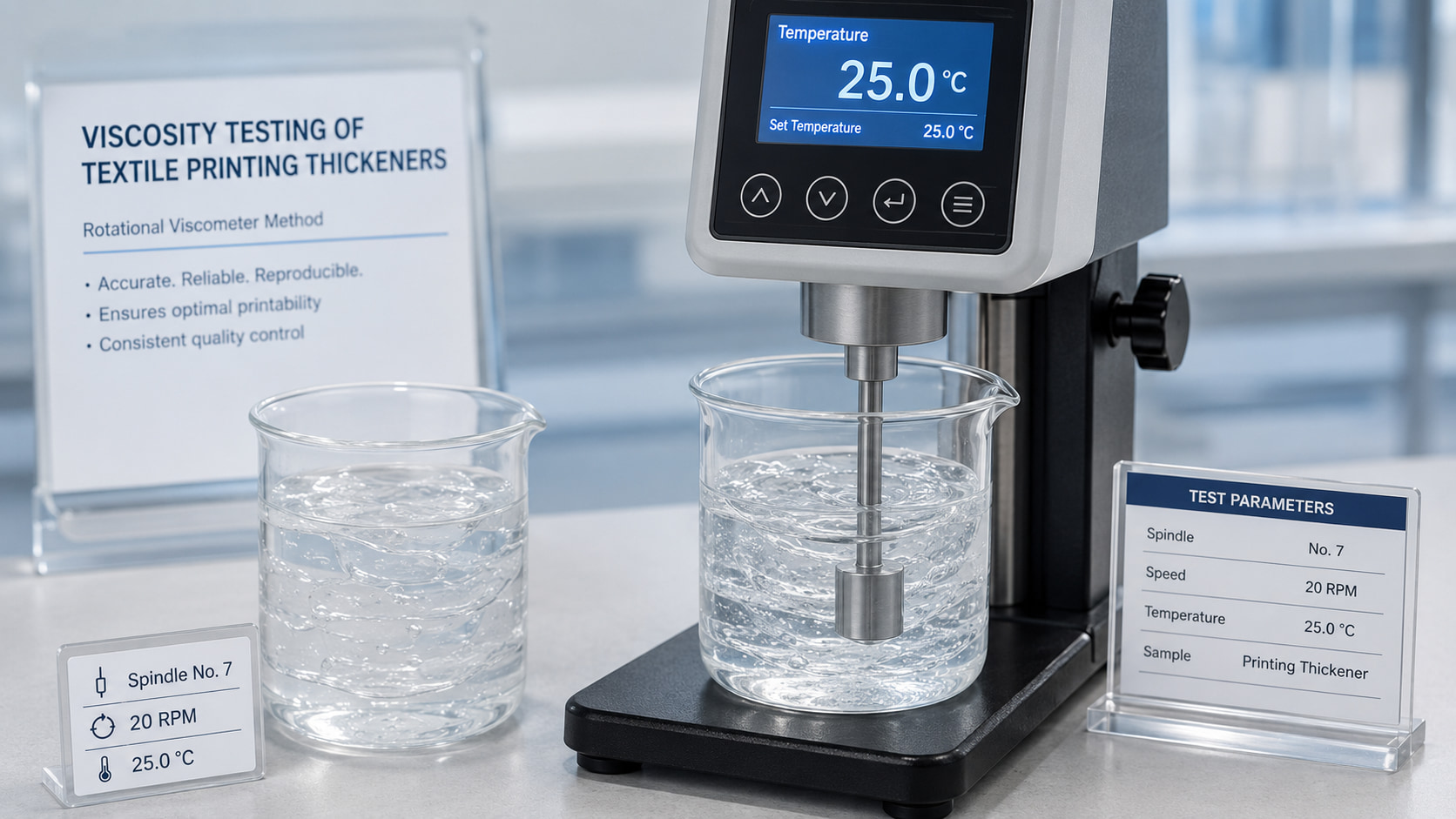
A correct viscosity record should include:
Sample temperature
ინსტრუმენტი
სპინდლი / როტორი
ბრუნვის სიჩქარე
კითხვის დრო
FSX Chemical’s current testing guidance also emphasizes that temperature, spindle and speed must be standardized before viscosity numbers are compared.
The useful rule is:
Same Formula + Same Temperature + Same Instrument + Same Spindle + Same Speed + Same Reading Time
Without this control, the machine sample and laboratory reference cannot be interpreted correctly.
Use a Cool-Down Recovery Test
This is one of the most useful tests for a rotary-circulation complaint.
Step 1
Take a representative paste sample before circulation.
Step 2
Take a sample after a defined circulation period.
Step 3
Measure the hot post-circulation sample immediately.
Step 4
Condition both samples to the same standard temperature.
Step 5
Measure after defined rest times.
If the post-circulation sample largely returns to its original range after cooling and rest, the main effect is likely reversible shear / thermal thinning.
If it remains far below the reference, investigate chemistry or permanent structural change.
When Is the Viscosity Loss More Than Shear or Heat?
Investigate a more persistent problem when viscosity remains low after:
Temperature normalization
Defined rest / recovery
Rechecking the measurement method
Possible causes include:
pH drift
Electrolyte interaction
Binder / thickener compatibility
Pigment / surfactant changes
Water dilution
დაბინძურება
Defoamer or auxiliary interaction
True polymer degradation in severe conditions
The next step should be staged controls—not immediate addition of more thickener.
Is the Acrylic Thickener Being Mechanically Damaged?
Operators often describe a permanent viscosity loss as “the pump broke the polymer.”
That mechanism is possible for some high-molecular-weight polymer systems under sufficiently severe mechanical conditions, but it should not be the first assumption in normal production.
Before concluding that irreversible chain damage occurred, first test:
Temperature recovery
Time-dependent recovery
pH
Electrolyte / binder effects
Dilution
A useful diagnostic is:
Circulated Paste → Cool → Rest → Re-measure → Compare with Uncirculated Control
Only a persistent difference after these controls justifies deeper investigation of mechanical degradation.
Binder Interaction During Long Circulation
Pigment binder is not an inert ingredient.
It contributes:
პოლიმერის ნაწილაკები
ზედაპირულად აქტიური ნივთიერებები
ელექტროლიტები
წყალი
pH effects
During long holding or circulation, the acrylic thickener and binder system can continue equilibrating.
For HASE-type associative thickeners, binder particles may participate directly in the temporary associative network.
If the paste loses viscosity only when binder is present, compare:
Thickener Base Under Circulation
with:
Complete Pigment/Binder Paste Under Circulation.
Pigment Dispersion, Surfactants and Electrolytes
Commercial pigment dispersions can add:
წყალი
ზედაპირულად აქტიური ნივთიერებები
დისპერსანტები
ელექტროლიტები
pH-control chemicals
These components can alter acrylic-thickener rheology.
Long circulation does not necessarily create new pigment chemistry, but it continuously subjects the complete colloidal system to:
Shear
ტემპერატურა
Air exposure
შერევა
A dark shade with higher pigment-dispersion loading can therefore show more viscosity drift than a light shade.
pH Drift During Holding and Circulation
pH-responsive acrylic thickeners should be checked before and after the run.
Possible pH changes can come from:
Volatile neutralizer loss
Ingredient equilibration
დაბინძურება
Water addition
If the paste uses ammonia or another volatile base, a long open holding period deserves particular attention.
ჩანაწერი:
Initial pH
Mid-run pH
End-run pH
If pH and viscosity move together, the issue may be activation drift rather than mechanical shear alone.
Dilution, Condensation, Cleaning Water and Contamination
Production viscosity loss is sometimes caused by simple water entry.
Possible sources include:
Residual wash water in tanks or lines
Incorrect operator adjustment
Water from cleaning procedures
Condensate or process leakage
A small amount of added water can create a large viscosity change because acrylic-thickener dosage–viscosity curves are often nonlinear.
Before blaming circulation, check:
Batch mass balance
Tank level
Cleaning history
Water additions
Why Evaporation Can Produce the Opposite Effect
Not every long-run change is thinning.
If water evaporates during warm open circulation, the paste can become more concentrated and viscosity may rise.
This is useful diagnostically.
If temperature rises while water is also evaporating, two effects can compete:
Higher temperature tends to reduce apparent viscosity.
Higher solids from water loss can increase viscosity.
This is another reason to record:
ტემპერატურა
Tank mass / level
სიბლანტე
Time
together.
Foam and Entrained Air Can Distort Viscosity Readings
Continuous pumping can entrain air if:
The pump suction leaks.
The return line splashes.
A vortex forms in the tank.
The paste contains a strong surfactant package.
Entrained air can make a sample:
Appear lighter / aerated
Give unstable viscosity readings
Produce inconsistent screen transfer
Deaerate or compare paste density before concluding that the polymer itself changed.
Pump Type, Speed and Recirculation Intensity
Pump conditions determine how strongly the paste is sheared.
Relevant variables include:
Pump type
Pump speed
Flow rate
Pressure
Recirculation frequency
A pump operating much faster than necessary can:
Increase shear exposure
Increase heat generation
Increase air entrainment risk
Increase energy consumption
The production goal is sufficient circulation for uniform supply—not maximum pump speed.
Pipe, Hose, Valve and Return-Line Effects
Line design can create high local stress even when average flow seems moderate.
Check for:
Small-diameter restrictions
Partially closed valves
Sharp pressure drops
Long narrow hoses
High-velocity return jets
These features can increase:
Local shear
Heat
ქაფი
If only one printing machine shows the viscosity problem, compare its circulation loop with a machine that runs normally.
Rotary Screen as a Repeated High-Shear Zone
Screen printing exposes paste to a wide range of shear conditions.
Published rheology studies describe very high local shear rates as paste passes through screen openings.
In a rotary process, paste can repeatedly experience:
A suitable synthetic thickener must therefore provide:
Controlled high-shear flow
Sufficient post-shear recovery
Stable long-run behavior
This is why rotary-screen qualification should include circulation time, not only a one-pass laboratory print.
Holding Time Before and During Printing
Holding time should be treated as a process variable.
A pigment paste can remain:
In the color kitchen
In a feed tank
In the circulation system
At the machine during stoppages
For a realistic stability test, record:
Preparation time
Time printing begins
Mid-run time
End-run time
Any long stoppages
The approved thickener should remain inside the required rheology window for the actual operating period.
ASE vs. HASE: Why Acrylic Architecture Matters
ASE-type acrylic thickeners rely mainly on pH-driven swelling and hydrodynamic volume.
HASE adds hydrophobic associative interactions.
For HASE systems, circulation can change the temporary associative network under shear.
Surfactant, binder and temperature can also change how that network rebuilds.
Modern associative-thickener literature describes this behavior as ideally smooth and reversible shear thinning, but the complete formulation determines the actual response.
ამიტომ:
Same Standing Viscosity ≠ Same Rotary-Circulation Stability.
Why Dark Pigment Shades Can Be More Sensitive
Dark shades commonly contain more pigment dispersion.
This can mean more:
წყალი
Surfactant
Dispersant
Electrolyte
The complete paste can therefore have a different circulation response from a pale shade.
When a complaint occurs only with black, navy or another dark shade, compare:
Pigment loading
Binder level
ქაფი
Temperature rise
ვისკოზურობის შენარჩუნება
before changing the thickener grade.
What Production Symptoms Should You Record?
A useful complaint record should include more than “paste becomes thin.”
Record whether you observe:
Pump flow becomes faster
Screen flooding
Edge spreading
More penetration
Lower surface color
Solid-area nonuniformity
ქაფი
Shade drift from beginning to end
These symptoms connect the laboratory viscosity change to real printing performance.
Build a Circulation Diagnostic Map
Sampling Point
გაზომვა
Main Question
Fresh complete paste
pH / temperature / viscosity
What is the starting condition?
After initial circulation
Temperature / viscosity
Is thinning immediate?
Mid-run
pH / temperature / viscosity / foam
Is the change progressing?
End-run
pH / temperature / viscosity
What is the maximum drift?
After cooling
სიბლანტე
How much thermal loss recovers?
After cooling + rest
სიბლანტე
How much structural recovery occurs?
This map usually provides more useful information than one end-of-run viscosity number.
Build a Time–Temperature–Viscosity Record
Plot or record:
Time → Paste Temperature → Measured Viscosity
Use a fixed viscosity method.
If viscosity falls as temperature rises and returns after cooling, the process is primarily thermal / reversible.
If viscosity continues to fall after temperature has stabilized, another time-dependent mechanism may be active.
If pH also moves, activation or formulation chemistry should be investigated.
Build a Shear-Recovery Profile
A simple production-oriented recovery test can use:
Standardized pre-shear viscosity.
A defined high-shear or circulation period.
Immediate post-shear viscosity.
Viscosity after a short rest.
Viscosity after a longer rest.
Keep the sample at the same measurement temperature.
Total Cost in Use = Thickener + Formula Adjustments + Pumping Energy + Machine Efficiency + Rework + Quality Loss
A synthetic thickener with a higher purchase price can be cheaper overall if it provides:
Better long-run viscosity retention
Faster structural recovery
Lower correction demand
More consistent shade
Compare cost per acceptable printed meter, not only price per kilogram.
რა ინფორმაცია უნდა გაუგზავნოთ მომწოდებელს?
For useful rotary-circulation troubleshooting, provide:
Current synthetic thickener / TDS
სათხელებლის დოზირება
Pigment and binder formula
საბოლოო pH
Viscosity and complete test method
Initial paste temperature
Mid-run / end-run temperature
Initial / mid-run / end-run viscosity
Viscosity after cool-down and rest
Pump type / speed if known
Circulation time
Pipe / hose information if relevant
Shade depth
Foam observations
Main print symptom: spreading, penetration, color loss or instability
FSX Chemical-ს შეუძლია ამ ინფორმაციის გამოყენება მეშვეობით ნიმუშები და შესაბამისობა to structure a controlled current-vs-candidate rotary-screen trial.
How Should a Mill Diagnose Rotary-Screen Viscosity Loss?
პრაქტიკული მართვის ჯაჭვი არის:
Standardize Viscosity Method → Record Temperature → Sample Before / During / After Circulation → Cool → Rest → Re-measure → Check pH / Foam / Water Entry → Compare Complete Paste vs. Base Thickener → Run Long Production Trial
ძირითადი პრინციპებია:
Rotary circulation can lower apparent viscosity through normal reversible shear thinning.
Paste temperature must be standardized before viscosity loss is interpreted.
Time-dependent structural recovery should be measured after circulation, not assumed.
Persistent loss after cooling and rest requires investigation of pH, electrolytes, binder, pigment, dilution and contamination before polymer damage is concluded.
Pump, piping, screen and return-line design can change shear and heat exposure significantly between machines.
The correct synthetic thickener is the grade that stays inside the required rotary-screen rheology and print-quality window for the full production run at the lowest practical Total Cost in Use.
ხშირად დასმული კითხვები
1. Why does pigment paste become thinner after rotary circulation?
Common causes include reversible shear thinning, temperature rise, slow structural recovery, pH drift, binder/pigment/electrolyte interaction, dilution or air entrainment.
2. Does rotary circulation permanently damage acrylic thickener?
Not necessarily. First cool the sample, allow a defined rest and remeasure it. If viscosity recovers, the main effect was reversible shear and/or temperature rather than permanent damage.
3. Why does viscosity fall when paste temperature rises?
Many water-based polymer systems show lower apparent viscosity at higher temperature, and associative acrylic networks can also change as temperature changes.
4. How can I tell whether heat or shear is the main cause?
Use separate controls: heat a sample without strong shear, shear another sample with temperature controlled, and compare both with the actual circulated paste.
5. How long should the paste rest before rechecking viscosity?
There is no universal time. Use defined checkpoints appropriate to the grade and production process, and compare all candidates using the same recovery method.
6. Should I add more thickener when the machine paste becomes thin?
Not before diagnosis. If the paste later cools and recovers, extra thickener can create an over-thick paste during stoppage or the next start.
7. Why does one rotary machine show more viscosity loss than another?
Compare pump speed, flow rate, pipe diameter, valve restrictions, return-line design, circulation time and paste temperature.
8. Why do dark pigment shades lose more viscosity during circulation?
Higher pigment loading can add more surfactant, dispersant, water and electrolytes, making the complete formula more demanding for the acrylic thickener.
9. Can foam affect viscosity testing?
Yes. Entrained air can create unstable readings and inconsistent screen transfer. Compare foam, density and deaerated samples where practical.
10. What should I record during a rotary production trial?
Record time, temperature, pH, viscosity, pump/circulation conditions, foam, screen behavior, penetration, shade and end-run recovery.
11. Is one initial viscosity specification enough for rotary printing?
No. A useful rotary specification should also consider mid-run and end-run behavior, standardized temperature and print-quality acceptance.
12. What should I send FSX Chemical for rotary-circulation troubleshooting?
Send the current thickener/TDS, formula, viscosity method, pH, initial and end-run temperatures, viscosity before/after circulation, recovery result, pump/circulation conditions and the observed print defect.
Diagnose Rotary-Screen Viscosity Loss Before Increasing Thickener Dosage
If your synthetic pigment paste starts at the correct viscosity but becomes thinner after rotary-screen circulation, FSX Chemical can help structure a controlled shear, heat and holding-time comparison.
For a useful technical review, send:
Your current synthetic thickener sample, TDS or COA
The key question is not simply how much viscosity is lost during circulation. It is how much of that loss comes from reversible shear, temperature and recovery—and how much remains after the paste returns to standardized conditions. That distinction determines whether the correct action is process control, formulation adjustment or a different synthetic-thickener grade.
გაიგეთ, რატომ არ შეიძლება ტექსტილის ბეჭდვის გასასქელებლის სიმჭიდროვის მნიშვნელობების შედარება კონცენტრაციის, ტემპერატურის, ხელსაწყოს, ღერძის, სიჩქარის, მომზადების მეთოდისა და გამოცდის დროის შესაბამისობის გარეშე.
Reactive dye screen printing with sodium alginate requires correct paste formulation, viscosity control, and steaming conditions. This guide covers flat and rotary screen paste requirements, alkali timing, common production defects, and how to diagnose paste-related causes.
ტექსტილის ბეჭდვისთვის განკუთვნილი გამკვრივებლები განსხვავდება ქიმიური შემადგენლობით, რეოლოგიით, საღებავებთან თავსებადობითა და გარეცხვისადმი მდგრადობით. ეს სახელმძღვანელო ადარებს გამკვრივებლების ძირითად ჯგუფებს, მათი გამოყენების საერთო მიმართულებებსა და იმ პარამეტრებს, რომლებიც მყიდველებმა წარმოებაში გამოცდის დაწყებამდე უნდა შეამოწმონ.
High-speed reactive printing requires more than high viscosity. FSX Chemical sodium alginate grades can be evaluated for shear response, recovery, filtration, paste stability, dye compatibility, wash-off and batch consistency under actual rotary-screen printing conditions.
Reliable textile printing thickener evaluation requires more than checking viscosity. This guide explains the essential raw-material, solution, paste, stability, application and finished-fabric testing parameters.
High-performance textile thickeners should support both production speed and print precision. Learn how rheology, filtration, hydration, paste stability and application matching influence high-speed textile printing.
Textile printing thickening agents control much more than viscosity. This 2026 guide explains sodium alginate, CMC, CMS, compound thickeners and digital printing paste, with practical guidance on rheology, testing, application matching and supplier qualification.
Improving viscosity control in textile printing pastes requires more than adjusting a final cP or mPa·s value. Reliable control starts with standardized testing and continues through hydration, temperature, mixing, formulation sequence and printing performance.
Sodium alginate is more than a viscosity builder in reactive textile printing. Learn how its dye compatibility, rheology, filtration, structural recovery and wash-off influence printing performance.
Sharp textile print edges depend on more than viscosity. Learn how thickener chemistry, rheology, structural recovery, filtration, fabric absorbency and machine settings work together.
CMC, CMS and sodium alginate can all thicken textile printing systems, but their chemistry, rheology, hydration, dye compatibility and application behavior differ significantly.
Flat and rotary screen printing use the same basic transfer principle but expose printing paste to different shear and residence histories. The correct thickener should therefore be selected by low-shear body, high-shear flow, recovery, elasticity and machine stability rather than viscosity alone.
გაგვიზიარეთ პროდუქტის დასახელება, გამოყენების სფერო, რაოდენობა, დანიშნულების ადგილი და ნებისმიერი TDS, ნიმუშის ფოტო ან დოკუმენტი, რომელიც უკვე გაქვთ. FSX Chemical შეისწავლის ინფორმაციას და გირჩევთ შემდეგ ნაბიჯს ფასის შეთავაზების, ნიმუშთან შესაბამისობის ან პროდუქტის შერჩევისთვის.
პროდუქტის ინფორმაციაპროდუქტის დასახელება, მარკა, მოდელი, ეტიკეტის ფოტო ან მომწოდებლის სარეფერენსო.
ხელმისაწვდომი დოკუმენტებიTDS, SDS, COA, ნიმუშის ფოტო, პროდუქციის სია ან სატესტო მონაცემები.
შეკვეთის დეტალებიშეფასებული რაოდენობა, შეფუთვა, დანიშნულების ქვეყანა, პორტი ან სავაჭრო პირობა.
განაცხადი ან საკითხიტექსტილის ბეჭდვის პროცესი, ფორმულირების საჭიროება, მიმდინარე პრობლემა ან სამიზნე მახასიათებელი.