Synthetic Thickener Batch-to-Batch Consistency: Which QC Parameters Best Predict Printing Performance?
Basic COA parameters confirm manufacturing consistency, but activation response, complete-paste viscosity retention, rheology, compatibility and...
Batch-to-batch consistency in synthetic textile printing thickener cannot be judged from one COA value. Appearance, solids, as-supplied pH and product viscosity are useful release parameters because they confirm manufacturing consistency, but they do not fully predict how an acrylic thickener will activate, respond to electrolytes, interact with pigment and binder, shear through a screen, recover after transfer or remain stable during holding. A practical QC program therefore uses three levels: basic identity and supply-form checks for every batch, functional rheology and compatibility tests that directly challenge the approved grade, and periodic application printing against a retained reference batch. The parameters that best predict printing performance are those measured under controlled conditions closest to the real pigment paste—not the properties of the unopened thickener alone.
Which QC Parameters Best Predict Printing Performance?
The parameters closest to the real printing process usually have the strongest predictive value.
A practical hierarchy is:
Basic Supply-Form QC
→ appearance, solids, as-supplied pH, product viscosity, density
Electrolyte tolerance usually predicts real pigment-paste stability better than water viscosity alone.
11. Binder Compatibility
Binder compatibility is highly predictive because binder is a major formulation component.
Binder addition can change:
Тұтқырлық
pH
Electrolyte load
Surfactant balance
Associative HASE structure
A practical QC challenge can compare:
Activated thickener base
Base + equivalent water
Base + approved reference binder
Measure:
Viscosity retention
pH
Gel / floc
Holding behavior
A standardized binder challenge is one of the most useful periodic functional tests for pigment-printing grades.
12. Pigment Compatibility
Commercial pigment dispersions add:
Pigment particles
Су
Dispersants
Surfactants
Electrolytes
A standardized reference pigment can therefore be used as another controlled challenge.
For incoming or periodic QC, use the same:
Pigment product
Pigment dosage
Binder
Су
Mixing sequence
so thickener-batch differences are not confused with pigment-lot differences.
13. Complete-Paste Viscosity Retention
Complete-paste viscosity is one of the most useful bridges between QC and production.
Prepare a standardized reference formula:
Water + Thickener + Pigment + Binder + Approved Auxiliaries
and record:
Initial viscosity
pH
Viscosity after holding
Көрінісі
Foam
This test integrates:
Активтендіру
Electrolyte response
Binder compatibility
Pigment compatibility
into one practical application-QC challenge.
If only one functional incoming test can be added beyond basic COA checks, a standardized complete reference paste can provide high practical value.
14. Multi-Speed Rheology / Shear-Thinning Profile
One Brookfield reading cannot fully describe printing rheology.
Research on polyacrylate printing thickeners evaluates multiple rheological behaviors because printing requires:
Structure at Rest → Flow Under Shear → Recovery After Shear
A practical mill test can compare viscosity at:
Low speed
Medium speed
Higher speed
under one standardized instrument method.
This does not replace a rheometer, but it can detect meaningful batch shifts in shear-thinning behavior.
Multi-speed consistency is often more predictive of screen behavior than a single viscosity point.
15. Structural Recovery / Thixotropy
After high shear, printing paste should rebuild enough structure to:
Hold pattern edges
Limit penetration
Maintain deposit
But recovery that is too fast or too elastic can reduce leveling or worsen screen release.
A controlled recovery test can record:
Initial viscosity
Post-shear viscosity
Short-rest viscosity
Longer-rest viscosity
Use recovery as an internal comparison against the approved reference batch.
Do not set one universal recovery percentage for all grades.
16. Stringing / Filament-Dragging Tendency
Polyacrylate printing-thickener research has treated filament-dragging ability as a distinct rheological property.
This is important because two batches can show similar shear viscosity but different:
Elasticity
Filament length
Screen release
If the application is sensitive to stringing, use a standardized internal lift / filament test or representative screen-release test.
Stringing should not replace the viscosity test.
It adds information that viscosity does not capture.
17. Holding-Time Stability
A batch can pass immediately after preparation and drift later.
Holding stability should evaluate:
Тұтқырлық
pH
Көрінісі
Foam
Separation
Gel / floc
at production-relevant times.
This parameter is especially useful when customers report:
Morning-to-afternoon viscosity change
End-run thinning
Delayed gel
Holding stability is therefore a stronger predictor than fresh viscosity for long color-kitchen or machine residence times.
18. Filtration, Gel and Floc Check
Viscosity can pass while screenability fails because of small gel or floc particles.
A standardized filtration check can record:
Sample mass
Filter / mesh
Filtration time
Residue amount
Residue appearance
This is useful for detecting:
Poor activation
Binder incompatibility
Cationic interaction
Storage damage
For screen-printing grades, residue control can be more predictive of blockage risk than viscosity alone.
19. Foam / Air-Entrainment Behavior
Foam is usually a system property rather than a thickener-only property.
But batch changes in:
Surfactant balance
Associative rheology
Тұтқырлық
can change foam retention.
During reference-paste QC, record:
Foam generated under fixed mixing
Foam decay
Paste density if useful
Do not use foam as a primary release parameter unless it is a known production risk for the approved grade.
20. Application Printing: The Highest-Level Verification
Application printing tests the combined result of all previous QC parameters.
Evaluate:
Screen passage
Screen release
Fine-line definition
Solid-area uniformity
Penetration
Color / opacity
Beginning-to-end consistency
Dry / wet rubbing
Fabric hand
This is the strongest evidence of printing equivalence.
But a full application trial is slower and more expensive.
Therefore, it is most useful for:
Initial approval
Periodic verification
Change control
Complaint investigation
rather than as the only incoming test for every batch.
Which Parameters Are Most Predictive?
Parameter
Predicts Manufacturing Consistency
Predicts Printing Performance
Көрінісі
High
Low
Solids
High
Low–Medium
As-supplied pH
Medium–High
Low
As-supplied viscosity
Medium–High
Low
Controlled activation viscosity
High
Medium–High
Dosage–viscosity curve
High
Medium–High
Electrolyte tolerance
Medium
High
Binder compatibility
Medium
High
Complete-paste retention
High
High
Multi-speed rheology
High
High
Recovery / stringing
Medium–High
High for sensitive processes
Application print trial
High
Highest practical verification
This table is a practical QC framework, not a universal numerical scoring standard.
The most predictive test depends on the known failure mode of the mill.
For example:
If viscosity collapses after binder, binder compatibility deserves more weight.
If rotary screen running drifts, multi-speed rheology and holding stability deserve more weight.
If screen release is the problem, elasticity / stringing deserves more weight.
What Should Be Tested on Every Incoming Batch?
A practical every-batch incoming program can include:
Supplier batch / COA identity
Көрінісі
Solids content
As-supplied pH
As-supplied viscosity where specified
One controlled activation or reference-paste test
The exact list depends on the commercial agreement and process risk.
For a critical thickener with a history of formulation sensitivity, adding one standardized reference-paste viscosity check can provide much more protection than relying only on the supplier COA.
What Should Be Tested Periodically?
Periodic application verification can include:
pH–viscosity curve
Dosage–viscosity curve
Electrolyte tolerance
Binder compatibility
Multi-speed rheology
Recovery / stringing
Holding stability
Сүзу
Screen printing
Periodic frequency should be based on:
Supplier history
Production criticality
Batch volume
Complaint history
Change notifications
Do not invent one universal testing frequency for every textile mill.
What Should Trigger Full Requalification?
Full or expanded requalification should be considered after meaningful changes such as:
Supplier change
Grade change
Major raw-material or manufacturing-process change reported by the supplier
Persistent batch drift
New binder / pigment / fixer system
New high-pigment / white-paste application
Repeated production complaint
The requalification should reproduce the relevant application conditions rather than repeat only basic COA tests.
Use an Approved “Golden Batch” or Retained Reference
One of the most useful QC tools is a retained sample from a proven commercial batch.
Use it as the reference in:
Activation test
Salt challenge
Binder challenge
Complete-paste test
Rheology comparison
A side-by-side comparison reduces the effect of:
Seasonal laboratory temperature
Instrument differences
Minor method drift
Replace or manage retained references according to a documented retention policy so aged reference material is not mistaken for fresh commercial behavior.
Normalize the Test Before Comparing Batches
For any functional QC method, standardize:
Water source
Thickener dosage
Active-solids basis where relevant
Neutralizer
Final pH
Mixing sequence
Mixing time
Equilibration time
Температура
Instrument / spindle / speed
Reading time
If the method changes, the result cannot be interpreted as a batch difference confidently.
QC method repeatability is part of product QC.
Use Trend Data, Not Isolated Pass/Fail Results
Track important parameters by batch.
Useful trend lines can include:
Solids
As-supplied pH
Activation viscosity
Reference-paste viscosity retention
Electrolyte retention
Trend data can reveal:
Gradual supplier drift
Seasonal method effects
Instrument changes
Step changes after manufacturing adjustments
A parameter can remain inside a broad specification while still showing a meaningful long-term shift.
Use trends to trigger investigation before production complaints increase.
How Should QC Acceptance Limits Be Set?
Acceptance limits should come from:
Approved commercial batches
Method repeatability
Successful production data
Minimum application requirements
Do not set a narrow limit that the laboratory method itself cannot repeat.
For functional tests, define:
Target / reference
Acceptable range
Conditional investigation range
Fail condition
The most useful limit is the one that separates commercially acceptable printing behavior from production risk.
It does not need to be the same as the supplier’s manufacturing specification.
What Should a Supplier COA Tell You?
A supplier COA should confirm the agreed batch-release parameters.
Depending on the commercial grade, these may include:
Batch identity
Көрінісі
Solids
pH
Viscosity or other agreed property
Commercial acrylic rheology-modifier TDS documents commonly publish appearance, solids, pH and as-supplied viscosity as typical physical properties.
But a COA should not be expected to replace application qualification.
The customer’s incoming / application QC should answer:
Does this approved grade still behave like the grade that passed our printing process?
Recommended Incoming-QC Workflow
Confirm supplier, grade, batch and COA.
Inspect appearance and packaging condition.
Measure agreed supply-form parameters.
Run one standardized activation / reference-paste test.
Compare with the approved retained reference where practical.
Review trend data.
Release, investigate or hold the batch according to the validated QC window.
Run expanded compatibility / application testing when triggered.
Basic supply-form QC is necessary for manufacturing consistency but has limited ability to predict full printing performance.
Solids content is a critical basic parameter because it changes the amount of active polymer delivered at a fixed product dosage.
Controlled activation and complete reference-paste tests are stronger functional predictors than as-supplied viscosity.
Electrolyte tolerance, binder compatibility, multi-speed rheology, recovery and holding stability help explain why two apparently similar batches can print differently.
A retained approved reference and stable test method are essential for meaningful lot-to-lot comparisons.
The best QC program combines fast incoming tests with periodic application verification and uses production data to define acceptance windows.
Frequently Asked Questions
1. Which QC parameter is most important for synthetic thickener batch consistency?
No single parameter is sufficient. Solids is one of the most important basic manufacturing controls, while a standardized activation or complete reference-paste test is more predictive of actual thickening performance.
2. Is as-supplied viscosity a good predictor of printing viscosity?
Usually not by itself. Many HASE products are supplied as low-viscosity acidic emulsions and only develop their working viscosity after neutralization and formulation.
3. Why should solids content be checked?
Solids affects how much active polymer is delivered at a fixed product dosage and can therefore change thickening efficiency and Total Cost in Use.
4. Should every incoming batch be screen-printed before release?
Not necessarily. A practical program can use basic QC plus a standardized activation/reference-paste test for routine incoming control, with full application printing for qualification, periodic verification, change control or complaints.
5. Why can two batches have the same Brookfield viscosity but print differently?
They can differ in shear thinning, recovery, elasticity, electrolyte tolerance or binder compatibility—properties that one viscosity point does not capture.
6. What is the value of an electrolyte-tolerance test?
It shows whether the batch retains useful viscosity after ionic stress, which is closer to the real pigment/binder/fixer environment than clean-water viscosity alone.
7. What is a good functional incoming test?
A standardized reference paste using fixed water, dosage, activation pH, pigment, binder, mixing, holding and viscosity method can provide strong lot-to-lot comparison value.
8. Should incoming QC compare product weight or active solids?
For routine use, follow the validated commercial method. For technical comparison, active-solids normalization can help separate concentration differences from polymer-efficiency differences.
9. Why use a retained reference batch?
It allows the new batch and a proven batch to be tested side by side under the same laboratory conditions, reducing the influence of method and seasonal variation.
10. How should QC limits be set?
Use approved batch data, method repeatability and successful production performance. Do not use arbitrary universal limits that are unrelated to the mill’s actual print window.
11. What should trigger a full requalification?
Supplier or grade change, meaningful manufacturing changes, repeated drift, a new critical formulation or a persistent production complaint can justify expanded testing.
12. What should I send FSX Chemical for a batch-consistency comparison?
Send approved and suspect batch COAs, solids/pH/viscosity data, your activation method, reference-paste formula, binder/pigment/fixer details, holding results and the exact printing difference observed.
Build Synthetic Thickener QC Around Printing Performance, Not COA Numbers Alone
If two acrylic thickener batches have similar supplier COAs but behave differently in pigment paste or on the printing machine, FSX Chemical can help structure an approved-vs.-suspect batch comparison using controlled activation, compatibility and application tests.
For a useful technical review, send:
Approved and suspect thickener batch numbers / COAs
Appearance, solids and as-supplied pH data
Your activation and viscosity test method
Current thickener dosage
Reference pigment / binder / fixer system
Electrolyte or process-water data if relevant
Holding-time results
Screen-printing observations
Photos, retained samples or production records if available
The QC parameters that best predict printing performance are the parameters that challenge the thickener under controlled conditions closest to the real printing paste. Basic COA values confirm batch identity; functional rheology, compatibility and reference-paste tests determine whether the batch is still commercially equivalent.
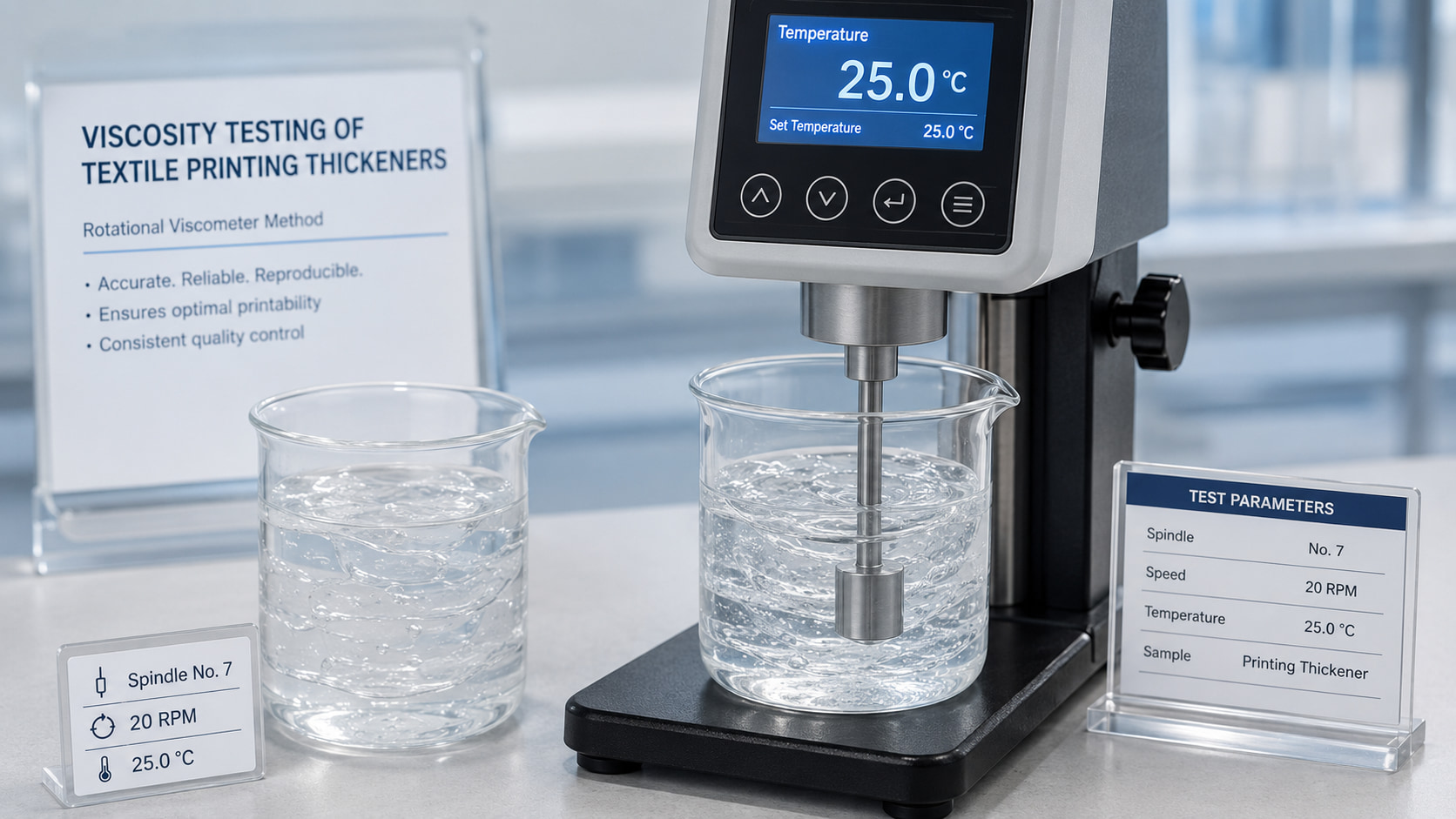
Тін басуға арналған қалыңдағыштың тұтқырлық мәндерін концентрациясы, температурасы, аспабы, шпинделі, жылдамдығы, дайындау әдісі және сынау уақыты сәйкес келмейінше салыстыруға болмайтынын біліңіз.
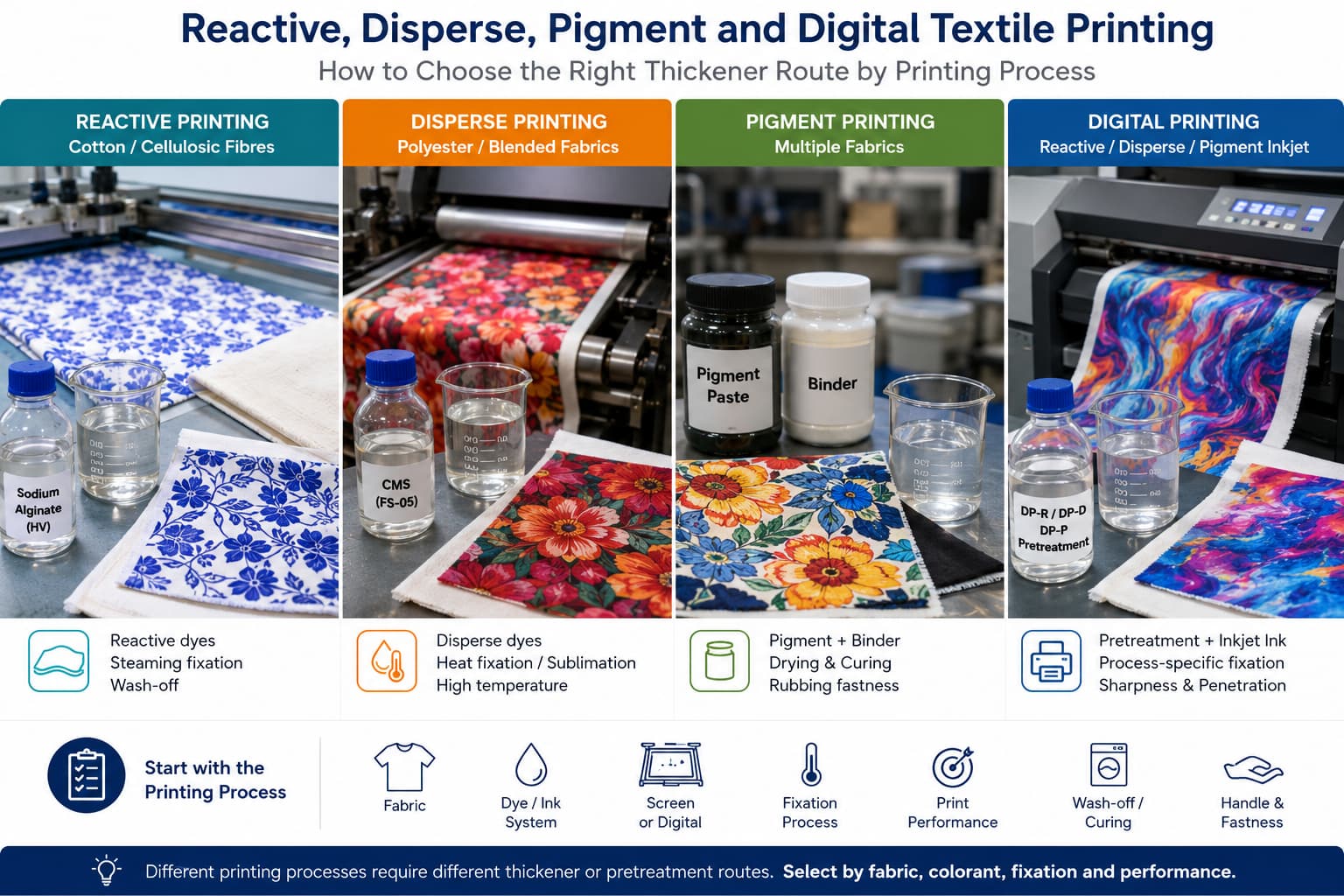
Мата, бояғыш немесе сияға негізделген реактивті, дисперсті, пигменттік және цифрлық тоқыма басып шығару үшін қалыңдағышты және алдын ала өңдеу әдістерін бекіту, жууға төзімділік және басып шығару сапасына қойылатын талаптарға сәйкес қалай таңдау керектігін үйреніңіз.
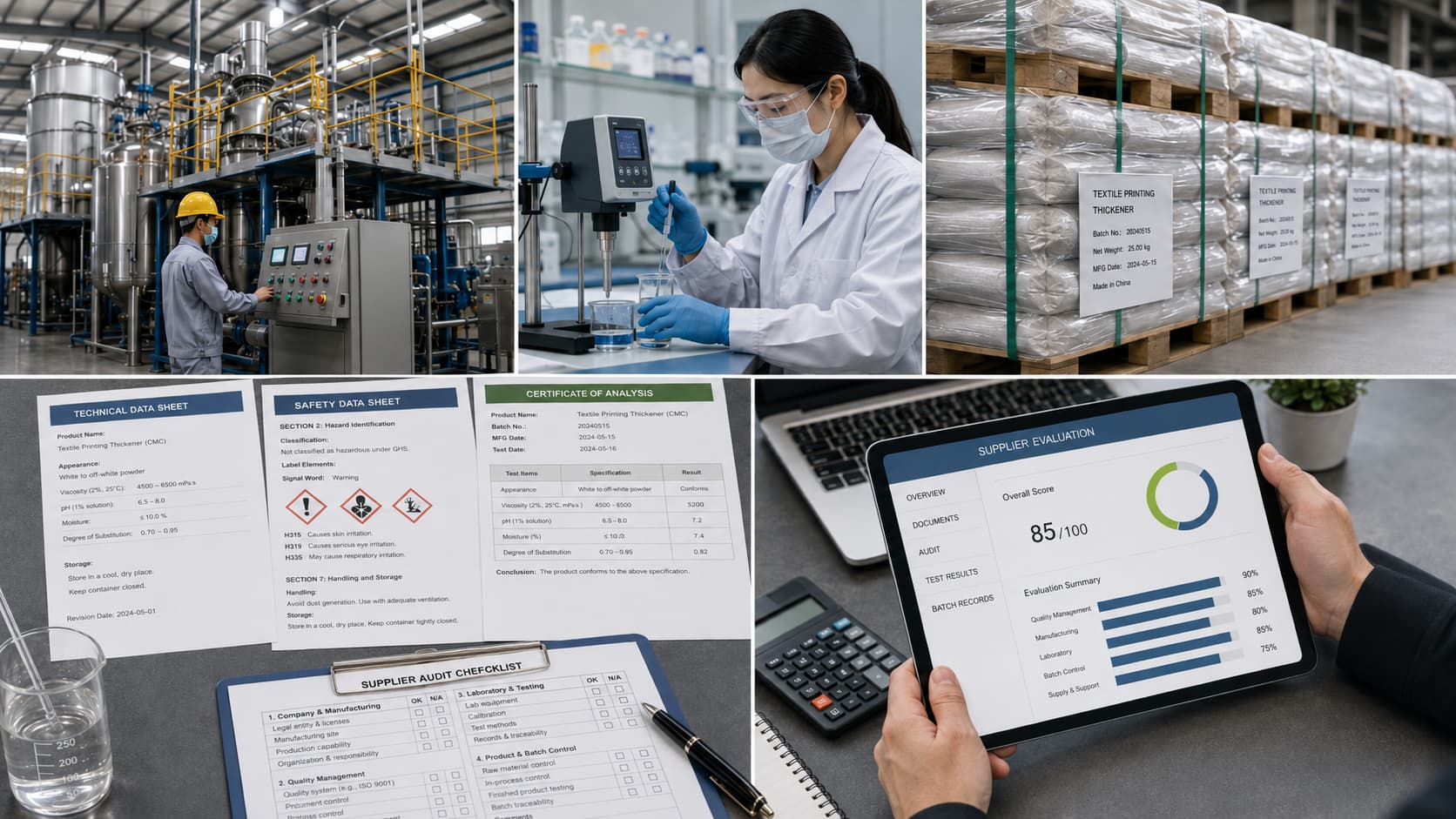
Тінткі басуға арналған қалыңдағыш өндірушіні бағалау әдісін үйреніңіз: компанияның беделін тексеру, өндірістік мүмкіндіктерін бағалау, сынау әдістерін зерттеу, партияларды қадағалау мүмкіндігі, техникалық құжаттама, үлгілерге қолдау көрсету және экспорттық жеткізу.
CMC негізіндегі басып шығару пастасы пигменттік, реактивті және цифрлық тоқыма басып шығаруда қолданылады. Бұл нұсқаулық қандай параметрлер маңызды екенін, жеткізушілерді қалай салыстыру керектігін және ірі көлемдегі тапсырыс бергенге дейін нені сұрау керектігін түсіндіреді.
Натрий альгинаты мен CMC екеуі де тоқыма басуда қоюлағыш ретінде қолданылады, бірақ олар әртүрлі бояғыш жүйелері мен өңдеу шарттарына сәйкес келеді. Бұл нұсқаулық негізгі айырмашылықтарды және оларды қашан қолдану керектігін түсіндіреді.
Understanding sodium alginate raw material source and manufacturing process helps procurement teams ask better questions and evaluate suppliers more effectively. This guide covers seaweed species, extraction steps, impurity origins, and what consistent manufacturing looks like in supplier documentation.
Incorrect storage is one of the most common causes of sodium alginate performance problems in textile printing. This guide covers powder and paste storage conditions, shelf life expectations, degradation indicators, and what to check when receiving a new shipment.
Technical datasheets vary in format and completeness between suppliers, and not every field matters equally for every application. This guide walks through a typical sodium alginate TDS section by section, explaining what each parameter means and how to spot gaps or red flags.
Many suppliers market "customized sodium alginate," but the term covers very different things in practice. This guide explains which parameters are genuinely adjustable, which are fixed by fundamental chemistry, and how to evaluate a supplier's customization claims.
When a print defect appears on the floor, the challenge is narrowing down the cause quickly. This reference guide organizes common sodium alginate paste-related defects by symptom, with likely causes ranked by probability and practical first checks for each.
Wholesale sodium alginate purchasing requires more than comparing unit price. This guide explains how textile printing buyers can confirm viscosity, mesh size, purity grade, packaging, COA, sample testing, and batch consistency before placing bulk orders.
Sodium alginate prices vary significantly between suppliers and grades, but not all price differences reflect genuine quality differences. This guide explains what drives cost, how to structure a like-for-like quote comparison, and what red flags to watch for when evaluating supplier proposals.
Өнімнің атауын, қолдану саласын, мөлшерін, жеткізу орнын және сізде бар кез келген TDS, үлгі фотосуреті немесе құжатты жіберіңіз. FSX Chemical бұл ақпаратты қарап шығып, баға ұсынысын алу, үлгі сәйкестендіру немесе өнімді таңдау бойынша келесі қадамды ұсынады.
Өнім туралы ақпаратӨнімнің атауы, сорты, моделі, жапсырмадағы фотосурет немесе жеткізушінің сілтемесі.
Қолжетімді құжаттарTDS, SDS, COA, үлгі фотосуреті, өнім тізімі немесе сынақ деректері.
Тапсырыс мәліметтеріЕсептелген мөлшер, қаптама, тағайындалған ел, порт немесе сауда шарты.
Өтінім немесе мәселеТекстиль басу процесі, формулалау қажеттілігі, ағымдағы мәселе немесе мақсатты көрсеткіштер.