Synthetic Thickener Batch-to-Batch Consistency: Which QC Parameters Best Predict Printing Performance?
Basic COA parameters confirm manufacturing consistency, but activation response, complete-paste viscosity retention, rheology, compatibility and...
Batch-to-batch consistency in synthetic textile printing thickener cannot be judged from one COA value. Appearance, solids, as-supplied pH and product viscosity are useful release parameters because they monitor agreed supply-form parameters, but they do not fully predict how an acrylic thickener will activate, respond to electrolytes, interact with pigment and binder, shear through a screen, recover after transfer or remain stable during holding. A practical QC program therefore uses three levels: basic identity and supply-form checks for every batch, functional rheology and compatibility tests that directly challenge the approved grade, and periodic application printing against a retained reference batch. The parameters that best predict printing performance are those measured under controlled conditions closest to the real pigment paste—not the properties of the unopened thickener alone.
Which QC Parameters Best Predict Printing Performance?
Tests that reproduce a known production failure mode are useful candidates for a QC program. Their predictive value must be established against actual results for the approved grade and process.
A practical hierarchy is:
Basic Supply-Form QC
→ appearance, solids, as-supplied pH, product viscosity, density
For a liquid acrylic thickener, compare with the approved reference for:
Color
Homogeneity
Ayrılık
Skin
Jel parçacıkları
Foreign material
Appearance can flag signs consistent with:
Storage damage
Freeze / heat damage
Contamination
Ayrılık
But a normal-looking batch can still have poor activation or compatibility.
Use appearance as a release screen, not as a print-performance predictor by itself.
2. Solids Content: One of the Most Important Basic Batch Controls
A specified nonvolatile-solids test measures the residue left under its defined drying conditions. That residue can include polymer and other nonvolatile formulation components; it is not automatically the active thickening polymer content.
If product dosage is fixed:
Nonvolatile Material Added (kg) = Product Added (kg) × Measured Nonvolatile Mass Fraction
Investigate whether the observed nonvolatile change is associated with differences in:
Thickening efficiency
Required dosage
Deposited nonvolatile material, and polymer deposit only where its composition is known
Toplam Kullanım Maliyeti
For example, Dow lists solids and pH as typical properties for one commercial HASE modifier and says those values are not intended as specifications. This illustrates a document distinction; it is not an FSX grade specification or proof of textile-printing suitability.
For incoming QC, solids is one of the strongest basic manufacturing-consistency parameters.
But it still does not describe polymer architecture or complete-paste compatibility.
3. As-Supplied pH: Manufacturing and Storage Indicator
Many alkali-swellable acrylic thickeners are supplied in acidic form.
As-supplied pH can help identify:
Parti tutarlılığı
Unexpected neutralization
Contamination
Storage changes
However, as-supplied pH is not the same as application pH.
The more predictive question is:
How does the batch build viscosity after controlled activation?
Do not reject or approve a batch only from as-supplied pH unless that value is part of the validated commercial specification.
4. As-Supplied Viscosity: Handling QC, Not Printing Viscosity
Many acrylic HASE products are intentionally supplied as low-viscosity emulsions for easy pumping and dosing.
Therefore, as-supplied viscosity mainly confirms:
Product consistency
Handling behavior
Absence of abnormal thickening / gel
It does not directly predict the viscosity the product will develop after:
Neutralization
Pigment addition
Binder addition
For print prediction, activated and complete-paste tests are much more useful.
5. Density / Specific Gravity: Useful Supporting Control
Density or specific gravity can help confirm:
Ürün kimliği
Parti tutarlılığı
Unexpected dilution
It is most useful when combined with:
Solids
Görünüm
pH
Density alone has low direct predictive value for screen-printing performance.
Use it as a supporting supply-form QC parameter.
6. Activation Response: A Stronger Predictor of Thickening Performance
Activation response is one of the most useful functional QC tests for ASE/HASE grades.
A simple controlled test can use:
Reference water
Fixed thickener dosage
Defined neutralizer
Defined final pH
Fixed mixing method
Fixed equilibration time
Fixed measurement temperature
Measure:
Nihai viskozite
Görünüm
Time to viscosity development
This test directly challenges the property that makes the thickener commercially useful.
It is generally much more predictive than as-supplied viscosity.
7. pH–Viscosity Response Curve
Acrylic thickener performance depends strongly on activation conditions.
A pH–viscosity curve can reveal whether two batches have similar:
Activation onset
Viscosity development
Useful operating plateau
For periodic verification or supplier qualification, prepare several controlled pH points rather than one endpoint only.
Plot:
pH → Activated Viscosity
Do not create one universal target curve for all synthetic thickeners.
Compare each commercial grade with its approved reference.
8. Thickening Efficiency at Fixed Dosage
One simple functional comparison is:
Defined Product-Mass Basis, or Independently Declared Active-Polymer Basis → Controlled Activation Conditions → Compare Viscosity
This can reveal meaningful differences in thickening efficiency.
But the test must control solids.
Equal product weight can deliver different nonvolatile residue when the measured solids differ. To compare active-polymer efficiency, obtain an independently defined active-polymer fraction; do not derive it from total nonvolatiles alone.
For deeper technical comparison, normalize by:
Product dosage
Independently declared active-polymer content, with its definition
as appropriate to the purpose.
9. Dosage–Viscosity Curve
One dosage point may hide important differences.
A dosage curve compares several thickener levels under one controlled activation method.
Plot:
Thickener Dosage → Activated Viscosity
This reveals:
Thickening efficiency
Curve shape
Sensitivity to dosage variation
Useful working region
For supplier qualification, this is often more informative than one high-viscosity point.
10. Electrolyte Tolerance
Electrolyte tolerance is one of the most important functional predictors for pigment-printing thickener.
Electrolyte tolerance usually predicts real pigment-paste stability better than water viscosity alone.
11. Binder Compatibility
Binder compatibility is highly predictive because binder is a major formulation component.
Binder addition can change:
Viskozite
pH
Electrolyte load
Surfactant balance
Associative HASE structure
A practical QC challenge can compare:
Activated thickener base
Base + equivalent water
Base + approved reference binder
Measure:
Viscosity retention
pH
Gel / floc
Holding behavior
A standardized binder challenge is one of the most useful periodic functional tests for pigment-printing grades.
12. Pigment Compatibility
Commercial pigment dispersions add:
Pigment particles
Su
Dispersants
Surfactants
Electrolytes
A standardized reference pigment can therefore be used as another controlled challenge.
For incoming or periodic QC, use the same:
Pigment product
Pigment dosage
Binder
Su
Mixing sequence
so thickener-batch differences are not confused with pigment-lot differences.
13. Complete-Paste Viscosity Retention
Complete-paste viscosity is one of the most useful bridges between QC and production.
Prepare a standardized reference formula:
Water + Thickener + Pigment + Binder + Approved Auxiliaries
and record:
Initial viscosity
pH
Viscosity after holding
Görünüm
Köpük
This test integrates:
Aktivasyon
Elektrolit tepkisi
Bağlayıcı uyumluluğu
Pigment compatibility
into one practical application-QC challenge.
If only one functional incoming test can be added beyond basic COA checks, a standardized complete reference paste can provide high practical value.
14. Multi-Speed Rheology / Shear-Thinning Profile
One Brookfield reading cannot fully describe printing rheology.
Research on polyacrylate printing thickeners evaluates multiple rheological behaviors because printing requires:
Structure at Rest → Flow Under Shear → Recovery After Shear
A practical mill test can compare apparent viscosity at defined instrument speeds; this is a method-specific profile, not a complete flow curve or an elasticity measurement. Compare viscosity at:
Low speed
Medium speed
Higher speed
under one standardized instrument method.
This does not replace a rheometer, but it can detect meaningful batch shifts in shear-thinning behavior.
Multi-speed consistency is often more predictive of screen behavior than a single viscosity point.
15. Structural Recovery / Thixotropy
After high shear, printing paste should rebuild enough structure to:
Hold pattern edges
Limit penetration
Maintain deposit
Recovery and elasticity are distinct properties. Compare post-shear recovery and screen release separately; visible stringing does not measure an elastic modulus.
A controlled recovery test can record:
Initial viscosity
Post-shear viscosity
Short-rest viscosity
Longer-rest viscosity
Use recovery as an internal comparison against the approved reference batch.
Do not set one universal recovery percentage for all grades.
16. Stringing / Filament-Dragging Tendency
A nylon-carpet digital-printing thickener study considered filament dragging separately from other rheological tests. Its application differs from pigment screen printing, so it supports asking a separate test question rather than transferring a grade or acceptance limit.
This is important because two batches can show similar shear viscosity but different:
Elasticity
Filament length
Screen release
If the application is sensitive to stringing, use a standardized internal lift / filament test or representative screen-release test.
Stringing should not replace the viscosity test.
It adds information that viscosity does not capture.
17. Holding-Time Stability
A batch can pass immediately after preparation and drift later.
Holding stability should evaluate:
Viskozite
pH
Görünüm
Köpük
Ayrılık
Gel / floc
at production-relevant times.
This parameter is especially useful when customers report:
Morning-to-afternoon viscosity change
End-run thinning
Delayed gel
Holding stability is therefore a stronger predictor than fresh viscosity for long color-kitchen or machine residence times.
18. Filtration, Gel and Floc Check
Viscosity can pass while screenability fails because of small gel or floc particles.
A standardized filtration check can record:
Sample mass
Filter / mesh
Filtration time
Residue amount
Residue appearance
This is useful for detecting:
Poor activation
Binder incompatibility
Cationic interaction
Storage damage
For screen-printing grades, residue control can be more predictive of blockage risk than viscosity alone.
19. Foam / Air-Entrainment Behavior
Foam is usually a system property rather than a thickener-only property.
But batch changes in:
Surfactant balance
Associative rheology
Viskozite
can change foam retention.
During reference-paste QC, record:
Foam generated under fixed mixing
Foam decay
Paste density if useful
Do not use foam as a primary release parameter unless it is a known production risk for the approved grade.
20. Application Printing: The Highest-Level Verification
Application printing tests the combined result of all previous QC parameters.
Değerlendirin:
Ekran bölümü
Screen release
İnce çizgilerin belirginliği
Katı alan homojenliği
Penetrasyon
Color / opacity
Beginning-to-end consistency
Dry / wet rubbing
Kumaş el
This is the strongest evidence of printing equivalence.
But a full application trial is slower and more expensive.
Therefore, it is most useful for:
Initial approval
Periodic verification
Değişiklik kontrolü
Complaint investigation
rather than as the only incoming test for every batch.
Which Parameters Are Most Predictive?
Parametre
Indicative Value for Supply-Form QC
Indicative Value for Application Screening
Görünüm
Yüksek
Low
Solids
Yüksek
Low–Medium
As-supplied pH
Medium–High
Low
As-supplied viscosity
Medium–High
Low
Controlled activation viscosity
Yüksek
Medium–High
Dosage–viscosity curve
Yüksek
Medium–High
Elektrolit toleransı
Orta
Yüksek
Bağlayıcı uyumluluğu
Orta
Yüksek
Complete-paste retention
Yüksek
Yüksek
Multi-speed rheology
Yüksek
Yüksek
Recovery / stringing
Medium–High
High for sensitive processes
Application print trial
Yüksek
Highest practical verification
This table is a qualitative shortlist for test selection, not a validated prediction model or universal scoring standard. Check which results actually track printing failures in the mill before using them as release gates.
The most predictive test depends on the known failure mode of the mill.
Örneğin:
If viscosity collapses after binder, binder compatibility deserves more weight.
If rotary screen running drifts, multi-speed rheology and holding stability deserve more weight.
If screen release is the problem, elasticity / stringing deserves more weight.
What Should Be Tested on Every Incoming Batch?
A practical every-batch incoming program can include:
Supplier batch / COA identity
Görünüm
Solids content
As-supplied pH
As-supplied viscosity where specified
One controlled activation or reference-paste test
The exact list depends on the commercial agreement and process risk.
For a critical thickener with a history of formulation sensitivity, adding one standardized reference-paste viscosity check can provide much more protection than relying only on the supplier COA.
What Should Be Tested Periodically?
Periodic application verification can include:
pH–viscosity curve
Dosage–viscosity curve
Elektrolit toleransı
Bağlayıcı uyumluluğu
Multi-speed rheology
Recovery / stringing
Bekleme kararlılığı
Filtreleme
Screen printing
Periodic frequency should be based on:
Supplier history
Production criticality
Batch volume
Complaint history
Change notifications
Do not invent one universal testing frequency for every textile mill.
What Should Trigger Full Requalification?
Full or expanded requalification should be considered after meaningful changes such as:
Supplier change
Grade change
Major raw-material or manufacturing-process change reported by the supplier
Persistent batch drift
New binder / pigment / fixer system
New high-pigment / white-paste application
Repeated production complaint
The requalification should reproduce the relevant application conditions rather than repeat only basic COA tests.
Use an Approved “Golden Batch” or Retained Reference
One of the most useful QC tools is a retained sample from a proven commercial batch.
Use it as the reference in:
Activation test
Salt challenge
Binder challenge
Complete-paste test
Rheology comparison
A side-by-side comparison reduces the effect of:
Seasonal laboratory temperature
Instrument differences
Minor method drift
Replace or manage retained references according to a documented retention policy so aged reference material is not mistaken for fresh commercial behavior.
Normalize the Test Before Comparing Batches
For any functional QC method, standardize:
Su kaynağı
Thickener dosage
Independently verified active-polymer basis where relevant
Neutralizer
Final pH
Mixing sequence
Karıştırma süresi
Equilibration time
Sıcaklık
Instrument / spindle / speed
Okuma süresi
If the method changes, the result cannot be interpreted as a batch difference confidently.
QC method repeatability is part of product QC.
Use a Paired-Lot QC Record Before Holding or Releasing a Batch
Use the following as a proposed incoming-QC investigation, adapted to the mill’s validated method. It is not an FSX batch record or a universal acceptance standard. A failed reading needs a valid reference comparison before it can be attributed to the incoming thickener.
Identify both materials. Record incoming and approved-reference lot numbers, opening dates, storage history and the reference’s permitted retention period. An aged reference is not automatically a valid control.
Prepare paired pastes. Make independent preparations from each lot using the same qualified water, binder, pigment, auxiliaries, product-mass basis, addition order and final batch mass. Re-reading one cup checks measurement repeatability; it does not check preparation repeatability.
Record the method with the result. Include activation conditions where applicable, pH, preparation and holding times, temperature, instrument, container, spindle, speed, read time, torque and any foam or residue. Select the instrument’s valid measuring range rather than averaging out-of-range readings.
Use pre-agreed gates. Apply the validated incoming-QC and application limits. Preserve the original result before investigating or adjusting a formula; a correction trial is a separate record.
Paired result
Working interpretation
Next action
Reference remains in its validated window; incoming lot repeatedly differs
A lot-specific difference is plausible, but the failed parameter does not identify its chemical cause
Hold the disputed lot for investigation; confirm preparation repeatability and the relevant compatibility or printing challenge
Both reference and incoming paste shift similarly
Method, reagent, temperature or reference-age effects remain possible
Check the common controls before attributing the shift to the incoming product
Independent preparations disagree within either lot
Preparation or sampling variability may exceed the proposed acceptance window
Resolve the method variation before making a lot-release decision
Both pass fresh-paste tests but the incoming lot drifts during holding or printing
The fresh-paste screen misses a production-relevant failure mode
Add the agreed holding or application challenge; do not widen limits simply to pass the lot
Keep the mass definitions separate. As a hypothetical calculation, 2.0 kg of product with 25% measured nonvolatiles adds 0.50 kg of nonvolatile material. It does not establish 0.50 kg of active thickening polymer. If active content is unavailable, report product dose and nonvolatile contribution separately and judge performance from the controlled complete-paste comparison.
Compare the suspect and approved reference side by side under the same:
Su
Dozaj
Activation pH
Binder
Pigment
Electrolyte challenge
Viskozite yöntemi
Şimdi karşılaştırın:
Supply-form QC
Activation curve
Complete-paste rheology
Bekleme kararlılığı
Application print
This separates:
Actual Thickener Batch Difference
kaynak:
Water / Formula / Machine / Method Difference.
Common QC Mistakes
1. Approving from COA Values Alone
Basic physical properties confirm batch identity better than full printing performance.
2. Using Water Viscosity as the Main Performance Specification
Binder, pigment, electrolytes and shear can change the final paste strongly.
3. Comparing Product Dosage Without Checking Solids
Equal product weight can deliver different nonvolatile residue. Active-polymer mass requires a separate, defined content basis, while application efficiency still needs a complete-paste test.
4. Measuring One Brookfield Point Only
Shear thinning, recovery and elasticity can change while one viscosity value remains similar.
5. Repeating Full Printing Trials but Skipping Fast Functional QC
A reference-paste test can provide faster lot-to-lot control.
6. Changing the QC Method Between Batches
Temperature, pH, spindle, speed and mixing differences can look like batch variation.
7. Using an Old Retained Sample Without Aging Control
The reference itself can change during storage.
8. Setting Limits Without Method Repeatability Data
An unrealistically tight specification creates false failures without improving production control.
A validated batch-consistency QC program can help identify and control costs associated with:
Production corrections
Extra thickener dosage
Ekran temizliği
Makine duruş süresi
Off-shade fabric
Yeniden işleme
Supplier disputes
A useful model is:
Cost in Use (currency/accepted m²) = [Material cost + QC and processing cost + Separately identified loss cost] ÷ Accepted fabric area (m²).
Use one currency and the same production boundary for the approved and incoming lots. Price each material as actual consumption × its unit price, including any documented formula correction. Allocate incoming-QC labor, consumables and equipment charges to the fabric area covered by that release decision; do not charge the full lot test repeatedly to every print run. Convert production, cleaning and rework time with stated labor or machine rates.
Keep machine efficiency, dosage and pass rate as separate measured indicators until their cost consequences are priced. Count a correction or rework material and its operating time once. If a machine rate already includes labor, energy or overhead, do not add those charges again; avoid adding a full rejected-fabric value that repeats costs already included. Divide by the final area meeting the same shade, fastness and hand criteria, and report unrecoverable losses or credits on an explicit basis.
The cheapest QC program is not the program with the fewest tests.
It is the program that uses inexpensive predictive tests to prevent expensive machine failures.
A standardized reference-paste challenge can therefore have high value even if the supplier already provides a COA.
What Information Should You Send to a Supplier?
For useful batch-consistency troubleshooting, provide:
Current synthetic thickener grade
Supplier batch numbers
COAs for approved and suspect batches
Appearance / solids / pH data
Activation test method
Activated viscosity results
Complete reference-paste formula
Binder / pigment / fixer identities
Electrolyte or hard-water data if relevant
Holding-time results
Screen-printing difference observed
Photos / production records where useful
FSX Chemical bu bilgileri şu yollarla kullanabilir: Numune ve Ürün Eşleştirme to structure an approved-vs.-suspect batch comparison.
Basic supply-form QC is necessary for manufacturing consistency but has limited ability to predict full printing performance.
A defined nonvolatile-solids method is a useful batch control; active-polymer delivery cannot be calculated from that result unless the equivalence has been established for the formulation.
Controlled activation and complete reference-paste tests are stronger functional predictors than as-supplied viscosity.
Electrolyte tolerance, binder compatibility, multi-speed rheology, recovery and holding stability help explain why two apparently similar batches can print differently.
A retained approved reference and stable test method are essential for meaningful lot-to-lot comparisons.
The best QC program combines fast incoming tests with periodic application verification and uses production data to define acceptance windows.
Sık Sorulan Sorular
1. Which QC parameter is most important for synthetic thickener batch consistency?
No single parameter is sufficient. Solids is one of the most important basic manufacturing controls, while a standardized activation or complete reference-paste test is more predictive of actual thickening performance.
2. Is as-supplied viscosity a good predictor of printing viscosity?
Usually not by itself. Many HASE products are supplied as low-viscosity acidic emulsions and only develop their working viscosity after neutralization and formulation.
3. Why should solids content be checked?
A defined solids test helps detect changes in nonvolatile residue. It does not identify active polymer by itself; compare the measured change with controlled activation, reference-paste response and cost at the validated working dosage.
4. Should every incoming batch be screen-printed before release?
Not necessarily. A practical program can use basic QC plus a standardized activation/reference-paste test for routine incoming control, with full application printing for qualification, periodic verification, change control or complaints.
5. Why can two batches have the same Brookfield viscosity but print differently?
They can differ in shear thinning, recovery, elasticity, electrolyte tolerance or binder compatibility—properties that one viscosity point does not capture.
6. What is the value of an electrolyte-tolerance test?
It shows whether the batch retains useful viscosity after ionic stress, which is closer to the real pigment/binder/fixer environment than clean-water viscosity alone.
7. What is a good functional incoming test?
A standardized reference paste using fixed water, dosage, activation pH, pigment, binder, mixing, holding and viscosity method can provide strong lot-to-lot comparison value.
8. Should incoming QC compare product weight or active solids?
Use the agreed product-mass method for routine incoming QC. Active-polymer normalization is an additional comparison only when that fraction and its analytical or documentary basis are known. Total nonvolatiles alone do not establish it.
9. Why use a retained reference batch?
It allows the new batch and a proven batch to be tested side by side under the same laboratory conditions, reducing the influence of method and seasonal variation.
10. How should QC limits be set?
Use approved batch data, method repeatability and successful production performance. Do not use arbitrary universal limits that are unrelated to the mill’s actual print window.
11. What should trigger a full requalification?
Supplier or grade change, meaningful manufacturing changes, repeated drift, a new critical formulation or a persistent production complaint can justify expanded testing.
12. What should I send FSX Chemical for a batch-consistency comparison?
Send approved and suspect batch COAs, solids/pH/viscosity data, your activation method, reference-paste formula, binder/pigment/fixer details, holding results and the exact printing difference observed.
Build Synthetic Thickener QC Around Printing Performance, Not COA Numbers Alone
If two acrylic thickener batches have similar supplier COAs but behave differently in pigment paste or on the printing machine, FSX Chemical can help structure an approved-vs.-suspect batch comparison using controlled activation, compatibility and application tests.
For a useful technical review, send:
Approved and suspect thickener batch numbers / COAs
Appearance, solids and as-supplied pH data
Your activation and viscosity test method
Mevcut kıvam arttırıcı dozu
Reference pigment / binder / fixer system
Electrolyte or process-water data if relevant
Holding-time results
Screen-printing observations
Photos, retained samples or production records if available
The QC parameters that best predict printing performance are the parameters that challenge the thickener under controlled conditions closest to the real printing paste. Basic COA values confirm batch identity; functional rheology, compatibility and reference-paste tests determine whether the batch is still commercially equivalent.
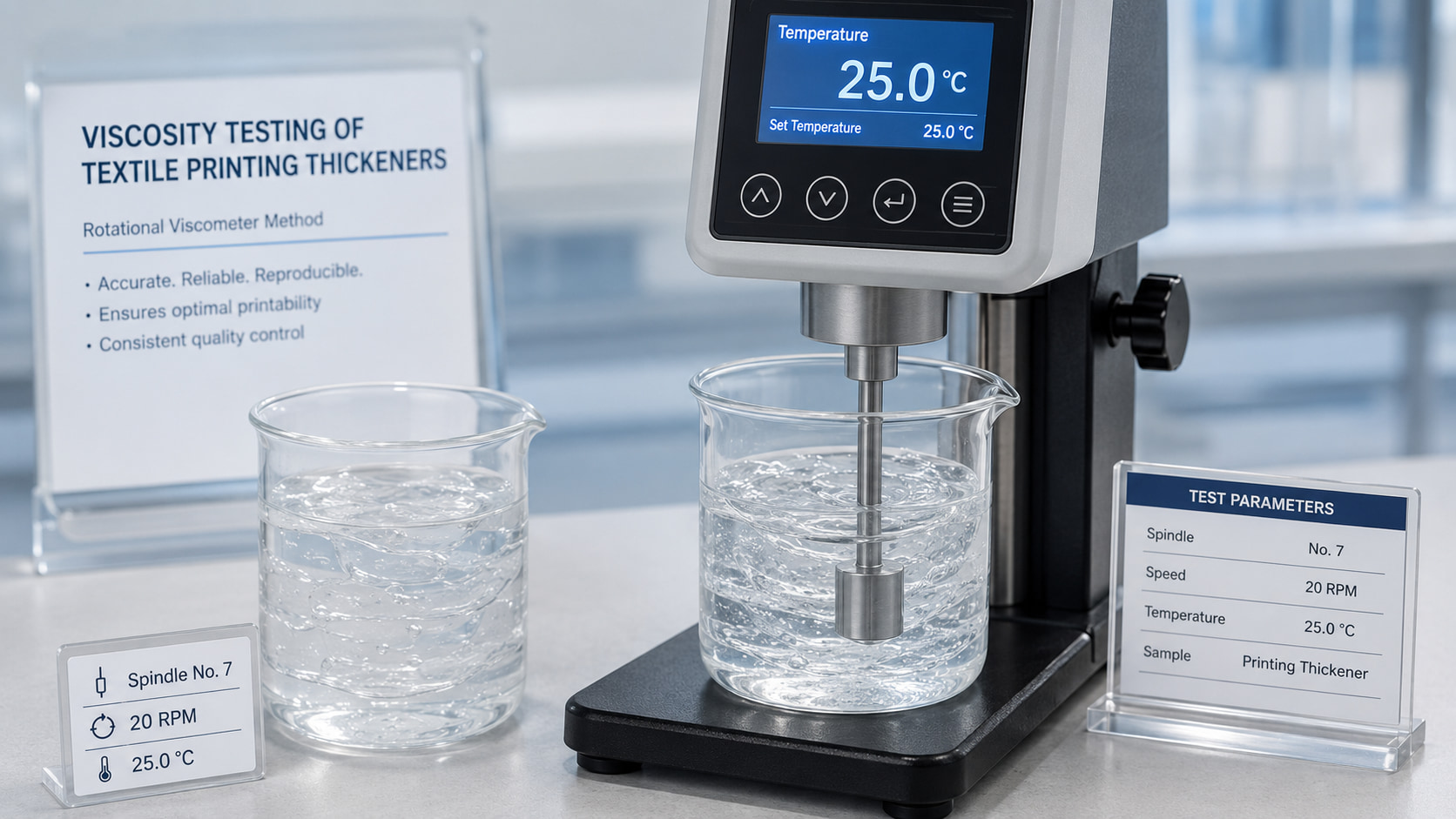
Konsantrasyon, sıcaklık, ölçüm cihazı, mil, hız, hazırlık yöntemi ve test süresi gibi faktörler eşleştirilmeden tekstil baskı kıvamlaştırıcılarının viskozite değerlerinin neden karşılaştırılamayacağını öğrenin.
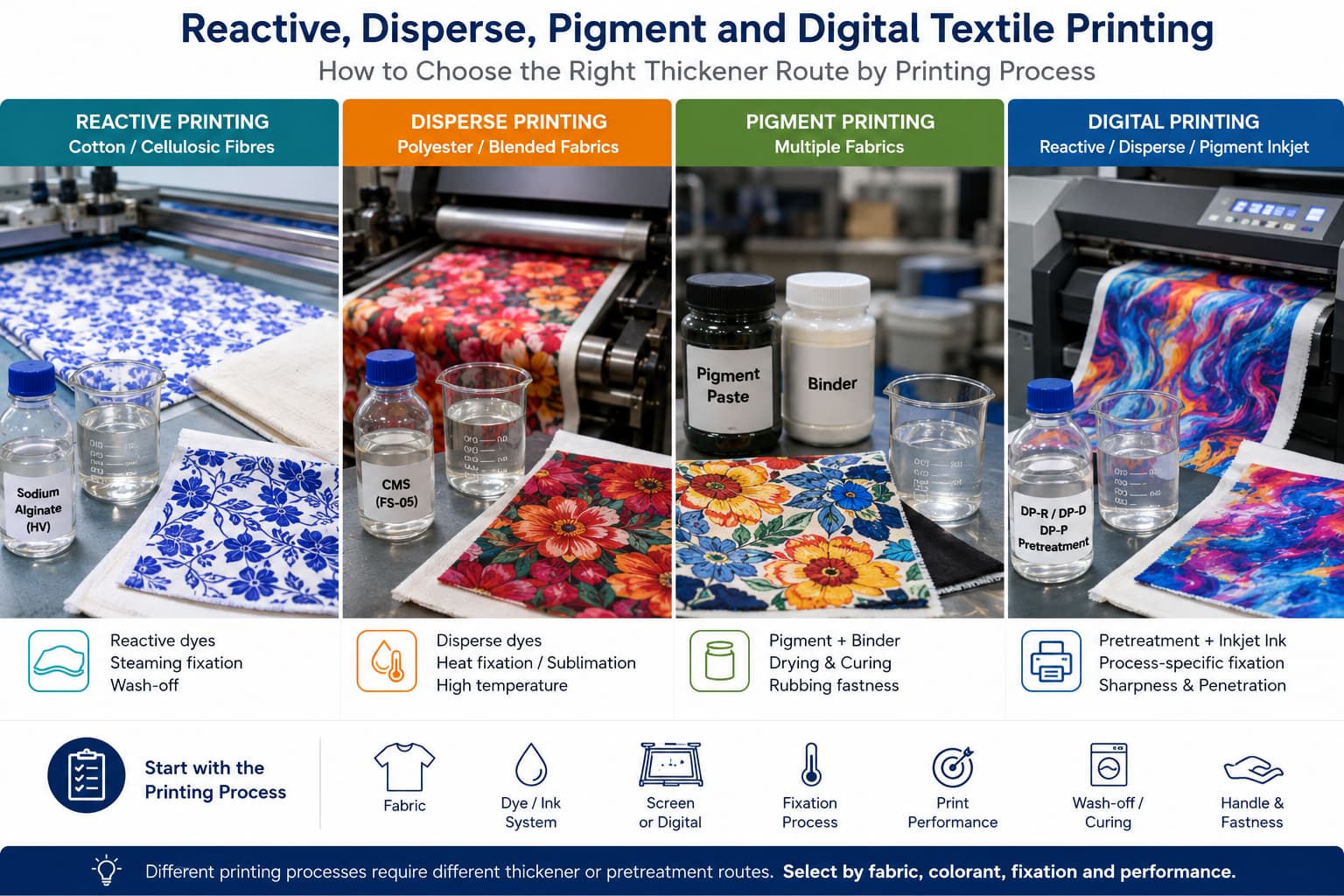
Kumaş, boya veya mürekkep, fiksaj, yıkamayla uzaklaştırılabilirlik ve baskı kalitesi gereksinimlerine göre reaktif, dispers, pigment ve dijital tekstil baskısı için kıvamlaştırıcı ve ön işlem seçeneklerini nasıl seçeceğinizi öğrenin.
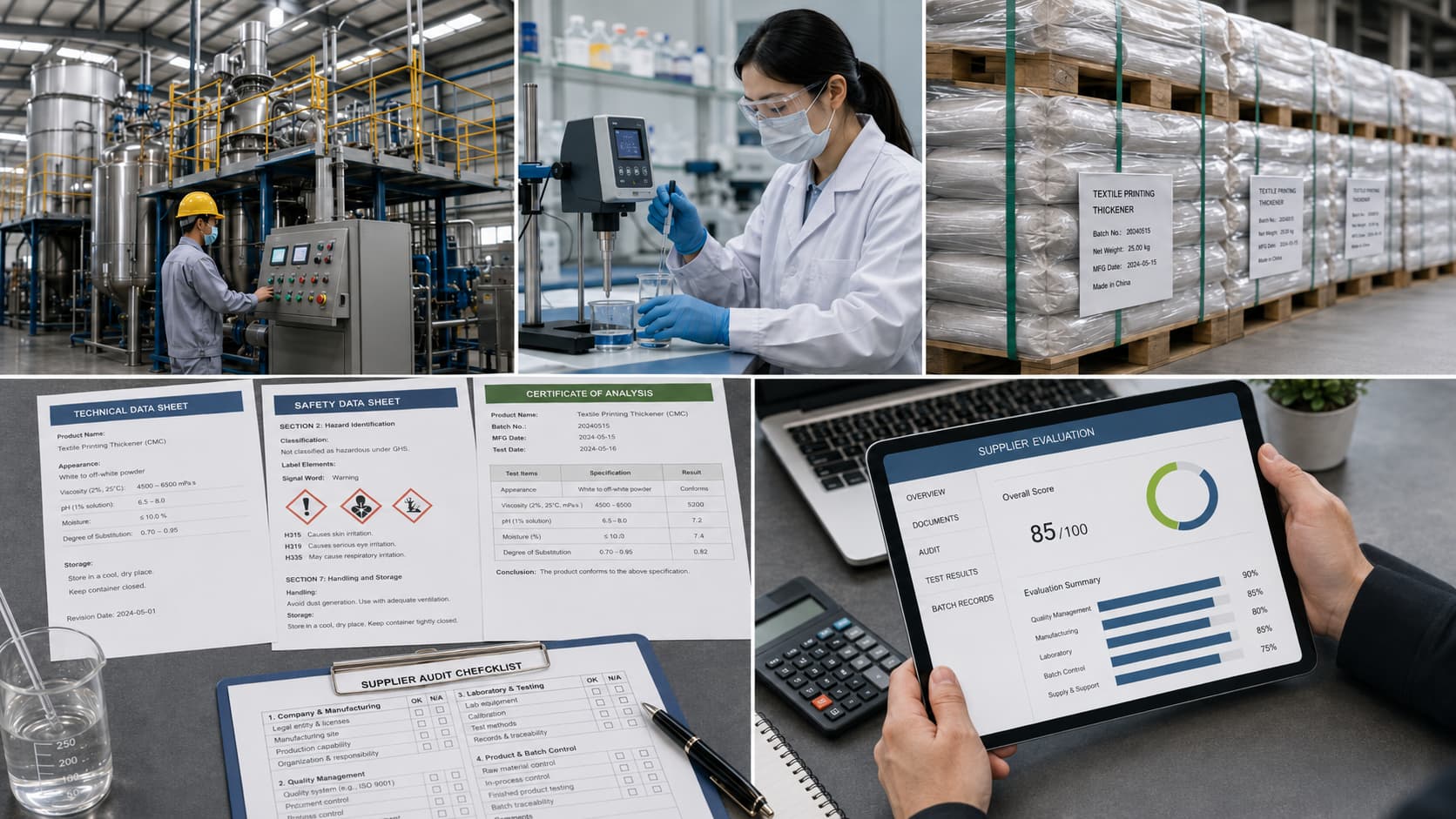
Şirket kimliği, üretim kapasitesi, test yöntemleri, parti izlenebilirliği, teknik belgeler, numune desteği ve ihracat tedarikini inceleyerek bir tekstil baskı kıvamlaştırıcı üreticisini nasıl değerlendireceğinizi öğrenin.
CMC bazlı baskı patı, pigmentli, reaktif ve dijital tekstil baskı alanlarında kullanılmaktadır. Bu kılavuzda, hangi parametrelerin önemli olduğu, tedarikçilerin nasıl karşılaştırılacağı ve toplu sipariş vermeden önce nelerin talep edilmesi gerektiği açıklanmaktadır.
Sodyum aljinat ve CMC, tekstil baskısında kıvamlaştırıcı olarak kullanılır; ancak farklı boyarmadde sistemlerine ve proses koşullarına uygundur. Bu kılavuz, temel farkları ve her birinin ne zaman kullanılacağını açıklar.
Sodyum aljinat hammaddesinin kaynağını ve üretim sürecini anlamak, tedarik ekiplerinin daha isabetli sorular sormasına ve tedarikçileri daha etkili bir şekilde değerlendirmesine yardımcı olur. Bu kılavuzda deniz yosunu türleri, ekstraksiyon aşamaları, safsızlıkların kaynakları ve tedarikçi belgelerinde tutarlı bir üretim sürecinin nasıl yansıtılması gerektiği ele alınmaktadır.
Learn how to store sodium alginate powder and prepared paste, check shelf-life limits, and decide when a textile printing batch needs quarantine or retesting.
Teknik veri sayfaları, tedarikçiler arasında biçim ve kapsam açısından farklılık gösterir; ayrıca her alan, her uygulama için aynı derecede önemli değildir. Bu kılavuz, tipik bir sodyum aljinat teknik veri sayfasını bölüm bölüm inceleyerek, her bir parametrenin ne anlama geldiğini ve eksiklikleri veya uyarı işaretlerini nasıl tespit edebileceğinizi açıklamaktadır.
Define a sodium alginate customization request by the proposed material or packing change, agreed methods and evidence. Separate grade matching from a verified change, then qualify the sample, application and commercial lot before release.
Diagnose sodium alginate printing defects through controlled checks for bleeding, blockage, viscosity drift, low shade and wash-off. Treat causes as hypotheses, and verify them against the approved paste and process.
Toptan sodyum aljinat alımı, sadece birim fiyatı karşılaştırmaktan ibaret değildir. Bu kılavuz, tekstil baskı alıcılarının toplu sipariş vermeden önce viskozite, ağ gözü boyutu, saflık derecesi, ambalaj, COA, numune testi ve parti tutarlılığını nasıl doğrulayabileceklerini açıklamaktadır.
Sodyum aljinat fiyatları, tedarikçiler ve kalite sınıfları arasında önemli ölçüde farklılık gösterir; ancak bu fiyat farklılıklarının tamamı gerçek kalite farklılıklarını yansıtmaz. Bu kılavuzda, maliyeti etkileyen faktörler, eşdeğer tekliflerin nasıl karşılaştırılacağı ve tedarikçi tekliflerini değerlendirirken dikkat edilmesi gereken uyarı işaretleri açıklanmaktadır.
Ürün adını, uygulama alanını, miktarı, teslimat yerini ve elinizdeki TDS, numune fotoğrafı veya belgeleri paylaşın. FSX Chemical bu bilgileri inceleyerek fiyat teklifi, numune karşılaştırması veya ürün seçimi için bir sonraki adımı önerecektir.
Ürün BilgileriÜrün adı, sınıfı, modeli, etiket fotoğrafı veya tedarikçi referansı.
Mevcut BelgelerTDS, SDS, COA, numune fotoğrafı, ürün listesi veya test verileri.
Sipariş DetaylarıTahmini miktar, ambalaj, varış ülkesi, liman veya teslim şekli.
Uygulama veya SorunTekstil baskı süreci, formülasyon gereksinimi, mevcut sorun veya hedeflenen performans.