Độ ổn định giữa các mẻ của chất làm đặc tổng hợp: Các thông số kiểm soát chất lượng nào dự báo tốt nhất hiệu suất in ấn?
Basic COA parameters confirm manufacturing consistency, but activation response, complete-paste viscosity retention, rheology, compatibility and...
Batch-to-batch consistency in synthetic textile printing thickener cannot be judged from one COA value. Appearance, solids, as-supplied pH and product viscosity are useful release parameters because they confirm manufacturing consistency, but they do not fully predict how an acrylic thickener will activate, respond to electrolytes, interact with pigment and binder, shear through a screen, recover after transfer or remain stable during holding. A practical QC program therefore uses three levels: basic identity and supply-form checks for every batch, functional rheology and compatibility tests that directly challenge the approved grade, and periodic application printing against a retained reference batch. The parameters that best predict printing performance are those measured under controlled conditions closest to the real pigment paste—not the properties of the unopened thickener alone.
Which QC Parameters Best Predict Printing Performance?
The parameters closest to the real printing process usually have the strongest predictive value.
A practical hierarchy is:
Basic Supply-Form QC
→ appearance, solids, as-supplied pH, product viscosity, density
Electrolyte tolerance usually predicts real pigment-paste stability better than water viscosity alone.
11. Binder Compatibility
Binder compatibility is highly predictive because binder is a major formulation component.
Binder addition can change:
Độ nhớt
pH
Lượng chất điện giải
Cân bằng chất hoạt động bề mặt
Associative HASE structure
A practical QC challenge can compare:
Activated thickener base
Base + equivalent water
Base + approved reference binder
Đơn vị đo lường:
Khả năng duy trì độ nhớt
pH
Gel / floc
Hành vi giữ
A standardized binder challenge is one of the most useful periodic functional tests for pigment-printing grades.
12. Pigment Compatibility
Commercial pigment dispersions add:
Pigment particles
Nước
Chất phân tán
Chất hoạt động bề mặt
Chất điện giải
A standardized reference pigment can therefore be used as another controlled challenge.
For incoming or periodic QC, use the same:
Pigment product
Pigment dosage
Binder
Nước
Trình tự trộn
so thickener-batch differences are not confused with pigment-lot differences.
13. Complete-Paste Viscosity Retention
Complete-paste viscosity is one of the most useful bridges between QC and production.
Prepare a standardized reference formula:
Water + Thickener + Pigment + Binder + Approved Auxiliaries
and record:
Initial viscosity
pH
Độ nhớt sau khi ủ
Hình thức
Bọt
This test integrates:
Kích hoạt
Phản ứng điện giải
Khả năng tương thích của chất kết dính
Pigment compatibility
into one practical application-QC challenge.
If only one functional incoming test can be added beyond basic COA checks, a standardized complete reference paste can provide high practical value.
14. Multi-Speed Rheology / Shear-Thinning Profile
One Brookfield reading cannot fully describe printing rheology.
Research on polyacrylate printing thickeners evaluates multiple rheological behaviors because printing requires:
Structure at Rest → Flow Under Shear → Recovery After Shear
A practical mill test can compare viscosity at:
Low speed
Medium speed
Higher speed
under one standardized instrument method.
This does not replace a rheometer, but it can detect meaningful batch shifts in shear-thinning behavior.
Multi-speed consistency is often more predictive of screen behavior than a single viscosity point.
15. Structural Recovery / Thixotropy
After high shear, printing paste should rebuild enough structure to:
Hold pattern edges
Limit penetration
Maintain deposit
But recovery that is too fast or too elastic can reduce leveling or worsen screen release.
A controlled recovery test can record:
Initial viscosity
Post-shear viscosity
Short-rest viscosity
Longer-rest viscosity
Use recovery as an internal comparison against the approved reference batch.
Do not set one universal recovery percentage for all grades.
16. Stringing / Filament-Dragging Tendency
Polyacrylate printing-thickener research has treated filament-dragging ability as a distinct rheological property.
This is important because two batches can show similar shear viscosity but different:
Độ đàn hồi
Filament length
Phát hành phim
If the application is sensitive to stringing, use a standardized internal lift / filament test or representative screen-release test.
Stringing should not replace the viscosity test.
It adds information that viscosity does not capture.
17. Holding-Time Stability
A batch can pass immediately after preparation and drift later.
Holding stability should evaluate:
Độ nhớt
pH
Hình thức
Bọt
Sự tách biệt
Gel / floc
at production-relevant times.
This parameter is especially useful when customers report:
Morning-to-afternoon viscosity change
End-run thinning
Delayed gel
Holding stability is therefore a stronger predictor than fresh viscosity for long color-kitchen or machine residence times.
18. Filtration, Gel and Floc Check
Viscosity can pass while screenability fails because of small gel or floc particles.
A standardized filtration check can record:
Sample mass
Filter / mesh
Filtration time
Residue amount
Residue appearance
This is useful for detecting:
Poor activation
Binder incompatibility
Cationic interaction
Storage damage
For screen-printing grades, residue control can be more predictive of blockage risk than viscosity alone.
19. Foam / Air-Entrainment Behavior
Foam is usually a system property rather than a thickener-only property.
But batch changes in:
Cân bằng chất hoạt động bề mặt
Associative rheology
Độ nhớt
can change foam retention.
During reference-paste QC, record:
Foam generated under fixed mixing
Foam decay
Paste density if useful
Do not use foam as a primary release parameter unless it is a known production risk for the approved grade.
20. Application Printing: The Highest-Level Verification
Application printing tests the combined result of all previous QC parameters.
Đánh giá:
Đoạn trích trên màn hình
Phát hành phim
Fine-line definition
Độ đồng đều của vùng rắn
Độ thâm nhập
Color / opacity
Beginning-to-end consistency
Chà khô / chà ướt
Vải dệt tay
This is the strongest evidence of printing equivalence.
But a full application trial is slower and more expensive.
Therefore, it is most useful for:
Initial approval
Periodic verification
Kiểm soát thay đổi
Complaint investigation
rather than as the only incoming test for every batch.
Which Parameters Are Most Predictive?
Parameter
Predicts Manufacturing Consistency
Predicts Printing Performance
Hình thức
Cao
Low
Chất rắn
Cao
Low–Medium
As-supplied pH
Medium–High
Low
Độ nhớt khi giao hàng
Medium–High
Low
Controlled activation viscosity
Cao
Medium–High
Dosage–viscosity curve
Cao
Medium–High
Khả năng dung nạp chất điện giải
Medium
Cao
Khả năng tương thích của chất kết dính
Medium
Cao
Complete-paste retention
Cao
Cao
Multi-speed rheology
Cao
Cao
Recovery / stringing
Medium–High
High for sensitive processes
Application print trial
Cao
Highest practical verification
This table is a practical QC framework, not a universal numerical scoring standard.
The most predictive test depends on the known failure mode of the mill.
For example:
If viscosity collapses after binder, binder compatibility deserves more weight.
If rotary screen running drifts, multi-speed rheology and holding stability deserve more weight.
If screen release is the problem, elasticity / stringing deserves more weight.
What Should Be Tested on Every Incoming Batch?
A practical every-batch incoming program can include:
Supplier batch / COA identity
Hình thức
Solids content
As-supplied pH
As-supplied viscosity where specified
One controlled activation or reference-paste test
The exact list depends on the commercial agreement and process risk.
For a critical thickener with a history of formulation sensitivity, adding one standardized reference-paste viscosity check can provide much more protection than relying only on the supplier COA.
What Should Be Tested Periodically?
Periodic application verification can include:
pH–viscosity curve
Dosage–viscosity curve
Khả năng dung nạp chất điện giải
Khả năng tương thích của chất kết dính
Multi-speed rheology
Recovery / stringing
Duy trì sự ổn định
Lọc
Screen printing
Periodic frequency should be based on:
Supplier history
Production criticality
Batch volume
Complaint history
Change notifications
Do not invent one universal testing frequency for every textile mill.
What Should Trigger Full Requalification?
Full or expanded requalification should be considered after meaningful changes such as:
Supplier change
Grade change
Major raw-material or manufacturing-process change reported by the supplier
Persistent batch drift
New binder / pigment / fixer system
New high-pigment / white-paste application
Repeated production complaint
The requalification should reproduce the relevant application conditions rather than repeat only basic COA tests.
Use an Approved “Golden Batch” or Retained Reference
One of the most useful QC tools is a retained sample from a proven commercial batch.
Use it as the reference in:
Activation test
Salt challenge
Binder challenge
Complete-paste test
Rheology comparison
A side-by-side comparison reduces the effect of:
Seasonal laboratory temperature
Instrument differences
Minor method drift
Replace or manage retained references according to a documented retention policy so aged reference material is not mistaken for fresh commercial behavior.
Normalize the Test Before Comparing Batches
For any functional QC method, standardize:
Nguồn nước
Liều lượng chất làm đặc
Active-solids basis where relevant
Chất trung hòa
Giá trị pH cuối cùng
Trình tự trộn
Thời gian trộn
Thời gian cân bằng
Nhiệt độ
Instrument / spindle / speed
Thời gian đọc
If the method changes, the result cannot be interpreted as a batch difference confidently.
QC method repeatability is part of product QC.
Use Trend Data, Not Isolated Pass/Fail Results
Track important parameters by batch.
Useful trend lines can include:
Chất rắn
As-supplied pH
Activation viscosity
Reference-paste viscosity retention
Electrolyte retention
Trend data can reveal:
Gradual supplier drift
Seasonal method effects
Instrument changes
Step changes after manufacturing adjustments
A parameter can remain inside a broad specification while still showing a meaningful long-term shift.
Use trends to trigger investigation before production complaints increase.
How Should QC Acceptance Limits Be Set?
Acceptance limits should come from:
Approved commercial batches
Method repeatability
Successful production data
Minimum application requirements
Do not set a narrow limit that the laboratory method itself cannot repeat.
For functional tests, define:
Target / reference
Acceptable range
Conditional investigation range
Fail condition
The most useful limit is the one that separates commercially acceptable printing behavior from production risk.
It does not need to be the same as the supplier’s manufacturing specification.
What Should a Supplier COA Tell You?
A supplier COA should confirm the agreed batch-release parameters.
Depending on the commercial grade, these may include:
Batch identity
Hình thức
Chất rắn
pH
Viscosity or other agreed property
Commercial acrylic rheology-modifier TDS documents commonly publish appearance, solids, pH and as-supplied viscosity as typical physical properties.
But a COA should not be expected to replace application qualification.
The customer’s incoming / application QC should answer:
Does this approved grade still behave like the grade that passed our printing process?
Recommended Incoming-QC Workflow
Confirm supplier, grade, batch and COA.
Inspect appearance and packaging condition.
Measure agreed supply-form parameters.
Run one standardized activation / reference-paste test.
Compare with the approved retained reference where practical.
Review trend data.
Release, investigate or hold the batch according to the validated QC window.
Run expanded compatibility / application testing when triggered.
Basic supply-form QC is necessary for manufacturing consistency but has limited ability to predict full printing performance.
Solids content is a critical basic parameter because it changes the amount of active polymer delivered at a fixed product dosage.
Controlled activation and complete reference-paste tests are stronger functional predictors than as-supplied viscosity.
Electrolyte tolerance, binder compatibility, multi-speed rheology, recovery and holding stability help explain why two apparently similar batches can print differently.
A retained approved reference and stable test method are essential for meaningful lot-to-lot comparisons.
The best QC program combines fast incoming tests with periodic application verification and uses production data to define acceptance windows.
Các câu hỏi thường gặp
1. Which QC parameter is most important for synthetic thickener batch consistency?
No single parameter is sufficient. Solids is one of the most important basic manufacturing controls, while a standardized activation or complete reference-paste test is more predictive of actual thickening performance.
2. Is as-supplied viscosity a good predictor of printing viscosity?
Usually not by itself. Many HASE products are supplied as low-viscosity acidic emulsions and only develop their working viscosity after neutralization and formulation.
3. Why should solids content be checked?
Solids affects how much active polymer is delivered at a fixed product dosage and can therefore change thickening efficiency and Total Cost in Use.
4. Should every incoming batch be screen-printed before release?
Not necessarily. A practical program can use basic QC plus a standardized activation/reference-paste test for routine incoming control, with full application printing for qualification, periodic verification, change control or complaints.
5. Why can two batches have the same Brookfield viscosity but print differently?
They can differ in shear thinning, recovery, elasticity, electrolyte tolerance or binder compatibility—properties that one viscosity point does not capture.
6. What is the value of an electrolyte-tolerance test?
It shows whether the batch retains useful viscosity after ionic stress, which is closer to the real pigment/binder/fixer environment than clean-water viscosity alone.
7. What is a good functional incoming test?
A standardized reference paste using fixed water, dosage, activation pH, pigment, binder, mixing, holding and viscosity method can provide strong lot-to-lot comparison value.
8. Should incoming QC compare product weight or active solids?
For routine use, follow the validated commercial method. For technical comparison, active-solids normalization can help separate concentration differences from polymer-efficiency differences.
9. Why use a retained reference batch?
It allows the new batch and a proven batch to be tested side by side under the same laboratory conditions, reducing the influence of method and seasonal variation.
10. How should QC limits be set?
Use approved batch data, method repeatability and successful production performance. Do not use arbitrary universal limits that are unrelated to the mill’s actual print window.
11. What should trigger a full requalification?
Supplier or grade change, meaningful manufacturing changes, repeated drift, a new critical formulation or a persistent production complaint can justify expanded testing.
12. What should I send FSX Chemical for a batch-consistency comparison?
Send approved and suspect batch COAs, solids/pH/viscosity data, your activation method, reference-paste formula, binder/pigment/fixer details, holding results and the exact printing difference observed.
Build Synthetic Thickener QC Around Printing Performance, Not COA Numbers Alone
If two acrylic thickener batches have similar supplier COAs but behave differently in pigment paste or on the printing machine, FSX Chemical can help structure an approved-vs.-suspect batch comparison using controlled activation, compatibility and application tests.
Để nhận được bài đánh giá kỹ thuật hữu ích, vui lòng gửi:
Approved and suspect thickener batch numbers / COAs
Appearance, solids and as-supplied pH data
Your activation and viscosity test method
Current thickener dosage
Reference pigment / binder / fixer system
Electrolyte or process-water data if relevant
Holding-time results
Screen-printing observations
Photos, retained samples or production records if available
The QC parameters that best predict printing performance are the parameters that challenge the thickener under controlled conditions closest to the real printing paste. Basic COA values confirm batch identity; functional rheology, compatibility and reference-paste tests determine whether the batch is still commercially equivalent.
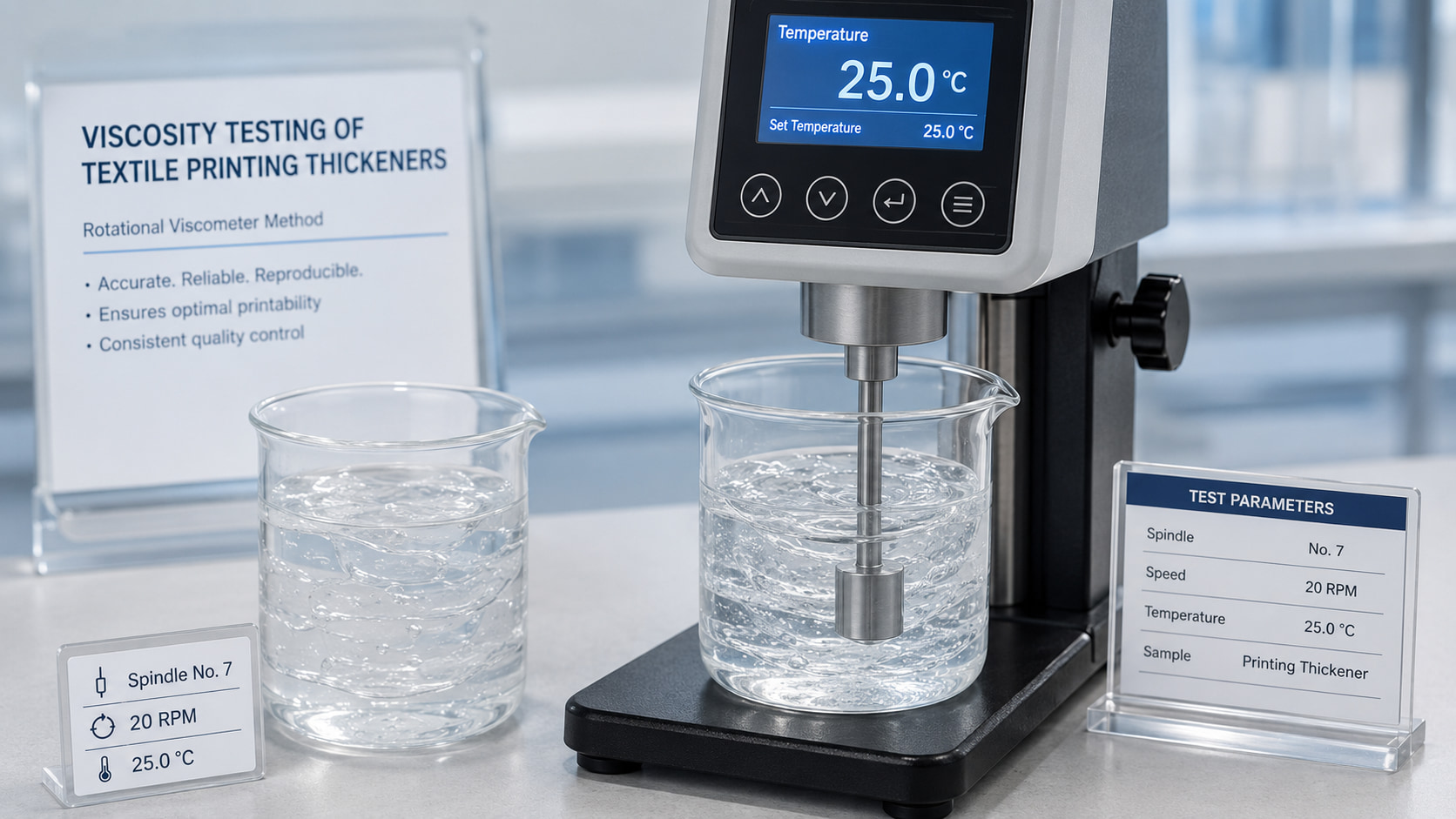
Tìm hiểu lý do tại sao không thể so sánh các giá trị độ nhớt của chất làm đặc trong in ấn dệt may nếu không đảm bảo các yếu tố như nồng độ, nhiệt độ, thiết bị, trục quay, tốc độ, phương pháp chuẩn bị và thời gian thử nghiệm đều giống nhau.
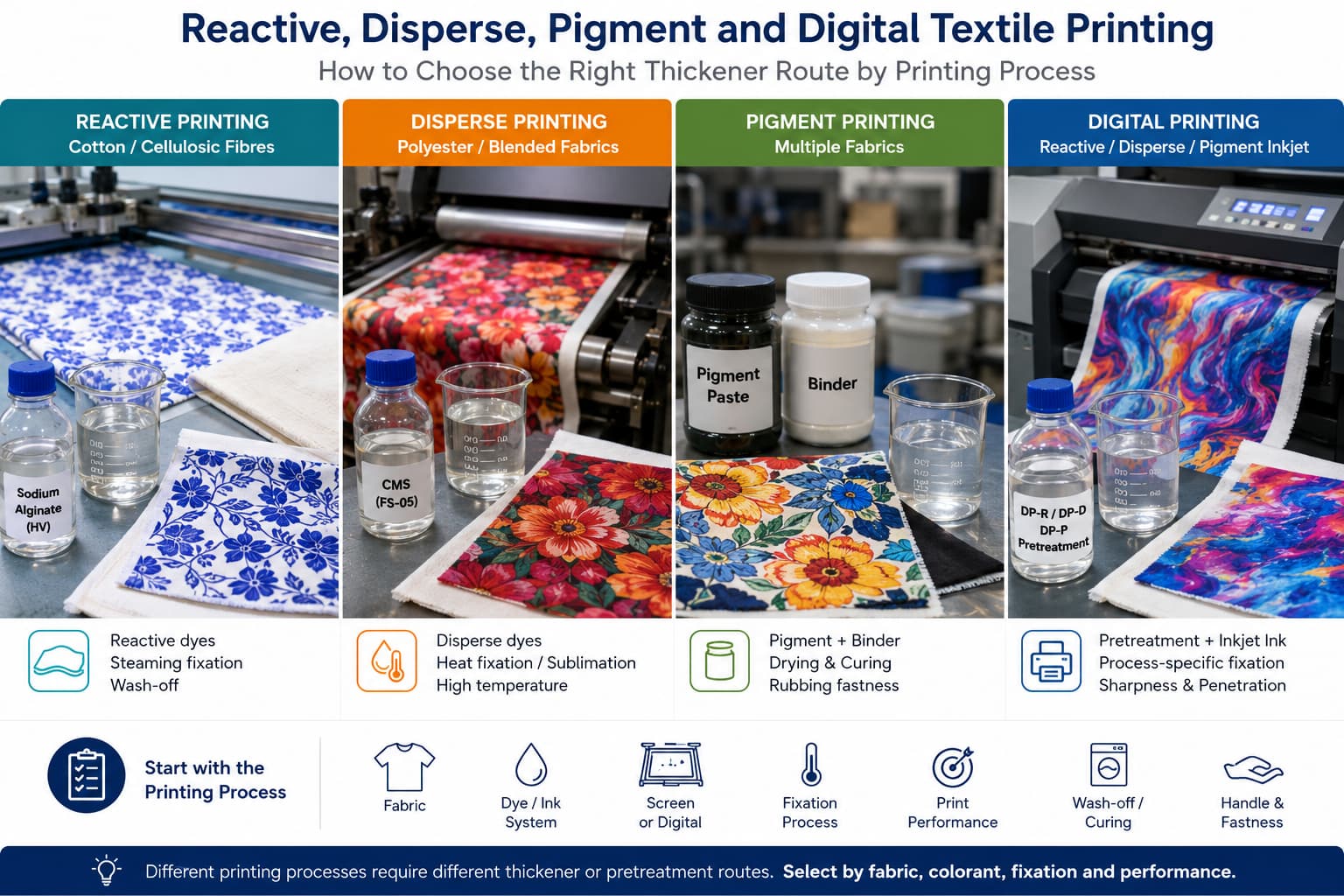
Tìm hiểu cách lựa chọn chất làm đặc và quy trình tiền xử lý cho các phương pháp in dệt phản ứng, in phân tán, in sắc tố và in kỹ thuật số, dựa trên các yêu cầu về vải, thuốc nhuộm hoặc mực in, quá trình cố định màu, khả năng rửa trôi và chất lượng in.
Tìm hiểu cách đánh giá một nhà sản xuất chất làm đặc dùng trong in ấn dệt may bằng cách kiểm tra thông tin nhận diện doanh nghiệp, năng lực sản xuất, phương pháp thử nghiệm, khả năng truy xuất nguồn gốc lô hàng, tài liệu kỹ thuật, hỗ trợ mẫu thử và khả năng cung ứng xuất khẩu.
Hỗn hợp in dựa trên CMC được sử dụng rộng rãi trong in vải bằng bột màu, in phản ứng và in kỹ thuật số. Hướng dẫn này giải thích các thông số quan trọng, cách so sánh các nhà cung cấp và những yêu cầu cần đưa ra trước khi đặt hàng số lượng lớn.
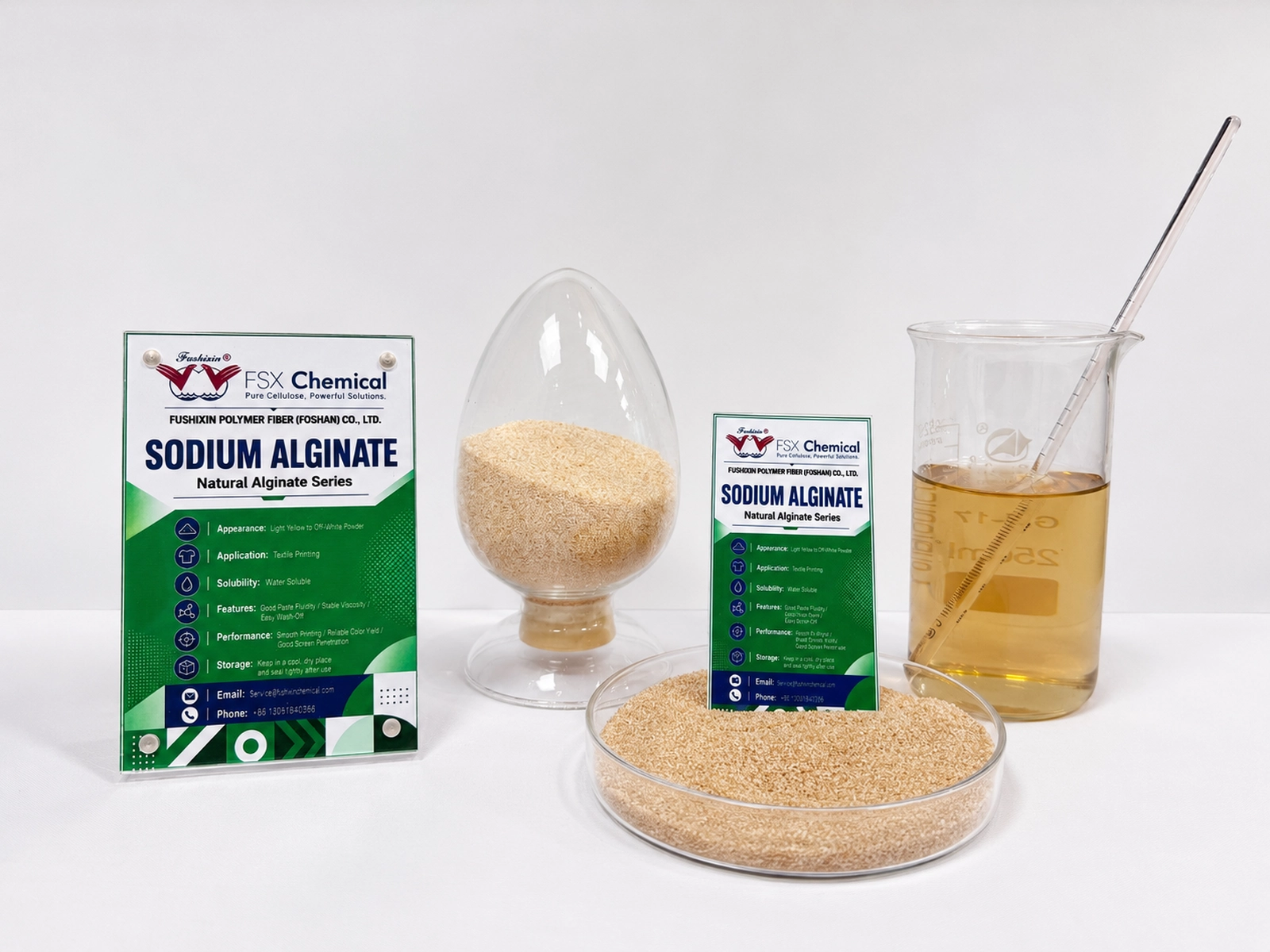
Cả natri alginat và CMC đều được sử dụng làm chất làm đặc trong in vải, nhưng chúng phù hợp với các hệ thống thuốc nhuộm và điều kiện quy trình khác nhau. Hướng dẫn này giải thích những điểm khác biệt chính và thời điểm nên sử dụng từng loại.
Việc hiểu rõ nguồn gốc nguyên liệu và quy trình sản xuất natri alginat sẽ giúp các đội ngũ mua hàng đặt ra những câu hỏi phù hợp hơn và đánh giá nhà cung cấp hiệu quả hơn. Cẩm nang này đề cập đến các loài tảo biển, các bước chiết xuất, nguồn gốc của tạp chất, cũng như những tiêu chí về quy trình sản xuất nhất quán cần có trong hồ sơ của nhà cung cấp.
Việc bảo quản không đúng cách là một trong những nguyên nhân phổ biến nhất dẫn đến các vấn đề về hiệu suất của natri alginat trong in ấn dệt may. Hướng dẫn này đề cập đến các điều kiện bảo quản dạng bột và dạng bột nhão, thời hạn sử dụng dự kiến, các dấu hiệu suy giảm chất lượng, cũng như những điều cần kiểm tra khi nhận hàng mới.
Các bảng dữ liệu kỹ thuật (TDS) có sự khác biệt về định dạng và mức độ đầy đủ giữa các nhà cung cấp, và không phải mọi trường thông tin đều có tầm quan trọng như nhau đối với mọi ứng dụng. Hướng dẫn này sẽ phân tích chi tiết từng phần của một bảng dữ liệu kỹ thuật (TDS) điển hình về natri alginat, giải thích ý nghĩa của từng thông số và cách nhận diện những thiếu sót hoặc dấu hiệu cảnh báo.
Nhiều nhà cung cấp quảng cáo sản phẩm "alginat natri tùy chỉnh", nhưng trên thực tế, thuật ngữ này lại bao hàm những khái niệm rất khác nhau. Hướng dẫn này sẽ giải thích những thông số nào thực sự có thể điều chỉnh, những thông số nào bị giới hạn bởi các quy luật hóa học cơ bản, và cách đánh giá các tuyên bố về khả năng tùy chỉnh của nhà cung cấp.
Khi xuất hiện lỗi in trên sàn, thách thức đặt ra là phải nhanh chóng xác định nguyên nhân. Cẩm nang tham khảo này phân loại các lỗi thường gặp liên quan đến hỗn hợp natri alginat theo triệu chứng, trong đó các nguyên nhân có khả năng xảy ra được xếp hạng theo mức độ khả năng và kèm theo các bước kiểm tra ban đầu thực tế cho từng trường hợp.
Việc mua sỉ natri alginat không chỉ đơn thuần là so sánh giá đơn vị. Hướng dẫn này giải thích cách các nhà mua hàng trong lĩnh vực in ấn dệt may có thể xác minh độ nhớt, kích thước mắt lưới, cấp độ tinh khiết, bao bì, chứng nhận phân tích (COA), kiểm tra mẫu và tính đồng nhất giữa các lô hàng trước khi đặt hàng số lượng lớn.
Giá alginat natri có sự chênh lệch đáng kể giữa các nhà cung cấp và các loại sản phẩm, nhưng không phải mọi sự chênh lệch về giá đều phản ánh sự khác biệt thực sự về chất lượng. Hướng dẫn này giải thích các yếu tố ảnh hưởng đến chi phí, cách so sánh báo giá trên cơ sở tương đương và những dấu hiệu cảnh báo cần lưu ý khi đánh giá các đề xuất của nhà cung cấp.
Vui lòng cung cấp tên sản phẩm, ứng dụng, số lượng, điểm đến và bất kỳ tài liệu kỹ thuật (TDS),
hình ảnh mẫu hoặc tài liệu nào mà quý khách đã có. FSX Chemical sẽ xem xét
thông tin này và đề xuất bước tiếp theo liên quan đến báo giá, đối chiếu mẫu
hoặc lựa chọn sản phẩm.
Thông tin sản phẩmTên sản phẩm, cấp loại, mẫu mã, ảnh nhãn mác hoặc mã tham chiếu của nhà cung cấp.
Các tài liệu có sẵnTDS, SDS, COA, ảnh mẫu, danh mục sản phẩm hoặc dữ liệu thử nghiệm.
Chi tiết đơn hàngSố lượng dự kiến, hình thức đóng gói, nước nhập khẩu, cảng hoặc điều kiện thương mại.
Yêu cầu hoặc Vấn đềQuy trình in trên vải, yêu cầu về công thức, vấn đề hiện tại hoặc chỉ tiêu hiệu suất.