Hệ thống chất làm đặc tổng hợp hỗn hợp: Khi nào nên pha trộn chất làm đặc acrylic với CMC hoặc CMS trong in ấn bằng bột màu
Acrylic thickener can be blended with selected CMC or CMS grades when a formula needs...
Compound synthetic thickener systems can be useful when one acrylic thickener does not provide the best balance of low-shear body, shear thinning, recovery, water retention, screenability, fabric hand and total formulation cost. In selected pigment-printing formulas, a small proportion of Carboxymethyl Cellulose (CMC) or Carboxymethyl Starch (CMS) can be evaluated as a supporting rheology component while acrylic thickener remains the main low-solids synthetic route. The purpose is not to replace acrylic thickener by weight or to blend polymers because one raw material is cheaper. A successful compound system gives each polymer a defined function, controls total polymer solids, remains compatible with pigment and binder, and is validated through complete-paste rheology, holding stability, screen printing, rubbing fastness and finished fabric hand.
When Should Acrylic Thickener Be Blended with CMC or CMS?
A compound system is worth testing when the acrylic-only reference paste is commercially acceptable but still has one clearly defined weakness.
Typical reasons to investigate a blend include:
Insufficient low-shear body at the desired acrylic dosage
A need to modify penetration or water retention
A need to change high-shear / low-shear balance
A cost target that cannot be reached by acrylic dosage adjustment alone
A desire to reduce stringing or alter recovery in a specific formula
A need for a different paste-body profile on a particular fabric or screen
The decision logic should be:
Define the Acrylic-Only Weakness → Select CMC or CMS for a Specific Function → Build a Controlled Blend Ladder → Test the Complete Pigment Paste → Print → Evaluate Fastness and Hand → Compare Total Cost in Use
Do not begin with:
“Replace 30% of the acrylic with the cheaper polymer.”
A compound thickener should be designed around performance first and cost second.
What Is a Compound Synthetic Thickener System?
A compound thickener combines two or more rheology-control polymers in one printing formulation.
In the context of this article, the system contains:
Acrylic Synthetic Thickener
plus selected:
CMC
CMS
or, in some development programs, both CMC and CMS
The components are not expected to perform identical jobs.
A well-designed blend uses:
Different Polymer Functions → One Application-Specific Rheology Profile
FSX Chemical’s current textile-thickener guidance also positions CMC and CMS as possible components in selected compound systems rather than universal direct replacements.
Why Blend Instead of Using One Thickener?
No polymer automatically gives the ideal combination of:
Low dosage
Low-shear body
High-shear flow
Phục hồi
Water retention
Khả năng dung nạp chất điện giải
Khả năng tương thích của chất kết dính
Soft hand
Low cost
Mixed-thickener studies in textile printing show that changing the thickener combination can change paste add-on, penetration and rheology.
Those published results are often from dye-printing systems rather than pigment printing, so they should not be copied directly into a pigment formula.
They support a more general principle:
Changing Polymer Ratio Changes the Flow System.
For pigment printing, the blend must therefore earn its place through the actual pigment / binder trial.
When Should You Not Use a Compound System?
Do not add CMC or CMS simply because:
The powder price is lower.
The acrylic thickener looks expensive per kilogram.
The acrylic-only paste already performs well.
A competitor uses a mixed thickener.
A blend can add:
More preparation steps
Powder hydration risk
More polymer solids
More filtration risk
More batch-to-batch variables
If the acrylic-only system already gives:
Stable rheology
Clean screen running
Low working dosage
Soft hand
Required fastness
then a compound route should only be adopted if it proves a measurable commercial advantage.
What Role Should Acrylic Thickener Play?
Acrylic thickener is usually the main low-solids rheology-control component in conventional pigment printing.
Depending on grade, it can provide:
Efficient viscosity development
Strong shear thinning
Controlled structural recovery
Low working dosage
Good pigment / binder compatibility in matched systems
In a compound system, acrylic thickener often remains responsible for the core:
Screen-Printing Rheology
while CMC or CMS is added to shift one or more secondary properties.
This is generally a safer development logic than asking CMC or CMS to replace the acrylic route completely without reformulation.
What Role Can CMC Play?
CMC is a water-soluble cellulose derivative available in a wide range of viscosity, degree-of-substitution and purity grades.
In selected pigment-printing compound systems, CMC may be evaluated for:
Paste-body adjustment
Water retention
Low-shear viscosity support
Penetration control
Cost-performance adjustment
But CMC is an anionic polymer and its behavior can change with:
Chất điện giải
Calcium / magnesium
Binder ionicity
Cationic fixers
pH
FSX Chemical’s current CMC pigment-printing guidance therefore recommends complete-paste testing rather than selection from pure-water viscosity alone.
CMC should be treated as a supporting rheology polymer—not as the pigment binder.
What Role Can CMS Play?
CMS is a modified starch derivative and is itself a product family rather than one universal material.
Selected CMS grades may be evaluated in compound pigment-printing systems for:
Viscosity support
Paste-body modification
Water retention
Suspension support
Cost-performance adjustment
FSX Chemical’s current CMS guidance also identifies blended-thickener systems as a relevant development route.
However, CMS behavior depends on:
Starch source
Mức độ thay thế
Molecular structure
Cấp độ độ nhớt
Bổ sung nước
Lọc
Do đó:
CMS Grade A ≠ CMS Grade B.
Use an application-specific grade and verify it with the actual pigment / binder formula.
CMC vs. CMS as a Secondary Blend Component
Khu vực lựa chọn
CMC
CMS
Base polymer
Cellulose derivative
Starch derivative
Possible blend role
Body, water retention, penetration / viscosity adjustment
Verify the blend at near-final viscosity, where tank circulation may be most difficult.
Batch QC for a Compound Thickener System
After commercial approval, QC should monitor both the individual components and the blend performance.
Useful controls include:
Acrylic solids / pH / batch identity
CMC or CMS identity / moisture / viscosity where specified
Standard hydration result
Compound-paste viscosity
Duy trì sự ổn định
Filtration residue
A standardized reference blend is often more predictive than individual raw-material COAs alone.
Periodically confirm the blend through the actual pigment-printing application.
Common Compound-Thickener Mistakes
1. Blending Only to Reduce Raw-Material Price
Lower raw-material cost can be lost through higher dosage, preparation or printing defects.
2. Treating CMC or CMS as a Weight-for-Weight Acrylic Replacement
The polymers have different solids, rheology and preparation behavior.
3. Comparing Water Viscosity Only
Pigment, binder, electrolyte and shear can change the blend strongly.
4. Ignoring Total Polymer Solids
More powder polymer can worsen fabric hand even if acrylic dosage falls.
5. Skipping Full Hydration
Incomplete CMC/CMS hydration creates false viscosity and filter residue.
6. Changing Polymer Ratio and Binder at the Same Time
The source of performance change becomes impossible to identify.
7. Assuming Mixed Polymers Always Create Synergy
Blend rheology can be synergistic, additive or antagonistic.
8. Approving from a Beaker Without Screen Printing
Machine shear, release and deposit must be verified.
Bảng khắc phục sự cố
Vấn đề được ghi nhận
Các biến cần kiểm tra trước tiên
Đừng vội kết luận
Blend viscosity is higher than expected
Total polymer solids, hydration, synergy, pH
Higher viscosity means better compound system
Blend viscosity is lower than either reference
pH, electrolytes, polymer interaction, dilution
The CMC/CMS grade is defective
Screen release becomes worse
Elasticity, recovery, polysaccharide dosage
Same Brookfield viscosity means same rheology
Fabric hand becomes harder
Total polymer solids, paste add-on, binder
Lower acrylic percentage always improves hand
Gel / lumps appear
Hydration, local pH, addition order, fixer
The polymers are universally incompatible
Lab blend works but production filters block
Hydration, mixing, filtration, scale-up
Formula percentage alone defines performance
Rubbing falls after blending
Binder distribution, curing, paste deposit
More CMC/CMS will fix fastness
Cost/kg falls but cost/meter rises
Dosage, preparation, speed, rejects
Cheaper blend is automatically more economical
Bạn nên gửi những thông tin nào cho nhà cung cấp?
For useful acrylic + CMC/CMS compound-thickener development, provide:
Chất làm đặc acrylic hiện tại / TDS
Current acrylic dosage
Target CMC or CMS grade if already selected
CMC DS / viscosity or CMS specification where available
Pigment product and dosage
Binder grade / dosage
Thiết bị cố định / thiết bị phụ trợ
Final paste pH
Độ nhớt và phương pháp thử nghiệm toàn diện
Độ cứng của nước / Độ dẫn điện
Fabric composition / construction
Rây phẳng hoặc rây quay
Thời gian giữ
Current weakness: cost, body, penetration, screenability, hand or stability
FSX Chemical có thể sử dụng thông tin này thông qua Mẫu và việc kết hợp to decide whether the next trial should use acrylic-only optimization, an acrylic + CMC route or an acrylic + CMS route.
How Should a Mill Develop a Compound Thickener for Pigment Printing?
A practical development chain is:
Define the Acrylic-Only Reference → Identify One Specific Weakness → Choose CMC or CMS for a Defined Role → Standardize Hydration / Activation → Build a Blend-Ratio Ladder → Normalize Polymer Solids → Test Complete Paste → Hold / Filter → Print → Cure → Compare Fastness / Hand → Scale → Lock QC
Các nguyên tắc chính là:
Compound thickener development should solve a defined rheology or cost problem, not simply replace acrylic with a cheaper polymer.
Acrylic thickener usually remains the main low-solids screen-rheology component, while CMC or CMS acts as a supporting modifier in selected formulas.
CMC and CMS are product families; grade, hydration, substitution, purity and electrolyte response matter.
Blended polymers can show synergistic, additive or antagonistic rheology, so blend performance must be measured rather than assumed.
Total polymer solids, binder compatibility, filtration, holding stability and fabric hand are as important as initial viscosity.
The best compound system is the blend that improves the required production property and Total Cost in Use without sacrificing screenability, fastness or finished-fabric quality.
Các câu hỏi thường gặp
1. Can acrylic thickener be blended with CMC for pigment printing?
Yes, in selected formulations. CMC can be evaluated as a supporting rheology component for body, water retention or penetration control, but the complete pigment/binder system must be tested.
2. Can acrylic thickener be blended with CMS?
Yes, selected CMS grades can be evaluated in compound systems for viscosity, body, water retention, suspension or cost-performance adjustment. Grade selection and hydration are important.
3. Is CMC better than CMS for a compound pigment thickener?
Neither is universally better. CMC and CMS have different polymer structures, hydration, film and electrolyte behavior. Select according to the weakness that needs correction.
4. Can CMC or CMS directly replace acrylic thickener by weight?
Not as a general rule. Their product solids, required dosage, rheology and preparation are different. Use a controlled partial-substitution matrix.
5. Why can a blend have lower viscosity than either thickener alone?
Polymer interactions, pH, electrolytes, dilution and associative effects can create antagonistic rheology. Mixed-polymer viscosity is not always additive.
6. Does adding CMC or CMS always reduce cost?
No. Include dosage, hydration, mixing, filtration, machine efficiency, rejects and hand in Total Cost in Use.
7. Can a compound thickener improve fabric hand?
Potentially, if it allows a lower total polymer deposit or better paste add-on. But excessive CMC/CMS solids can also make the print heavier or stiffer.
8. Why does a compound paste form lumps?
Common causes include incomplete CMC/CMS hydration, local acrylic over-neutralization, poor addition order, electrolyte shock or cationic fixer interaction.
9. Should I compare blend ratios by product weight or active solids?
Record both. Product-weight comparison is practical for production, while active-polymer solids help explain rheology efficiency and hand.
10. Does CMC or CMS improve rubbing fastness?
They are not the main pigment binder. Any fastness change should be evaluated through binder distribution, curing and complete-paste compatibility.
11. What is the best first blend ratio?
There is no universal ratio. Start from the acrylic-only reference and introduce the secondary polymer in controlled partial-substitution steps appropriate to the actual commercial grades.
12. What should I send FSX Chemical for compound-thickener matching?
Send the current acrylic thickener, CMC/CMS data, pigment, binder, fixer, full or simplified formula, viscosity method, water quality, fabric, screen route, holding time and the specific performance or cost target.
Develop a Compound Thickener Only When Each Polymer Has a Clear Job
If your acrylic pigment-printing thickener gives acceptable results but you want to adjust paste body, penetration, water retention, working dosage or Total Cost in Use, FSX Chemical can help structure a controlled acrylic + CMC or acrylic + CMS trial.
Để nhận được bài đánh giá kỹ thuật hữu ích, vui lòng gửi:
Your current acrylic thickener sample, TDS or COA
Current acrylic dosage
CMC or CMS grade / TDS if already selected
Pigment product and dosage
Loại chất kết dính và liều lượng
Fixer / auxiliary package
Final paste pH
Complete viscosity test method
Độ cứng của nước / Độ dẫn điện
Fabric and screen route
Thời gian giữ
Your current technical or cost target
Bắt đầu bằng Mẫu và việc kết hợp for a controlled compound-thickener comparison.
A successful compound thickener is not the formula with the highest CMC or CMS replacement percentage. It is the system in which acrylic, CMC or CMS each contributes a defined rheological function, and the complete paste delivers stable screen printing, acceptable fastness and hand, and a lower practical Total Cost in Use.
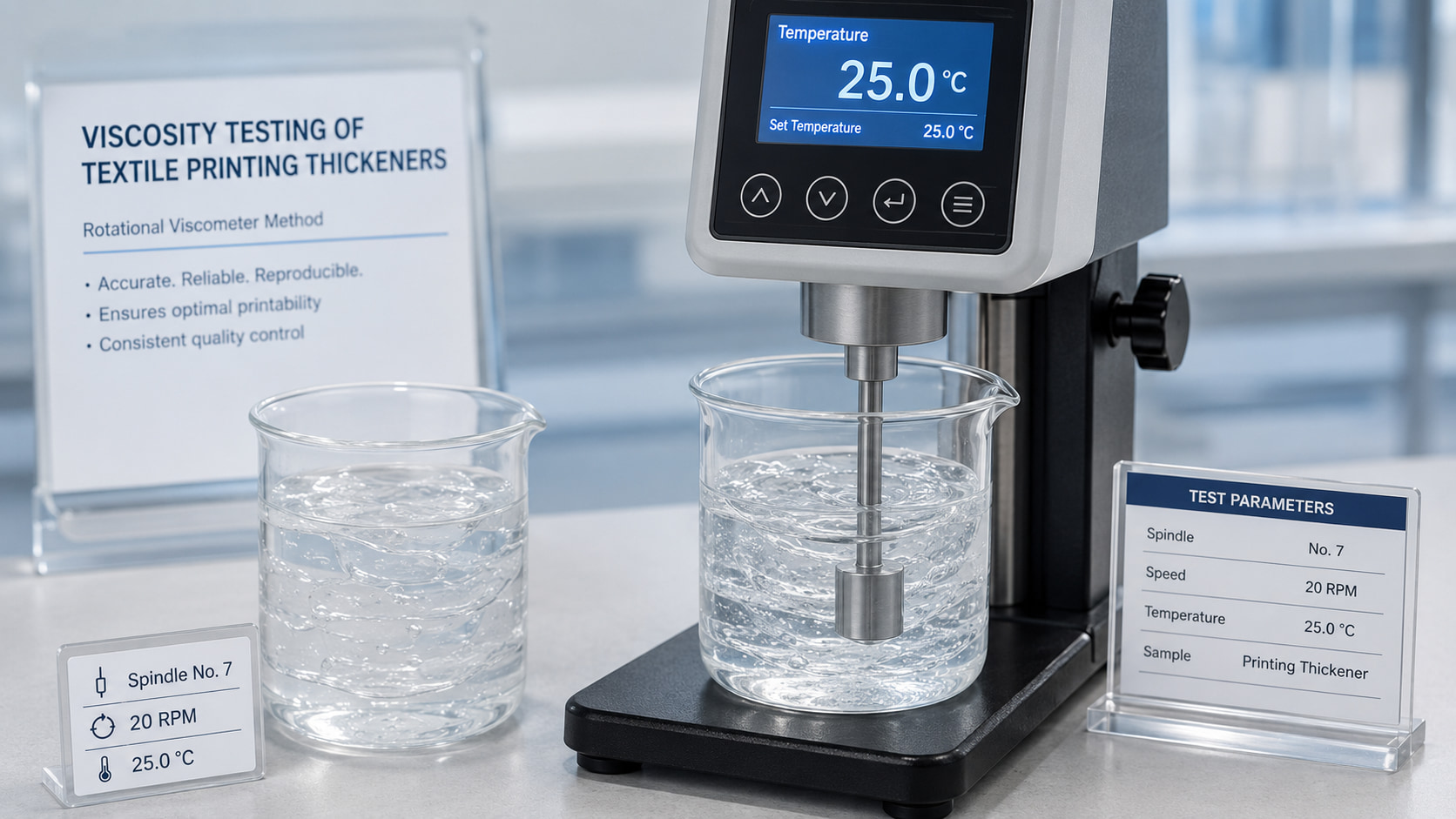
Tìm hiểu lý do tại sao không thể so sánh các giá trị độ nhớt của chất làm đặc trong in ấn dệt may nếu không đảm bảo các yếu tố như nồng độ, nhiệt độ, thiết bị, trục quay, tốc độ, phương pháp chuẩn bị và thời gian thử nghiệm đều giống nhau.
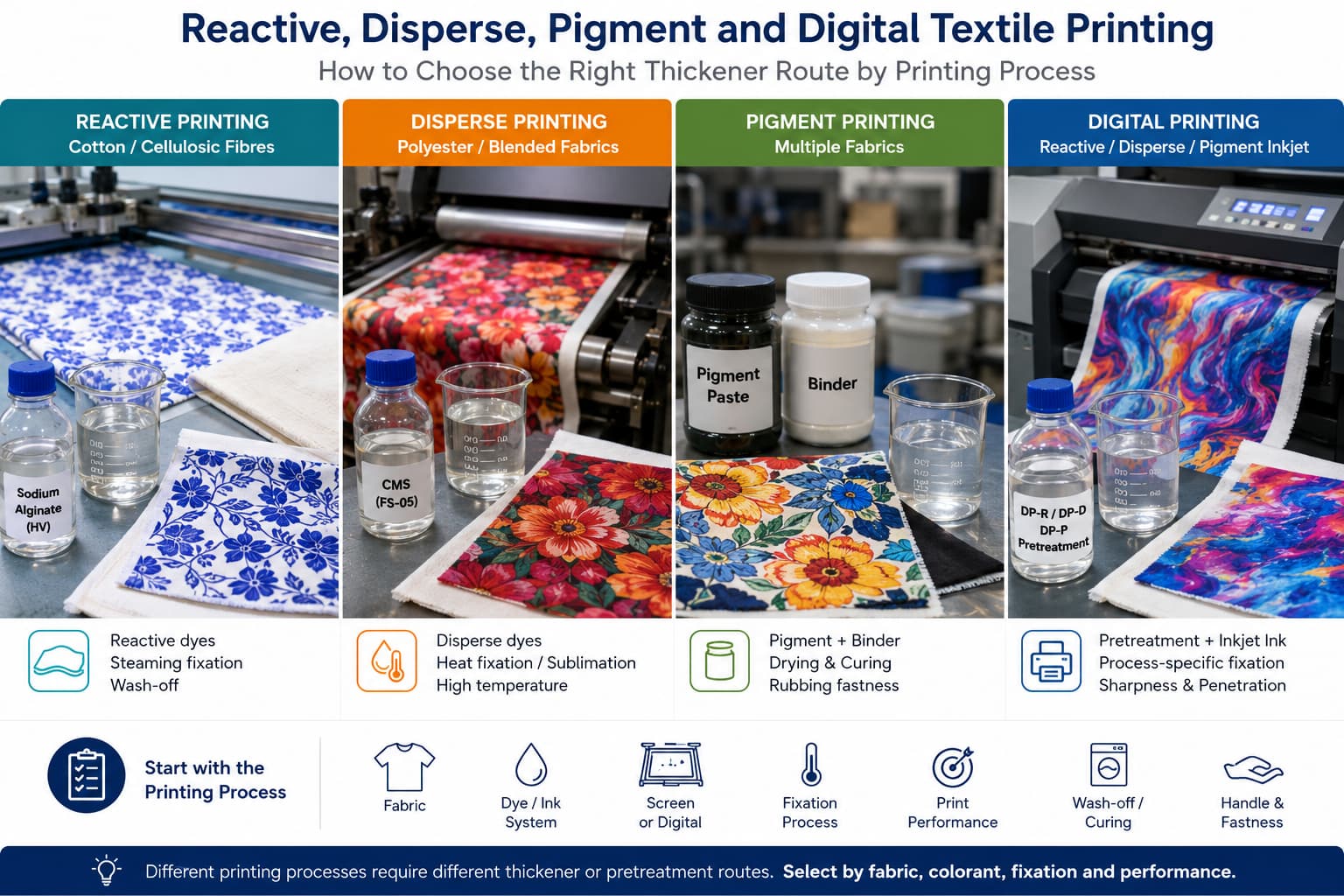
Tìm hiểu cách lựa chọn chất làm đặc và quy trình tiền xử lý cho các phương pháp in dệt phản ứng, in phân tán, in sắc tố và in kỹ thuật số, dựa trên các yêu cầu về vải, thuốc nhuộm hoặc mực in, quá trình cố định màu, khả năng rửa trôi và chất lượng in.
So sánh CMC, CMS, natri alginat và mực in kỹ thuật số trong in ấn dệt may. Tìm hiểu cách thức từng loại nguyên liệu phù hợp với các quy trình in phản ứng, in phân tán, in sắc tố và in kỹ thuật số, cũng như những yếu tố mà người mua cần xem xét trước khi thử mẫu, đối chiếu chất lượng và mua số lượng lớn.
Natri alginat được sử dụng rộng rãi trong in ấn dệt may với vai trò là chất làm đặc ổn định và có thể giặt được cho hỗn hợp in phản ứng. Tìm hiểu cách đánh giá cấp độ độ nhớt, độ tinh khiết và tính phù hợp trong ứng dụng trước khi mua hàng, cũng như cách FSX Chemical hỗ trợ người mua trên toàn cầu thông qua dữ liệu kỹ thuật và mẫu sản phẩm.
Carboxymethyl cellulose (CMC) được sử dụng rộng rãi trong các quy trình in ấn, xử lý chất làm cứng và nhuộm vải. Hướng dẫn này sẽ giải thích cách đánh giá các loại CMC, những thông số nào là quan trọng nhất, cũng như cách FSX Chemical có thể hỗ trợ các quyết định mua hàng.
Carboxymethyl cellulose được sử dụng làm chất làm đặc và chất ổn định trong mực in gốc nước, in ống đồng và quá trình tiền xử lý cho in phun. Hướng dẫn này trình bày các thông số kỹ thuật chính của sản phẩm và các yếu tố cần xem xét khi lựa chọn nhà cung cấp dành cho các đội ngũ mua hàng.
Hỗn hợp in dựa trên CMC được sử dụng rộng rãi trong in vải bằng bột màu, in phản ứng và in kỹ thuật số. Hướng dẫn này giải thích các thông số quan trọng, cách so sánh các nhà cung cấp và những yêu cầu cần đưa ra trước khi đặt hàng số lượng lớn.
Cả natri alginat và CMC đều được sử dụng làm chất làm đặc trong in vải, nhưng chúng phù hợp với các hệ thống thuốc nhuộm và điều kiện quy trình khác nhau. Hướng dẫn này giải thích những điểm khác biệt chính và thời điểm nên sử dụng từng loại.
CMC loại thực phẩm và loại công nghiệp có cùng cơ sở hóa học nhưng lại khác biệt đáng kể về độ tinh khiết, dải DS và các yêu cầu quy định. Hướng dẫn này giải thích những điểm khác biệt chính và lý do tại sao việc sử dụng loại không phù hợp lại gây ra các vấn đề trong sản xuất.
Việc chuẩn bị hỗn hợp dán đúng cách cũng quan trọng không kém việc lựa chọn loại thuốc nhuộm trong in vải bằng thuốc nhuộm phản ứng. Hướng dẫn này đề cập đến các phương pháp hòa tan natri alginat, phạm vi nồng độ tùy theo mục đích sử dụng, điều kiện bảo quản, cũng như cách khắc phục các sự cố thường gặp trong quá trình chuẩn bị.
Tỷ lệ cố định thuốc nhuộm ảnh hưởng trực tiếp đến hiệu suất màu, độ bền màu khi giặt và lượng chất thải trong quá trình in bằng thuốc nhuộm phản ứng. Hướng dẫn này giải thích cách natri alginat hỗ trợ quá trình cố định thuốc nhuộm, các thông số của hỗn hợp thuốc nhuộm nào ảnh hưởng đến tỷ lệ cố định, cũng như cách khắc phục tình trạng tỷ lệ cố định thấp trong quá trình sản xuất.
Kích thước hạt (mesh) của natri alginat ảnh hưởng đến tốc độ hòa tan của bột, mức độ đồng đều khi ngậm nước, cũng như hiệu quả của hỗn hợp in trong quá trình in lụa. Hướng dẫn này giải thích những tác động thực tiễn của thông số mesh đối với các ứng dụng hỗn hợp in trên vải.
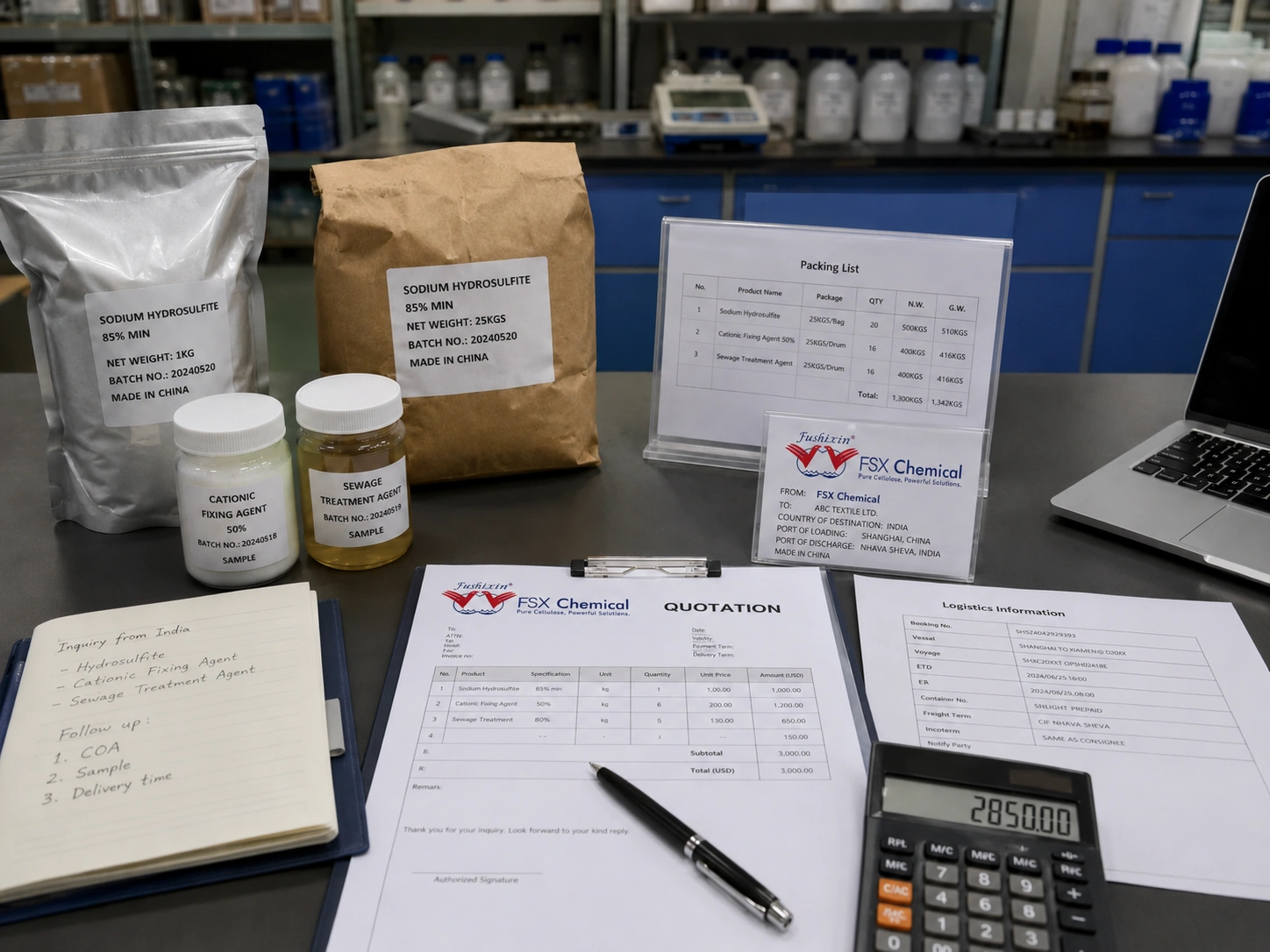
Vui lòng cung cấp tên sản phẩm, ứng dụng, số lượng, điểm đến và bất kỳ tài liệu kỹ thuật (TDS),
hình ảnh mẫu hoặc tài liệu nào mà quý khách đã có. FSX Chemical sẽ xem xét
thông tin này và đề xuất bước tiếp theo liên quan đến báo giá, đối chiếu mẫu
hoặc lựa chọn sản phẩm.
Thông tin sản phẩmTên sản phẩm, cấp loại, mẫu mã, ảnh nhãn mác hoặc mã tham chiếu của nhà cung cấp.
Các tài liệu có sẵnTDS, SDS, COA, ảnh mẫu, danh mục sản phẩm hoặc dữ liệu thử nghiệm.
Chi tiết đơn hàngSố lượng dự kiến, hình thức đóng gói, nước nhập khẩu, cảng hoặc điều kiện thương mại.
Yêu cầu hoặc Vấn đềQuy trình in trên vải, yêu cầu về công thức, vấn đề hiện tại hoặc chỉ tiêu hiệu suất.