Compound Synthetic Thickener Systems: When to Blend Acrylic Thickener with CMC or CMS for Pigment Printing
Acrylic thickener can be blended with selected CMC or CMS grades when a formula needs...
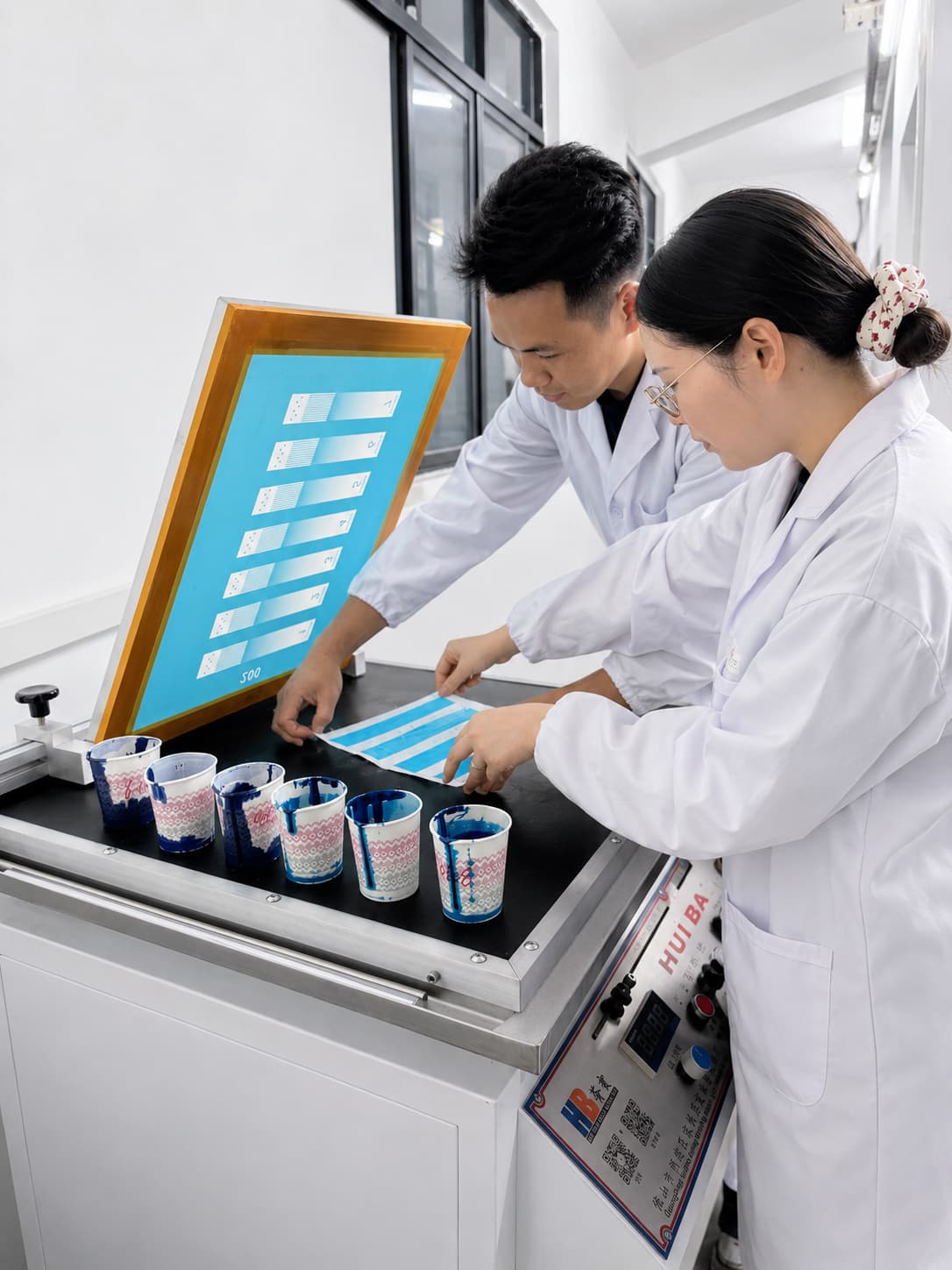
Consider an acrylic-thickener blend for pigment printing only when the acrylic-only reference has a defined problem and the secondary grade is declared suitable for evaluation. CMC or an FSX CMS candidate can change paste flow, holding behavior and deposited solids, but a blend does not guarantee synergy or cost savings. Confirm CMS product identity first, then compare preparation, complete-paste stability, screen transfer, rubbing and hand at controlled pH, carrier water and deposit.
When Should Acrylic Thickener Be Blended with CMC or CMS?
A compound system is worth testing when the acrylic-only reference paste is commercially acceptable but still has one clearly defined weakness.
Typical reasons to investigate a blend include:
Insufficient low-shear body at the desired acrylic dosage
A need to modify penetration or water retention
A need to change high-shear / low-shear balance
A cost target that cannot be reached by acrylic dosage adjustment alone
A desire to reduce stringing or alter recovery in a specific formula
A need for a different paste-body profile on a particular fabric or screen
The decision logic should be:
Define the Acrylic-Only Weakness → Select CMC or CMS for a Specific Function → Build a Controlled Blend Ladder → Test the Complete Pigment Paste → Print → Evaluate Fastness and Hand → Compare Total Cost in Use
Do not begin with:
“Replace 30% of the acrylic with the cheaper polymer.”
A compound thickener should be designed around performance first and cost second.
What Is a Compound Synthetic Thickener System?
A compound thickener combines two or more rheology-control polymers in one printing formulation.
In the context of this article, the system contains:
Acrylic Synthetic Thickener
plus selected:
CMC
CMS
or, in some development programs, both CMC and CMS
The components are not expected to perform identical jobs.
A well-designed blend uses:
Different Polymer Functions → One Application-Specific Rheology Profile
Use the current FSX product route and the exact grade TDS as the starting point for candidate selection. No pigment blend is approved by a broad product-family label; request a formulation-specific recommendation before arranging the trial.
Why Blend Instead of Using One Thickener?
No polymer automatically gives the ideal combination of:
Low dosage
Low-shear body
High-shear flow
Recovery
Water retention
Elektrolit toleransı
Bağlayıcı uyumluluğu
Soft hand
Low cost
Manufacturer guidance demonstrates that some synthetic textile thickeners are offered for blending with natural gums. The SNF conventional-printing overview distinguishes application routes; its examples are not an acrylic/CMC/CMS pigment-printing recipe or proof that an FSX blend will perform better. Use controlled trials to establish the effect in the actual pigment/binder system.
Those published results are often from dye-printing systems rather than pigment printing, so they should not be copied directly into a pigment formula.
They support a more general principle:
Changing Polymer Ratio Changes the Flow System.
For pigment printing, the blend must therefore earn its place through the actual pigment / binder trial.
When Should You Not Use a Compound System?
Do not add CMC or CMS simply because:
The powder price is lower.
The acrylic thickener looks expensive per kilogram.
The acrylic-only paste already performs well.
A competitor uses a mixed thickener.
A blend can add:
More preparation steps
Additional preparation or activation risk for the declared supply forms
Additional nonvolatile material and, where documented, polymer input
More filtration risk
More batch-to-batch variables
If the acrylic-only system already gives:
Stable rheology
Clean screen running
Low working dosage
Soft hand
Gerekli renk haslığı
then a compound route should only be adopted if it proves a measurable commercial advantage.
What Role Should Acrylic Thickener Play?
Acrylic thickener is usually the main low-solids rheology-control component in conventional pigment printing.
Depending on grade, it can provide:
Efficient viscosity development
Strong shear thinning
Controlled structural recovery
Low working dosage
Good pigment / binder compatibility in matched systems
In a compound system, acrylic thickener often remains responsible for the core:
Screen-Printing Rheology
while CMC or CMS is added to shift one or more secondary properties.
This is generally a safer development logic than asking CMC or CMS to replace the acrylic route completely without reformulation.
What Role Can CMC Play?
CMC is a water-soluble cellulose derivative available in a wide range of viscosity, degree-of-substitution and purity grades.
In selected pigment-printing compound systems, CMC may be evaluated for:
Paste-body adjustment
Water retention
Low-shear viscosity support
Penetration control
Cost-performance adjustment
But CMC is an anionic polymer and its behavior can change with:
Electrolytes
Calcium / magnesium
Binder ionicity
Cationic fixers
pH
FSX Chemical’s current CMC pigment-printing guidance therefore recommends complete-paste testing rather than selection from pure-water viscosity alone.
CMC should be treated as a supporting rheology polymer—not as the pigment binder.
What Role Can CMS Play?
In this guide, FSX CMS refers to a commercial synthetic printing-thickener family. Do not infer carboxymethyl-starch chemistry, a starch source or DS from the family name. A material explicitly identified by its supplier as carboxymethyl starch is a different chemistry-specific case; an FSX candidate requires its own current grade declaration.
Selected CMS grades may be evaluated in compound pigment-printing systems for:
Viscosity support
Paste-body modification
Water retention
Suspension support
Cost-performance adjustment
The current FSX CMS page separates reactive, disperse and specialty printing candidates. That does not establish pigment-binder compatibility. Ask for an exact grade recommendation and preparation method before introducing a CMS candidate into a pigment paste.
For an FSX CMS candidate, first document product identity, declared composition where available, supply form, preparation method, concentration and complete viscosity method. Apply additional polymer-specific descriptors only when the grade chemistry is confirmed:
Exact grade and declared chemical family
Applicable composition or substitution data, if relevant to that chemistry
Defined viscosity and preparation method
Full-paste filtration, holding and screen behavior
Therefore:
CMS Grade A ≠ CMS Grade B.
Use an application-specific grade and verify it with the actual pigment / binder formula.
CMC vs. CMS as a Secondary Blend Component
Selection area
CMC
FSX CMS candidate
Identity
Carboxymethyl cellulose; confirm exact grade
Commercial synthetic printing-thickener family; confirm exact grade, supply form and intended route
Trial purpose
Defined change in body, water retention or flow
Defined flow or preparation target supported by the grade recommendation
Grade information
DS, moisture/purity and full viscosity method where declared
Composition and chemistry-relevant descriptors; no automatic starch/DS assumption
Uyumluluk
Preparation, water quality and complete pigment/binder/auxiliary paste
The same complete-paste checks using its own preparation method
Release basis
Screen running, deposit, fastness, hand and cost
The same outcomes, not a chemical-family ranking
This table is a selection framework, not a ranking.
The better secondary polymer depends on the specific weakness of the acrylic-only reference paste.
Why Polymer Blends Do Not Guarantee Synergy
Blending two thickeners does not guarantee that:
Viscosity of A + Viscosity of B = Better Viscosity.
Mixed polymers can show:
Synergistic viscosity increase
Almost additive behavior
Antagonistic thinning
More elasticity
Less elasticity
Different recovery
The result depends on:
Polimer konsantrasyonu
Charge density
Molecular weight
pH
Electrolytes
Binder / surfactants
Therefore:
Never predict blend performance from the two individual water viscosities.
Total Polymer Solids Still Matter
One advantage of acrylic pigment thickeners is that many grades work at relatively low dosage.
A secondary thickener contributes nonvolatile material according to its declared composition and working dose. Powder moisture, salts and other ingredients can affect that balance; do not treat every kilogram of product as a kilogram of active polymer.
If too much powder polymer is added to reduce acrylic cost, the blend can increase:
Total deposited solids
Yüzey kalıntısı
Fabric stiffness
Hazırlık maliyeti
Calculate:
Declared thickener-polymer input = sum of each thickener dose × its confirmed polymer mass fraction. Separately track total nonvolatile input using the appropriate declared or measured method. If active fractions are unavailable, compare on a labelled product-dose basis rather than inventing an active-solids normalization.
Then compare the final printed fabric.
A lower raw-material cost per kilogram does not prove lower cost per printed meter.
Low-Shear Body and Paste Hold
One reason to test CMC or CMS is to change low-shear paste body without simply increasing acrylic dosage.
Useful low-shear structure can improve:
Paste hold on screen
Anti-sag behavior
Kontrollü penetrasyon
Suspension
But excessive body can increase:
Pumping resistance
Screen-filling difficulty
Heavy deposit
The blend should therefore be tested across multiple shear conditions.
Do not optimize low-shear viscosity independently from screen passage.
High-Shear Flow and Screen Passage
Acrylic thickeners are often selected because of useful shear-thinning behavior.
Adding a confirmed secondary-polymer component can change the flow curve.
The paste may become:
More pseudoplastic
Less shear thinning
More resistant under squeegee shear
More elastic
depending on the polymers and ratio.
Mixed-thickener research in textile printing demonstrates that polymer composition can change pseudoplastic behavior, add-on and penetration.
For pigment printing, the important question is:
Does the compound paste pass the actual screen cleanly at the required deposit?
Recovery, Leveling and Print Definition
When application shear falls, viscosity may rise because of rate dependence; any additional time-dependent rebuilding must be measured separately. Check post-screen flow over the actual interval available before the deposit levels or spreads.
If recovery is too slow:
Edges can spread.
Penetration can increase.
Fine detail can soften.
If recovery is too fast or elasticity is too high:
Leveling can suffer.
Screen marks can remain.
Stringing can increase.
CMC or CMS can shift recovery relative to an acrylic-only reference.
The direction is grade- and ratio-specific.
Measure it rather than assuming the blend improves recovery.
Water Retention and Penetration
Test whether the selected secondary grade changes water retention or penetration in the actual paste. A generic CMS label does not establish that it shares CMC hydration or film behavior.
This can affect:
Fabric wetting
Penetrasyon
Surface pigment concentration
Screen drying behavior
Water retention can be useful when the acrylic-only paste penetrates too rapidly into an absorbent substrate.
But excessive retention can also change:
Kurutma
Seviyelendirme
Binder-film development
Evaluate face-side color, reverse-side penetration and drying behavior together.
Screenability and Filtration
A secondary grade adds preparation and filtration variables according to its declared supply form. A powder may need dispersion and hydration; a liquid may need homogenization, dilution or activation. None of these steps follows from the CMS family name alone.
A compound paste should be checked for:
Complete grade-appropriate preparation and viscosity development
Jel parçacıkları
Undissolved powder
Filtreleme artığı
Şablon tıkanması
Screen release
Compare the actual preparation work for the selected reference and candidate. A powder secondary grade can add feeding and hydration operations, while a liquid candidate has its own mixing and activation requirements.
Any added preparation step must be evaluated against its intended benefit, filtration behavior, batch repeatability and machine interruptions.
Binder Compatibility
Pigment binder remains the main fixation component.
Compound thickener development must therefore keep binder compatibility at the center.
Test whether CMC or CMS addition changes:
Viskozite
pH
Flocculation
Gel formation
Bekleme kararlılığı
Binder-film distribution
CMC and many acrylic thickeners are anionic, but that does not guarantee compatibility with every binder or auxiliary package.
CMS compatibility is also grade-specific.
Use the complete binder-containing paste for approval.
Pigment Dispersion and Surfactants
Pigment dispersion introduces:
Pigment particles
Su
Dispersant
Surfactant
Electrolytes
These components can affect all parts of a compound system differently.
Örneğin:
Surfactants may change HASE association.
Electrolytes can change acrylic and CMC chain expansion.
Pigment solids can change apparent viscosity through particle crowding.
This is why blend optimization must use the production pigment system.
Electrolytes and Hard Water
CMC and anionic acrylic thickeners can respond to ionic conditions. For an FSX CMS candidate, use its exact grade declaration and complete-paste test rather than infer ionic character from the family name.
The magnitude and direction can differ.
Test the blend with:
Reference water
Bitkiye su vermek
Representative pigment / binder electrolyte load
Fixer if used
If hard water is relevant, also monitor:
Calcium
Magnesium
Conductivity
A compound system that is stable in deionized water but unstable in plant water should not be approved.
pH and Acrylic Thickener Activation
Many acrylic ASE/HASE thickeners require controlled pH activation.
CMC or CMS should not be allowed to make that activation step uncontrolled.
Record:
pH before acrylic activation
pH after activation
pH after CMC / CMS addition
Final paste pH
Held pH
If the blend changes the final pH, viscosity differences may come from acrylic activation rather than the secondary polymer itself.
Control pH before drawing conclusions about synergy.
Prepare CMC and the Exact CMS Grade Before Blending
Preparation depends on the actual supply form and grade method. A powder component can introduce a hydration step that is absent from some liquid routes, but neither supply form defines the polymer chemistry.
For a powder grade requiring hydration, incomplete preparation can create:
Lumps
False low viscosity
Delayed viscosity increase
Filter residue
Use the selected grade’s documented preparation method and endpoint. Where hydration is required, specify its water, feed, mixing, temperature and time conditions; verify the required development rather than transfer another grade’s waiting time.
Control:
Su kalitesi
Toz ekleme oranı
Karıştırma
Su içme zamanı
Temperature where relevant
Do not compare blend ratios until the powder component is fully hydrated under a repeatable method.
Addition Order for a Compound Thickener
There is no universal addition order for every acrylic + CMC/CMS system.
A controlled development program may compare:
A fully prepared CMC or grade-confirmed CMS component added to an appropriately activated acrylic base
Acrylic added into a prepared secondary-thickener base
Selected post-addition route where the commercial acrylic grade supports it
For each route, record:
pH
Viskozite
Gel / lumps
Karıştırma süresi
Bekleme kararlılığı
Choose the route that gives the most repeatable complete-paste behavior.
Do not select an order only because it is convenient in the laboratory.
Gel, Floc and Lumps in Mixed-Polymer Systems
Compound systems create more opportunities for local concentration problems.
Possible causes of gel or lumps include:
Incomplete grade-appropriate dispersion, hydration or activation
Local acrylic over-neutralization
Electrolyte shock
Cationic fixer interaction
Poor mixing
If gel appears, identify the first stage where it forms.
Do not assume:
“CMC and acrylic are chemically incompatible.”
The actual cause can be preparation sequence or local pH.
Fabric Hand and Residual Polymer Solids
Pigment printing already leaves a binder film on the textile.
Adding a secondary grade changes the nonvolatile deposit according to its composition, dose and paste transfer. Determine the actual change rather than assuming all supplied solids are polymer.
If the blend requires too much secondary thickener to reach the target rheology, printed-area hand can become:
Heavier
Stiffer
More coated
Compare hand at matched:
Color / opacity
Paste add-on
Sürtünme haslığı
Do not compare a thin acrylic-only print with a much heavier compound-paste deposit and attribute the entire hand difference to polymer chemistry.
Rubbing Fastness: Thickener Is Not the Binder
CMC and CMS are rheology-control components.
They do not replace the dedicated pigment binder.
If dry or wet rubbing falls after blending, first investigate:
Binder-to-pigment ratio
Binder distribution
Paste add-on
Sertleştirme
Thickener / binder compatibility
Do not correct poor rubbing by simply increasing CMC or CMS.
The blend should improve rheology without disrupting binder-film performance.
Curing and Binder Film Formation
After the compound paste is printed, binder must still form a continuous durable film.
Validate the blend under the same:
Kurutma koşulları
Curing temperature
Curing time
Fabric conditions
used for the acrylic-only reference.
If the compound system changes water retention or deposit, drying and curing may also need review.
Do not assume the same thermal response without a production-relevant trial.
Post-Cure Cleaning and Residue
Conventional pigment printing should not be treated like reactive printing wash-off.
The binder film is intended to remain.
However, CMC or CMS addition can change:
Yüzey kalıntısı
Post-cure washing behavior where washing is used
El
Screen / equipment cleaning
If the process includes post-cure washing, compare the actual customer process.
Do not claim that one blend is “easy wash-off” without a defined procedure and finished-fabric test.
When Can a Compound System Improve Total Cost in Use?
A compound system can create economic value if the lower acrylic dosage or improved rheology offsets the added:
CMC / CMS cost
Su içme zamanı
Enerji karışımı
Filtreleme
QC complexity
A useful model is:
Cost per accepted m² = allocated monetary production costs ÷ accepted finished-print area (m²). Use the same boundary, currency and acceptance target for the reference and blend. Price actual product consumption; convert measured preparation time and energy with stated rates. Count waste and rejects once: consumed ingredients already include their material value, while distinct rework or disposal charges may be added separately. Keep unpriced capacity, hand and stability measures alongside the monetary result. A linear-metre comparison requires an equivalent stated fabric width.
Adopt the blend only when its required quality or process benefit has a documented commercial justification at the agreed cost per accepted output.
Raw-material price per kilogram is not enough.
Build a Controlled Blend-Ratio Ladder
Start with the acrylic-only formula as the reference.
Then create several defined partial-substitution levels.
For example, a laboratory design can use:
Reference: acrylic-only
Low blend: small CMC or CMS contribution
Medium blend: larger secondary-polymer contribution
High blend: stress point for technical understanding
The exact percentages should be chosen for the commercial grade and target problem.
Do not assume a universal 90/10, 80/20 or 70/30 ratio is appropriate for every formula.
At each point, keep pigment, binder and auxiliaries constant first.
Compare Product Dose and Documented Composition
Record the actual supply forms and declared fractions for every component. Product solids, active polymer and the water introduced by a stock solution are different quantities; two apparently equal product-dose trials may have different final water and polymer inputs.
Therefore, comparing only product kilograms can be misleading.
Record:
Product dosage
Product solids
Confirmed polymer fraction and its source, or explicitly mark it as not supplied
Final paste viscosity
Total thickener cost
Only when polymer fractions are documented can this comparison help distinguish:
A change in rheology at a defined polymer input
kaynak:
A higher measured polymer input. If polymer fractions are unknown, report product-dose and nonvolatile-content results; do not claim active-polymer-normalized efficiency.
For commercial decisions, also include preparation cost and print result.
Recommended Laboratory Compound-Thickener Matrix
Numune
Acrylic
CMC / CMS
Temel Amaç
A
Current reference
0
Baseline
B
Slightly reduced
Low
Low-blend screening
T
Reduced
Orta
Rheology / cost balance
D
Further reduced
Higher
Stress / boundary test
For every sample, record:
Final pH
Low- / high-speed viscosity
Recovery
Stringing
Filtreleme artığı
Bekleme kararlılığı
Screen behavior
Paste add-on
Kumaş el
The best sample is not necessarily the one with the lowest acrylic percentage.
Separate a Blend Effect from Dilution and Activation Effects
The following is a proposed attribution test, not a production formula or FSX blend result. A partial-substitution ladder changes two doses together; add controls before describing an improvement as synergy.
Karşılaştırma
What to hold or measure
Question answered
Acrylic-only controls at each acrylic dose used
Final batch mass, water balance, pigment, binder, pH and hold history
Did reducing acrylic itself produce the observed change?
Secondary-only diagnostic where preparation permits
The actual secondary dose and the same complete formulation
What contribution or instability appears without acrylic?
Combined candidate
Both declared doses, preparation order and all carrier water
How does the mixture behave under the same process conditions?
Independently prepared repeat pastes
Repeat full mixing and hydration, not only instrument readings
Is the difference larger than preparation and measurement variation?
Balance water introduced by a prehydrated stock into the final recipe. Bring each candidate into its declared operating pH window and record that condition; do not force an unsuitable shared pH merely to simplify the comparison. Read viscosity at the same temperature, instrument, spindle, speed and elapsed time, then check recovery, filter residue and screen transfer.
Do not assume that individual viscosities add linearly. A claim of interaction requires a stated reference model, a defined response and repeatable differences; a higher viscosity alone is not commercially useful synergy. Approve the final blend only after its intended benefit survives deposit, fastness, hand, preparation and cost checks.
Holding and Storage Stability
Mixed polymers can continue equilibrating after preparation.
Check the compound paste:
Fresh
After normal color-kitchen holding
Near the end of the intended working period
Record:
Viscosity drift
pH
Ayrılık
Gel
Köpük
Filter residue
A compound system that only matches the acrylic reference immediately after preparation is not production-qualified.
Controlled Pigment Printing Trial
Use one fabric lot and one diagnostic design.
Keep:
Pigment level
Binder level
Fixer / auxiliary package
Screen
Squeegee settings
Sertleştirme
constant during the first comparison.
Değerlendirin:
İnce çizgilerin belirginliği
Katı alan homojenliği
Screen release
Penetrasyon
Color / opacity
Dry / wet rubbing
El
Only after the best blend is identified should binder or machine settings be optimized further.
Scale-Up to the Color Kitchen
Scale-up must reproduce the actual secondary-grade preparation alongside acrylic activation. Record the supply forms and their validated development endpoints; a liquid CMS candidate does not automatically share the powder CMC hydration step.
Verify the blend at near-final viscosity, where tank circulation may be most difficult.
Batch QC for a Compound Thickener System
After commercial approval, QC should monitor both the individual components and the blend performance.
Useful controls include:
Acrylic solids / pH / batch identity
CMC or CMS identity / moisture / viscosity where specified
Standard preparation result for the declared supply form
Compound-paste viscosity
Bekleme kararlılığı
Filtreleme artığı
A standardized reference blend can reveal complete-formulation changes that individual raw-material COAs do not measure. Establish its control limits from the validated blend and confirm its relationship to the printing result.
Periodically confirm the blend through the actual pigment-printing application.
Common Compound-Thickener Mistakes
1. Blending Only to Reduce Raw-Material Price
Lower raw-material cost can be lost through higher dosage, preparation or printing defects.
2. Treating CMC or CMS as a Weight-for-Weight Acrylic Replacement
The polymers have different solids, rheology and preparation behavior.
3. Comparing Water Viscosity Only
Pigment, binder, electrolyte and shear can change the blend strongly.
4. Ignoring Total Polymer Solids
More powder polymer can worsen fabric hand even if acrylic dosage falls.
5. Skipping Required Preparation
Incomplete grade-appropriate dispersion, hydration or activation can distort the viscosity result or leave residue. Define the required preparation and endpoint for each supply form.
6. Changing Polymer Ratio and Binder at the Same Time
The source of performance change becomes impossible to identify.
7. Assuming Mixed Polymers Always Create Synergy
Blend rheology can be synergistic, additive or antagonistic.
8. Approving from a Beaker Without Screen Printing
Machine shear, release and deposit must be verified.
Troubleshooting Table
Gözlemlenen Sorun
İlk Kontrol Edilecek Değişkenler
Varsaymayın
Blend viscosity is higher than expected
Total polymer solids, hydration, synergy, pH
Higher viscosity means better compound system
Blend viscosity is lower than either reference
pH, electrolytes, polymer interaction, dilution
The CMC/CMS grade is defective
Screen release becomes worse
Elasticity, recovery, secondary-thickener dosage
Same Brookfield viscosity means same rheology
Fabric hand becomes harder
Total polymer solids, paste add-on, binder
Lower acrylic percentage always improves hand
Gel / lumps appear
Hydration, local pH, addition order, fixer
The polymers are universally incompatible
Lab blend works but production filters block
Hydration, mixing, filtration, scale-up
Formula percentage alone defines performance
Rubbing falls after blending
Binder distribution, curing, paste deposit
More CMC/CMS will fix fastness
Cost/kg falls but cost/meter rises
Dosage, preparation, speed, rejects
Cheaper blend is automatically more economical
What Information Should You Send to a Supplier?
For useful acrylic + CMC/CMS compound-thickener development, provide:
Current acrylic thickener / TDS
Current acrylic dosage
Target CMC or CMS grade if already selected
CMC DS / viscosity or CMS specification where available
Pigment product and dosage
Binder grade / dosage
Fixer / auxiliaries
Final paste pH
Viskozite ve tam test yöntemi
Water hardness / conductivity
Fabric composition / construction
Flat or rotary screen
Bekletme süresi
Current weakness: cost, body, penetration, screenability, hand or stability
FSX Chemical bu bilgileri şu yollarla kullanabilir: Numune ve Ürün Eşleştirme to decide whether the next trial should use acrylic-only optimization, an acrylic + CMC route or an acrylic + CMS route.
How Should a Mill Develop a Compound Thickener for Pigment Printing?
A practical development chain is:
Define the Acrylic-Only Reference → Identify One Specific Weakness → Confirm the Secondary Grade and Supply Form → Validate Its Preparation → Build a Blend-Ratio Ladder → Label Product Dose and Any Confirmed Polymer Basis → Test Complete Paste → Hold / Filter → Print → Cure → Compare Fastness / Hand → Scale → Lock QC
Temel ilkeler şunlardır:
Compound thickener development should solve a defined rheology or cost problem, not simply replace acrylic with a cheaper polymer.
Acrylic thickener usually remains the main low-solids screen-rheology component, while CMC or CMS acts as a supporting modifier in selected formulas.
CMC is a cellulose derivative with grade-specific DS and viscosity. Confirm FSX CMS grade identity before applying chemistry-specific descriptors; preparation and complete-paste response must be tested.
Blended polymers can show synergistic, additive or antagonistic rheology, so blend performance must be measured rather than assumed.
Total polymer solids, binder compatibility, filtration, holding stability and fabric hand are as important as initial viscosity.
The best compound system is the blend that improves the required production property and Total Cost in Use without sacrificing screenability, fastness or finished-fabric quality.
Sık Sorulan Sorular
1. Can acrylic thickener be blended with CMC for pigment printing?
Yes, in selected formulations. CMC can be evaluated as a supporting rheology component for body, water retention or penetration control, but the complete pigment/binder system must be tested.
2. Can acrylic thickener be blended with CMS?
A CMS candidate may be considered after the supplier confirms the exact grade identity, pigment-printing scope and preparation method. Test the complete pigment/binder formulation; a range-level label alone does not approve the blend.
3. Is CMC better than CMS for a compound pigment thickener?
Neither is universally better. CMC and the confirmed CMS candidate may differ in chemistry, preparation and complete-paste behavior; do not infer those properties from the CMS name alone. Select according to the weakness that needs correction.
4. Can CMC or CMS directly replace acrylic thickener by weight?
Not as a general rule. Their product solids, required dosage, rheology and preparation are different. Use a controlled partial-substitution matrix.
5. Why can a blend have lower viscosity than either thickener alone?
Polymer interactions, pH, electrolytes, dilution and associative effects can create antagonistic rheology. Mixed-polymer viscosity is not always additive.
6. Does adding CMC or CMS always reduce cost?
No. Compare priced product consumption, preparation, filtration, printing and rework per accepted output. Record efficiency, rejects and hand as process and quality results, and monetize a time or loss only under a defined, non-overlapping cost allocation.
7. Can a compound thickener improve fabric hand?
Potentially, if it allows a lower total polymer deposit or better paste add-on. But excessive CMC/CMS solids can also make the print heavier or stiffer.
8. Why does a compound paste form lumps?
Check incomplete grade-appropriate dispersion, hydration or activation, local acrylic over-neutralization, addition order, electrolyte shock and fixer compatibility. Identify the first addition stage where the defect appears rather than diagnose from the CMS name.
9. Should I compare blend ratios by product weight or active solids?
Always record as-supplied product dose and all stock-solution carrier water. Compare on an active-polymer basis only when each polymer fraction is independently documented. Track measured nonvolatile content separately; if polymer fractions are not supplied, label them as unknown rather than infer them from drying residue.
10. Does CMC or CMS improve rubbing fastness?
They are not the main pigment binder. Any fastness change should be evaluated through binder distribution, curing and complete-paste compatibility.
11. What is the best first blend ratio?
There is no universal ratio. Start from the acrylic-only reference and introduce the secondary polymer in controlled partial-substitution steps appropriate to the actual commercial grades.
12. What should I send FSX Chemical for compound-thickener matching?
Send the current acrylic thickener, CMC/CMS data, pigment, binder, fixer, full or simplified formula, viscosity method, water quality, fabric, screen route, holding time and the specific performance or cost target.
Develop a Compound Thickener Only When Each Polymer Has a Clear Job
If your acrylic pigment-printing thickener gives acceptable results but you want to adjust paste body, penetration, water retention, working dosage or Total Cost in Use, FSX Chemical can help structure a controlled acrylic + CMC or acrylic + CMS trial.
A useful compound thickener is the system in which each confirmed grade contributes a defined function and the complete paste meets the required screen-printing, fastness and hand targets with a verified cost-in-use justification. Replacement percentage or assumed active solids alone is not the approval basis.
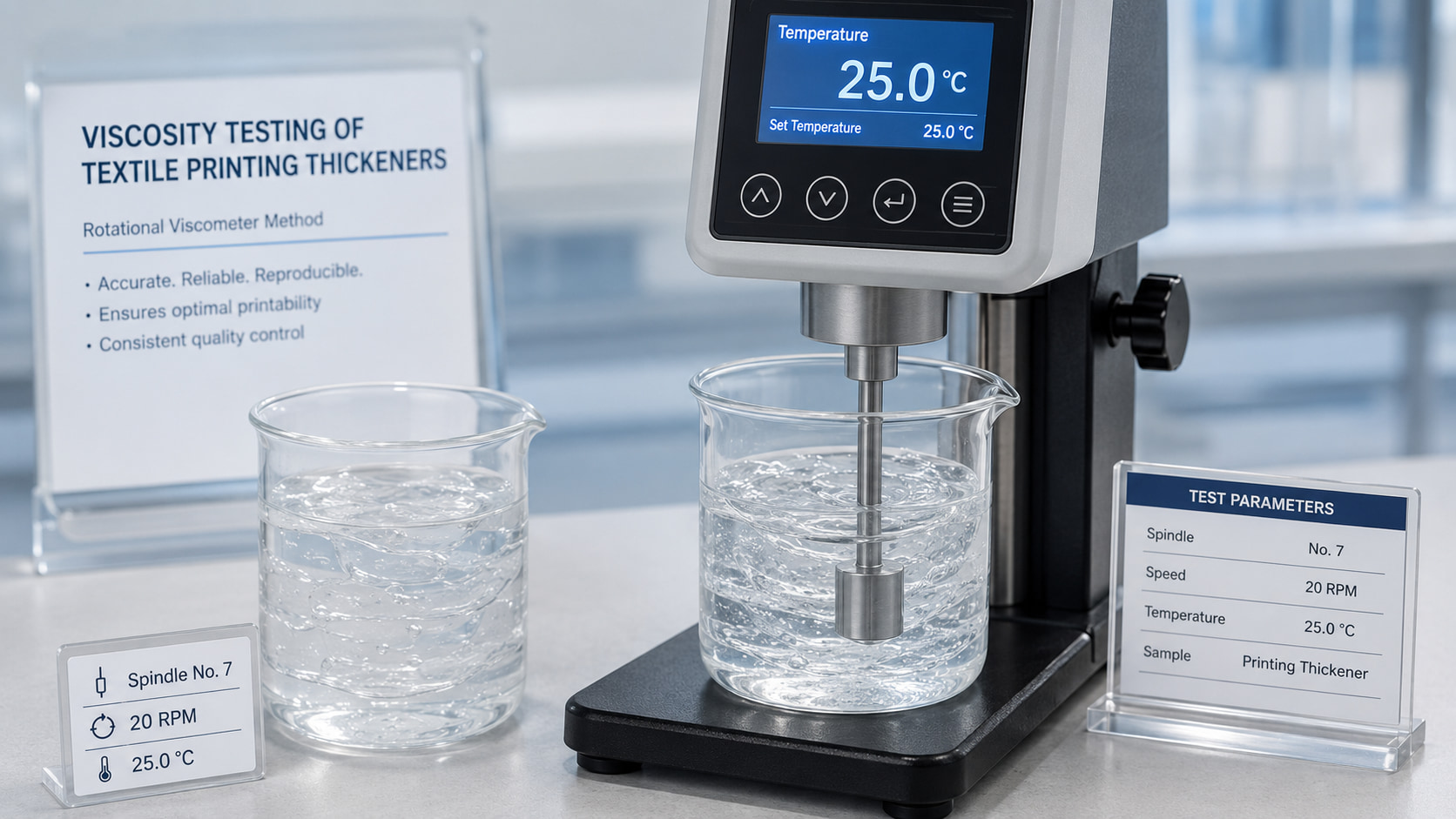
Konsantrasyon, sıcaklık, ölçüm cihazı, mil, hız, hazırlık yöntemi ve test süresi gibi faktörler eşleştirilmeden tekstil baskı kıvamlaştırıcılarının viskozite değerlerinin neden karşılaştırılamayacağını öğrenin.
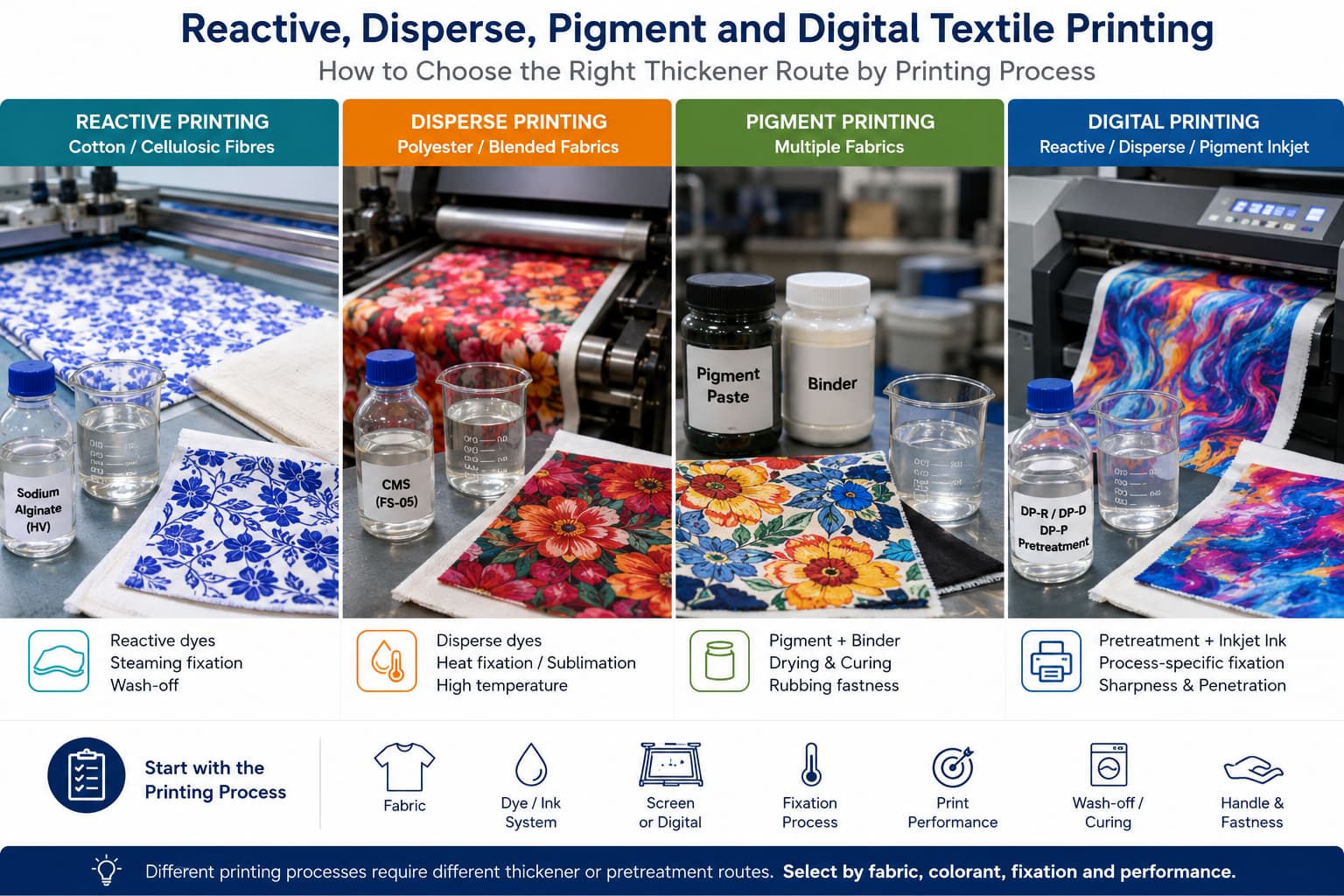
Kumaş, boya veya mürekkep, fiksaj, yıkamayla uzaklaştırılabilirlik ve baskı kalitesi gereksinimlerine göre reaktif, dispers, pigment ve dijital tekstil baskısı için kıvamlaştırıcı ve ön işlem seçeneklerini nasıl seçeceğinizi öğrenin.
Tekstil baskısı için CMC, CMS, sodyum aljinat ve dijital baskı patını karşılaştırın. Her ürün seçeneğinin reaktif, dispers, pigment ve dijital baskı süreçlerine nasıl uygun olduğunu ve alıcıların numune testi, ürün sınıfı eşleştirme ve toplu satın alma öncesinde neleri incelemesi gerektiğini öğrenin.
Sodyum aljinat, tekstil baskısında reaktif baskı patı için kararlı ve yıkamayla uzaklaştırılabilir bir kıvamlaştırıcı olarak yaygın kullanılır. Satın almadan önce viskozite sınıfını, saflığı ve uygulamaya uygunluğu nasıl değerlendireceğinizi ve FSX Chemical’ın teknik veriler ve numunelerle küresel alıcılara nasıl destek sağladığını öğrenin.
Choose CMC for textile printing by application, DS, viscosity method and formulation trials. Use a practical checklist to compare grades before bulk purchase.
Karboksimetil selüloz, su bazlı mürekkeplerde, gravür baskıda ve inkjet baskı ön işleminde kıvamlaştırıcı ve stabilizatör olarak kullanılır. Bu kılavuz, satın alma ekipleri için temel ürün sınıfı parametrelerini ve tedarikle ilgili hususları ele alır.
CMC bazlı baskı patı, pigmentli, reaktif ve dijital tekstil baskı alanlarında kullanılmaktadır. Bu kılavuzda, hangi parametrelerin önemli olduğu, tedarikçilerin nasıl karşılaştırılacağı ve toplu sipariş vermeden önce nelerin talep edilmesi gerektiği açıklanmaktadır.
Sodyum aljinat ve CMC, tekstil baskısında kıvamlaştırıcı olarak kullanılır; ancak farklı boyarmadde sistemlerine ve proses koşullarına uygundur. Bu kılavuz, temel farkları ve her birinin ne zaman kullanılacağını açıklar.
Food-grade and industrial-grade CMC labels do not define one universal DS, viscosity or purity comparison. Textile buyers should verify grade-specific assay and methods, then test the complete formulation; food-contact or pharmaceutical use needs separate, applicable documentation.
Prepare sodium alginate printing paste with a grade-specific concentration and controlled powder dispersion. Validate hydration, viscosity, filtration, air removal and holding time before production.
Separate reactive dye fixation from retained color and fastness. Review alginate preparation, application, alkali, paste age, steaming and wash-off through defined control comparisons; shade or rinse color alone does not establish fixation percentage.
Mesh size describes sodium alginate powder particle size, not final viscosity or print quality. Compare dispersion, hydration, retained matter and complete-paste performance under a defined method.
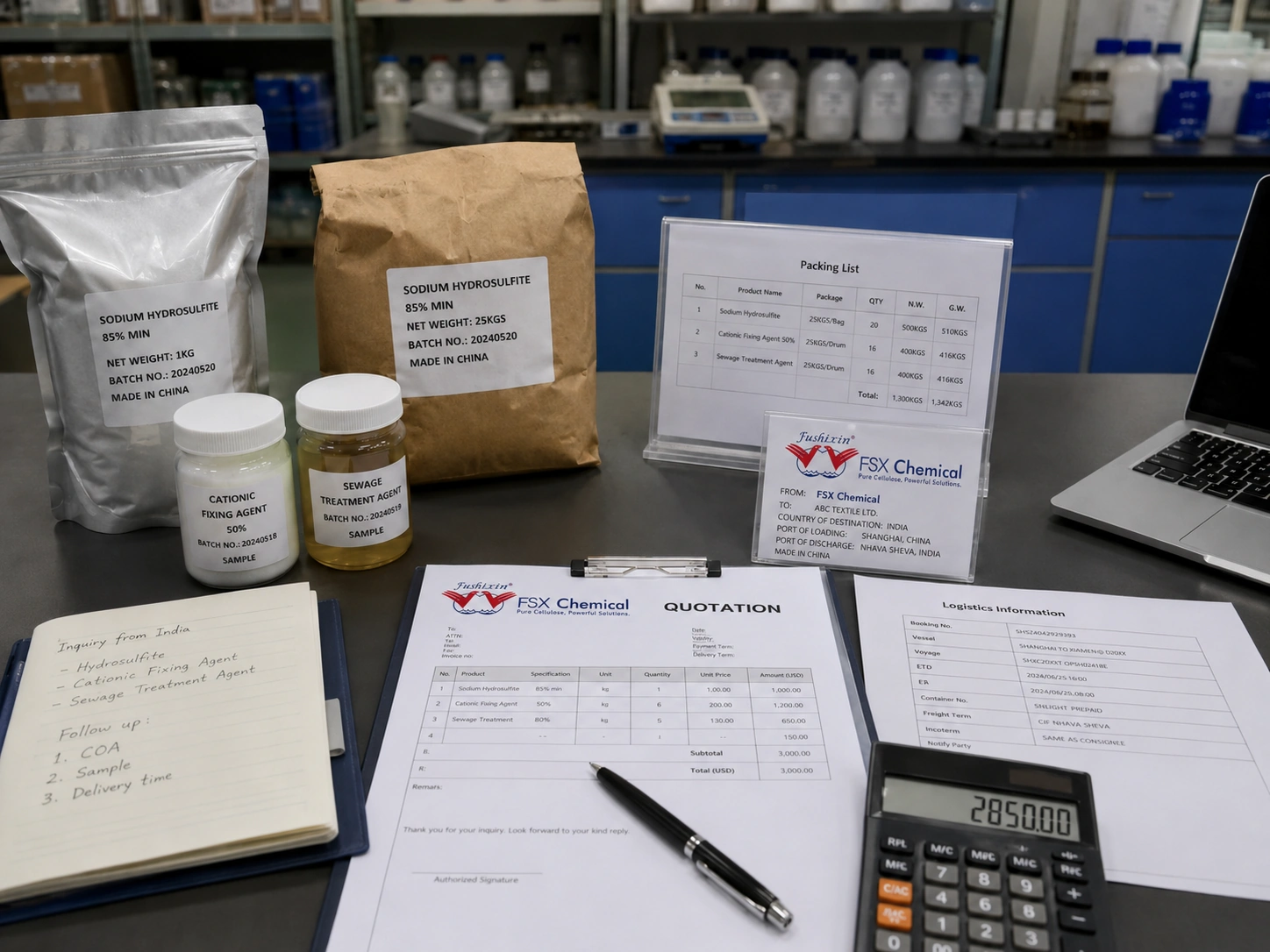
Ürün adını, uygulama alanını, miktarı, teslimat yerini ve elinizdeki TDS, numune fotoğrafı veya belgeleri paylaşın. FSX Chemical bu bilgileri inceleyerek fiyat teklifi, numune karşılaştırması veya ürün seçimi için bir sonraki adımı önerecektir.
Ürün BilgileriÜrün adı, sınıfı, modeli, etiket fotoğrafı veya tedarikçi referansı.
Mevcut BelgelerTDS, SDS, COA, numune fotoğrafı, ürün listesi veya test verileri.
Sipariş DetaylarıTahmini miktar, ambalaj, varış ülkesi, liman veya teslim şekli.
Uygulama veya SorunTekstil baskı süreci, formülasyon gereksinimi, mevcut sorun veya hedeflenen performans.