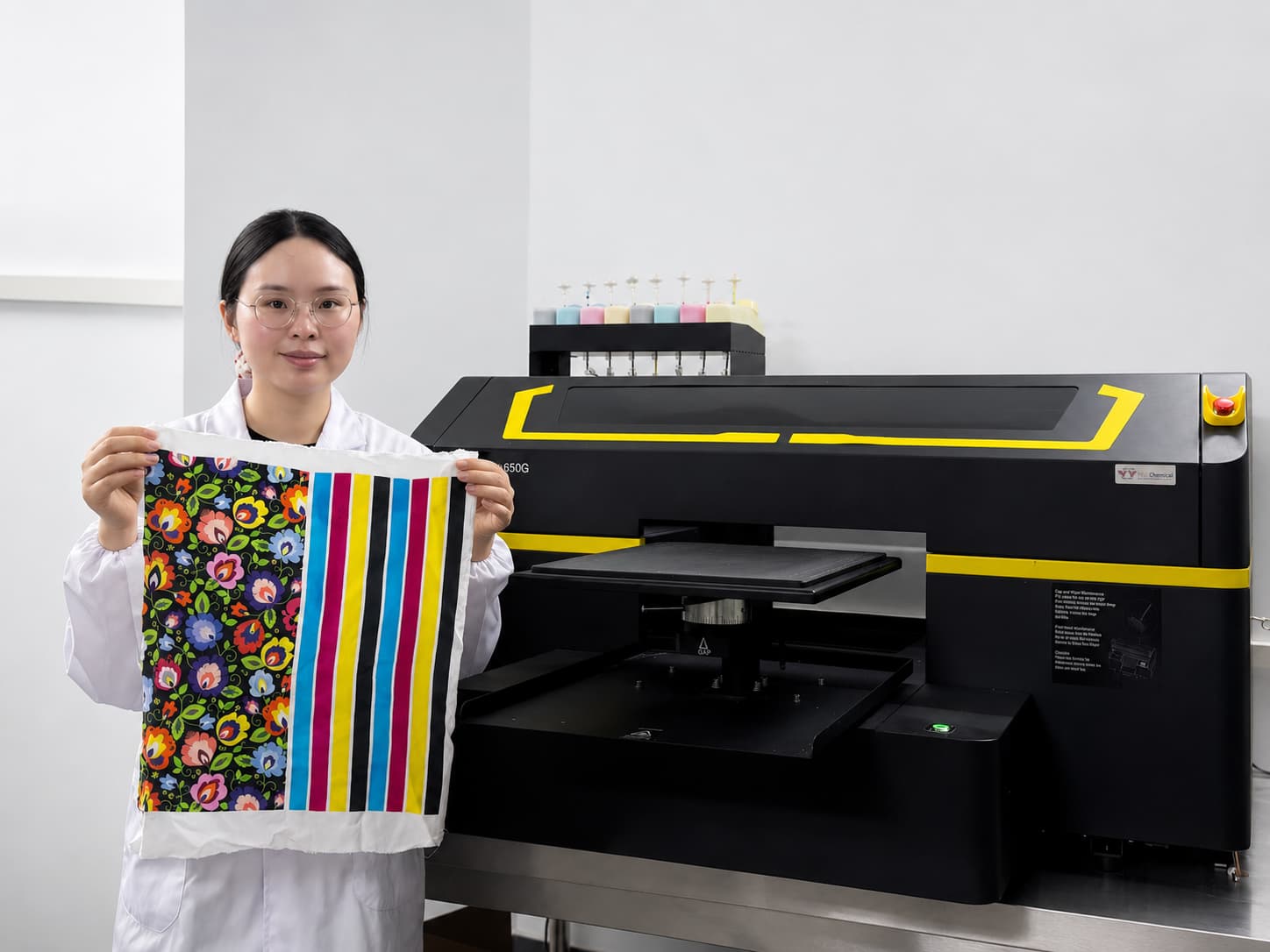
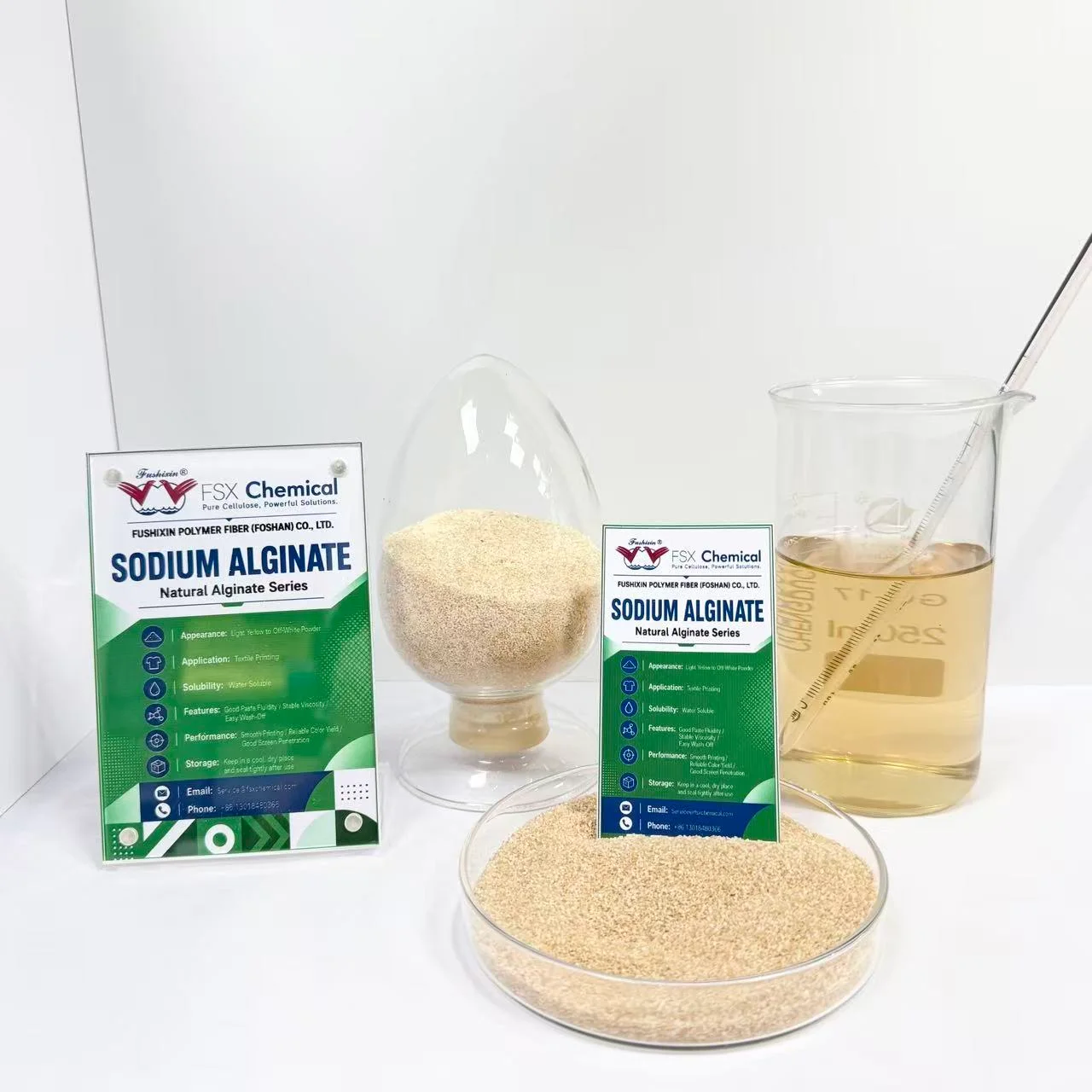
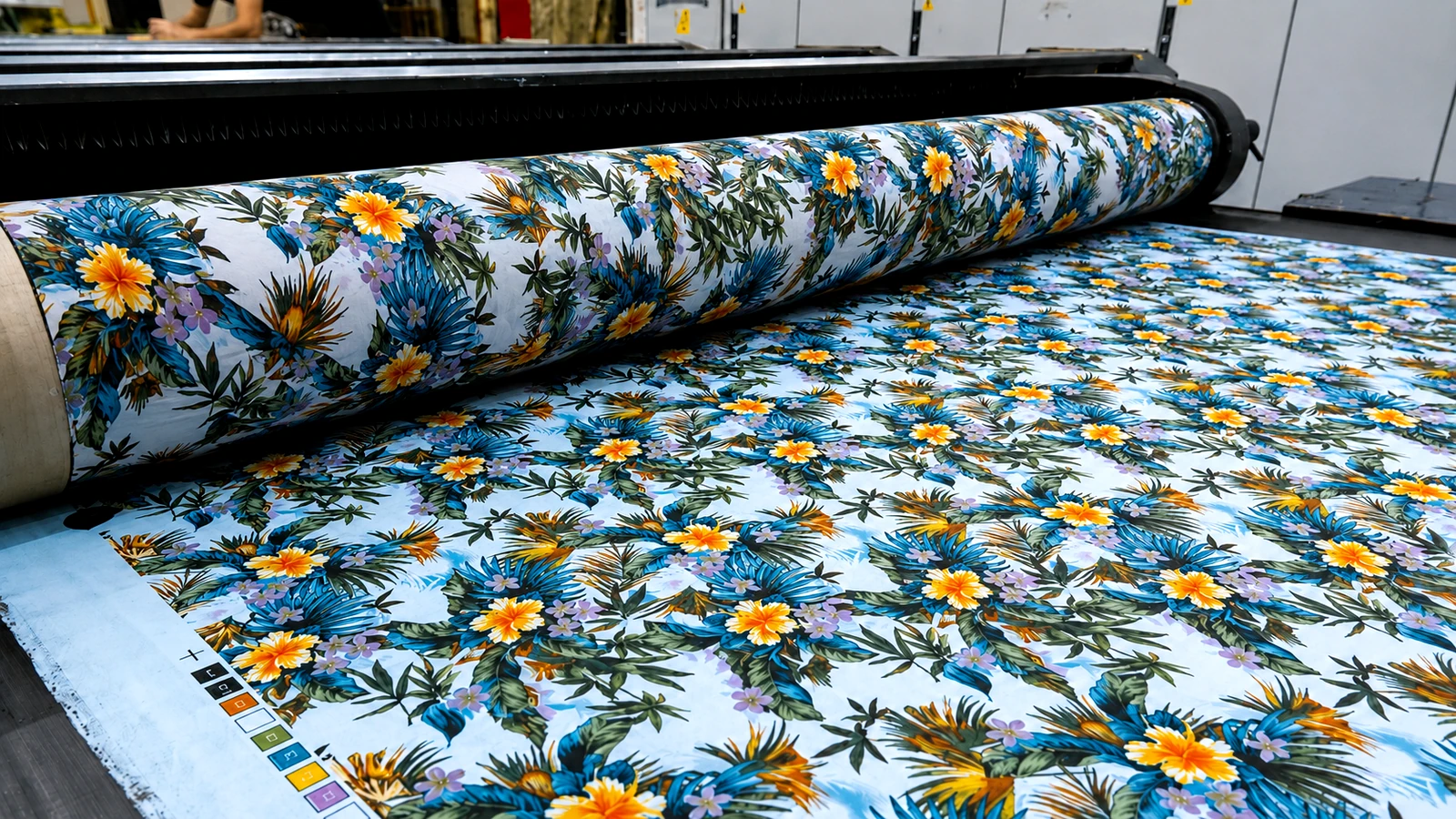
Compare the Best Textile Printing Thickeners for High-Precision Results
The best textile printing thickener is not determined by viscosity alone. This guide compares sodium...
High-precision textile printing requires more than a thick paste. The printing system must transfer a controlled amount of color to the fabric, reproduce fine lines, limit unwanted spreading and remain stable throughout preparation, storage and machine operation.
Different thickener technologies achieve these objectives in different ways. Sodium alginate is an important benchmark for reactive printing, synthetic thickeners are widely evaluated in pigment and specialized systems, while CMS, CMC and compound formulations can provide useful rheology-adjustment routes in selected applications.
Digital textile printing requires a separate selection approach. In many inkjet processes, the thickening function is part of a fabric pretreatment rather than a conventional color paste.
There is therefore no universal best textile printing thickener. The best choice is the grade that produces the required precision in the customer’s actual fabric, colorant, formulation, machine and post-treatment process.
What Does High-Precision Textile Printing Require?
High-precision printing means that the printed design is reproduced with controlled edges, consistent coverage and the intended level of penetration. The exact standard depends on the fabric, design, printing equipment and customer specification.
A fine geometric pattern may require sharply defined edges, while a solid area may require uniform coverage without visible mottling. A lightweight fabric may also require a different paste-transfer balance from a heavy or highly absorbent textile.
Controlled flow through the printing equipment
The paste must move when it is exposed to mixing, pumping, squeegee pressure or rotary-screen shear. Excessive resistance can reduce transfer or create uneven application.
At the same time, the paste must not become so fluid that it spreads beyond the intended design after reaching the fabric.
Suitable structural recovery
After the paste passes through the screen, it should recover enough structure to help maintain the printed outline. Recovery that is too slow may contribute to spreading or bleeding.
Excessively rapid or strong recovery may also create problems, including poor leveling, incomplete transfer or visible screen-related marks.
Controlled penetration
Precision does not always mean keeping all color on the fabric surface. The required penetration depends on fabric construction, colorant system, end use and whether the print must appear on one side or through the textile structure.
The thickener should help produce the intended balance between surface definition and penetration.
Repeatable production behavior
A laboratory sample may produce a sharp print once but still be unsuitable for production if its viscosity changes during storage or machine circulation.
High precision requires repeatability from the beginning to the end of the production batch and from the approved sample to commercial supply.
Why There Is No Universal Best Thickener
Textile printing thickeners are selected within a complete chemical and mechanical system. Dye chemistry, pigment binders, salts, alkalis, auxiliaries, water quality and machine shear can all change paste behavior.
A sodium alginate grade that performs well in reactive printing may not be the preferred route for pigment printing. A synthetic thickener designed for a binder system may not provide the required behavior in an alginate- based reactive paste.
Product family does not define the complete grade
Two products sold as sodium alginate, CMS or CMC may have different viscosity ranges, purity, substitution levels, particle size, hydration behavior and electrolyte response.
Buyers should compare permanent commercial grades rather than general chemical names.
High viscosity is not the same as high precision
Viscosity measured at one concentration and rotational speed represents only one test condition. It does not fully describe shear thinning, structural recovery, filtration, paste transfer or behavior on the fabric.
A high-viscosity product may still produce poor screen passage or unsuitable leveling. A lower-viscosity system may deliver better precision when its complete rheological profile matches the process.
The best route must be application-tested
Supplier recommendations can reduce the number of candidates, but final approval should be based on the customer’s controlled laboratory and production-relevant trials.
Quick Comparison of Textile Printing Thickeners
Thickener Route
Strongest Starting Application
Potential Precision Advantage
Main Limitation to Check
Sodyum aljinat
Reactive printing on cotton, viscose and other cellulosic fabrics
Established balance of reactive-dye compatibility, screen behavior, definition and wash-off
Grade variation, hydration, filtration, dosage and supply consistency
Synthetic thickener
Pigment printing and selected specialized formulations
Efficient thickening and adjustable rheology at relatively low addition in suitable systems
Binder compatibility, electrolyte sensitivity, film handle and preparation procedure
Compound or hybrid thickener
Application-specific reactive, pigment or specialized systems
Can balance flow, recovery, chemical tolerance and cost in use
Composition consistency and dependence on the supplier’s complete formulation
Carboxymethyl starch
Selected printing and mixed-thickener formulations
Paste-body adjustment and useful blending flexibility
Possible interaction with reactive dyes and variation between CMS grades
Karboksimetil selüloz
Selected printing, coating and rheology-adjustment applications
Wide viscosity options and useful paste-body control
Not a universal alginate replacement; salt and dye compatibility must be confirmed
Digital printing pretreatment paste
Reactive, pigment or other inkjet textile processes
Controls ink spreading, penetration and pretreatment uniformity
Requires process-specific filtration, ink compatibility and coating control
This table identifies practical starting routes rather than guaranteed rankings. The final result depends on the specific grade and complete printing conditions.
1. Sodium Alginate
Sodyum aljinat is an important benchmark for reactive dye printing on cellulosic textiles. It is commonly evaluated where colorant compatibility, print definition and wash-off must be balanced.
Where sodium alginate is often the best starting route
Reactive printing on cotton
Reactive printing on viscose and related cellulosic fibres
Formulations where clean post-print removal is important
Potential precision advantages
A properly matched alginate grade can provide a useful balance of standing viscosity, flow under screen pressure and recovery after application. This can help control print edges and penetration.
Sodium alginate is also widely used because it is generally suitable for reactive-dye formulations when the grade and process are correctly selected.
Parameters that affect the result
Viscosity grade and measurement method
Polymer composition and molecular-weight distribution
Purity and residual salts
Particle size and hydration behavior
Filtration and undissolved residue
Water hardness and process-water quality
Alkali, salt and dye concentration
Paste holding time and temperature
When sodium alginate may not be the preferred route
Pigment printing, some discharge systems and digital inkjet pretreatment may require different polymer and rheology characteristics. Sodium alginate should not be selected simply because it performs well in reactive screen printing.
2. Synthetic Thickeners
Synthetic thickeners are commonly evaluated in pigment printing and other formulations where efficient viscosity development and compatibility with a binder system are important.
Different synthetic thickeners can have substantially different compositions, neutralization requirements and responses to salts or other formulation ingredients.
Where synthetic thickeners may provide a strong starting route
Selected reactive systems where polysaccharide interaction is a concern
Specialized coating and functional printing formulations
Potential precision advantages
In a correctly formulated system, a synthetic thickener can provide strong standing viscosity while flowing under the shear generated by a screen or squeegee.
The formulator may also adjust the neutralization and dosage to target a specific rheological range.
Main risks to evaluate
Compatibility with the binder and pigment dispersion
Sensitivity to electrolytes and pH
Foam formation during high-speed mixing
Paste recovery after shear
Final fabric handle
Curing and rubbing performance
Correct neutralization and preparation sequence
A synthetic thickener should not be selected only because it achieves high viscosity at a low dosage. The complete pigment paste and cured textile result must be tested.
3. Compound and Hybrid Thickeners
Compound thickeners combine different materials to create an application-specific balance. The formulation may contain natural, modified-natural or synthetic components.
Why compound systems can support precision
One component may provide paste body, another may improve flow under shear, and a third may adjust chemical tolerance or preparation behavior. This approach can be useful when one polymer cannot meet all requirements.
Potential advantages
Customized balance of viscosity and shear response
Improved hydration or preparation convenience
Adjustment of salt, alkali or binder tolerance
Potential reduction of factory-side formulation changes
Application-specific cost and performance balance
Important procurement controls
Buyers should approve a compound thickener under a permanent grade code. The approved sample, TDS, quotation, packaging and COA should refer to the same product.
Because performance depends on the complete blend, replacing one compound product with another based only on viscosity is particularly risky.
Questions to ask the supplier
Which printing process is the grade designed for?
What dosage and preparation method are recommended?
Which dyes, pigments, salts or binders have been evaluated?
What viscosity method is used?
Which batch parameters appear on the COA?
Can the supplier provide a matching sample for the actual formulation?
4. Carboxymethyl Starch
Karboksimetil Nişasta is a modified starch derivative used in selected textile printing and mixed-thickener formulations.
Potential roles in high-precision formulations
Building stock-paste viscosity
Adjusting paste body and flow
Serving as part of a mixed thickener system
Supporting formulation cost adjustment
Providing a starch-derived polymer route
Why grade selection is important
CMS grades can differ in degree of substitution, viscosity, purity, residual salts, particle size and hydration. These differences can affect both rheology and chemical interaction.
Limitations in reactive printing
Some starch-derived thickeners may interact with reactive dyes or become more difficult to remove after fixation. This can influence color response, fabric handle and wash-off.
CMS should therefore be treated as a candidate for formulation testing, not as an automatic one-to-one replacement for sodium alginate.
When a CMS route is worth evaluating
CMS may be relevant when the objective is to develop a mixed thickener, adjust paste body or evaluate a different cost-performance balance. The full dye formulation and final fabric result should remain the approval basis.
5. Carboxymethyl Cellulose
Karboksimetil Selüloz is a cellulose derivative available in different viscosity, substitution and purity ranges.
Potential functions in textile printing
Viscosity development in selected water-based formulations
Paste-body adjustment
Flow control in a blended thickener system
Stabilization of selected coating or pretreatment formulations
Adjustment of handling and application properties
Why CMC is not a direct universal replacement
CMC and sodium alginate have different polymer structures and interactions with dyes, salts and alkalis. A similar viscosity specification does not confirm equivalent reactive-printing performance.
Important CMC grade parameters
İkame derecesi
Viscosity and complete test method
Purity and residual salt content
Nem
pH
Particle size and hydration rate
Electrolyte tolerance
Compatibility with the complete color system
CMC is most useful when the supplier and buyer define the exact process problem it is intended to solve.
6. Digital Printing Pretreatment Pastes
High-precision digital textile printing requires a different selection route from conventional screen-printing paste. In many inkjet systems, fabric pretreatment controls how ink droplets spread, penetrate and remain positioned on the textile surface.
A dedicated Dijital Baskı Macunu should be selected according to ink chemistry, fabric, application method, drying, fixation and washing.
Precision requirements in digital pretreatment
Uniform pickup across the fabric width
Controlled ink spreading
Appropriate surface penetration
Fine filtration and low residue
Compatibility with the ink and printhead process
Stable storage and coating behavior
Acceptable fabric handle after treatment
Why higher viscosity may reduce digital performance
A pretreatment that is too thick may coat unevenly, create excessive surface film or become difficult to filter and apply. The ideal viscosity depends on whether the process uses padding, coating, spraying or another application system.
Digital precision must be evaluated as a complete system
Fabric absorbency, pretreatment pickup, drying, ink droplet size, resolution, fixation and washing all influence the final image.
A pretreatment product cannot guarantee high resolution independently of these other variables.
Best Thickener Route by Printing Process
Baskı Süreci
Recommended Starting Route
Main Precision Criteria
Critical Trial
Reactive screen printing on cotton
Sodium alginate or a validated reactive compound thickener
Edge definition, dye compatibility, penetration and wash-off
Full reactive paste and washing trial
Reactive rotary printing
Sodium alginate or a high-speed matched compound system
Flow under shear, recovery, pumping and long-run stability
Machine-speed production trial
Pigment screen printing
Synthetic or binder-compatible compound thickener
Definition, binder compatibility, handle and rubbing performance
Complete paste, curing and fastness trial
Mixed or cost-optimized reactive formulation
Alginate-CMS or another validated hybrid route
Color response, rheology, wash-off and fabric handle
Several shades and blend ratios
Selected coating or auxiliary formulation
CMC, CMS or application-specific compound thickener
Coating uniformity, stability and downstream compatibility
Actual coating-equipment trial
Reaktif dijital baskı
Dedicated reactive digital pretreatment paste
Ink control, coating pickup, definition and wash-off
Actual ink, fabric and printer test
Digital pigment printing
Dedicated pigment pretreatment and binder-compatible system
Droplet control, curing, handle and durability
Printing, curing, rubbing and washing tests
These recommendations identify the most practical starting route. They do not replace grade-specific testing.
Technical Parameters That Control Precision
Viscosity under a defined method
Every viscosity result should state concentration, preparation method, hydration time, temperature, instrument, spindle and rotational speed.
Results from different methods should not be compared directly without a validated correlation.
Kesme incelmesi davranışı
A printing paste usually needs to become easier to move under screen or squeegee shear. The degree of shear thinning should suit the machine and design.
Recovery after shear
Recovery helps the paste maintain the printed shape after transfer. Recovery should be evaluated under a controlled procedure and confirmed through printing.
Yield behavior and paste hold
Sufficient structure at low stress can help prevent unwanted flow while the paste is standing. Excessive structure can make pumping or transfer more difficult.
Filtration and screen residue
Undissolved particles, gels or contamination can create blocked screens, missing details and unstable paste transfer. Filtration should be evaluated using a method relevant to the production equipment.
Macun stabilitesi
Measure the paste after the normal production holding time. A grade that meets viscosity immediately after mixing may drift before printing begins.
Chemical compatibility
Test the thickener with the actual dye, pigment, binder, salt, alkali and auxiliaries. A water-only viscosity test is insufficient for approval.
Fabric interaction
Fabric absorbency, construction, weight, pretreatment and surface condition affect spreading and penetration. Use representative production fabric in the trial.
How to Run a Side-by-Side Thickener Trial
Step 1: Define the precision target
Identify whether the main objective is fine-line definition, reduced spreading, controlled penetration, uniform solid coverage or improved long-run consistency.
Step 2: Select a representative reference
Use the current approved production grade and a properly stored sample as the control.
Step 3: Standardize preparation
Use the same water source
Use the same concentration basis
Use identical mixing equipment and containers
Control mixing speed and time
Control hydration and resting time
Measure all samples at the same temperature
Step 4: Complete initial screening
Powder wetting and lump formation
Su içme zamanı
Viscosity under the agreed method
Filtration and residue
Foam, separation or settling
Viscosity after the normal holding period
Step 5: Test the complete color paste
Add the actual dyes, pigments, binders, salts, alkalis and auxiliaries. Change only one main variable at a time during the first comparison.
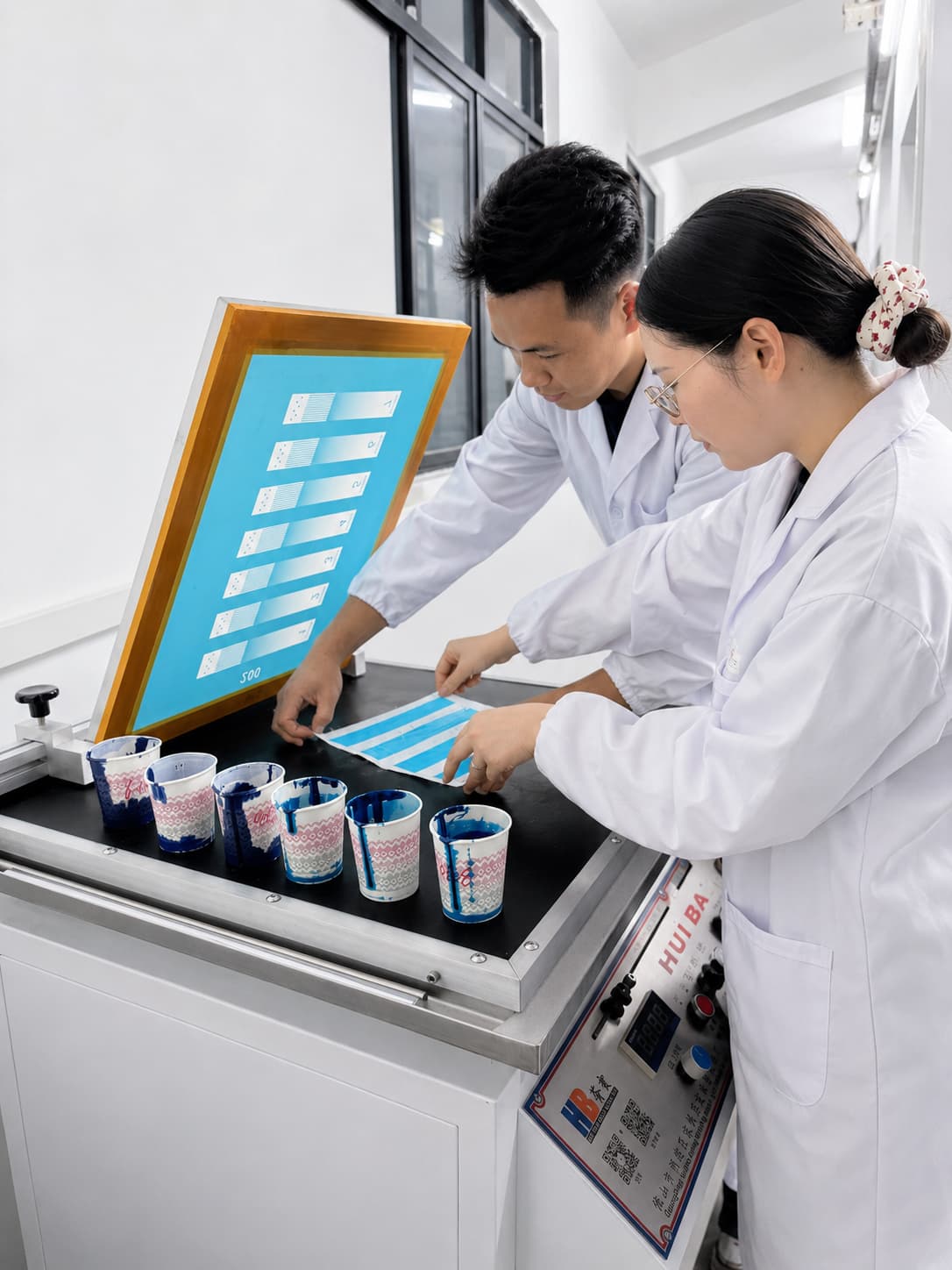
Step 6: Print a precision test pattern
Include fine lines, small text, sharp corners, closely spaced elements, solid areas and gradients where relevant to the production process.
Step 7: Evaluate machine behavior
Screen passage or coating behavior
Paste transfer
Foam and filtration
Machine cleaning
Consistency over the trial length
Need for water or thickener correction
Step 8: Evaluate the final textile
Kenar tanımı
Bleeding and spreading
Penetrasyon
Coverage and levelness
Shade response
Wash-off or curing performance
Kumaş sap
Relevant fastness requirements
Step 9: Repeat under more than one condition
Where practical, test a light shade, a dark shade and more than one representative fabric or design. One successful sample may not cover the full production range.
Step 10: Verify the commercial batch
Link the approved sample to a permanent grade code and specification. Confirm the first commercial shipment before releasing it for routine production.
How to Compare Cost in Use
The lowest-priced thickener is not automatically the most economical option for precision printing. A cheaper product may require a higher dosage or create additional preparation, cleaning and rework.
Include these cost factors
Thickener dosage per paste batch
Karıştırma ve su emme süresi
Heating or cooling requirements
Filtration and screen-cleaning labor
Unused or rejected paste
Machine interruptions
Water and post-treatment requirements
Rejected or reprocessed fabric
Technical support and batch documentation
Compare at equal quality
Cost comparisons are valid only when the candidate and reference meet the same print-definition, shade, fastness, handle and production requirements.
A lower-cost paste that produces unacceptable edges or additional reprocessing is not a true saving.
Procurement Checklist
Documents to request
Current Technical Data Sheet
Current Safety Data Sheet
Permanent product and grade code
Complete viscosity test method
Recommended application and preparation procedure
Representative sample
Batch-specific Certificate of Analysis
Valid supporting documents for any compliance claim
Application information to send the supplier
Fabric and fibre composition
Reactive, pigment, disperse, acid or digital process
Boya, pigment veya mürekkep sistemi
Printing machine and normal speed
Current thickener and dosage
Target viscosity and test method
Water quality and paste-preparation procedure
Main precision problem
Fixation, curing and washing process
Required final textile result
Supplier questions
Which grade is recommended for this exact printing system?
Why is this grade preferred over the other available grades?
Can the supplier review the current TDS or reference sample?
Can matching samples be supplied for side-by-side testing?
How is sample-to-bulk consistency controlled?
Which parameters are checked for each production batch?
How are technical complaints investigated?
Common Selection Mistakes
Choosing by viscosity alone
One viscosity value does not describe shear response, recovery, filtration or print behavior.
Assuming one thickener is best for every process
Reactive, pigment and digital printing have different chemical and rheological requirements.
Using a water-only test for final approval
Dyes, salts, alkalis, binders and auxiliaries can change the final paste substantially.
Comparing samples prepared by different methods
Different water, mixing, temperature or hydration conditions can create an apparent product difference.
Evaluating only one shade
A grade that works in a light formulation may behave differently in a dark shade with a higher colorant or electrolyte load.
Ignoring the final fabric handle
Sharp printing is not sufficient if the thickener or binder system leaves unacceptable stiffness or residue.
Buying an unnamed matching sample
Every approved sample should be connected to a repeatable commercial grade and specification.
Comparing price before dosage and production performance
Price per kilogram does not represent total cost per printed metre or per acceptable production batch.
FSX Chemical’ın Sınıf Eşleştirmeyi Nasıl Desteklediği
FSX Chemical supplies sodium alginate, CMS, CMC and digital printing paste for different textile printing requirements. Candidate grades can be reviewed according to the customer’s fabric, colorant system, formulation, machine and precision target.
Current definition, penetration or stability problem
Required packaging, volume and destination
Technical support may include
Review of the current product specification
Selection of a suitable starting thickener route
Recommendation of a matching grade
Provision of relevant TDS and SDS documents
Representative samples for comparative testing
Guidance for standardized laboratory preparation
Review of printing-trial feedback
Batch documentation for the selected commercial grade
A recommended grade should be treated as a candidate for evaluation rather than a guaranteed direct replacement. Final approval depends on the customer’s complete printing process📧 E-posta: Service@fsxchemical.com
Sodyum aljinat, tekstil baskıcılığında reaktif baskı macunu için kararlı ve yıkanabilir bir kıvam arttırıcı olarak yaygın olarak kullanılmaktadır. Satın almadan önce viskozite derecesini, saflığı ve uygulamaya uygunluğu nasıl değerlendireceğinizi öğrenin; ayrıca FSX Chemical’ın teknik veriler ve numunelerle küresel alıcılara nasıl destek sağladığını keşfedin.
Karboksimetil selüloz (CMC), tekstil ürünlerinin baskı, apre ve boyama işlemlerinde yaygın olarak kullanılmaktadır. Bu kılavuzda, CMC türlerinin nasıl değerlendirileceği, hangi parametrelerin en önemli olduğu ve FSX Chemical’ın satın alma kararlarında nasıl destek olabileceği açıklanacaktır.
Karboksimetil selüloz, su bazlı mürekkeplerde, gravür baskıda ve mürekkep püskürtmeli baskı ön işlemlerinde kıvam arttırıcı ve stabilizatör olarak kullanılır. Bu kılavuz, satın alma ekipleri için temel kalite parametrelerini ve tedarikle ilgili hususları ele almaktadır.
Doğru CMC tedarikçisini seçmek, sadece fiyatları karşılaştırmaktan ibaret değildir. Bu kılavuz, satın alma ekiplerinin toplu sipariş vermeden önce uymaları gereken değerlendirme kriterlerini, belge kontrol listesini ve deneme sürecini ele almaktadır.
Hem sodyum aljinat hem de CMC, tekstil baskısında kıvam arttırıcı olarak kullanılır; ancak bunlar farklı boyama sistemlerine ve işlem koşullarına uygundur. Bu kılavuzda, aralarındaki temel farklar ve her birinin ne zaman kullanılması gerektiği açıklanmaktadır.
Tekstillerde dijital mürekkep püskürtmeli baskı, serigrafi baskıya kıyasla farklı macun ve ön işlem gereksinimlerine sahiptir. Bu kılavuz, dijital tekstil baskısında sodyum aljinatın nasıl kullanıldığını ve tedarik ekiplerinin hangi kalite parametrelerini belirtmeleri gerektiğini açıklamaktadır.
Gıda sınıfı ve endüstriyel sınıf CMC, aynı temel kimyasal yapıya sahiptir ancak saflık, DS aralığı ve yasal gereklilikler açısından önemli farklılıklar gösterir. Bu kılavuz, temel farklılıkları ve yanlış sınıfın kullanılmasının neden üretim sorunlarına yol açtığını açıklamaktadır.
Reaktif boya ile tekstil baskısında, macunun doğru şekilde hazırlanması, renk tonu seçimi kadar önemlidir. Bu kılavuzda sodyum aljinatın çözünme yöntemleri, uygulamaya göre konsantrasyon aralıkları, saklama koşulları ve hazırlık aşamasında sık karşılaşılan sorunların nasıl giderileceği ele alınmaktadır.
Sodyum aljinat, doğal ve biyolojik olarak parçalanabilir bir polimerdir; ancak tekstil baskısında kullanılması, yönetilmesi gereken atık su oluşumuna neden olmaktadır. Bu kılavuz, sodyum aljinatın çevresel profilini, yıkama atık sularının özelliklerini ve tedarik ekiplerinin kıvam arttırıcı seçimi ve çevresel etki konusunda bilmesi gerekenleri ele almaktadır.
Reaktif boya baskısında boya sabitlenme oranı, renk verimini, yıkama haslığını ve atık su yükünü doğrudan etkiler. Bu kılavuzda, sodyum aljinatın boya sabitlenmesini nasıl desteklediği, hangi macun parametrelerinin sabitlenme oranını etkilediği ve üretimde düşük sabitlenme sorunlarının nasıl giderileceği açıklanmaktadır.
Sodyum aljinatın parçacık boyutu (mesh), tozun ne kadar hızlı çözündüğünü, ne kadar homojen bir şekilde su emdiğini ve elde edilen macunun serigrafi baskısında nasıl bir performans gösterdiğini etkiler. Bu kılavuz, tekstil baskı macunu uygulamalarında mesh değerinin pratik sonuçlarını açıklamaktadır.
Reaktif boya ile tekstil baskısında, macunun doğru şekilde hazırlanması, renk tonu seçimi kadar önemlidir. Bu kılavuzda sodyum aljinatın çözünme yöntemleri, uygulamaya göre konsantrasyon aralıkları, saklama koşulları ve hazırlık aşamasında sık karşılaşılan sorunların nasıl giderileceği ele alınmaktadır.
Ürün adını, kullanım alanını, miktarı, teslimat yerini ve elinizde bulunan TDS,
örnek fotoğraf veya belgeleri bizimle paylaşın. FSX Chemical bu
bilgileri inceleyerek fiyat teklifi, numune eşleştirme
veya ürün seçimi için atılması gereken bir sonraki adımı önerecektir.
Ürün BilgileriÜrün adı, sınıfı, modeli, etiket fotoğrafı veya tedarikçi referansı.
Mevcut BelgelerTDS, SDS, COA, numune fotoğrafı, ürün listesi veya test verileri.
Sipariş DetaylarıTahmini miktar, ambalaj, varış ülkesi, liman veya ticaret şartı.
Başvuru veya SorunTekstil baskı süreci, formülasyon gereksinimi, mevcut sorun veya hedeflenen performans.

 TR
TR  EN
EN  BN
BN  ES
ES  FR
FR  ID
ID  RU
RU  AR
AR  UR
UR