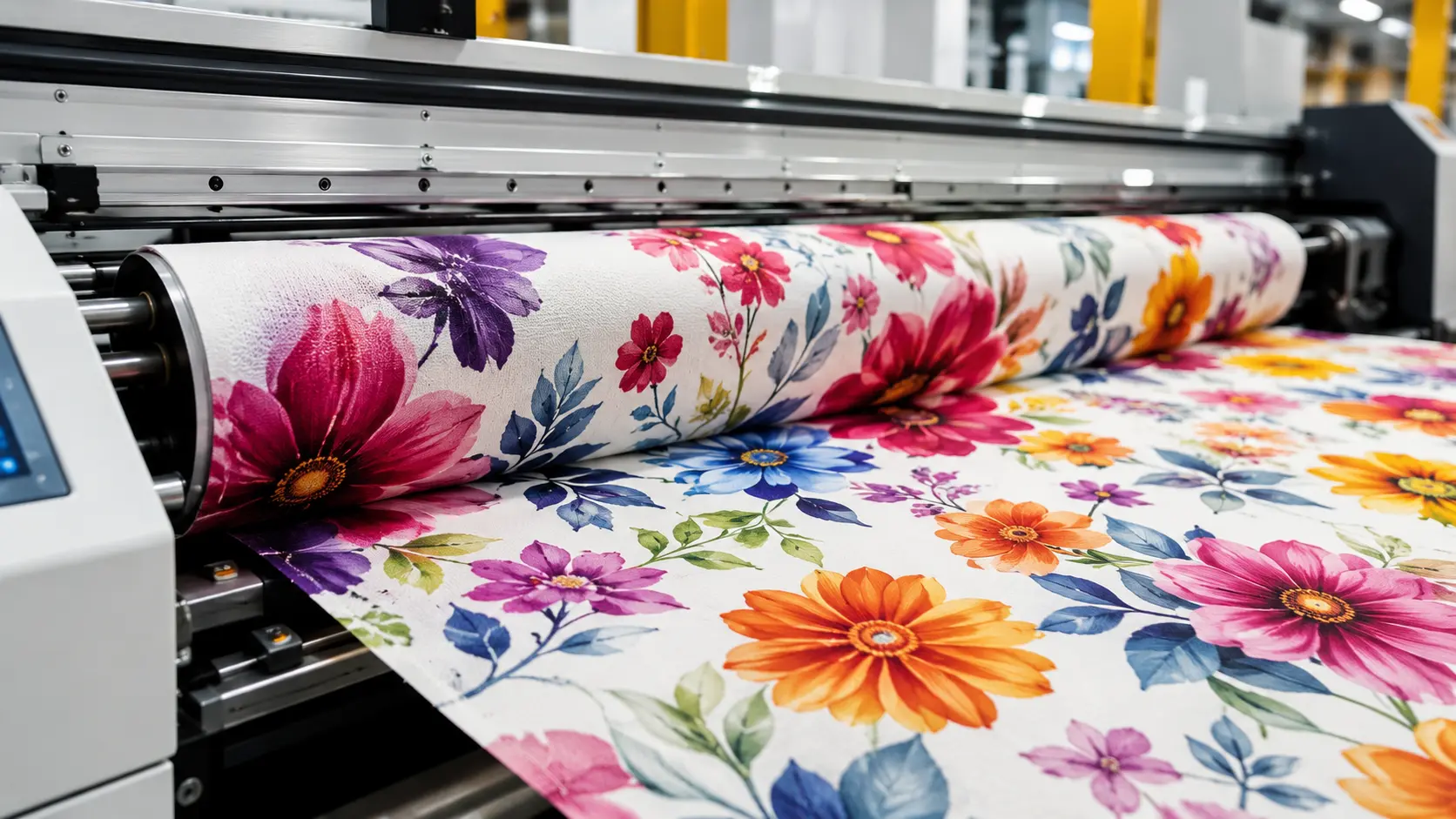
Thermofixation for Direct Disperse Inkjet Printing: How Temperature and Time Interact with Pretreatment Chemistry
Thermofixation is the stage where direct disperse inkjet printing changes from a surface-deposited image into...
Thermofixation is the stage where direct disperse inkjet printing changes from a surface-deposited image into a dyed polyester structure. Temperature increases molecular mobility in polyester and accelerates disperse-dye diffusion, while time determines how long that diffusion can continue. But temperature and time do not act on the dye alone. They also act on the pretreatment polymer, residual auxiliaries, fabric structure and any surface film that was created before printing. A pretreatment that gives excellent pre-fixation sharpness can still reduce final color yield if it holds too much dye at the surface, while an aggressive thermofixation condition can increase diffusion yet also change migration, shade, surface residue or fabric dimensions. The correct process therefore matches disperse-dye class, polyester construction and pretreatment chemistry inside a validated temperature–time window rather than using one universal thermofixation recipe.
How Do Temperature and Time Interact with Pretreatment Chemistry?
Thermofixation should be viewed as a coupled dye–polyester–pretreatment process.
A useful process chain is:
Pretreatment → Pretreatment Drying → Direct Inkjet Printing → Post-Print Stabilization / Drying Where Required → Thermofixation → Reduction Clearing / Washing → Final Print
During thermofixation:
Heat increases the mobility of polyester molecular segments in accessible amorphous regions.
Disperse dye molecules gain mobility and diffuse from the printed surface into the polyester.
Pretreatment polymers and auxiliaries remain around or on the textile surface and can influence how easily dye leaves that surface environment.
Therefore:
Temperature × Time × Dye Class × Pretreatment Chemistry × Polyester Structure
must be considered together.
There is no universal temperature and time that is correct for every direct disperse ink, polyester fabric and pretreatment.
Where Thermofixation Sits in Direct Disperse Inkjet Printing
Direct-to-fabric disperse inkjet printing normally separates image formation from final dye fixation.
The printer deposits an aqueous disperse ink accurately onto the polyester surface.
Before fixation, much of the dye is still concentrated in or near:
The dried ink deposit
The pretreatment layer
The fiber surface
Thermofixation supplies the thermal energy needed to move the disperse dye into the polyester phase.
This is why a pattern can look sharp immediately after printing but still have:
Low final K/S
High surface dye
Poor rubbing fastness
after washing if fixation is insufficient.
Direct Disperse Thermofixation Is Not Sublimation Transfer
This article focuses on direct disperse inkjet printing on polyester fabric.
In sublimation transfer:
Ink is first printed on paper.
Heat transfers dye from paper into polyester.
In direct disperse inkjet printing:
Ink is deposited directly on polyester.
The fabric may already contain a pretreatment polymer and auxiliaries.
Thermofixation must move dye from that printed textile surface into PET.
The pretreatment–fixation interaction is therefore much more direct in the fabric-printing route.
What Happens to Disperse Dye During Thermofixation?
Disperse dyes have low water solubility and affinity for hydrophobic polyester.
At elevated temperature, molecular mobility in the less-ordered regions of PET increases, making dye diffusion into the polymer more favorable.
The simplified mechanism is:
Surface Dye → Molecular Mobility / Desorption → Diffusion into Accessible PET Regions → Retention inside Polyester
This is a kinetic process.
The final result depends on:
Dye molecular structure
Sıcaklık
Zaman
Polyester morphology
Pretreatment surface environment
1. Temperature Controls the Rate of Dye Diffusion
As fixation temperature rises within a suitable range, disperse-dye diffusion into polyester generally accelerates.
This can increase:
Color strength
Dye penetration
Removal resistance during after-treatment
Published direct-polyester inkjet work illustrates this strongly: one pretreatment system showed much higher K/S at higher fixation temperatures than at a substantially lower temperature.
But this does not mean:
Higher Temperature Is Always Better.
The optimum depends on dye class, fabric and pretreatment chemistry.
2. Time Controls How Long Diffusion Continues
At a given temperature, longer time generally provides more opportunity for dye diffusion.
If time is too short:
More dye can remain near the fiber surface.
Post-wash K/S can remain below its achievable level.
Surface / rubbing fastness can be weaker.
But simply extending time indefinitely is not an efficient control strategy.
The production target is the shortest stable residence time that gives the required:
Renk verimi
Fastness
Shade
Fabric quality
3. Temperature and Time Are Coupled, but Not Perfect Substitutes
A higher temperature can often achieve a similar or stronger fixation response in less time.
A lower temperature may require longer time.
However:
Temperature × Time Is Not a Simple Interchangeable Number.
Different thermal conditions can change:
Dye diffusion rate
Dye sublimation / migration tendency
Pretreatment-film behavior
Polyester dimensional response
For example, published polyester inkjet research compared combinations including lower-temperature / longer-time and higher-temperature / shorter-time conditions, and the K/S response did not increase indefinitely with thermal severity.
Therefore, optimize a two-dimensional temperature–time window rather than one variable alone.
What Happens When Temperature Is Too Low?
Olası belirtiler şunlardır:
Low post-wash K/S
Large amount of removable surface dye
Weak dry / wet rubbing fastness
Good pre-fixation appearance but poor final color
If the print is sharp before fixation but weak after reduction clearing, insufficient dye diffusion is a stronger suspect than pretreatment sharpness.
What Happens When Time Is Too Short?
A short thermal exposure can produce symptoms similar to low temperature:
Incomplete dye diffusion
Higher floating / removable dye
Lower final color yield
Before increasing pretreatment polymer or ink load, verify whether the existing fixation time allows the selected disperse dye to reach its intended polyester depth.
What Happens When Thermal Severity Is Too High?
Excessive temperature or time can create different risks depending on dye, polymer, fabric and equipment.
Possible effects include:
Unwanted dye migration
Sublimation loss or shade instability for susceptible dyes
Changes in surface-polymer film
Fabric dimensional change
Increased energy cost
One published direct-polyester inkjet study, for example, showed strong K/S at two high-temperature conditions but did not show continuous improvement at the highest tested thermal condition.
The important lesson is:
Do Not Optimize Thermofixation by Maximum Heat Exposure.
What Pretreatment Must Do Before Thermofixation
Before fixation, the pretreatment has already performed its main image-formation job.
It should have helped control:
Lateral ink spreading
Penetrasyon
Printed-line width
Surface color distribution
During thermofixation, that same pretreatment should not prevent an acceptable amount of disperse dye from moving into the polyester.
Therefore, a good direct-disperse pretreatment balances:
Pre-Fixation Surface Hold
with:
Thermal Dye Transfer into Polyester.
Pretreatment Polymer: Sharpness Before Fixation vs. Dye Release During Fixation
Polymeric pretreatments improve sharpness by restricting uncontrolled ink flow on the polyester surface.
But high polymer concentration or an overly continuous film can also retain more disperse dye near the surface.
Research on direct disperse inkjet systems has noted this trade-off: water-borne macromolecular pretreatments help prevent infiltration and improve sharpness, but they can also hinder dye penetration into polyester and increase floating color that must later be washed away.
The correct polymer add-on is therefore:
Enough to Control Spreading, but Not More Than Needed for the Required Surface Localization.
When Polymer Add-On Is Too Low
Before fixation, low polymer add-on can cause:
Wider droplets
Fuzzy edges
Deeper uncontrolled penetration
Thermofixation cannot restore geometric sharpness that was already lost during printing.
If the image is blurred before fixation, changing fixation temperature is usually not the first correction.
When Polymer Add-On Is Too High
Excess polymer can create:
Very strong surface localization
Heavy dried film
More retained surface dye
Greater after-wash demand
The print may look dark and sharp before washing but lose significant color during reduction clearing if a large fraction of the dye never diffused effectively into PET.
This is why pre-wash K/S should not be used alone to approve pretreatment dosage.
Polymer Chemistry Changes the Thermal Response
Different pretreatment polymers do not behave identically when heated.
Possible differences include:
Film oluşumu
Softening behavior
Water retention
Dye affinity
Thermal stability
Common pretreatment routes can use polysaccharides, cellulose derivatives or synthetic / compound polymers.
A thermofixation window validated for one polymer system should not automatically be transferred to another.
Pretreatment Rheology Still Matters During Fixation
Rheology acts mainly before fixation, but its effects continue into thermofixation because it determines:
How much polymer remains on the face
How deeply chemistry penetrates
How uniformly the surface layer dries
Two pretreatments with the same standing viscosity can create different polymer distributions.
Those distributions can then release disperse dye differently during heat fixation.
Therefore:
Same Brookfield Viscosity ≠ Same Thermofixation Response.
Salts and Ionic Auxiliaries
Some published polyester inkjet pretreatments contain salts that alter polymer rheology or surface interaction.
Selected formulations have shown improvements in sharpness and color yield.
But salt effects depend on:
Ion type
Valence
Polimer kimyası
Dozaj
Salt residue also remains present during thermofixation and after-treatment.
Do not copy one literature salt formulation as a universal polyester recipe.
Film-Forming / Crosslinkable Pretreatments
Some specialized polyester pretreatments contain latex, resin or crosslinkable chemistry.
For these systems, the fixation heat can perform two functions simultaneously:
Promote disperse-dye diffusion into PET
Change or cure the pretreatment film
Published one-bath polyester inkjet research has shown that pretreatment chemistry and curing temperature/time can interact strongly with final K/S and surface properties.
This is an important boundary:
A Thermofixation Window Can Also Be a Pretreatment-Film Reaction Window.
Therefore, supplier-specific instructions matter more for reactive / crosslinkable pretreatment systems.
Pretreatment Drying Is Not Thermofixation
Before printing, pretreatment is commonly dried to create a controlled surface.
This stage primarily removes the pretreatment carrier water and establishes polymer distribution.
It is not the stage where disperse dye is fixed, because no printed disperse dye is present yet.
Keep these settings separate in production records:
Pretreatment drying temperature / time
Thermofixation temperature / time
Confusing the two makes troubleshooting difficult.
Post-Print Drying Is Also a Separate Stage
Some direct disperse processes include drying or stabilization after inkjet printing but before final thermofixation.
Its purpose is to control the wet printed image and handling before high-temperature fixation.
If post-print drying is inadequate, ink can continue to move before thermofixation.
If it is excessively aggressive, the surface deposit can change before dye diffusion begins.
Record this stage independently when it exists.
Residual Moisture Before Thermofixation
The moisture state entering thermofixation affects the early heating phase.
More retained moisture means:
More energy is initially used for water evaporation.
The printed surface can remain mobile for longer.
Actual fabric-temperature rise can lag the chamber setting.
This is why two fabrics exposed to the same nominal thermofixation condition can experience different thermal histories if their incoming moisture differs.
Keep pre-fixation moisture reasonably consistent during a temperature/time study.
Measure Sharpness Before and After Fixation
This is one of the fastest diagnostic tools.
Before Fixation
After Fixation
Likely Direction
Blurred
Blurred
Pretreatment / printing / wet-image control
Sharp
Less sharp
Thermal migration / fixation-stage movement
Sharp
Sharp but weak after washing
Insufficient dye diffusion / fixation
Sharp and dark before wash
Large color loss after clearing
High surface dye / incomplete fixation
Do not use final K/S alone to decide whether the defect began before or during thermofixation.
Thermal Migration During Fixation
When heat is applied, dye and residual formulation components gain mobility.
If the pretreatment surface contains too much unfixed dye or a film with strong dye affinity, heat can change where the dye resides.
Possible effects include:
Edge softening
Surface dye redistribution
Reduced white-ground cleanliness
Thermal migration is dye- and system-specific.
If image geometry changes only after fixation, compare lower and higher thermal severity while keeping pretreatment and printing constant.
How Thermofixation Changes Color Yield
Color yield generally improves as more disperse dye enters and remains in the polyester within the useful fixation window.
Published direct-inkjet polyester work has shown large K/S differences among different temperature/time combinations.
But final K/S is a combined result of:
Initial ink amount
Pretreatment localization
Dye diffusion
After-treatment loss
Always compare post-wash / post-clearing K/S.
How Thermofixation Changes Dye Penetration
Before fixation, disperse dye can remain concentrated near the printable face.
During fixation, dye diffuses into PET.
Higher thermal severity can increase penetration into the fiber phase, but this is not the same as liquid ink penetration through the fabric thickness.
Distinguish:
Liquid Penetration Before Fixation — controlled mainly by ink, pretreatment and fabric structure.
Molecular Dye Diffusion During Fixation — controlled mainly by dye/PET thermal kinetics.
These mechanisms should not be confused.
How Thermofixation Changes Fastness
When more dye becomes incorporated into polyester rather than remaining as loose surface color, resistance to after-treatment and rubbing can improve.
But fastness also depends on:
Dye chemistry
After-treatment quality
Residual surface dye
Fabric / finish
Do not assume high K/S automatically means adequate fastness.
Both should be tested.
Why Reduction Clearing Matters to the Final Evaluation
Many direct disperse printing processes use reduction clearing or another validated wash-off route after heat fixation.
This removes:
Unfixed / surface disperse dye
Residual pretreatment polymer
Other process residues
A thermofixation condition should therefore be approved from the fabric after the normal clearing / washing sequence.
Otherwise, surface dye can make an under-fixed condition appear darker than it really is.
Different Disperse Dyes Need Different Thermal Windows
Disperse dyes differ in:
Molecular size
Energy class
Sublimation fastness
Diffusion behavior
Thermal stability
A thermofixation condition developed for one red dye is not automatically correct for:
Another red
Blue
Black mixture
A different ink supplier
Multi-color production should be validated with the most demanding shade / ink set, not only one convenient laboratory color.
Polyester Construction Changes the Thermofixation Window
Fabric construction changes heat transfer and dye distribution.
Important variables include:
GSM
Thickness
Filament count
Porosity
Stretch
Therefore, a fixation setting should be validated on the real production fabric rather than on polyester fiber identity alone.
Woven Polyester
Stable woven fabrics can show relatively predictable residence and dimensional behavior.
But dense woven construction can require different heat penetration from lightweight open weave.
Check:
Face / back shade
Dimensional change
Post-clearing K/S
Knitted Polyester
Knits can respond strongly to heat and tension.
Thermofixation can interact with:
Width setting
Relaxation
Stretch
GSM
Record fabric dimensions together with color results during scale-up.
Microfiber Polyester
Fine-filament polyester has high surface area and can display different dye uptake and thermal response from conventional filament fabric.
Do not transfer a coarse-filament thermofixation window directly to microfiber without testing.
Polyester Blends
Polyester blends can impose additional thermal constraints because the second fiber or finish may respond differently to high temperature.
For blends, check:
Thermal tolerance of all fiber components
Dimensional stability
Shade on the polyester component
El
Do not optimize fixation solely for PET if the complete fabric cannot tolerate the condition.
Production Thermofixation Equipment
Laboratory hot-air devices and production stenters / fixation units do not create identical thermal histories.
Production adds:
Full-width airflow
Continuous fabric motion
Zone-to-zone temperature profiles
Exhaust and chamber humidity
Kumaş gerginliği
Scale-up should therefore reproduce:
Final post-clearing K/S
Netlik
Fastness
Fabric dimensions
rather than simply copying the laboratory set temperature.
Set Temperature vs. Actual Fabric Temperature
The machine setpoint is not always the fabric temperature.
Actual fabric heating depends on:
Incoming moisture
Fabric mass
Air velocity
Kaldırma süresi
Machine loading
During the early part of the fixation zone, evaporation and heat transfer can delay the fabric reaching the target thermal condition.
Use direct or validated indirect fabric-temperature measurements when precise scale-up is required.
Nominal Residence Time
Where effective fabric path length is known:
Nominal Residence Time = Effective Heated Path Length ÷ Line Speed
This provides a useful production reference.
But:
Same Nominal Residence Time ≠ Same Thermal Exposure.
Airflow and actual fabric temperature must also be considered.
Airflow and Widthwise Thermal Uniformity
Uneven airflow can create different thermal histories across the fabric width.
This can produce:
Left-to-right K/S variation
Different dye diffusion
Different dimensional response
If pretreatment and printing are uniform before fixation but post-fixation shade becomes uneven, map:
Airflow
Fabric temperature
Post-clearing K/S
across the width.
Build a Temperature × Time Matrix
Start from the ink supplier / validated process baseline.
Then build a controlled matrix around it.
Condition
Sıcaklık
Zaman
Post-Clearing K/S
Fastness / Shade
A
Lower controlled
Longer
Measure
Değerlendir
B
Reference
Reference
Kontrol
Kontrol
C
Higher controlled
Shorter
Measure
Değerlendir
D
Reference
Shorter
Measure
Under-fix stress point
E
Higher controlled
Reference
Measure
Thermal stress point
The exact temperatures and times must come from the selected disperse ink, polyester substrate and equipment.
Do not copy literature conditions as production defaults.
Build a Pretreatment × Thermofixation Matrix
After the basic temperature/time window is known, compare pretreatment levels.
Pretreatment Condition
Lower Thermal Severity
Reference Thermal Severity
Higher Thermal Severity
Lower polymer add-on
Test
Test
Diagnostic
Reference add-on
Test
Kontrol
Test
Higher polymer add-on
Diagnostic
Test
Test
For each condition, compare:
Pre-fixation sharpness
Post-fixation sharpness
Post-clearing K/S
Fastness
Kumaş el
This identifies whether a fixation problem is being masked by excess or insufficient pretreatment.
Recommended Diagnostic Sequence
Confirm print sharpness before thermofixation.
Freeze pretreatment, ink load and printer settings.
Run a temperature × time matrix.
Measure post-clearing K/S and fastness.
Check whether image geometry changes during fixation.
How Should a Mill Optimize Thermofixation for Direct Disperse Inkjet Printing?
A practical workflow is:
Freeze Pretreatment → Confirm Pre-Fixation Sharpness → Build Temperature × Time Matrix → Fix → Reduction Clear / Wash → Measure K/S / Sharpness / Fastness → Check Fabric Dimensions → Then Fine-Tune Pretreatment If Needed
Temel ilkeler şunlardır:
Temperature accelerates disperse-dye diffusion into polyester, while time controls how long that diffusion can proceed.
Temperature and time interact but are not perfectly interchangeable because they also affect dye migration, pretreatment films and fabric behavior.
Pretreatment must provide enough surface hold for sharp printing without trapping excessive dye outside the polyester during fixation.
Pretreatment drying, post-print drying and thermofixation are three separate process stages and should be recorded separately.
Pre-fixation sharpness and post-clearing K/S should both be measured so image-formation defects can be separated from fixation defects.
The best process is the temperature–time–pretreatment window that gives stable post-clearing color, sharpness, fastness and fabric quality at the lowest practical Total Cost in Use.
Sık Sorulan Sorular
1. What is thermofixation in direct disperse inkjet printing?
It is the high-temperature stage used to promote molecular diffusion of disperse dye from the printed textile surface into polyester after direct inkjet printing.
2. Is a higher thermofixation temperature always better?
No. Higher temperature can accelerate dye diffusion, but excessive thermal severity can increase migration, sublimation risk, energy use or fabric / pretreatment-film changes.
3. Can lower temperature be compensated by longer time?
Sometimes partially, but temperature and time are not perfectly interchangeable. Dye class, PET structure and pretreatment chemistry must be considered.
4. Why does the print look dark before washing but become weak after reduction clearing?
A large fraction of the dye may still be on or near the surface rather than effectively diffused into polyester. Check fixation temperature/time and pretreatment polymer add-on.
5. Can too much pretreatment thickener reduce fixation?
It can in some systems. Excess polymer may retain more dye in the surface film and increase floating color, even while improving pre-fixation sharpness.
6. Is pretreatment drying the same as thermofixation?
No. Pretreatment drying occurs before printing and establishes the pretreatment surface. Thermofixation occurs after printing and promotes disperse-dye diffusion into polyester.
7. Is post-print drying the same as thermofixation?
No. Post-print drying or stabilization controls the wet printed image before the high-temperature dye-fixation stage.
8. Why can sharpness become worse after thermofixation?
Thermal migration, excessive thermal severity, surface-film behavior or residual dye mobility can change edge definition during fixation.
9. What should be measured besides K/S?
Measure pre- and post-fixation sharpness, post-clearing K/S, penetration, rubbing/washing fastness, white-ground cleanliness and fabric dimensions as relevant.
10. Can one thermofixation recipe be used for every disperse ink color?
Not automatically. Different disperse dyes and ink formulations can have different molecular size, diffusion and sublimation behavior.
11. Why can production fixation differ from the laboratory?
Actual fabric temperature, airflow, moisture, line speed and residence uniformity can differ even when the nominal temperature is similar.
12. What should I send FSX Chemical for thermofixation troubleshooting?
Send the polyester construction, disperse ink/TDS, pretreatment/TDS and add-on, drying conditions, thermofixation temperature/time or line speed, reduction clearing route and pre-/post-fixation print results.
Match Pretreatment Surface Control with the Thermofixation Window
If direct disperse printing on polyester is sharp before fixation but loses color, develops thermal blur, shows high floating dye or changes fastness after thermofixation, FSX Chemical can help separate pretreatment, dye-diffusion and production-heating causes.
Şöyle başlayın: Örnekler ve Eşleştirme and provide your current polyester, disperse ink, pretreatment and thermofixation conditions.
The correct thermofixation condition is not the highest temperature or longest time. It is the controlled thermal window that releases enough disperse dye from the printed pretreatment layer, drives it into polyester efficiently, preserves image geometry and fabric quality, and minimizes removable surface dye after the normal clearing process.
Sodyum aljinat, pamuk üzerine reaktif boya baskısı için standart kıvam arttırıcıdır; ancak polyester üzerine dispers boya baskısı için uygun değildir. Bu kılavuzda, bunun nedeni, boya kimyasında hangi farklılıkların söz konusu olduğu ve polyester ile polyester karışımlı kumaşlara baskı için hangi kıvam arttırıcı türlerinin uygun olduğu açıklanmaktadır.
Choosing a textile printing thickener starts with more than viscosity. Learn how fiber type, fabric construction, absorbency, dye chemistry and printing technology determine the most suitable thickener route.
Direct disperse printing and sublimation transfer use related dye chemistry but control the image on different surfaces. Direct printing may require fabric pretreatment to control aqueous ink on polyester, while transfer printing relies heavily on coated transfer paper and heat-transfer conditions.
CMS can be evaluated as a thickener or compound-thickener component in selected polyester disperse printing systems, but performance depends on complete-paste stability, screen rheology, dye release during thermal fixation and finished print quality—not stock-paste viscosity alone.
CMS and tamarind-derived thickeners can both work in polyester disperse printing, but they differ in hydration, rheology, screen running, dye release, wash-off and batch behavior. The correct choice should be made from controlled printing trials rather than viscosity or price alone.
Cotton, viscose and lyocell all support reactive inkjet chemistry, but their swelling, water uptake, fabric structure and penetration behavior can require different pretreatment add-on, drying, moisture and fixation windows.
Padding, coating and spray can all be used to apply textile pretreatment before digital printing, but they do not create the same chemical distribution inside the fabric. Padding thoroughly wets the textile and uses a squeeze nip to control retained liquor. Coating meters a controlled layer onto the surface and is highly sensitive to coating gap, fabric tension, thickness and rheology. Spray meters droplets onto one or both fabric faces and can reduce the amount of water carried into drying, but nozzle overlap, atomization, line speed and fabric wetting become critical. The correct route should therefore be selected from fabric structure, required penetration, target dry chemical add-on, surface localization, drying capacity and widthwise uniformity—not from application-method preference alone.
Digital textile printing uses two very different viscosity systems: low-viscosity ink designed for stable jetting through microscopic printhead nozzles, and higher-structure fabric pretreatment designed to control wetting, penetration, migration and fixation on the textile. Conventional textile thickener should therefore not be added directly to a production ink simply because the printed fabric is bleeding or the ink appears too fluid. Doing so can change viscosity, surface tension, extensional behavior, filtration, droplet formation and printhead reliability. The normal solution is to control the fabric through pretreatment while keeping the ink inside the printhead manufacturer’s jetting window. Specialized polymer-containing or pretreatment-free inks are possible, but they must be engineered and validated as complete ink formulations for the specific printhead.
Fabric wettability and contact angle strongly influence what happens during the first milliseconds after an inkjet droplet reaches a pretreated textile surface. If the surface wets too rapidly, the droplet may spread laterally or penetrate too deeply before the pretreatment can localize it. If the surface is too resistant to wetting, droplets may bead, coalesce poorly or produce nonuniform coverage. On textiles, however, contact angle is not a simple solid-surface number because fiber curvature, yarn geometry, porosity, capillary absorption, roughness and residual moisture all contribute. The useful target is therefore not the lowest or highest contact angle, but a controlled wetting window that gives repeatable droplet spreading, penetration, edge definition, color yield and fixation on the actual fabric.
Pretreated fabric can become sticky or tacky before digital printing even when the pretreatment formula has not visibly separated and the fabric appears dry. The most common causes are excessive residual moisture, moisture regain from humid air, excessive or poorly distributed polymer add-on, hygroscopic pretreatment components, incomplete drying, uneven drying across the width, and roll storage before the surface has stabilized. The correct response is not simply to raise dryer temperature or reduce thickener. First determine whether the tackiness appears immediately after drying, develops during conditioning or storage, or occurs only in specific width zones. That timing reveals whether moisture, polymer distribution, drying or storage is the stronger root cause.
Wet pick-up and dry chemical add-on describe two different parts of digital textile pretreatment. Wet pick-up tells the mill how much pretreatment liquor the fabric retains after application, while dry chemical add-on tells the mill how much nonvolatile chemistry is actually deposited on the textile after water is removed. Wet pick-up is therefore a key machine and moisture-control parameter; dry add-on is the more direct chemistry/dosage parameter. Neither should be used alone. A stable production process controls the liquor concentration, measures wet pick-up or deposited wet add-on, calculates the resulting chemical add-on, verifies drying and residual moisture, and then confirms the finished print after fixation and washing.
Disperse digital printing pretreatment on polyester is primarily a surface-control process. The pretreatment must apply enough migration-control polymer to slow uncontrolled ink spreading without creating an uneven, overly heavy or difficult-to-dry film. Viscosity controls how the pretreatment wets, penetrates and remains near the polyester surface; wet pick-up controls how much liquid and chemistry the fabric actually receives; drying determines where that chemistry finally remains before inkjet printing. If any one of these variables drifts, print sharpness can change even when the disperse ink, printer and artwork remain unchanged. The correct target is therefore a validated viscosity–pick-up–drying window that gives repeatable droplet localization, color yield, fixation and wash-off on the actual polyester fabric.
Ürün adını, kullanım alanını, miktarı, teslimat yerini ve elinizde bulunan TDS,
örnek fotoğraf veya belgeleri bizimle paylaşın. FSX Chemical bu
bilgileri inceleyerek fiyat teklifi, numune eşleştirme
veya ürün seçimi için atılması gereken bir sonraki adımı önerecektir.
Ürün BilgileriÜrün adı, sınıfı, modeli, etiket fotoğrafı veya tedarikçi referansı.
Mevcut BelgelerTDS, SDS, COA, numune fotoğrafı, ürün listesi veya test verileri.
Sipariş DetaylarıTahmini miktar, ambalaj, varış ülkesi, liman veya ticaret şartı.
Başvuru veya SorunTekstil baskı süreci, formülasyon gereksinimi, mevcut sorun veya hedeflenen performans.