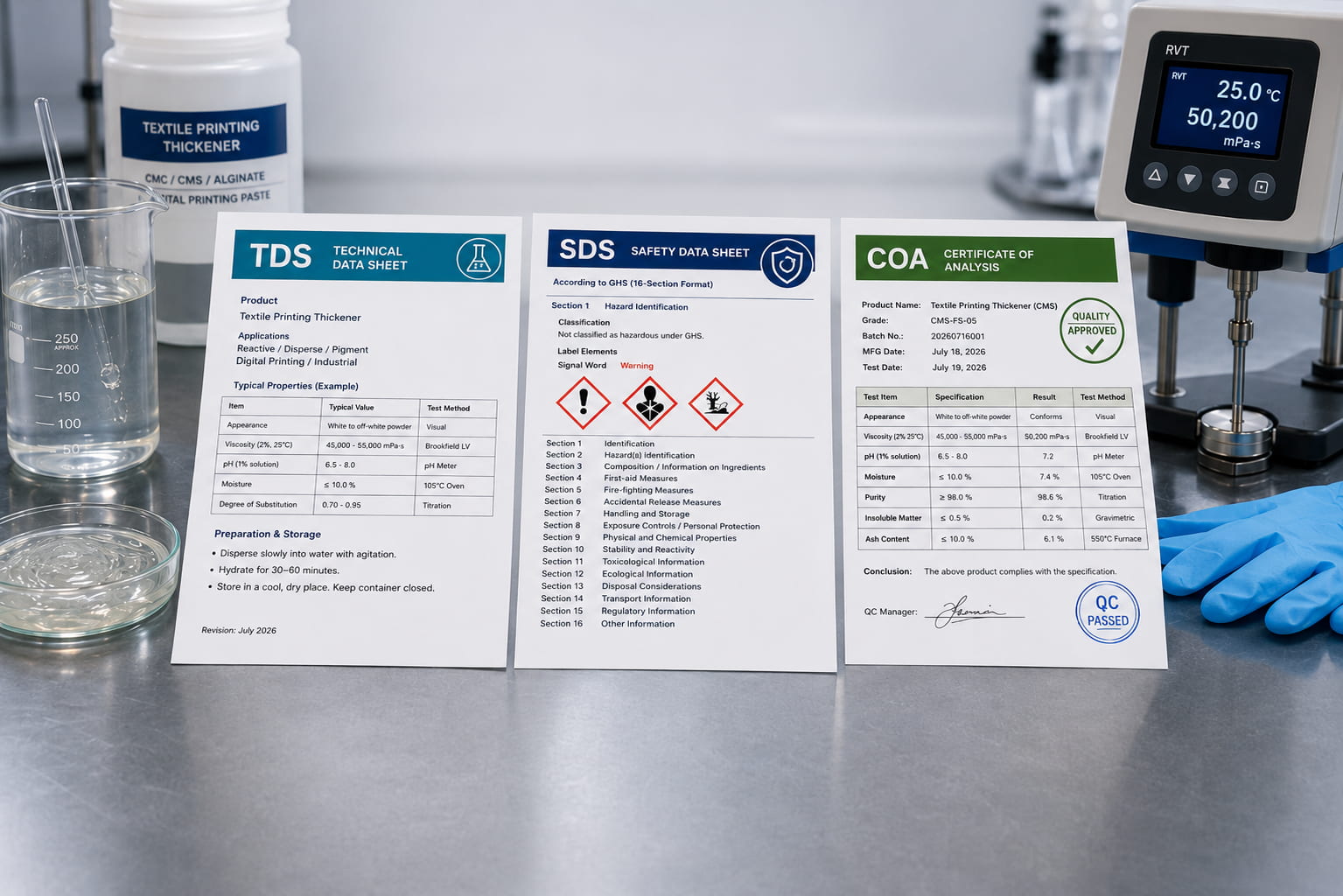
Select a low-viscosity sodium alginate supplier by matching a method-defined grade to your reactive-printing paste, then comparing preparation behavior and finished-print results under the same conditions. Low viscosity alone does not mean faster hydration, less residue or suitability for ink circulated through a printhead. Identify the commercial grade and agree sample-to-bulk controls before ordering.
Sodium alginate is commonly used as a thickener in reactive textile printing paste. In some applications, buyers may prefer a lower viscosity grade or a grade with better dispersion and hydration behavior. However, “low viscosity” and “high solubility” should be verified through technical documents and sample testing, not only by supplier descriptions.
This guide explains how buyers can evaluate low viscosity sodium alginate for textile printing and related formulation applications by reviewing specifications, testing samples, and confirming batch consistency before bulk purchase.
What Low Viscosity Sodium Alginate Means in Practice
Low Viscosity Should Be Defined by Test Method
Low viscosity is relative to a stated method. Record concentration and its basis (for example, mass percent of as-supplied product or a stated dry basis), instrument model, geometry or spindle, speed, sample temperature, container and volume, reading time and sample preparation. Do not compare values obtained by different methods as if they were the same grade specification.
Before comparing suppliers, buyers should ask how the viscosity was tested and whether the method is similar to their own internal evaluation process.
High Solubility Depends on Preparation Conditions
Sodium alginate can dissolve in water, while poor powder dispersion can form slowly hydrating lumps. Alginate-manufacturer dissolution guidance explains this distinction. Record powder wetting and dispersion, viscosity development under a defined method, and residual material separately. A low-viscosity result is not a solubility measurement or proof of faster preparation.
Use the supplier-approved preparation method and the mill’s actual water and equipment. Record powder feed rate, mixer geometry and speed, temperature and observation times; do not prescribe one universal mixing speed or hydration time. A repeatable viscosity plateau is an operational checkpoint, not proof that every particle has dissolved.
Low Viscosity Is Not Always the Best Choice
A lower viscosity grade may be useful for certain preparation or formulation requirements, but it may not provide enough thickening effect for every printing paste system.
The suitable grade should be selected according to the printing process, target paste viscosity, fabric type, dye system, and production conditions.
Main Applications Buyers May Consider
Реактивна паста для друку на текстилі
Sodium alginate is commonly used as a thickener in reactive textile printing paste. Buyers usually pay attention to viscosity, paste formation, dissolution behavior, filtration, and handling during printing.
If a low viscosity grade is being considered, buyers should confirm whether it can still meet the required paste structure and application behavior.
Screen Printing and Rotary Printing Preparation
For screen printing and rotary printing preparation, paste smoothness, filtration behavior, and viscosity stability can affect production handling.
The sodium alginate grade should be tested under real preparation conditions, including the buyer’s water quality, stirring method, and paste concentration.
Printing Ink or Related Formulation Testing
Conventional printing paste and fabric pretreatment are separate from ink that circulates through an inkjet printhead. Do not add ordinary textile alginate to nozzle ink on the basis of a low bulk-viscosity result or a screen-printing trial. That use requires dedicated ink formulation and qualification for the named printhead and ink-delivery system.
For any proposed inkjet-ink use, ask the ink and printhead suppliers to define the compatibility and jetting tests for the actual system. FUJIFILM’s printhead technology paper identifies ink compatibility and nozzle-surface durability as selection considerations. It does not qualify any FSX alginate grade, and a paste TDS is not inkjet approval.
Основні технічні характеристики, на які слід звернути увагу покупцям
Viscosity Range and Testing Method
Viscosity is one of the most important parameters when sourcing low viscosity sodium alginate. Buyers should review the viscosity range together with the test concentration, temperature, instrument method, and unit.
Без цих даних значення в'язкості, надані різними постачальниками, можуть виявитися несумісними для прямого порівняння.
Розмір комірок та характеристики розчинення
Mesh size can influence how sodium alginate disperses and hydrates during paste preparation. However, actual dissolution behavior also depends on the buyer’s preparation method.
Compare preparation time, visible lumps and a defined filtration result separately. Record filter medium and aperture, effective area, feed mass and concentration, temperature, pressure or gravity conditions, and test duration. Retained material may include gels, undissolved powder or other insolubles; this check alone is not a purity assay.
Вологість, рН та зовнішній вигляд
Moisture, pH, and appearance are basic but important quality indicators. They affect storage, handling, quality control, and repeat purchasing.
These parameters should be reviewed in the TDS and confirmed through COA data for each production batch.
Однорідність партії
For repeat orders, batch consistency matters. If viscosity, moisture, pH, or dissolution behavior changes significantly between batches, the buyer may need to adjust the formulation again.
COA review helps buyers confirm whether batch data remains within the agreed specification range.

Documents Buyers Should Request
TDS for Specification Review
The Technical Data Sheet helps buyers review the standard specification range. It should include key parameters such as appearance, viscosity, mesh size, moisture, pH, storage conditions, and testing method.
For low viscosity sodium alginate, the viscosity test method should be clearly stated because it directly affects grade comparison.
COA for Batch Confirmation
The supplier’s COA reports selected test results for an identified commercial grade and lot. Check the methods, units and agreed limits, and confirm that the lot number matches the bags. A supplier COA is not independent verification of every result or proof of full printing performance; carry out the agreed incoming checks separately.
Buyers can compare COA records across shipments to check whether key parameters remain stable over time.
SDS and Export Documents When Required
For international purchasing, buyers may also need SDS, invoice, packing list, labels, and other export-related documents. The required document list may vary by destination country, product type, and internal purchasing process.
Document requirements should be confirmed before shipment to avoid delays in internal review or customs communication.
Additional Statements or Test Documents
If the buyer needs confirmation related to restricted substances, environmental claims, customer audit requirements, or internal supplier approval, these requirements should be clearly requested before order confirmation.
A practical supplier should explain which documents can be provided and which claims require third-party testing or formal certification.
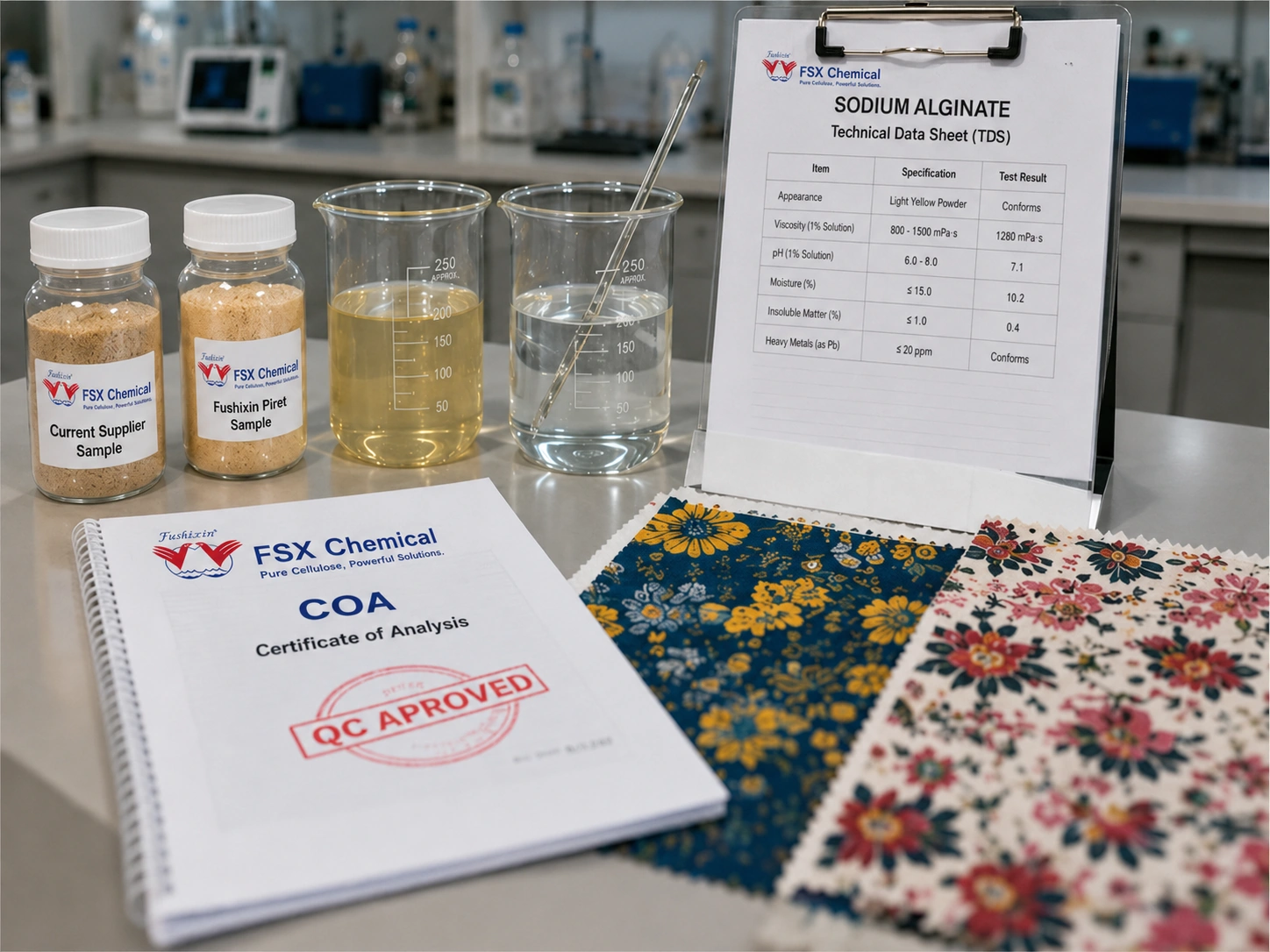
How to Test Low Viscosity Sodium Alginate Before Bulk Purchase
Test in the Actual Formulation
Sample testing should be done in the buyer’s own formulation whenever possible. Dyes, auxiliaries, water quality, pH, stirring method, paste concentration, and storage time can all affect final behavior.
Testing only in clean water may not be enough to confirm whether the grade is suitable for production.
Observe Dissolution and Paste Handling
Під час випробувань покупці повинні звертати увагу на швидкість розчинення, однорідність пасти, наявність грудочок, властивості фільтрації, стабільність в’язкості та зручність нанесення.
Use preparation observations together with the specification and the finished print. Hold dye system, fabric, deposition and fixation/washing conditions constant when comparing grades; then assess definition, color result, wash-off and hand against the agreed reference. Equal measured paste viscosity does not establish equal printing performance.
| Comparison checkpoint | What to record | What it cannot establish alone |
|---|---|---|
| Powder addition | Water identity, feed rate, mixer settings and lump observations. | Equilibrium solubility or production performance. |
| Defined-age solution | Repeat viscosity readings at stated times and temperature, with the same method. | Complete molecular dissolution or inkjet suitability. |
| Фільтрація | Specified filter, loading and flow conditions, with a repeatable residue/flow assessment. | Chemical identity or purity of retained material. |
| Complete print trial | Matched paste, fabric and process; approved finished-print criteria. | Approval for every future fabric, formulation or bulk lot. |
This is a proposed comparison record. Set acceptance limits from the approved reference and intended process; the table contains no FSX test result or universal pass limit.
Compare Approved Sample with Bulk Shipment
Before confirming a bulk order, buyers should check whether the approved sample and bulk shipment will follow the same viscosity range, mesh size, packaging format, batch traceability, and COA requirements.
Це допомагає знизити ризик розбіжності між зразком та основною партією.
Common Mistakes When Choosing Low Viscosity Sodium Alginate
Choosing Only by the Lowest Viscosity
The lowest viscosity option may not provide the required paste structure or application behavior. Buyers should choose a grade that matches the target formulation instead of selecting only by a lower number.
Assuming High Solubility Without Testing
Replace a broad “high solubility” promise with a stated preparation test: dispersion behavior, observation time, method-defined viscosity development and residue under the agreed conditions. Different water or addition conditions require a new comparison; do not equate easy wetting with complete dissolution.
Relying on Broad Supplier Claims
Claims such as “eco-friendly,” “high-performance,” “global supply,” or “fast delivery” should be supported by documents, agreed terms, or test data when they are important to the purchasing decision.
For practical sourcing, buyers should focus on specification, sample testing, COA data, packaging, and export document support.
How FSX Chemical Supports Sodium Alginate Buyers
Review FSX Chemical’s sodium alginate grade information and request current documents for the commercial grade being considered. Use the supplier’s current preparation instructions as the starting point for a controlled mill comparison.
Our support is focused on practical grade matching and export procurement. We can provide TDS, COA, SDS where applicable, sample support, and grade matching suggestions based on the customer’s printing process, target viscosity, fabric type, formulation conditions, packaging needs, and document requirements.
We do not suggest confirming low viscosity sodium alginate only by product name, broad solubility claims, or price. The recommended grade should be reviewed through technical documents and tested in the buyer’s own formulation before bulk purchase.
Next Steps
- Define Your Target Viscosity — share the required viscosity range, test concentration, temperature, instrument method, and unit if available.
- Request a TDS — review viscosity range, mesh size, pH, moisture, appearance, storage conditions, and testing method.
- Request a COA — confirm whether batch data matches the agreed specification range before shipment.
- Ask for Grade Matching — share your printing process, fabric type, formulation conditions, and existing product grade if available.
- Замовити зразок — test the recommended sodium alginate grade in your own paste preparation or formulation conditions before confirming bulk orders.
- Confirm Packaging and Export Documents — check bag size, labels, batch traceability, SDS, invoice, packing list, and other required documents before shipment.
- Зв’яжіться з компанією FSX Chemical — share the current viscosity method, preparation issue and intended product addition point. Email: service@fsxchemical.com.