In lưới quay so với in lưới phẳng: Yêu cầu về tính lưu biến của chất làm đặc thay đổi như thế nào
Flat and rotary screen printing use the same basic transfer principle but expose printing paste...
Flat-screen and rotary-screen textile printing both force color paste through patterned screen openings, but they do not expose the thickener to the same mechanical history. Flat-screen printing is typically a reciprocating, semi-continuous process in which a squeegee crosses a stationary screen and the screen is then lifted before the fabric advances. Rotary-screen printing is continuous: paste is supplied inside a rotating cylindrical screen while an internal squeegee or magnetic-rod system forces paste through the design at production speed. Because the paste experiences different shear, residence time, recovery and circulation conditions, the rheology that works on one machine may not transfer directly to the other. This guide explains how to compare low-shear body, shear thinning, elasticity, structural recovery and long-run stability before selecting a textile printing thickener.
Same Screen-Printing Principle, Different Mechanical History
Flat-screen and rotary-screen textile printing share the same basic principle:
Printing paste is forced through open areas of a patterned screen and deposited on the fabric.
But the mechanics are different.
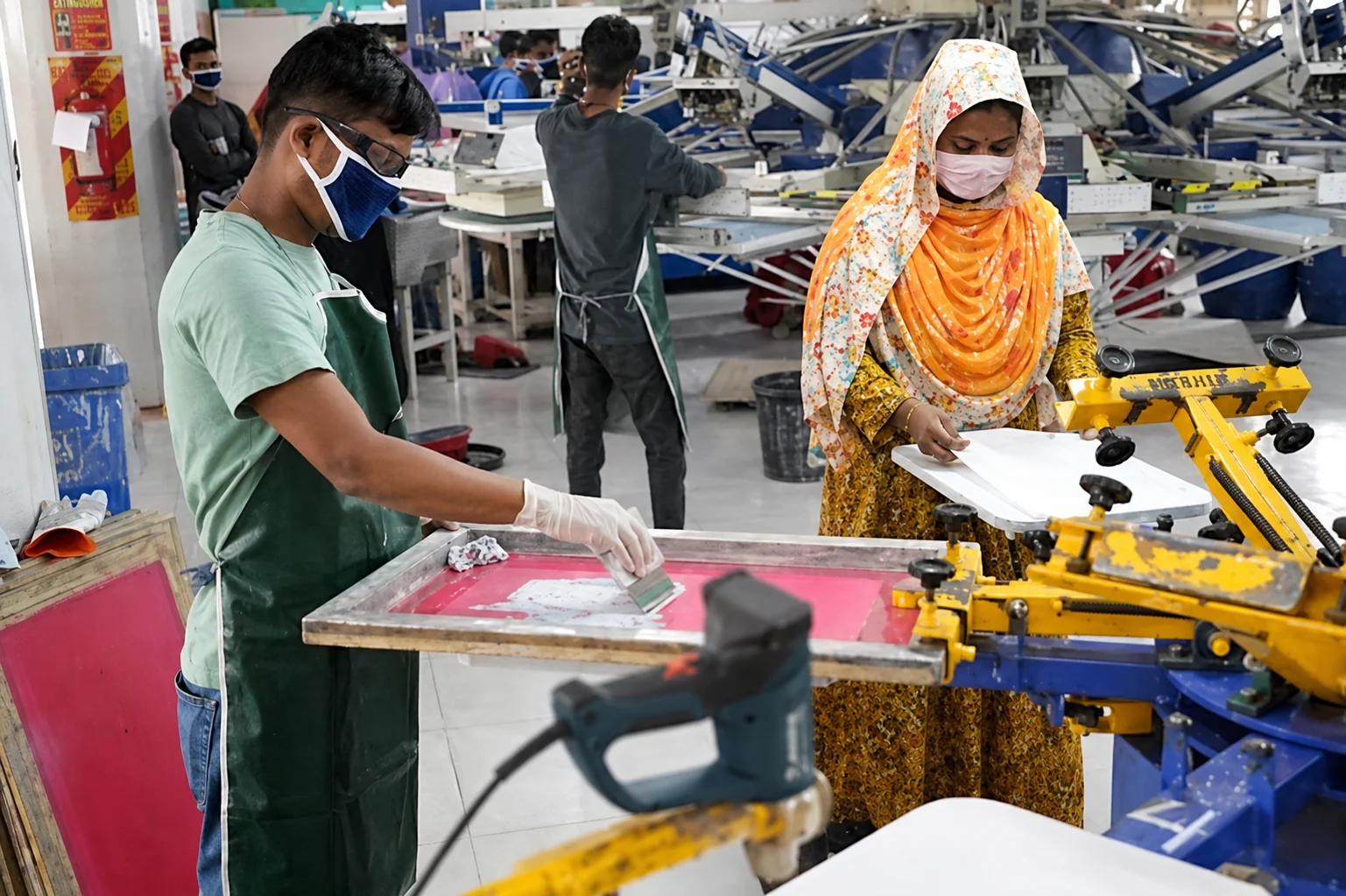
In flat-screen printing, a flat screen is placed over the fabric, a squeegee traverses the image area, the screen is lifted and the fabric advances to the next repeat.
In rotary-screen printing, a cylindrical screen rotates continuously with the moving fabric while paste is supplied inside the screen and forced outward through the design openings.
Textile process references describe flat-screen printing as a semi-continuous reciprocating process and rotary-screen printing as a continuous, higher-productivity process. Published rotary-screen research also shows that screen mesh, machine settings and print-paste rheology jointly affect paste deposit and penetration.
This leads to the first important rule:
The machine changes the shear history of the paste, so machine selection changes the rheology requirement.
That does not mean every rotary paste must be thinner than every flat-screen paste.
It means the complete flow-and-recovery profile must match the machine.
How Flat-Screen Printing Exposes the Paste to Shear
Flat-screen printing is usually intermittent.
A typical cycle is:
Screen Down → Squeegee Stroke → Paste Through Mesh → Screen Lift → Fabric Advance → Next Stroke
During the squeegee stroke, the paste experiences significant shear as it moves across the screen and through the open mesh.
After the stroke, however, part of the paste may remain relatively stationary on the screen before the next cycle.
This creates several rheological demands:
Enough low-shear body to prevent uncontrolled spreading
Good flow during the squeegee stroke
Recovery after transfer
Resistance to excessive paste drying or skinning during intermittent dwell
Repeatable viscosity between successive strokes
Flat-screen printing may therefore tolerate a different low-shear structure than a continuous rotary line, but the correct target depends on:
Automatic vs. manual flat screen
Stroke speed
Number of squeegee passes
Screen open area
Fabric absorbency
Time between strokes
Do not reduce flat-screen rheology to a rule such as “flat screen needs higher viscosity.”
How Rotary-Screen Printing Exposes the Paste to Shear
Rotary-screen printing is continuous.
The fabric travels under cylindrical screens while paste is continuously supplied inside each screen.
An internal blade, roller or magnetic-rod squeegee system forces paste through the pattern.
Commercial rotary systems are designed for high-volume production and consistent long runs.
This creates a different operating history:
Feed / Circulation → Screen Interior → High Shear at Transfer Zone → Deposit on Moving Fabric → Continued Paste Residence and Recirculation
The paste must therefore maintain useful rheology not only for one stroke but through a long, repeated mechanical history.
Important risks include:
Progressive viscosity drift
Excessive shear thinning that does not recover
Foam accumulation
Evaporation during long runs
Temperature rise
Deposit variation from beginning to end
Rotary-screen production often makes long-run rheological stability more commercially visible because even a small change can affect many meters of fabric.
Why One Viscosity Number Cannot Define Machine Suitability
A Brookfield or rotational-viscometer value is useful only under a defined method.
It usually describes one point in the paste’s flow behavior.
Screen printing exposes paste to a range of shear rates.
Research on textile printing thickeners shows that both flow and viscoelastic properties are strongly connected with print-quality parameters, and screen-printing studies show that paste behavior changes substantially between low-shear rest conditions and the high-shear conditions present during passage through screen openings.
Therefore, two pastes can both read:
30,000 mPa·s
under one test method and still behave differently in:
1. Low-Shear Body: Holding the Pattern Before and After Transfer
At low shear, the printing paste needs enough structure to resist uncontrolled movement.
This helps support:
Pattern definition
Reduced bleeding
Stable paste on the screen
Controlled penetration
For flat-screen printing, low-shear body can be especially visible during the interval between strokes.
For rotary screen, low-shear body remains important after the paste leaves the screen and before drying, but excessive rest viscosity can create problems in feed and transfer.
The correct target is therefore not maximum rest viscosity.
It is enough structure to control the design without making the paste difficult to move.
2. Shear Thinning: Flowing Through the Screen
Textile printing pastes often need pseudoplastic or shear-thinning behavior.
Under squeegee or screen-transfer shear, apparent viscosity decreases so the paste can move through the screen openings.
Once shear is reduced, the paste can recover part of its original structure.
Research on textile printing rheology summarizes the desired balance as:
Lower viscosity under high shear for application + Higher viscosity at low shear for pattern control
If shear thinning is too weak:
Transfer can be incomplete.
Higher pressure may be needed.
Screen filling can become poor.
If shear thinning is excessive:
Paste can become too fluid during machine operation.
Penetration can become excessive.
Edges can soften.
Rotary lines often reveal excessive long-duration shear thinning more quickly because the paste experiences repeated continuous shear.
3. Structural Recovery: What Happens After the Paste Leaves the Screen?
After the paste passes through the screen, the shear rate drops sharply.
The paste should recover enough structure to stop uncontrolled lateral flow.
Recovery that is too slow can lead to:
Bleeding
Blurred fine lines
Haloing
Excess penetration
Recovery that is too fast or too strong can also create problems if the paste does not level sufficiently after transfer.
This can contribute to:
Uneven solid areas
Surface texture
Poor penetration
Flat and rotary machines can therefore prefer different recovery windows depending on:
Fabric speed
Time before drying
Lớp lắng đọng dạng bột nhão
Design coverage
Structural recovery should be evaluated on the actual machine, not inferred from static viscosity.
4. Elasticity and Stringiness
Viscoelasticity affects how printing paste deforms and separates from the screen.
Some elasticity can support recovery.
Too much elasticity can create:
Stringiness
Poor screen release
Uneven deposit
Tail or edge defects
Published textile-thickener research notes that elasticity influences both passage through screen openings and subsequent flow through textile fibers.
This property can become especially important when transferring a formula between flat and rotary machines because screen separation mechanics differ.
Do not assume a highly elastic paste that performs well on one machine will automatically release cleanly on the other.
5. Long-Run Stability: Why Rotary Often Exposes Hidden Weaknesses
Rotary-screen printing is designed for continuous high-volume production.
That means a paste may remain in the machine system for an extended period while experiencing:
Repeated shear
Circulation
Mechanical pumping
Air incorporation
Temperature variation
Evaporation
A useful rotary-screen paste should therefore be checked at:
Start of run
After a defined production interval
Mid-run
Near the end of the intended production window
So sánh:
Độ nhớt
Bọt
Screen running
Hiệu suất màu
Pattern definition
A paste that gives an excellent 10-meter sample but drifts after 1,000 meters has not passed a realistic rotary-screen qualification.
6. Intermittent Dwell: Why Flat-Screen Paste Can Fail Differently
Machine-specific rheology affects more than print quality.
Bao gồm:
Liều lượng chất làm đặc
Paste preparation
Pumping energy
Tốc độ máy
Screen interruptions
Waste paste
Sửa lại
Final washing or curing
A useful framework is:
Total Cost in Use = Thickener Cost + Preparation + Machine Efficiency + Downtime + Post-Treatment + Rework + Quality Loss
A thickener that costs more per kilogram can be the lower-cost rotary route if it maintains long-run viscosity and reduces interruptions.
A lower-cost product can be the better flat-screen route if it provides stable print definition without drying on the screen.
Compare cost per acceptable printed meter, not powder price alone.
Bạn nên cung cấp những thông tin nào cho nhà cung cấp chất làm đặc?
For useful flat-vs-rotary grade matching, provide:
Rây phẳng hoặc rây quay
Machine manufacturer/model where relevant
Tốc độ sản xuất
Screen mesh/engraving
Squeegee type and settings
Fabric composition and construction
Dye/pigment route
Current thickener product/TDS
Liều lượng hiện tại
Viscosity and full test method
Complete or simplified formula
Thời gian giữ keo
Current defect: spreading, transfer, blocking, drift, penetration or cost
FSX Chemical có thể sử dụng thông tin này thông qua Mẫu và việc kết hợp to compare sodium alginate, CMC, CMS or other route-appropriate thickeners under matched machine conditions.
How Should Thickener Rheology Be Matched to Flat or Rotary Screen?
Flat and rotary screen use the same transfer principle but expose paste to different mechanical histories.
Same viscosity does not mean the same flow, recovery or machine behavior.
Rotary production places strong emphasis on continuous shear and long-run stability.
Flat-screen production adds intermittent dwell, pause/restart and screen-drying risks.
Screen mesh, squeegee and fabric must be recorded before changing the thickener.
The final acceptance standard is stable production and finished-print quality—not a viscosity number alone.
Các câu hỏi thường gặp
1. Does rotary-screen printing need lower-viscosity paste than flat-screen printing?
Not as a universal rule. Rotary printing often needs excellent high-shear flow and long-run stability, while flat screen can place more emphasis on low-shear hold and pause/restart behavior. Test the actual machine.
2. Why can the same paste work on flat screen but fail on rotary screen?
Rotary printing exposes the paste to continuous feed, repeated shear, circulation and longer machine residence. A paste can therefore drift or thin differently during a long run.
3. Why can a rotary paste fail on flat screen?
Flat-screen dwell between strokes can expose weak low-shear body, slow structural recovery or surface drying that was less visible on the continuous rotary line.
4. Is Brookfield viscosity enough to select a thickener?
No. It should be combined with shear-thinning, recovery, elasticity and machine-print testing.
5. What rheology is generally useful for screen printing?
A useful paste often has sufficient viscosity at low shear, lower apparent viscosity under application shear and enough recovery after transfer to control spreading.
6. Does faster rotary speed always require lower paste viscosity?
No. Speed changes shear, residence and deposit conditions, but the correct adjustment can involve rheology, screen specification, squeegee settings or thickener grade—not viscosity alone.
7. Why does rotary print quality change from the beginning to the end of a run?
Possible causes include long dwell, low humidity, excessive paste concentration, poor water retention or fine mesh. Diagnose the complete system.
9. Does higher structural recovery always give sharper printing?
No. Excessively fast or strong recovery can reduce leveling and cause uneven solid areas. The target is a balanced recovery window.
10. Can the same sodium alginate grade be used for both flat and rotary reactive printing?
Often it can be evaluated on both, but concentration and process settings may need adjustment. Approve the grade on each machine.
11. Should I change thickener before changing screen or squeegee settings?
Not automatically. Machine settings and rheology interact. Record the current screen/squeegee conditions and change one major variable at a time.
12. What should I send FSX Chemical for flat-vs-rotary matching?
Send machine type, speed, screen, squeegee conditions, fabric, dye route, current thickener, dosage, viscosity method, formula and the current machine defect.
Match Thickener Rheology to Your Flat or Rotary Screen
If the same printing paste behaves differently after moving between flat and rotary screen machines, FSX Chemical can help determine whether the next trial should focus on thickener grade, concentration, shear recovery or machine/process conditions.
For a useful technical comparison, send:
Your current thickener sample, TDS or COA
Rây phẳng hoặc rây quay
Tốc độ máy
Screen mesh/engraving
Squeegee type/settings
Fabric composition and construction
Dye/pigment route
Current thickener dosage
Độ nhớt và phương pháp thử nghiệm toàn diện
Complete or simplified formula
Thời gian giữ keo
Current screen-running, spreading, penetration, color or cost target
The most useful question is not “Which viscosity is best for rotary or flat screen?” It is “What rheological profile gives stable transfer, recovery and print quality under this machine’s real shear history?”
Tìm hiểu lý do tại sao không thể so sánh các giá trị độ nhớt của chất làm đặc trong in ấn dệt may nếu không đảm bảo các yếu tố như nồng độ, nhiệt độ, thiết bị, trục quay, tốc độ, phương pháp chuẩn bị và thời gian thử nghiệm đều giống nhau.
Natri alginat được sử dụng rộng rãi trong in ấn dệt may với vai trò là chất làm đặc ổn định và có thể giặt được cho hỗn hợp in phản ứng. Tìm hiểu cách đánh giá cấp độ độ nhớt, độ tinh khiết và tính phù hợp trong ứng dụng trước khi mua hàng, cũng như cách FSX Chemical hỗ trợ người mua trên toàn cầu thông qua dữ liệu kỹ thuật và mẫu sản phẩm.
Carboxymethyl cellulose (CMC) được sử dụng rộng rãi trong các quy trình in ấn, xử lý chất làm cứng và nhuộm vải. Hướng dẫn này sẽ giải thích cách đánh giá các loại CMC, những thông số nào là quan trọng nhất, cũng như cách FSX Chemical có thể hỗ trợ các quyết định mua hàng.
Hỗn hợp in dựa trên CMC được sử dụng rộng rãi trong in vải bằng bột màu, in phản ứng và in kỹ thuật số. Hướng dẫn này giải thích các thông số quan trọng, cách so sánh các nhà cung cấp và những yêu cầu cần đưa ra trước khi đặt hàng số lượng lớn.
Cả natri alginat và CMC đều được sử dụng làm chất làm đặc trong in vải, nhưng chúng phù hợp với các hệ thống thuốc nhuộm và điều kiện quy trình khác nhau. Hướng dẫn này giải thích những điểm khác biệt chính và thời điểm nên sử dụng từng loại.
Tỷ lệ cố định thuốc nhuộm ảnh hưởng trực tiếp đến hiệu suất màu, độ bền màu khi giặt và lượng chất thải trong quá trình in bằng thuốc nhuộm phản ứng. Hướng dẫn này giải thích cách natri alginat hỗ trợ quá trình cố định thuốc nhuộm, các thông số của hỗn hợp thuốc nhuộm nào ảnh hưởng đến tỷ lệ cố định, cũng như cách khắc phục tình trạng tỷ lệ cố định thấp trong quá trình sản xuất.
Kích thước hạt (mesh) của natri alginat ảnh hưởng đến tốc độ hòa tan của bột, mức độ đồng đều khi ngậm nước, cũng như hiệu quả của hỗn hợp in trong quá trình in lụa. Hướng dẫn này giải thích những tác động thực tiễn của thông số mesh đối với các ứng dụng hỗn hợp in trên vải.
Các tiêu chuẩn về độ tinh khiết của natri alginat không chỉ gói gọn trong một con số duy nhất. Hướng dẫn này giải thích ý nghĩa của các chỉ số như hàm lượng hoạt chất, NaCl, chất không hòa tan và kim loại nặng đối với hiệu suất của bột in dệt — cũng như khi nào nên yêu cầu độ tinh khiết cao hơn so với loại tiêu chuẩn công nghiệp.
Sự bất ổn định về độ nhớt trong hỗn hợp in alginat natri là một trong những nguyên nhân phổ biến nhất dẫn đến sự chênh lệch màu sắc và các khuyết tật in trong quá trình in bằng thuốc nhuộm phản ứng. Hướng dẫn này giải thích lý do tại sao độ nhớt thay đổi trong quá trình sản xuất, những yếu tố nào góp phần gây ra sự bất ổn định, cũng như cách lựa chọn loại sản phẩm có độ ổn định cao hơn phù hợp với điều kiện quy trình của bạn.
Việc bảo quản không đúng cách là một trong những nguyên nhân phổ biến nhất dẫn đến các vấn đề về hiệu suất của natri alginat trong in ấn dệt may. Hướng dẫn này đề cập đến các điều kiện bảo quản dạng bột và dạng bột nhão, thời hạn sử dụng dự kiến, các dấu hiệu suy giảm chất lượng, cũng như những điều cần kiểm tra khi nhận hàng mới.
Kỹ thuật in khuôn tay đòi hỏi loại bột in có các đặc tính lưu biến khác với kỹ thuật in lụa bằng máy. Hướng dẫn này giải thích công thức pha chế bột in từ natri alginat dành cho kỹ thuật in khuôn thủ công, bao gồm các ứng dụng như Ajrak, Bagru và batik, kèm theo các phương pháp đánh giá bột in thực tiễn dành cho các hoạt động sản xuất quy mô nhỏ.
In lụa bằng thuốc nhuộm phản ứng kết hợp với natri alginat đòi hỏi phải có công thức hỗn hợp in chính xác, kiểm soát độ nhớt và điều kiện hấp hơi phù hợp. Hướng dẫn này đề cập đến các yêu cầu đối với hỗn hợp in lụa phẳng và quay, thời gian xử lý kiềm, các lỗi sản xuất thường gặp, cũng như cách chẩn đoán các nguyên nhân liên quan đến hỗn hợp in.
Vui lòng cung cấp tên sản phẩm, ứng dụng, số lượng, điểm đến và bất kỳ tài liệu kỹ thuật (TDS),
hình ảnh mẫu hoặc tài liệu nào mà quý khách đã có. FSX Chemical sẽ xem xét
thông tin này và đề xuất bước tiếp theo liên quan đến báo giá, đối chiếu mẫu
hoặc lựa chọn sản phẩm.
Thông tin sản phẩmTên sản phẩm, cấp loại, mẫu mã, ảnh nhãn mác hoặc mã tham chiếu của nhà cung cấp.
Các tài liệu có sẵnTDS, SDS, COA, ảnh mẫu, danh mục sản phẩm hoặc dữ liệu thử nghiệm.
Chi tiết đơn hàngSố lượng dự kiến, hình thức đóng gói, nước nhập khẩu, cảng hoặc điều kiện thương mại.
Yêu cầu hoặc Vấn đềQuy trình in trên vải, yêu cầu về công thức, vấn đề hiện tại hoặc chỉ tiêu hiệu suất.