Rotary Screen vs. Flat Screen Printing: How Thickener Rheology Requirements Change
Flat and rotary screen printing use the same basic transfer principle but expose printing paste...
Flat-screen and rotary-screen textile printing both force color paste through patterned screen openings, but they do not expose the thickener to the same mechanical history. Flat-screen printing is typically a reciprocating, semi-continuous process in which a squeegee crosses a stationary screen and the screen is then lifted before the fabric advances. Rotary-screen printing is continuous: paste is supplied inside a rotating cylindrical screen while an internal squeegee or magnetic-rod system forces paste through the design at production speed. Because the paste experiences different shear, residence time, recovery and circulation conditions, the rheology that works on one machine may not transfer directly to the other. This guide explains how to compare low-shear body, shear thinning, elasticity, structural recovery and long-run stability before selecting a textile printing thickener.
Same Screen-Printing Principle, Different Mechanical History
Flat-screen and rotary-screen textile printing share the same basic principle:
Printing paste is forced through open areas of a patterned screen and deposited on the fabric.
But the mechanics are different.
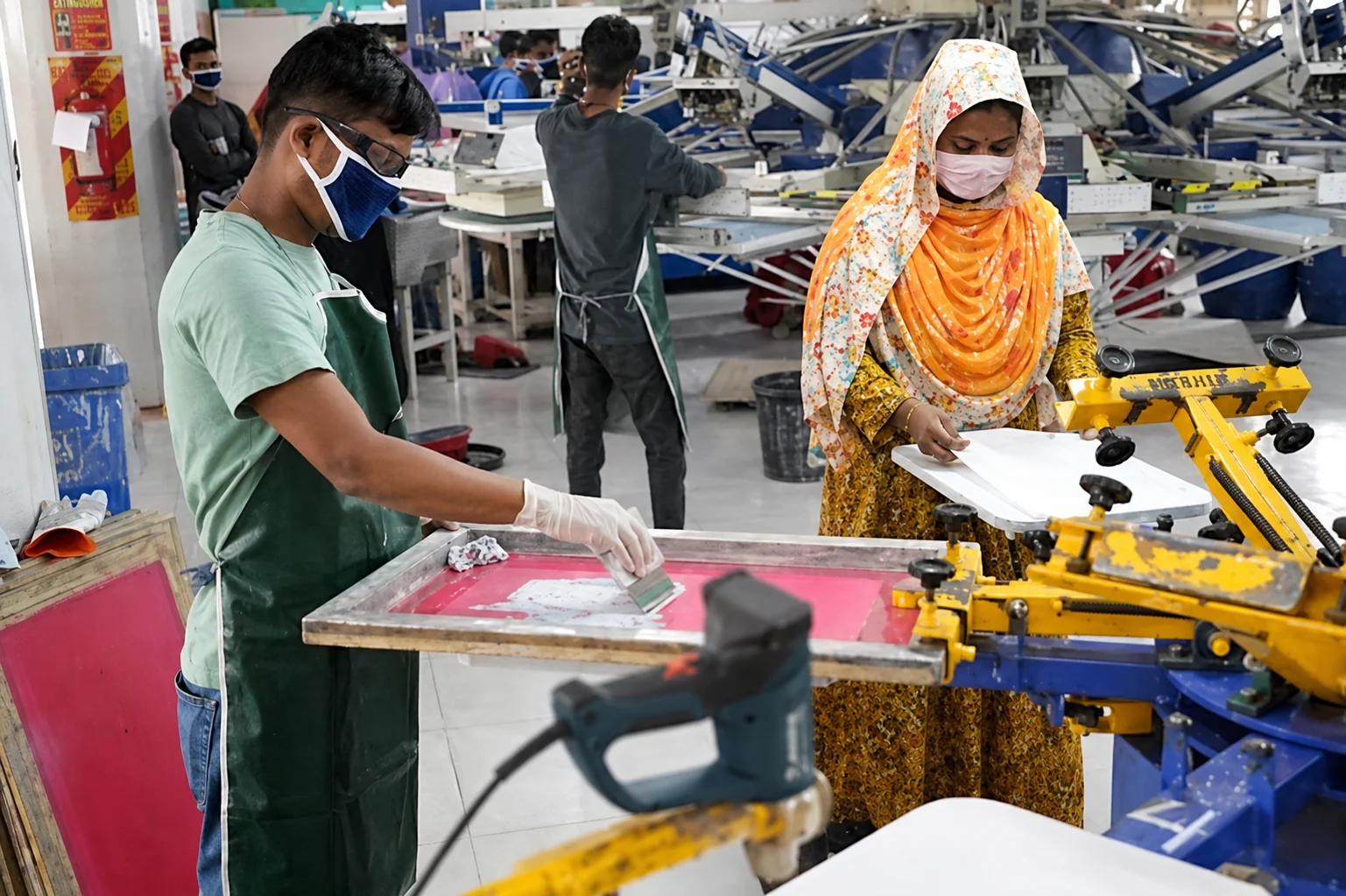
In flat-screen printing, a flat screen is placed over the fabric, a squeegee traverses the image area, the screen is lifted and the fabric advances to the next repeat.
In rotary-screen printing, a cylindrical screen rotates continuously with the moving fabric while paste is supplied inside the screen and forced outward through the design openings.
Textile process references describe flat-screen printing as a semi-continuous reciprocating process and rotary-screen printing as a continuous, higher-productivity process. Published rotary-screen research also shows that screen mesh, machine settings and print-paste rheology jointly affect paste deposit and penetration.
This leads to the first important rule:
The machine changes the shear history of the paste, so machine selection changes the rheology requirement.
That does not mean every rotary paste must be thinner than every flat-screen paste.
It means the complete flow-and-recovery profile must match the machine.
How Flat-Screen Printing Exposes the Paste to Shear
Flat-screen printing is usually intermittent.
A typical cycle is:
Screen Down → Squeegee Stroke → Paste Through Mesh → Screen Lift → Fabric Advance → Next Stroke
During the squeegee stroke, the paste experiences significant shear as it moves across the screen and through the open mesh.
After the stroke, however, part of the paste may remain relatively stationary on the screen before the next cycle.
This creates several rheological demands:
Enough low-shear body to prevent uncontrolled spreading
Good flow during the squeegee stroke
Recovery after transfer
Resistance to excessive paste drying or skinning during intermittent dwell
Repeatable viscosity between successive strokes
Flat-screen printing may therefore tolerate a different low-shear structure than a continuous rotary line, but the correct target depends on:
Automatic vs. manual flat screen
Stroke speed
Number of squeegee passes
Screen open area
Fabric absorbency
Time between strokes
Do not reduce flat-screen rheology to a rule such as “flat screen needs higher viscosity.”
How Rotary-Screen Printing Exposes the Paste to Shear
Rotary-screen printing is continuous.
The fabric travels under cylindrical screens while paste is continuously supplied inside each screen.
An internal blade, roller or magnetic-rod squeegee system forces paste through the pattern.
Commercial rotary systems are designed for high-volume production and consistent long runs.
This creates a different operating history:
Feed / Circulation → Screen Interior → High Shear at Transfer Zone → Deposit on Moving Fabric → Continued Paste Residence and Recirculation
The paste must therefore maintain useful rheology not only for one stroke but through a long, repeated mechanical history.
Important risks include:
Progressive viscosity drift
Excessive shear thinning that does not recover
Foam accumulation
Evaporation during long runs
Temperature rise
Deposit variation from beginning to end
Rotary-screen production often makes long-run rheological stability more commercially visible because even a small change can affect many meters of fabric.
Why One Viscosity Number Cannot Define Machine Suitability
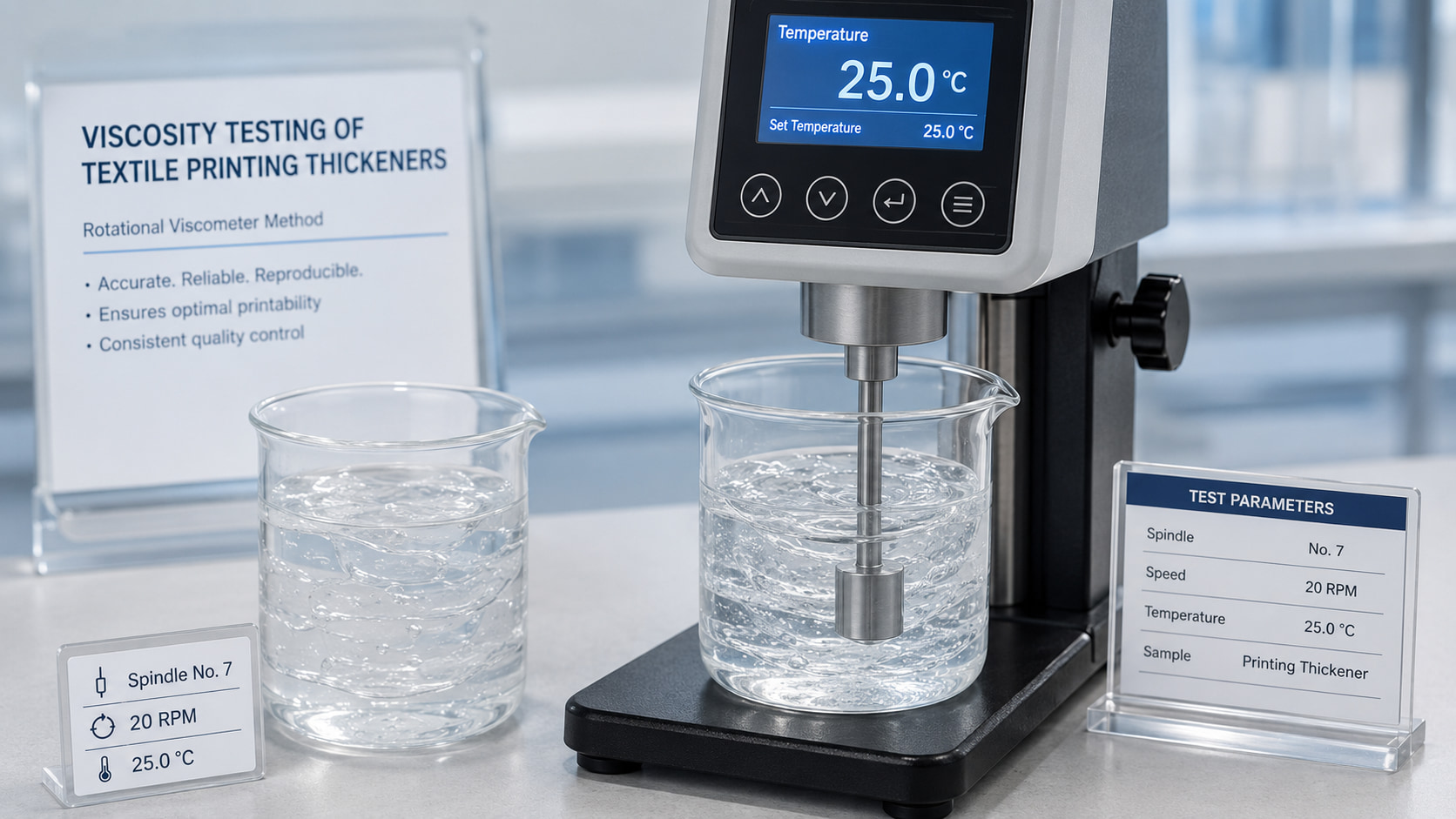
A Brookfield or rotational-viscometer value is useful only under a defined method.
It usually describes one point in the paste’s flow behavior.
Screen printing exposes paste to a range of shear rates.
Research on textile printing thickeners shows that both flow and viscoelastic properties are strongly connected with print-quality parameters, and screen-printing studies show that paste behavior changes substantially between low-shear rest conditions and the high-shear conditions present during passage through screen openings.
Therefore, two pastes can both read:
30,000 mPa·s
under one test method and still behave differently in:
1. Low-Shear Body: Holding the Pattern Before and After Transfer
At low shear, the printing paste needs enough structure to resist uncontrolled movement.
This helps support:
Pattern definition
Reduced bleeding
Stable paste on the screen
Controlled penetration
For flat-screen printing, low-shear body can be especially visible during the interval between strokes.
For rotary screen, low-shear body remains important after the paste leaves the screen and before drying, but excessive rest viscosity can create problems in feed and transfer.
The correct target is therefore not maximum rest viscosity.
It is enough structure to control the design without making the paste difficult to move.
2. Shear Thinning: Flowing Through the Screen
Textile printing pastes often need pseudoplastic or shear-thinning behavior.
Under squeegee or screen-transfer shear, apparent viscosity decreases so the paste can move through the screen openings.
Once shear is reduced, the paste can recover part of its original structure.
Research on textile printing rheology summarizes the desired balance as:
Lower viscosity under high shear for application + Higher viscosity at low shear for pattern control
If shear thinning is too weak:
Transfer can be incomplete.
Higher pressure may be needed.
Screen filling can become poor.
If shear thinning is excessive:
Paste can become too fluid during machine operation.
Penetration can become excessive.
Edges can soften.
Rotary lines often reveal excessive long-duration shear thinning more quickly because the paste experiences repeated continuous shear.
3. Structural Recovery: What Happens After the Paste Leaves the Screen?
After the paste passes through the screen, the shear rate drops sharply.
The paste should recover enough structure to stop uncontrolled lateral flow.
Recovery that is too slow can lead to:
Bleeding
Blurred fine lines
Haloing
Excess penetration
Recovery that is too fast or too strong can also create problems if the paste does not level sufficiently after transfer.
This can contribute to:
Uneven solid areas
Surface texture
Poor penetration
Flat and rotary machines can therefore prefer different recovery windows depending on:
Fabric speed
Time before drying
Paste deposit
Design coverage
Structural recovery should be evaluated on the actual machine, not inferred from static viscosity.
4. Elasticity and Stringiness
Viscoelasticity affects how printing paste deforms and separates from the screen.
Some elasticity can support recovery.
Too much elasticity can create:
Stringiness
Poor screen release
Uneven deposit
Tail or edge defects
Published textile-thickener research notes that elasticity influences both passage through screen openings and subsequent flow through textile fibers.
This property can become especially important when transferring a formula between flat and rotary machines because screen separation mechanics differ.
Do not assume a highly elastic paste that performs well on one machine will automatically release cleanly on the other.
5. Long-Run Stability: Why Rotary Often Exposes Hidden Weaknesses
Rotary-screen printing is designed for continuous high-volume production.
That means a paste may remain in the machine system for an extended period while experiencing:
Repeated shear
Circulation
Mechanical pumping
Air incorporation
Temperature variation
Evaporation
A useful rotary-screen paste should therefore be checked at:
Start of run
After a defined production interval
Mid-run
Near the end of the intended production window
Compare:
Viscosity
Foam
Screen running
Color yield
Pattern definition
A paste that gives an excellent 10-meter sample but drifts after 1,000 meters has not passed a realistic rotary-screen qualification.
6. Intermittent Dwell: Why Flat-Screen Paste Can Fail Differently
Machine-specific rheology affects more than print quality.
Include:
Thickener dosage
Paste preparation
Pumping energy
Machine speed
Screen interruptions
Waste paste
Rework
Final washing or curing
A useful framework is:
Total Cost in Use = Thickener Cost + Preparation + Machine Efficiency + Downtime + Post-Treatment + Rework + Quality Loss
A thickener that costs more per kilogram can be the lower-cost rotary route if it maintains long-run viscosity and reduces interruptions.
A lower-cost product can be the better flat-screen route if it provides stable print definition without drying on the screen.
Compare cost per acceptable printed meter, not powder price alone.
What Information Should You Send to a Thickener Supplier?
For useful flat-vs-rotary grade matching, provide:
Flat or rotary screen
Machine manufacturer/model where relevant
Production speed
Screen mesh/engraving
Squeegee type and settings
Fabric composition and construction
Dye/pigment route
Current thickener product/TDS
Current dosage
Viscosity and full test method
Complete or simplified formula
Paste holding time
Current defect: spreading, transfer, blocking, drift, penetration or cost
FSX Chemical can use this information through Samples & Matching to compare sodium alginate, CMC, CMS or other route-appropriate thickeners under matched machine conditions.
How Should Thickener Rheology Be Matched to Flat or Rotary Screen?
Flat and rotary screen use the same transfer principle but expose paste to different mechanical histories.
Same viscosity does not mean the same flow, recovery or machine behavior.
Rotary production places strong emphasis on continuous shear and long-run stability.
Flat-screen production adds intermittent dwell, pause/restart and screen-drying risks.
Screen mesh, squeegee and fabric must be recorded before changing the thickener.
The final acceptance standard is stable production and finished-print quality—not a viscosity number alone.
Frequently Asked Questions
1. Does rotary-screen printing need lower-viscosity paste than flat-screen printing?
Not as a universal rule. Rotary printing often needs excellent high-shear flow and long-run stability, while flat screen can place more emphasis on low-shear hold and pause/restart behavior. Test the actual machine.
2. Why can the same paste work on flat screen but fail on rotary screen?
Rotary printing exposes the paste to continuous feed, repeated shear, circulation and longer machine residence. A paste can therefore drift or thin differently during a long run.
3. Why can a rotary paste fail on flat screen?
Flat-screen dwell between strokes can expose weak low-shear body, slow structural recovery or surface drying that was less visible on the continuous rotary line.
4. Is Brookfield viscosity enough to select a thickener?
No. It should be combined with shear-thinning, recovery, elasticity and machine-print testing.
5. What rheology is generally useful for screen printing?
A useful paste often has sufficient viscosity at low shear, lower apparent viscosity under application shear and enough recovery after transfer to control spreading.
6. Does faster rotary speed always require lower paste viscosity?
No. Speed changes shear, residence and deposit conditions, but the correct adjustment can involve rheology, screen specification, squeegee settings or thickener grade—not viscosity alone.
7. Why does rotary print quality change from the beginning to the end of a run?
Possible causes include long dwell, low humidity, excessive paste concentration, poor water retention or fine mesh. Diagnose the complete system.
9. Does higher structural recovery always give sharper printing?
No. Excessively fast or strong recovery can reduce leveling and cause uneven solid areas. The target is a balanced recovery window.
10. Can the same sodium alginate grade be used for both flat and rotary reactive printing?
Often it can be evaluated on both, but concentration and process settings may need adjustment. Approve the grade on each machine.
11. Should I change thickener before changing screen or squeegee settings?
Not automatically. Machine settings and rheology interact. Record the current screen/squeegee conditions and change one major variable at a time.
12. What should I send FSX Chemical for flat-vs-rotary matching?
Send machine type, speed, screen, squeegee conditions, fabric, dye route, current thickener, dosage, viscosity method, formula and the current machine defect.
Match Thickener Rheology to Your Flat or Rotary Screen
If the same printing paste behaves differently after moving between flat and rotary screen machines, FSX Chemical can help determine whether the next trial should focus on thickener grade, concentration, shear recovery or machine/process conditions.
For a useful technical comparison, send:
Your current thickener sample, TDS or COA
Flat or rotary screen
Machine speed
Screen mesh/engraving
Squeegee type/settings
Fabric composition and construction
Dye/pigment route
Current thickener dosage
Viscosity and complete test method
Complete or simplified formula
Paste holding time
Current screen-running, spreading, penetration, color or cost target
The most useful question is not “Which viscosity is best for rotary or flat screen?” It is “What rheological profile gives stable transfer, recovery and print quality under this machine’s real shear history?”
Sodium alginate is widely used in textile printing as a stable and washable thickener for reactive printing paste. Learn how to evaluate viscosity grade, purity, and application suitability before purchasing, and how FSX Chemical supports global buyers with technical data and samples.
Carboxymethyl cellulose (CMC) is widely used in the printing, sizing, and dyeing processes of textiles. This guide will explain how to evaluate CMC grades, which parameters are most important, and how FSX Chemical can support purchasing decisions.
CMC-based printing paste is used across pigment, reactive, and digital textile printing. This guide explains what parameters matter, how to compare suppliers, and what to request before placing a bulk order.
Both sodium alginate and CMC are used as thickeners in textile printing, but they suit different dye systems and process conditions. This guide explains the key differences and when to use each.
Dye fixation rate directly affects color yield, wash fastness, and wastewater load in reactive dye printing. This guide explains how sodium alginate supports dye fixation, what paste parameters influence fixation rate, and how to troubleshoot low fixation in production.
Sodium alginate particle size (mesh) affects how quickly the powder dissolves, how evenly it hydrates, and how the resulting paste performs in screen printing. This guide explains the practical implications of mesh specification for textile printing paste applications.
Sodium alginate purity specifications cover more than a single number. This guide explains what active content, NaCl, insoluble matter, and heavy metal data mean for textile printing paste performance — and when higher purity is worth specifying over a standard industrial grade.
Viscosity instability in sodium alginate printing paste is one of the most common causes of color variation and print defects in reactive dye printing. This guide explains why viscosity changes during production, what factors contribute to instability, and how to select a grade with better stability for your process conditions.
Incorrect storage is one of the most common causes of sodium alginate performance problems in textile printing. This guide covers powder and paste storage conditions, shelf life expectations, degradation indicators, and what to check when receiving a new shipment.
Hand block printing requires printing paste with different rheological properties from machine screen printing. This guide explains sodium alginate paste formulation for artisan block printing, including Ajrak, Bagru, and batik applications, with practical paste assessment methods for small-scale operations.
Reactive dye screen printing with sodium alginate requires correct paste formulation, viscosity control, and steaming conditions. This guide covers flat and rotary screen paste requirements, alkali timing, common production defects, and how to diagnose paste-related causes.
Share the product name, application, quantity, destination and any TDS,
sample photo or document you already have. FSX Chemical will review the
information and recommend the next step for quotation, sample matching
or product selection.
Product InformationProduct name, grade, model, label photo or supplier reference.
Available DocumentsTDS, SDS, COA, sample photo, product list or test data.
Order DetailsEstimated quantity, packaging, destination country, port or trade term.
Application or IssueTextile printing process, formulation need, current issue or target performance.