Reactive Digital Printing Steaming Conditions: How Temperature, Time and Steam Moisture Affect Color Yield
Steaming is the fixation stage that converts a well-printed reactive inkjet image into a stable...
Steaming is the fixation stage that converts a well-printed reactive inkjet image into a stable textile print. Temperature, steaming time and steam moisture jointly control dye dissolution, cellulose swelling, dye diffusion and the reaction between reactive dye and fiber. Too little heat, moisture or residence time can leave color underdeveloped and fixation incomplete, while excessive steaming severity can increase migration, hydrolysis, energy use or shade inconsistency. The correct target is therefore not one universal temperature or time, but a validated steaming window matched to the reactive ink, pretreatment chemistry, residual fabric moisture, substrate and washing process.
How Do Steaming Conditions Affect Reactive Digital Printing?
Reactive digital printing depends on a sequence of controlled steps:
Steaming is where the printed reactive dye gains the heat and moisture needed to move through the pretreatment layer, enter the cellulose structure and react under alkaline conditions.
The three main process variables are:
Steaming temperature
Steaming time
Steam moisture / steam quality
These variables are interdependent.
A lower temperature may require a longer time. A drier steam environment may need a different moisture-management system. A fabric with high residual moisture may respond differently from a very dry fabric even at the same steamer setting.
The useful target is therefore:
Minimum Controlled Steaming Severity That Delivers the Required Post-Wash Color, Fixation, Definition and Fastness.
Do not treat one published temperature or dwell time as a universal specification.
Why Reactive Inkjet Prints Need Steaming
Reactive dyes form covalent bonds with cellulose only when the dye, fiber, moisture and alkaline fixation chemistry are brought into the correct reaction environment.
During steaming:
Moisture plasticizes and swells the cellulose structure.
Dye molecules dissolve and become mobile.
Heat increases molecular movement and diffusion.
Alkali activates cellulose and supports the dye–fiber reaction.
The steaming stage must therefore do more than “heat the fabric.”
It creates the physical and chemical environment in which diffusion and fixation occur.
If the process only reaches the correct temperature but lacks sufficient moisture, fixation can still be poor.
If moisture is present but time or temperature is inadequate, color development can also remain incomplete.
Temperature, Time and Steam Moisture Must Be Optimized Together
A useful way to think about steaming is:
Fixation Response = f(Temperature, Time, Steam Moisture, Pretreatment, Fabric, Ink)
Changing one variable can change the importance of the others.
A more moisture-retentive pretreatment can change dye mobility during steaming.
A higher alkali add-on can change the rate of reactive fixation and hydrolysis.
A heavier or more absorbent fabric can take longer to reach the intended thermal and moisture state.
Published studies on reactive inkjet cotton have reported different optimum steaming conditions depending on fabric, pretreatment, dye system and equipment.
The correct production condition must be developed from the actual process.
1. How Steaming Temperature Affects Color Yield
Temperature affects the rate of dye diffusion and chemical reaction.
As temperature rises within a useful process range, it can increase dye mobility, cellulose accessibility, diffusion through the moist fiber and the rate of dye fixation.
This can increase post-wash color yield when the process was previously under-fixed.
But the response does not remain linear indefinitely.
Once sufficient diffusion and fixation are achieved, additional temperature may deliver little useful color gain while increasing energy use or side reactions.
Temperature must therefore be evaluated through the final washed print, not only the appearance immediately after steaming.
What Happens When Temperature Is Too Low?
When the actual fabric fixation temperature is insufficient, possible symptoms include:
Lower post-wash K/S or color strength
Higher amount of unfixed dye removed during washing
Lower fixation efficiency
Potential fastness loss
Longer steaming time required to reach the same response
Before increasing the set temperature, confirm that the steamer has reached stable operating conditions, steam distribution is uniform, the fabric actually reaches the intended condition, and pretreatment alkali and moisture are adequate.
A “low-temperature problem” can actually be a steam-moisture or pretreatment problem.
What Happens When Temperature Is Too High?
Excess temperature is not automatically beneficial.
Higher reactive-dye hydrolysis risk
Unnecessary energy consumption
Possible shade drift depending on dye chemistry
Changes in moisture balance
Fabric or finish stress
The correct limit depends on the reactive ink system and fabric.
If increasing temperature no longer gives a meaningful improvement in post-wash color or fixation, the process may already be beyond the useful thermal requirement.
Do not optimize a steamer by K/S alone. Include shade consistency, fastness, fabric appearance and energy use.
2. How Steaming Time Affects Fixation
Steaming time determines how long the printed textile remains in the fixation environment.
A heavier fabric, different steamer design or lower thermal severity can change how long these stages require.
Published reactive inkjet research has repeatedly shown that steaming time interacts with pretreatment chemistry and affects color yield.
Therefore, dwell time should be optimized only after the pretreatment and steaming environment are controlled.
What Happens When Steaming Time Is Too Short?
Insufficient residence time can leave the fixation process incomplete.
Lower washed color strength
More dye loss during washing
Lower fixation percentage
Potential batch-to-batch shade variation if line speed fluctuates
If short steaming is necessary for productivity, the mill should not automatically compensate by increasing temperature.
First verify whether the limiting factor is fabric heating, steam moisture, pretreatment chemistry or ink load.
What Happens When Steaming Time Is Too Long?
Once the useful fixation response has reached a plateau, longer steaming mainly increases production time, energy consumption and steamer occupancy, and can increase process exposure without a proportional quality benefit.
For some systems, excessive steaming may also affect shade, migration or fabric appearance.
Plot post-wash color and fixation against time to find the shortest condition that remains safely inside the production quality window.
3. Why Steam Moisture Is a Critical Chemical Variable
Steam moisture is sometimes treated as a machine-utility parameter, but for reactive printing it is part of the chemistry.
Water helps plasticize cellulose, open diffusion pathways, dissolve reactive dye and pretreatment chemicals, and support molecular transport.
Research on reactive dye fixation has shown that fabric water content can materially affect both K/S and fixation.
This means a steamer with correct temperature but poor moisture control can still produce unstable color.
For production troubleshooting, evaluate steam quality together with fabric residual moisture, urea or moisture-management chemistry, fabric GSM and steam circulation.
What Happens When the Steam Environment Is Too Dry?
A steam environment with insufficient available moisture can reduce fiber swelling and dye mobility.
Lower dye diffusion
Reduced fixation
Uneven color development
Greater sensitivity to residual fabric moisture
This risk becomes more important when the pretreated fabric is very dry, moisture-management chemistry has been reduced, or the fabric is heavy or difficult to wet uniformly.
The correction should target moisture balance rather than simply extending time indefinitely.
What Happens When Condensation or Moisture Is Excessive?
More moisture is not always better.
Excess liquid water or nonuniform condensation can create local dye migration, bleeding, uneven shade, water marks and loss of fine-line definition.
The target is uniform moist steam exposure—not uncontrolled condensation on the textile.
If defects appear intermittently across fabric width or machine position, inspect steam distribution and condensation management before changing the pretreatment formula.
Chamber Temperature vs. Actual Fabric Temperature
The steamer set point is not always the same as the thermal history of the fabric.
Actual fabric response can be influenced by incoming fabric temperature, fabric moisture, GSM and thickness, machine loading, steam flow and residence time.
For difficult processes, validate the fixation condition from the printed result and, where practical, actual process measurements rather than the displayed chamber number alone.
Pretreatment Chemistry Changes the Steaming Window
Reactive digital pretreatment establishes the chemical environment that the ink encounters during steaming.
Important pretreatment variables include migration-control polymer, alkali, urea or another moisture-management system, wet pick-up, total dry chemical add-on and drying condition.
A steaming condition should therefore be validated whenever the pretreatment chemistry changes significantly.
Pretreatment drying controls the starting moisture condition before the printed fabric reaches the steamer.
Research on reactive cotton fixation confirms that water content strongly affects dye diffusion and fixation; extremely low or excessive fabric water content can both reduce the useful response.
This supports an important process principle:
Maximum Dryness Is Not the Target.
The mill should control pretreatment wet pick-up, dryer severity, residual moisture and steam moisture as one moisture-management chain.
Alkali Add-On and Reactive Dye Fixation
Alkali activates the reactive dye–cellulose fixation route.
But the useful alkali level depends on reactive dye chemistry, pretreatment add-on, fabric and steaming condition.
Too little alkali can limit fixation. Excessive alkalinity can increase dye hydrolysis or create unnecessary wash-off load.
When a steaming trial gives weak fixation, do not increase temperature before confirming that sufficient and uniform alkali reached the textile.
Urea and Other Moisture-Management Systems
Conventional reactive textile pretreatments often use urea to help maintain a moist environment and support dye dissolution during fixation.
However, newer reduced-urea and urea-free processes show that urea is not the only possible route.
The useful conclusion is:
Steaming Must Be Matched to the Moisture-Management System Actually Used.
If urea or another hygroscopic component is changed, the old steaming condition should be revalidated.
Pretreatment Polymer and Ink Localization
The migration-control polymer affects where the ink remains before and during fixation.
A stronger surface-localization effect can increase apparent surface color, but steaming can still move dissolved dye if moisture conditions change.
The correct polymer level should balance edge definition, penetration, dye accessibility and washability.
Steaming should therefore be evaluated on the final washed fabric rather than the steamed-but-unwashed print.
Cotton: Building the Steaming Window
Cotton is the most common reactive digital substrate, but its fixation response varies with mercerization, scouring quality, knit or woven construction, GSM and pretreatment pick-up.
For cotton, establish the steaming window by comparing post-wash K/S, fixation or wash-off loss, penetration, fine-line definition and fastness.
Published cotton inkjet studies report different optimum steaming conditions under different pretreatments, confirming that the substrate/process combination—not one industry number—defines the correct window.
Viscose: Swelling and Moisture Sensitivity
Viscose is regenerated cellulose and generally behaves differently from cotton in swelling, water uptake, wet dimensional behavior and ink penetration.
Therefore, the cotton steaming window should be used only as a starting point.
Check whether viscose shows more penetration, different post-wash color, different fixation response or greater sensitivity to moisture variation before adjusting time or temperature.
Lyocell: Fixation, Penetration and Fiber Variant
Lyocell is also regenerated cellulose but should not be treated as identical to viscose.
Published reactive inkjet work comparing lyocell and cotton shows that pretreatment chemistry, steaming time, fixation and penetration interact differently across substrates and lyocell variants.
Record exact lyocell type, fabric construction, finishing history, residual moisture, post-wash color and penetration when building the production steaming specification.
Fabric Construction and GSM
Steaming is not controlled by fiber chemistry alone.
A lightweight cotton jersey and a heavy cotton woven fabric can heat at different rates, retain different moisture levels and carry different pretreatment add-on.
For comparison, record fiber composition, knit or woven, GSM, thickness and pretreatment pick-up.
Do not transfer a steaming specification to a much heavier fabric without validation.
Color Yield Is Not the Same as Dye Fixation
This distinction is essential.
Color yield describes the optical depth of the finished print. Fixation describes how much reactive dye has formed the intended stable association or chemical bond with the fiber rather than remaining removable during washing.
A pretreatment that localizes dye strongly near the surface can increase apparent K/S without producing an equivalent increase in fixation.
Therefore, when optimizing steaming, compare pre-wash color where useful, post-wash color, fixation or dye-loss indicators, fastness and penetration.
Do not choose the steaming condition from the darkest unwashed sample.
Steaming and Ink Penetration
During steaming, dissolved reactive dye remains mobile before fixation is completed.
Moisture and fiber swelling can influence how far it moves.
Excessive migration can reduce surface color concentration and fine-detail sharpness. Insufficient diffusion can reduce dye accessibility and fixation.
The desired result is:
Enough Molecular Diffusion for Fixation Without Uncontrolled Macroscopic Migration.
Steaming, Bleeding and Edge Definition
If a print looks sharp before steaming but bleeds after steaming, investigate steam moisture or condensation, residual fabric moisture, pretreatment polymer add-on, ink load and fabric absorbency.
Do not immediately increase pretreatment viscosity.
The image may already have been correctly printed, with migration occurring only during the fixation stage.
A diagnostic design containing fine lines and color-to-color boundaries makes this easier to identify.
Light vs. Dark Ink Loads
High-ink-load dark areas place more demand on moisture management, alkali availability, dye diffusion and wash-off.
A steaming condition that works for pale shades may be less robust in black, navy or high-total-ink solid areas.
Include both fine-detail and high-ink-load test patterns during qualification.
Do not use one low-coverage test design to approve the full production range.
Steam Uniformity Across Fabric Width and Length
Average steamer temperature can look correct while steam distribution is uneven.
Possible symptoms include left-to-right shade variation, beginning-to-end color drift, localized bleeding and different wash-off behavior across the width.
Check steam flow, fabric loading, condensation points, machine warm-up and line-speed stability before reformulating the pretreatment.
Steamer Type, Loading and Production Reality
Laboratory steamers, atmospheric production steamers and other fixation equipment do not necessarily give identical heat and moisture transfer.
Important variables include steam supply, operating mode, fabric path, machine loading, warm-up condition and dwell-time distribution.
A laboratory optimum should therefore be confirmed on the real production steamer.
Scale-up should reproduce the fixation result, not simply copy the nominal time and temperature.
Washing-Off After Steaming
Steaming performance cannot be judged before washing-off.
Nominal time / temperature defines equivalent fixation
Fastness fails although K/S is high
Fixation, wash-off, hydrolyzed dye
Color depth predicts fastness
Total Cost in Use
Steaming optimization affects more than energy consumption.
A useful model is:
Total Cost in Use = Pretreatment + Ink + Steaming Energy + Steamer Capacity + Washing + Rework + Quality Loss
An overly mild steaming condition can increase dye loss, rework and ink demand.
An overly severe condition can increase energy use, residence time and production bottlenecks.
The most economical condition is the shortest stable steaming window that consistently delivers the required post-wash color and fastness.
What Information Should You Send to a Supplier?
For useful reactive digital steaming troubleshooting, provide:
Reactive ink / dye system
Fabric composition / construction / GSM
Current pretreatment product or TDS
Migration-control polymer dosage
Alkali type / dosage
Urea or moisture-management system
Wet pick-up / dry add-on
Pretreatment drying conditions
Residual moisture if available
Steamer type
Current steaming temperature and time
Steam / condensation observations
Wash-off process
Main problem: low color, fixation loss, bleeding, penetration or fastness
FSX Chemical can use this information through Samples & Matching to determine whether the root cause is more likely pretreatment, drying, steaming or their interaction.
How Should a Mill Define Reactive Digital Printing Steaming Conditions?
A practical development chain is:
Freeze Pretreatment / Ink / Fabric → Record Residual Moisture → Establish Temperature Region → Optimize Time → Verify Steam Moisture / Uniformity → Wash → Compare Post-Wash Color / Fixation / Definition → Confirm on Production Steamer → Lock Operating Window
The key principles are:
Reactive dye fixation requires heat, moisture, alkali and sufficient reaction time; one variable cannot be optimized in isolation.
Higher temperature does not automatically produce higher final color yield.
Steaming time should be long enough for useful fixation but not longer than required for stable production quality.
Steam moisture is a chemical variable because cellulose swelling and dye diffusion depend strongly on water availability.
Color yield, dye fixation and penetration should be evaluated separately.
The correct specification is a validated steaming window matched to the actual pretreatment, reactive ink, fabric and washing process.
Frequently Asked Questions
1. What is the best steaming temperature for reactive digital printing?
There is no universal temperature. The correct range depends on reactive ink chemistry, fabric, pretreatment, steam moisture, dwell time and steamer design.
2. Does higher steaming temperature always increase K/S?
No. Color can reach a plateau, while excessive temperature may increase hydrolysis, energy use or shade variation.
3. How long should reactive digital prints be steamed?
Use the shortest residence time that consistently gives the required post-wash color and fixation under the validated temperature and steam-moisture conditions.
4. Why is steam moisture important?
Water plasticizes and swells cellulose and supports dye dissolution and diffusion. Insufficient moisture can reduce fixation even when temperature is correct.
5. Can too much steam moisture cause problems?
Yes. Excessive condensation can cause dye migration, bleeding, water marks and nonuniform shade.
6. Why is my print dark before washing but lighter afterward?
A significant fraction of the visible dye may be unfixed or hydrolyzed. Evaluate fixation, alkali, steaming and wash-off rather than pre-wash K/S alone.
7. Does pretreatment affect the required steaming condition?
Yes. Alkali, migration-control polymer, moisture-management chemicals, pick-up and residual moisture all change the fixation environment.
8. Should cotton, viscose and lyocell use the same steaming conditions?
Not automatically. Their swelling, moisture transport and dye penetration behavior differ, so each important production substrate should be validated.
9. Why does a print bleed only after steaming?
Check steam moisture, condensation, residual fabric moisture, pretreatment polymer add-on and high ink load. The original inkjet placement may have been correct.
10. Should steaming be optimized before pretreatment?
First establish a stable pretreatment and printing condition. Then optimize steaming while holding those variables constant.
11. Why do laboratory and production steaming results differ?
Different equipment can have different heat transfer, steam distribution, fabric loading and dwell-time behavior even when nominal settings are similar.
12. What should I send FSX Chemical for reactive steaming troubleshooting?
Send the fabric, reactive ink, pretreatment chemistry, pick-up, drying / moisture data, steamer type, steaming temperature and time, washing process and the exact color, fixation or bleeding problem.
Optimize Reactive Digital Printing from Pretreatment Through Steaming
If your reactive digital prints show good image definition before steaming but weak post-wash color, fixation loss, bleeding or shade variation after fixation, FSX Chemical can help review pretreatment, moisture control and steaming as one process.
The best reactive digital printing steaming condition is not one universal temperature or time. It is the controlled combination of heat, moisture and residence time that allows the actual pretreated fabric and reactive ink system to reach the required post-wash color, fixation, definition and fastness with the lowest practical Total Cost in Use.
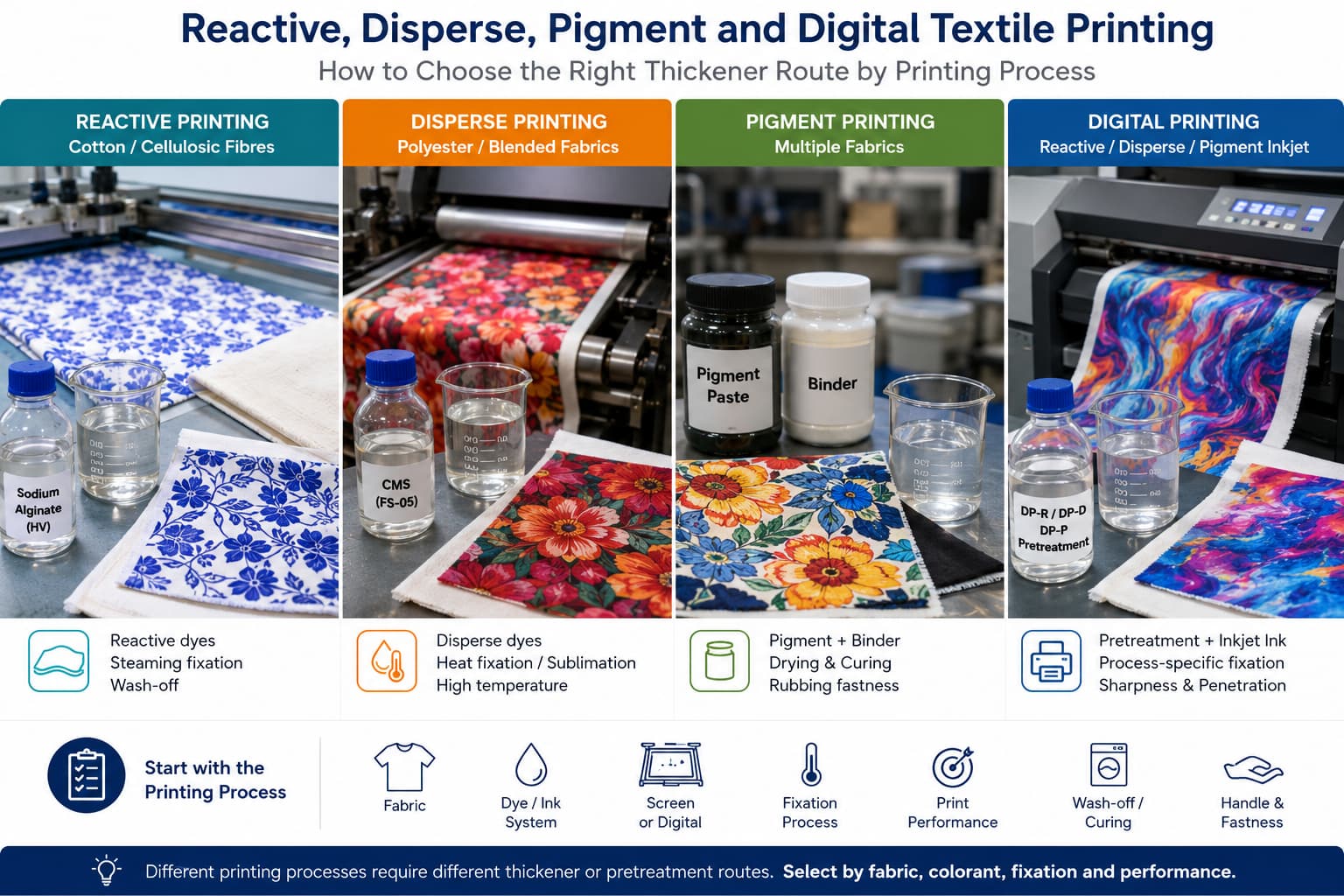
Learn how to choose thickener and pretreatment routes for reactive, disperse, pigment and digital textile printing based on fabric, dye or ink, fixation, wash-off and print-quality requirements.
Digital inkjet printing on textiles has different paste and pre-treatment requirements compared to screen printing. This guide explains how sodium alginate is used in digital textile printing and what grade parameters procurement teams should specify.
Dye fixation rate directly affects color yield, wash fastness, and wastewater load in reactive dye printing. This guide explains how sodium alginate supports dye fixation, what paste parameters influence fixation rate, and how to troubleshoot low fixation in production.
Sodium alginate is commonly used as a thickener in reactive textile printing paste, but other textile uses require application-specific validation. This guide compares printing, digital pretreatment, warp sizing, dyeing-related formulations, coating, and finishing by function, technical requirements, risks, documents, and sample tests.
Viscosity control in digital textile printing involves two different systems: the jetting ink and the fabric pretreatment formulation. This guide explains how temperature, formulation, measurement methods and process conditions affect jetting stability and print quality.
The best digital printing paste is the one matched to the ink chemistry, fabric and fixation route. This guide compares pretreatment requirements for reactive inkjet on cellulosic fabrics and direct disperse inkjet on polyester, then explains how buyers should evaluate samples before bulk purchasing.
The future of textile printing thickeners will be shaped by application-specific rheology, digital pretreatment, bio-based materials, hybrid formulations, faster preparation and data-driven process control. This guide explains which trends are commercially relevant and which still require industrial validation.
FSX Chemical offers separate digital printing paste routes for reactive, disperse and pigment systems, supported by application review, sample matching and technical documentation. This guide explains how buyers can evaluate the right route before bulk purchasing.
Stable digital printing paste requires more than a target viscosity. This guide explains how product selection, water quality, addition sequence, mixing, pH, temperature, filtration, hygiene, storage and quality records influence pretreatment and production consistency.
Textile printing chemical innovation in 2026 is moving beyond higher viscosity and stronger color. The leading developments focus on safer inputs, renewable polymers, waterborne nano-binders, stable pigment dispersions, lower-energy fixation and multifunctional printing systems.
Viscosity control in digital textile printing is not about reaching one number. Reliable performance requires the right pretreatment rheology, test method, temperature, chemical compatibility, filtration, fabric pickup and holding stability.
This product review examines FSX Digital Printing Paste as a textile inkjet pretreatment and thickening route, focusing on ink-system matching, rheology, filtration, print definition, stability and real production testing.
Share the product name, application, quantity, destination and any TDS,
sample photo or document you already have. FSX Chemical will review the
information and recommend the next step for quotation, sample matching
or product selection.
Product InformationProduct name, grade, model, label photo or supplier reference.
Available DocumentsTDS, SDS, COA, sample photo, product list or test data.
Order DetailsEstimated quantity, packaging, destination country, port or trade term.
Application or IssueTextile printing process, formulation need, current issue or target performance.