The Future of Textile Printing: Trends in Thickener Technology
The future of textile printing thickeners will be shaped by application-specific rheology, digital pretreatment, bio-based...
Textile printing technology is changing as factories adopt more digital processes, shorter production runs, faster color changes and increasingly detailed quality-control requirements. These changes are also redefining what buyers expect from a textile printing thickener.
Future-ready thickeners will not be selected only by product family or one viscosity value. They will need to provide a controlled rheological profile, compatibility with the complete formulation, practical preparation, repeatable batch performance and sufficient technical documentation.
At the same time, the industry is exploring bio-based polymers, hybrid systems, lower-addition formulations and digital process monitoring. However, not every new material or laboratory concept is ready for commercial textile production.
The most important question is therefore not which material sounds most innovative. It is which technology can deliver a measurable improvement in the intended printing process without creating new quality, washing, handling or supply risks.
Why Thickener Technology Is Changing
Traditional textile printing pastes combine the colorant, thickener and required auxiliaries in one formulation. In many digital printing processes, part of this chemical system is instead applied to the fabric as a separate pretreatment before inkjet printing.
This change means that thickener technology is no longer developing in only one direction. Conventional screen and rotary printing still require stable, high-body pastes, while digital pretreatments may require lower viscosity, fine filtration, uniform application and precise control of ink migration.
Production runs are becoming more varied
Shorter orders, faster design changes and a wider range of fabrics can make one universal printing paste less practical. Factories increasingly need grades that can be matched to a defined substrate, machine and colorant system.
Quality control is becoming more data-oriented
A laboratory viscosity reading remains useful, but factories also need to understand how the paste changes during mixing, storage, circulation and printing.
This is encouraging interest in more complete rheological testing, standardized preparation records and, in suitable production lines, continuous or inline monitoring.
Sustainability claims require stronger evidence
Natural origin, renewable feedstock and lower addition level may all be relevant, but none of them proves that the complete printing process is more sustainable.
Future product evaluation will increasingly connect raw-material selection with dosage, preparation, machine reliability, washing, wastewater, documentation and rejected production.
A Practical Map of Thickener Technology Trends
Not every trend has the same level of commercial maturity. Buyers should distinguish technologies that can be evaluated immediately from those that still require extensive formulation development.
Technology Direction
Current Status
Main Objective
Buyer Action
Application-specific rheology
Commercially relevant now
Match flow and recovery to the actual printing process
Compare more than one viscosity condition
Digital printing pretreatment
Commercially relevant and expanding
Control ink migration, penetration and surface deposition
Test with the actual ink, fabric and application method
Hybrid and compound thickeners
Commercially relevant now
Balance rheology, preparation, compatibility and cost
Approve the complete blend as one commercial grade
Bio-based polymer development
Established materials with ongoing innovation
Expand renewable polymer routes and performance options
Verify composition, dosage and process performance
Faster hydration and lower-addition grades
Commercial development priority
Improve preparation and cost in use
Measure actual dosage and mixing requirement
Improved salt and alkali tolerance
Commercial development priority
Increase stability in demanding formulations
Test in the complete chemical system
Inline viscosity monitoring
Available but not universal
Detect process drift during production
Confirm sensor suitability and calibration method
Digital twins and predictive control
Emerging industrial direction
Link material data with process performance
Build reliable historical data before automation
Nanocellulose and responsive polymers
Mainly research and specialized development
Create advanced rheology or functional response
Avoid treating laboratory potential as commercial readiness
Technology status can vary by country, supplier and printing sector. A material may be commercially established in coatings or technical inks while still requiring substantial development for conventional textile printing.
1. Application-Specific Rheology
The industry is gradually moving away from selecting thickeners by one viscosity number alone. Future product development will focus more on the complete relationship between shear, flow, recovery and print quality.
Why a single viscosity value is limited
Most textile printing pastes do not behave like simple Newtonian liquids. Their apparent viscosity can change when they are mixed, pumped, filtered or forced through a screen.
Two products may show a similar reading at one rotational speed but behave differently during high-speed rotary printing or after transfer to the fabric.
Future grade design will focus on rheological profiles
A future-ready grade may be designed to provide sufficient body at low shear, easier flow during printing and controlled recovery after the paste reaches the textile surface.
The preferred profile depends on machine speed, screen geometry, fabric absorbency, design detail and the required level of penetration.
What laboratories should measure
Viscosity at more than one rotational speed where practical
Time-dependent change during the normal holding period
Recovery after defined mechanical shear
Filtration and screen-passage behavior
Paste transfer, penetration and outline definition
Final fabric performance after fixation and washing
More detailed rheological testing should support application decisions, not replace actual printing trials.
2. Digital Printing Pretreatment Systems
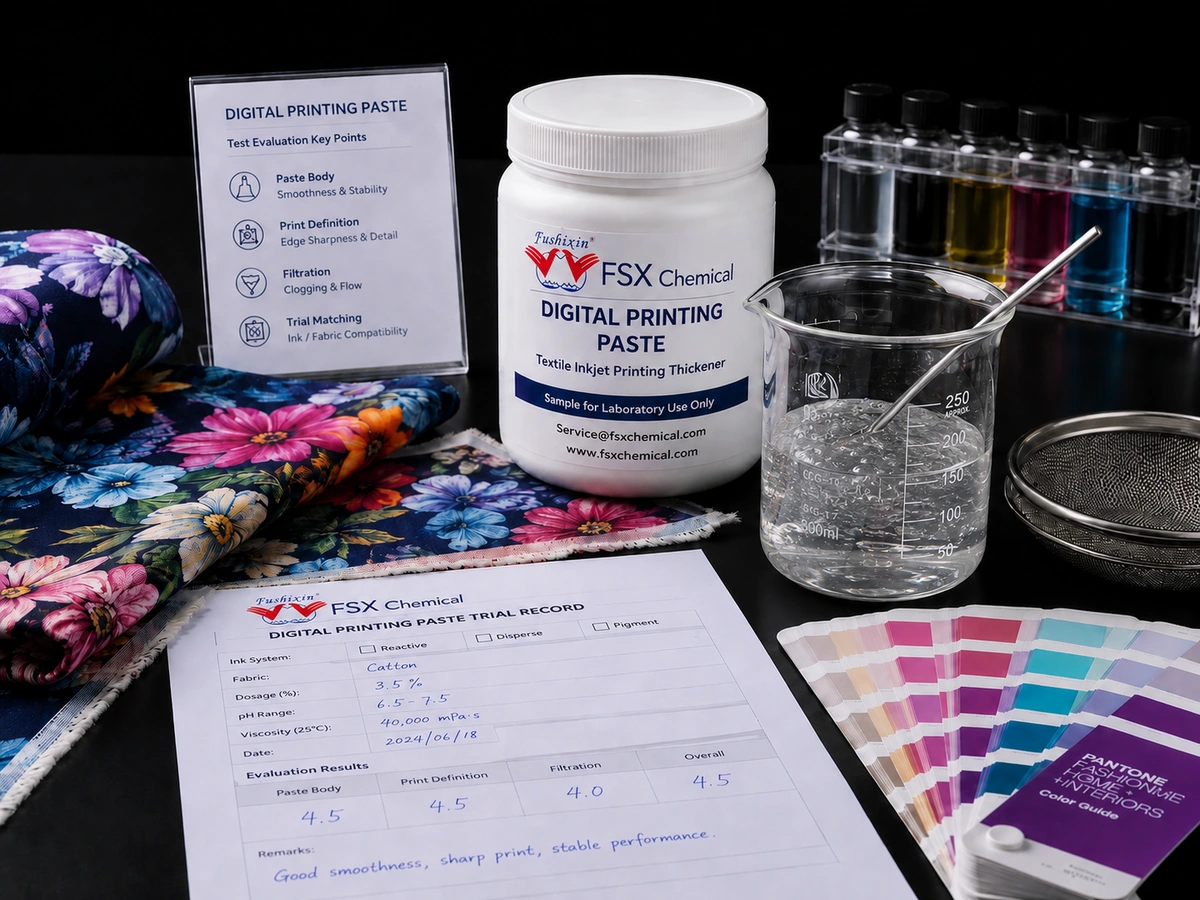
Digital textile printing is changing the role of thickening agents. In many inkjet processes, dyes or pigments are delivered through the printhead, while thickening and fixation-supporting components are applied separately to the fabric.
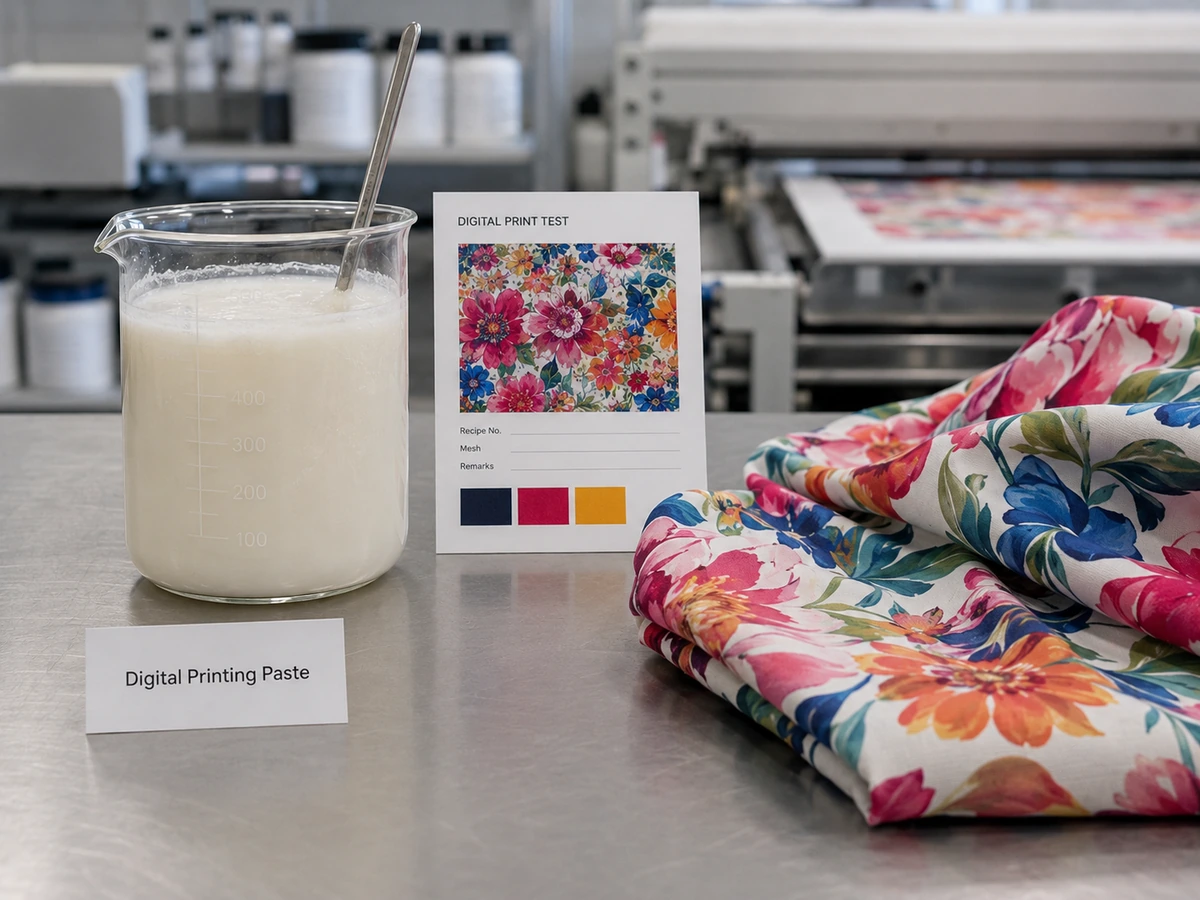
This creates demand for specialized digital printing paste and pretreatment formulations rather than conventional high-viscosity printing pastes.
Key functions of digital pretreatment
Controlling ink spreading and pattern bleeding
Supporting droplet positioning on the fabric
Adjusting penetration into the textile structure
Helping achieve uniform pretreatment pickup
Maintaining compatibility with the selected ink chemistry
Supporting downstream fixation and washing
Lower viscosity does not mean lower technical demand
Digital pretreatments may use lower viscosity than screen-printing pastes, but they often require tighter control of filtration, coating uniformity, particle content and storage stability.
A small change in pretreatment rheology may alter how the liquid is applied by padding, coating, spraying or another delivery method.
Toward more integrated ink and pretreatment design
Future development is likely to connect fabric pretreatment, ink formulation and fixation more closely. A thickener will be evaluated as one part of an integrated printing system rather than as an isolated raw material.
Buyers should therefore provide the ink type, fabric, pretreatment method, drying condition and target print result when requesting a matching grade.
3. Hybrid and Compound Thickeners
One polymer rarely provides the ideal balance of viscosity, shear response, electrolyte tolerance, wash-off, preparation and price. Compound thickeners address this problem by combining complementary material routes.
Why hybrid systems are developing
To balance standing viscosity and flow under shear
To improve preparation or hydration behavior
To adjust tolerance to salts, alkalis or binders
To support lower or more practical application dosage
To match a particular machine or fabric
To reduce the need for factory-side formulation adjustment
Natural and synthetic components may be combined
Hybrid technology should not be simplified into a competition between natural and synthetic polymers. A carefully designed combination may provide more stable production than either component used alone.
The final sustainability and performance result depends on composition, dosage, compatibility, washing and process reliability.
The commercial grade must remain identifiable
Buyers should approve a compound thickener using a permanent product code, specification and batch-control method. An unnamed laboratory blend is not sufficient for long-term commercial purchasing.
The supplier should also explain the intended application, preparation procedure, viscosity test method and known formulation limitations.
4. Bio-Based and Circular Material Routes
Interest in renewable polymers is encouraging further development of alginate, starch, cellulose, plant gum and other biopolymer-based thickening systems.
Some of these material families already have a long history in textile printing. The innovation is increasingly focused on modification, purification, blending and performance optimization rather than simply introducing a natural polymer for the first time.
Sodium alginate development
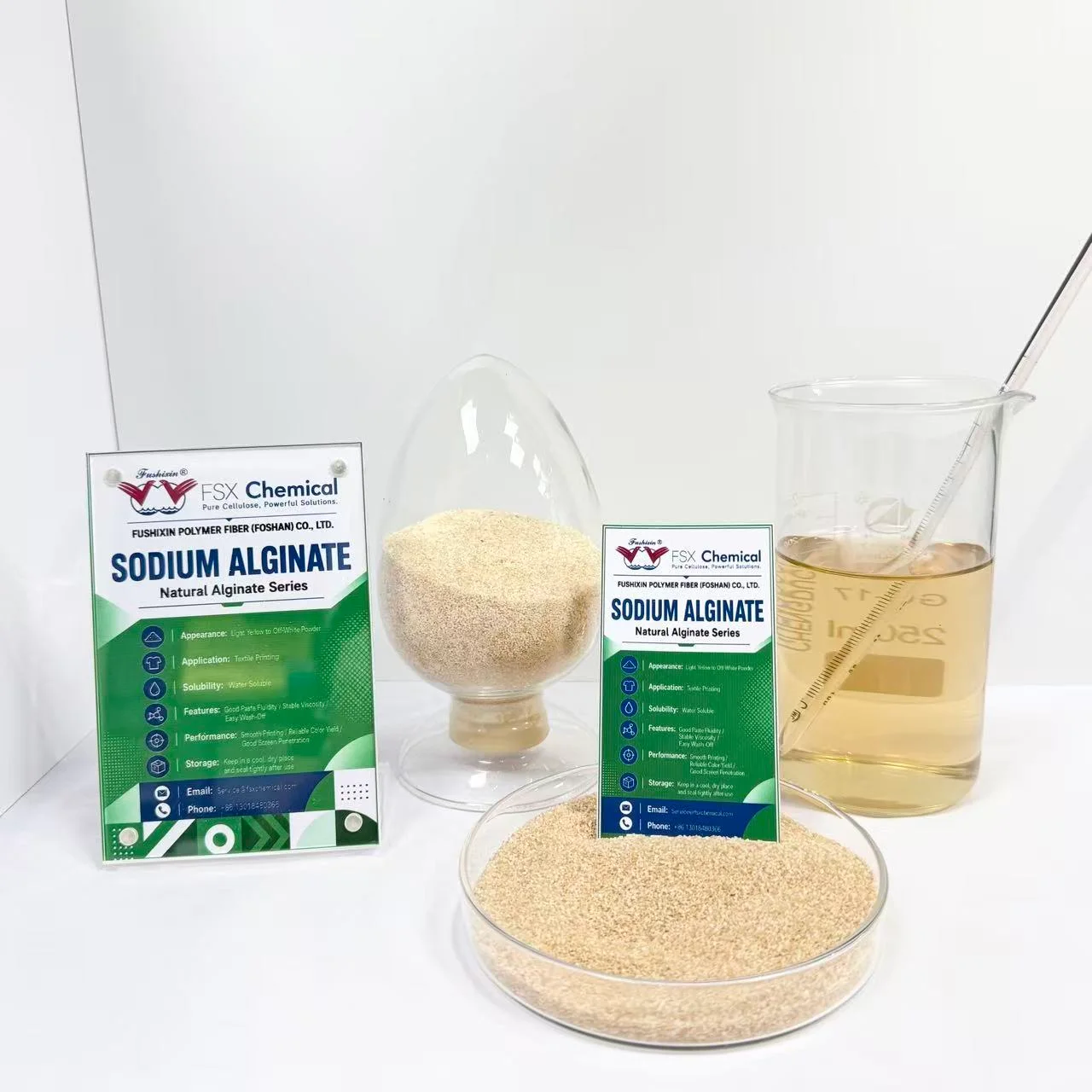
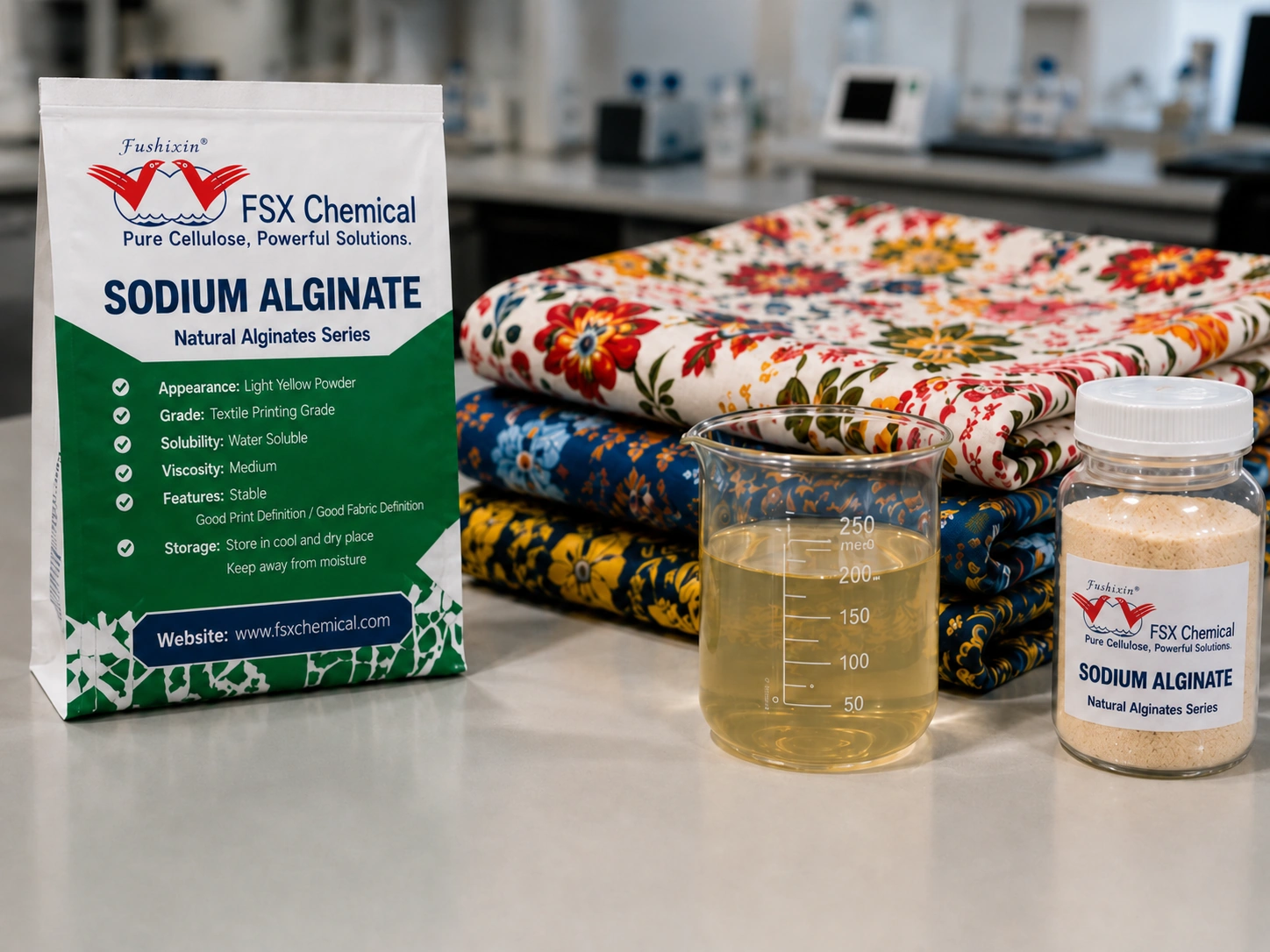
Sodium alginate remains an important thickener route for reactive printing on cellulosic textiles.
Future development may focus on more precise grade selection, improved hydration, stable filtration, efficient dosage and consistent behavior at different printing speeds.
Carboxymethyl starch development
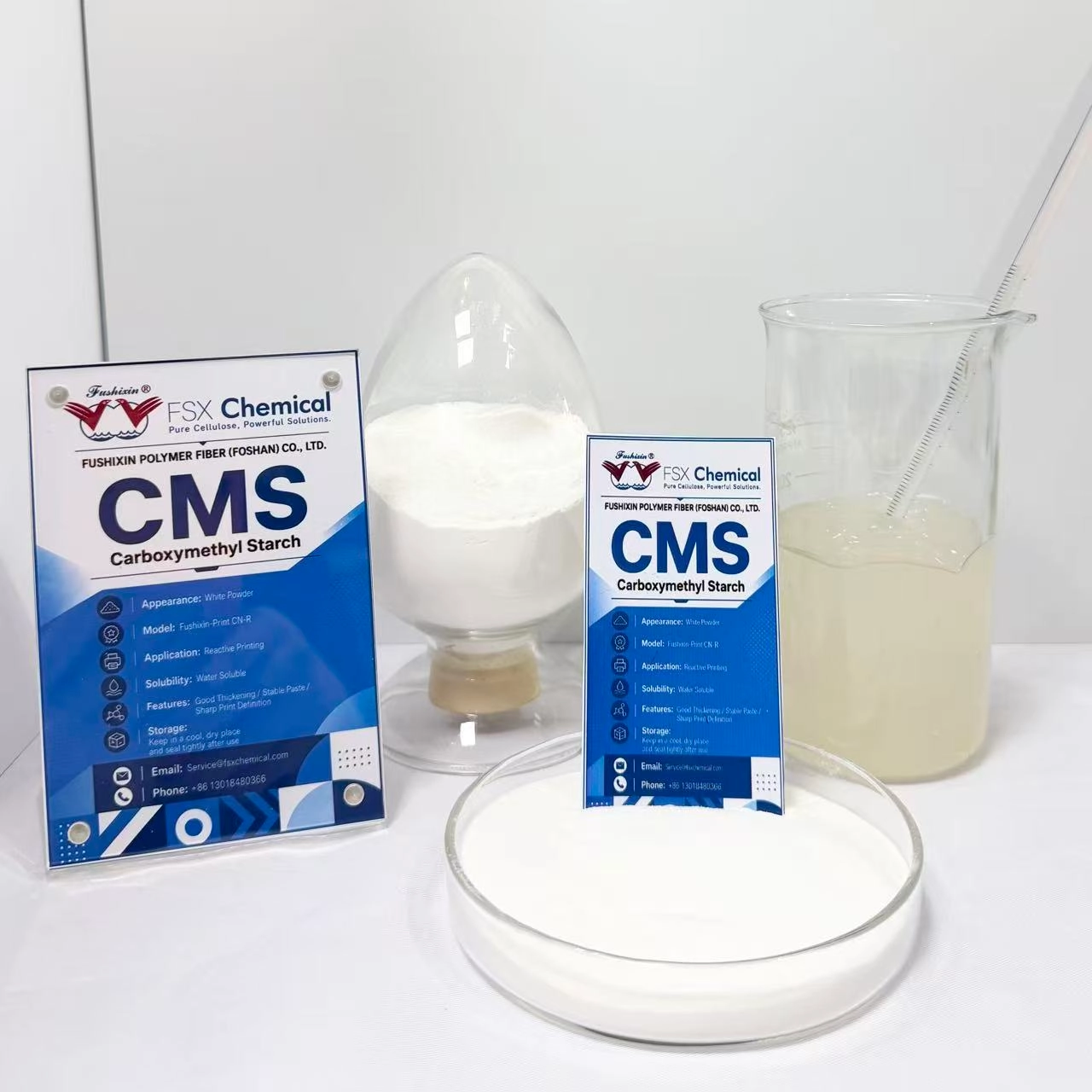
Carboxymethyl Starch provides a starch-derived route for selected printing and mixed-thickener formulations.
Development priorities may include better compatibility, controlled substitution, improved paste rheology and more predictable performance in blended systems.
Carboxymethyl cellulose development
Carboxymethyl Cellulose offers a cellulose-derived polymer route with a broad range of viscosity and substitution grades.
Future textile applications will depend on matching the grade to the colorant system, electrolyte level, preparation process and desired rheology.
Circular feedstocks and nanocellulose
Research is also examining nanocellulose and cellulose recovered from waste streams as rheology modifiers and coating components.
These materials may offer useful shear-thinning and network-forming behavior, but industrial textile printing still requires validation of dispersion, filtration, cost, supply consistency and end-of-process behavior.
Bio-based is not automatically biodegradable
Chemical modification, additives and disposal conditions can change the environmental behavior of a bio-based polymer. Any biodegradability claim should identify the specific product, test method and test conditions.
5. High-Efficiency and Faster-Hydrating Grades
Preparation time is an important part of thickener performance. Factories may lose production capacity when a product requires long hydration, repeated filtration or correction after mixing.
Faster wetting and dispersion
Future grades may be designed with particle-size control, surface modification or optimized formulation to reduce persistent lump formation and improve dispersion under suitable mixing conditions.
Rapid hydration must still be balanced with manageable powder addition. A product that hydrates very quickly can form lumps if the available mixer cannot disperse it evenly.
Lower-addition direction
Higher thickening efficiency may allow a lower dosage in some formulations. However, a lower quantity should not be assumed from the viscosity shown on a TDS.
The candidate must provide acceptable screen behavior, print definition, fixation, washing and fabric handle at the proposed dosage.
Cold-water preparation
Grades that can be prepared under practical ambient or controlled low-temperature conditions may reduce heating requirements and simplify production.
Actual preparation efficiency depends on water quality, seasonal temperature, mixer design, batch size and hydration time.
Concentrated liquid or ready-to-use systems
Some factories may consider concentrated liquid or pre-formulated systems to reduce powder handling and preparation variability.
These systems should be evaluated for storage stability, preservation, transport cost, active content, packaging and shelf-life management.
6. Greater Formulation Tolerance
Modern printing formulations can contain salts, alkalis, dyes, pigments, binders, humectants, defoamers and other auxiliaries. These components may change polymer hydration and apparent viscosity.
A major development direction is therefore greater tolerance to the chemical and physical variation found in real production.
Electrolyte tolerance
A thickener that performs well in clean water may lose viscosity after salts or ionic auxiliaries are added. Future grades may be optimized for a defined electrolyte range.
pH and alkali stability
Reactive and other printing systems may expose the thickener to alkaline or changing pH conditions. Stability should be tested over the normal paste holding time, not only immediately after preparation.
Water-quality tolerance
Hardness, conductivity and dissolved ions can vary between factories and seasons. More robust grades may help reduce sensitivity, but actual process water should remain part of the approval test.
Temperature tolerance
Paste viscosity can change with preparation and measurement temperature. Future product specifications may place greater emphasis on behavior over a practical process-temperature range rather than at only one laboratory condition.
Tolerance is not universal compatibility
A supplier should define which formulation conditions have been evaluated. Terms such as salt-tolerant or alkali-stable should not be interpreted as unlimited resistance under every concentration and process.
7. Inline Viscosity Monitoring and Data-Driven Control
Traditional quality control relies on samples removed from a mixing tank or production line. This approach provides useful information, but it only represents the condition at the sampling time and under the laboratory test method.
Continuous monitoring
Inline sensors can measure changes while the material remains in the process. In suitable systems, this may help identify temperature drift, dilution, evaporation or formulation variation earlier.
Inline monitoring is available for industrial liquids, coatings and printing systems, but it is not automatically suitable for every textile paste.
Challenges in measuring printing pastes
Non-Newtonian and time-dependent rheology
Different shear conditions between sensor and printing machine
Air bubbles, particles or contamination
Temperature variation
Cleaning and sensor fouling
Need for correlation with the approved laboratory method
Closed-loop process adjustment
A more advanced production line may connect viscosity, temperature and formulation data with automated correction. This could include controlled water or concentrate addition within defined limits.
Automation should be based on a validated process model. An incorrect target or unreliable sensor can automate the wrong correction.
Digital twins and predictive models
Digital-twin and predictive-control concepts aim to connect raw-material data, process conditions and production outcomes. In textile printing, this could eventually support earlier detection of quality risks and more consistent grade selection.
These systems require reliable historical data, standardized laboratory methods and accurate production records. They should be treated as an emerging direction rather than a replacement for technical judgment.
8. Chemical Transparency and Batch Traceability
Future thickener technology will be evaluated not only by performance but also by the quality of the supporting information.
Textile brands, mills and chemical buyers increasingly require clearer product identity, chemical-management documentation and batch traceability.
Permanent grade identification
The sample, TDS, quotation, purchase order, package label and COA should refer to the same permanent commercial grade.
This reduces the risk of approving a specially prepared laboratory sample that is not connected to routine production.
More structured batch data
Buyers may require batch-specific information for agreed parameters such as viscosity, moisture, pH or other grade-relevant properties.
The COA method should match the commercial specification. Values measured at different concentrations or temperatures should not be compared as if they used one common method.
Chemical input management
Manufacturing Restricted Substances List programs focus on chemical inputs used during manufacturing rather than only substances detected in the finished textile.
When compliance is required, buyers should request evidence that applies to the specific commercial product and verify the document scope, certificate holder, issuer and validity period.
Environmental data must be product-specific
General statements about natural origin, low impact or biodegradability should not be transferred automatically to every grade in a product family.
Future supplier evaluation will place greater value on verifiable data and clearer limitations than on broad environmental marketing language.
9. Functional and Smart Textile Printing
Textile printing is expanding beyond decorative color. Printed coatings and inks are being developed for conductivity, sensing, antimicrobial functions, controlled release, protective effects and responsive materials.
These applications create new rheological requirements for the polymer system used to carry and deposit functional materials.
Functional-particle suspension
A thickener or rheology modifier may need to keep conductive particles, capsules or other active materials uniformly distributed without making the formulation impossible to print.
Precision deposition
Functional printing may require controlled line width, film thickness and surface placement. The rheological target can therefore differ from a conventional textile color paste.
Responsive and smart polymers
Research on temperature-, pH-, moisture- or stimulus-responsive polymers may eventually support adaptive textile surfaces and specialized printing systems.
These materials remain application-specific and frequently require additional curing, crosslinking, safety and durability evaluation.
Do not mix research trends with standard products
A supplier of conventional textile thickeners should not imply that every CMS, CMC, alginate or compound grade is suitable for conductive, antimicrobial or smart textiles.
Functional printing requires separate formulation development and end-use-specific testing.
How These Trends Affect Different Printing Processes
Printing Process
Likely Thickener Priorities
Important Approval Tests
Reactive screen printing
Dye compatibility, controlled rheology, wash-off and batch consistency
Paste stability, screen behavior, color response and washing
High-speed rotary printing
Flow under shear, recovery, pumping and machine-speed adaptability
Multi-speed viscosity, machine trial and print penetration
Pigment printing
Binder compatibility, low-addition efficiency and film behavior
Paste stability, curing, handle and rubbing performance
Reactive digital printing
Pretreatment uniformity, droplet control and ink compatibility
Coating pickup, print sharpness, fixation and wash-off
Digital pigment printing
Pretreatment-binder balance, filtration and surface deposition
Jetting compatibility, curing, handle and durability
Functional textile printing
Particle suspension, precision deposition and functional stability
Rheology, print geometry, durability, safety and end-use function
A grade developed for one process should not be transferred automatically to another. The same product may require a different dosage or may be unsuitable when the colorant, equipment or fabric changes.
What Buyers Should Prepare for Now
Buyers do not need to wait for every emerging technology to become commercially mature. Several practical actions can improve current sourcing and make future product evaluation easier.
Standardize the current viscosity method
Record concentration, water source, mixing procedure, hydration time, measurement temperature, instrument, spindle and rotational speed.
Keep a complete application baseline
Current thickener and dosage
Fabric and colorant system
Paste formulation and preparation sequence
Normal holding time
Machine type and speed
Fixation and washing conditions
Current quality problems
Actual cost-in-use factors
Separate critical requirements from preferences
Screen blockage, unacceptable color response or unstable paste may be critical failures. Powder color or a minor difference in hydration time may be a preference rather than an automatic rejection criterion.
Build sample-to-bulk verification
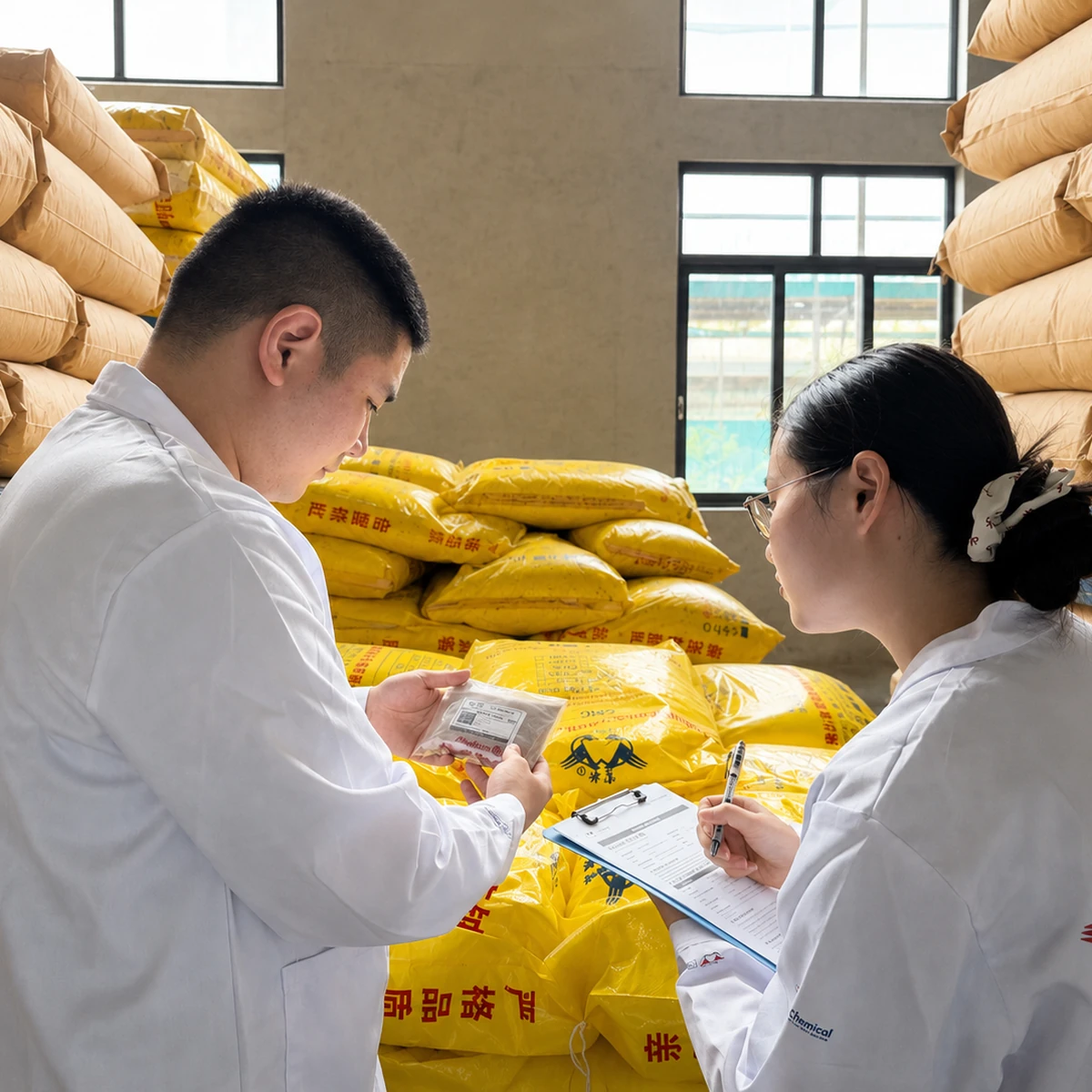
Link every approved sample to a permanent commercial grade and confirm the first bulk batch before full production use.
Request evidence for future-oriented claims
Terms such as bio-based, high-efficiency, low-impact, smart or salt-tolerant should be supported by a clear specification or test direction.
How to Evaluate a Future-Ready Thickener
Step 1: Define the improvement target
Decide whether the project is intended to improve rheology, preparation, digital pretreatment, dosage, chemical compatibility, monitoring or documentation.
Step 2: Select the appropriate technology route
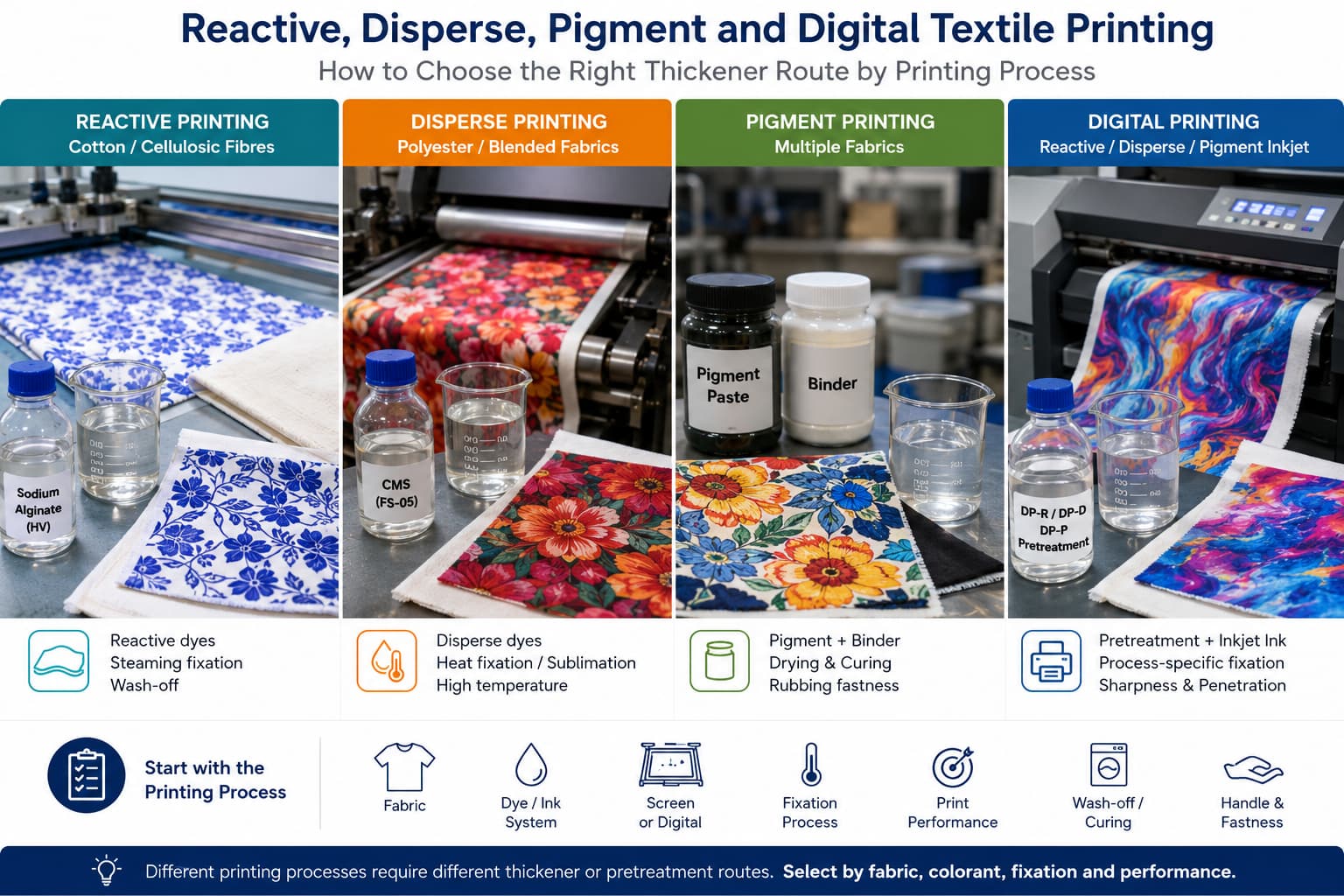
Choose sodium alginate, CMS, CMC, a compound thickener or a specialized digital printing paste according to the actual process.
Step 3: Review the TDS and test method
Confirm viscosity conditions, pH, moisture, purity, substitution data where relevant and the recommended application.
Step 4: Prepare the reference and candidate together
Use the same water, concentration, mixing equipment, temperature, hydration time and measurement procedure.
Step 5: Evaluate more than viscosity
Dispersion and hydration
Filtration and residue
Response to salts, alkalis and auxiliaries
Time-dependent paste stability
Flow and recovery under relevant shear
Application behavior on the machine
Final textile result
Step 6: Compare cost in use
Include dosage, mixing, energy, filtration, machine cleaning, unused paste, washing, reprocessing and rejected fabric.
Step 7: Verify claims and documents
Check that environmental, chemical-management or certification claims apply to the exact commercial grade.
Step 8: Confirm the first commercial batch
Review packaging, grade code, COA, incoming viscosity and application performance before routine approval.
Common Mistakes When Following Technology Trends
Choosing innovation instead of application fit
A newer polymer is not automatically better than a well-matched established grade. Production suitability remains the first requirement.
Expecting one product to fit every process
Screen printing, rotary printing, digital pretreatment and functional coatings require different rheological and chemical properties.
Comparing only viscosity
One viscosity value cannot describe filtration, shear response, recovery, compatibility or final print behavior.
Assuming lower dosage from a high TDS value
Thickening efficiency in water does not automatically predict dosage in a complete printing formulation.
Using bio-based as proof of sustainability
Raw-material origin is only one part of the assessment. Preparation, washing, waste, transport and batch consistency also matter.
Installing sensors without a process baseline
Inline monitoring is useful only when the measurement can be related to an approved laboratory and production standard.
Confusing research with industrial availability
Nanocellulose, responsive polymers and digital-twin systems may have significant potential, but readiness depends on scale, cost, equipment and application validation.
Approving an unnamed sample
A future-oriented formulation still needs a permanent grade code, commercial specification and repeatable production route.
How FSX Chemical Supports Thickener Development
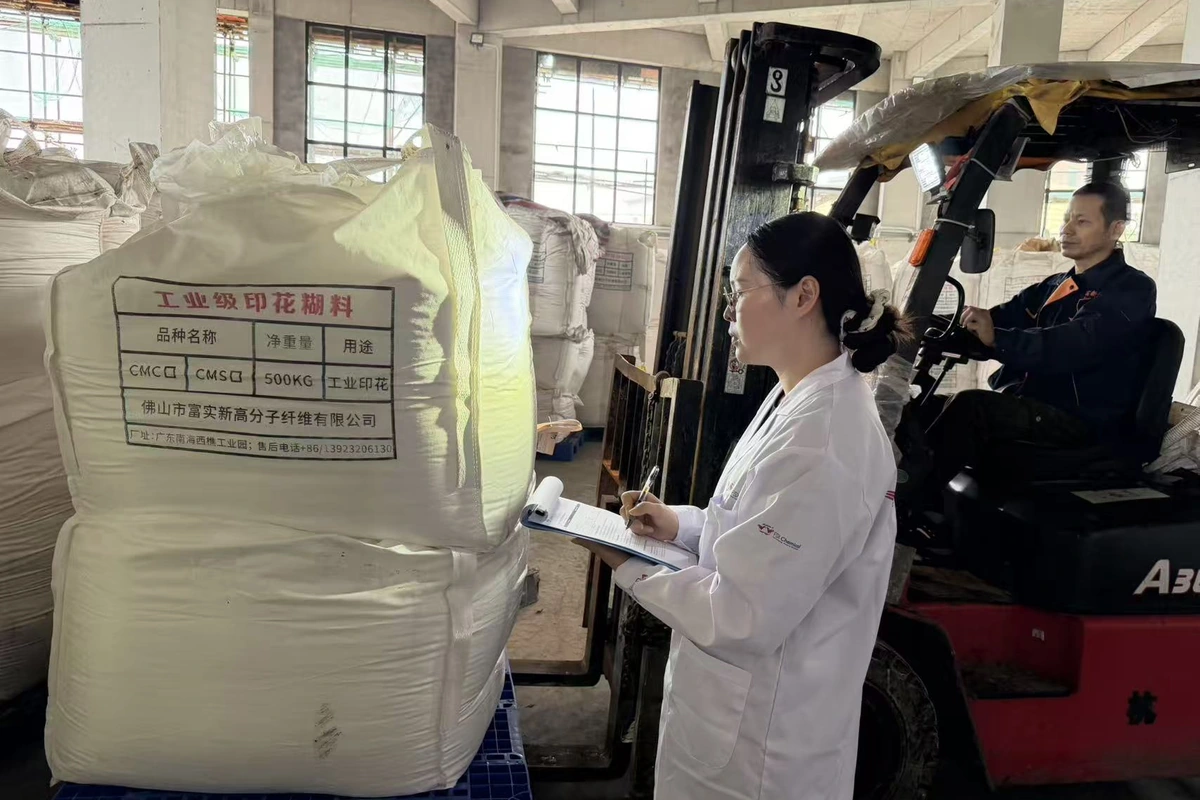
FSX Chemical supplies sodium alginate, CMS, CMC and digital printing paste for different textile printing systems. Candidate grades can be reviewed according to the customer’s current product, formulation, equipment and development objective.
Buyers can provide
Current TDS or representative sample
Fabric and fibre composition
Dye, pigment or ink system
Printing or pretreatment method
Current formulation and dosage
Target viscosity and complete test method
Machine type and production conditions
Main technical or sustainability objective
Technical review may include
Comparison of the current product specification
Selection of a suitable starting grade
Review of viscosity and preparation conditions
Provision of relevant TDS and SDS documents
Representative samples for laboratory testing
Guidance for side-by-side formulation evaluation
Review of printing-trial feedback
Batch documentation for the selected commercial grade
A recommended grade should be treated as a candidate for controlled evaluation. Final approval depends on the customer’s complete formulation, production equipment and textile-quality requirements📧 Email: Service@fsxchemical.com
Learn how to choose thickener and pretreatment routes for reactive, disperse, pigment and digital textile printing based on fabric, dye or ink, fixation, wash-off and print-quality requirements.
Digital inkjet printing on textiles has different paste and pre-treatment requirements compared to screen printing. This guide explains how sodium alginate is used in digital textile printing and what grade parameters procurement teams should specify.
CMS for textile printing paste can help adjust viscosity, improve paste handling, and support stable formulation performance. This guide explains how buyers can evaluate CMS grades by viscosity, DS, solubility, pH, moisture, and sample testing before bulk purchase.
Cellulose-based raw materials are used in textile printing, printing paste preparation, thickening, and formulation support. This guide explains how buyers can evaluate CMC, CMS, sodium alginate, textile printing thickeners, and printing paste products by specification, documentation, sample testing, and supplier support.
Chemical formulation support for textile printing should begin with clear application information. This guide explains what buyers should provide when requesting product matching, formulation adjustment, sample testing, TDS, COA, SDS, and technical support for CMC, CMS, sodium alginate, textile printing thickeners, and printing paste products.
Sodium alginate is commonly used as a thickener in reactive textile printing paste, but other textile uses require application-specific validation. This guide compares printing, digital pretreatment, warp sizing, dyeing-related formulations, coating, and finishing by function, technical requirements, risks, documents, and sample tests.
Grade matching is not simply finding a product with a similar viscosity. This guide explains how textile printing mills can compare paste grades through application review, controlled preparation, printing trials and sample-to-bulk verification.
Sodium alginate is widely used as a thickener in reactive dye printing, but grade selection requires more than choosing an HV, MV or LV label. This guide explains its technical role, key purchasing parameters, preparation controls and production trial requirements.
Print sharpness and wash-off performance depend on more than printing-paste viscosity. This guide explains how CMC and CMS grade, rheology, degree of substitution, paste preparation, dye compatibility and washing conditions should be evaluated.
Viscosity control in digital textile printing involves two different systems: the jetting ink and the fabric pretreatment formulation. This guide explains how temperature, formulation, measurement methods and process conditions affect jetting stability and print quality.
Effective batch quality control begins with raw-material approval and continues through process monitoring, representative sampling, laboratory testing, release review, traceability and corrective action.
Laboratory evaluation of a printing thickener should cover more than one viscosity result. This guide explains powder inspection, stock-paste preparation, rheology, formulation compatibility, printing trials, wash-off and final performance assessment.
Share the product name, application, quantity, destination and any TDS,
sample photo or document you already have. FSX Chemical will review the
information and recommend the next step for quotation, sample matching
or product selection.
Product InformationProduct name, grade, model, label photo or supplier reference.
Available DocumentsTDS, SDS, COA, sample photo, product list or test data.
Order DetailsEstimated quantity, packaging, destination country, port or trade term.
Application or IssueTextile printing process, formulation need, current issue or target performance.

 EN
EN  BN
BN  ES
ES  TR
TR  FR
FR  ID
ID  RU
RU  AR
AR  UR
UR  VI
VI  TL
TL  HI
HI  UK
UK  KK
KK  KA
KA  UZ
UZ