Technical Insights: Viscosity Control in Digital Textile Printing
Viscosity control in digital textile printing is not about reaching one number. Reliable performance requires...
Viscosity is one of the most important control parameters in digital textile printing, but it is also one of the easiest parameters to misunderstand. When a digital print shows poor definition, excessive ink spreading, uneven color or inconsistent pretreatment pickup, the first reaction is often to increase or decrease the viscosity.
That approach can work only when viscosity is actually the cause of the problem. In many cases, the same symptom can also be created by fabric absorbency, chemical compatibility, uneven coating, temperature, incomplete hydration, filtration problems or unstable storage conditions.
Digital textile printing also involves two very different viscosity systems: the viscosity of the ink inside the ink delivery and printhead system, and the viscosity or rheology of the fabric pretreatment applied before printing.
These should not be treated as the same parameter. Ink viscosity is normally controlled within the operating requirements of the selected ink and printhead system. Pretreatment-paste viscosity is selected according to the fabric, application equipment, chemistry, pickup target and required print performance.
This guide focuses primarily on viscosity control of digital textile printing pretreatments and pastes while explaining how those properties connect with ink behavior and final print quality.
Why Viscosity Control Matters in Digital Textile Printing
Digital printing requires accurate control of very small quantities of liquid. The fabric, pretreatment and ink must interact consistently over thousands of printed metres.
The pretreatment paste controls how chemicals are distributed on or within the fabric before ink deposition. Its viscosity and rheology influence application uniformity, wet pickup, penetration, drying and the way ink subsequently interacts with the textile.
Viscosity that is too low may contribute to
Excessive penetration into absorbent fabrics
Uncontrolled movement during coating or padding
Uneven chemical distribution
Reduced ability to control ink spreading
Variation in pretreatment pickup
Physical instability in some formulations
Viscosity that is too high may contribute to
Poor coating or padding uniformity
Difficult pumping and transfer
Excessive surface deposition
Filter-loading problems
Longer leveling time
Uneven drying
An unnecessarily heavy surface feel
The objective is therefore not maximum viscosity. It is a stable operating window that supports uniform pretreatment and acceptable printing on the selected fabric.
Ink Viscosity and Pretreatment Paste Viscosity Are Different
Digital textile printing uses viscosity in two different parts of the process, and confusing them can lead to incorrect troubleshooting.
Ink viscosity
Ink viscosity influences fluid delivery, droplet formation and printhead operation. It is closely connected with ink formulation, operating temperature, surface tension and the requirements of the selected printhead.
Printing mills should follow the approved specifications of the ink and equipment suppliers rather than adjusting the ink by adding textile thickener.
Pretreatment paste viscosity
Pretreatment viscosity determines how the chemical formulation is applied to the fabric before inkjet printing. It can be controlled through the thickener grade, concentration, water, additives and preparation process.
A digital printing paste should therefore be selected according to the ink route, fabric and pretreatment application process rather than from the ink viscosity specification.
The two systems interact indirectly
Pretreatment influences how an ink droplet wets, spreads and remains near the fabric surface. A printing defect may therefore look like an ink problem even when the actual cause is nonuniform pretreatment.
Viscosity vs Rheology: Why One Number Is Not Enough
Viscosity describes resistance to flow under a defined measurement condition. Rheology describes how that resistance changes with shear, time and structural recovery.
During storage
The pretreatment is exposed to relatively low shear. Sufficient structure may be required to maintain physical uniformity.
During pumping
Mechanical force increases. The formulation must move through lines and pumps without excessive resistance.
During coating or padding
The paste experiences further shear as it passes through rollers, blades or another application system.
After reaching the fabric
The mechanical force decreases. Structural recovery can influence leveling, penetration and chemical location before drying.
Why equal viscosity can produce different results
Two pretreatment products can show the same viscosity at one test speed but behave differently during coating because their shear-thinning and recovery characteristics differ.
For this reason, routine viscosity is an important QC parameter, but application approval should also include rheology and actual fabric testing.
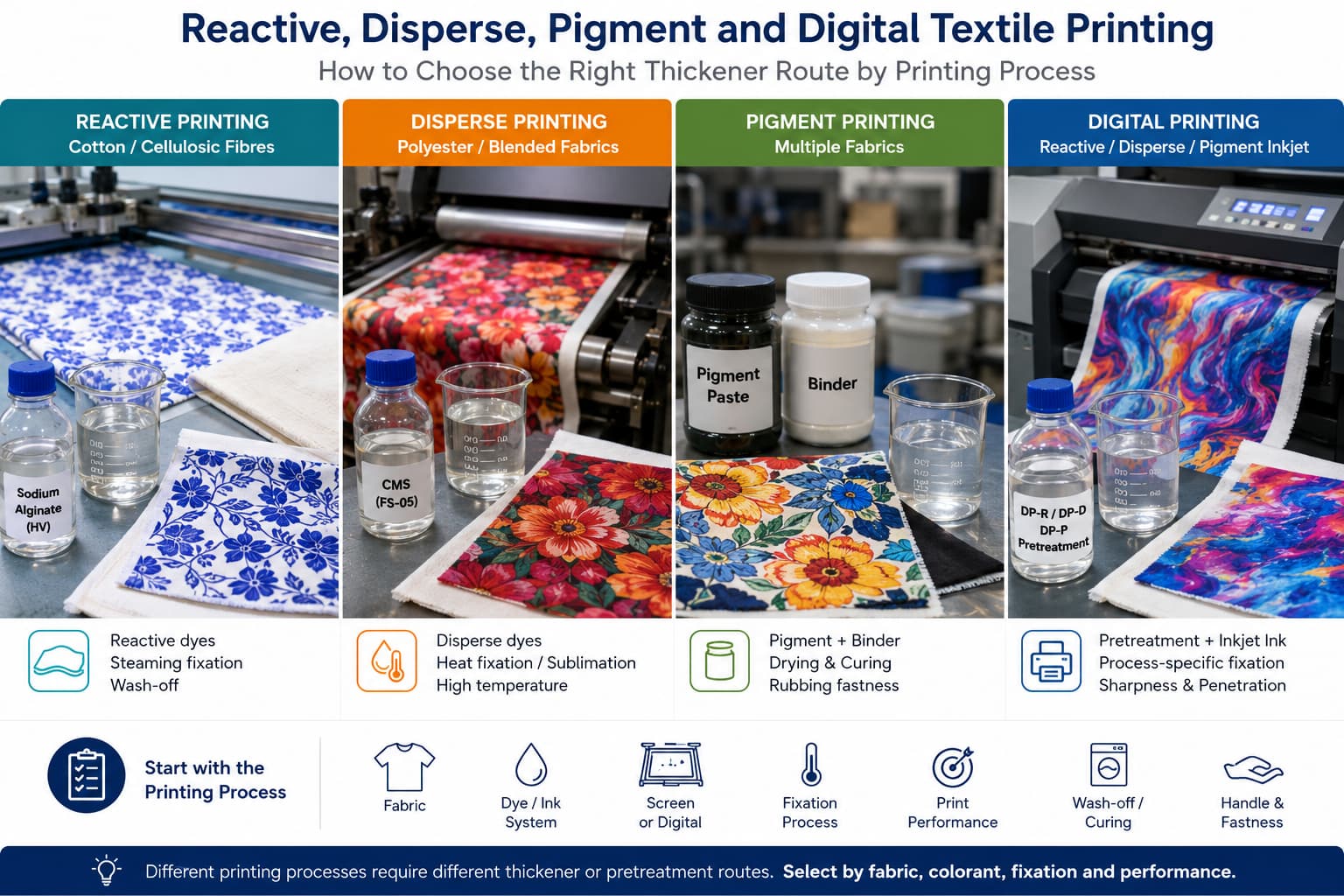
1. Define the Digital Printing Route First
The correct viscosity range cannot be selected until the printing chemistry has been identified.
Reactive digital printing
Reactive digital printing is commonly used on suitable cotton, viscose and other cellulosic fabrics. Pretreatment chemistry may include thickener, alkali, humectant and other application-specific components.
Disperse digital printing
Disperse digital processes are associated mainly with polyester systems. Pretreatment requirements depend on whether the process is direct printing, transfer-related or another specialized route.
Pigment digital printing
Pigment printing requires attention to pigment, binder and curing chemistry. Pretreatment viscosity must be evaluated together with binder compatibility, surface deposition and final handle.
Do not use one universal digital paste
A formulation designed for reactive ink should not automatically be transferred to a pigment or disperse system simply because its viscosity appears suitable.
2. Establish a Practical Viscosity Window
A production specification should normally use an acceptable operating window rather than one unexplained exact value.
Begin with the approved reference
Measure the product currently producing acceptable results using a standardized method.
Connect viscosity with application pickup
Record the pretreatment application quantity together with viscosity. A similar viscosity is not useful when the candidate deposits a very different amount of chemistry onto the fabric.
Connect viscosity with print quality
Compare ink spreading, edge definition, solid-area uniformity, shade and final handle within the candidate viscosity range.
Avoid chasing a single number
The most useful operating window is the range in which the paste remains stable, applies uniformly and produces acceptable finished fabric.
3. Standardize the Viscosity Test Method
A viscosity value cannot be interpreted correctly without the test conditions.
Record all critical variables
Product or paste identification
Sample concentration
Concentration calculation basis
Water source
Preparation procedure
Mixer type and speed
Mixing and hydration time
Resting time
Measurement temperature
Viscometer model
Spindle, rotor or geometry
Rotational speed
Reading time
Reported unit
Use one method for all comparisons
Current and candidate products should be prepared with identical water, containers, mixing conditions and measurement settings.
Do not compare unrelated TDS values
Two supplier viscosity specifications should not be considered equivalent unless their concentration and test methods are compatible.
4. Control Temperature
Temperature can change apparent viscosity and is an important source of disagreement between laboratory and production results.
Mixing can generate heat
High-speed mixing may warm the paste. A sample measured immediately after preparation may therefore give a different result from the same material after conditioning.
Factory temperature changes by season
A pretreatment prepared in a warm workshop can behave differently from one prepared under cooler conditions.
Condition samples before comparison
Reference and candidate samples should reach the same defined measurement temperature.
Record production temperature
Where viscosity drift occurs during long runs, monitor both paste viscosity and temperature before changing the formula.
5. Standardize Water Quality and Solids
Water is often the largest component of digital printing pretreatment. Variation in water quality or total solids can significantly change the formulation.
Monitor relevant water properties
Temperature
pH
Hardness where relevant
Conductivity where relevant
Visible suspended material
Variation from the water-treatment system
Control total batch weight
Small weighing or dilution errors can create a meaningful viscosity difference in polymer-thickened systems.
Prevent evaporation
Open tanks and containers can lose water, increasing effective solids and viscosity over time.
Record all water additions
Unrecorded operator dilution changes every chemical concentration in the pretreatment and makes troubleshooting difficult.
6. Optimize Dispersion and Hydration
Incomplete polymer hydration can create viscosity drift even when the product itself is stable.
Create liquid circulation before addition
When a powdered thickener is used, establish suitable water movement before introducing the powder.
Add powder gradually
Rapid addition can create surface-hydrated lumps containing dry polymer inside.
Standardize mixing
Record mixer type, impeller, batch size, mixing speed, addition time and total mixing duration.
Allow the required hydration period
A visually smooth paste may continue developing viscosity. Measure only after the defined preparation period.
Check the complete vessel
Material near the vessel wall, surface or bottom may not receive the same circulation as material near the mixer.
7. Control Chemical Addition Sequence
Digital pretreatments may contain salts, alkalis, binders, humectants, wetting agents and other auxiliaries. Addition sequence can influence polymer behavior and final viscosity.
Avoid local chemical shock
Adding a concentrated chemical into a small area can create local thinning, gel formation or flocculation.
Follow the approved dilution procedure
Where an auxiliary requires pre-dilution, control both dilution ratio and addition rate.
Measure after critical additions
Record viscosity, pH and appearance after components that may change ionic strength or polymer interaction.
Preserve one production sequence
A laboratory formula is difficult to reproduce when operators add the same materials in a different order.
8. Manage Shear During Mixing and Circulation
Pretreatment viscosity is affected not only by ingredients but also by mechanical history.
During preparation
Sufficient shear is needed for dispersion, but unnecessary prolonged high-speed mixing can increase temperature and introduce air.
During pumping
Pumps and transfer lines expose the formulation to additional mechanical force.
During coating or padding
The application system may expose the paste to higher shear than the routine laboratory viscosity test.
After shear
Structural recovery influences whether the formulation remains uniform on the fabric or continues spreading before drying.
Do not copy laboratory RPM directly to production
The same rotational speed does not create the same circulation in a small beaker and a production tank.
9. Connect Viscosity with Filtration
Digital textile processes require careful control of particles, gels and contamination.
Filterability is not the same as viscosity
A paste can show the correct viscosity and still contain hydrated gels, foreign particles or precipitated chemicals.
Define the filtration test
Record filter material, opening size, sample quantity, filtration condition and time.
Inspect retained material
Identify whether residue consists of incompletely hydrated thickener, precipitated formulation components, fibres or contamination.
Test fresh and stored paste
Some particles appear only after the formulation has been held for a period of time.
Do not use filtration to hide incompatibility
Repeated formation of new residue after filtration indicates that the formulation itself should be reviewed.
10. Monitor Holding and Storage Stability
Digital printing paste should remain suitable throughout the period between preparation and fabric application.
Establish realistic checkpoints
Immediately after preparation
After complete hydration
After final chemical addition
After the normal production holding period
During an extended production run where relevant
Measure more than viscosity
pH
Separation
Settling
Gel formation
Foam
Filtration
Odor or color change where relevant
Use closed comparison containers
Evaporation can create artificial viscosity increase during a storage trial.
Print both fresh and stored pretreatment
A small numerical viscosity change may be acceptable when fabric application and printing remain stable. Conversely, a small change may be important when it affects pickup or definition.
11. Match Viscosity to Fabric Pickup
Pretreatment viscosity should be evaluated together with the quantity and uniformity of chemistry applied to the fabric.
Fabric absorbency matters
Highly absorbent fabric can draw more liquid into its structure, while a tightly finished or less absorbent surface may retain more pretreatment near the top.
Fabric construction matters
Lightweight knits, dense woven fabrics, open constructions and textured surfaces may require different rheological balance.
Application equipment matters
Padding, coating, spraying and other pretreatment systems do not apply the same mechanical force or liquid quantity.
Measure pickup consistently
Compare pretreatment quantity under identical equipment settings and fabric conditions.
Do not increase viscosity simply to increase surface concentration
Excessive viscosity may reduce leveling or produce an unnecessarily heavy surface deposit. Application quantity and rheology should be optimized together.
12. Evaluate Ink Spreading and Print Definition
One of the main reasons to control pretreatment viscosity is to create a fabric surface that supports predictable ink placement.
Use a controlled digital test pattern
Fine lines
Small text
Sharp corners
Closely spaced colors
Gradients
Dark solid areas
Evaluate edge sharpness
Check whether droplets remain within the intended design boundary after printing, fixation and washing or curing.
Evaluate solid areas
Excessive pretreatment viscosity or uneven pickup may produce local differences in ink absorption and visual levelness.
Evaluate penetration
Examine both the face and reverse side of the fabric where penetration is an important quality criterion.
Evaluate dark colors carefully
Dark blacks, navy shades and saturated colors can reveal spreading, leveling and chemical-distribution problems more clearly than light laboratory shades.
Evaluate after complete post-treatment
The final decision should be made after the normal fixation, washing or curing route, not from the wet print alone.
Viscosity Priorities for Reactive Digital Printing
Reactive digital printing on suitable cellulosic fabrics requires pretreatment chemistry that supports controlled ink placement and later dye fixation.
Important viscosity-related priorities
Uniform pretreatment pickup
Compatibility with alkali and other auxiliaries
Stable holding behavior
Controlled ink spreading
Fine-line definition
Suitable moisture behavior during fixation
Effective wash-off
Acceptable final fabric handle
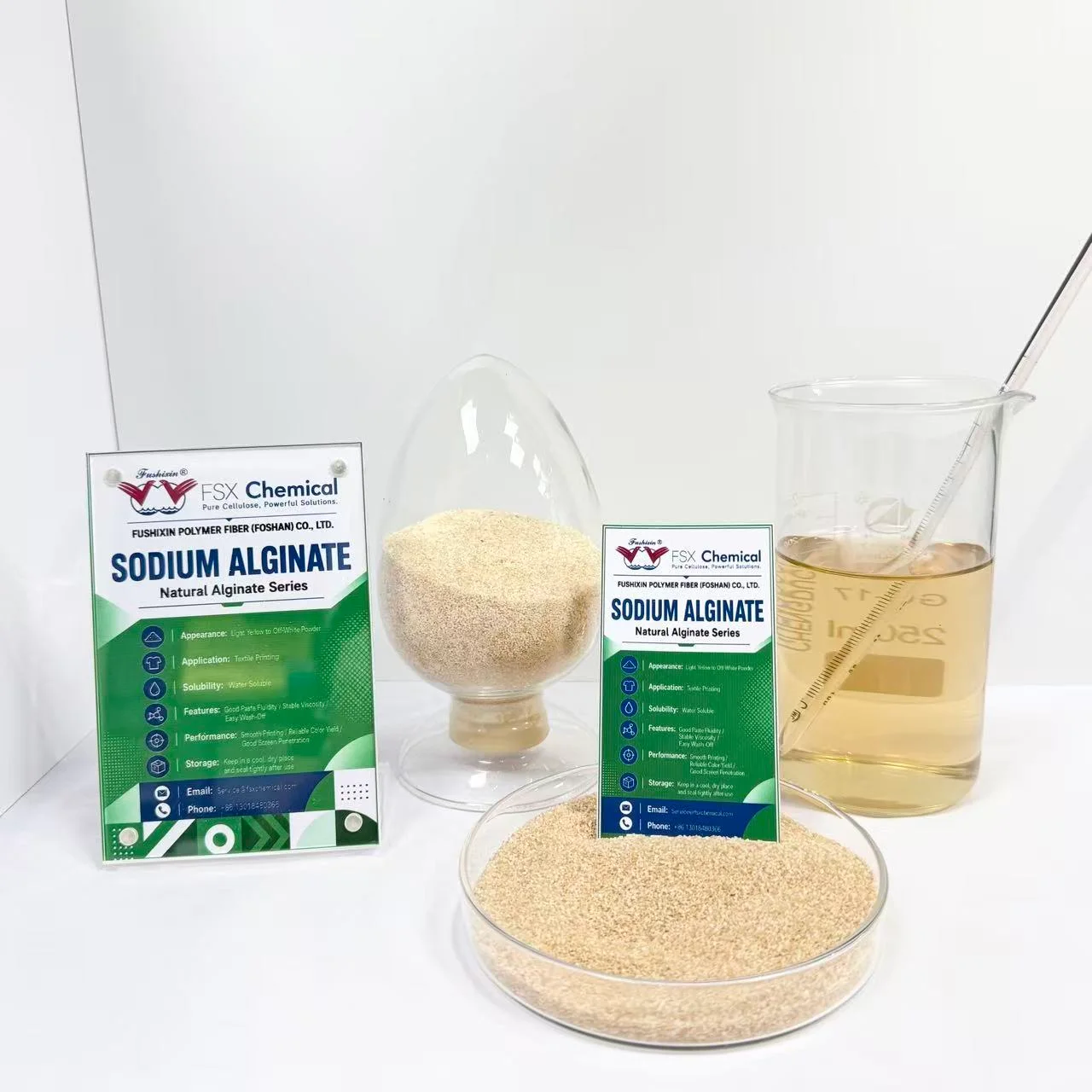
Sodium alginate is widely associated with conventional reactive printing, while digital pretreatment may require an application-specific compound formulation rather than simply transferring a conventional screen-printing paste.
Final viscosity should therefore be determined using the actual pretreatment equipment, fabric, reactive ink and fixation process.
Viscosity Priorities for Disperse Digital Printing
Disperse digital printing is mainly associated with polyester, but pretreatment requirements differ depending on the printing and fixation route.
Important evaluation areas include
Uniform application to polyester
Drying behavior
Filtration
Paste stability
Color uniformity
Thermal fixation behavior
Migration control where relevant
Final surface quality
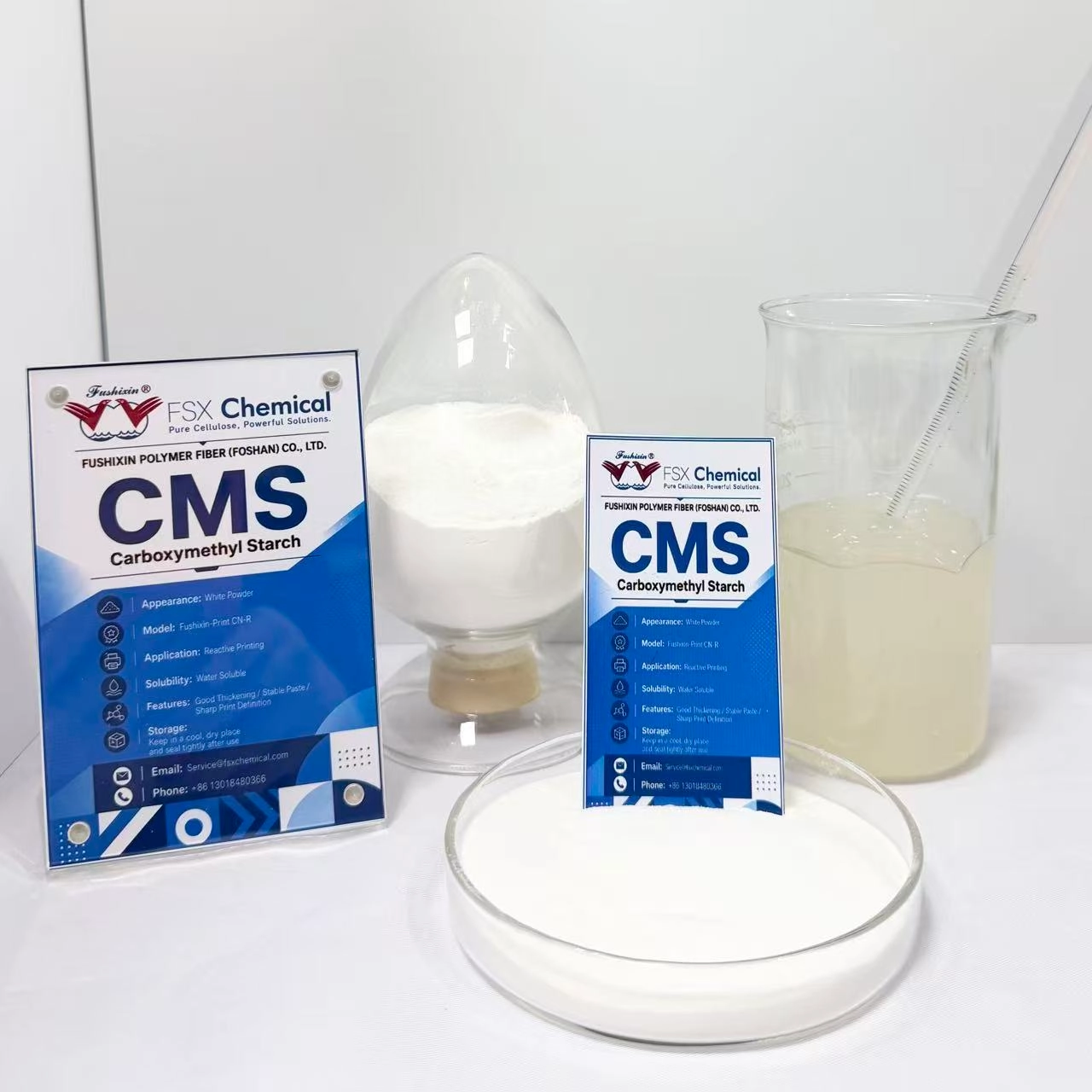
CMS and other rheology components may be evaluated in selected formulations, but a complete digital disperse paste should be tested as one system.
Viscosity Priorities for Pigment Digital Printing
Pigment digital printing introduces additional interaction between pretreatment, pigment particles, binder chemistry and curing.
Binder compatibility
The thickening system should not destabilize the binder or create flocculation during preparation or storage.
Uniform surface application
Pretreatment should remain sufficiently uniform across the fabric width to support consistent pigment deposition.
Controlled surface film
Excessive thickener or binder deposition can improve apparent surface concentration while creating an undesirable fabric handle.
Curing performance
Evaluate definition together with binder-film development, dry and wet rubbing performance and handle after the complete curing process.
Selected CMC or other polymers may serve as components of specialized formulations, but compatibility should be confirmed before use.
Troubleshooting High, Low and Drifting Viscosity
Observed Problem
Possible Causes
Recommended Checks
Viscosity is higher than expected
Excess concentration, continued hydration, evaporation, low temperature or weighing error
Check batch weight, hydration time, temperature, container closure and test method
Viscosity is lower than expected
Excess water, incomplete formulation, high temperature, chemical interaction or incorrect product dosage
Check weighing, temperature, addition sequence and formulation
Viscosity increases during storage
Continued hydration, evaporation or temperature decrease
Review hydration period, closure, temperature and storage history
Viscosity decreases during storage
Polymer interaction, pH change, electrolyte effect, contamination or prolonged shear
Review chemistry, hygiene, pH, conductivity and mixing history
Viscosity changes after alkali or salt addition
Ionic interaction, local chemical shock or unsuitable addition sequence
Test staged additions and review dilution and mixing procedures
Correct viscosity but excessive ink spreading
Unsuitable rheology, low pretreatment pickup, high fabric absorbency or incompatible chemistry
Review rheology, pickup, fabric profile and complete formula
Correct viscosity but uneven solid colors
Uneven application, foam, poor fabric preparation or coating variation
Measure pickup across the width and inspect pretreatment uniformity
High viscosity and difficult coating
Excess structure, excessive dosage or unsuitable shear response
Review concentration, multi-speed behavior and application settings
Laboratory and production viscosity differ
Different water, mixing scale, temperature, holding time or measurement method
Compare complete preparation and QC records
Different operators obtain different results
Different mixing, resting, temperature or instrument procedure
Standardize the SOP and operator training
Before correcting a batch with water or additional thickener, confirm temperature, concentration, hydration and the complete test method. Correcting the wrong cause can make the paste even less stable.
Recommended Digital Printing Paste QC Plan
A reliable QC plan should connect incoming product control with pretreatment preparation and finished-fabric evaluation.
Incoming raw material
Commercial grade and batch identity
Appearance and package condition
Relevant solids or moisture
Specified viscosity or other agreed parameters
Current batch documentation
Prepared stock or pretreatment paste
Dispersion and hydration
Viscosity
pH
Filtration
Foam
Appearance
After complete chemical formulation
Viscosity
pH
Physical stability
Filtration
Holding stability
Fabric application
Wet or dry pickup
Width uniformity
Surface appearance
Drying behavior
Digital printing result
Fine-line definition
Ink spreading
Solid-area uniformity
Color response
Penetration
Fixation or curing
Wash-off where applicable
Fabric handle
Required durability
Laboratory-to-Production Scale-Up
Laboratory viscosity approval should be followed by production-relevant testing because tank size, mixing, heat transfer and application equipment change the mechanical environment.
Preserve the approved laboratory method
Record water, concentration, addition sequence, mixer, hydration time, temperature and viscosity procedure.
Prepare a controlled production batch
Begin with a limited batch that is large enough to represent normal mixing and application conditions.
Check tank uniformity
Where practical, compare samples from relevant positions before releasing the pretreatment.
Monitor application throughout the run
Record viscosity, temperature, pickup, machine conditions and fabric quality from the beginning to the end.
Verify the first commercial shipment
The first production batch of a newly approved product should be checked against the sample and laboratory method before routine use.
Information to Send for Paste Matching
Accurate technical information allows the supplier to select a more relevant candidate and reduces unnecessary sample rounds.
Digital printing route
Reactive, disperse or pigment
Direct or other application route where relevant
Printer and pretreatment equipment type
Fabric information
Fibre composition
Fabric weight
Woven or knitted construction
Surface treatment
Absorbency behavior
Representative fabric sample
Current pretreatment information
Current product name and grade
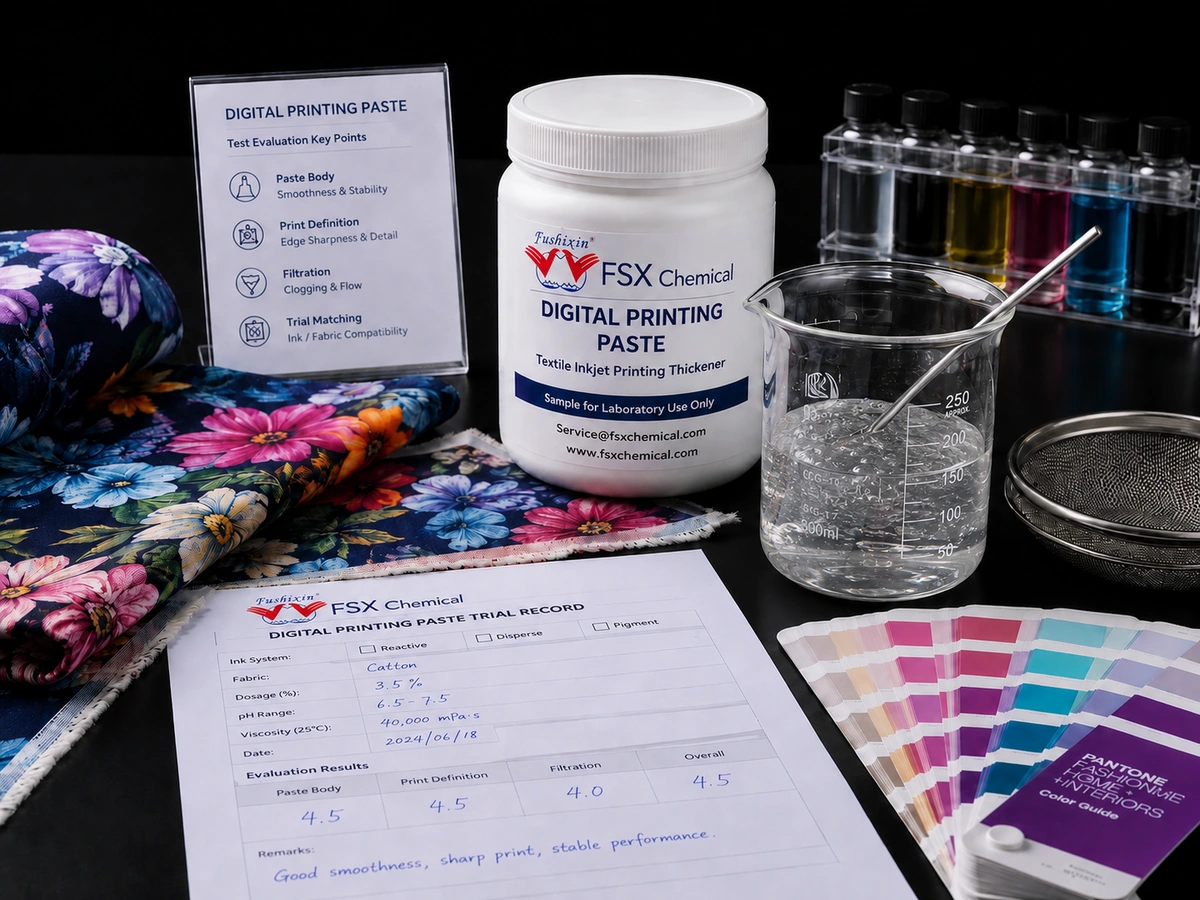
TDS, SDS or recent COA
Current formulation
Current dosage
Preparation procedure
Holding time
Viscosity information
Target and actual viscosity
Sample concentration
Measurement temperature
Viscometer and spindle
Rotational speed
Hydration and resting time
Performance information
Current pickup
Ink spreading or definition problem
Dark-color performance
Filtration or storage problem
Finished-fabric handle
Printed fabric photographs or samples
How FSX Chemical Supports Digital Printing Projects
FSX Chemical provides digital printing paste and textile thickener routes for printing mills, pretreatment formulators, chemical distributors and importers.
Product matching begins with the customer’s digital ink route, fabric, current formulation, viscosity method and printing problem instead of one general viscosity target.
Candidate review may include
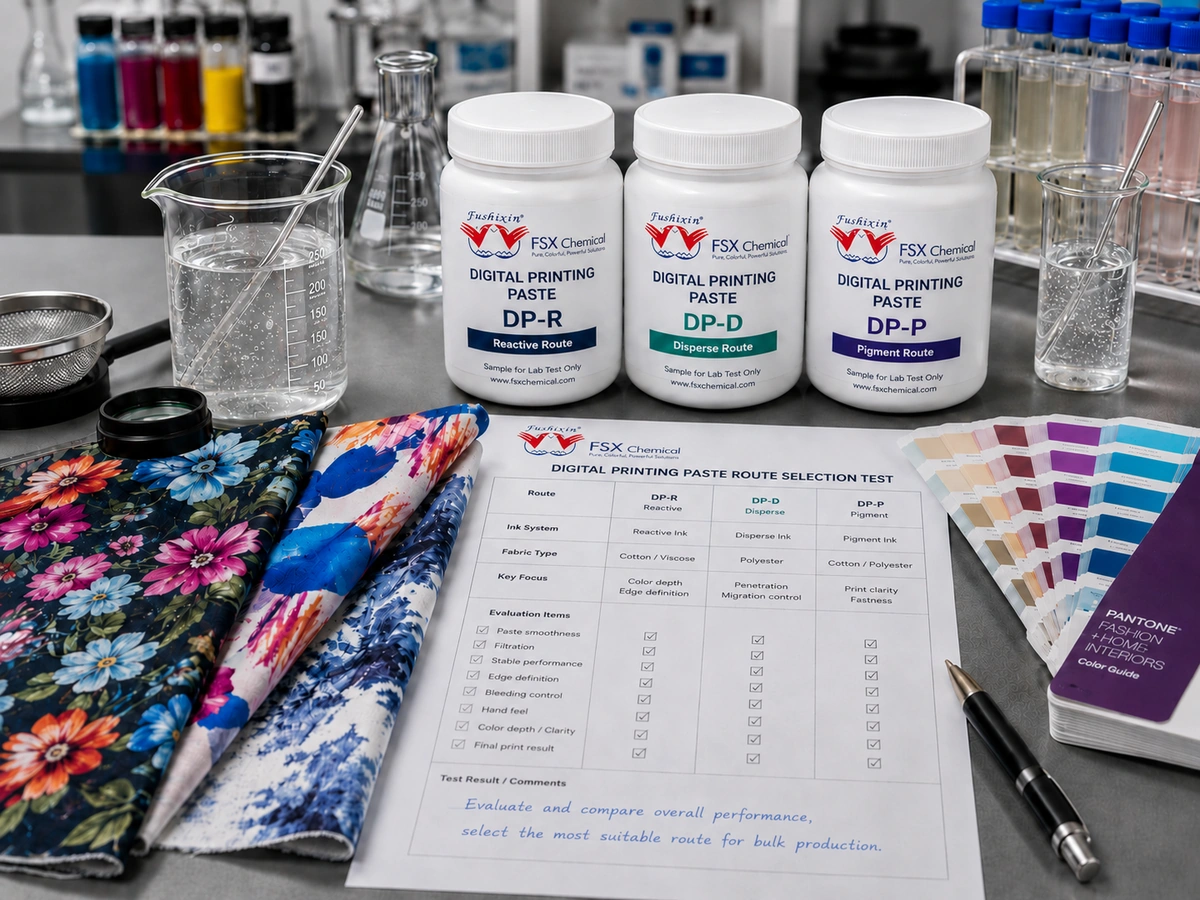
Reactive, disperse or pigment paste-route selection
Review of the current TDS or physical sample
Alignment of viscosity test methods
Review of preparation and hydration conditions
Selection of a candidate commercial grade
Provision of relevant TDS and SDS information
Representative sample comparison
Review of filtration and holding stability
Review of printed-fabric trial results
First commercial batch verification planning
Related sodium alginate , CMC and CMS routes may also be reviewed when the customer is developing a compound pretreatment system.
A recommended product remains a candidate for controlled evaluation. Final suitability depends on the customer’s fabric, ink system, pretreatment equipment, formulation and complete printing process.
Learn how to choose thickener and pretreatment routes for reactive, disperse, pigment and digital textile printing based on fabric, dye or ink, fixation, wash-off and print-quality requirements.
Compare CMC, CMS, sodium alginate and digital printing paste for textile printing. Learn how each route fits reactive, disperse, pigment and digital processes, and what buyers should review before sample testing, grade matching and bulk purchase.
Digital inkjet printing on textiles has different paste and pre-treatment requirements compared to screen printing. This guide explains how sodium alginate is used in digital textile printing and what grade parameters procurement teams should specify.
CMS for textile printing paste can help adjust viscosity, improve paste handling, and support stable formulation performance. This guide explains how buyers can evaluate CMS grades by viscosity, DS, solubility, pH, moisture, and sample testing before bulk purchase.
Carboxymethyl Starch CMS can be evaluated for selected textile sizing, printing paste, and digital printing formulation systems. This guide explains how buyers should review viscosity grade, dissolution behavior, pH, moisture, film behavior, formulation compatibility, TDS, COA, SDS, sample testing, and batch consistency before bulk purchase.
Sodium alginate is commonly used as a thickener in reactive textile printing paste, but other textile uses require application-specific validation. This guide compares printing, digital pretreatment, warp sizing, dyeing-related formulations, coating, and finishing by function, technical requirements, risks, documents, and sample tests.
Viscosity control in digital textile printing involves two different systems: the jetting ink and the fabric pretreatment formulation. This guide explains how temperature, formulation, measurement methods and process conditions affect jetting stability and print quality.
Digital printing pastes should be selected by ink chemistry, fabric, application method and post-treatment. This guide compares sodium alginate, CMC, CMS, synthetic polymer and compound pretreatment routes for textile inkjet printing.
The best digital printing paste is the one matched to the ink chemistry, fabric and fixation route. This guide compares pretreatment requirements for reactive inkjet on cellulosic fabrics and direct disperse inkjet on polyester, then explains how buyers should evaluate samples before bulk purchasing.
Improving textile printing quality requires more than changing one chemical. This guide explains how FSX Chemical supports process-based selection of sodium alginate, CMC, CMS and digital printing paste, followed by sample testing, production validation and batch-document review.
The future of textile printing thickeners will be shaped by application-specific rheology, digital pretreatment, bio-based materials, hybrid formulations, faster preparation and data-driven process control. This guide explains which trends are commercially relevant and which still require industrial validation.
FSX Chemical offers separate digital printing paste routes for reactive, disperse and pigment systems, supported by application review, sample matching and technical documentation. This guide explains how buyers can evaluate the right route before bulk purchasing.
Share the product name, application, quantity, destination and any TDS,
sample photo or document you already have. FSX Chemical will review the
information and recommend the next step for quotation, sample matching
or product selection.
Product InformationProduct name, grade, model, label photo or supplier reference.
Available DocumentsTDS, SDS, COA, sample photo, product list or test data.
Order DetailsEstimated quantity, packaging, destination country, port or trade term.
Application or IssueTextile printing process, formulation need, current issue or target performance.

 EN
EN  BN
BN  ES
ES  TR
TR  FR
FR  ID
ID  RU
RU  AR
AR  UR
UR  VI
VI  TL
TL  HI
HI  UK
UK  KK
KK  KA
KA  UZ
UZ