Textile Printing Thickener Testing Parameters: Lab Protocol and Acceptance Limits
Reliable textile printing thickener evaluation requires more than checking viscosity. This guide explains the essential...
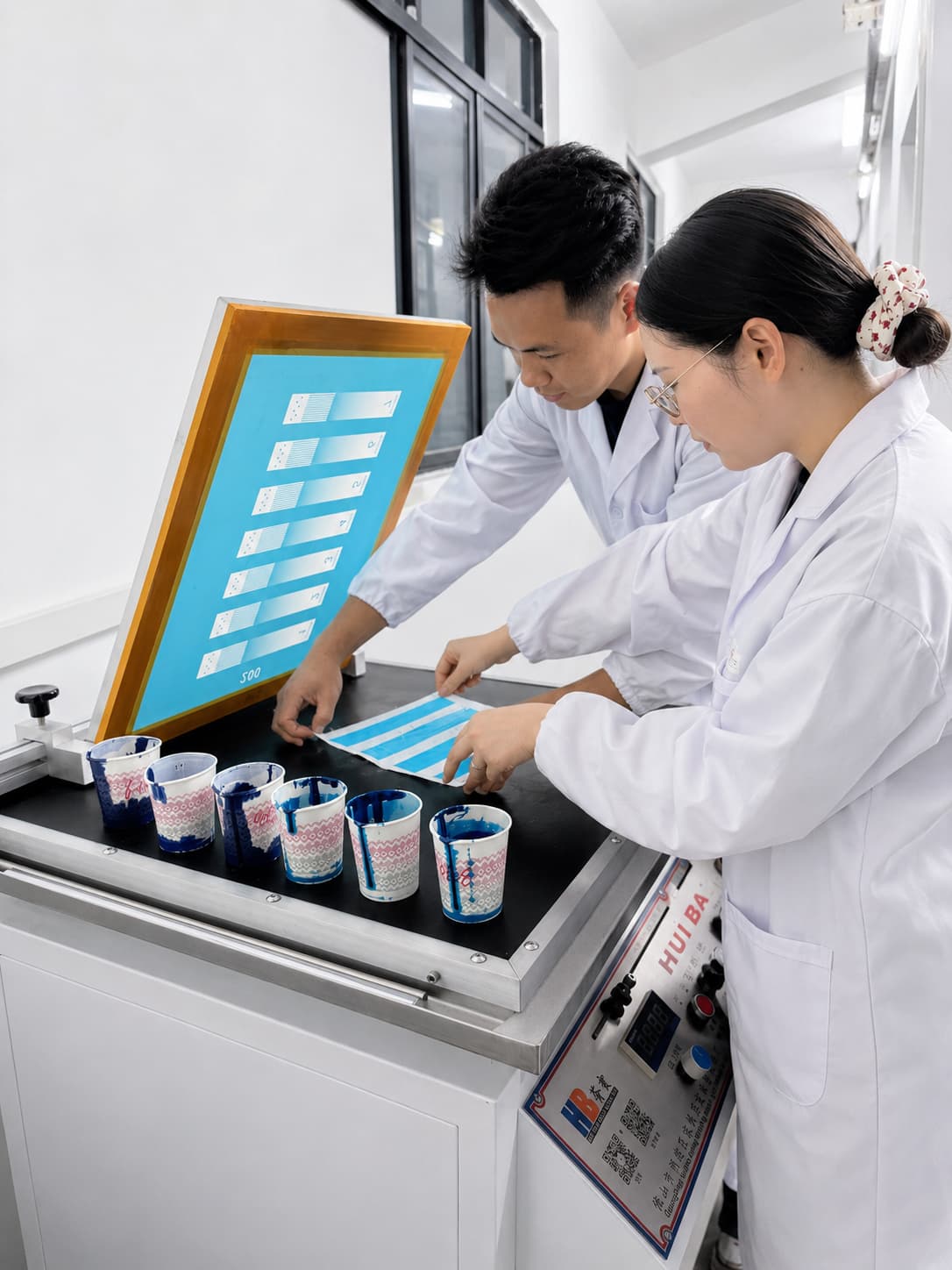
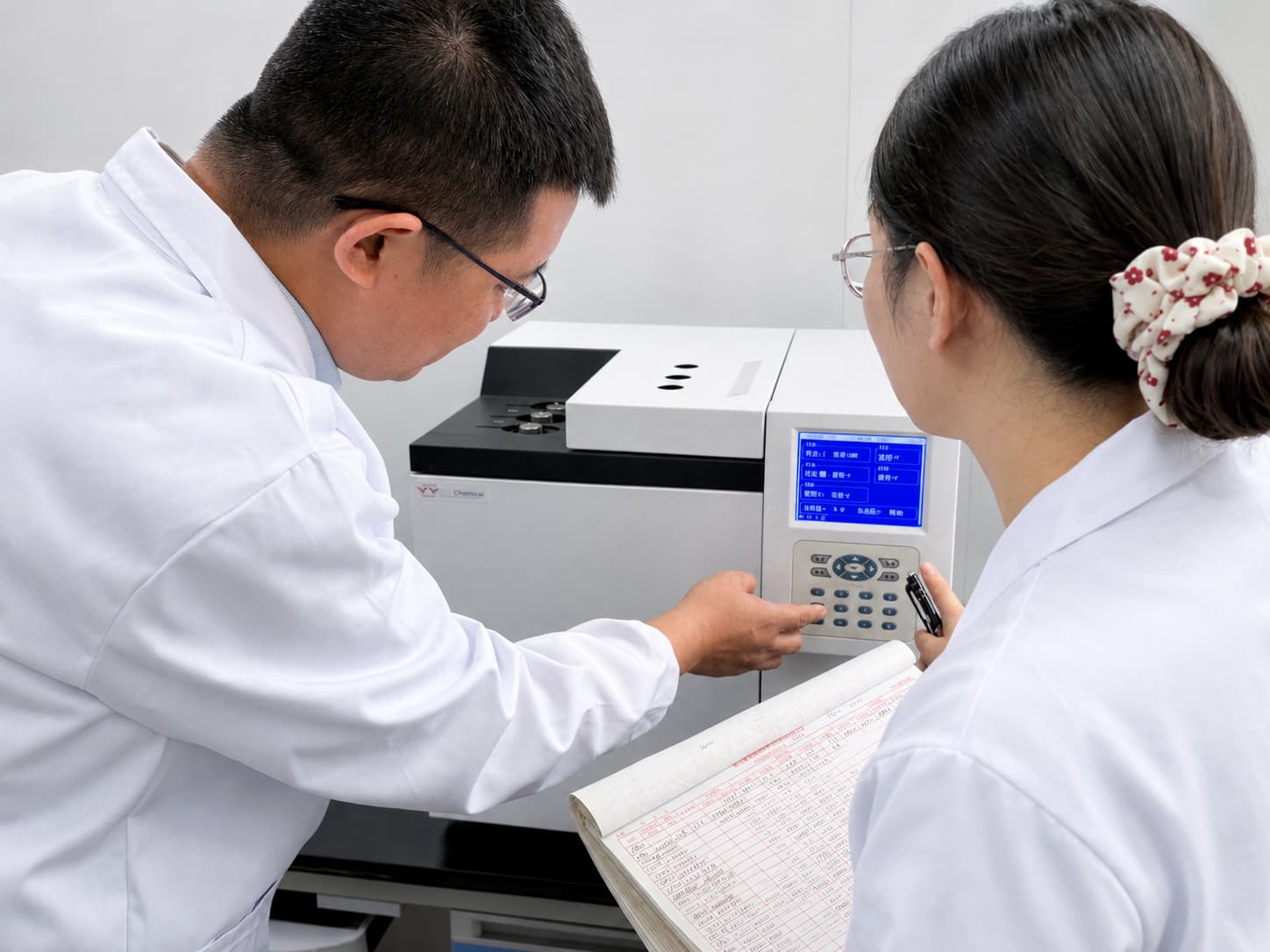
The essential tests for a textile printing thickener are identity and traceability, moisture or solids, pH, method-controlled viscosity, rheology, hydration, filtration, complete-paste compatibility, print performance and batch consistency. No single viscosity result can predict screen passage, print definition, holding stability or finished-fabric quality.
A thickener that passes a clean-water viscosity test may lose structure after dyes, salts, alkalis or binders are added. Another product may produce the correct initial viscosity but create excessive filter residue, foam, poor paste transfer or difficult wash-off.
A reliable testing program should therefore move through several levels: incoming raw-material inspection, solution or stock-paste testing, complete formulation testing, printing-machine evaluation and finished-fabric assessment.
This guide lists the essential testing parameters and explains what each result can and cannot prove. Specific methods and acceptance limits should be defined for the selected thickener, printing route, equipment and fabric.
Why One Test Result Is Not Enough
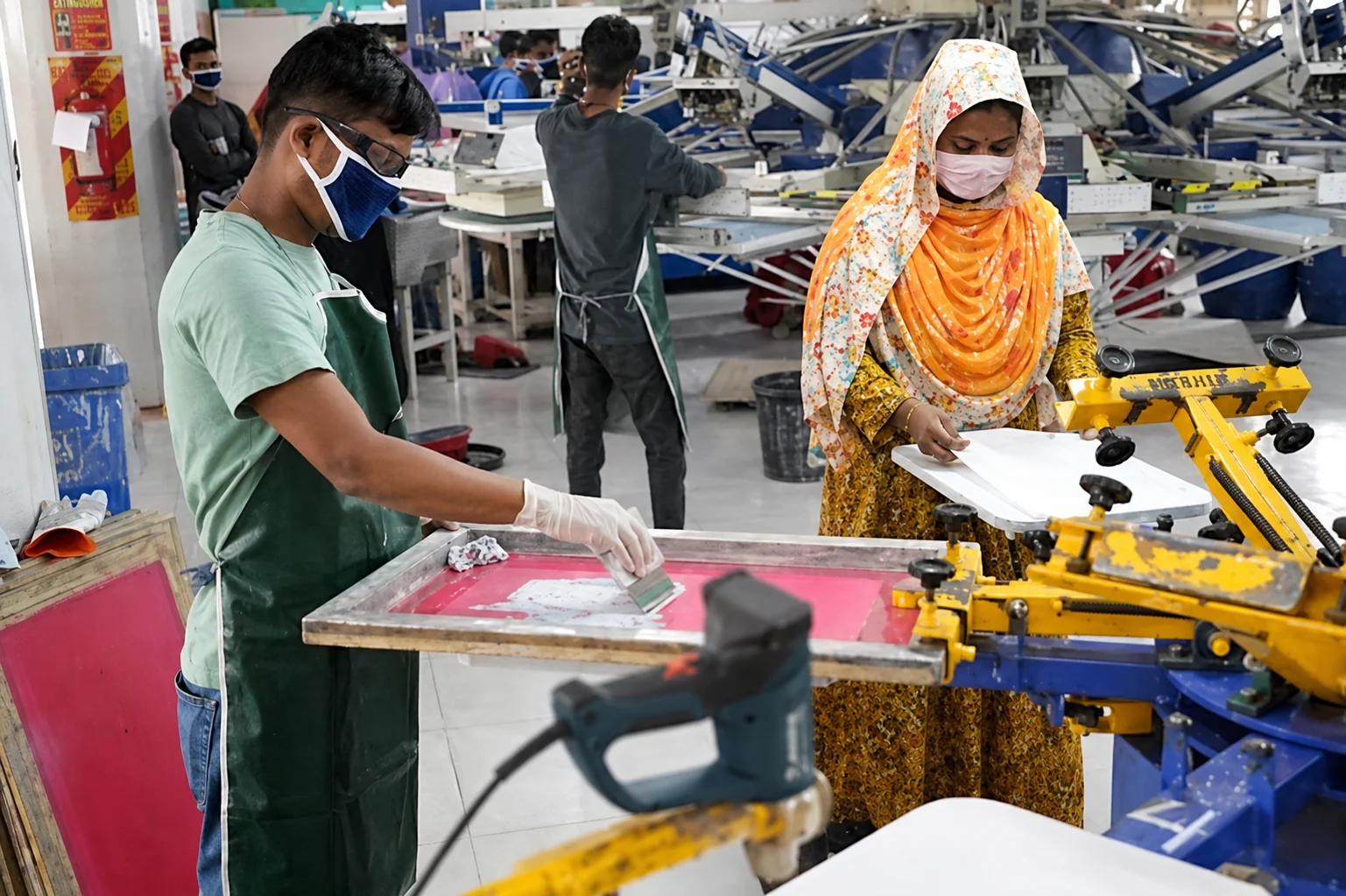
Textile printing is a dynamic process. The thickener experiences water, mixing, hydration, chemical additions, pumping, filtration, screen or coating shear, contact with fabric, drying, fixation and washing.
No single laboratory number represents all of these conditions.
Viscosity does not fully describe rheology
Two products may have the same apparent viscosity at one rotational speed but flow differently during pumping or screen passage.
Raw-material testing does not prove formula compatibility
A thickener may perform well in clean water and then change after salt, alkali, dye, pigment or binder is added.
Paste testing does not replace fabric testing
A smooth and stable paste can still produce poor definition, excessive penetration, weak wash-off or an unacceptable fabric handle.
One batch does not prove commercial consistency
Sample approval should be connected with a permanent commercial grade, specification, batch documentation and first-shipment verification.
Is the correct commercial product suitable for laboratory use?
Solution or stock paste
Dispersion, hydration, viscosity, rheology, filtration, foam and physical stability
Can the product be prepared consistently?
Complete printing paste
Chemical compatibility, viscosity retention, filtration, holding stability and application behavior
Does the thickener remain suitable in the real formula?
Printed and finished fabric
Definition, penetration, shade, levelness, fixation, wash-off, handle and required fastness
Does the product meet the final manufacturing requirement?
1. Product Identity and Batch Traceability
Testing begins by confirming exactly which product has been received. Samples, production material and documents should use consistent identification.
Record the following information
Supplier name
Commercial product and grade code
Batch or lot number
Production or retest date where applicable
Package number and package condition
Sample source
Applicable TDS, SDS and COA version
An unlabelled or temporary sample may be useful for early screening, but it should not be approved for purchasing until it is connected with a repeatable commercial grade.
2. Appearance and Physical Condition
Appearance is a basic incoming check that can reveal contamination, moisture exposure, separation or packaging damage.
For powder thickeners, inspect
Color and general uniformity
Free-flowing condition
Hard lumps or compacted areas
Visible fibres or foreign particles
Evidence of moisture exposure
Unusual odor
For liquid or pre-formulated thickeners, inspect
Separation or settling
Surface skin
Gel particles
Color variation
Gas formation or swollen packaging
Unusual odor
Appearance cannot prove application performance, but abnormal physical condition should be investigated before the material enters production.
3. Moisture, Solids or Active Content
Moisture and solids affect the effective quantity of thickening material added to the formulation.
Powder products
Moisture variation can influence flowability, storage behavior and the amount of dry polymer delivered at a fixed addition weight.
Liquid products
Solids or active content helps distinguish whether viscosity differences result from polymer performance or simply from a different supplied concentration.
Why the test method matters
Drying temperature, sample size, duration and calculation basis should be defined. Some formulations may contain volatile materials that influence a simple loss-on-drying result.
Buyers should clarify whether the reported value represents moisture, total solids, active polymer or another defined parameter.
4. pH
pH can provide useful information about product consistency and potential compatibility, but the result is meaningful only when the sample concentration and preparation method are defined.
Possible pH checkpoints
Raw liquid product
Defined powder solution
Stock paste
Completed printing paste
Paste after the normal holding period
Why pH matters
pH can influence polymer hydration, synthetic-thickener activation, binder stability, dye chemistry, preservation and holding behavior.
One acceptable pH value does not prove that the thickener is compatible with the complete printing formulation.
5. Viscosity
Viscosity is one of the most common thickener specifications and one of the most frequently misinterpreted.
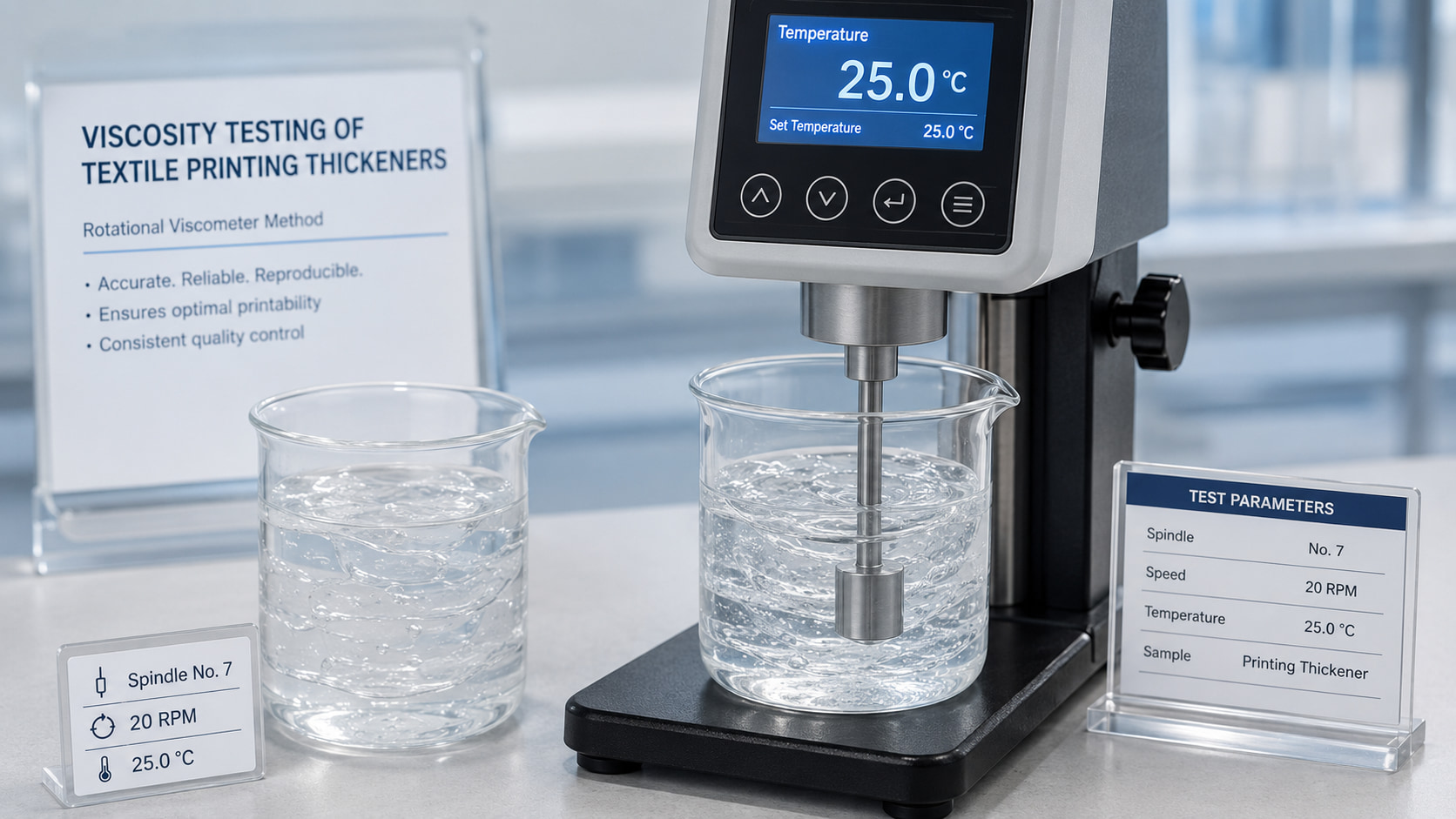
A complete viscosity method should record
Product or paste concentration
Concentration calculation basis
Water source
Preparation and powder-addition procedure
Mixer type, speed and duration
Hydration or resting time
Measurement temperature
Viscometer model or measurement principle
Spindle, rotor or geometry
Rotational speed
Reading time
Unit
Test the same sample at the same temperature
Mixing-generated heat or seasonal laboratory variation can create an apparent difference that is unrelated to product quality.
Do not compare unlike concentrations
A viscosity result from a one-percent solution should not be compared directly with a result obtained at another concentration.
Test both stock and complete paste
The stock-paste result supports incoming control. The complete-paste result shows how the thickener responds to the real chemical system.
6. Rheology and Shear Response
Rheology describes how the paste changes under different shear and time conditions. It is more informative than one viscosity value when machine behavior and print definition are important.
Multi-speed viscosity
Measuring at several rotational speeds can show whether the paste is strongly or weakly shear-thinning.
Flow under shear
The paste should move through pumps, pipes, screens, squeegees or coating units without excessive resistance.
Structural recovery
After application, the paste should recover sufficient structure to control spreading and penetration.
Time-dependent behavior
Some pastes change after prolonged mixing, circulation or resting. The test plan should reflect the factory’s actual operating time.
Advanced rheological data is useful, but it should still be connected with an application trial.
7. Dispersion and Hydration
Dispersion and hydration testing evaluates how easily a thickener can be converted into a uniform solution or paste.
Record during preparation
Powder-addition time
Initial wetting behavior
Lump formation
Required mixing time
Hydration or resting time
Foam development
Top-to-bottom uniformity
Incomplete hydration may cause
Viscosity drift
Gel particles
Excessive filter residue
Nonrepeatable laboratory results
Screen or nozzle-related problems
Reference and candidate products should be prepared using an identical procedure unless the supplier has clearly specified a different required method.
8. Particle Size and Powder Handling
Particle profile can influence dusting, flowability, wetting, hydration rate and lump formation.
Fine particles
Fine powder may hydrate rapidly but can form surface-wetted lumps when it is added too quickly or into weak liquid circulation.
Coarser particles
Coarser particles may disperse more gradually but require a longer hydration period.
Powder handling checks
Flow through the feeding system
Dust generation
Compaction during storage
Bag-to-bag uniformity
Ease of manual or automatic dosing
Particle size should not be judged as good or bad in isolation. The preferred profile depends on the factory’s mixing and dosing equipment.
9. Filtration, Insolubles and Gel Content
Filtration testing helps identify particles that may affect screens, filters, pumps, coating equipment or digital pretreatment systems.
A defined filtration method should include
Filter material
Opening or mesh size
Sample quantity
Gravity, vacuum or pressure condition
Filtration time
Residue evaluation method
Inspect the retained material
Residue may consist of dry powder, hydrated gel, coarse polymer, precipitated chemicals, fibres or foreign contamination.
Test at more than one stage
A useful program may test the stock solution, completed paste and stored paste because residue can form after chemical addition or holding.
Filtration can remove particles, but it cannot permanently correct an incompatible formulation.
10. Chemical Compatibility
Chemical compatibility testing determines whether the thickener remains suitable after the actual printing ingredients are added.
Reactive printing checks
Evaluate the candidate with representative reactive dyes, alkali, salt, humectant and other auxiliaries.
Pigment printing checks
Evaluate compatibility with pigment dispersion, binder, crosslinker, catalyst and curing system.
Disperse printing checks
Evaluate dye distribution, paste stability, filtration and fixation behavior on polyester.
Compound thickener checks
When several polymers are combined, inspect blend viscosity, separation, gel formation and performance after storage.
Useful compatibility measurements
Viscosity before and after chemical addition
pH
Appearance
Separation or sedimentation
Filtration
Print performance after holding
11. Holding and Storage Stability
Printing pastes may remain in a tank for several hours before use or circulate through the machine during long production runs.
Define representative time points
Immediately after preparation
After full hydration
After completion of the formula
After the normal production holding period
After extended circulation where relevant
Check for
Viscosity drift
Separation
Settling
Skin formation
Gel development
Foam retention
Odor change
Filtration change
Samples should be stored in comparable closed containers to prevent evaporation from creating false viscosity differences.
12. Foam and Air Entrapment
Foam can interfere with mixing, viscosity measurement, filtration, coating uniformity and printed solid areas.
Evaluate foam during
Powder or liquid addition
High-speed mixing
Chemical addition
Pumping and circulation
Application to the fabric
Record both formation and decay
A paste may create high initial foam that disappears quickly, or lower foam that remains trapped for a long period.
Defoamer should not be added automatically before identifying whether the foam is caused by the thickener, mixer position, contaminated equipment or another auxiliary.
13. Color, Clarity and Odor
Solution color, clarity and odor can support product comparison and help detect contamination or degradation.
Color
A strongly colored thickener solution may influence light shades or optical evaluation, although acceptable color depends on the application.
Clarity
Clarity can help reveal insolubles or incomplete hydration, but a naturally hazy formulation is not automatically unsuitable.
Odor
Unusual odor in a water-based liquid or stored paste may indicate contamination, degradation or unsuitable storage.
These checks should be recorded under consistent lighting, concentration and preparation conditions.
14. Microbiological Stability
Water-based liquid thickeners and prepared pastes may be vulnerable to microbiological contamination depending on their composition, storage and preservation system.
Possible warning signs
Odor change
Gas formation
Package swelling
Unexpected viscosity loss
Color change
Surface growth
Control factors
Water quality
Tank and line hygiene
Container closure
Storage temperature
Holding time
Approved preservation system
Microbiological limits and test methods should be selected according to the supplied product, local requirements and the factory’s risk level.
15. Paste Transfer and Machine Performance
Laboratory properties should be connected with the equipment used in actual textile manufacturing.
Different concentrations, temperatures, spindles or speeds can create results that are not directly comparable.
Measuring before complete hydration
The apparent viscosity may continue changing after the result has been recorded.
Testing only in clean water
Real dyes, salts, alkalis, binders and other polymers may change the thickener’s performance.
Changing several variables simultaneously
Changing the thickener, dosage, auxiliaries and machine settings together prevents clear interpretation.
Ignoring temperature
Temperature variation can be mistaken for product or batch variation.
Using visual smoothness as a filtration test
A paste may look smooth while still containing particles that affect equipment or print quality.
Approving only the wet print
Definition, color, wash-off and handle may change after fixation and washing.
Skipping first-batch verification
The first commercial shipment should be checked against the approved sample and method.
Troubleshooting Unexpected Test Results
Unexpected Result
Possible Causes
Recommended Checks
Supplier and buyer viscosity results differ
Different concentration, water, preparation, temperature, instrument or speed
Exchange complete methods and test one shared sample
Viscosity changes between operators
Different powder addition, mixing, resting or reading procedure
Standardize preparation and operator instructions
High filtration residue
Incomplete hydration, gel formation, chemical precipitation or contamination
Inspect residue and test stock and completed paste separately
Stock paste passes but final paste fails
Dye, salt, alkali, binder or polymer incompatibility
Add components in stages and test after each critical addition
Correct viscosity but poor definition
Unsuitable rheology, fabric absorbency, excessive pickup or machine settings
Review multi-speed behavior, fabric and application conditions
Stable laboratory paste changes in production
Scale, circulation, heat, evaporation, holding time or contamination
Compare laboratory and production preparation records
Bulk product differs from approved sample
Grade identity, batch variation, storage or test-method difference
Review batch codes, COA, retained samples and incoming method
Print is sharp but fabric is stiff
Excessive dosage, high pickup, poor removal or binder-film buildup
Review dosage, wash-off, curing and final surface deposition
Frequently Asked Questions
Which parameters should be tested first for a textile printing thickener?
Start with product identity, package condition, moisture or solids, pH and viscosity using a fully defined method. Then test hydration, filtration and the complete printing paste before printing on the target fabric.
Why can supplier and buyer viscosity results differ?
Concentration, water quality, powder-addition method, hydration time, temperature, instrument, spindle, speed and reading time can all change the result. Exchange the complete method and test a shared sample.
Is a clean-water viscosity test enough?
No. Dyes, salts, alkalis, binders and other auxiliaries can change thickener structure. Test both the stock solution and the complete formulation under the intended holding conditions.
What is an appropriate acceptance limit?
Acceptance limits should be grade-, method- and application-specific. Define them from approved-sample data, repeatability, production trials and the operating window; do not copy an unrelated supplier range.
How should a sample be compared with the first bulk batch?
Use the same preparation and measurement methods, compare retained samples and COA data, run side-by-side complete-paste and printing tests, and confirm package and batch identity.
How FSX Chemical Supports Thickener Testing
FSX Chemical supplies sodium alginate, CMC, CMS, digital printing paste and related textile thickener routes for printing mills, formulators, distributors and importers.
Product matching begins by aligning the customer’s application, preparation method and testing parameters rather than comparing one isolated viscosity value.
A recommended sample remains a candidate for controlled evaluation. Final approval depends on the customer’s complete formulation, fabric, equipment, fixation and finished-textile requirements📧 Email: Service@fsxchemical.com
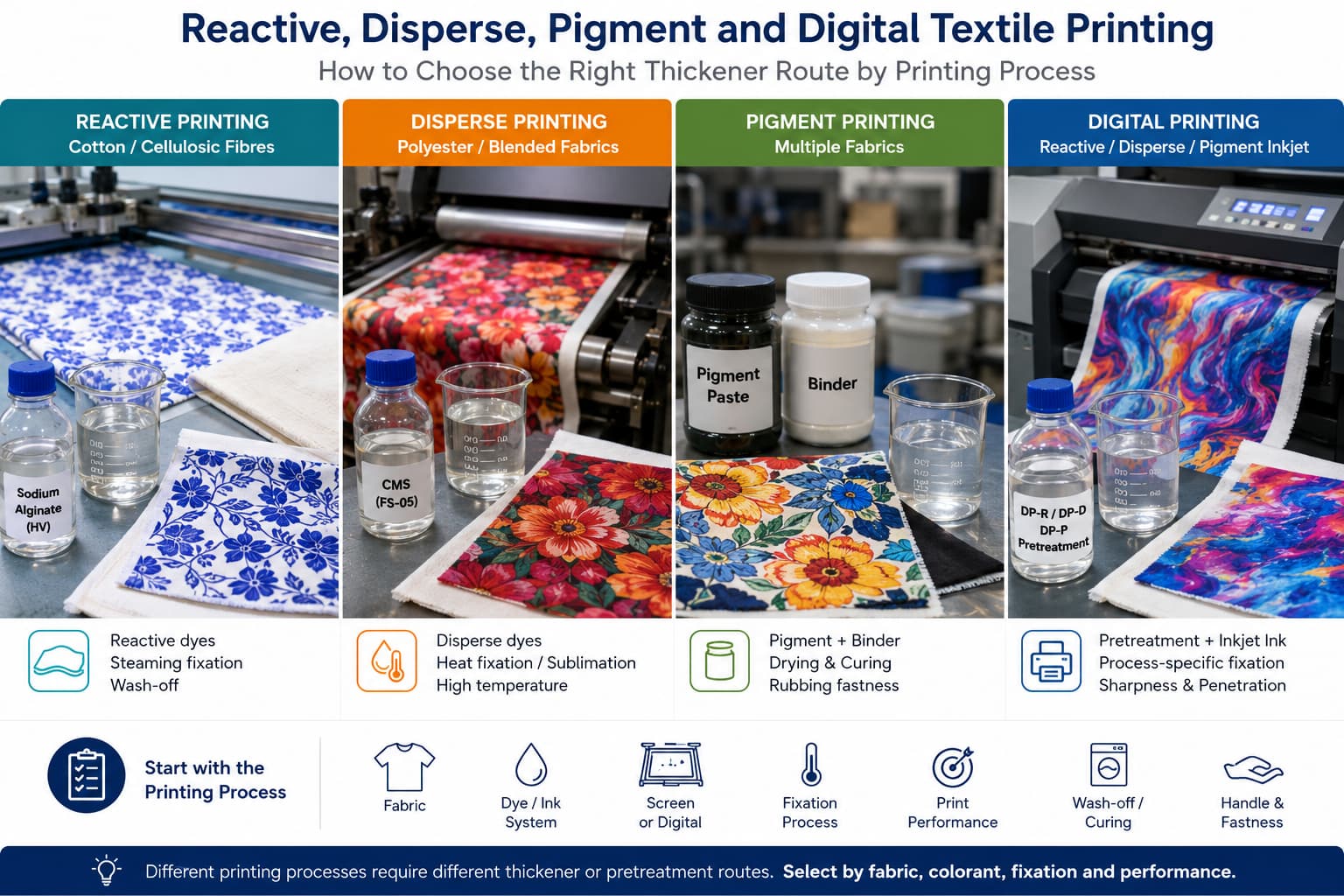
Learn how to choose thickener and pretreatment routes for reactive, disperse, pigment and digital textile printing based on fabric, dye or ink, fixation, wash-off and print-quality requirements.
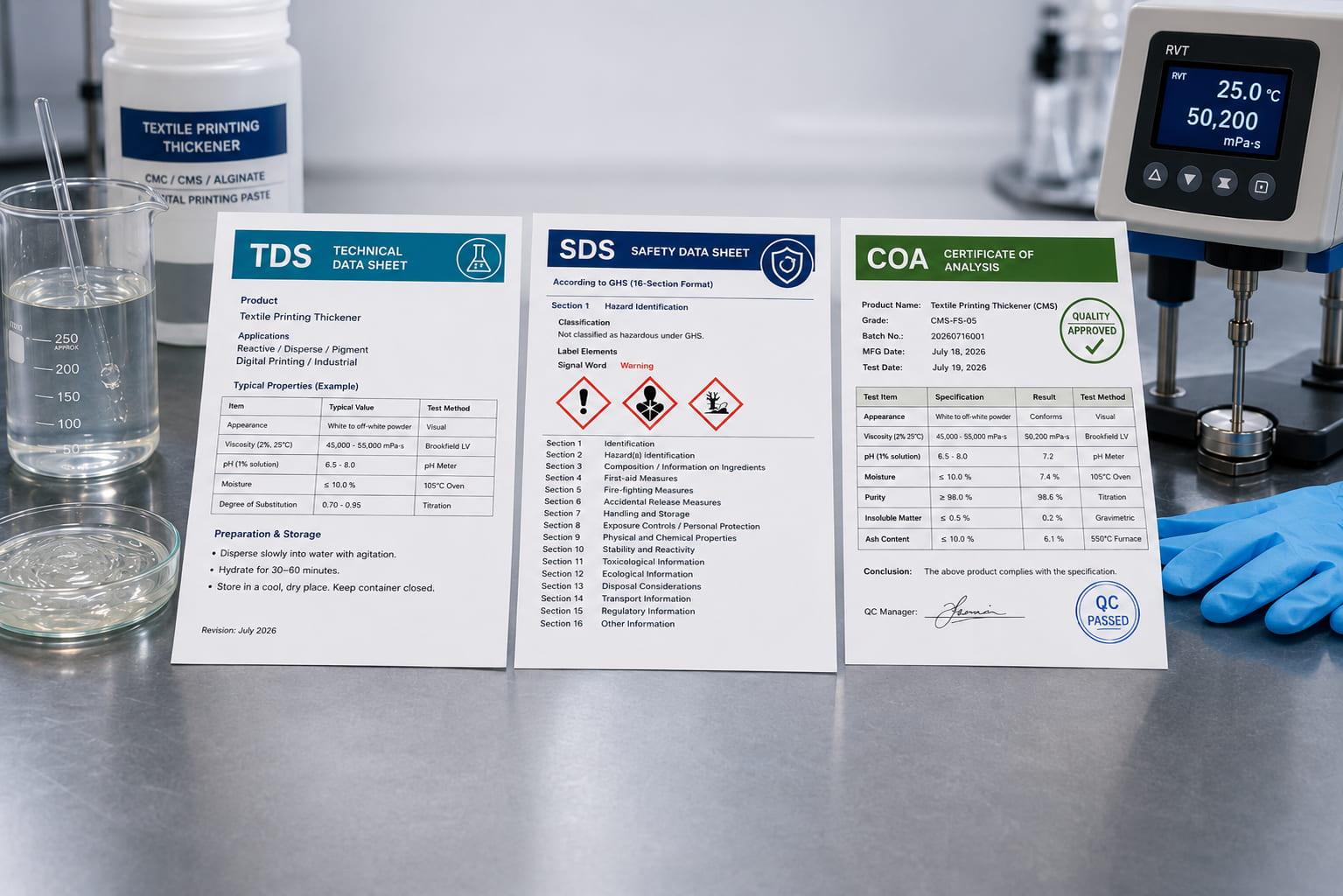
Learn the difference between TDS, SDS and COA documents, what textile printing buyers should verify, and how to check specifications, safety data, test methods, batch results and document issuers.
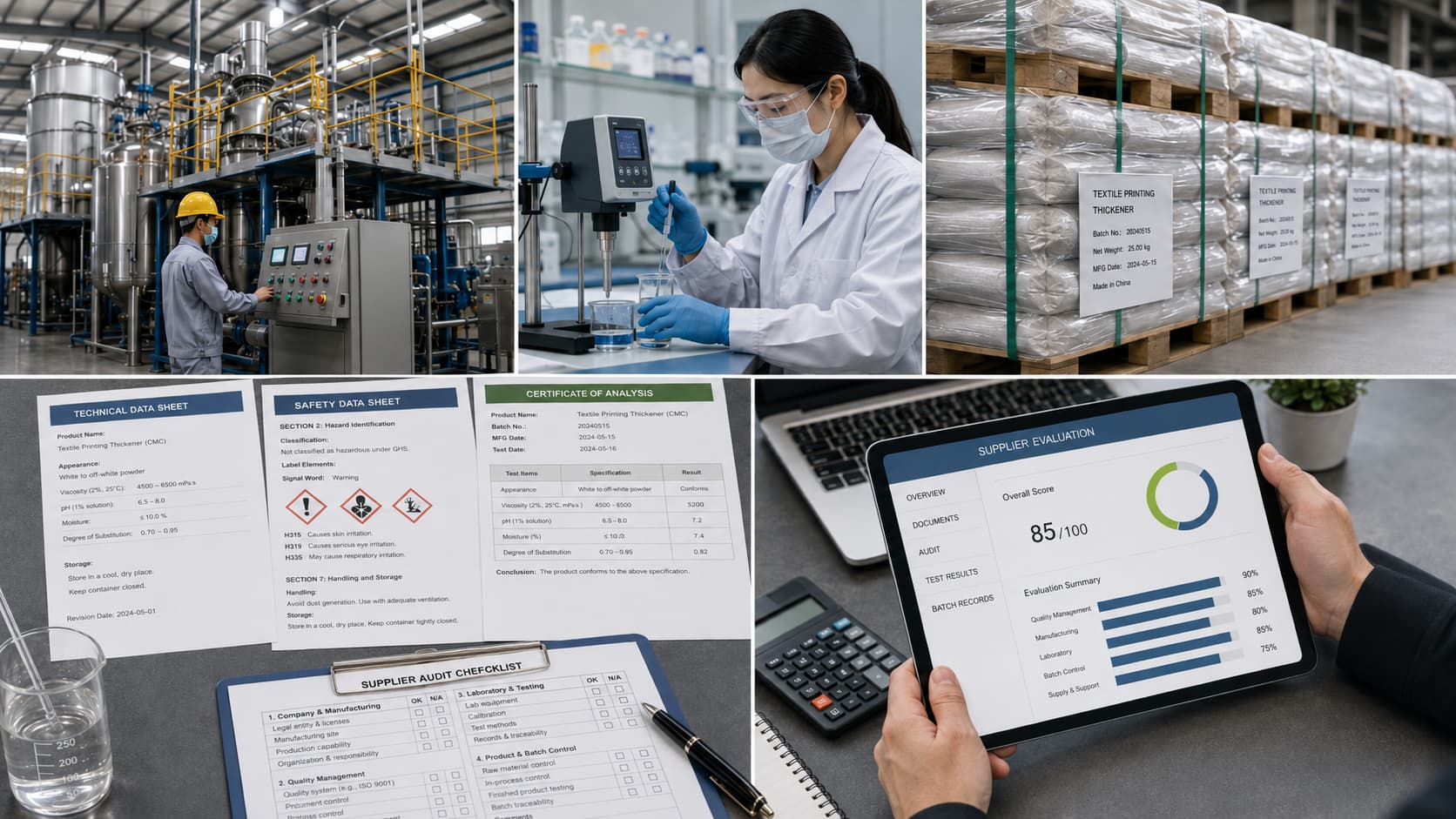
Learn how to evaluate a textile printing thickener manufacturer by checking company identity, production capability, test methods, batch traceability, technical documents, sample support and export supply.
Compare CMC, CMS, sodium alginate and digital printing paste for textile printing. Learn how each route fits reactive, disperse, pigment and digital processes, and what buyers should review before sample testing, grade matching and bulk purchase.
Sodium alginate is widely used in textile printing as a stable and washable thickener for reactive printing paste. Learn how to evaluate viscosity grade, purity, and application suitability before purchasing, and how FSX Chemical supports global buyers with technical data and samples.
Carboxymethyl cellulose (CMC) is widely used in the printing, sizing, and dyeing processes of textiles. This guide will explain how to evaluate CMC grades, which parameters are most important, and how FSX Chemical can support purchasing decisions.
Choosing the right CMC supplier involves more than comparing price. This guide covers the evaluation criteria, documentation checklist, and trial process that procurement teams should follow before committing to a bulk order.
CMC-based printing paste is used across pigment, reactive, and digital textile printing. This guide explains what parameters matter, how to compare suppliers, and what to request before placing a bulk order.
Both sodium alginate and CMC are used as thickeners in textile printing, but they suit different dye systems and process conditions. This guide explains the key differences and when to use each.
Dye fixation rate directly affects color yield, wash fastness, and wastewater load in reactive dye printing. This guide explains how sodium alginate supports dye fixation, what paste parameters influence fixation rate, and how to troubleshoot low fixation in production.
Sodium alginate particle size (mesh) affects how quickly the powder dissolves, how evenly it hydrates, and how the resulting paste performs in screen printing. This guide explains the practical implications of mesh specification for textile printing paste applications.
Share the product name, application, quantity, destination and any TDS,
sample photo or document you already have. FSX Chemical will review the
information and recommend the next step for quotation, sample matching
or product selection.
Product InformationProduct name, grade, model, label photo or supplier reference.
Available DocumentsTDS, SDS, COA, sample photo, product list or test data.
Order DetailsEstimated quantity, packaging, destination country, port or trade term.
Application or IssueTextile printing process, formulation need, current issue or target performance.

 EN
EN  BN
BN  ES
ES  TR
TR  FR
FR  ID
ID  RU
RU  AR
AR  UR
UR  VI
VI  TL
TL  HI
HI  UK
UK  KK
KK  KA
KA  UZ
UZ