AR
AR  EN
EN  BN
BN  ES
ES  TR
TR  FR
FR  ID
ID  RU
RU  UR
UR  VI
VI  TL
TL  HI
HI  UK
UK  KK
KK  KA
KA  UZ
UZ 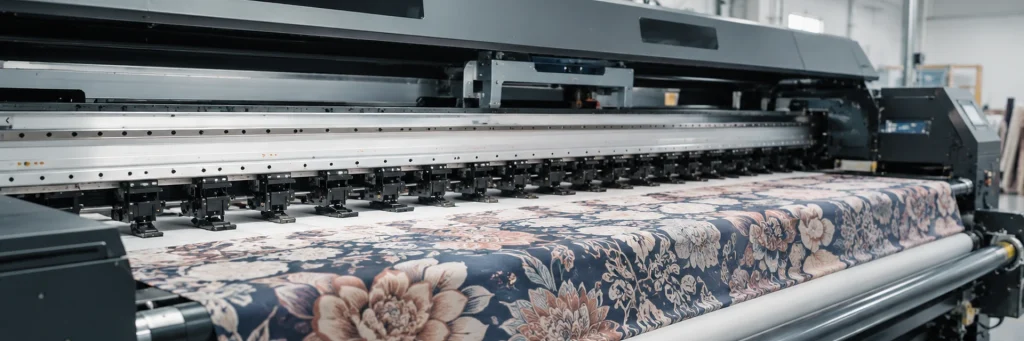
يجب أن يحقق اختيار المواد الكيميائية المستخدمة في طباعة المنسوجات التوازن بين الامتثال للقوانين ومتطلبات قوائم المواد المسموح بها (MRSL) وقوائم المواد المقيدة (RSL)، ووثائق المنتج، والأدلة المختبرية، والأداء الفعلي للطباعة. يشرح هذا الدليل كيف يمكن للمشترين تقييم كل متطلب من هذه المتطلبات دون الاعتماد على ادعاءات الموردين غير المدعومة بأدلة.
These requirements do not all evaluate the same thing. A chemical may be legally marketable but not accepted by a particular brand. A product may be listed under an industry chemical program but still perform poorly in the customer’s printing paste.
Technical buyers should therefore separate compliance screening from application testing. Both are required before a new printing chemical is approved for commercial production.
هام: Industry standards and legal requirements change over time. Before purchasing, verify the latest applicable version, product scope, certificate validity and destination-market requirements through the official standard owner or regulatory authority.
Why Standards Must Be Defined Before Chemical Selection
A supplier cannot recommend a fully appropriate product without knowing the finished textile, manufacturing process, destination market and customer program. The requirements for a printed organic cotton garment may differ from those for polyester advertising fabric or an industrial textile.
Buyers should identify the applicable requirements before comparing suppliers. Otherwise, a sample may complete technical testing and still be rejected later because the supporting compliance documentation is insufficient.
Start with the finished product
The selection process should begin with the intended textile article, including:
- Fiber composition and fabric construction
- Reactive, disperse, pigment or other printing system
- Final product category and consumer use
- Destination countries or regions
- Brand or retailer requirements
- Organic or other voluntary certification programs
- Required colorfastness and physical performance
This information determines which regulations, restricted-substance limits, chemical approval programs and test methods must be considered.
The Six Types of Requirements Buyers Need to Separate
“Industry standard” is often used as a general phrase, but several different types of requirements may apply to textile printing chemicals.
| Requirement Type | What It Controls | Example | Effect on Chemical Selection |
|---|---|---|---|
| Law or regulation | Legal manufacture, import, use or presence of substances | REACH restrictions in the European Union | Creates mandatory market-access requirements |
| Manufacturing Restricted Substances List | Restricted substances in chemical formulations used during production | ZDHC MRSL | Influences which input chemicals a wet-processing facility may purchase |
| Restricted Substances List | Restricted substances in the finished textile article | Brand or retailer RSL | Requires assessment of final-product residue risk |
| Product or process certification | Conformity with a defined voluntary program | OEKO-TEX ECO PASSPORT or GOTS chemical-input approval | May require an approved product, formulation or supplier route |
| Performance test standard | Colorfastness, rubbing, washing or another textile property | ISO 105 series | Influences technical grade and formulation selection |
| Management or laboratory standard | Quality systems or laboratory competence | ISO 9001 or ISO/IEC 17025 | Supports supplier evaluation but does not certify every product |
MRSL vs. RSL: A Critical Purchasing Distinction
Buyers frequently treat an MRSL and an RSL as if they were interchangeable. They address related but different parts of chemical management.
What is an MRSL?
A Manufacturing Restricted Substances List restricts specified substances in chemical formulations used at manufacturing facilities. Its purpose is to control hazardous chemistry before it enters the production process.
For a printing mill, an MRSL may affect the purchasing of dyes, pigments, binders, thickeners, surfactants, preservatives, reducing agents, cleaning chemicals and other formulations used on site.
What is an RSL?
A Restricted Substances List sets requirements for substances that may be present in the finished textile or component. The finished fabric is normally tested using the method and limit specified by the brand, regulation or product program.
Why MRSL conformance does not guarantee RSL compliance
Using MRSL-conformant inputs can reduce finished-product risk, but it does not provide an unconditional guarantee. Contamination, process conditions, other materials, incorrect dosage and substances generated during production may still influence the final article.
Final-product testing and production controls may therefore remain necessary even when all purchased formulations have valid MRSL documentation.
| سؤال | MRSL | RSL |
|---|---|---|
| What is mainly evaluated? | The chemical formulation entering production | The finished textile or component |
| Who commonly uses it? | Chemical formulators, mills, brands and supply-chain programs | Brands, retailers, regulators and finished-product laboratories |
| When is it checked? | Before purchase and during chemical inventory management | During material or finished-product approval |
| Does passing one prove the other? | No. They should be treated as connected but separate controls. | |
How Major Industry Programs Affect Chemical Selection
ZDHC Manufacturing Restricted Substances List
The ZDHC MRSL is widely used by textile, apparel, leather and footwear supply chains to evaluate chemical formulations used in manufacturing. Facilities may use the ZDHC Gateway Chemical Module to review listed formulations and conformance information.
Buyers should request the product’s current ChemCheck information where required and verify the exact commercial product name, manufacturer, conformance level and validity status. An expired or differently named product should not be assumed to have the same status.
ZDHC describes its MRSL as a living document that is regularly updated. Where ZDHC conformance is required, verify the current MRSL basis, exact commercial product, manufacturer, conformance level and status in the official ZDHC system before approval.
OEKO-TEX ECO PASSPORT
OEKO-TEX ECO PASSPORT is designed for textile and leather chemicals, colorants and auxiliaries. Certification is connected to an identified chemical formulation and is subject to defined testing and assessment requirements.
A buyer should verify the certificate through the official OEKO-TEX label or certificate-checking system. Check the product name, certificate number, holder, expiry date and certification stage rather than relying on a logo shown in a supplier presentation.
ECO PASSPORT certification applies to the chemical product within its stated scope. It does not automatically certify the printing mill, fabric or finished garment.
Global Organic Textile Standard
GOTS controls the processing of certified organic textile products and includes requirements for chemical inputs used in wet processing. A chemical derived from cellulose, starch or seaweed is not automatically approved simply because its raw material is natural.
Chemical inputs used in a GOTS-certified production route should have the appropriate approval or Letter of Approval required by the applicable GOTS system. Buyers should verify the exact formulation and its status through the approved certification route or official positive list.
GOTS requirements and transition periods can change. For an organic textile route, confirm the currently applicable standard version, the exact chemical formulation or Letter of Approval, and any customer-specific requirement with the certification body before purchase.
REACH and destination-market legislation
REACH restrictions may apply to substances on their own, in mixtures or in articles placed on the European market. Applicability depends on the substance, concentration, use and specific restriction entry.
Other destination markets may apply different chemical, consumer-product, labeling or worker-safety requirements. A declaration prepared for one market should not automatically be treated as sufficient for every country.
GHS-based hazard communication
The Globally Harmonized System provides a framework for chemical hazard classification, labels and Safety Data Sheets. Individual jurisdictions implement GHS through their own laws and may use different revisions or local requirements.
The SDS should match the supplied product and intended market language. It supports safe handling and compliance review, but it is not proof of printing performance or complete MRSL conformity.
How Performance Standards Affect Chemical Grade Selection
Compliance screening determines whether a product can enter the approval process. Performance testing determines whether it can produce the required textile result.
A chemical may have suitable restricted-substance documentation but fail to provide the required print definition, color yield, fixation, wash-off or fabric handle.
Colorfastness to washing
ISO 105-C06 provides methods for assessing resistance to domestic and commercial laundering under defined conditions. The result can be influenced by dye selection, fixation, washing, fiber type and the complete printing formulation.
A thickener supplier should not claim that one chemical alone guarantees a particular wash-fastness grade.
Colorfastness to rubbing
ISO 105-X12 evaluates color transfer under dry and wet rubbing conditions. Binder selection, pigment fixation, surface deposits, residual paste and washing efficiency can all influence the result.
Print definition and application performance
Print sharpness, screen passage, penetration and viscosity stability may be evaluated using a customer’s internal method because there may not be one universal test that represents every printing machine and fabric.
The internal method should still be controlled. It should define the fabric, formulation, sample preparation, printing conditions, fixation and evaluation criteria.
Step-by-Step Chemical Approval Process

Step 1: Define all applicable requirements
Create a requirement list covering destination-market laws, customer RSL, MRSL program, voluntary certification, performance tests and internal production needs.
Record the required document version and acceptance date. Avoid using an undated requirement such as “must meet international standards.”
Step 2: Define the chemical’s function
Confirm whether the product is a dye, pigment, thickener, binder, pretreatment, alkali, dispersing agent, reducing agent, preservative or compound formulation. Different chemical functions create different compliance and performance risks.
Step 3: Screen supplier documentation
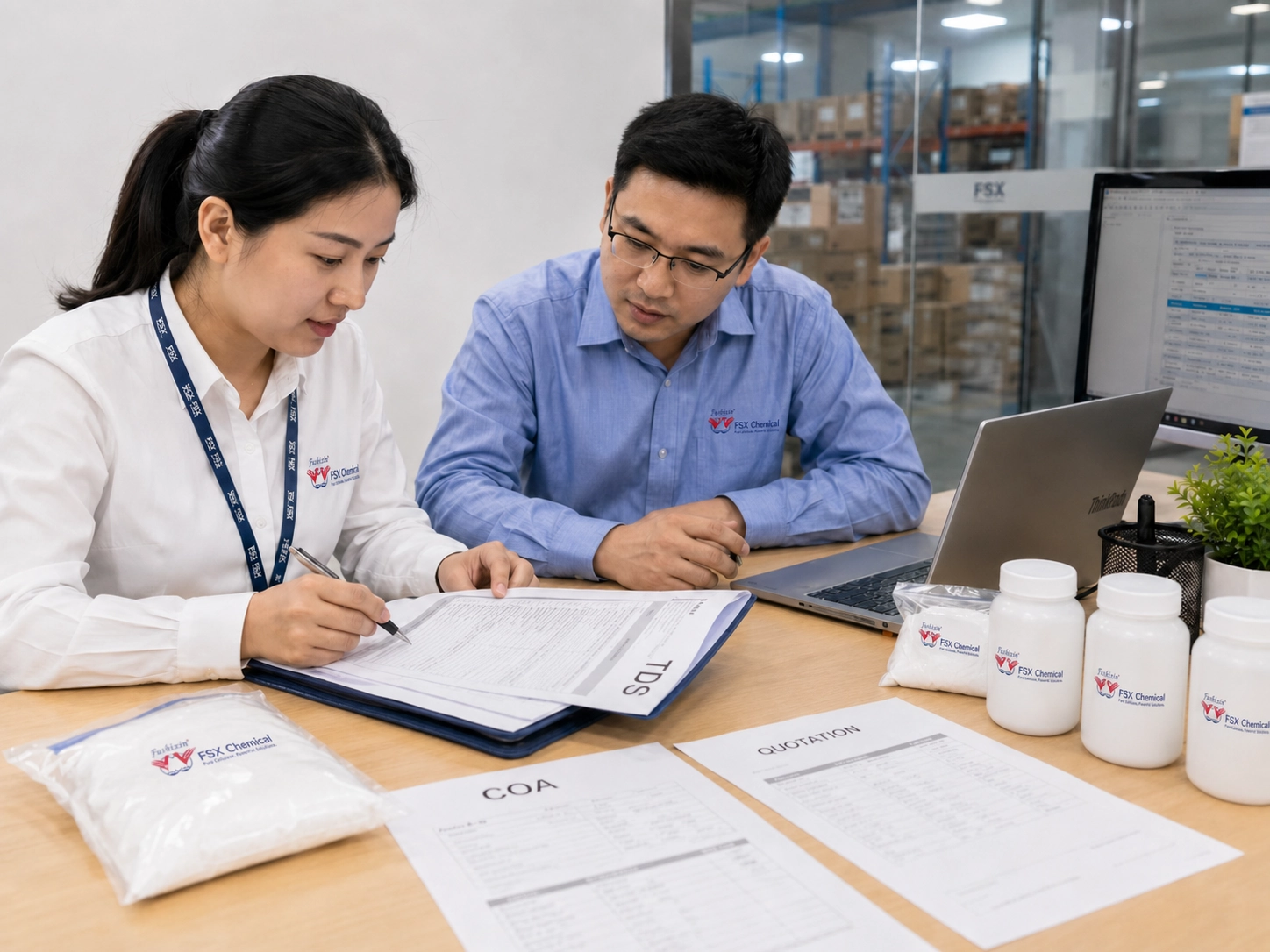
Request the relevant documents before arranging a commercial-scale trial. Depending on the requirement, these may include:
- ورقة البيانات الفنية
- ورقة بيانات السلامة
- Current certificate or Letter of Approval
- ZDHC ChemCheck report or Gateway listing where applicable
- Restricted-substance declaration
- Third-party test report
- Product specification
- شهادة تحليل عينة تمثيلية
- Change-notification commitment
Step 4: Verify document scope
Confirm that the document applies to the exact product grade and manufacturing entity being offered. Similar trade names, relabeled products and distributor documents require additional review.
Step 5: Complete a risk assessment
Consider the chemical composition, manufacturing impurities, preservatives, additives, dosage, intended process and final textile use. A natural or bio-based origin should not be used as a substitute for compliance evidence.
Step 6: Test the sample technically
Conduct controlled laboratory testing using the actual dye or ink system, fabric and production conditions. Record viscosity, compatibility, stability and final printing performance.
Step 7: Run a production trial
A laboratory sample may behave differently during bulk mixing, circulation, screen printing, steaming, drying or washing. Use a controlled production trial before approving a high-volume change.
Step 8: Approve the supplier and exact grade
The approval record should identify the supplier, manufacturer, product name, grade, manufacturing location where relevant, specification, required documents and approved application.
Step 9: Monitor documents and changes
Certificates, Gateway listings and test reports may expire or be updated. The procurement system should include periodic verification and a procedure for reviewing formulation, supplier, site or regulatory changes.
Product-Specific Checks for Textile Printing Thickeners
CMC, CMS, sodium alginate and compound printing pastes should not be selected from chemical origin alone. Buyers must combine compliance evidence with grade-specific technical evaluation.
| Product | Technical Selection Factors | Compliance Questions |
|---|---|---|
| كاربوكسي ميثيل السليلوز (CMC) | Viscosity method, degree of substitution, solubility, moisture, particle size and dye compatibility | Does the documentation apply to the exact grade, additives and manufacturing source? |
| نشا الكربوكسي ميثيل (CMS) | Viscosity efficiency, hydration, paste rheology, wash-off and printing-system suitability | For certified organic routes, is the exact chemical input appropriately approved? |
| ألجينات الصوديوم | Viscosity, purity, solubility, particle size, paste stability and reactive-dye performance | Are preservatives or other formulation components included in the compliance assessment? |
| Compound Printing Thickener | Complete-formulation viscosity, electrolyte tolerance, stability, screen passage and wash-off | Does the certificate cover the complete commercial formulation rather than one ingredient? |
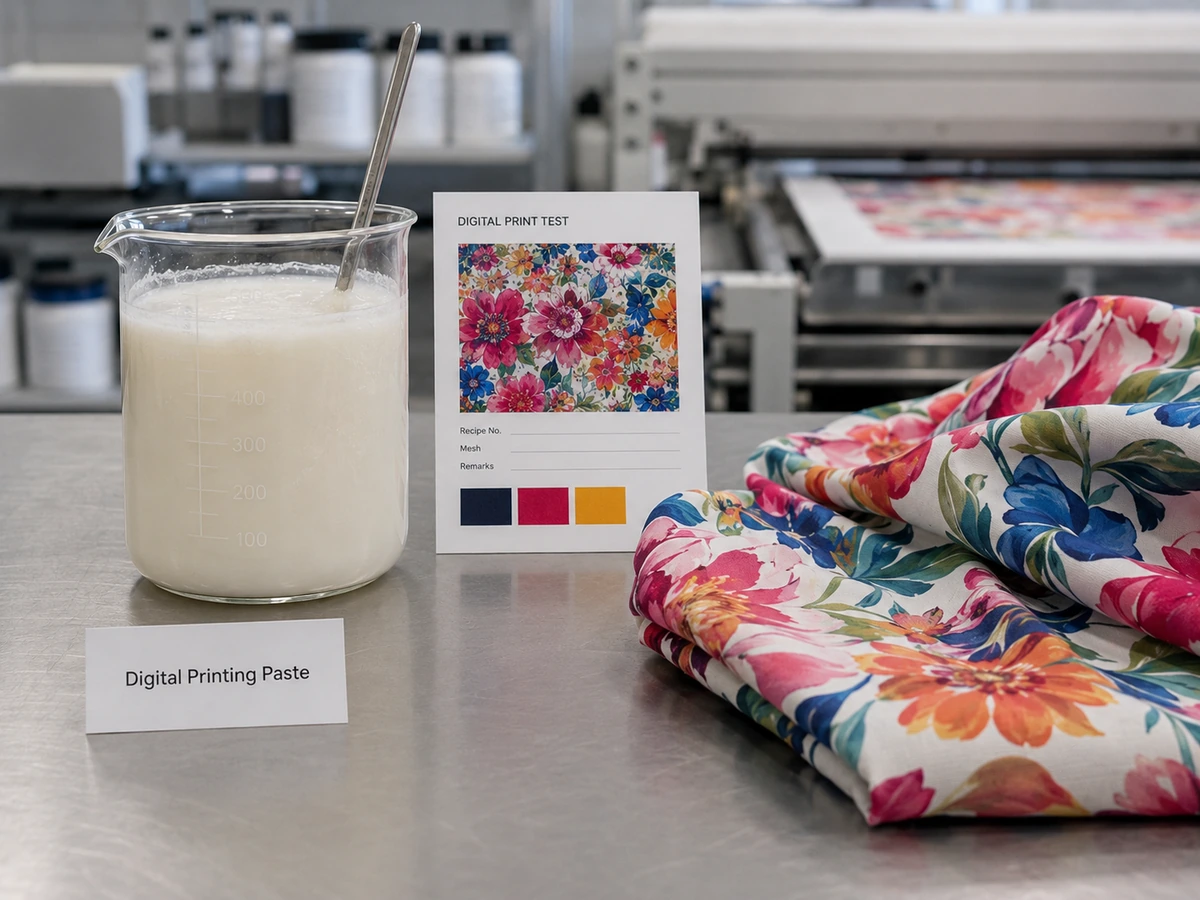
| معجون الطباعة الرقمية | Filtration, residue, pH, stability, fabric response and ink-system compatibility | Is the product approved for the intended application and supplied formulation? |
Check formulated products more carefully
A pure polymer and a formulated printing paste do not necessarily have the same compliance profile. Compound products may contain preservatives, surfactants, salts, dispersants or other performance additives.
Compliance declarations should apply to the complete supplied formulation, not only to the main polymer named on the label.
How to Verify Certificates and Test Reports
A certificate image or supplier statement should be treated as a starting point for verification, not the final decision.
Certificate verification checklist
- Exact commercial product name and grade
- Legal certificate holder
- Manufacturer and production site where stated
- Certificate or approval number
- Standard name and version
- Conformance level or certification stage
- Issue and expiry dates
- Product and application scope
- Issuing or approving organization
- Status in the official public database
Test-report verification checklist
- Sample name and batch identification
- Sampling party and sampling date
- Test laboratory and accreditation scope
- Test method and method version
- Detection or reporting limit
- Test results and units
- Applicable requirement or limit
- Report date and authorization
A laboratory accreditation logo does not prove that every method on a report falls within the laboratory’s accredited scope. Buyers can request the laboratory’s current scope when the result is critical.
Build a Standards-Based Supplier Scorecard
Compliance requirements should normally be treated as approval gates rather than as commercial preferences. A low price should not compensate for a missing mandatory document.
| مجال التقييم | Questions to Ask | Decision Role |
|---|---|---|
| Legal and customer compliance | Are all mandatory requirements documented? | Approval gate |
| Certificate verification | Are scope, holder, product and validity confirmed? | Approval gate where required |
| Technical performance | Does the grade work in the actual formulation and process? | Application approval |
| اتساق الدُفعات | Can the supplier provide a clear specification and batch COA? | Repeat-order assessment |
| Change control | Will relevant formulation, source or site changes be communicated? | Long-term supply control |
| Commercial conditions | Are price, packing, MOQ and delivery acceptable? | Final sourcing comparison |
Common Compliance Mistakes in Chemical Purchasing
Assuming “eco-friendly” is a recognized approval
Terms such as “green,” “non-toxic” and “eco-friendly” are too broad to replace a defined requirement. Ask which standard, test method and product scope support the claim.
Using an expired certificate
Certificates and chemical listings may expire, be suspended or change scope. Validity should be checked when the product is approved and periodically during repeat purchasing.
Accepting a certificate for a different grade
Similar product names do not prove identical formulations. The approved grade should match the product name on the purchase order, packaging and technical documents.
Assuming a natural polymer is automatically compliant
Natural origin does not address possible impurities, preservatives, processing aids or formulation additives. CMC, CMS and sodium alginate still require product-specific review.
Ignoring destination-market requirements
A chemical accepted by one brand or certification program may require additional evidence for another customer or market.
Selecting compliance without testing performance
A valid certificate cannot determine whether a printing thickener provides the required viscosity, color yield, print sharpness, wash-off or fabric handle.
الأسئلة الشائعة
What is the difference between an MRSL and an RSL?
An MRSL controls hazardous chemical inputs used during manufacturing, while an RSL controls restricted substances in the finished material or product. A mill may need to satisfy both.
Does an SDS prove that a textile chemical meets ZDHC or another standard?
No. An SDS communicates hazard and handling information; it is not proof of product-specific MRSL conformance or certification. Verify the exact formulation in the relevant official system.
Can one certificate cover every grade from a supplier?
Not automatically. Check the certificate holder, exact product or formulation name, scope, issuer, validity period and any listed limitations before connecting it to an order.
Is a compliant thickener automatically suitable for production?
No. Compliance screening does not prove viscosity behavior, filtration, print definition, color yield, wash-off or fabric handle. Complete formulation and production trials remain necessary.
What should a buyer send for a compliance and grade review?
Provide the exact application, fabric, dye or ink system, destination market, customer program, required standard, current TDS, test method and target production performance.
Compliance Document and Sample Support from FSX Chemical
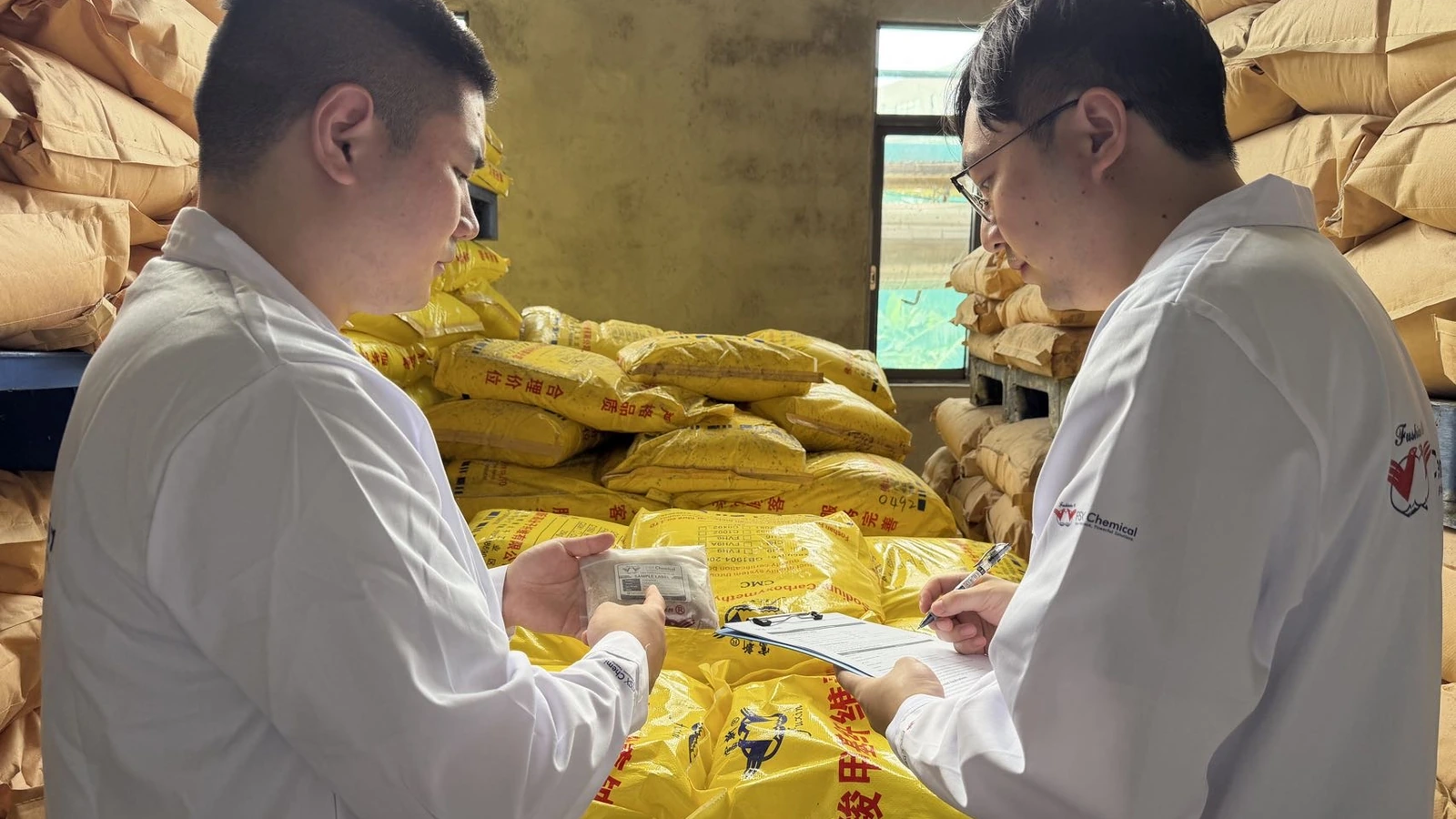
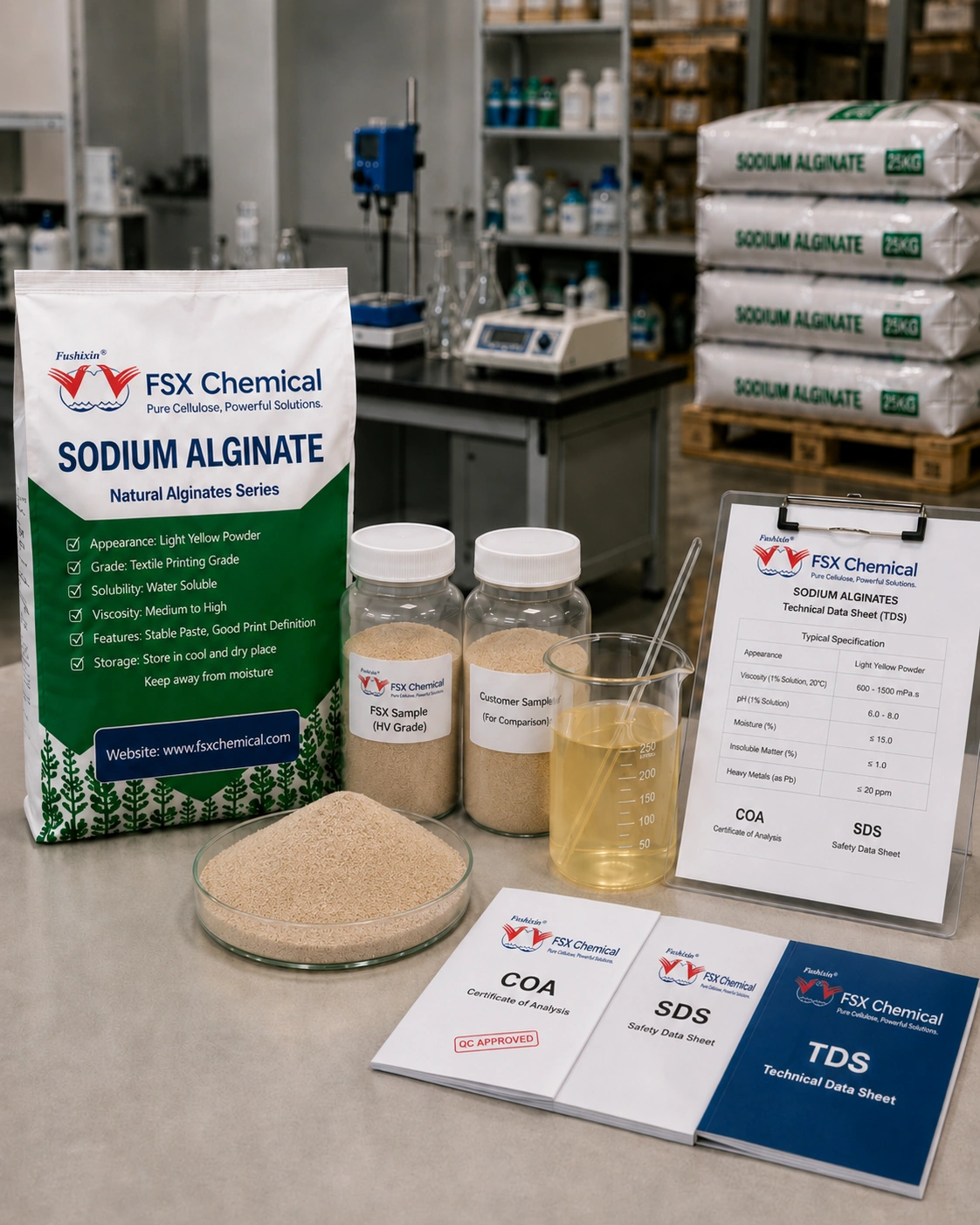
Available review materials may include:
- ورقة البيانات الفنية
- ورقة بيانات السلامة
- Product specification information
- عينة تمثيلية
- شهادة تحليل الدفعة (COA) للإنتاج المؤكد، حيثما ينطبق ذلك
- Selected certificates or third-party documents already on file
- Packing and export-document information
Before relying on a certificate for supplier approval, request the current copy and verify its holder, scope, issuer and validity. Document availability does not replace customer-side application and compliance review.
For grade matching, provide the printing process, fabric, dye or ink system, target viscosity, current TDS, required standard and destination market. This helps separate mandatory document requirements from technical performance targets.
Need to Review a Textile Printing Chemical Grade?
Send FSX Chemical your required product, application, current TDS, applicable MRSL or certification program, destination market and sample testing conditions. Our team can confirm which available documents and product routes can be reviewed📧 البريد الإلكتروني: Service@fsxchemical.com