














Technical Guide Printing Process & Thickener Selection Updated July 2026 Direct Answer
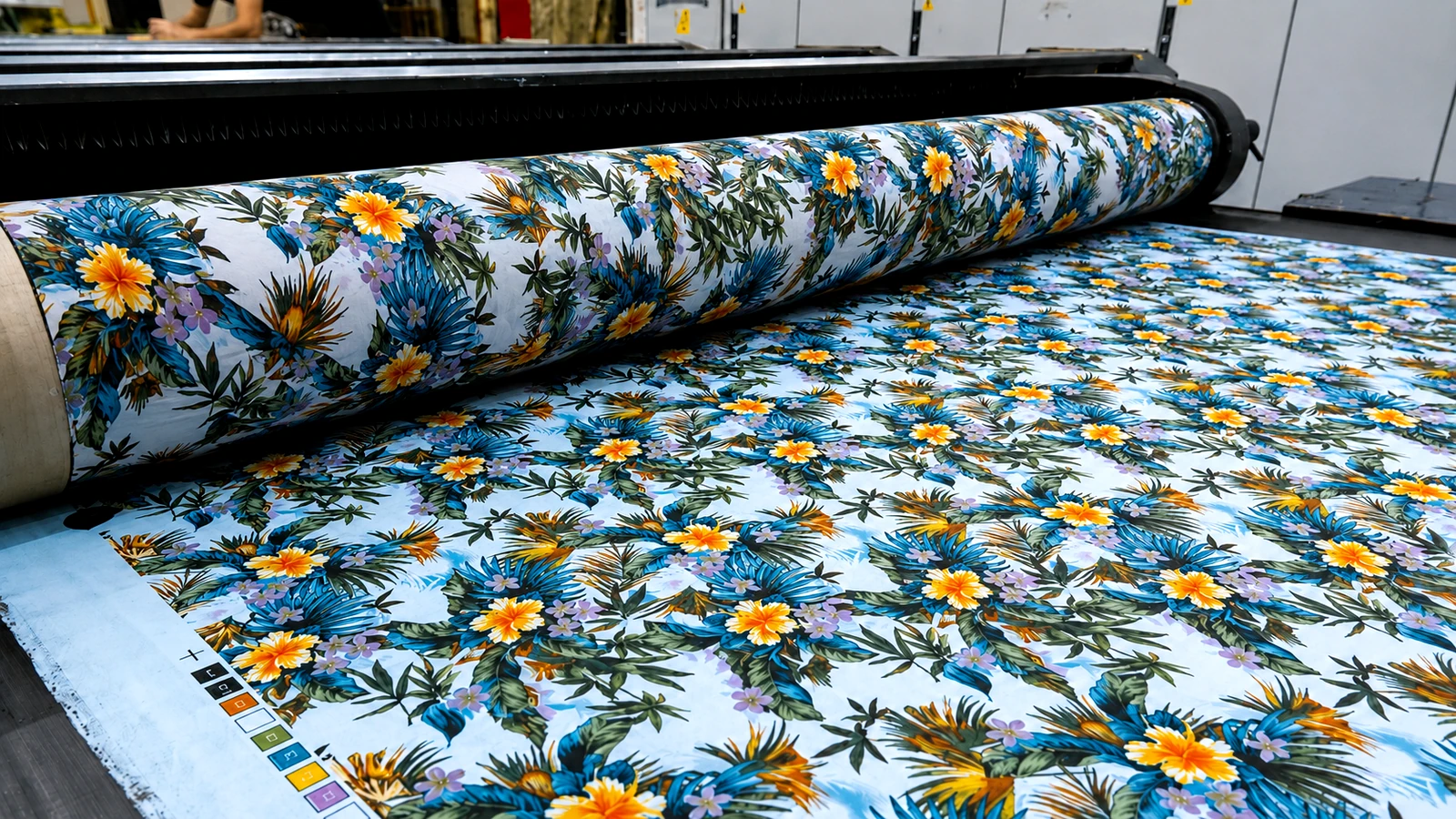
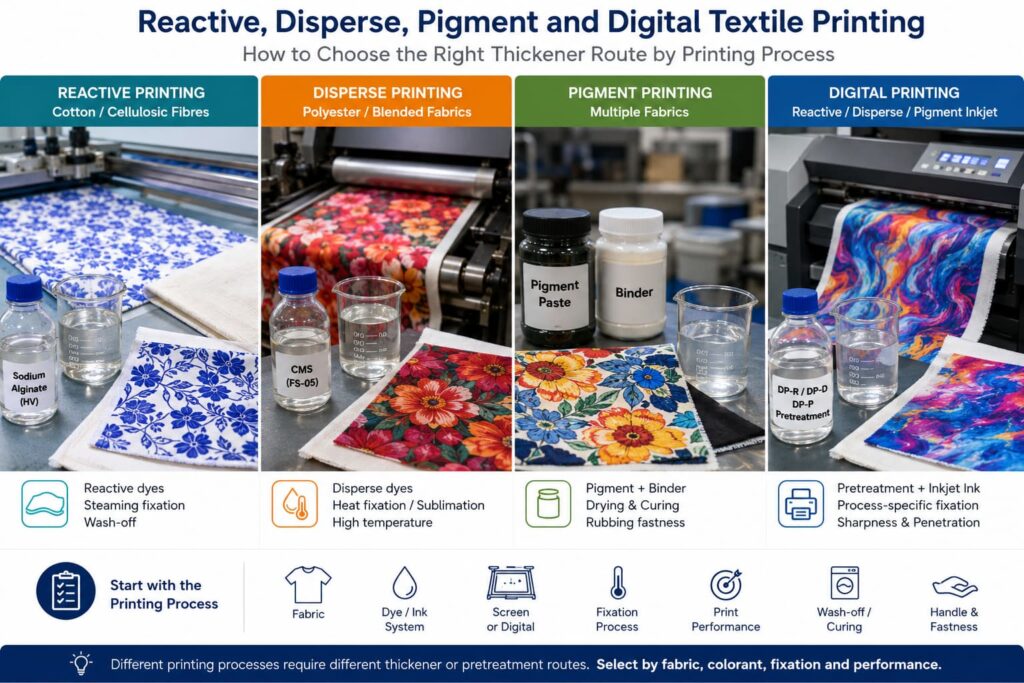
Choose a textile printing thickener or pretreatment route by identifying the fabric, colourant system, printing method and fixation process before comparing viscosity or price. Sodium alginate is commonly used as a benchmark for reactive screen printing on cellulosic fabrics. Disperse printing on polyester requires a route compatible with disperse dyes and heat fixation. Conventional pigment printing normally depends on a synthetic thickener and binder system. Digital textile printing requires a process-specific pretreatment selected for reactive, disperse or pigment inkjet printing.
Colourant System
vs Printing Method
Reactive, disperse and pigment describe different colourant and fixation systems. Digital describes the method used to place ink droplets on the textile. Digital textile printing can therefore use reactive ink, disperse ink or pigment ink. A “digital printing paste” must be selected according to the specific digital ink and fabric route rather than treated as one universal fourth dye system.
Selection Hierarchy
Six Questions to Answer Before Selecting a Thickener
Product selection should follow the production route. Starting with a viscosity number or product price can lead to an unsuitable comparison. QUESTION 01
What Is the Fabric?
Confirm cotton, viscose, lyocell, polyester, silk, wool or a blended fabric before selecting the colourant and paste route. QUESTION 02
Which Colourant?
Identify reactive dye, disperse dye, pigment ink or another dye class. Different colourants require different fixation chemistry. QUESTION 03
Screen or Digital?
Conventional screen paste and digital fabric pretreatment have different preparation, rheology and application requirements. QUESTION 04
How Is It Fixed?
Confirm steaming, thermofixation, sublimation or binder curing, together with the intended temperature and time. QUESTION 05
What Is the Main Problem?
Identify low colour yield, bleeding, poor sharpness, difficult wash-off, unstable paste or unacceptable fabric handle. QUESTION 06
How Will It Be Tested?
Define the laboratory method, application trial and acceptance criteria before comparing candidate products.
Quick Process Matrix
Printing Process and Starting Thickener Route
The table provides an initial selection framework. Final suitability must be confirmed using the intended recipe, fabric and machinery.
| مسار الطباعة | Typical Fabric | Starting Thickener or Paste Route | Fixation / Post-Treatment | Main Evaluation Points |
|---|---|---|---|---|
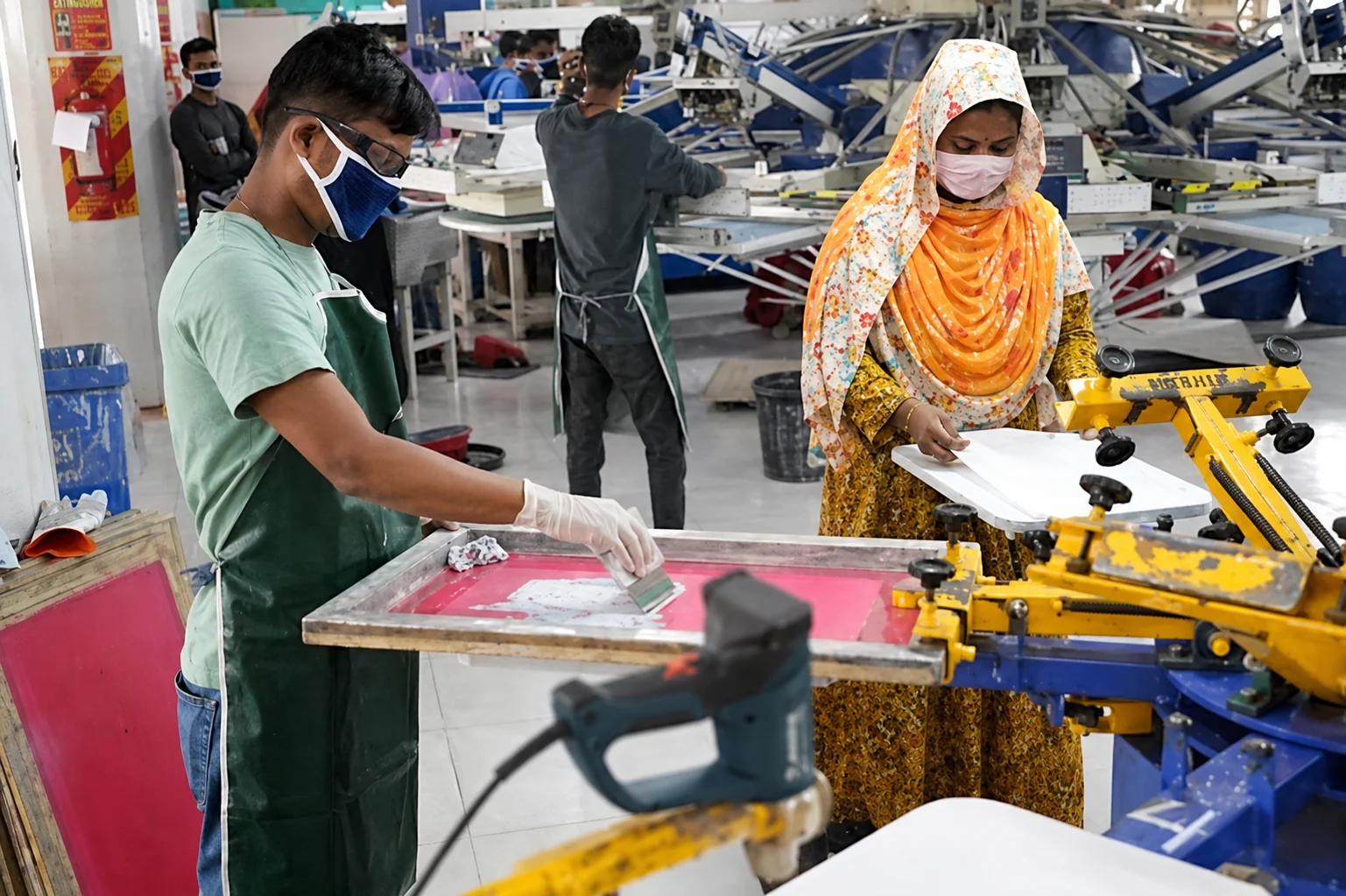
| الطباعة الحساسة على الشاشة | Cotton, viscose, lyocell and suitable cellulosic fabrics | Sodium alginate benchmark; selected reactive CMS route may be evaluated | Steaming followed by washing and removal of unfixed dye and thickener | Colour yield, definition, penetration, wash-off and handle |
| Disperse screen printing | Polyester and suitable polyester blends | Process-specific disperse printing thickener, including selected CMS or synthetic routes | Heat or steam fixation according to the dye and production route | Dispersion, screen running, fixation, sharpness and residue |
| Pigment screen printing | Cotton, polyester and many blended or mixed-fibre fabrics | Synthetic thickener combined with a compatible pigment binder and auxiliary system | Drying and binder curing | Rubbing fastness, colour strength, sharpness, curing and handle |
| الطباعة الرقمية التفاعلية | Cotton, viscose, lyocell, silk and suitable cellulosic routes | Reactive digital pretreatment or paste route such as DP-R | Steaming and wash-off | Ink bleeding, edge definition, colour development and wash-off |
| الطباعة الرقمية الموزعة | Polyester and suitable polyester blends | Disperse digital pretreatment route such as DP-D, depending on direct or transfer printing | Heat fixation or sublimation | Penetration, sharpness, ink spreading, fixation and fastness |
| الطباعة الرقمية بالأصباغ | Cotton, polyester and suitable blends | Pigment digital pretreatment route such as DP-P, coordinated with the binder-containing ink system | Drying and curing | Rubbing fastness, definition, colour strength and hand feel |
Product names and internal model codes are not universal industry standards. Confirm the applicable TDS and trial procedure before use.
Reactive Screen Printing
Choosing a Thickener for Reactive Printing
Reactive dyes form chemical bonds with suitable fibres such as cotton and viscose during fixation. The thickener must control the printing paste without consuming a significant part of the reactive dye or preventing its transfer to the fibre.
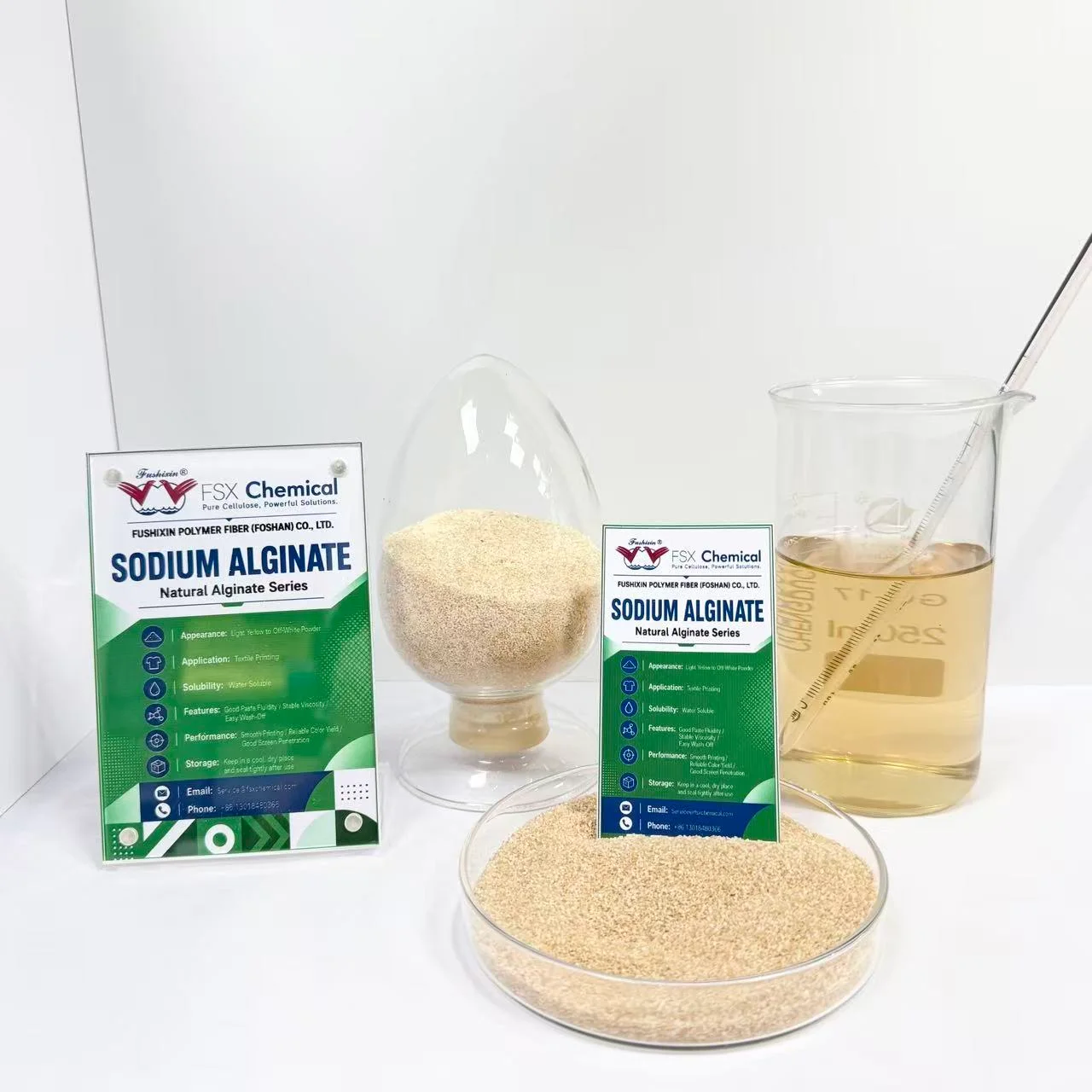
Sodium alginate is widely used as the reference thickener for conventional reactive printing because its structure generally has limited reaction with reactive dyes and it can provide useful screenability, colour yield and wash-off performance when the complete process is controlled.[1] 01
طريقة استخدام ألجينات الصوديوم
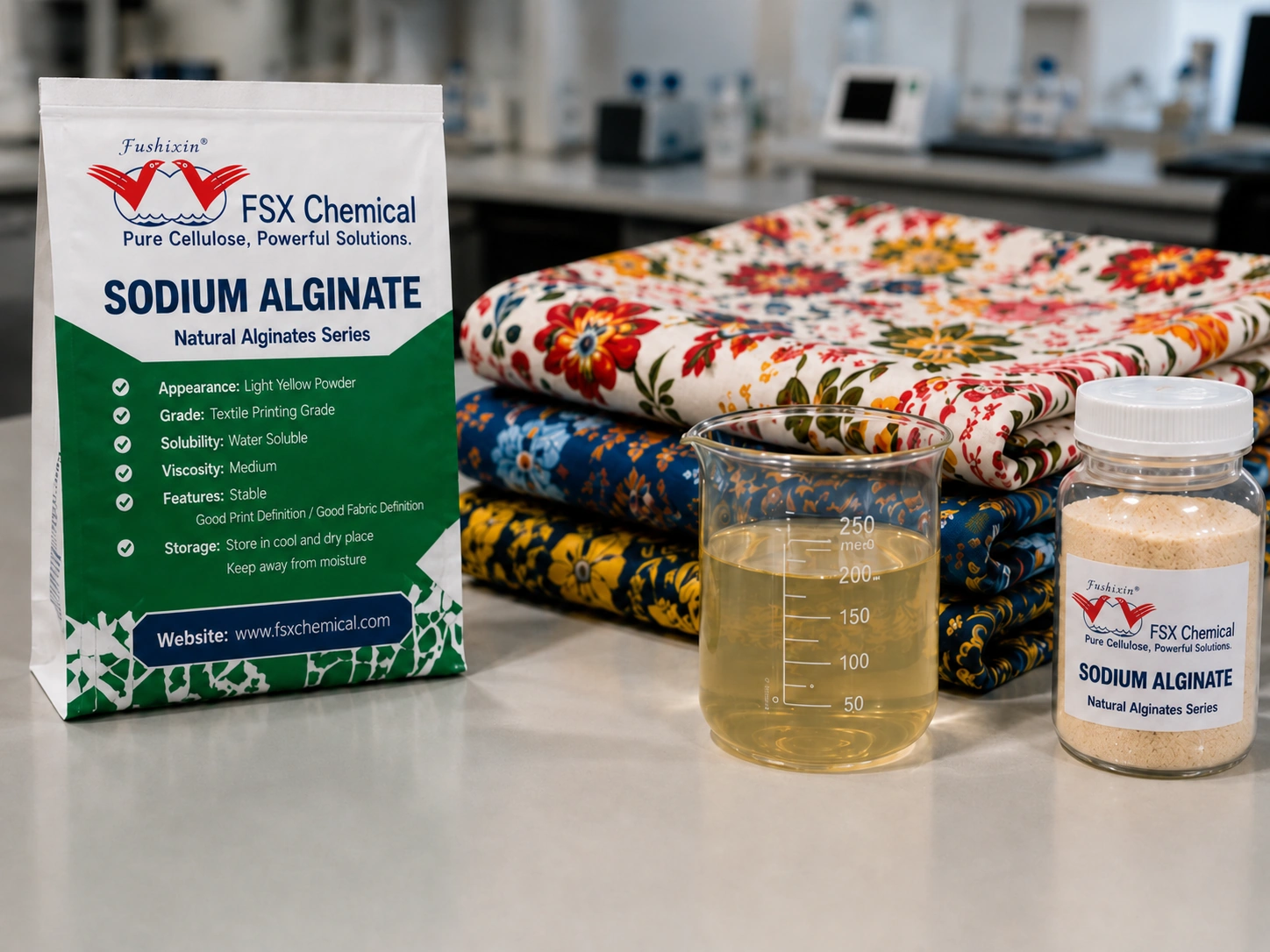
Use sodium alginate as the initial benchmark when evaluating reactive screen printing on cotton, viscose or other suitable cellulosic fibres.
- Compare HV, MV and LV under the same test method
- Confirm stock-paste concentration
- Evaluate screen release and edge definition
- Review colour yield, wash-off and fabric handle
Review sodium alginate grades 02
Reactive CMS Route
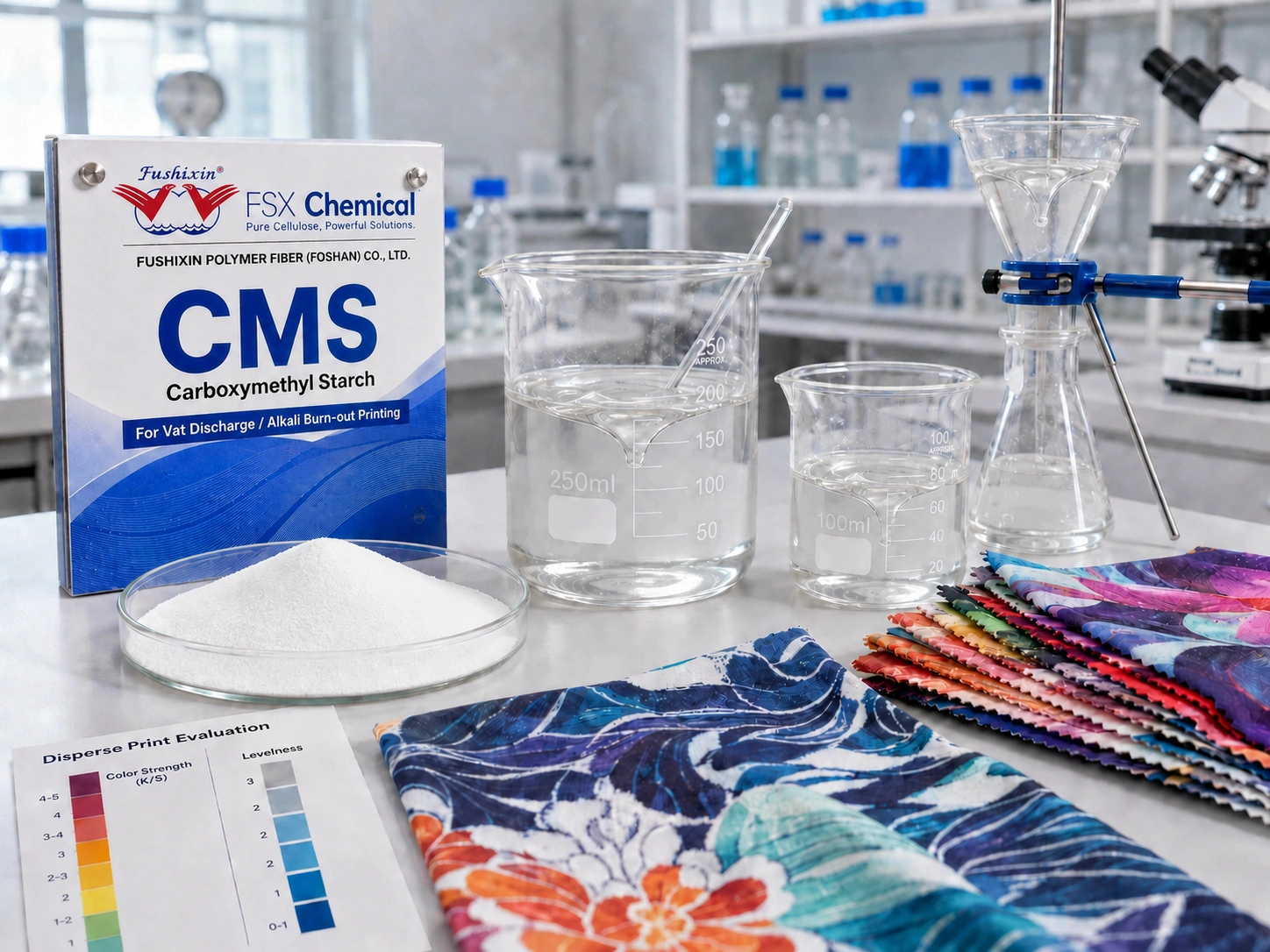
A suitable high-substitution CMS grade or controlled blend may be evaluated when the mill is considering a different rheology or cost-performance route.
- Confirm grade suitability for reactive printing
- Compare colour yield and outline sharpness
- Check background cleanliness and wash-off
- Do not assume universal one-to-one replacement
CMC is not automatically a direct alginate replacement.
Selected CMC grades may be useful in specialty printing and other industrial systems, but conventional reactive printing suitability depends on degree of substitution, purity, dye interaction and the complete recipe. It must be proven through controlled trials.
Disperse Screen Printing
Choosing a Thickener for Polyester Disperse Printing
Disperse dyes are designed for hydrophobic fibres, particularly polyester. The printing paste must maintain a stable dye dispersion, transfer cleanly through the screen and release the dye during the selected heat-fixation process.
A reactive printing thickener should not be transferred directly to disperse printing simply because it gives a similar laboratory viscosity. The dye, auxiliary, acidity, heat treatment and residue requirements are different.
FS-05 CMS Route
FSX Chemical positions FS-05 as a starting CMS route for selected disperse screen-printing trials.
- Confirm powder dispersion and hydration
- Review screen running and paste stability
- Evaluate definition after fixation
- Check residue, washing and fabric handle
Synthetic Thickener Route
A process-specific synthetic thickener may also be used when the formulation requires low dosage, salt tolerance or a particular rheological profile.
- Confirm compatibility with dispersing agents
- Check the valid pH and electrolyte range
- Evaluate heat stability
- Review removal or residual-film behaviour
Direct printing and transfer printing are different routes.
Direct disperse printing places the colourant on the fabric before fixation. Sublimation transfer printing first prints transfer paper and then transfers the dye to polyester under heat. Their paste, coating and ink requirements should not be treated as identical.
Pigment Screen Printing
Why Pigment Printing Requires a Binder System
Pigments do not have the same fibre affinity or chemical fixation route as reactive and disperse dyes. In conventional pigment printing, the pigment is normally fixed to the fabric through a polymeric binder film.
The printing paste therefore commonly includes a pigment dispersion, synthetic thickener, binder and other auxiliaries. Research on textile pigment printing evaluates both colour properties and dry or wet rubbing fastness because binder formation and curing affect the final result.[2]
Thickener Responsibilities
- Control screen-printing rheology
- Limit unwanted spreading
- Support even pigment distribution
- Remain compatible with the binder and auxiliaries
Binder Responsibilities
- Attach pigment particles to the fabric
- Develop rubbing and washing resistance
- Form correctly during curing
- Balance fastness with fabric softness
Do not select pigment paste by viscosity alone.
Binder compatibility, curing temperature, curing time, pigment loading, rubbing fastness and fabric handle may be more important than matching one initial viscosity value.
الطباعة الرقمية على المنسوجات
Why Digital Printing Uses a Separate Pretreatment Decision
In conventional screen printing, the dye, thickener and most auxiliaries are combined in the colour paste before application. In textile inkjet printing, many functional chemicals are instead applied to the fabric through pretreatment, while the printer jets a low-viscosity ink through fine nozzles.[3]
The pretreatment helps control droplet spreading, penetration, edge definition, colour development and fixation. It must be selected according to the ink chemistry and textile substrate. DP-R
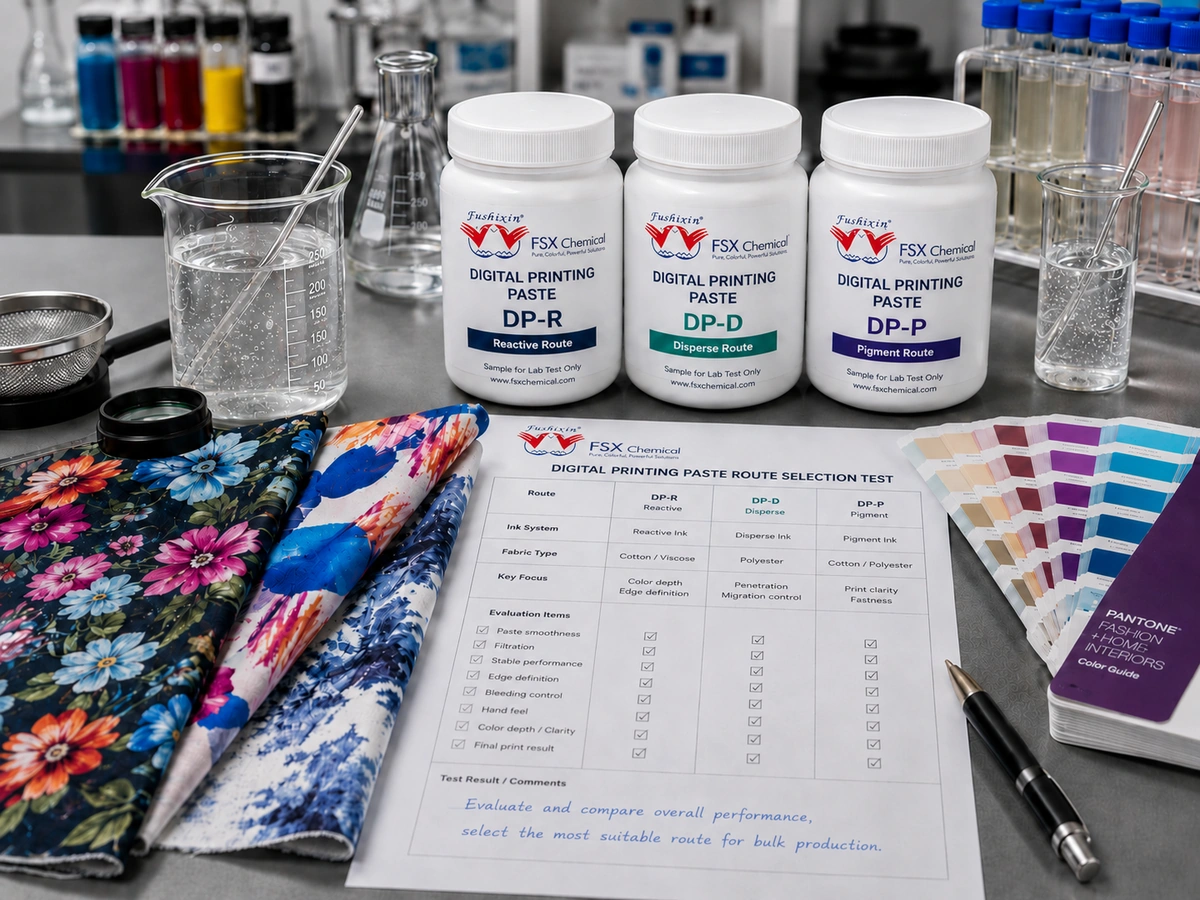
الطباعة الرقمية التفاعلية
DP-R is the FSX Chemical starting route for reactive inkjet pretreatment evaluation on suitable cellulosic and related fibres.
- Confirm fabric absorbency and preparation
- Review thickener, alkali and humectant requirements
- Evaluate bleeding, definition and colour development
- Confirm steaming and wash-off conditions
DP-D
الطباعة الرقمية بالتشتت
DP-D is the starting route for disperse inkjet evaluation on polyester and suitable polyester blends.
- Confirm direct or transfer printing
- Review coating or pretreatment dosage
- Evaluate droplet spreading and penetration
- Confirm heat fixation or sublimation
DP-P
الطباعة الرقمية بالأصباغ
DP-P is the starting route for pigment inkjet pretreatment evaluation on suitable natural and synthetic fabrics.
- Confirm pigment ink and binder system
- Evaluate surface ink control and edge sharpness
- Review curing and rubbing fastness
- Balance colour strength with fabric handle
TEST
Digital Trial Boundary
Digital pretreatment must be tested with the actual printer, ink, waveform, resolution, fabric, drying and fixation process.
- Do not rely only on laboratory viscosity
- Check filtration and coating uniformity
- Review nozzle and machine compatibility
- Confirm production-side repeatability
Review digital printing paste routes
Fixation and Post-Treatment
Why Fixation Determines Product Selection
| الطريق | Typical Fixation Direction | Post-Treatment Focus | Selection Risk |
|---|---|---|---|
| Reactive dye | Steaming or another validated reactive fixation process | Removal of unfixed dye, alkali, auxiliaries and thickener | Poor wash-off may reduce cleanliness and handle |
| Disperse dye | Heat fixation, high-temperature steaming or sublimation, depending on the route | Removal of surface dye or residual paste where required | Incorrect heat response may reduce colour or definition |
| الصباغ | Binder drying and curing | Usually no dye wash-off route equivalent to reactive printing | Under-curing can reduce fastness; over-curing may affect handle |
| Digital inkjet | Depends on reactive, disperse or pigment ink chemistry | Must follow the corresponding ink and fibre route | “Digital” alone does not define the required fixation process |
Performance Evaluation
What to Check During a Printing Trial
The same acceptance criteria should not be applied blindly to every process, but the following indicators provide a useful evaluation framework.
- Paste preparation and hydration
- Viscosity stability during use
- Screen release or pretreatment uniformity
- Edge definition and fine-line sharpness
- Colour yield or colour strength
- Ink or paste penetration
- نظافة الخلفية
- Bleeding or uncontrolled spreading
- Fixation efficiency
- Wash-off or residue removal
- Dry and wet rubbing fastness
- Final fabric handle
Rheology affects print application and definition.
Thickeners are used to control paste movement and reduce unwanted dye migration. The useful rheological profile depends on the application method rather than one universally ideal viscosity. [5]
Common Selection Errors
Six Mistakes to Avoid
Choosing by viscosity alone
Similar viscosity values do not prove equivalent dye compatibility, rheology, wash-off, fixation or fabric handle.
Ignoring fabric composition
Cotton, viscose and polyester require different colourant and fixation routes. A product proven on one fibre may fail on another.
Mixing screen and digital logic
Screen-printing colour paste and digital pretreatment perform different functions and should not be compared only by dosage or viscosity.
Ignoring fixation
A thickener or pretreatment must remain compatible with steaming, heat fixation, sublimation or binder curing.
Comparing price per kilogram only
Dosage, dye or ink consumption, washing, rejected fabric and batch adjustment may change the real production cost.
Skipping the production trial
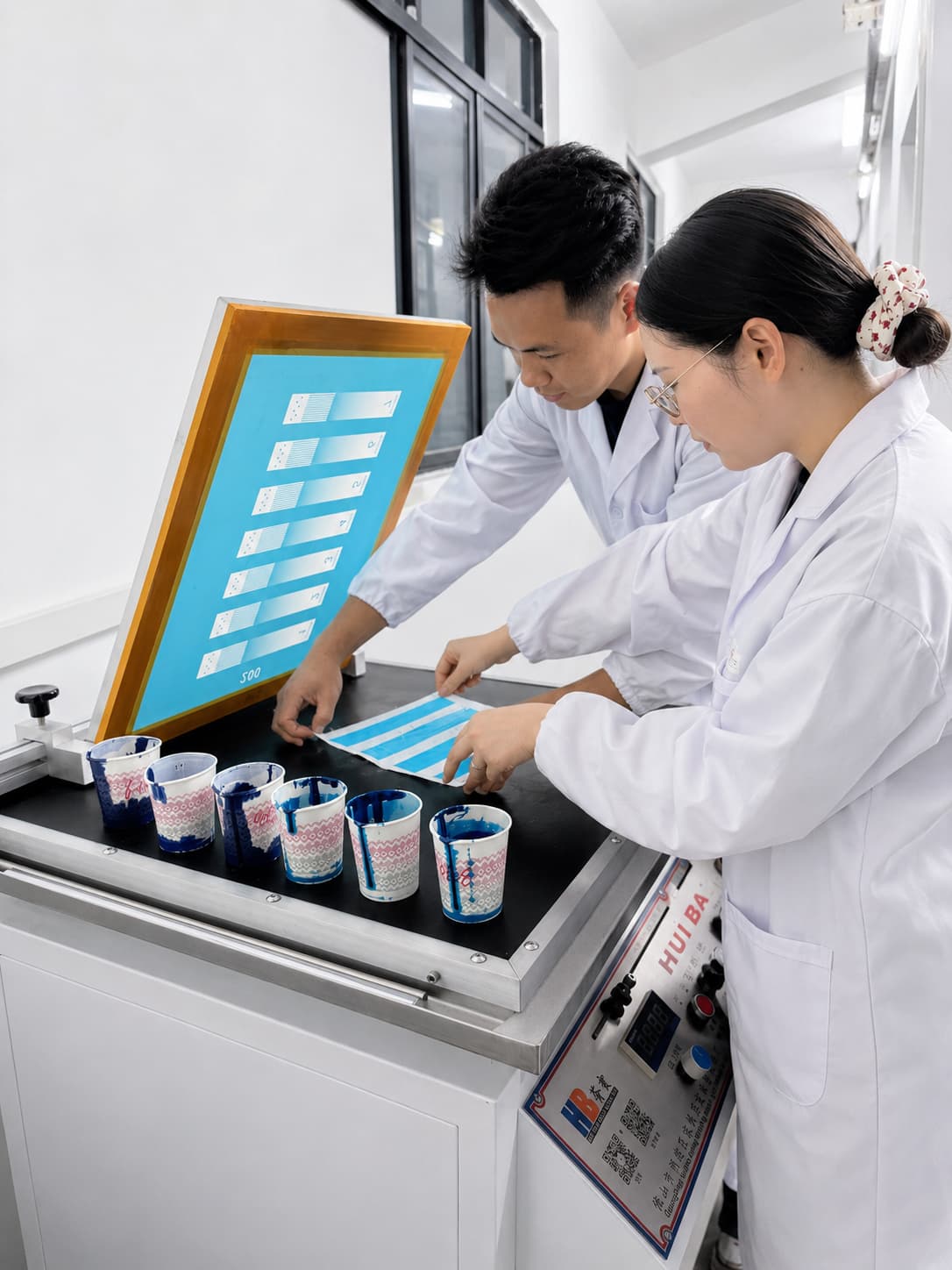
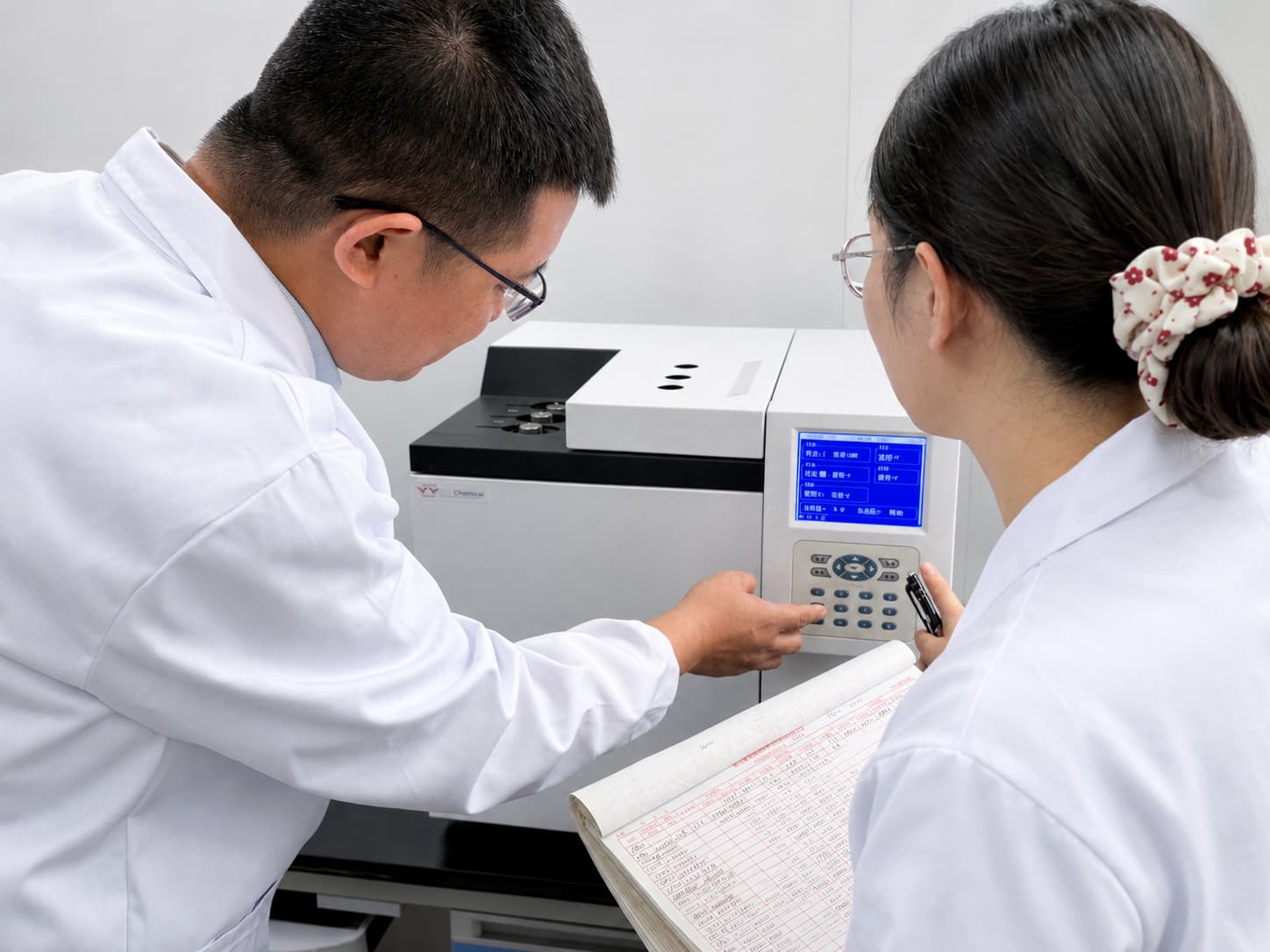
Laboratory testing is useful for screening, but final approval requires the buyer’s actual machinery, recipe and process.
Buyer Information
What to Send for Process-Based Grade Matching
- Fabric composition and construction
- Reactive, disperse or pigment colourant
- Screen or digital printing method
- Direct or transfer digital route
- Current product name and specification
- Current recipe and dosage
- اللزوجة المستهدفة وطريقة الاختبار
- Steaming, heating or curing conditions
- مشكلة الإنتاج الحالية
- Required fastness and fabric handle
- Monthly consumption
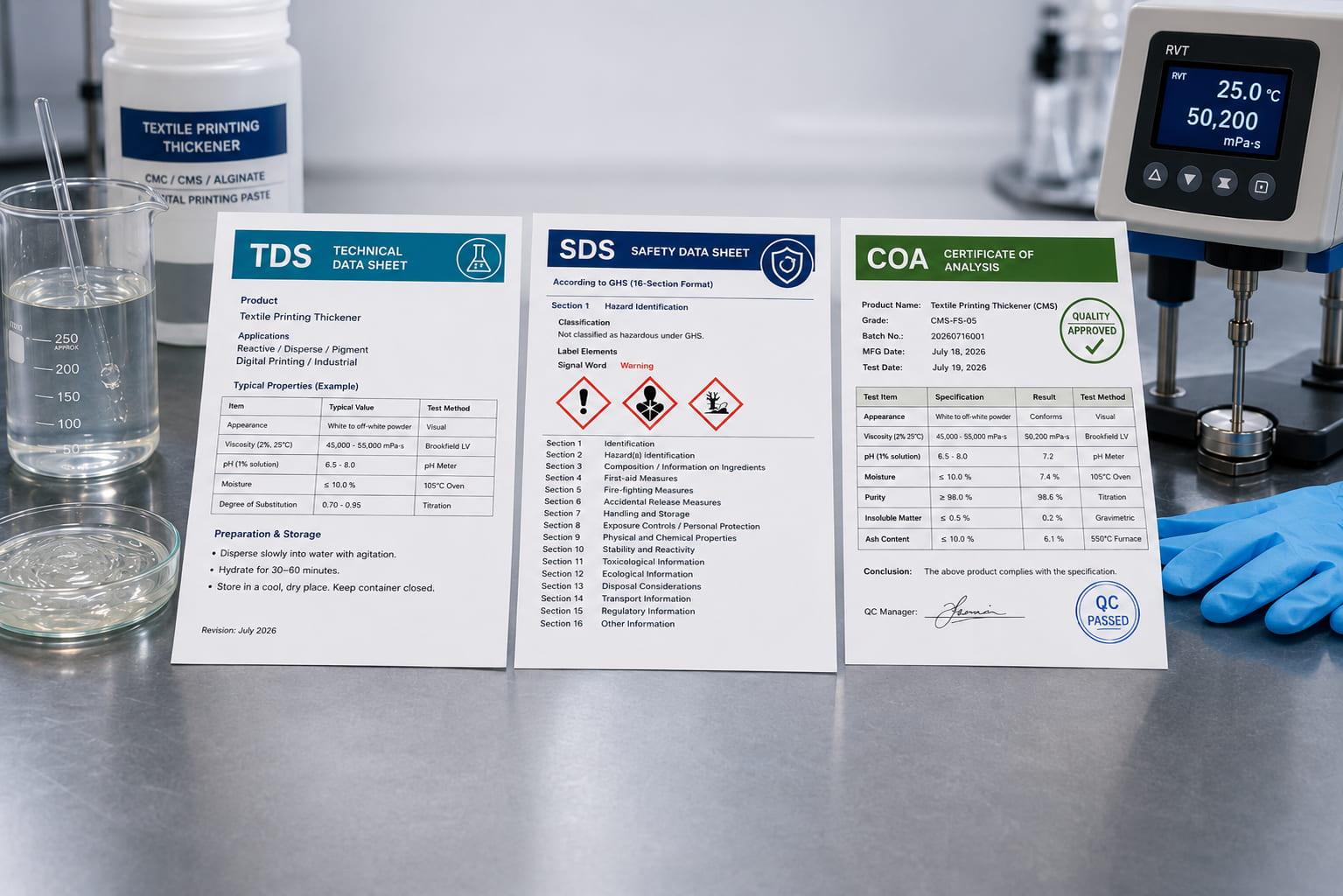
- Required TDS, SDS and batch COA
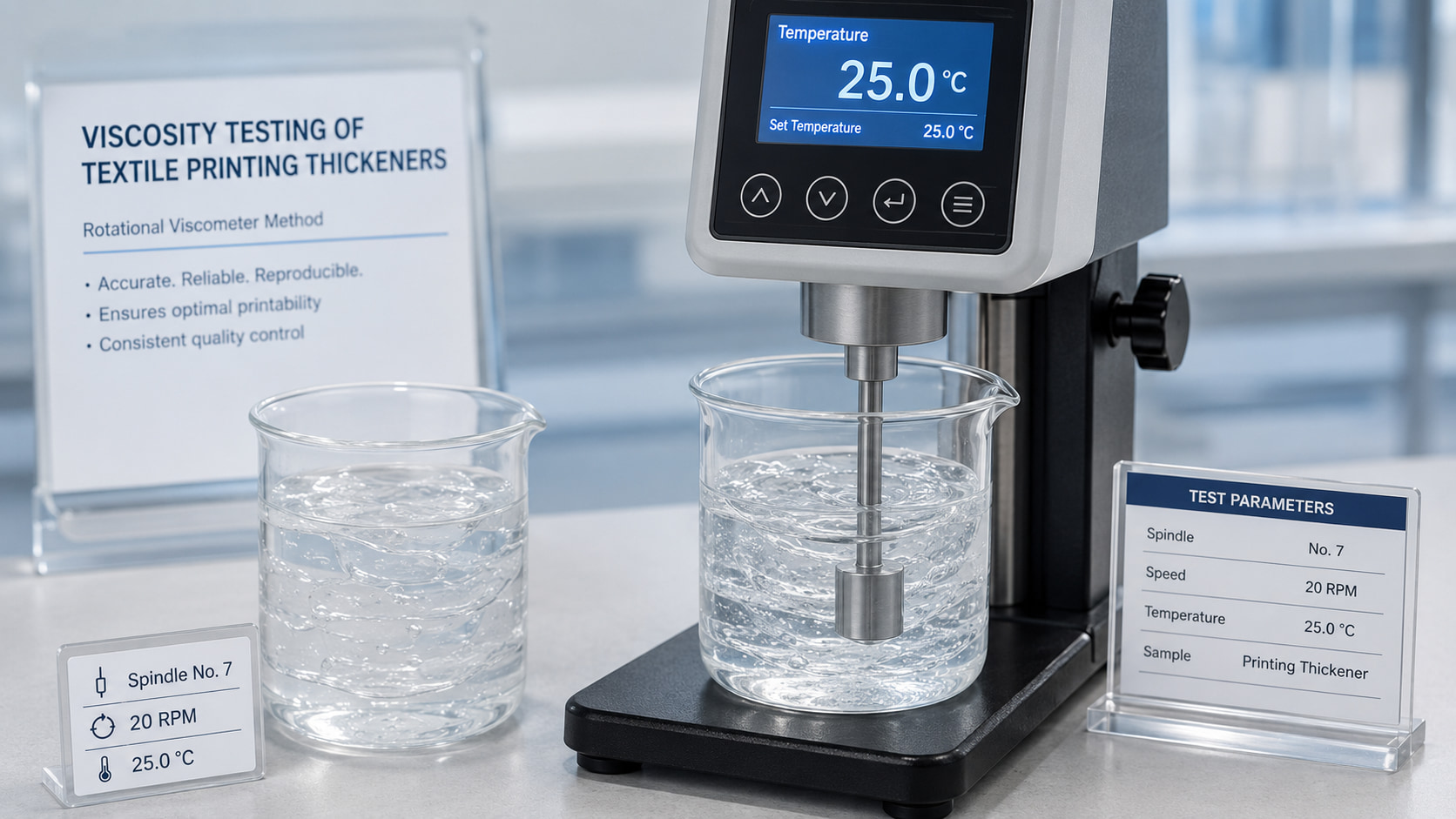
For viscosity comparisons, review how to compare textile printing thickener viscosity test methods .
For a material-route comparison, review the CMC, CMS, sodium alginate and digital printing paste selection guide .
FSX Chemical Routes
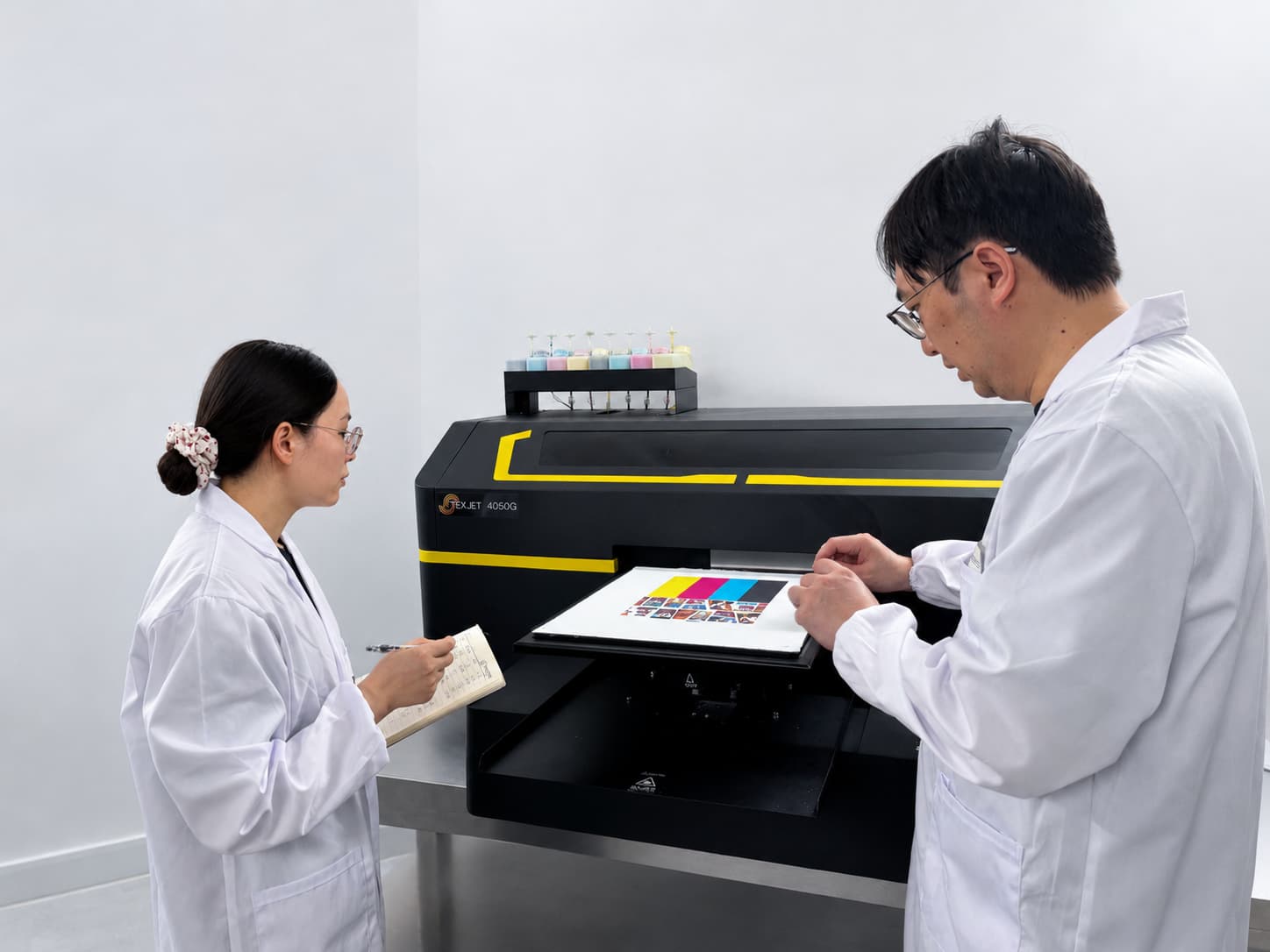
Product Routes Available for Initial Evaluation
| عائلة المنتجات | FSX Routes | Initial Application Direction | Required Confirmation |
|---|---|---|---|
| ألجينات الصوديوم | التيار العالي / التيار المتوسط / التيار المنخفض | الطباعة التفاعلية على المنسوجات | Stock-paste concentration, print method, colour and wash-off |
| CMS | CN-R / FS-05 / H5 | Reactive, disperse and selected specialty routes | Dye system, fabric, preparation, fixation and trial result |
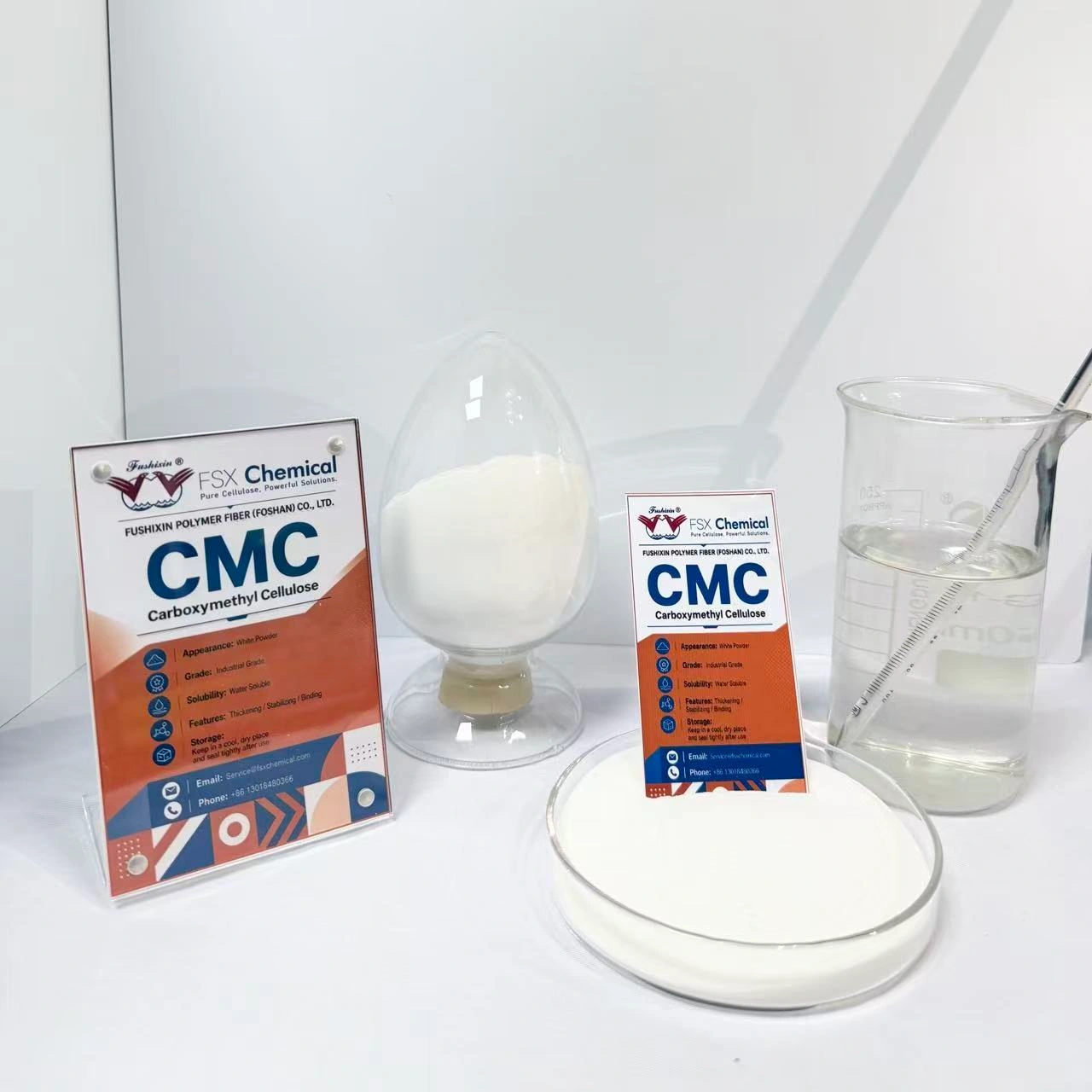
| CMC | HD / MD / LD | Selected printing, specialty and industrial formulations | DS, viscosity method, purity and full recipe compatibility |
| معجون الطباعة الرقمية | DP-R / DP-D / DP-P | Reactive, disperse and pigment inkjet printing | Ink, fabric, product form, dosage, printer and fixation route |
الأسئلة الشائعة للمشترين
الأسئلة الشائعة
Which thickener is normally considered first for reactive printing?
Sodium alginate is commonly used as the initial benchmark for conventional reactive printing on cotton, viscose and suitable cellulosic fabrics. Selected CMS alternatives may also be tested, but they require controlled recipe and printing trials. Can the same thickener be used for reactive and disperse printing?
It should not be assumed. Reactive and disperse dye systems use different fabrics, auxiliaries, fixation conditions and post-treatment. A grade must be validated for the intended printing process. Is sodium alginate the default thickener for pigment printing?
No. Conventional pigment printing normally relies on a compatible synthetic thickener and binder system. Pigment fixation, curing, rubbing fastness and fabric handle must be evaluated together. Is digital printing paste mixed directly into the printer ink?
Not usually in the same way as conventional screen-printing colour paste. Many digital textile systems apply functional chemicals through fabric pretreatment, while the printer uses a separately formulated low-viscosity ink. Can one digital pretreatment be used for reactive, disperse and pigment inks?
It should not be assumed. Reactive, disperse and pigment inks have different fibre interactions, fixation processes and auxiliary requirements. Use a route developed and tested for the specific ink system. Is the lowest-priced thickener the lowest-cost option?
Not necessarily. Buyers should also consider dosage, colour yield, ink or dye consumption, washing, curing, rejected fabric, machine cleaning and batch consistency. What is required before approving a product for bulk supply?
Confirm the product grade, laboratory method, application trial, fixation route, final print result, batch specification, packing, documents and commercial conditions.
About This Technical Guide
Prepared by the FSX Chemical Technical Content Team for textile printing mills, dye and paste formulators, chemical distributors and procurement teams comparing process-specific thickener and digital pretreatment routes.
شركة FSX للكيماويات
شركة فوشان فوشيشين للألياف البوليمرية المحدودة.
تم التحديث في يوليو 2026
Technical References
Supporting Process and Printing Research
These sources provide technical context. Commercial product selection must still be confirmed using the applicable TDS, batch information and customer production trial.
- Schneider, R. and Šostar-Turk, S. Research discussing sodium alginate and alternative thickeners in reactive dye printing. View research record
- Neral, B., Šostar-Turk, S. and Vončina, B. “Properties of UV-cured pigment prints on textile fabric.” The study evaluates a pigment printing paste containing synthetic thickener, binder and pigment dispersion. View research record
- “Recent developments in the preparatory processes for the digital printing of textiles.” Technical discussion of fabric pretreatment and digital textile printing workflow. View publication record
- Research on disperse dye inkjet printing of polyester and the relationship between ink formulation, spreading, printability and heat fixation. View research record
- “Rheological study of interactions between non-ionic surfactants and polysaccharide thickeners used in textile printing.” Technical discussion of rheology, shear behaviour and print definition. View research record
Start with the Printing Process, Not Only the Product Name
Send your fabric, dye or ink system, printing method, current product, viscosity method, fixation process and target result. FSX Chemical can review an initial sodium alginate, CMS, CMC or digital printing paste route for controlled sample evaluation.
طلب عينة مطابقة اطلب عرض أسعار📧 البريد الإلكتروني: Service@fsxchemical.com