La guía definitiva sobre los agentes espesantes para la impresión textil en 2026
Textile printing thickening agents control much more than viscosity. This 2026 guide explains sodium alginate,...
Textile printing thickening agents control much more than viscosity. In 2026, successful thickener selection increasingly combines rheology, hydration, filtration, chemical compatibility, application testing, batch consistency and responsible chemical management. This guide compares sodium alginate, CMC, CMS, compound thickeners and digital printing paste across the major textile printing processes.
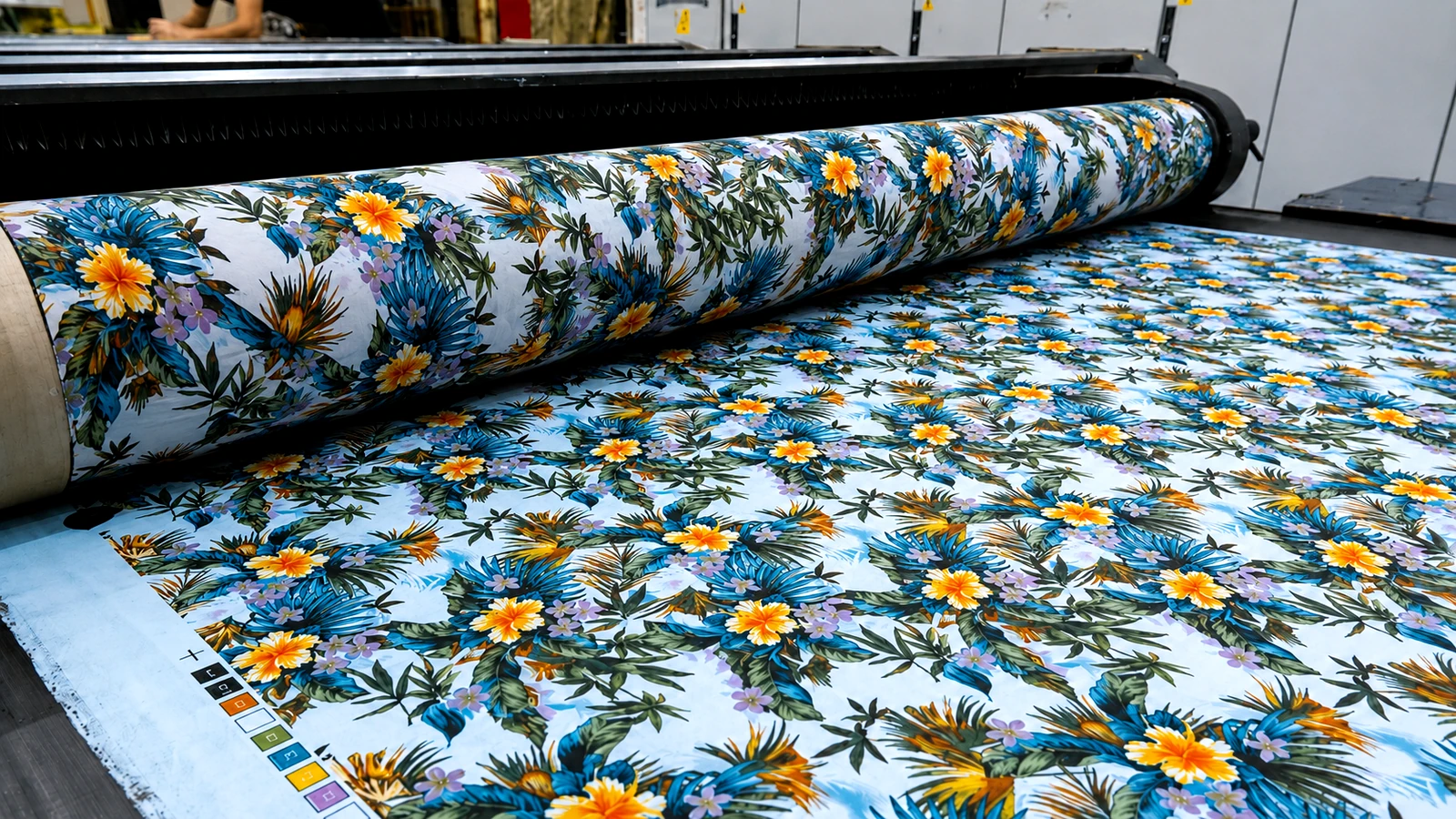
Thickening agents are among the most important functional materials in textile printing chemistry. They help create the paste structure needed to transport dyes, pigments and auxiliaries through preparation, application and fixation without allowing uncontrolled spreading across the fabric.
Yet selecting a textile printing thickener has become more complex than choosing a high-, medium- or low-viscosity product.
Modern printing mills may operate flat-screen, rotary-screen and digital inkjet lines. They may print cotton with reactive dyes, polyester with disperse colorants, pigment systems on multiple fibers or several technologies inside the same facility.
These processes do not require identical rheology or chemical compatibility. A thickener that performs well in one system may be a poor choice in another, even when the viscosity appears similar.
The most useful approach in 2026 is therefore process-based selection: first identify the printing chemistry and production conditions, then select and validate the most appropriate thickening route.
What Are Textile Printing Thickening Agents?
Textile printing thickening agents are polymers or formulated rheology-control systems used to create the flow properties required in printing pastes and textile pretreatment formulations.
Their purpose is not simply to make a liquid thicker. They help control how the paste behaves while being mixed, stored, pumped, transferred through a screen or applied to a textile surface.
A printing thickener can influence
Paste viscosity
Comportamiento de fluidez por cizallamiento
Recuperación estructural
Fragmento de la pantalla
Transferencia por pasta
Fabric penetration
Lateral spreading
Definición de líneas finas
Uniformidad del área sólida
Estabilidad de sujeción
Because these properties interact with dyes, pigments, salts, alkalis, binders and fabric surfaces, thickener selection must be tied to the complete application.
Why Thickeners Matter Beyond Viscosity
Viscosity is one of the most frequently quoted specifications for a textile printing thickener, but viscosity alone cannot describe how a paste behaves during printing.
A laboratory measurement normally represents one concentration, temperature and shear condition.
A printing machine exposes the paste to changing mechanical forces. The paste may be nearly stationary in a tank, flow through pipelines, pass through a screen and then rapidly recover after reaching the fabric.
This creates several different requirements
At relatively low shear, sufficient structure may help maintain paste stability.
Under higher shear, easier flow may support pumping and application.
After transfer to the fabric, structural recovery can help limit uncontrolled spreading.
This is why two thickeners with similar viscosity can produce noticeably different printing results.
The Five Main Thickener Routes in 2026
Thickener Route
What It Is
Common Evaluation Direction
Main Selection Factors
Alginato de sodio
Polisacárido derivado de algas marinas
Conventional reactive printing
Viscosity, rheology, filtration, definition and wash-off
CMC
Cellulose-derived modified polymer
Selected printing and compound systems
DS, viscosity, hydration, rheology and compatibility
CMS
Modified starch polymer
Selected disperse, reactive and compound systems depending on grade
Viscosity, screen behavior, stability, wash-off and cost in use
Synthetic / Compound Thickener
Formulated rheology-control system
Pigment and process-specific formulations
Binder compatibility, electrolyte tolerance, rheology and dosage
Pasta para impresión digital
Inkjet pretreatment or functional paste system
Reactive, disperse or pigment digital printing
Ink system, fabric, pickup, filtration, definition and fixation
These five routes should not be treated as interchangeable versions of the same product.
The correct starting point depends on the dye or ink chemistry, fabric, printing machine, pretreatment method, fixation route and finished-textile requirements.
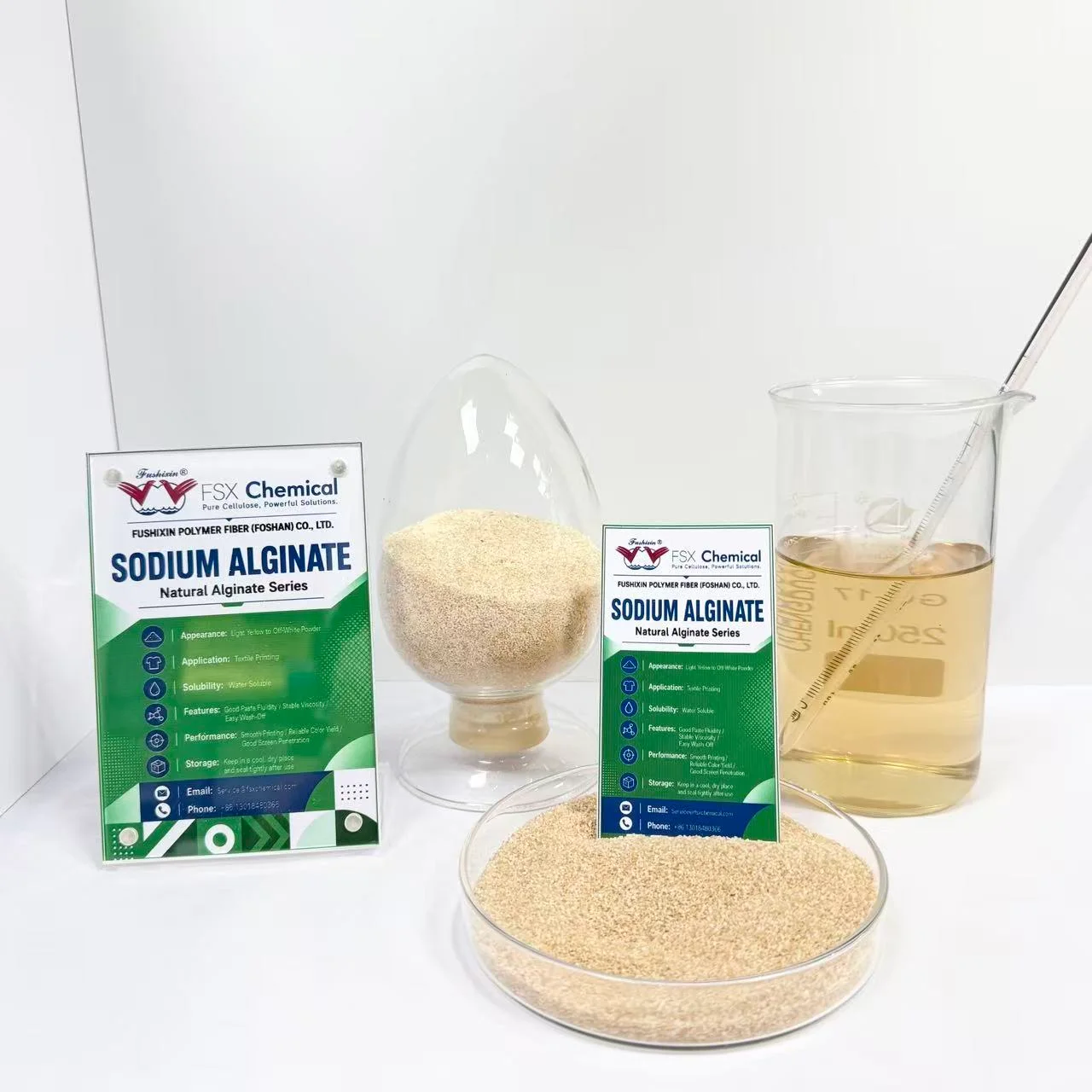
1. Sodium Alginate
Alginato de sodio is one of the best-known thickening routes for conventional reactive textile printing on suitable cellulosic fabrics.
It is derived from brown algae and is available in different viscosity and application grades.
Why sodium alginate is important in reactive printing
Its chemistry and established application behavior make it a common benchmark when formulating reactive printing pastes.
Important purchasing parameters include
Actual viscosity specification
Viscosity test concentration
Instrument and speed
Hidratación
Filtración
Reología
Compatibilidad con pastas reactivas
Definición de impresión
Fixation and wash-off
Do not buy sodium alginate from HV, MV or LV alone
High-, medium- and low-viscosity labels are supplier classification systems rather than universal international quality grades.
Buyers should compare the actual viscosity value and complete test method before assuming two grades are equivalent.
2. Carboxymethyl Cellulose (CMC)
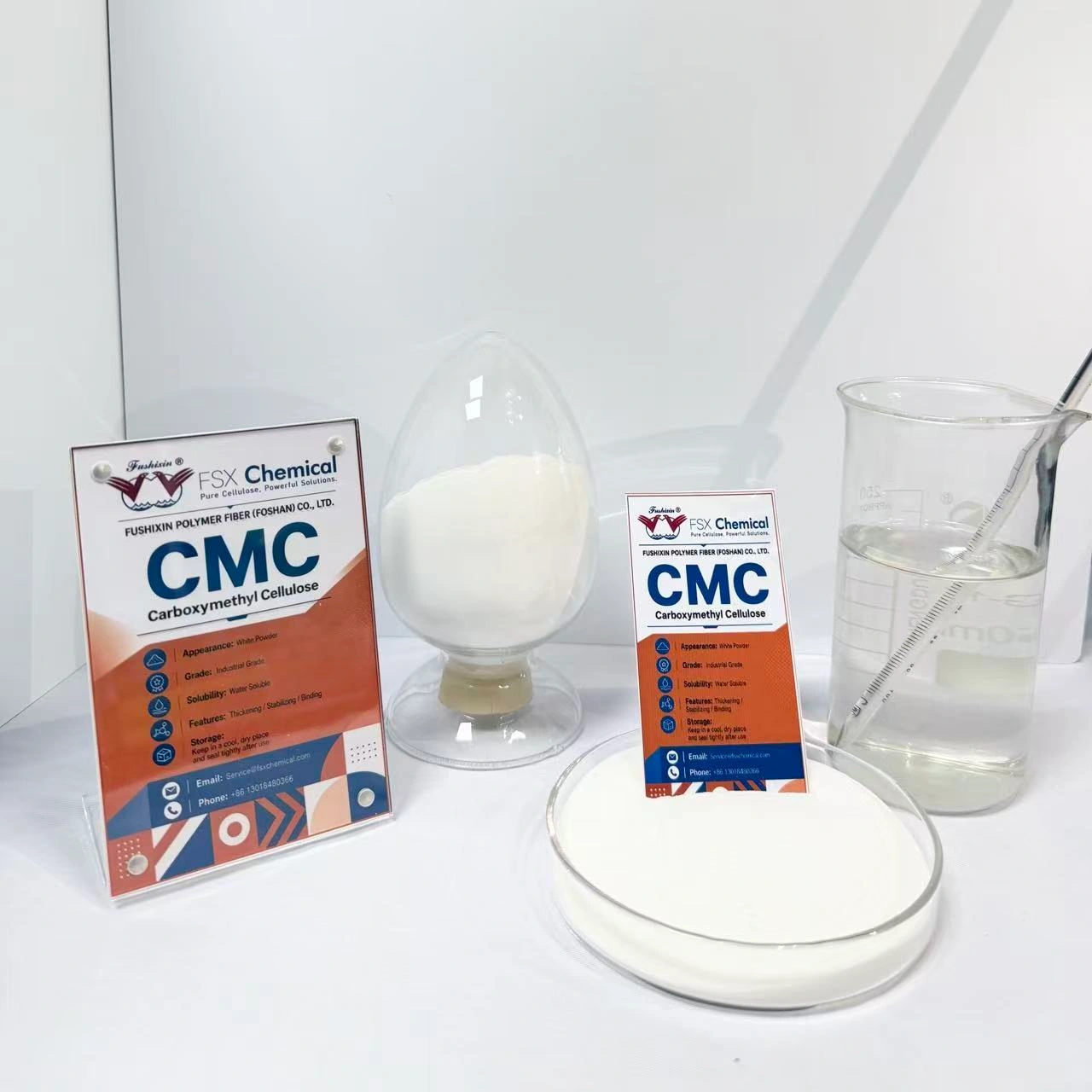
Carboximetilcelulosa , commonly known as CMC, is a water-soluble cellulose derivative used across many industrial rheology applications.
Selected CMC grades can also be evaluated in textile printing, viscosity-control and compound-thickener systems.
CMC selection involves more than viscosity
Grado de sustitución
Viscosidad
Concentración de prueba
Disolución
Hidratación
Filtración
Respuesta electrolítica
Reología
Complete-formula compatibility
Degree of substitution matters
Degree of substitution, or DS, can influence solubility and ionic behavior. However, a higher DS should not automatically be interpreted as higher product quality.
CMC is not automatically a 1:1 alginate replacement
Replacing sodium alginate with CMC changes the polymer chemistry. Such a change should be treated as a formulation-development project and confirmed with actual printing trials.
3. Carboxymethyl Starch (CMS)
Almidón carboximetílico , or CMS, is a chemically modified starch polymer used in selected textile thickening systems.
Depending on the grade and formulation, CMS can be evaluated in disperse, selected reactive, compound and specialty printing routes.
Important CMS evaluation factors include
Commercial grade
Viscosity and method
Hidratación
Filtración
Fragmento de la pantalla
Estabilidad de sujeción
Color-paste compatibility
Wash-off where applicable
Dosis eficaz
CMS and cost optimization
CMS is sometimes evaluated as part of a lower-cost or blended thickener strategy.
The correct economic comparison should use the optimized dosage and final printing result rather than raw-material price alone.
4. Synthetic and Compound Thickeners
Not every textile printing process is best served by one natural or modified polysaccharide.
Synthetic rheology modifiers and compound thickener systems can be designed to provide a different balance of flow, structural recovery, electrolyte tolerance and effective dosage.
Compound systems can combine functions such as
Viscosidad base
Shear thinning
Recuperación estructural
Estabilidad de la pasta
Tolerancia a los electrolitos
Fragmento de la pantalla
Definición de impresión
Cost optimization
Pigment printing requires special attention
In pigment printing, the thickener needs to operate inside a system that may also contain pigment dispersion, binder and curing auxiliaries.
Binder compatibility and final fabric handle can therefore be as important as viscosity.
It is better understood as a process-specific textile pretreatment or functional paste route selected according to digital ink chemistry and the fabric.
Reactive digital printing
Pretreatment is evaluated for ink migration, definition, fixation, wash-off and final fabric quality on suitable cellulosic fabrics.
Disperse digital printing
Polyester systems require their own evaluation of pretreatment uniformity, filtration and thermal processing.
Pigment digital printing
Pigment systems require particular attention to binder compatibility, curing, rubbing performance, definition and hand feel.
Digital printing paste is not digital ink
Textile pretreatment thickeners should not simply be added directly into inkjet ink. The ink and the fabric-side pretreatment perform different functions and should be formulated and evaluated separately.
Viscosity vs Rheology
Viscosity describes resistance to flow under defined measurement conditions. Rheology describes the broader way a material flows and changes structure when mechanical conditions change.
For textile printing, rheology often explains differences that a single viscosity number cannot.
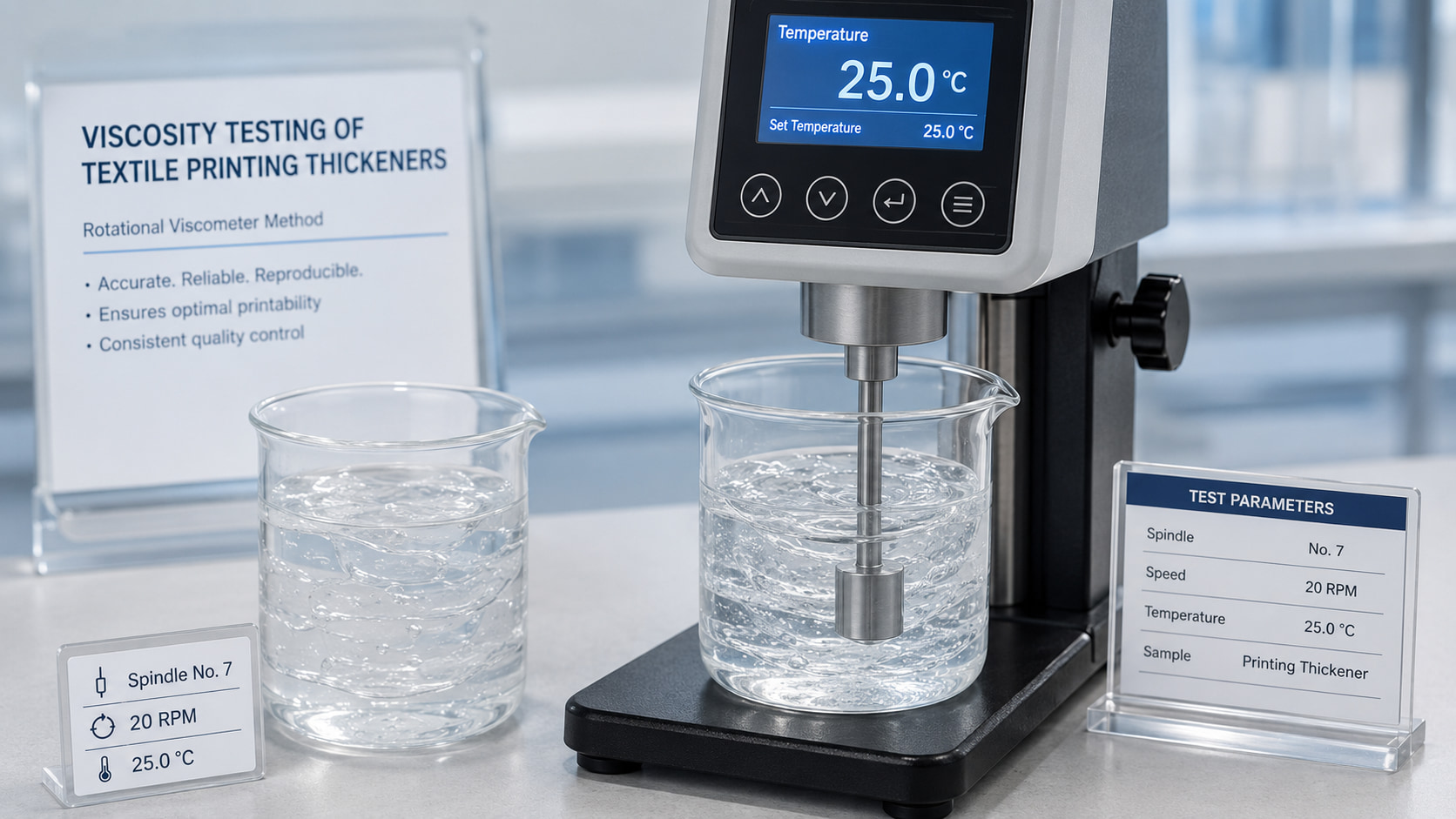
A reliable viscosity comparison should record
Concentración del producto
Water source
Preparation procedure
Hora de hidratarse
Temperatura de medición
Instrument
Spindle or rotor
Rotational speed
Reading time
Two TDS values should not be compared directly if the measurement methods are different.
Shear Thinning and Structural Recovery
Many printing pastes are designed to become easier to flow as shear increases.
This can support pumping and passage through a screen while preserving useful structure under lower-shear conditions.
After printing, recovery matters
Once the strongest mechanical force is removed, suitable structural recovery can help control unwanted lateral spreading.
Too little recovery can contribute to
Bordes difuminados
Mezcla de colores
Desaparición de las líneas finas
Poor small-text reproduction
Too much structure can also be undesirable
Excessive resistance can reduce paste transfer or create poor large-area coverage.
The objective is therefore rheological balance rather than maximum viscosity.
Hydration and Dissolution
Poor polymer preparation can create inaccurate laboratory results and unnecessary production problems.
Control powder addition
Introduce powdered thickener using a repeatable method that minimizes persistent lumps and uneven wetting.
Allow sufficient hydration
Some polymers continue developing viscosity after mixing. Correcting the batch too early can lead to excessive final viscosity.
Standardize mixing
Mixer type, speed, batch size, temperature and total mixing time should remain consistent when comparing products.
Preparation behavior should be considered part of thickener performance, not simply a laboratory inconvenience.
Filtration and Screen Passage
Filtration is a critical practical parameter for textile printing thickeners.
Undissolved polymer, gel particles or incompatible material can contribute to screen problems and production interruptions.
Use a standardized filtration method
Keep concentration, hydration, sample quantity, filter material and opening size consistent.
Inspect the residue
Residue can come from incomplete hydration, gel formation, contamination or precipitation after other chemicals are added.
Test the complete paste
A stock thickener may filter well in water but behave differently after dyes, salts, alkalis or binders enter the formulation.
Chemical Compatibility
The thickener operates as part of a chemical system rather than in isolation.
Depending on the printing route, compatibility should be checked with
Reactive dyes
Disperse colorants
Pigment dispersions
Salts
Alkalis
Binders
Humectants
Wetting agents
Defoamers
Other polymers
Staged addition during troubleshooting can help identify which component changes viscosity, stability or filtration.
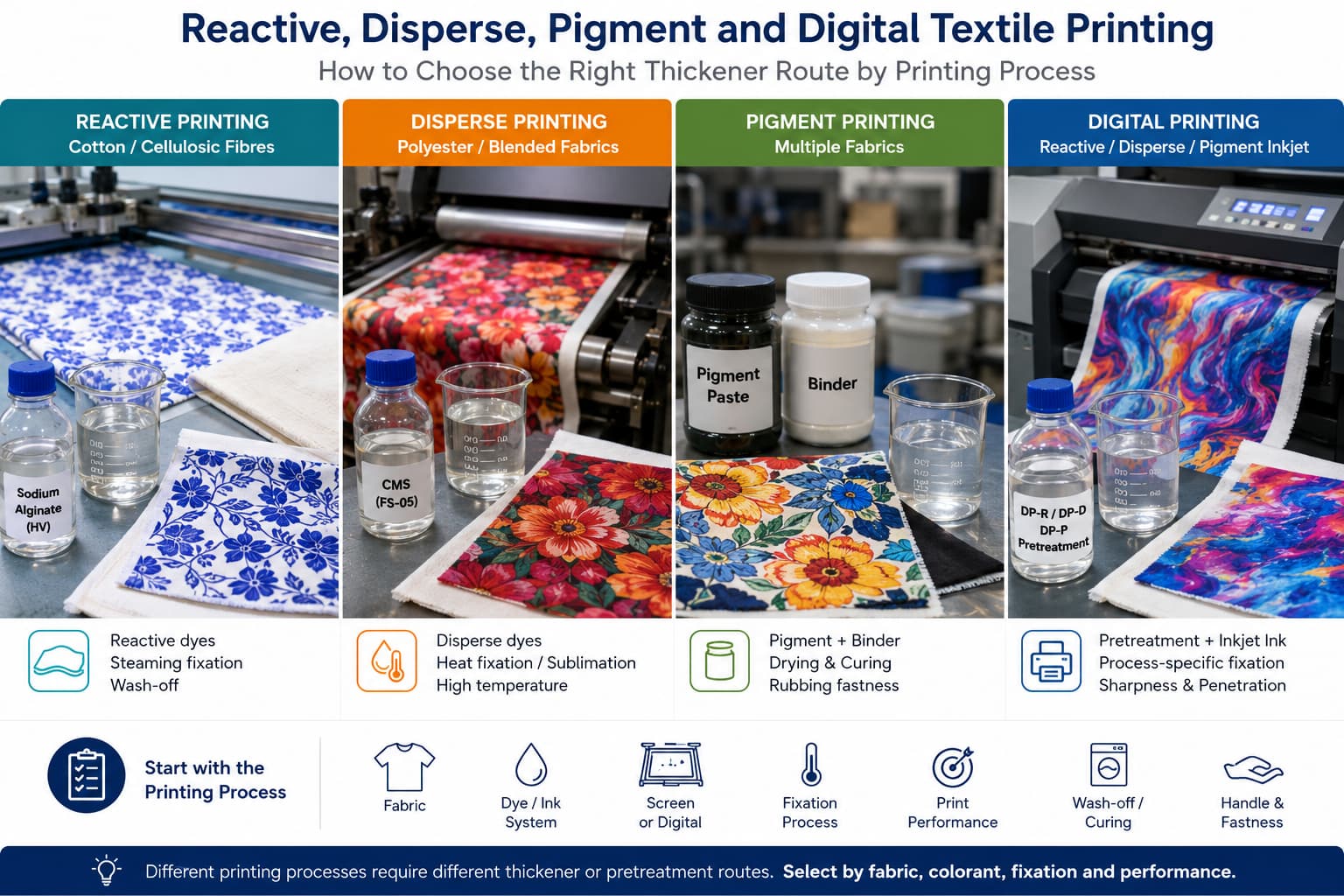
Choosing a Thickener for Reactive Printing
Sodium alginate is a common benchmark starting route for conventional reactive printing on cotton, viscose and other suitable cellulosic fabrics.
Evaluar
Viscosidad
Reología
Filtración
Fragmento de la pantalla
Color-paste compatibility
Definición de líneas finas
Uniformidad del área sólida
Fijación
Se enjuaga
Final fabric handle
CMC, CMS or compound systems may be evaluated in selected formulations, but a direct one-to-one substitution should not be assumed.
Choosing a Thickener for Disperse Printing
Disperse printing is primarily associated with polyester, and the thickener must be selected around the colorant, textile, machine and thermal fixation process.
CMS and application-specific compound routes can be evaluated for
Estabilidad de la pasta
Fragmento de la pantalla
Transferencia
Uniformidad del área sólida
Thermal-process compatibility
Finished polyester quality
A thickener successful in reactive cotton printing should not automatically be transferred to polyester disperse printing.
Choosing a Thickener for Pigment Printing
Pigment printing depends on a different chemistry because the colorant typically relies on a binder system and curing process.
Evaluate the thickener together with
Pigment dispersion
Binder
Electrolytes
Curing auxiliaries
Acabado de la tela
Final evaluation should include
Definición de impresión
Uniformidad del color
Curing behavior
Rendimiento de fricción
Sensación al tacto de la tela
Choosing Chemistry for Digital Textile Printing
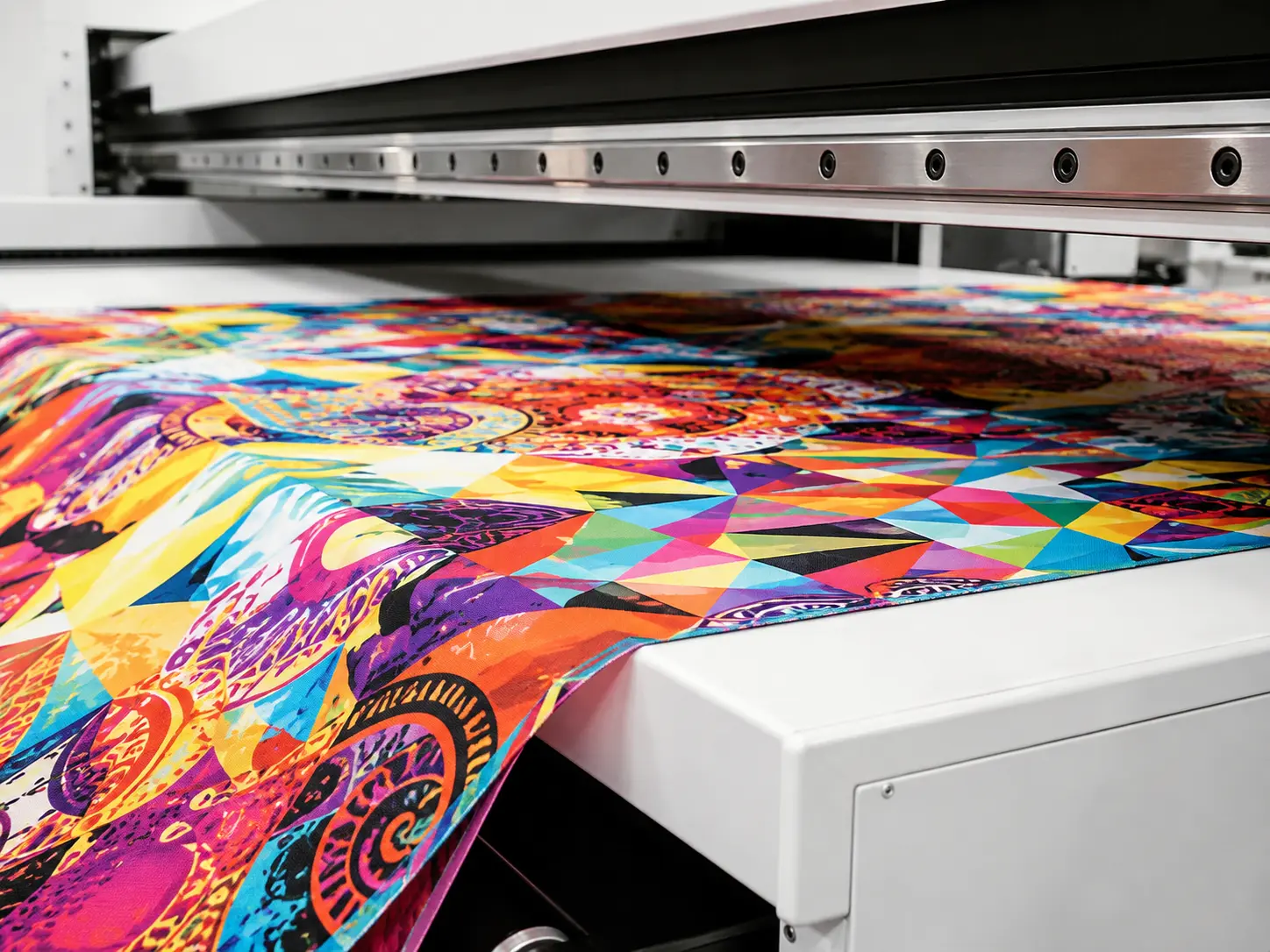
Digital textile printing requires process-specific pretreatment rather than a conventional screen-printing paste transferred unchanged into an inkjet process.
A practical workflow is
Fabric → Pretreatment → Drying → Inkjet Printing → Fixation or Curing → Washing or Finishing
Selection should begin with
Tinta reactiva, dispersa o pigmentada
Composición del tejido
Equipos de pretratamiento
Recolección previa al tratamiento
Secado
Required print definition
Proceso de fijación o curado
A digital pretreatment system should be judged from the finished textile, not only its viscosity before printing.
Impresión en pantalla plana vs. impresión rotativa
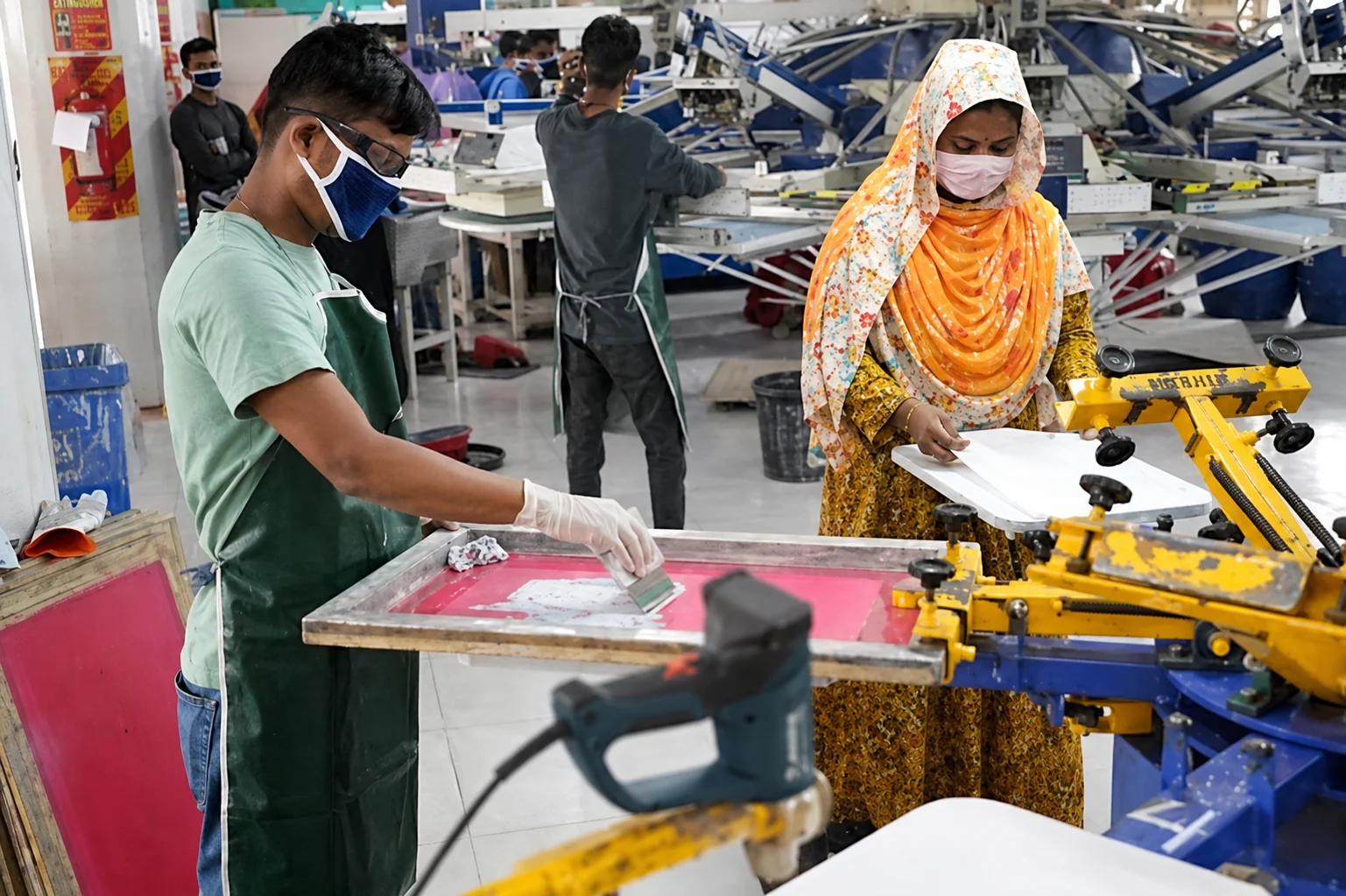
Flat-screen and rotary-screen printing expose paste to different application mechanics.
Impresión en pantalla plana
Important variables include squeegee pressure, squeegee speed, screen parameters, paste transfer and repeat-to-repeat consistency.
Serigrafía rotativa
Continuous production places greater emphasis on stable circulation, practical filtration, pumping and long-run paste stability.
A thickener should therefore be tested on equipment representative of the intended production process.
Fine Lines vs Large Solid Areas
Different design elements stress the printing paste in different ways.
Fine lines reveal
Spreading control
Recuperación estructural
Fragmento de la pantalla
Small-detail transfer
Large solid areas reveal
Transfer uniformity
Leveling
Penetración
Paste delivery consistency
A useful diagnostic design should contain both fine details and large solid areas.
Understanding HV, MV and LV Grades
High viscosity, medium viscosity and low viscosity are common commercial grade descriptions, especially for sodium alginate.
These terms should not be interpreted as universal international specifications.
HV does not mean highest quality
A high-viscosity product simply represents a different viscosity direction under the supplier’s defined test conditions.
MV may be preferable in another process
A medium-viscosity grade can sometimes provide easier preparation, transfer or dosage control depending on the formulation.
Always request the actual method
Concentration, temperature, instrument, spindle and speed are more useful for supplier comparison than HV, MV or LV alone.
Why the Same Viscosity Does Not Mean the Same Product
Matching one viscosity number is a useful starting point but does not prove product equivalence.
Two thickeners with similar viscosity may still differ in:
Polymer chemistry
Molecular characteristics
Grado de sustitución
Purity-related parameters
Particle characteristics
Hydration rate
Comportamiento de fluidez por cizallamiento
Recuperación estructural
Respuesta electrolítica
Filtración
Application testing remains necessary even when the candidate matches the reference viscosity.
Essential Thickener Testing Parameters
Professional thickener evaluation should occur at several levels.
Raw product or stock solution
Apariencia
Moisture or solids where applicable
pH
Viscosidad
Hidratación
Filtración
Complete printing paste
Viscosity after chemical addition
Reología
Estabilidad física
Espuma
Filtración
Estabilidad de sujeción
Printing application
Fragmento de la pantalla
Transferencia por pasta
Definición
Penetración
Uniformidad del área sólida
Finished textile
Color result
Fijación
Wash-off where relevant
Fastness where relevant
Mango de tela
Flujo de trabajo recomendado para ensayos de laboratorio
Step 1: Define the application
Record the printing route, fabric, dye or ink system and equipment.
Step 2: Select the current benchmark
Use the commercial product already approved in production whenever possible.
Step 3: Align the test methods
Standardize concentration, preparation, hydration, temperature, viscosity method and filtration.
Step 4: Prepare reference and candidate together
Keep laboratory variables as consistent as possible.
Step 5: Compare stock properties
Evaluate hydration, viscosity, pH, filtration and appearance.
Step 6: Prepare the complete printing paste
Use the actual dyes, pigments and auxiliaries required by production.
Step 7: Test holding stability
Repeat critical measurements after a realistic waiting period.
Step 8: Print the same fabric
Use the same design and machine conditions for both products.
Step 9: Complete normal post-treatment
Perform fixation, washing or curing according to the real production process.
Step 10: Optimize dosage
After the candidate passes the baseline comparison, determine its practical operating concentration separately.
Ampliación de la producción
Laboratory approval is not the final stage of thickener qualification.
Larger mixing equipment, pump shear, circulation, long holding times and production speed can expose differences that are not visible in a small laboratory batch.
Use a controlled production trial
Keep the formulation, fabric and machine conditions as stable as practical while evaluating the candidate.
Monitor the whole production run
Compare fabric from the beginning, middle and end.
Record operational behavior
Paste preparation
Bombeo
Filtración
Screen cleaning
Machine interruptions
Paste consumption
Calidad del tejido terminado
Troubleshooting Common Thickener Problems
Problema
Possible Cause
Qué hay que revisar
Viscosidad demasiado baja
Dosage, incomplete hydration or test-method difference
Concentration, mixing, hydration and measurement method
Viscosidad demasiado alta
Overdosage, evaporation or temperature difference
Solids, water loss, temperature and formulation
Alto nivel de residuos en el filtro
Lumps, gels, contamination or incompatibility
Preparation and staged chemical addition
Poor screen passage
Filtration or unsuitable rheology
Residue, viscosity, screen and shear behavior
Print bleeding
Insufficient recovery or excessive penetration
Rheology, fabric, dosage and machine conditions
Broken fine lines
Poor transfer or screen restriction
Paste transfer, viscosity, filtration and equipment
Paste changes during storage
Temperature, evaporation or chemical instability
Holding conditions, pH and complete formulation
Lab trial passes but production fails
Diferencia de ampliación
Mixing, circulation, holding time and machine conditions
Not every printing defect is caused by the thickener. Fabric, colorant, machine condition, fixation and operator variables should also be investigated.
Costo total de uso
Thickener price per kilogram is only one part of the purchasing decision.
Material cost
Compare delivered price at the optimized dosage.
Preparation cost
Consider hydration time, mixing, energy, filtration and labor.
Machine cost
Include screen cleaning, downtime, pump problems and production speed.
Waste cost
Include filter residue, leftover paste and off-specification batches.
Quality cost
Include reprinting, rejected fabric and additional post-treatment.
The lowest-priced thickener is therefore not automatically the lowest-cost printing solution.
What Is Changing in Textile Thickener Selection in 2026?
Textile thickener purchasing continues to move beyond basic specification matching.
1. Process-specific products are becoming more important
Buyers increasingly distinguish reactive, disperse, pigment and digital systems rather than asking for one generic textile thickener.
2. Rheology is receiving more attention
A single viscosity number cannot fully explain high-speed transfer, screen passage or fine-pattern control.
3. Digital pretreatment is becoming more specialized
Reactive, disperse and pigment inkjet systems require different fabric-side chemistry and post-treatment.
4. Grade matching is becoming more data-driven
Current TDS documents, physical samples, viscosity methods and real printing results provide a stronger basis for supplier qualification than generic product names.
5. Total cost in use matters more than purchase price
Dosage, filtration, waste, machine efficiency and rejected fabric can have greater economic impact than a small difference in raw-material price.
6. Chemical-management evidence is becoming more important
Brands and manufacturing supply chains increasingly expect chemical suppliers to provide clearer product identity, safety information, batch documentation and evidence supporting applicable chemical- management claims.
A responsible buyer should distinguish product-specific evidence from general company statements and should also verify applicable legal, customer and brand requirements for the target market.
How to Evaluate a Thickener Supplier
The product and the supplier should be evaluated together.
Supplier Area
Question to Ask
Product Fit
Is the proposed grade designed for my printing process?
Método de prueba
Is the viscosity method clearly defined?
Technical Support
Can my current product and printing problem be reviewed?
Comparación de muestras
Can I test a representative commercial grade?
Control de calidad por lotes
Which critical parameters are checked before release?
Documentation
Are relevant TDS, SDS and batch documents available?
Traceability
Can the sample, grade and production batch be connected?
Chemical Claims
Can compliance or sustainability claims be supported?
Commercial Supply
Can repeat bulk orders be supplied after qualification?
Sample-to-Bulk Verification
A strong sample-to-bulk process protects both technical and purchasing teams.
The qualification chain should connect
Customer application requirement
Candidate commercial grade
TDS and test method
Muestra representativa
Laboratory trial
Prueba de impresión
Approved operating dosage
Commercial quotation
Production batch
Batch documentation
First-shipment verification
The sample should have a permanent commercial identity that can be connected with future bulk production.
The first commercial shipment should receive stronger incoming verification before the product enters routine production.
Cómo FSX Chemical facilita la correspondencia de grados
Buyers can begin with either the printing application or a product already approved in their factory.
A través de Muestras y combinación , the current TDS, physical sample, viscosity method and printing conditions can be used to select a technically relevant trial grade.
Entre la información útil se incluye:
Fabricante actual y calidad comercial
TDS o COA reciente
Muestra física de referencia
Viscosidad y método de ensayo completo
Dosis actual
Printing formulation
Reactive, disperse, pigment or digital process
Composición del tejido
Printing equipment
Proceso de fijación o curado
Current problem or improvement target
Estimated commercial requirement
The objective is to identify a suitable candidate for controlled comparison rather than assume that a similar product name or viscosity guarantees equivalent printing performance📧 Correo electrónico: Service@fsxchemical.com
Descubre por qué no se pueden comparar los valores de viscosidad de los espesantes para la impresión textil sin tener en cuenta la concentración, la temperatura, el instrumento, el husillo, la velocidad, el método de preparación y el tiempo de prueba.
Aprende a elegir espesantes y métodos de pretratamiento para la impresión textil reactiva, dispersa, con pigmentos y digital, según los requisitos del tejido, el colorante o la tinta, la fijación, la resistencia al lavado y la calidad de impresión.
Compara CMC, CMS, alginato de sodio y pasta para impresión digital en la impresión textil. Descubre cómo cada opción se adapta a los procesos reactivos, dispersos, pigmentados y digitales, y qué deben tener en cuenta los compradores antes de realizar pruebas de muestras, comparar calidades y realizar compras a granel.
El alginato de sodio se utiliza ampliamente en la impresión textil como espesante estable y lavable para las pastas de impresión reactivas. Descubre cómo evaluar el grado de viscosidad, la pureza y la idoneidad para cada aplicación antes de comprar, y cómo FSX Chemical apoya a los compradores de todo el mundo con datos técnicos y muestras.
La carboximetilcelulosa (CMC) se utiliza ampliamente en los procesos de estampado, encolado y teñido de textiles. En esta guía se explica cómo evaluar los distintos grados de CMC, qué parámetros son los más importantes y cómo FSX Chemical puede ayudarte a tomar decisiones de compra.
La carboximetilcelulosa se utiliza como espesante y estabilizador en tintas a base de agua, impresión en huecograbado y pretratamiento para impresión de chorro de tinta. Esta guía aborda los parámetros clave de los grados y las consideraciones de abastecimiento para los equipos de compras.
Elegir al proveedor adecuado de CMC implica mucho más que comparar precios. Esta guía aborda los criterios de evaluación, la lista de verificación de la documentación y el proceso de prueba que los equipos de compras deben seguir antes de comprometerse a realizar un pedido a granel.
La pasta de impresión a base de CMC se utiliza en la impresión textil con pigmentos, reactiva y digital. Esta guía explica qué parámetros son importantes, cómo comparar proveedores y qué solicitar antes de realizar un pedido al por mayor.
Tanto el alginato de sodio como la CMC se utilizan como espesantes en la impresión textil, pero se adaptan a diferentes sistemas de tinte y condiciones de proceso. Esta guía explica las diferencias clave y cuándo utilizar cada uno.
La impresión digital por inyección de tinta sobre textiles tiene requisitos distintos en cuanto a pastas y pretratamiento en comparación con la serigrafía. Esta guía explica cómo se utiliza el alginato de sodio en la impresión textil digital y qué parámetros de calidad deben especificar los equipos de compras.
El CMC de grado alimenticio y el de grado industrial comparten la misma composición química básica, pero difieren significativamente en cuanto a pureza, rango de DS y requisitos normativos. Esta guía explica las diferencias clave y por qué el uso de un grado incorrecto genera problemas de producción.
La preparación correcta de la pasta es tan importante como la selección del grado en la impresión textil con tintes reactivos. Esta guía aborda los métodos de disolución del alginato de sodio, los rangos de concentración según la aplicación, las condiciones de almacenamiento y cómo resolver problemas comunes en la preparación.
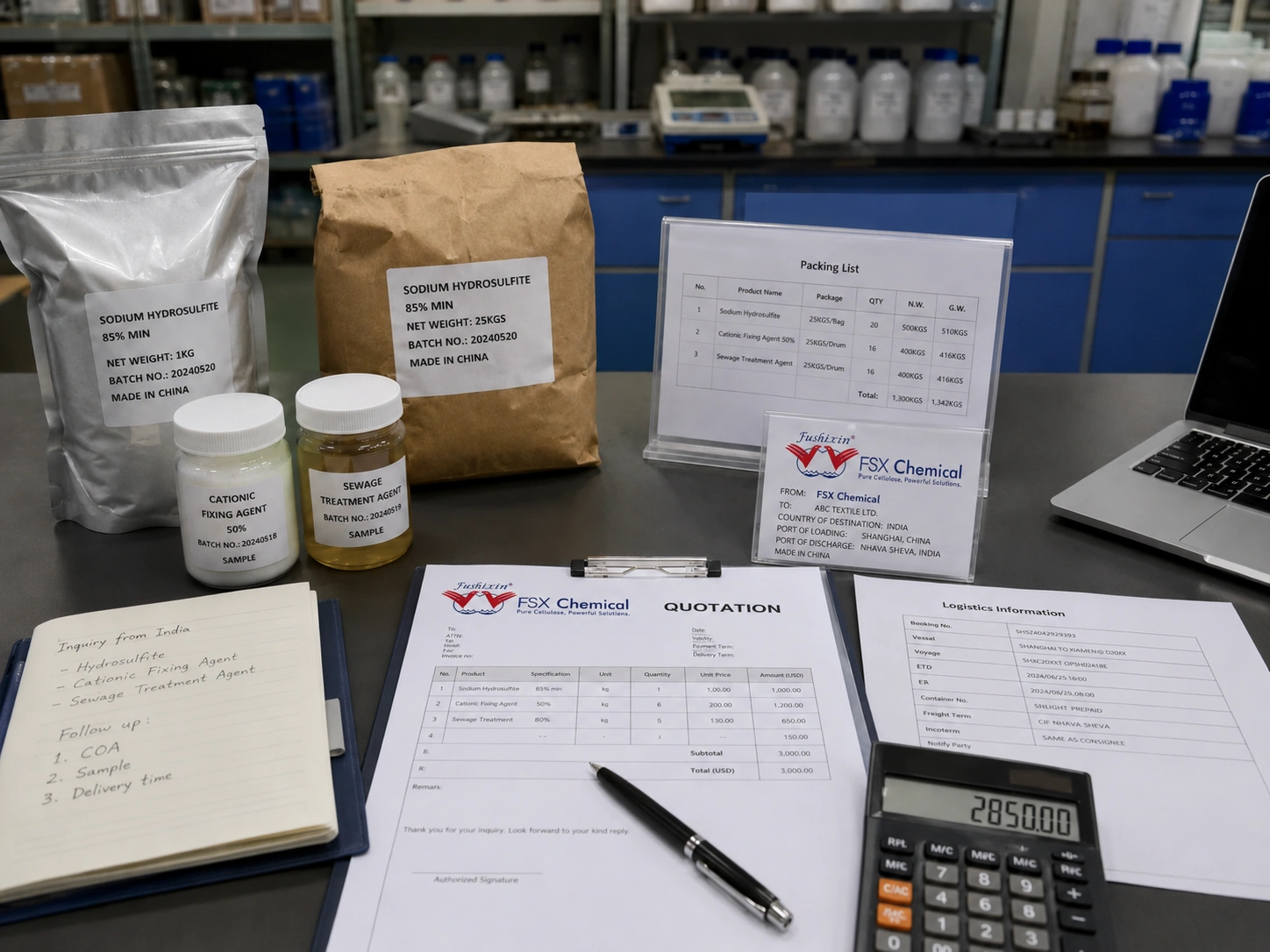
Comparta el nombre del producto, su aplicación, la cantidad, el destino y cualquier ficha técnica (TDS),
foto de muestra o documento que ya tenga. FSX Chemical revisará la
información y le recomendará el siguiente paso para la cotización, la comparación de muestras
o la selección del producto.
Información del productoNombre del producto, categoría, modelo, foto de la etiqueta o referencia del proveedor.
Documentos disponiblesTDS, SDS, COA, foto de muestra, lista de productos o datos de pruebas.
Detalles del pedidoCantidad estimada, embalaje, país de destino, puerto o término comercial.
Solicitud o problemaProceso de impresión textil, requisitos de formulación, problema actual o objetivo de rendimiento.