2026 میں ٹیکسٹائل پرنٹنگ کے گاڑھا کرنے والے ایجنٹس کا حتمی رہنما
Textile printing thickening agents control much more than viscosity. This 2026 guide explains sodium alginate,...
Textile printing thickening agents control much more than viscosity. In 2026, successful thickener selection increasingly combines rheology, hydration, filtration, chemical compatibility, application testing, batch consistency and responsible chemical management. This guide compares sodium alginate, CMC, CMS, compound thickeners and digital printing paste across the major textile printing processes.
Thickening agents are among the most important functional materials in textile printing chemistry. They help create the paste structure needed to transport dyes, pigments and auxiliaries through preparation, application and fixation without allowing uncontrolled spreading across the fabric.
Yet selecting a textile printing thickener has become more complex than choosing a high-, medium- or low-viscosity product.
Modern printing mills may operate flat-screen, rotary-screen and digital inkjet lines. They may print cotton with reactive dyes, polyester with disperse colorants, pigment systems on multiple fibers or several technologies inside the same facility.
These processes do not require identical rheology or chemical compatibility. A thickener that performs well in one system may be a poor choice in another, even when the viscosity appears similar.
The most useful approach in 2026 is therefore process-based selection: first identify the printing chemistry and production conditions, then select and validate the most appropriate thickening route.
What Are Textile Printing Thickening Agents?
Textile printing thickening agents are polymers or formulated rheology-control systems used to create the flow properties required in printing pastes and textile pretreatment formulations.
Their purpose is not simply to make a liquid thicker. They help control how the paste behaves while being mixed, stored, pumped, transferred through a screen or applied to a textile surface.
A printing thickener can influence
پیسٹ کی چِپچِپاہٹ
Shear-thinning behavior
ساختی بحالی
اسکرین کا گزرگاہ
پیسٹ ٹرانسفر
Fabric penetration
Lateral spreading
باریک لکیر کی تعریف
جامد رقبائی یکسانیت
استحکام برقرار رکھنا
Because these properties interact with dyes, pigments, salts, alkalis, binders and fabric surfaces, thickener selection must be tied to the complete application.
Why Thickeners Matter Beyond Viscosity
Viscosity is one of the most frequently quoted specifications for a textile printing thickener, but viscosity alone cannot describe how a paste behaves during printing.
A laboratory measurement normally represents one concentration, temperature and shear condition.
A printing machine exposes the paste to changing mechanical forces. The paste may be nearly stationary in a tank, flow through pipelines, pass through a screen and then rapidly recover after reaching the fabric.
This creates several different requirements
At relatively low shear, sufficient structure may help maintain paste stability.
Under higher shear, easier flow may support pumping and application.
After transfer to the fabric, structural recovery can help limit uncontrolled spreading.
This is why two thickeners with similar viscosity can produce noticeably different printing results.
The Five Main Thickener Routes in 2026
موٹا کرنے کا راستہ
What It Is
Common Evaluation Direction
Main Selection Factors
سوڈیم الگینیٹ
Seaweed-derived polysaccharide
Conventional reactive printing
Viscosity, rheology, filtration, definition and wash-off
سی ایم سی
Cellulose-derived modified polymer
Selected printing and compound systems
DS, viscosity, hydration, rheology and compatibility
سی ایم ایس
Modified starch polymer
Selected disperse, reactive and compound systems depending on grade
Viscosity, screen behavior, stability, wash-off and cost in use
Synthetic / Compound Thickener
Formulated rheology-control system
Pigment and process-specific formulations
Binder compatibility, electrolyte tolerance, rheology and dosage
ڈیجیٹل پرنٹنگ پیسٹ
Inkjet pretreatment or functional paste system
Reactive, disperse or pigment digital printing
Ink system, fabric, pickup, filtration, definition and fixation
These five routes should not be treated as interchangeable versions of the same product.
The correct starting point depends on the dye or ink chemistry, fabric, printing machine, pretreatment method, fixation route and finished-textile requirements.
1. Sodium Alginate
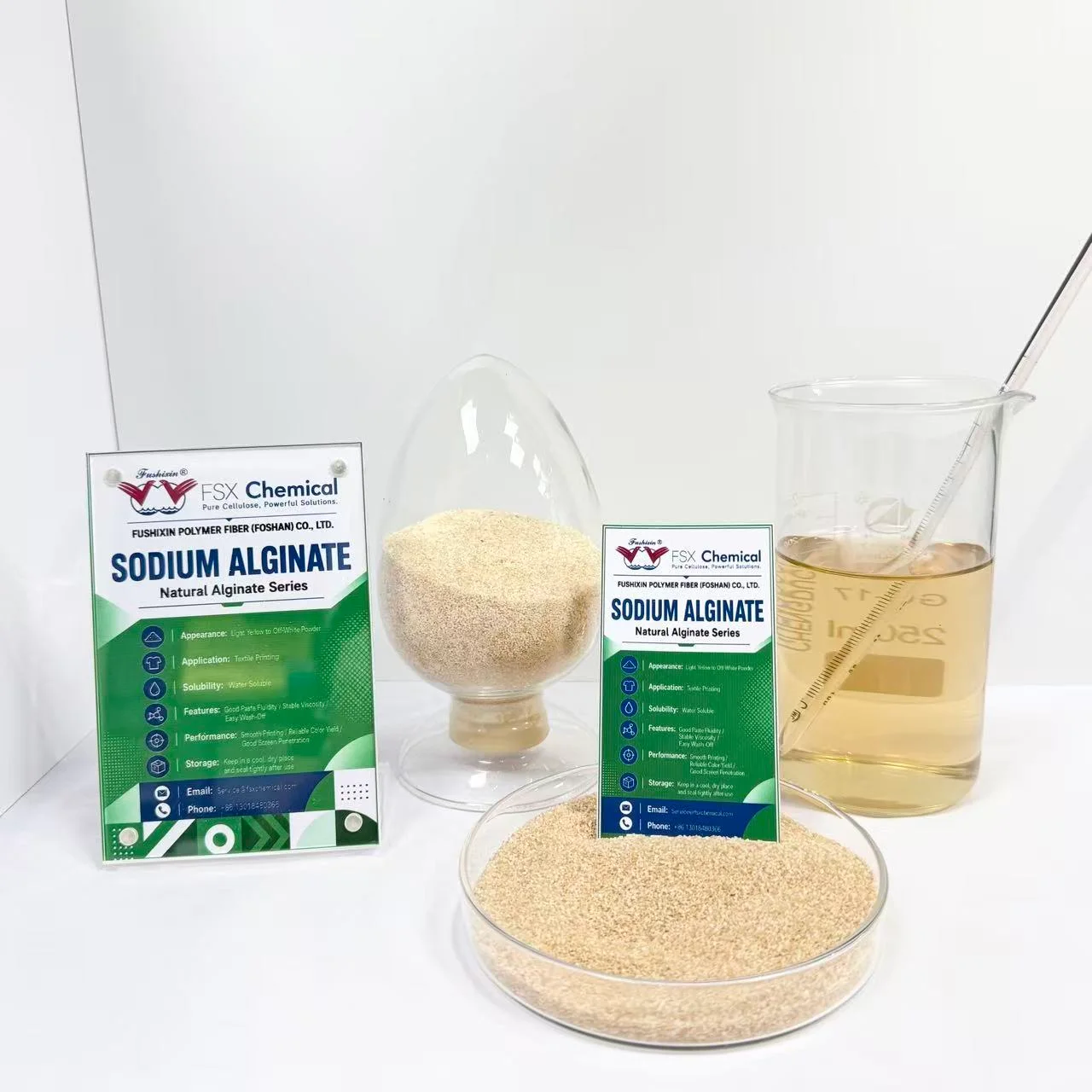
سوڈیم الگینٹ is one of the best-known thickening routes for conventional reactive textile printing on suitable cellulosic fabrics.
It is derived from brown algae and is available in different viscosity and application grades.
Why sodium alginate is important in reactive printing
Its chemistry and established application behavior make it a common benchmark when formulating reactive printing pastes.
Important purchasing parameters include
Actual viscosity specification
Viscosity test concentration
Instrument and speed
ہائیڈریشن
چھانٹائی
ریولوجی
Reactive-paste compatibility
تعریف پرنٹ کریں
Fixation and wash-off
Do not buy sodium alginate from HV, MV or LV alone
High-, medium- and low-viscosity labels are supplier classification systems rather than universal international quality grades.
Buyers should compare the actual viscosity value and complete test method before assuming two grades are equivalent.
2. Carboxymethyl Cellulose (CMC)
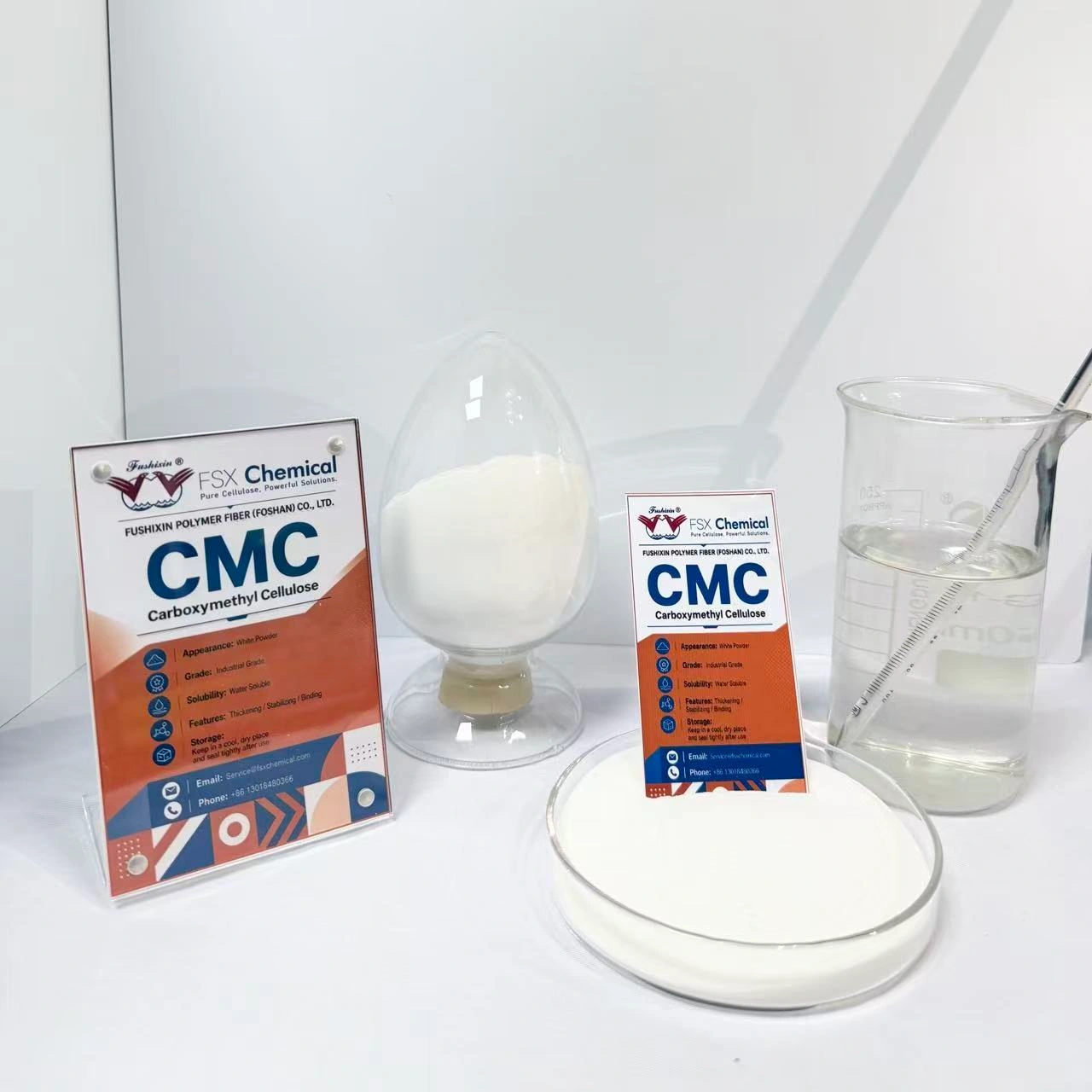
کاربوکسی میتھل سیلولوز , commonly known as CMC, is a water-soluble cellulose derivative used across many industrial rheology applications.
Selected CMC grades can also be evaluated in textile printing, viscosity-control and compound-thickener systems.
CMC selection involves more than viscosity
متبادل کی ڈگری
سَانچَر
ٹیسٹ کی توجہ
حل پذیری
ہائیڈریشن
چھانٹائی
الیکٹرولائٹ کا ردعمل
ریولوجی
Complete-formula compatibility
Degree of substitution matters
Degree of substitution, or DS, can influence solubility and ionic behavior. However, a higher DS should not automatically be interpreted as higher product quality.
CMC is not automatically a 1:1 alginate replacement
Replacing sodium alginate with CMC changes the polymer chemistry. Such a change should be treated as a formulation-development project and confirmed with actual printing trials.
3. Carboxymethyl Starch (CMS)
کاربوکسی میتھل نشاستہ , or CMS, is a chemically modified starch polymer used in selected textile thickening systems.
Depending on the grade and formulation, CMS can be evaluated in disperse, selected reactive, compound and specialty printing routes.
Important CMS evaluation factors include
تجارتی معیار
Viscosity and method
ہائیڈریشن
چھانٹائی
اسکرین کا گزرگاہ
استحکام برقرار رکھنا
Color-paste compatibility
Wash-off where applicable
مؤثر خوراک
CMS and cost optimization
CMS is sometimes evaluated as part of a lower-cost or blended thickener strategy.
The correct economic comparison should use the optimized dosage and final printing result rather than raw-material price alone.
4. Synthetic and Compound Thickeners
Not every textile printing process is best served by one natural or modified polysaccharide.
Synthetic rheology modifiers and compound thickener systems can be designed to provide a different balance of flow, structural recovery, electrolyte tolerance and effective dosage.
Compound systems can combine functions such as
بنیادی چپچپا پن
شیر تھننگ
ساختی بحالی
پیسٹ کی استحکام
الیکٹرولائٹ برداشت
اسکرین کا گزرگاہ
تعریف پرنٹ کریں
لاگت کی اصلاح
Pigment printing requires special attention
In pigment printing, the thickener needs to operate inside a system that may also contain pigment dispersion, binder and curing auxiliaries.
Binder compatibility and final fabric handle can therefore be as important as viscosity.
5. Digital Printing Paste
ڈیجیٹل پرنٹنگ پیسٹ is different from the conventional raw-polymer thickener categories.
It is better understood as a process-specific textile pretreatment or functional paste route selected according to digital ink chemistry and the fabric.
Reactive digital printing
Pretreatment is evaluated for ink migration, definition, fixation, wash-off and final fabric quality on suitable cellulosic fabrics.
Disperse digital printing
Polyester systems require their own evaluation of pretreatment uniformity, filtration and thermal processing.
Pigment digital printing
Pigment systems require particular attention to binder compatibility, curing, rubbing performance, definition and hand feel.
Digital printing paste is not digital ink
Textile pretreatment thickeners should not simply be added directly into inkjet ink. The ink and the fabric-side pretreatment perform different functions and should be formulated and evaluated separately.
Viscosity vs Rheology
Viscosity describes resistance to flow under defined measurement conditions. Rheology describes the broader way a material flows and changes structure when mechanical conditions change.
For textile printing, rheology often explains differences that a single viscosity number cannot.
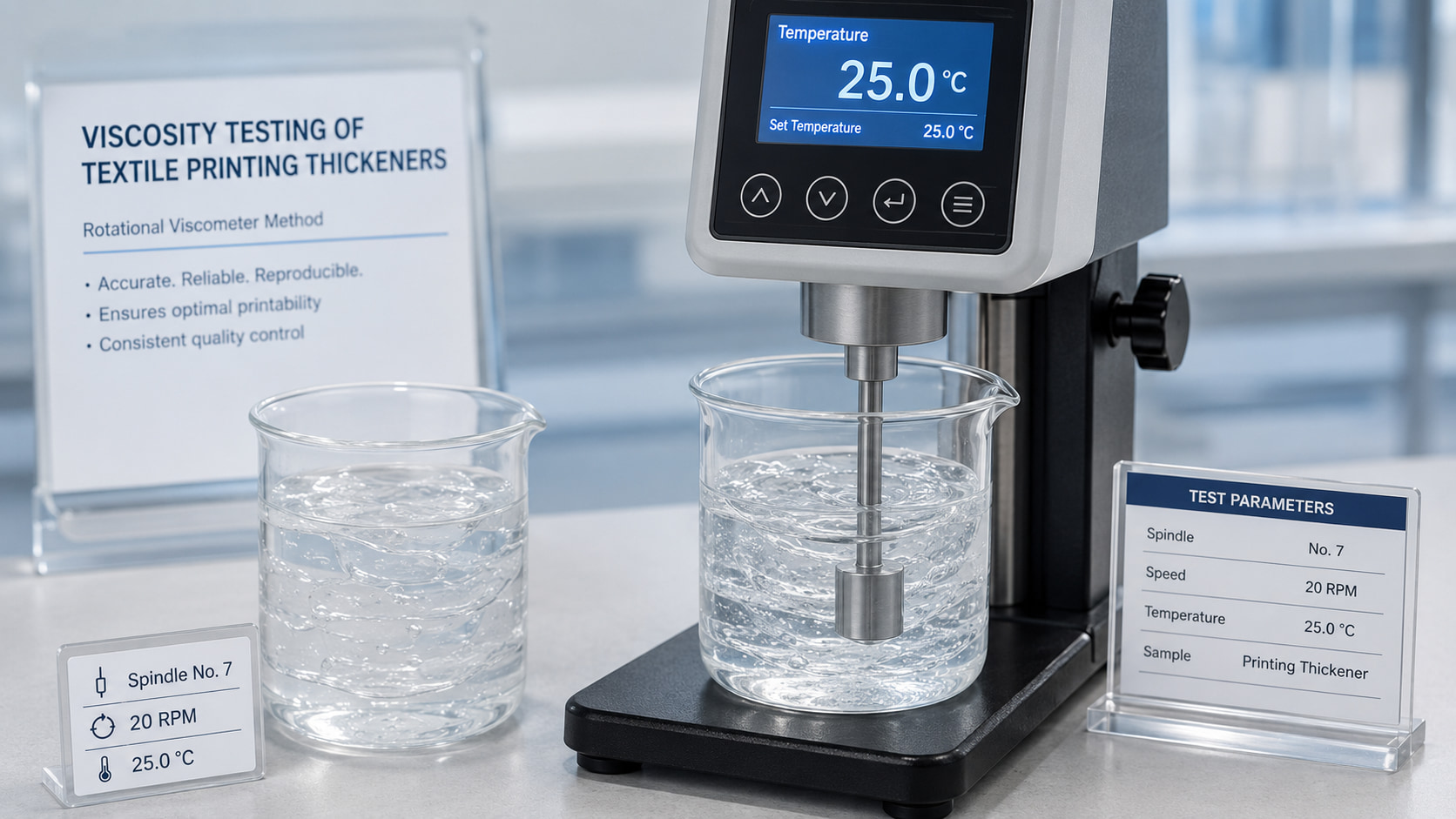
A reliable viscosity comparison should record
مصنوعات کی توجہ
پانی کا ماخذ
Preparation procedure
ہائیڈریشن کا وقت
ماپنے کا درجہ حرارت
آلہ
Spindle or rotor
گردشی رفتار
پڑھنے کا وقت
Two TDS values should not be compared directly if the measurement methods are different.
Shear Thinning and Structural Recovery
Many printing pastes are designed to become easier to flow as shear increases.
This can support pumping and passage through a screen while preserving useful structure under lower-shear conditions.
After printing, recovery matters
Once the strongest mechanical force is removed, suitable structural recovery can help control unwanted lateral spreading.
Too little recovery can contribute to
دھندلی کنارے
رنگ کا پھیلنا
باریک لکیروں کا خاتمہ
Poor small-text reproduction
Too much structure can also be undesirable
Excessive resistance can reduce paste transfer or create poor large-area coverage.
The objective is therefore rheological balance rather than maximum viscosity.
Hydration and Dissolution
Poor polymer preparation can create inaccurate laboratory results and unnecessary production problems.
Control powder addition
Introduce powdered thickener using a repeatable method that minimizes persistent lumps and uneven wetting.
Allow sufficient hydration
Some polymers continue developing viscosity after mixing. Correcting the batch too early can lead to excessive final viscosity.
Standardize mixing
Mixer type, speed, batch size, temperature and total mixing time should remain consistent when comparing products.
Preparation behavior should be considered part of thickener performance, not simply a laboratory inconvenience.
Filtration and Screen Passage
Filtration is a critical practical parameter for textile printing thickeners.
Undissolved polymer, gel particles or incompatible material can contribute to screen problems and production interruptions.
Use a standardized filtration method
Keep concentration, hydration, sample quantity, filter material and opening size consistent.
Inspect the residue
Residue can come from incomplete hydration, gel formation, contamination or precipitation after other chemicals are added.
Test the complete paste
A stock thickener may filter well in water but behave differently after dyes, salts, alkalis or binders enter the formulation.
Chemical Compatibility
The thickener operates as part of a chemical system rather than in isolation.
Depending on the printing route, compatibility should be checked with
Reactive dyes
Disperse colorants
Pigment dispersions
نمک
Alkalis
Binders
Humectants
Wetting agents
Defoamers
Other polymers
Staged addition during troubleshooting can help identify which component changes viscosity, stability or filtration.
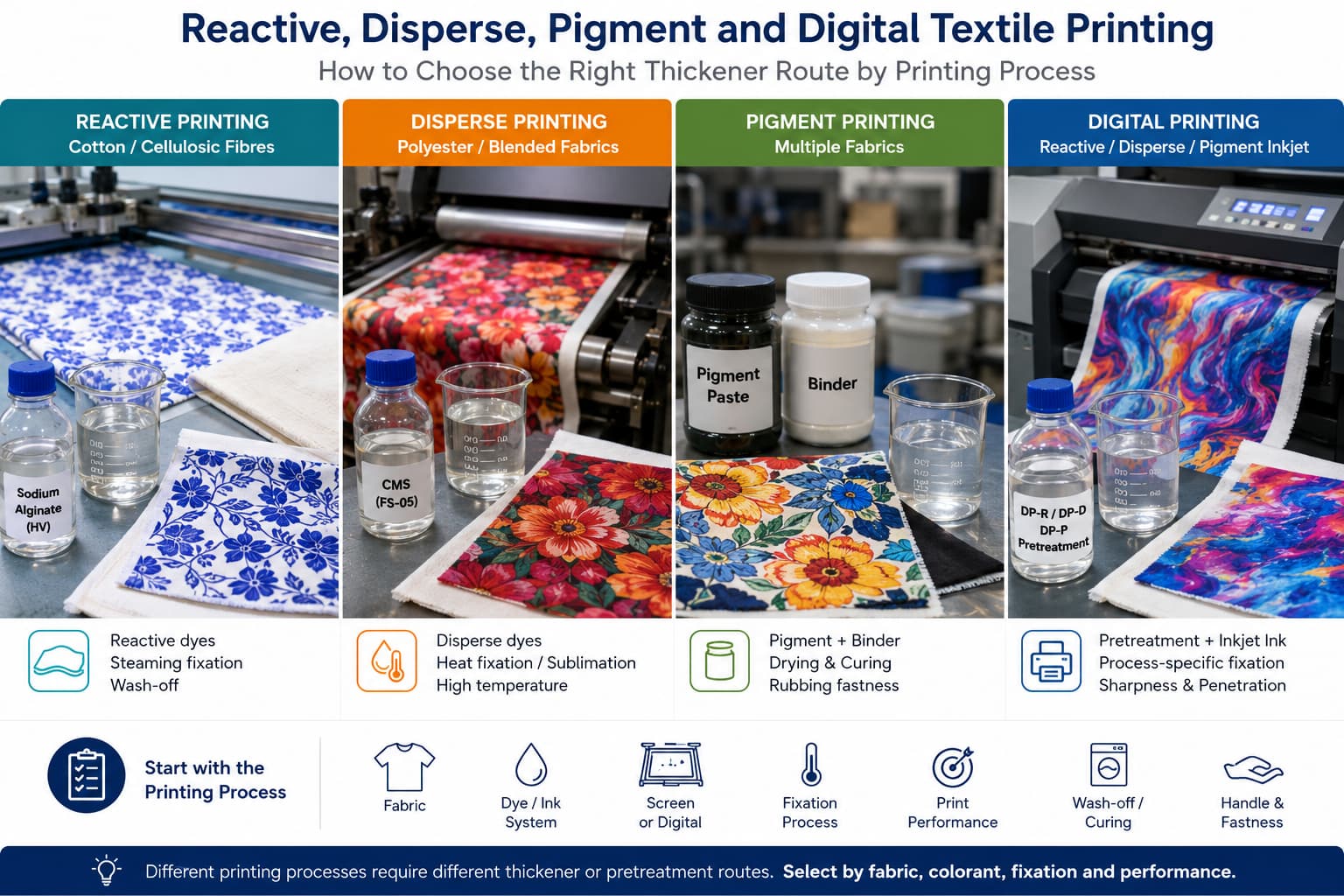
Choosing a Thickener for Reactive Printing
Sodium alginate is a common benchmark starting route for conventional reactive printing on cotton, viscose and other suitable cellulosic fabrics.
Evaluate
سَانچَر
ریولوجی
چھانٹائی
اسکرین کا گزرگاہ
Color-paste compatibility
باریک لکیر کی تعریف
جامد رقبائی یکسانیت
تثبیت
دھل جانے والا
حتمی کپڑے کا ہینڈل
CMC, CMS or compound systems may be evaluated in selected formulations, but a direct one-to-one substitution should not be assumed.
Choosing a Thickener for Disperse Printing
Disperse printing is primarily associated with polyester, and the thickener must be selected around the colorant, textile, machine and thermal fixation process.
CMS and application-specific compound routes can be evaluated for
پیسٹ کی استحکام
اسکرین کا گزرگاہ
Transfer
جامد رقبائی یکسانیت
Thermal-process compatibility
Finished polyester quality
A thickener successful in reactive cotton printing should not automatically be transferred to polyester disperse printing.
Choosing a Thickener for Pigment Printing
Pigment printing depends on a different chemistry because the colorant typically relies on a binder system and curing process.
Evaluate the thickener together with
رنگدانے کی منتشر
بائنڈر
الیکٹرولائٹس
Curing auxiliaries
کپڑے کی فنش
Final evaluation should include
تعریف پرنٹ کریں
رنگ کی یکسانیت
Curing behavior
رَگڑنے کی کارکردگی
کپڑے کا ہاتھ سے محسوس ہونے والا احساس
Choosing Chemistry for Digital Textile Printing
Digital textile printing requires process-specific pretreatment rather than a conventional screen-printing paste transferred unchanged into an inkjet process.
A practical workflow is
کپڑا → پیش علاج → خشک کرنا → انک جیٹ پرنٹنگ → فکسیشن یا کیورنگ → دھلائی یا فنشنگ
Selection should begin with
ردعمل کرنے والی، منتشر یا رنگ دار سیاہی
کپڑے کی ترکیب
پری ٹریٹمنٹ کا سامان
ابتدائی تیاری کی وصولی
سکھانا
Required print definition
ثابت کرنے یا شفا دینے کا عمل
A digital pretreatment system should be judged from the finished textile, not only its viscosity before printing.
Flat-Screen vs Rotary-Screen Printing
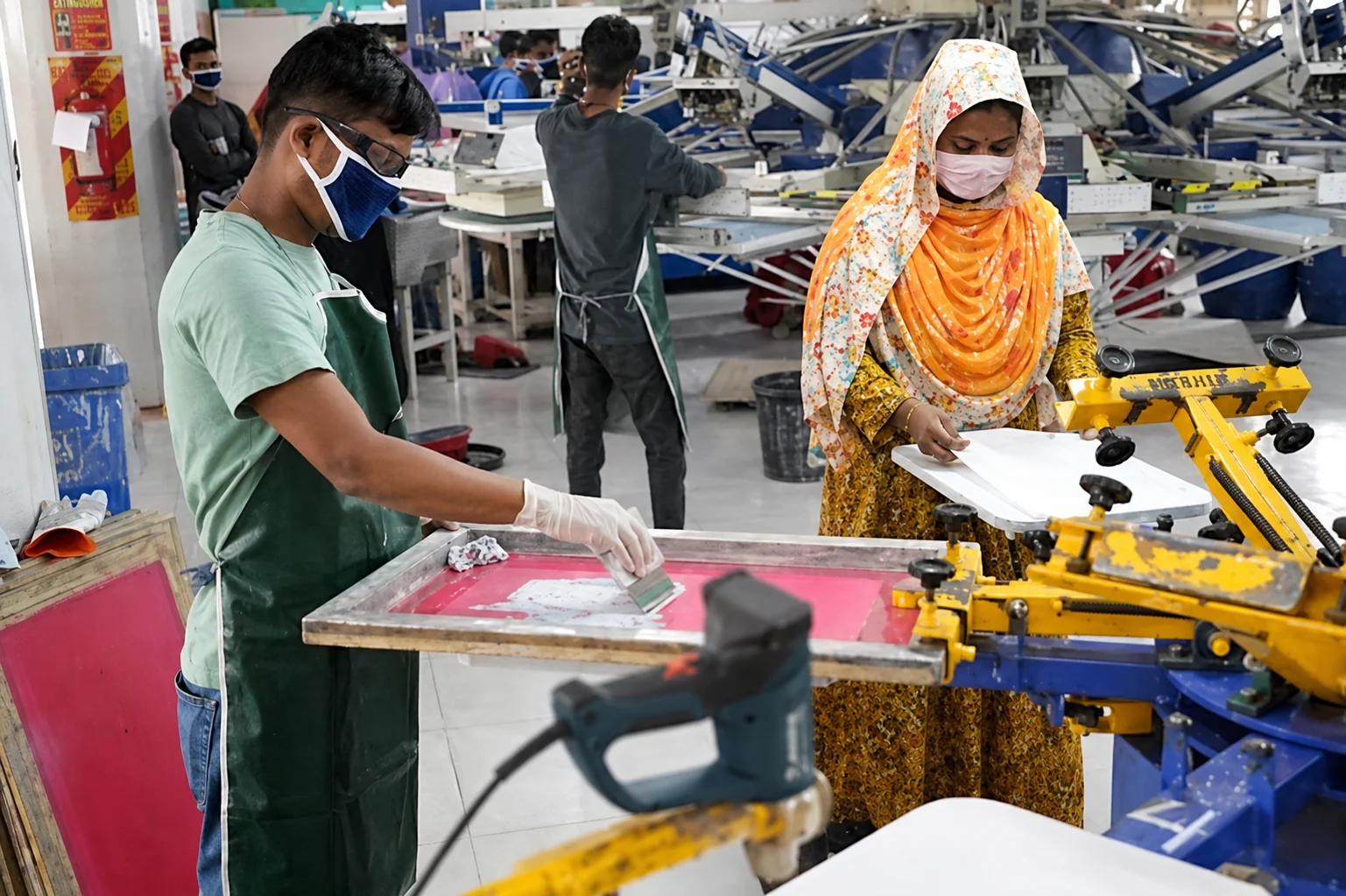
Flat-screen and rotary-screen printing expose paste to different application mechanics.
Flat-screen printing
Important variables include squeegee pressure, squeegee speed, screen parameters, paste transfer and repeat-to-repeat consistency.
Rotary-screen printing
Continuous production places greater emphasis on stable circulation, practical filtration, pumping and long-run paste stability.
A thickener should therefore be tested on equipment representative of the intended production process.
Fine Lines vs Large Solid Areas
Different design elements stress the printing paste in different ways.
Fine lines reveal
Spreading control
ساختی بحالی
اسکرین کا گزرگاہ
Small-detail transfer
Large solid areas reveal
Transfer uniformity
سطح بندی
دراندازی
Paste delivery consistency
A useful diagnostic design should contain both fine details and large solid areas.
Understanding HV, MV and LV Grades
High viscosity, medium viscosity and low viscosity are common commercial grade descriptions, especially for sodium alginate.
These terms should not be interpreted as universal international specifications.
HV does not mean highest quality
A high-viscosity product simply represents a different viscosity direction under the supplier’s defined test conditions.
MV may be preferable in another process
A medium-viscosity grade can sometimes provide easier preparation, transfer or dosage control depending on the formulation.
Always request the actual method
Concentration, temperature, instrument, spindle and speed are more useful for supplier comparison than HV, MV or LV alone.
Why the Same Viscosity Does Not Mean the Same Product
Matching one viscosity number is a useful starting point but does not prove product equivalence.
Two thickeners with similar viscosity may still differ in:
پولیمر کیمسٹری
Molecular characteristics
متبادل کی ڈگری
Purity-related parameters
Particle characteristics
Hydration rate
Shear-thinning behavior
ساختی بحالی
الیکٹرولائٹ کا ردعمل
چھانٹائی
Application testing remains necessary even when the candidate matches the reference viscosity.
Essential Thickener Testing Parameters
Professional thickener evaluation should occur at several levels.
Raw product or stock solution
ظاہری شکل
جہاں قابلِ اطلاق ہو، نمی یا ٹھوس مادّے۔
پی ایچ
سَانچَر
ہائیڈریشن
چھانٹائی
Complete printing paste
کیمیائی اضافے کے بعد چِپچپا پن
ریولوجی
جسمانی استحکام
جھاگ
چھانٹائی
استحکام برقرار رکھنا
Printing application
اسکرین کا گزرگاہ
پیسٹ ٹرانسفر
Definition
دراندازی
جامد رقبائی یکسانیت
Finished textile
Color result
تثبیت
Wash-off where relevant
Fastness where relevant
کپڑے کا ہینڈل
تجویز کردہ لیبارٹری ٹرائل ورک فلو
Step 1: Define the application
Record the printing route, fabric, dye or ink system and equipment.
Step 2: Select the current benchmark
Use the commercial product already approved in production whenever possible.
Step 3: Align the test methods
Standardize concentration, preparation, hydration, temperature, viscosity method and filtration.
Step 4: Prepare reference and candidate together
Keep laboratory variables as consistent as possible.
Step 5: Compare stock properties
Evaluate hydration, viscosity, pH, filtration and appearance.
Step 6: Prepare the complete printing paste
Use the actual dyes, pigments and auxiliaries required by production.
Step 7: Test holding stability
Repeat critical measurements after a realistic waiting period.
Step 8: Print the same fabric
Use the same design and machine conditions for both products.
Step 9: Complete normal post-treatment
Perform fixation, washing or curing according to the real production process.
Step 10: Optimize dosage
After the candidate passes the baseline comparison, determine its practical operating concentration separately.
پیداوار میں توسیع
Laboratory approval is not the final stage of thickener qualification.
Larger mixing equipment, pump shear, circulation, long holding times and production speed can expose differences that are not visible in a small laboratory batch.
Use a controlled production trial
Keep the formulation, fabric and machine conditions as stable as practical while evaluating the candidate.
Monitor the whole production run
Compare fabric from the beginning, middle and end.
Record operational behavior
پیسٹ کی تیاری
پمپنگ
چھانٹائی
Screen cleaning
Machine interruptions
Paste consumption
تیار کپڑے کا معیار
Troubleshooting Common Thickener Problems
Problem
Possible Cause
کیا چیک کریں
Viscosity too low
Dosage, incomplete hydration or test-method difference
Concentration, mixing, hydration and measurement method
Viscosity too high
Overdosage, evaporation or temperature difference
Solids, water loss, temperature and formulation
فلٹر کے باقیات زیادہ
Lumps, gels, contamination or incompatibility
Preparation and staged chemical addition
Poor screen passage
Filtration or unsuitable rheology
Residue, viscosity, screen and shear behavior
Print bleeding
Insufficient recovery or excessive penetration
Rheology, fabric, dosage and machine conditions
Broken fine lines
Poor transfer or screen restriction
Paste transfer, viscosity, filtration and equipment
Paste changes during storage
Temperature, evaporation or chemical instability
Holding conditions, pH and complete formulation
Lab trial passes but production fails
توسیعی فرق
Mixing, circulation, holding time and machine conditions
Not every printing defect is caused by the thickener. Fabric, colorant, machine condition, fixation and operator variables should also be investigated.
استعمال میں کل لاگت
Thickener price per kilogram is only one part of the purchasing decision.
مواد کی لاگت
Compare delivered price at the optimized dosage.
تیاری کی لاگت
Consider hydration time, mixing, energy, filtration and labor.
مشین کی لاگت
Include screen cleaning, downtime, pump problems and production speed.
Waste cost
Include filter residue, leftover paste and off-specification batches.
معیار لاگت
Include reprinting, rejected fabric and additional post-treatment.
The lowest-priced thickener is therefore not automatically the lowest-cost printing solution.
What Is Changing in Textile Thickener Selection in 2026?
Textile thickener purchasing continues to move beyond basic specification matching.
1. Process-specific products are becoming more important
Buyers increasingly distinguish reactive, disperse, pigment and digital systems rather than asking for one generic textile thickener.
2. Rheology is receiving more attention
A single viscosity number cannot fully explain high-speed transfer, screen passage or fine-pattern control.
3. Digital pretreatment is becoming more specialized
Reactive, disperse and pigment inkjet systems require different fabric-side chemistry and post-treatment.
4. Grade matching is becoming more data-driven
Current TDS documents, physical samples, viscosity methods and real printing results provide a stronger basis for supplier qualification than generic product names.
5. Total cost in use matters more than purchase price
Dosage, filtration, waste, machine efficiency and rejected fabric can have greater economic impact than a small difference in raw-material price.
6. Chemical-management evidence is becoming more important
Brands and manufacturing supply chains increasingly expect chemical suppliers to provide clearer product identity, safety information, batch documentation and evidence supporting applicable chemical- management claims.
A responsible buyer should distinguish product-specific evidence from general company statements and should also verify applicable legal, customer and brand requirements for the target market.
How to Evaluate a Thickener Supplier
The product and the supplier should be evaluated together.
Supplier Area
پوچھنے کے لیے سوال
Product Fit
Is the proposed grade designed for my printing process?
آزمائشی طریقہ
Is the viscosity method clearly defined?
Technical Support
Can my current product and printing problem be reviewed?
نمونے کی بنیاد پر مصنوعات کا انتخاب
Can I test a representative commercial grade?
بیچ کوالٹی کنٹرول
Which critical parameters are checked before release?
دستاویزات
کیا متعلقہ TDS، SDS اور بیچ دستاویزات دستیاب ہیں؟
تتبع پذیری
Can the sample, grade and production batch be connected?
Chemical Claims
Can compliance or sustainability claims be supported?
تجارتی فراہمی
Can repeat bulk orders be supplied after qualification?
Sample-to-Bulk Verification
A strong sample-to-bulk process protects both technical and purchasing teams.
The qualification chain should connect
Customer application requirement
Candidate commercial grade
TDS and test method
Representative sample
Laboratory trial
چھپائی کا تجربہ
Approved operating dosage
تجارتی اقتباس
پیداواری بیچ
بیچ دستاویزات
پہلی ترسیل کی تصدیق
The sample should have a permanent commercial identity that can be connected with future bulk production.
The first commercial shipment should receive stronger incoming verification before the product enters routine production.
Buyers can begin with either the printing application or a product already approved in their factory.
کے ذریعے نمونے اور ملاپ , the current TDS, physical sample, viscosity method and printing conditions can be used to select a technically relevant trial grade.
مفید معلومات میں شامل ہیں
موجودہ تیار کنندہ اور تجارتی معیار
ٹی ڈی ایس یا حالیہ COA
جسمانی حوالہ نمونہ
سانچاقی اور مکمل آزمائشی طریقہ
موجودہ خوراک
چھپائی کی ترکیب
ردعمل پذیر، منتشر، رنگ یا ڈیجیٹل عمل
کپڑے کی ترکیب
چھپائی کا سامان
ثابت کرنے یا شفا دینے کا عمل
Current problem or improvement target
Estimated commercial requirement
The objective is to identify a suitable candidate for controlled comparison rather than assume that a similar product name or viscosity guarantees equivalent printing performance📧 ای میل: Service@fsxchemical.com
جانیں کہ ٹیکسٹائل پرنٹنگ کے گاڑھا کرنے والے کے وسکوسیٹی اقدار کا موازنہ کیوں نہیں کیا جا سکتا جب تک کہ ارتکاز، درجہ حرارت، آلہ، اسپنڈل، رفتار، تیاری کا طریقہ اور ٹیسٹ کا وقت یکساں نہ ہوں۔.
سیکھیں کہ ردعمل کرنے والی، منتشر، رنگین اور ڈیجیٹل ٹیکسٹائل پرنٹنگ کے لیے کپڑے، رنگ یا سیاہی کی بنیاد پر گاڑھا کرنے والا مادہ اور پری ٹریٹمنٹ کے راستے کیسے منتخب کیے جائیں، تاکہ فکسیشن، دھونے کے قابل ہٹانے اور پرنٹ کے معیار کی ضروریات پوری ہوں۔.
ٹیکسٹائل پرنٹنگ کے لیے CMC، CMS، سوڈیم الگینٹ اور ڈیجیٹل پرنٹنگ پیسٹ کا موازنہ کریں۔ جانیں کہ ہر طریقہ کار ری ایکٹیو، ڈسپرز، پگمنٹ اور ڈیجیٹل عمل کے لیے کیسے موزوں ہے، اور خریداروں کو سیمپل ٹیسٹنگ، گریڈ میچنگ اور بڑے پیمانے پر خریداری سے پہلے کن باتوں کا جائزہ لینا چاہیے۔.
سوڈیم الگینٹ ردعمل پذیر پرنٹنگ پیسٹ کے لیے ایک مستحکم اور دھونے کے قابل گاڑھا کرنے والا مادہ ہے، جو ٹیکسٹائل پرنٹنگ میں وسیع پیمانے پر استعمال ہوتا ہے۔ خریداری سے پہلے چپچپا پن کے گریڈ، خالصت، اور استعمال کے لیے موزونیت کا جائزہ لینے کا طریقہ سیکھیں، اور جانیں کہ FSX کیمیکل عالمی خریداروں کو تکنیکی ڈیٹا اور نمونوں کے ساتھ کیسے معاونت فراہم کرتا ہے۔.
کاربوکسی میتھل سیلولوز (CMC) ٹیکسٹائل کی پرنٹنگ، سائزنگ اور رنگائی کے عمل میں وسیع پیمانے پر استعمال ہوتا ہے۔ یہ رہنما بتائے گا کہ CMC گریڈز کا جائزہ کیسے لیا جائے، کون سے پیرامیٹرز سب سے زیادہ اہم ہیں، اور FSX کیمیکل خریداری کے فیصلوں میں کس طرح معاونت کر سکتا ہے۔.
کاربوکسی میتھل سیلولوز کو پانی پر مبنی سیاہیوں، گراور پرنٹنگ اور انک جیٹ پری ٹریٹمنٹ میں گاڑھا کرنے اور استحکام بخشنے کے لیے استعمال کیا جاتا ہے۔ یہ رہنما خریداری کی ٹیموں کے لیے اہم گریڈ پیرامیٹرز اور حصول کے دوران غور طلب امور کا احاطہ کرتی ہے۔.
صحیح CMC سپلائر کا انتخاب صرف قیمت کے موازنہ سے زیادہ ہے۔ یہ رہنما خریداری کی ٹیموں کے لیے تشخیص کے معیار، دستاویزات کی چیک لسٹ، اور آزمائشی عمل کا احاطہ کرتی ہے جن پر انہیں بڑے پیمانے پر آرڈر دینے سے پہلے عمل کرنا چاہیے۔.
CMC پر مبنی پرنٹنگ پیسٹ کو رنگدار، ردعمل پذیر اور ڈیجیٹل ٹیکسٹائل پرنٹنگ میں استعمال کیا جاتا ہے۔ یہ رہنما بتاتا ہے کہ کون سے پیرامیٹرز اہم ہیں، سپلائرز کا موازنہ کیسے کریں اور بڑے آرڈر دینے سے پہلے کیا درخواست کریں۔.
سوڈیم الگینٹ اور سی ایم سی دونوں ٹیکسٹائل پرنٹنگ میں گاڑھا کرنے کے لیے استعمال ہوتے ہیں، لیکن یہ مختلف رنگ ساز نظاموں اور عمل کے حالات کے لیے موزوں ہیں۔ یہ رہنما اہم فرق اور ہر ایک کے استعمال کے اوقات کی وضاحت کرتی ہے۔.
ٹیکسٹائل پر ڈیجیٹل انک جیٹ پرنٹنگ کے لیے اسکرین پرنٹنگ کے مقابلے میں مختلف پیسٹ اور پیش علاج کی ضروریات ہوتی ہیں۔ یہ رہنما بتاتی ہے کہ ڈیجیٹل ٹیکسٹائل پرنٹنگ میں سوڈیم الگنیٹ کا استعمال کیسے کیا جاتا ہے اور خریداری کی ٹیموں کو کون سے گریڈ کے پیرامیٹرز متعین کرنے چاہئیں۔.
خوراکی اور صنعتی گریڈ کے CMC کی بنیادی کیمسٹری ایک جیسی ہوتی ہے، لیکن خالصت، DS کی حد اور ضابطہ جاتی تقاضوں میں ان میں نمایاں فرق ہوتا ہے۔ یہ رہنما اہم فرق بیان کرتی ہے اور بتاتی ہے کہ غلط گریڈ کے استعمال سے پیداوار میں مسائل کیوں پیدا ہوتے ہیں۔.
ری ایکٹیو ڈائی ٹیکسٹائل پرنٹنگ میں گریڈ کے انتخاب کی طرح پیسٹ کی تیاری بھی اتنی ہی اہم ہے۔ یہ رہنما سوڈیم الگنیٹ کے تحلیل کے طریقے، استعمال کے لحاظ سے ارتکاز کی حدود، ذخیرہ کرنے کے حالات، اور تیاری کے عام مسائل کے حل کا طریقہ بیان کرتی ہے۔.
پروڈکٹ کا نام، استعمال، مقدار، منزل اور کوئی بھی TDS، نمونہ کی تصویر یا دستاویز جو آپ کے پاس موجود ہو، فراہم کریں۔ FSX کیمیکل اس معلومات کا جائزہ لے گا اور کوٹیشن، نمونہ کی مطابقت یا پروڈکٹ کے انتخاب کے لیے اگلا قدم تجویز کرے گا۔.
مصنوعات کی معلوماتمصنوعہ کا نام، گریڈ، ماڈل، لیبل کی تصویر یا سپلائر کا حوالہ.
دستیاب دستاویزاتٹی ڈی ایس، ایس ڈی ایس، سی او اے، نمونہ کی تصویر، مصنوعات کی فہرست یا ٹیسٹ کے اعداد و شمار۔.
آرڈر کی تفصیلاتمتوقع مقدار، پیکیجنگ، منزل ملک، بندرگاہ یا تجارتی اصطلاح۔.
درخواست یا مسئلہٹیکسٹائل پرنٹنگ کا عمل، فارمولیشن کی ضرورت، موجودہ مسئلہ یا ہدف کارکردگی۔.