Les avantages de la mise en correspondance de qualité laboratoire dans l'approvisionnement en produits chimiques textiles
Laboratory grade matching helps textile chemical buyers move beyond product names, quotation prices and isolated...
Laboratory grade matching helps textile chemical buyers move beyond product names, quotation prices and isolated viscosity values. By aligning the current benchmark, test method, formulation, fabric and printing conditions, buyers can identify technically relevant candidate grades before committing to production-scale supply. This guide explains how laboratory grade matching can improve supplier qualification, sample-to-bulk continuity, batch control and total cost in use for textile printing chemicals.
What Is Laboratory Grade Matching in Textile Chemical Supply?
Laboratory grade matching is a controlled process used to identify a technically relevant commercial chemical grade by comparing it with a customer’s current product, formulation and production requirements.
It is more rigorous than asking a supplier for an equivalent product based on a generic description such as “high-viscosity sodium alginate,” “textile-grade CMC,” “CMS thickener” or “digital printing paste.”
A meaningful matching project connects several pieces of information:
Current Product → Technical Data → Test Method → Laboratory Sample → Complete Formulation → Fabric → Printing Process → Post-Treatment → Finished Textile Performance
The objective is not to prove that two products are chemically identical.
The objective is to determine whether a candidate commercial grade can deliver the required technical result under controlled conditions and can then be evaluated for commercial supply.
This distinction is particularly important in textile printing because a thickener or pretreatment product is only one part of a larger formulation. Its behavior may change after dyes, pigments, binders, electrolytes, alkalis and other auxiliaries are introduced.
Why Laboratory Grade Matching Matters Before Commercial Supply
Textile chemical sourcing often begins with a commercial question: can another supplier provide a comparable product at a better price, with more stable supply or with stronger technical support?
However, a purchasing comparison becomes risky when commercial decisions are made before the technical baseline is defined.
Without laboratory grade matching, two common problems can occur:
A buyer selects a product that looks similar on the TDS but behaves differently in the real printing process.
A supplier sends a sample that performs well, but the relationship between the approved sample and later commercial batches is not clearly controlled.
Laboratory matching reduces this uncertainty by creating a documented technical reference before large-scale purchasing begins.
It can support:
More relevant candidate-grade selection
Standardized comparison methods
Faster elimination of unsuitable grades
Better communication between buyer and supplier
Clearer production-trial criteria
More reliable commercial cost comparison
Improved sample-to-bulk traceability
It does not remove the need for a production trial. Instead, it makes the production trial more focused and technically meaningful.
1. It Prevents Selection by Product Name Alone
Industrial chemical names describe material families, not complete performance.
For example, two products can both be called CMC but differ in:
Degré de substitution
Plage de viscosité
Concentration d'essai
Molecular characteristics
Purity
Hydration behavior
Réponse électrolytique
Filtration
The same principle applies to CMS, sodium alginate and compound thickener systems.
Even within one polymer family, a grade designed for one viscosity range or application may not be suitable for another.
This is why laboratory grade matching should start with an exact commercial benchmark whenever possible.
Useful benchmark information includes:
Fournisseur actuel
Current commercial grade
TDS actuel
Current COA where available
Échantillon physique
Posologie actuelle
Current viscosity method
Formule d'impression complète
Current technical problem or improvement target
When this information is available, the supplier can select a candidate based on the actual application rather than on a generic chemical name.
2. It Aligns Viscosity and Other Test Methods
One of the most valuable functions of laboratory matching is test-method alignment.
A viscosity number is meaningful only when the measurement conditions are defined.
Before comparing two grades, laboratories should align as many of the following conditions as possible:
Concentration du produit
Dry basis or as-received basis
Qualité de l'eau
Powder addition procedure
Mixing speed
Mixing time
Pause hydratation
Hydration temperature
Température de mesure
Viscometer
Axe, rotor ou géométrie
Vitesse de rotation
Temps de lecture
A specification of “1,500 mPa·s” does not create a valid comparison if one supplier measures at 1% concentration and another at 2%, or if the instruments and rotational speeds are different.
Even when the measured viscosity is similar, the products may still print differently.
Une viscosité identique ne garantit pas les mêmes performances d'impression.
Different polymers or grades can show different:
Réduction de la viscosité sous cisaillement
Reprise structurelle
Hydratation
Réponse électrolytique
Filtration
Surface retention
Pénétration
Dye or binder compatibility
For this reason, viscosity should be treated as one controlled laboratory parameter rather than the final definition of equivalence.
3. It Tests the Complete Printing Formulation
A stock solution can look excellent before it enters the real printing formula.
That does not mean it will remain stable after the formulation is completed.
Textile printing pastes may contain:
Reactive dyes
Disperse dyes
Pigments
Classeurs
Alcalins
Sels
Urée
Reducing or anti-reducing agents
Dispersing agents
Agents antimousse
Autres auxiliaires
These components can change viscosity, rheology, stability and print behavior.
Therefore, a good laboratory matching procedure should move through two stages:
Stage A: Stock-Property Screening
Comparez :
Aspect
Dissolution or hydration
Viscosité
pH, le cas échéant
Filtration
Short-term stability
Stage B: Complete-Paste Evaluation
Add the real production chemicals and compare:
Viscosity after formulation
Rhéologie
Stabilité de la prise
Mousse
Filtration
Screen or application behavior
Final printing result
This prevents the buyer from approving a product that performs well only in water but poorly in the actual chemical environment.
4. It Connects the Chemical Grade to the Real Printing Process
The same textile chemical can behave differently when the fabric, machine or printing route changes.
A technically meaningful comparison should therefore define the application before the candidate is selected.
Application Variable
Pourquoi est-ce important ?
Fiber composition
Reactive cotton, disperse polyester and pigment systems have different chemical requirements.
Composition du tissu
Woven, knitted, heavy and lightweight fabrics can absorb and retain paste differently.
Printing method
Rotary screen, flat screen and digital processes impose different rheological and application conditions.
Vitesse de la machine
Higher or lower speeds can change transfer, penetration and drying behavior.
Fixation
Steaming, thermal fixation and curing require different formulation logic.
Lavage
Wash-off can reveal differences that are not visible immediately after printing.
For conventional reactive printing, the matching process should continue through steaming and washing.
For disperse printing, thermal fixation must be included.
For pigment printing, binder compatibility, curing, rubbing fastness and fabric hand feel become essential.
This is why the best laboratory question is not:
“Does this candidate have the same viscosity?”
It is:
“Does this candidate deliver the required finished textile performance under the same process conditions?”
5. It Improves Sample-to-Bulk Continuity
Laboratory matching becomes commercially valuable only when the approved sample remains connected to the product delivered later.
Before approving the sample, buyers should confirm:
The exact commercial grade represented by the sample
The relevant TDS version
The agreed test method
The batch or production source where practical
The intended commercial packaging
The parameters that will be controlled in routine supply
After the first commercial shipment arrives, retain a reference sample and repeat key incoming tests under the same method used during approval.
This provides a technical reference if performance changes during later shipments.
FSX Chemical’s Échantillons et correspondances process is designed around this type of controlled comparison rather than a product-name-only recommendation.
6. It Makes Supplier Qualification More Evidence-Based
Supplier qualification should not depend only on company size, quotation price or marketing claims.
Laboratory grade matching provides evidence about how the supplier responds to a real technical requirement.
During the matching process, buyers can evaluate whether the supplier can:
Understand the actual printing application
Request the right technical information
Explain the viscosity test method
Recommend an identifiable commercial grade
Provide a representative sample
Supply useful TDS and SDS documentation
Discuss complete-formulation behavior
Respond to laboratory feedback
Keep the sample connected to commercial production
This is more useful than asking whether a supplier can “guarantee the same product.”
A responsible supplier should distinguish between:
Similarity in one measured property
Technical suitability in the full formulation
Commercial equivalence after production validation
These are not the same thing.
7. It Supports Better Total Cost in Use Decisions
Grade matching is also a commercial tool.
A new chemical should not be approved only because its price per kilogram is lower.
Laboratory testing can identify the effective dosage and reveal hidden production effects before commercial conversion.
Comparez :
Delivered product price
Posologie efficace
Pause hydratation
Preparation labor
Filtration loss
Paste waste
Screen cleaning
Machine interruptions
Rendement en couleur
Fixation performance
Exigences en matière de lavage
Rejected or reprocessed fabric
A practical cost model is:
Total Cost in Use = Delivered Chemical Cost + Effective Dosage + Preparation Cost + Process Loss + Downtime + Post-Treatment Impact + Quality Loss
The lowest quotation can therefore be more expensive in production if the dosage or process losses are higher.
Conversely, a candidate with a higher price per kilogram can still be commercially competitive if it reduces effective dosage or improves production stability.
The correct comparison should be made after the candidate dosage has been technically optimized.
A Practical Laboratory Grade Matching Workflow
The following workflow can be used for textile thickeners and other application-sensitive textile chemicals.
Step 1: Define the Current Benchmark
Record the existing supplier, commercial grade, TDS, dosage and known QC method.
Step 2: Define the Printing Process
Identify:
Réactif
Se disperser
Pigment
Numérique
Other specialty process
Step 3: Define the Fabric
Record fiber composition, construction and pretreatment condition.
Step 4: Define the Technical Target
The objective may be:
Supplier diversification
Cost optimization
Better color yield
Better print definition
Improved filtration
Lower dosage
More stable supply
Reduced preparation time
Step 5: Align the Laboratory Method
Standardize water, concentration, mixing, hydration, temperature and measurement method.
Step 6: Screen Stock Properties
Compare appearance, hydration, viscosity, filtration and pH where relevant.
Step 7: Compare Rheology
If equipment is available, evaluate viscosity at multiple rotational speeds or use a rheometer to understand shear response.
Step 8: Prepare the Complete Formula
Use the customer’s actual dyes, pigments, binder, salts, alkalis and auxiliaries.
Step 9: Check Holding Stability
Record viscosity change, separation, foam and filtration after an appropriate holding period.
Step 10: Apply the Product to the Real Fabric
Use the actual screen-printing, pretreatment or laboratory application method as closely as practical.
Step 11: Complete the Real Post-Treatment
Steam, thermally fix, cure or wash according to the real process.
Step 12: Evaluate Finished Fabric
Comparez :
Netteté
Pénétration
Uniformité de la zone solide
Rendement en couleur
Background cleanliness
Fastness where relevant
Fabric hand feel where relevant
Step 13: Optimize Dosage
Do not force every candidate into the same dosage. Determine the technically appropriate dosage range for each suitable grade.
Step 14: Move to Production Trial
Only candidates that pass the laboratory stage should consume machine time and production fabric.
How Matching Logic Changes for Sodium Alginate, CMC and CMS
Different thickener families require different emphasis during laboratory matching.
Alginate de sodium
Alginate de sodium is a common benchmark for conventional reactive printing on suitable cellulosic fabrics.
Important comparison points include:
Viscosité selon une méthode définie
Hydratation
Filtration
Rhéologie
Compatibilité avec les colorants réactifs
Définition des traits fins
Fixation
À rincer
When a buyer is replacing one sodium alginate grade with another, the matching process should still continue through printing and washing rather than stopping at stock viscosity.
CMC should not be presented as a universal one-to-one replacement for sodium alginate.
A selected grade can instead be evaluated in suitable textile printing or compound-thickener systems through controlled testing.
CMS
Amidon carboxyméthylique (CMS) can be evaluated in selected disperse, specialty and compound-thickener systems, with selected reactive applications requiring formulation-specific validation.
Important matching points include:
Rendement visqueux
Hydratation
Filtration
Stabilité de la pâte
Passage à l'écran
Posologie efficace
Dye-system compatibility
The relevant route depends on the complete formulation and finished textile result rather than the polymer name alone.
Laboratory Matching for Digital Textile Printing Products
Digital textile printing products require a separate matching logic because the thickener or functional paste is often used in fabric pretreatment rather than in a conventional screen-printing color paste.
The first question should be the ink system:
Réactif
Se disperser
Pigment
Then define:
Fiber composition
Composition du tissu
Formule actuelle de prétraitement
Mode d'emploi
Wet pick-up where relevant
Dry or wet printing route
Printer and ink system
Fixation
Lavage ou séchage
A digital pretreatment should not be approved from viscosity alone.
Compare the actual printed textile for:
Étalement de l'encre
Bleeding
Netteté des contours
Uniformité de la zone solide
Color development
Fixation
Fastness where relevant
Poignée en tissu
The matching principle remains the same: the candidate must be evaluated as part of the complete process.
What Information Should Be Recorded During Matching?
A laboratory comparison is more valuable when the test can be repeated.
A simple matching record can include:
Category
Information to Record
Current product
Supplier, grade, batch, TDS version and current dosage
Candidate product
Supplier, commercial grade, batch or sample reference and TDS version
Eau
Source, hardness or conductivity where relevant
Préparation
Concentration, addition sequence, mixing speed, mixing time and hydration time
Viscosité
Temperature, instrument, spindle or rotor, speed and reading time
Complete formula
Dye or pigment, binder, salt, alkali, urea and other auxiliaries
Tissu
Fiber composition, construction and preparation
Impression
Machine or laboratory method, screen or application conditions and speed where relevant
Post-traitement
Drying, steaming, fixation, curing, washing and finishing
Final result
Color, sharpness, penetration, uniformity, fastness and fabric handle where relevant
This record makes supplier discussions more objective because both parties can compare the same conditions.
Common Grade Matching Mistakes to Avoid
Mistake 1: Matching Only by Viscosity
Viscosity is necessary but insufficient. Rheology and complete-formulation compatibility also matter.
Mistake 2: Comparing Different Test Methods
A viscosity comparison is unreliable if concentration, temperature, instrument or rotational speed differs.
Mistake 3: Testing Only in Water
Stock viscosity does not show how the grade behaves with dyes, salts, alkalis, binders and auxiliaries.
Mistake 4: Using Different Fabrics for Each Candidate
Fabric variation can hide or exaggerate product differences.
Mistake 5: Approving Before Fixation or Washing
Freshly printed fabric is not the final product. Reactive printing in particular should be evaluated after fixation and wash-off.
Mistake 6: Assuming the Same Dosage Is Required
A candidate should be optimized rather than forced into a one-to-one dosage comparison.
Mistake 7: Ignoring Sample-to-Bulk Control
The commercial order should stay connected to the grade and specification that passed the test.
Mistake 8: Selecting by Price Before Technical Approval
Commercial comparison should follow technical validation, not replace it.
From Laboratory Approval to Commercial Order
Laboratory approval should be treated as one stage in a larger supply-qualification process.
A practical sequence is:
Confirm the candidate commercial grade.
Confirm the agreed TDS and test method.
Retain the approved laboratory sample.
Record the approved formulation and dosage.
Run a controlled production trial.
Evaluate the finished textile.
Confirm the commercial quotation based on the optimized dosage.
Place the first commercial order under the approved grade.
Review batch-specific quality documentation where appropriate.
Retain an incoming sample from the first shipment.
Repeat key QC tests.
Monitor repeat-order consistency.
This approach makes grade matching useful not only for product selection but also for long-term supply management.
That chain is more valuable than a verbal promise that two products are “the same.”
What Are the Main Benefits of Laboratory Grade Matching?
For textile chemical buyers, the main benefits can be summarized in seven points:
More relevant candidate selection: the supplier works from the real application rather than a generic product name.
Better test-method alignment: viscosity and other QC data become more comparable.
Complete-formulation validation: the candidate is tested with the actual dyes, auxiliaries and process chemistry.
Lower production-trial risk: unsuitable grades can be eliminated before machine-scale testing.
Stronger sample-to-bulk control: the approved sample stays connected to commercial supply.
Better cost decisions: effective dosage and Total Cost in Use can be compared after technical optimization.
More evidence-based supplier qualification: technical capability is demonstrated through the matching process itself.
The most important principle is:
Do not search for a product that only looks equivalent on paper. Search for a commercial grade that can be validated under your actual production conditions.
Foire aux questions
1. What is laboratory grade matching for textile chemicals?
It is a controlled comparison process used to identify a technically relevant candidate grade based on the current product, test method, formulation, fabric and production process. The candidate is then validated through laboratory and production testing.
2. Is grade matching the same as finding an identical chemical?
No. The objective is normally to identify a technically suitable commercial candidate, not to prove that two products are chemically identical. Performance should be validated under the actual application conditions.
3. Why is viscosity not enough for grade matching?
Two materials can have similar viscosity but different shear response, structural recovery, hydration, filtration, electrolyte response and formulation compatibility. Complete printing performance must also be evaluated.
4. What information should I send to a supplier for grade matching?
Useful information includes the current commercial grade, TDS, physical sample, viscosity test method, dosage, printing formula, fabric, machine, fixation process, current technical problem and commercial target.
5. Can CMC be matched directly to sodium alginate?
CMC can be evaluated as a candidate in selected textile printing and compound-thickener systems, but a universal one-to-one replacement should not be assumed. The complete formulation and finished printing result should be tested.
6. Can CMS be matched for reactive printing?
Selected CMS grades or compound systems can be evaluated in certain reactive applications, but suitability depends on dye chemistry, formulation, fabric and process conditions. Laboratory and production validation are necessary.
7. How should sodium alginate grades be compared?
Align the viscosity method first, then compare hydration, filtration, rheology, complete reactive paste behavior, print definition, fixation and wash-off under the same conditions.
8. Does laboratory approval mean I can immediately replace my current supplier?
Not necessarily. Laboratory approval should normally be followed by a controlled production trial and first-shipment verification before full commercial conversion.
9. How does grade matching reduce purchasing risk?
It establishes a technical baseline before the commercial order, helping buyers avoid unsuitable grades, unclear test methods, misleading price comparisons and sample-to-bulk gaps.
10. How does grade matching help reduce cost?
It allows the buyer to determine the effective dosage and production behavior of each candidate before comparing commercial cost. This supports a Total Cost in Use comparison rather than a price-per-kilogram comparison.
11. Should the approved sample be retained?
Yes. Retaining the approved sample provides a useful reference for the first commercial shipment and later batch investigations.
12. Can digital printing pastes also be grade matched?
Yes, but digital printing requires process-specific testing. The supplier should know the ink type, fabric, pretreatment method, printing route, fixation and post-treatment conditions before selecting a candidate.
Request Laboratory Grade Matching with FSX Chemical
If you are comparing a current textile printing chemical with a new supplier, FSX Chemical can help identify a technically relevant candidate for controlled laboratory evaluation.
Pour une correspondance plus précise, envoyez-nous :
Laboratory grade matching should connect the current benchmark, candidate sample, standardized test, production result and commercial batch into one controlled decision process.
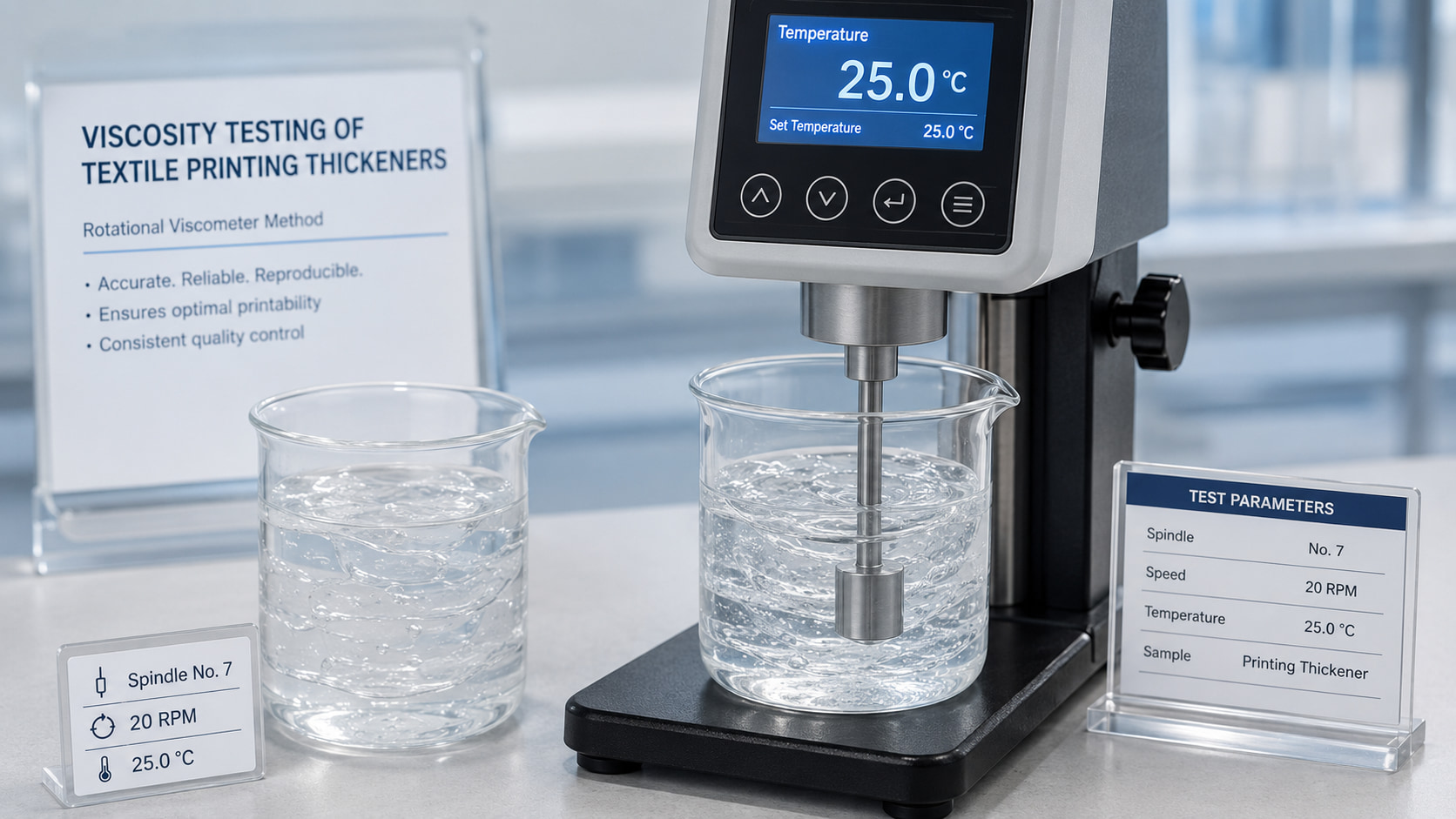
Découvrez pourquoi les valeurs de viscosité des épaississants utilisés dans l'impression textile ne peuvent pas être comparées sans tenir compte de la concentration, de la température, de l'instrument, de l'axe, de la vitesse, de la méthode de préparation et de la durée de l'essai.
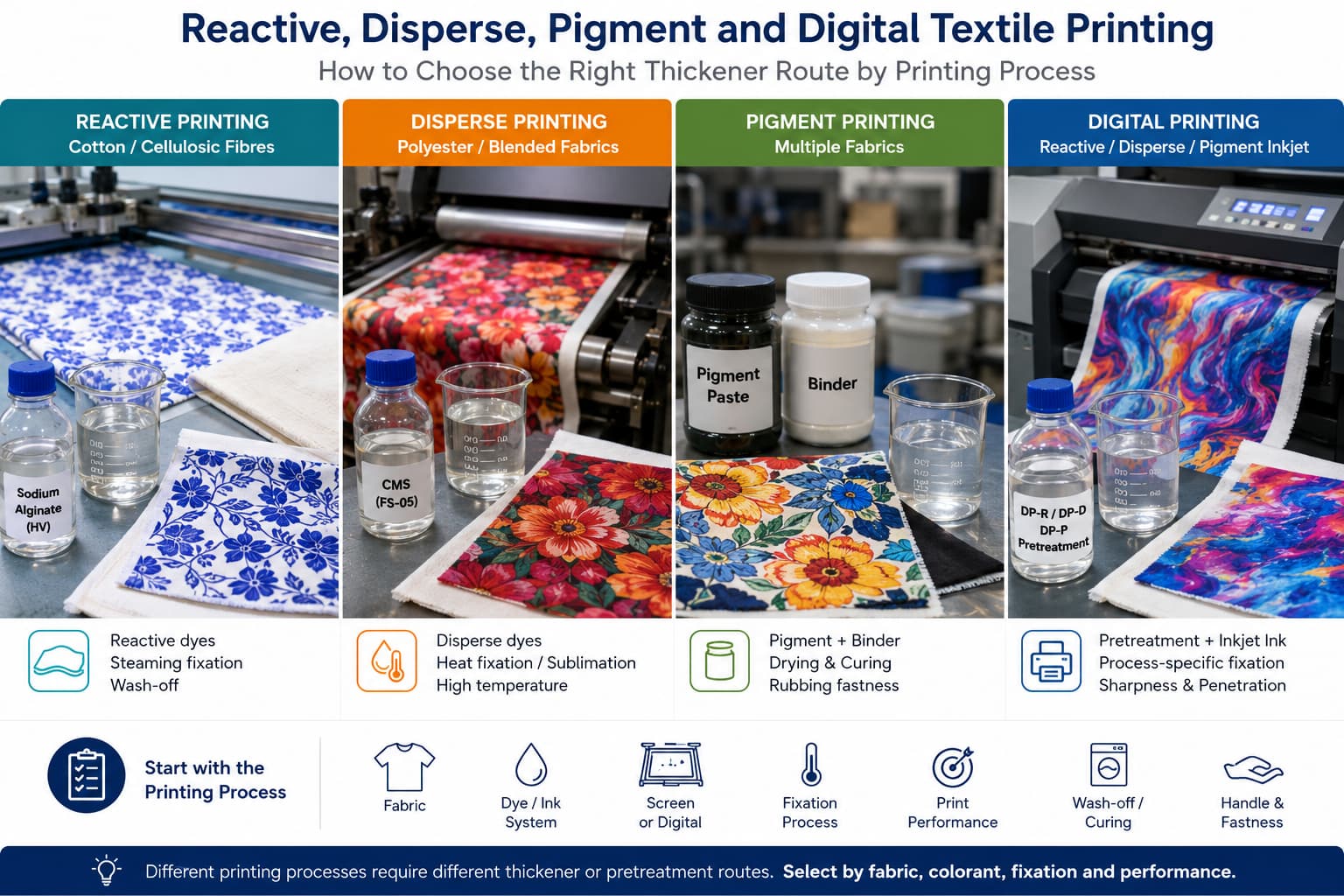
Découvrez comment choisir les agents épaississants et les procédés de prétraitement adaptés à l'impression textile réactive, dispersée, pigmentée et numérique, en fonction des exigences liées au tissu, à la teinture ou à l'encre, à la fixation, à l'élimination au lavage et à la qualité d'impression.
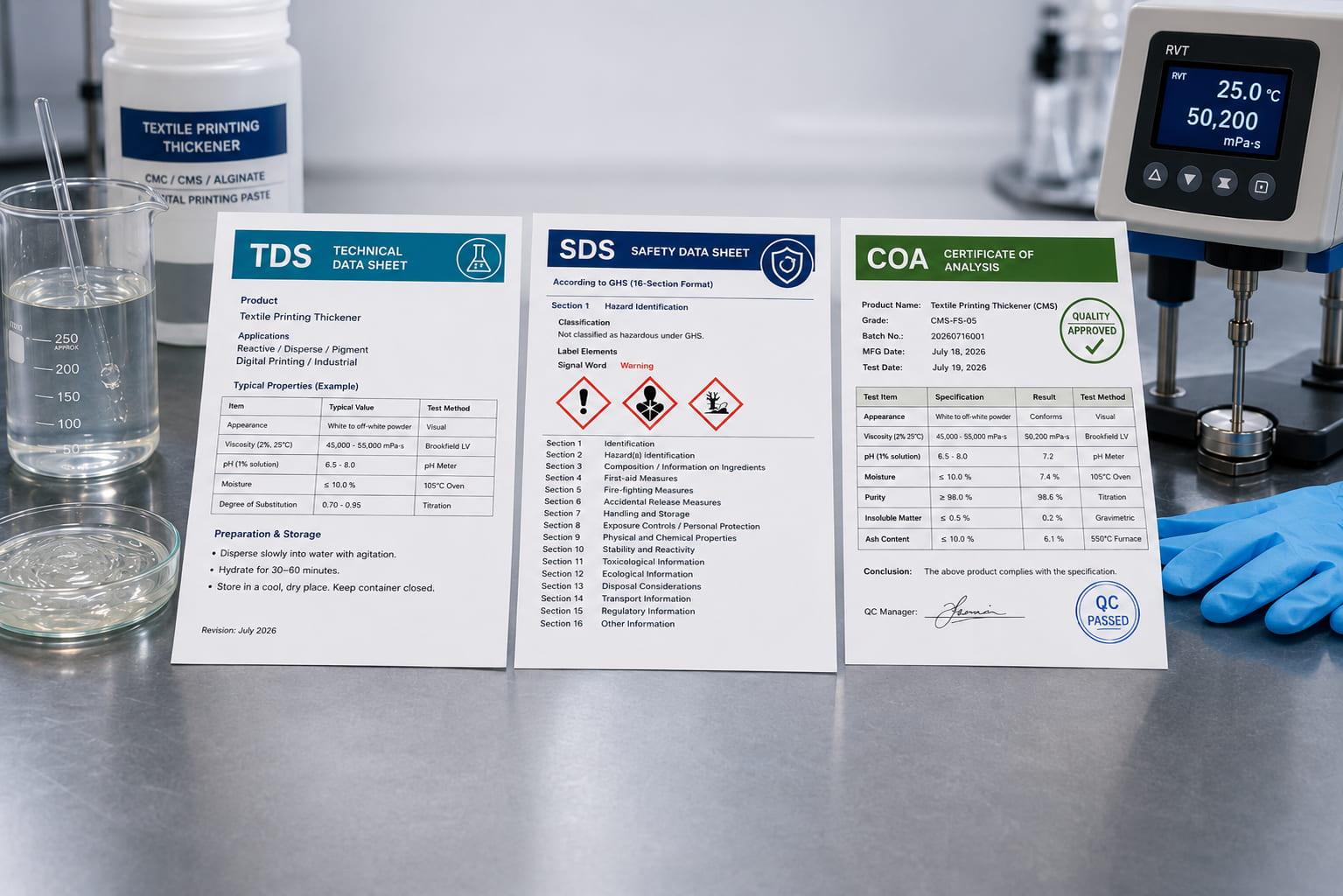
Découvrez la différence entre les documents TDS, SDS et COA, ce que les acheteurs de produits d'impression textile doivent vérifier, ainsi que la manière de contrôler les spécifications, les données de sécurité, les méthodes d'essai, les résultats des lots et les émetteurs des documents.
Comparez le CMC, le CMS, l'alginate de sodium et la pâte d'impression numérique pour l'impression textile. Découvrez comment chaque solution s'adapte aux procédés réactifs, dispersés, pigmentés et numériques, et ce que les acheteurs doivent vérifier avant de procéder à des tests d'échantillons, à la mise en correspondance des qualités et à l'achat en gros.
L'alginate de sodium est largement utilisé dans l'impression textile comme épaississant stable et lavable pour les pâtes d'impression réactives. Découvrez comment évaluer le degré de viscosité, la pureté et l'adéquation à l'application avant tout achat, et comment FSX Chemical accompagne les acheteurs du monde entier en leur fournissant des données techniques et des échantillons.
La carboxyméthylcellulose (CMC) est largement utilisée dans les processus d'impression, d'encollage et de teinture des textiles. Ce guide explique comment évaluer les différentes qualités de CMC, quels sont les paramètres les plus importants et comment FSX Chemical peut vous aider dans vos décisions d'achat.
La carboxyméthylcellulose est utilisée comme épaississant et stabilisant dans les encres à base d'eau, l'impression en héliogravure et le prétraitement pour l'impression à jet d'encre. Ce guide présente les principaux paramètres relatifs aux différentes qualités de ce produit ainsi que les éléments à prendre en compte par les équipes d'approvisionnement.
Le choix d'un fournisseur de CMC ne se résume pas à une simple comparaison des prix. Ce guide présente les critères d'évaluation, la liste de contrôle des documents à fournir et le processus d'essai que les équipes chargées des achats doivent suivre avant de s'engager dans une commande en gros.
La pâte d'impression à base de CMC est utilisée dans l'impression textile pigmentaire, réactive et numérique. Ce guide explique quels sont les paramètres importants, comment comparer les fournisseurs et ce qu'il faut demander avant de passer une commande en gros.
L'alginate de sodium et la CMC sont tous deux utilisés comme épaississants dans l'impression textile, mais ils conviennent à des systèmes de teinture et à des conditions de traitement différents. Ce guide explique les principales différences entre ces deux produits et précise dans quels cas il convient d'utiliser l'un ou l'autre.
L'impression numérique à jet d'encre sur textiles présente des exigences différentes en matière de pâte et de prétraitement par rapport à la sérigraphie. Ce guide explique comment l'alginate de sodium est utilisé dans l'impression textile numérique et quels paramètres de qualité les équipes d'approvisionnement doivent préciser.
Le CMC de qualité alimentaire et celui de qualité industrielle partagent la même composition chimique de base, mais présentent des différences significatives en termes de pureté, de plage de DS et d'exigences réglementaires. Ce guide explique les principales différences et pourquoi l'utilisation d'une qualité inadaptée peut entraîner des problèmes de production.
Veuillez nous communiquer le nom du produit, son application, la quantité, la destination, ainsi que toute fiche technique (TDS),
photo ou document dont vous disposez déjà. FSX Chemical examinera ces
informations et vous recommandera la marche à suivre pour obtenir un devis, trouver un échantillon correspondant
ou choisir un produit.
Informations sur le produitNom du produit, référence, modèle, photo de l'étiquette ou référence du fournisseur.
Documents disponiblesFiche technique (TDS), fiche de données de sécurité (SDS), certificat d'analyse (COA), photo d'exemple, liste des produits ou données d'essai.
Détails de la commandeQuantité estimée, conditionnement, pays de destination, port ou conditions commerciales.
Demande ou problèmeProcédé d'impression textile, besoins en matière de formulation, problème actuel ou performances visées.