टेक्सटाइल प्रिंटिंग रसायनशास्त्र में गुणवत्ता से समझौता किए बिना लागत कैसे कम करें
Reducing textile printing chemical costs does not mean buying the cheapest raw materials. Sustainable savings...
Reduce textile-printing chemical cost by comparing the cost of accepted finished fabric at the required quality, not only the purchase price per kilogram. Use the same production boundary, fabric, shade and quality gates; record actual consumption, processing and losses, and count each cost once. A cheaper ingredient is a saving only after its approved production route delivers a lower comparable cost.
A lower-priced thickener may require a higher dosage. A cheaper auxiliary may destabilize the printing paste. A formulation that reduces chemical cost may increase screen cleaning, downtime, washing requirements or rejected fabric.
For this reason, cost reduction in textile printing chemistry should be measured by total cost in use rather than by raw-material price alone. The objective is to produce acceptable printed fabric with the most efficient combination of chemistry, preparation, machine operation and quality control.
This guide explains practical ways to reduce textile printing costs without compromising the quality requirements that determine whether the finished fabric is commercially acceptable.
Why the Cheapest Chemical Is Not Always the Lowest-Cost Choice
Textile printing chemistry should be evaluated as part of the complete manufacturing process. The purchase price of a thickener, dye auxiliary or printing-paste component represents only one part of its economic impact.
Material cost
Material cost is the agreed unit-cost basis multiplied by the quantity consumed in the defined run. Use either a delivered unit cost that already includes specified logistics charges, or a purchase price plus separately allocated logistics to the same boundary. Do not add the same freight or packaging twice. Reconcile unused material returned to stock and record consumed or discarded paste; a purchase invoice alone does not measure consumption.
तैयारी की लागत
Mixing time, hydration, heating or cooling, labor, filtration and equipment cleaning can all add cost before printing begins.
मशीन की लागत
Poor paste transfer, difficult pumping, screen blockage or repeated cleaning can reduce productive machine time.
Quality cost
Poor definition, uneven color, excessive penetration, difficult wash-off or unacceptable fabric handle can create rework or rejected production.
Supply-chain cost
Record additional supply-chain costs only where they are not already included in the material or conversion ledger. Identify the chosen inventory-cost basis and allocation period. Keep a separately labelled estimate of lost sales or production opportunity apart from recorded operating cost; the same downtime event must not be charged twice.
A technically efficient product with a slightly higher unit price can therefore produce a lower total cost than a cheaper product that creates losses elsewhere.
1. Establish Your Current Cost and Quality Baseline
Cost optimization should begin with the current approved production process. Without a baseline, it is difficult to determine whether a new chemical or formulation actually saves money.
Record the current chemical formula
Thickener type and dosage
Dye or pigment concentration
Salt and alkali where applicable
Binder and crosslinker where applicable
Humectants and wetting agents
Defoamer and other auxiliaries
Total batch size
Record current production performance
Paste preparation time
Normal holding time
Filtration frequency
Screen or machine cleaning frequency
Printing speed
Paste remaining after production
Typical rework or rejection causes
Define the quality that must be protected
Cost reduction is useful only when the candidate system continues to meet the required print definition, color uniformity, penetration, fixation, wash-off, handle and other customer specifications.
The existing successful process should therefore become the reference against which every cost-saving trial is evaluated.
2. Select the Right Thickener Route First
Thickener selection can have a major influence on both chemical cost and production efficiency. The lowest-priced polymer is not necessarily the correct polymer for the printing chemistry.
सोडियम अल्गीनेट
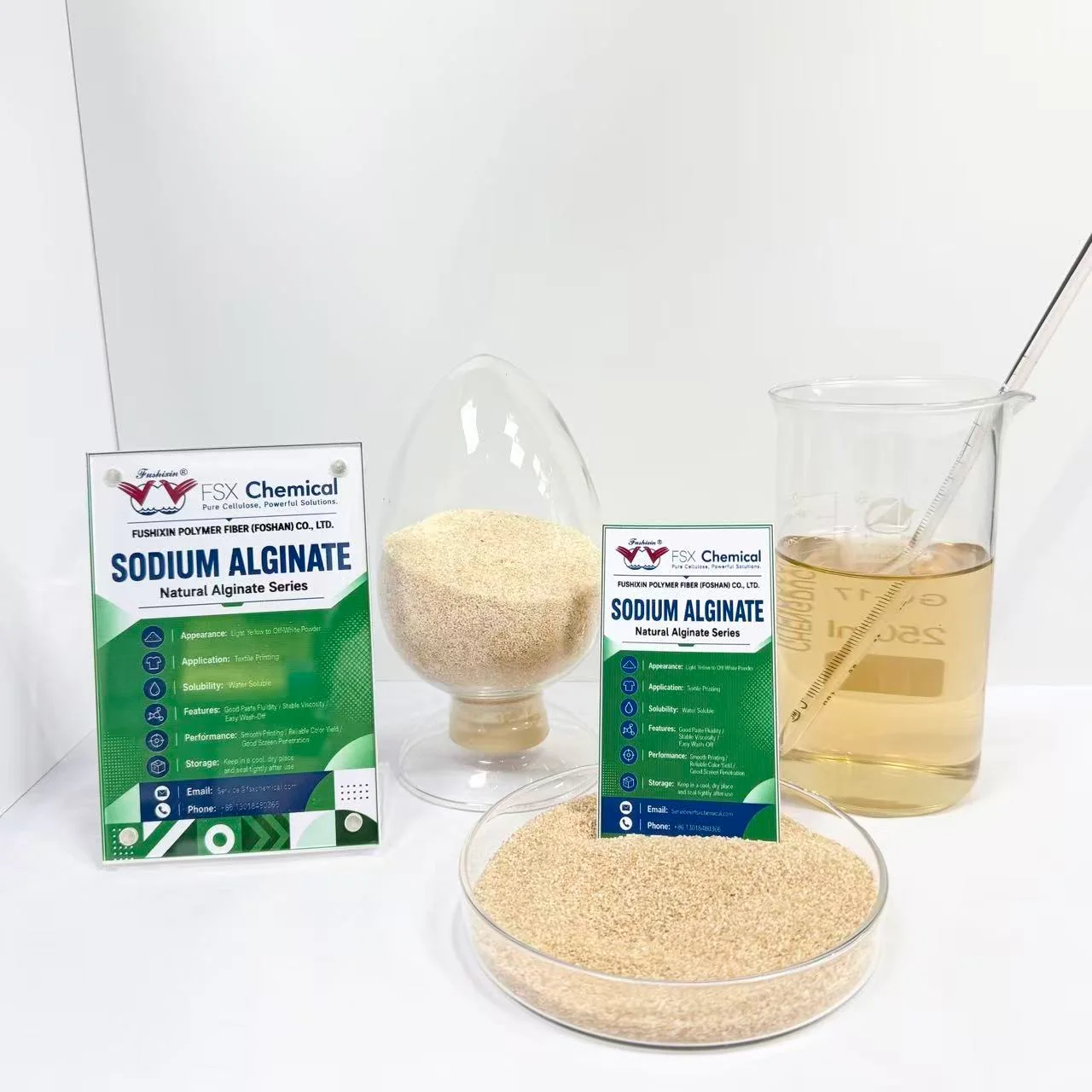
सोडियम अल्गीनेट is a common starting route for conventional reactive dye printing on suitable cellulosic textiles. Grade selection should consider viscosity, rheology, filtration, definition and wash-off.
सीएमसी
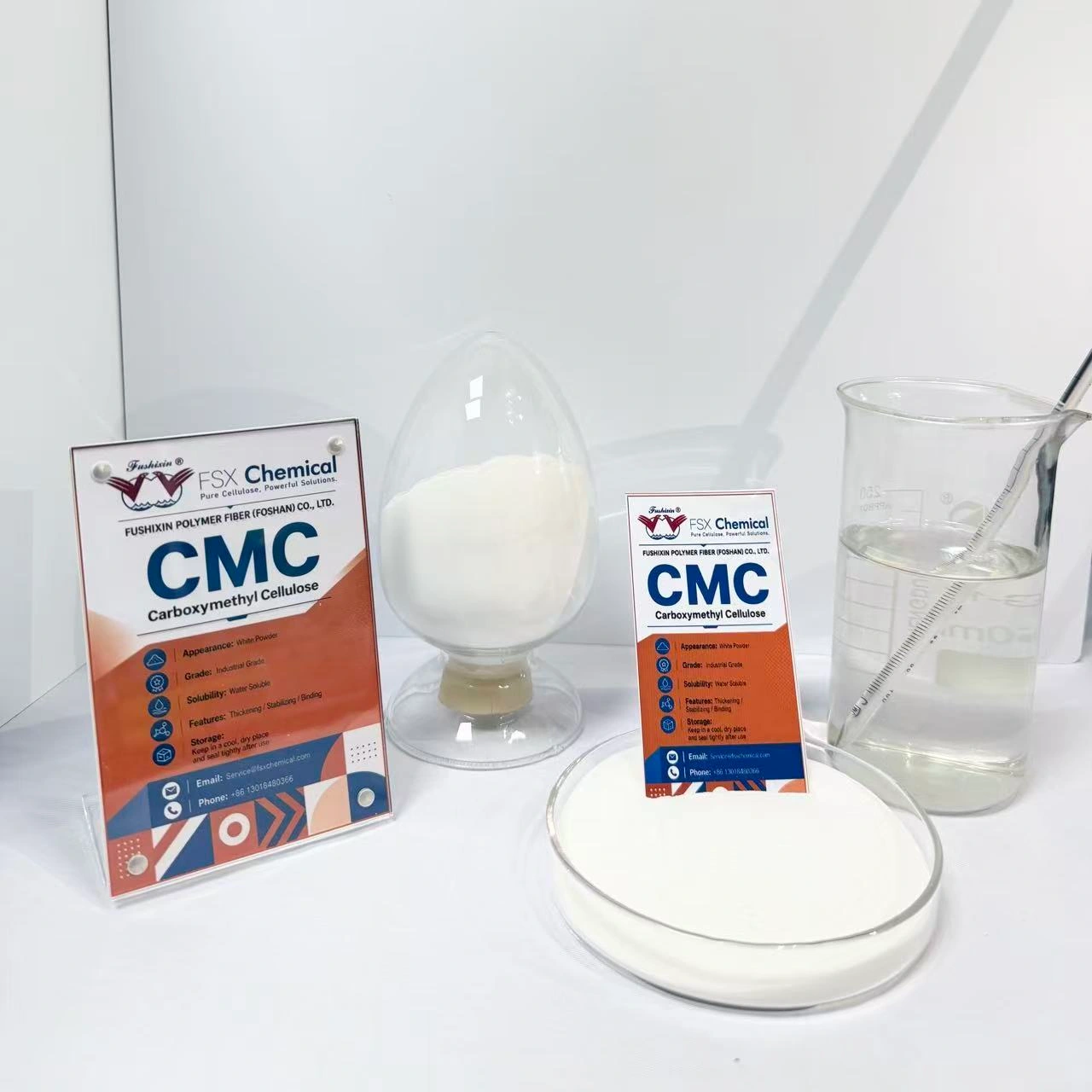
कार्बोक्सीमेथिल सेलुलोज can be evaluated for selected textile printing, viscosity-control and compound-thickener formulations according to grade characteristics and chemical compatibility.
सीएमएस
Evaluate the exact FSX CMS commercial grade proposed for the printing route. Confirm its identity and application scope from the current grade-specific documents rather than assuming that the CMS trade name establishes a particular chemical composition. Compare its dosage, compatibility and finished-fabric performance against the approved reference.
डिजिटल प्रिंटिंग पेस्ट
डिजिटल प्रिंटिंग पेस्ट should be selected according to the ink route, fabric and pretreatment process rather than by transferring a conventional screen-printing formulation directly.
Choosing the appropriate polymer family first prevents costly attempts to force an unsuitable thickener to perform through additional chemicals or excessive dosage.
3. Optimize Effective Dosage Instead of Price per Kilogram
One of the most common purchasing mistakes is comparing two thickeners by price per kilogram without comparing the concentration required in the actual printing paste.
Compare at equal concentration first
A baseline comparison at the same concentration can reveal differences in viscosity development, hydration, filtration and rheology.
Then optimize each candidate independently
Once both products are technically understood, adjust the concentration of each candidate gradually to determine its practical operating window.
Do not optimize to viscosity alone
The lowest dosage that reaches a viscosity target may not provide the required structural recovery, transfer, stability or print definition.
Calculate chemical cost at the approved dosage
Commercial comparison should use the optimized production dosage rather than an arbitrary laboratory concentration.
4. Standardize Viscosity Before Comparing Products
Incorrect viscosity comparison can lead directly to incorrect cost calculations.
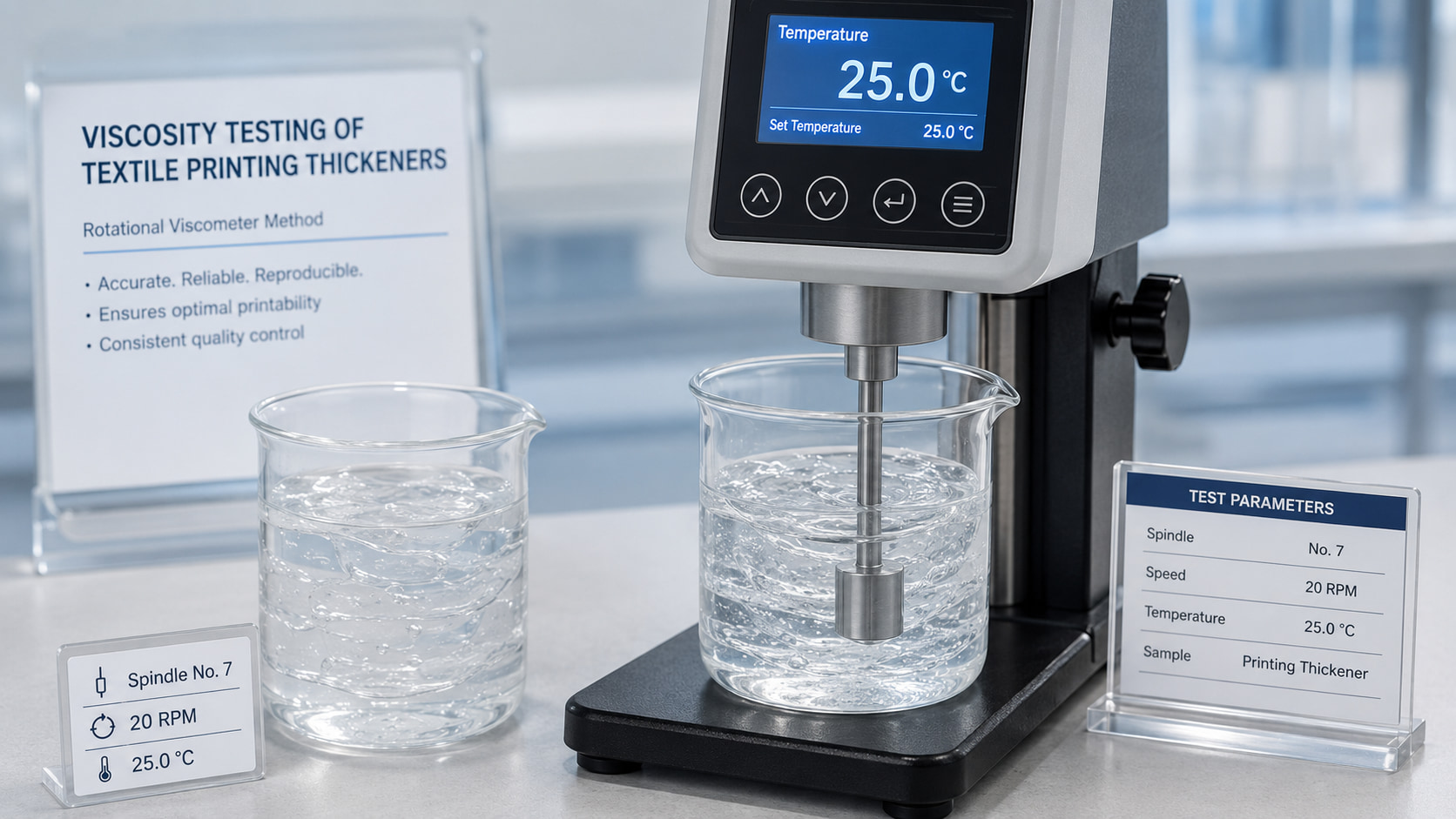
A viscosity specification should always be connected to a complete test method.
Record
Sample concentration
जल स्रोत
तैयारी प्रक्रिया
Mixing time
हाइड्रेशन या विश्राम का समय
मापन तापमान
विसकोमीटर
स्पिंडल या रोटर
घूर्णन गति
पढ़ने का समय
रिपोर्ट की गई इकाई
A candidate that appears to have twice the viscosity of another product may not actually have twice the thickening efficiency if the supplier specifications were generated under different methods.
Cost optimization should therefore be based on side-by-side testing under identical conditions.
5. Use Rheology to Protect Printing Performance
Reducing thickener dosage too aggressively can produce a paste that reaches an acceptable laboratory viscosity but behaves poorly on the printing machine.
During storage
The paste needs sufficient structure to remain physically stable.
During pumping and printing
The paste should flow efficiently under shear without creating excessive resistance.
After transfer to the fabric
Structural recovery can help control unwanted lateral spreading and penetration.
When possible, compare viscosity at several shear conditions or connect routine viscosity data with actual screen and fabric trials.
Cost reduction that destroys the required rheological balance is usually false economy.
6. Improve Dispersion and Hydration Efficiency
Poor preparation wastes both chemicals and production time.
Control powder addition
Rapid addition of powdered polymer into weak circulation can create lumps or partially hydrated material.
Use an appropriate mixing procedure
Record mixer type, batch size, addition time, mixing speed and total hydration period.
Avoid unnecessary overmixing
Longer mixing does not automatically improve paste quality. Excessive mixing can introduce air, generate heat and consume additional energy.
Allow complete hydration before correction
Adding more thickener because an incompletely hydrated batch appears thin can result in excessive final viscosity after hydration continues.
Standardization reduces operator variation
A repeatable preparation SOP reduces the number of manual corrections and makes lower-cost formulations easier to control.
7. Eliminate Unnecessary Formulation Cost
Printing formulations often develop gradually over time. Additional auxiliaries may be introduced to solve temporary problems and remain in the recipe even after the original cause has disappeared.
Review the role of every component
Each chemical should have a defined function and a justified dosage.
Use controlled reduction trials
Reduce one component at a time while monitoring paste properties, printing behavior and final fabric.
Do not remove chemicals simply because they are expensive
A small quantity of a higher-cost auxiliary may prevent a much larger quality or processing loss.
Do not change several ingredients simultaneously
Multiple changes make it difficult to determine which adjustment produced an improvement or failure.
Formula simplification should therefore be evidence-based rather than price-based.
8. Reduce Filtration, Cleaning and Downtime Costs
Filtration and machine cleaning are frequently overlooked when chemical costs are calculated.
Poorly hydrated material can become waste
Lumps and gels retained by filters represent purchased polymer that never reaches the fabric.
Filter loading increases labor
Frequent filter changes or screen cleaning consume operator time and can interrupt production.
Identify the source of residue
Residue can come from incomplete hydration, polymer gel, chemical precipitation, fibre contamination or equipment cleanliness.
Test stock and complete paste separately
If the stock thickener filters well but residue appears after other chemicals are added, formulation compatibility should be investigated.
A product with better practical filtration at the approved dosage may justify a higher purchase price if it reduces waste and downtime.
9. Improve Paste Holding Stability
Printing paste that changes significantly during normal production holding can create both chemical waste and quality variation.
Monitor over realistic time periods
Test viscosity, pH, appearance, filtration and physical stability at relevant production checkpoints.
Control evaporation
Open containers or tanks can lose water and increase effective solids, creating apparent viscosity drift.
Control temperature
Temperature differences can influence viscosity and lead operators to make unnecessary corrections.
Print both fresh and held paste
A small numerical change may be acceptable if printing performance remains stable, while a similar numerical change may be important if it changes transfer or definition.
10. Reduce Paste Waste and Overproduction
Unused paste is a direct cost because it contains not only thickener but also dyes, pigments and other auxiliaries.
Improve batch-size planning
Use historical consumption data to reduce systematic overproduction of color paste.
Track remaining paste
Measure leftover material by color, machine or production order instead of treating it as an unavoidable loss.
Improve formula repeatability
Stable recipes and controlled preparation reduce the need to discard off-specification batches.
Reduce correction loops
Repeated additions of water, thickener or auxiliaries increase batch volume and make the final formulation harder to control.
11. Reduce Rework and Rejected Fabric
The most expensive chemical problem is often not the chemical itself but the fabric that must be reprocessed or rejected.
Common chemistry-related defects can include
Poor print definition
Excessive bleeding
Broken fine lines
Uneven solid colors
अत्यधिक प्रवेश
Poor fixation
Difficult wash-off
Unacceptable fabric handle
Use a standard diagnostic print pattern
Fine lines, small text, sharp corners and large dark areas help reveal differences between candidate formulations.
Evaluate after complete processing
A formulation that looks excellent immediately after printing may not remain superior after fixation, washing or curing.
Cost-saving decisions should therefore be based on acceptable finished fabric rather than wet-print appearance.
12. Consider Fixation and Post-Treatment Costs
Chemical optimization should include the stages after printing.
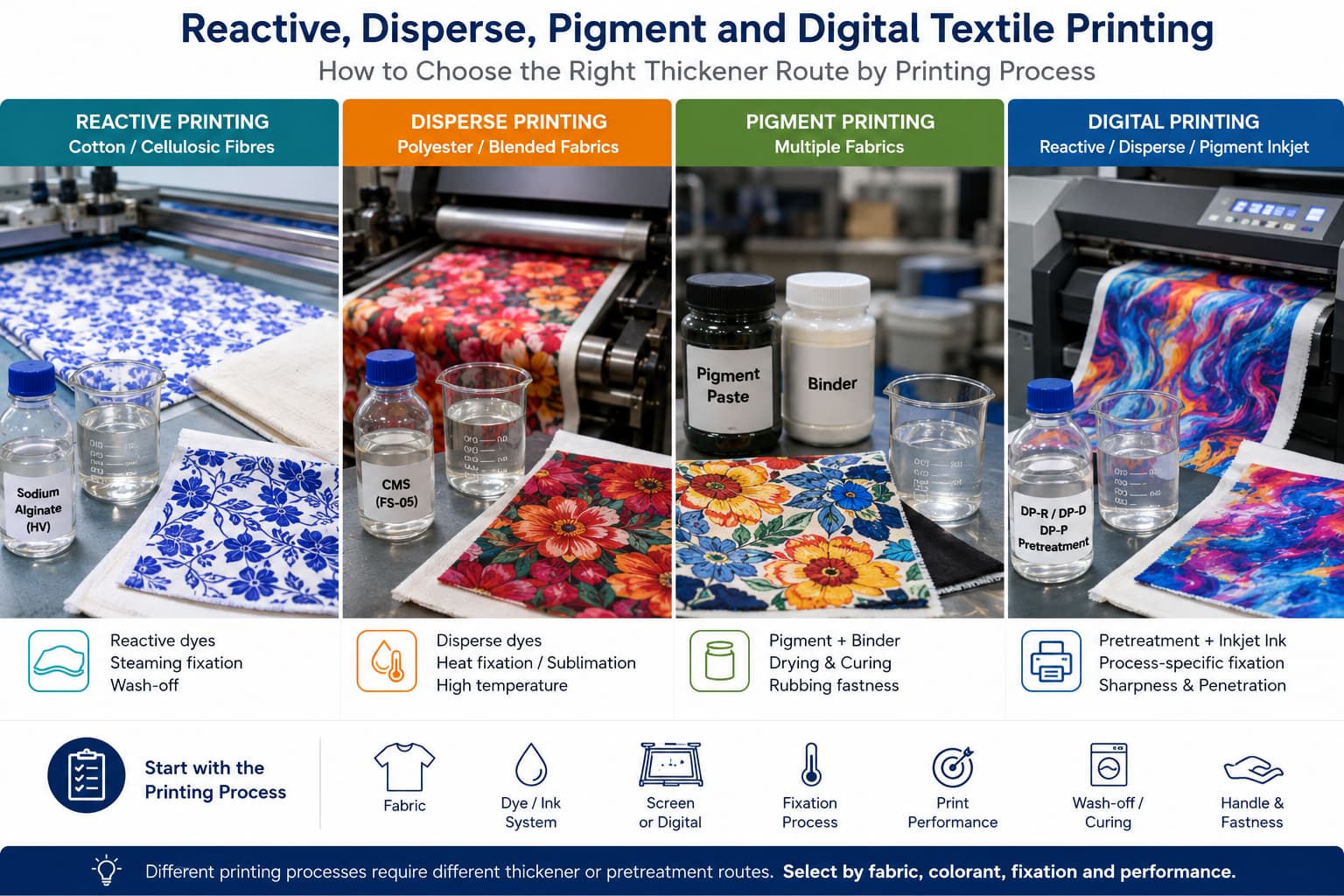
प्रतिक्रियाशील मुद्रण
Fixation and wash-off performance can influence water, energy, time and final fabric quality.
Disperse printing
Thermal processing, cleaning and surface residue should be included in the economic comparison.
Pigment printing
Binder level, curing efficiency and final handle are important because an apparently cheaper formula may require additional correction or finishing.
डिजिटल प्रिंटिंग
Pretreatment pickup, drying and fixation or curing should be considered together rather than optimizing pretreatment chemical price independently.
13. Evaluate Compound Thickeners Strategically
Cost optimization does not always require replacing one thickener with a cheaper polymer. In some applications, combining polymers can provide a more useful balance of viscosity, rheology and cost.
Define the role of each component
One polymer may provide base viscosity while another improves shear-thinning behavior, stability, filtration or structural recovery.
Build a controlled formulation matrix
Change blend ratios step by step while keeping other variables constant.
Track total solids
Reducing one expensive polymer is not a real saving if total polymer solids rise substantially elsewhere in the formula.
Test the full printing process
Compound systems should be evaluated for preparation, storage, machine behavior, final print quality and post-treatment.
The preferred blend is the one that achieves the required quality at the most practical total cost, not necessarily the blend containing the highest percentage of the cheapest component.
14. Use Batch Consistency as a Cost-Control Tool
Batch consistency has direct economic value. A product that requires repeated recipe correction increases laboratory, production and quality costs even when its purchase price is attractive.
Routine incoming control can include
Commercial grade identity
Batch number
दृश्यमानता
सहमत पद्धति के तहत सान्द्रता
Moisture or solids where relevant
pH जहाँ प्रासंगिक हो
Filtration or hydration where important
Use the same method over time
Changing laboratory methods creates apparent variation that can result in unnecessary production corrections.
Monitor trends
Historical batch data can help detect gradual movement before it becomes a production problem.
15. Qualify Alternative Suppliers Without Increasing Risk
Supplier competition can create valuable commercial flexibility, but a new source should not be selected from quotation price alone.
Use the current product as the benchmark
Compare the existing approved grade with the candidate under identical laboratory conditions.
Request technical documents
Review the candidate TDS, relevant specification, viscosity method and available batch documentation.
Test a representative sample
Complete both basic laboratory testing and a real printing trial.
Optimize before calculating cost
Determine the practical dosage and formula of the candidate before comparing commercial economics.
पहले वाणिज्यिक बैच का सत्यापन करें
The first bulk shipment should be compared with the approved sample before routine conversion.
An alternative supplier can also be maintained as a qualified backup source even when the current supplier remains in use.
Cost Optimization by Printing Route
प्रिंटिंग मार्ग
Cost Optimization Focus
Quality That Must Be Protected
प्रतिक्रियाशील मुद्रण
Thickener dosage, paste preparation, fixation and wash-off
Definition, color response, fixation and clean fabric handle
विखुरित मुद्रण
Thickener route, paste stability, transfer and thermal process
Levelness, definition, fixation and polyester surface quality
वर्णक मुद्रण
Thickener-binder balance, solids and curing efficiency
Definition, rubbing performance and fabric handle
प्रतिक्रियाशील डिजिटल मुद्रण
Pretreatment dosage, pickup, drying and wash-off
Ink control, color performance, definition and handle
डिस्पर्स डिजिटल प्रिंटिंग
Pretreatment efficiency, filtration and thermal processing
Uniformity, definition and stable color development
संयुक्त गाढ़ाकरण प्रणालियाँ
Polymer ratio, total solids and effective dosage
Rheology, stability, machine performance and finished fabric
Each route requires its own optimization because the chemical and processing conditions are different.
How to Calculate Total Cost in Use
For a matched production run, calculate cost per accepted m² = total in-scope run cost ÷ accepted finished area. Keep every numerator entry in one currency and period; state the exchange-rate date where relevant. Use the same fabric construction, finished width, shade/coverage, route and final-quality criteria. If reporting per linear metre, hold finished width constant; do not compare metres of unequal width as equivalent output. Count accepted fabric only once after any permitted rework.
Cost Area
What to Record
यह क्यों मायने रखता है
Materials Consumed
Consumed quantities at one declared delivered or separately built-up unit-cost basis; reconcile returns and waste
Prevents purchased inventory being mistaken for run consumption
तैयारी
Mixing, hydration, energy and labor
Shows cost before printing begins
छानन
Filter use, residue and cleaning
Identifies hidden material and labor loss
मशीन
Speed, downtime and cleaning frequency
Connects chemistry with productivity
Paste Waste
Mass and disposition of unused or off-specification paste; additional disposal or recovery cost
Tracks loss without charging paste ingredients again if already included in materials consumed
उपचारोपरांत
Water, heat, washing, curing and processing time
Captures downstream cost
Quality Loss
Additional rework, rejection handling and claims not already included elsewhere; state recovery credits
Uses the same quality gate and avoids duplicating material or conversion cost
Supply Chain
Only allocated freight, packaging, inventory or emergency charges outside the recorded material basis
Keeps the delivery boundary consistent and counts each charge once
Build the numerator from mutually exclusive entries for materials consumed, conversion and additional quality/waste handling not already counted. If material or processing costs for rejected fabric are already in the run total, do not add their full value again as a separate “scrap cost.” Add only additional loss or recovery items on the declared basis. A zero accepted output has no finite unit cost and cannot establish a saving. The Asian Productivity Organization’s manual on material flow cost accounting explains the link between physical material quantities and related costs. The equation here is a proposed mill comparison, not an ISO-prescribed calculation or an FSX test result.
Record the existing formulation, product grades, dosage, test methods and production settings.
Step 2: Define the cost objective
Identify whether the main target is lower thickener cost, lower total chemical cost, faster preparation, less waste, improved productivity or lower post-treatment cost.
Step 3: Select one variable to optimize
Change one product, dosage or formulation component at a time.
Step 4: Compare laboratory properties
Dispersion
जलपूरकता
संधानशीलता
रियोलॉजी
पीएच
छानन
स्थिरता बनाए रखना
चरण 5: पूरी प्रिंटिंग पेस्ट तैयार करें
Use the actual dyes, pigments and auxiliaries rather than testing the thickener only in water.
Step 6: Print the same fabric
Keep fabric lot, design, machine and application conditions as consistent as possible.
Step 7: Complete the normal post-treatment
Evaluate fixation, washing, curing and final fabric handle.
Step 8: Optimize candidate dosage
Adjust the successful candidate gradually while monitoring the same quality criteria.
Step 9: Conduct a limited production trial
Confirm that laboratory savings survive larger batch size, circulation, holding time and normal production speed.
Step 10: Calculate cost per acceptable production unit
Use the declared run boundary and sum each ledger entry once. Divide by accepted area or another fully specified matched unit, report the accepted yield, and retain the quality results alongside the cost sheet. Compare recurring production cost separately from one-off qualification or changeover expense.
Step 11: Verify the first commercial shipment
Confirm that the bulk grade corresponds to the product used in the successful trial.
Common Cost-Reduction Mistakes
Choosing the lowest price per kilogram
This ignores dosage, processing and quality losses.
Reducing thickener dosage before understanding rheology
The paste may reach an acceptable viscosity but lose transfer or definition.
Replacing one polymer weight for weight
Sodium alginate, CMC, CMS and synthetic thickeners do not necessarily have equivalent thickening efficiency or application behavior.
Adding water to reduce chemical consumption
Uncontrolled dilution changes the concentration of the entire printing formulation and may reduce color or fixation performance.
Changing several chemicals at once
The source of improvement or failure becomes difficult to identify.
Ignoring filtration and machine behavior
A laboratory saving can disappear through production downtime.
Ignoring post-treatment
Additional washing or curing requirements can offset savings made in the printing paste.
Calculating cost before optimizing dosage
Candidate products should be compared at their practical approved dosage, not at arbitrary equal weights.
Approving a laboratory sample without bulk verification
The sample-to-bulk transition should remain part of the economic and technical evaluation.
How FSX Chemical Supports Cost Optimization
FSX Chemical provides CMC, CMS, sodium alginate, digital printing paste and related thickener routes for textile printing customers.
Cost optimization can begin with the customer’s existing product rather than selecting a lower-priced grade without a technical benchmark.
के माध्यम से नमूने और मिलान, buyers can provide their current TDS or reference sample, viscosity method and printing route for candidate-grade review. Agree the comparison conditions before any cost-saving claim. Email: service@fsxchemical.com.
उपयोगी जानकारी में शामिल हैं
वर्तमान उत्पाद और वाणिज्यिक ग्रेड
वर्तमान टीडीएस या सीओए
भौतिक संदर्भ नमूना
Current purchase or delivered cost where comparison is required
खुराक
संधानशीलता और पूर्ण परीक्षण विधि
Printing formula
कपड़ा
Printing machine
Normal holding time
वर्तमान उत्पादन समस्या
Estimated bulk requirement and destination
The comparison can focus on
Alternative thickener family
Candidate viscosity grade
प्रभावी खुराक
जल संवर्धन और छानन
पेस्ट की स्थिरता
प्रिंटिंग प्रदर्शन
Batch requirements
Total cost in use
A candidate product should not be considered a confirmed cost-saving solution until it has met the required application and finished-fabric standards.
जानें कि कपड़ा मुद्रण के लिए थिकनर की विस्कोसीटी मानों की तुलना बिना समान सांद्रता, तापमान, उपकरण, स्पिंडल, गति, तैयारी विधि और परीक्षण समय के नहीं की जा सकती।.
कपड़े, रंग या स्याही, स्थिरीकरण, धोने पर छूटना और मुद्रण गुणवत्ता की आवश्यकताओं के आधार पर प्रतिक्रियाशील, डिस्पर्स, पिगमेंट और डिजिटल टेक्सटाइल प्रिंटिंग के लिए गाढ़ा करने वाले पदार्थ और पूर्व-उपचार मार्ग चुनने का तरीका जानें।.
टेक्सटाइल प्रिंटिंग के लिए CMC, CMS, सोडियम अल्जिनेट और डिजिटल प्रिंटिंग पेस्ट की तुलना करें। जानें कि प्रत्येक माध्यम प्रतिक्रियाशील, विसरणीय, वर्णक और डिजिटल प्रक्रियाओं के लिए कैसे उपयुक्त है, और नमूना परीक्षण, ग्रेड मिलान और थोक खरीद से पहले खरीदारों को किन बातों की समीक्षा करनी चाहिए।.
सोडियम अल्गीनेट का उपयोग प्रतिक्रियाशील प्रिंटिंग पेस्ट के लिए एक स्थिर और धोने योग्य गाढ़ा करने वाले पदार्थ के रूप में वस्त्र मुद्रण में व्यापक रूप से किया जाता है। खरीदने से पहले चिपचिपापन ग्रेड, शुद्धता और अनुप्रयोग उपयुक्तता का मूल्यांकन कैसे करें, और FSX केमिकल तकनीकी डेटा और नमूनों के साथ वैश्विक खरीदारों का समर्थन कैसे करता है, यह जानें।.
Choose CMC for textile printing by application, DS, viscosity method and formulation trials. Use a practical checklist to compare grades before bulk purchase.
कार्बोक्सिमीथाइल सेलुलोज़ का उपयोग जल-आधारित स्याही, ग्रावुर मुद्रण और इंकजेट पूर्व-उपचार में गाढ़ा करने वाले और स्थिरीकरणकर्ता के रूप में किया जाता है। यह मार्गदर्शिका खरीद टीमों के लिए प्रमुख ग्रेड पैरामीटर और स्रोत चयन संबंधी विचारों को कवर करती है।.
CMC-आधारित प्रिंटिंग पेस्ट का उपयोग पिगमेंट, रिएक्टिव और डिजिटल टेक्सटाइल प्रिंटिंग में किया जाता है। यह मार्गदर्शिका बताती है कि किन मापदंडों का महत्व है, आपूर्तिकर्ताओं की तुलना कैसे करें, और थोक ऑर्डर देने से पहले क्या अनुरोध करना चाहिए।.
सोडियम अल्जिनेट और सीएमसी दोनों का उपयोग वस्त्र मुद्रण में गाढ़ा करने वाले पदार्थ के रूप में किया जाता है, लेकिन ये विभिन्न रंग प्रणाली और प्रक्रिया की शर्तों के लिए उपयुक्त होते हैं। यह मार्गदर्शिका प्रमुख अंतर और प्रत्येक का उपयोग कब करना चाहिए, यह बताती है।.
टेक्सटाइल पर डिजिटल इंकजेट प्रिंटिंग में स्क्रीन प्रिंटिंग की तुलना में अलग पेस्ट और पूर्व-उपचार की आवश्यकताएँ होती हैं। यह मार्गदर्शिका बताती है कि डिजिटल टेक्सटाइल प्रिंटिंग में सोडियम अल्जिनेट का उपयोग कैसे किया जाता है और खरीद टीमें किन ग्रेड पैरामीटरों को निर्दिष्ट करें।.
Food-grade and industrial-grade CMC labels do not define one universal DS, viscosity or purity comparison. Textile buyers should verify grade-specific assay and methods, then test the complete formulation; food-contact or pharmaceutical use needs separate, applicable documentation.
Prepare sodium alginate printing paste with a grade-specific concentration and controlled powder dispersion. Validate hydration, viscosity, filtration, air removal and holding time before production.
Assess sodium alginate in reactive-printing wastewater using measured COD load, product-specific biodegradation evidence and controlled process comparisons. Includes a buyer checklist and illustrative load calculation.
उत्पाद का नाम, उपयोग, मात्रा, गंतव्य और आपके पास पहले से मौजूद कोई भी टीडीएस, नमूना फोटो या दस्तावेज़ साझा करें। FSX केमिकल इस जानकारी की समीक्षा करेगा और कोटेशन, नमूना मिलान या उत्पाद चयन के लिए अगले कदम की सिफारिश करेगा।.
उत्पाद की जानकारीउत्पाद का नाम, ग्रेड, मॉडल, लेबल की तस्वीर या आपूर्तिकर्ता संदर्भ।.
उपलब्ध दस्तावेज़टीडीएस, एसडीएस, सीओए, नमूना फोटो, उत्पाद सूची या परीक्षण डेटा।.
आदेश विवरणअनुमानित मात्रा, पैकेजिंग, गंतव्य देश, बंदरगाह या व्यापारिक शर्त।.
आवेदन या समस्याटेक्सटाइल मुद्रण प्रक्रिया, सूत्रीकरण आवश्यकता, वर्तमान समस्या या लक्षित प्रदर्शन।.