Ready-to-Use vs. Alkali-Activated Acrylic Thickener: Which Route Fits Textile Pigment Printing?
Ready-to-use and alkali-activated acrylic thickeners shift production control to different places. Compare pH control, batching...
Ready-to-use and alkali-activated acrylic thickeners can both work in textile pigment printing, but they shift process control to different places. A ready-to-use grade is designed to simplify addition and viscosity adjustment, while an alkali-activated grade relies more explicitly on neutralization, pH control and mixing to develop its full rheology. The best route is not determined by convenience alone. Mills should compare batching time, pH sensitivity, binder and pigment compatibility, electrolyte tolerance, holding stability, screen rheology, fabric hand, incoming QC and Total Cost in Use. “Ready-to-use” is also a handling description rather than one universal chemistry: some products are pre-neutralized, while others can be added directly to an already alkaline formulation and become activated there.
Ready-to-Use vs. Alkali-Activated: Which Route Fits Pigment Printing?
Choose the route that gives the most stable complete pigment paste with the simplest practical production control.
A ready-to-use acrylic thickener is generally attractive when the mill values:
Fast batching
Fewer neutralization steps
Lower operator dependency
Simpler viscosity correction
An alkali-activated acrylic thickener can be attractive when the mill values:
Low-viscosity product handling before activation
More direct control over activation
Ability to tune viscosity through neutralization and dosage
A process already designed around controlled pH adjustment
But neither route should be approved from handling convenience alone.
The final decision should follow:
Handling Route → Activation / pH → Complete-Paste Compatibility → Rheology → Screen Trial → Curing → Finished Fabric → Total Cost in Use
What Does “Ready-to-Use” Actually Mean?
“Ready-to-use” is not one universal polymer category.
In commercial acrylic rheology modifiers, the phrase can describe different supply forms.
Pre-Neutralized Ready-to-Use
The polymer is supplied in a form that can be incorporated without a separate pre-neutralization step.
The mill may still need to control final formulation pH.
Direct-Addition Product
The product can be dosed directly into a formulation that is already alkaline enough to activate or maintain the intended rheology.
The product itself may still be acidic as supplied.
Self-Associative / Pre-Adjusted Commercial System
Some acrylic thickeners are designed for easy post-addition or direct viscosity adjustment with minimal extra preparation.
अतः:
Ready-to-Use ≠ Automatically Fully Neutralized
and:
Ready-to-Use ≠ pH-Independent.
Always read the grade-specific TDS before deciding how the product should be added.
What Is an Alkali-Activated Acrylic Thickener?
An alkali-activated acrylic thickener is commonly supplied as a relatively low-viscosity acidic emulsion or dispersion.
After a base is added, the polymer develops much more viscosity.
Common neutralizers can include:
Ammonia / ammonium hydroxide
Sodium hydroxide
Selected amines
Supplier-specified alkaline systems
The correct neutralizer depends on the commercial product and formulation.
One product may be designed for strong inorganic alkali; another may perform better with a different neutralization route.
Do not assume every acrylic thickener uses the same neutralizer or target pH.
Many alkali-swellable acrylic thickeners contain carboxylic acid groups.
At relatively low pH, the polymer remains more compact.
When a suitable base raises the pH:
Acid Groups Neutralize → Carboxylate Groups Form → Electrostatic Repulsion Increases → Polymer Swells / Expands → Hydrodynamic Volume Increases → Viscosity Builds
Commercial ASE products can remain easy-to-handle, low-viscosity liquids before activation and then thicken quickly after the formulation moves above the relevant pH threshold.
This mechanism gives useful processing flexibility, but it also makes:
Neutralizer dosage
पीएच
मिश्रण
Electrolyte load
critical process variables.
Where Does Process Control Sit in Each Route?
Control Area
Ready-to-Use Route
Alkali-Activated Route
Product addition
Usually simpler
Requires activation planning
Neutralizer control
Reduced or formula-dependent
Critical
Final pH
Still important
Critical for activation
Mixing sensitivity
Often lower
Can be higher during neutralization
Viscosity correction
Can be convenient
Must separate pH from dosage effects
Operator dependency
Potentially lower
Potentially higher
The ready-to-use route moves more formulation control into the product design.
The alkali-activated route leaves more activation control at the mill.
Neither is automatically more technically advanced.
Batching Speed and Operator Simplicity
Ready-to-use products can reduce:
Neutralizer preparation
Activation waiting time
pH correction steps
Risk of local over-neutralization
This can be useful in color kitchens where:
Many small batches are prepared
Operators change frequently
Fast shade change is important
Alkali-activated products can still be very fast if the process is well designed.
Some commercial ASE/HASE products thicken rapidly after alkali addition.
The actual batching-time difference should therefore be measured rather than assumed.
pH Control and Neutralizer Accuracy
This is the main control point for alkali-activated thickener.
If the pH is too low:
Viscosity can remain below target.
Dosage may appear inefficient.
Spreading can increase.
If too much alkali is added:
pH can move outside the preferred formulation range.
Ionic load can increase.
Binder / pigment compatibility can change.
The target should be:
Supplier-Validated Activation Window
not:
Maximum Possible pH.
A ready-to-use product can simplify neutralization, but final paste pH should still be checked because pigment, binder and auxiliaries can shift it.
Mixing, Local pH and Homogeneity
Concentrated alkali added too quickly can create a local pH much higher than the average tank pH.
Possible problems include:
Local over-swelling
Gel-like regions
Uneven viscosity development
Poor batch repeatability
For alkali-activated grades, define:
Neutralizer concentration
Addition rate
Mixing speed
Mixing time
Equilibration time
A ready-to-use product can reduce this particular risk, although it still needs adequate dispersion through the complete paste.
Viscosity Adjustment During Production
Ready-to-use grades can be attractive for direct viscosity adjustment when the commercial product is designed for post-addition.
But do not assume any acrylic thickener can be poured into a completed pigment paste safely.
Check:
Supplier addition instructions
Local concentration risk
Mixing capacity
Final pH
For alkali-activated systems, a low viscosity problem should first be separated into:
Under-Activation?
or:
Insufficient Thickener Dosage?
Adding more product to an under-activated system can increase cost without fixing the root cause.
Binder Compatibility
Both routes must be tested with the production binder.
Binder can change:
पीएच
Electrolyte load
Surfactant balance
संधानशीलता
Elasticity
A ready-to-use grade is not automatically binder-compatible just because it requires fewer activation steps.
An alkali-activated grade can also remain stable if its pH and electrolyte window match the binder system.
Use a water-dilution control to separate simple dilution from binder chemistry.
Pigment Dispersion Compatibility
Pigment dispersions can introduce:
पानी
Dispersants
Surfactants
Electrolytes
pH-adjusting chemicals
Therefore, the route should be checked at:
Light pigment loading
Normal production loading
High / dark-shade loading
A ready-to-use paste can still lose viscosity after high pigment loading.
An alkali-activated system can also shift because pigment changes the pH and ionic environment.
Electrolyte Tolerance
Many acrylic/polyacrylate thickeners are polyelectrolytes.
Electrolytes can reduce polymer expansion by screening charged groups.
This can lower viscosity even after correct activation.
Evaluate:
Viscosity Retention (%) = Viscosity After Formula Challenge ÷ Reference Viscosity × 100
for:
Pigment addition
Binder addition
Fixer addition
Representative salt / hard-water conditions
Ready-to-use and alkali-activated grades can both be electrolyte-sensitive.
The label alone does not predict salt tolerance.
Process Water and Hardness
Use the real production water when qualifying either route.
Calcium and magnesium can influence:
सक्रियण
Viscosity retention
Binder / pigment stability
If water hardness varies significantly between factories or seasons, include representative high-hardness conditions.
A ready-to-use grade can simplify neutralization but cannot eliminate poor water compatibility.
Rheology: Same Viscosity, Different Flow
Do not compare the two routes from one Brookfield number.
Screen printing requires:
Low-Shear Body → Shear Thinning → Screen Transfer → Structural Recovery
Compare:
Low-speed viscosity
Higher-speed viscosity
Recovery after controlled shear
Stringiness / elasticity
Screen release
A ready-to-use grade and an alkali-activated grade can reach the same low-shear viscosity but behave differently under the squeegee.
Same Viscosity ≠ Same Rheology.
स्थिरता बनाए रखना
The complete paste should remain stable for the real production period.
Measure:
Fresh viscosity
Intermediate viscosity
End-of-shift viscosity
पीएच
तापमान
फोम
Separation / gel
For alkali-activated systems, delayed pH equilibration can affect the early holding curve.
For ready-to-use systems, pigment/binder interactions can still produce delayed drift.
Do not confuse easy preparation with guaranteed holding stability.
As-Supplied Storage and Handling
Product storage should follow the grade-specific TDS.
Possible differences include:
As-supplied viscosity
Freeze sensitivity
Storage temperature range
Need for remixing before use
A pre-neutralized ready-to-use product can have a different storage profile from a low-viscosity acidic ASE product.
Do not transfer shelf-life or storage-temperature claims between grades.
Foam and Defoamer Interaction
Mixing and neutralization can influence foam.
Check:
Foam during addition
Foam after pigment
Foam after binder
Defoamer compatibility
Ready-to-use systems may reduce one mixing step, which can lower air incorporation.
But surfactant-rich formulations can still foam strongly.
A ready-to-use product is not automatically lower-solids.
An alkali-activated grade is not automatically higher-solids.
Compare:
Product solids
Working dosage
Active polymer introduced
Binder solids
Cured fabric hand
The fair comparison is the polymer load required to reach the same useful printing window.
Color Yield, Rubbing Fastness and Curing
Thickener controls rheology, but binder and curing create the main pigment-fixation film.
After printing, compare:
K/S / color yield
परिभाषा प्रिंट करें
प्रवेश
Dry rubbing
Wet rubbing
Fabric hand
Keep curing constant during the comparison.
If rubbing differs, investigate:
Binder distribution
Paste deposit
उपचार
before concluding that one activation route is inherently better.
Flat Screen vs. Rotary Screen
सपाट स्क्रीन
Check:
Low-shear hold
Squeegee stroke
Pause / restart
Recovery
घूर्णन स्क्रीन
Check:
Pumpability
Continuous shear
Mid-run viscosity
End-run viscosity
फोम
A simple ready-to-use addition route can be valuable in fast color kitchens, but the production rheology still must survive the intended machine shear.
How to Compare the Two Routes in the Laboratory
Step 1: Define the Current Reference
Record the current formula, viscosity method and finished-print standard.
Step 2: Prepare Each Candidate by Its Correct Route
Do not force a ready-to-use grade into an unnecessary activation procedure, and do not test an alkali-activated grade without proper neutralization.
Step 3: Build a Dosage Curve
Find the useful viscosity/rheology range for each grade.
Step 4: Add Pigment and Binder
Record pH and viscosity after critical additions.
Step 5: Hold
Check stability over the production time.
Step 6: Print and Cure
Use the same fabric, screen, binder and curing conditions.
Step 7: Compare Finished Fabric and Cost
Evaluate color, rubbing, hand and Total Cost in Use.
This prevents a technically promising grade from being rejected too early while also preventing endless adjustments to a fundamentally poor fit.
Practical Route-Selection Matrix
Selection Area
Ready-to-Use Route
Alkali-Activated Route
Preparation simplicity
Usually higher
More activation control required
Neutralizer handling
Reduced or formulation-dependent
Usually required
pH sensitivity
Still relevant
Critical
Operator dependency
Potentially lower
Potentially higher
Batching speed
Potentially faster
Can be fast with good SOP
Viscosity tunability
Grade-dependent
Often strong via pH + dosage
Electrolyte tolerance
Grade-dependent
Grade-dependent
बाइंडर अनुकूलता
Must verify
Must verify
Best decision basis
Complete-paste trial
Complete-paste trial
This matrix describes operating tendencies, not universal product specifications.
When Does Ready-to-Use Usually Make More Sense?
Ready-to-use is often attractive when:
Fast color-kitchen batching is important.
Operator skill levels vary.
Reducing manual pH correction is a priority.
Many small production batches are prepared.
The approved formulation is relatively stable and standardized.
It can also be useful when post-addition viscosity adjustment is required and the commercial grade is explicitly designed for that use.
When Does Alkali-Activated Usually Make More Sense?
Alkali-activated can be attractive when:
The mill already has strong pH-control procedures.
Neutralizer addition is automated.
The operator wants direct control over activation.
Low-viscosity product handling before activation is useful.
The formula is already alkaline.
It can also provide a clear technical window for troubleshooting because pH and dosage can be studied separately.
But this only works if measurement and mixing are controlled.
How to Convert from One Route to the Other
Do not make a universal 1:1 replacement.
Use this sequence:
Document current thickener, dosage, solids and pH.
Document current viscosity method.
Define current print standard.
Prepare the new grade by its own recommended method.
Build a dosage curve.
Test pigment and binder compatibility.
Compare rheology and holding stability.
Run screen trial and curing.
Compare finished fabric and cost.
The new route may require changes to:
Water balance
Neutralizer
Addition order
Mixing time
That is normal formulation optimization, not evidence that the new route is unsuitable.
उत्पादन परीक्षण अनुमोदन
Run the best laboratory condition on the real machine.
Record:
Grade / batch
खुराक
Neutralizer if used
Final pH
Complete formula
Start / mid / end-run viscosity
Machine speed
Screen / squeegee settings
परिभाषा प्रिंट करें
Color consistency
उपचार
Dry / wet rubbing
Fabric hand
Approve the route only when both process stability and finished fabric pass.
Incoming QC After Approval
For either route, incoming QC can include:
Grade identity
दृश्यमानता
पीएच
Solids
As-supplied viscosity where meaningful
Standardized activation / application check
Batch / COA traceability
For alkali-activated products, a standardized activation test can be especially useful.
For ready-to-use products, direct-addition viscosity response can be included in periodic application verification.
Common Selection Mistakes
1. Assuming Ready-to-Use Means Fully Pre-Neutralized
Some direct-addition products are still acidic as supplied.
2. Assuming Ready-to-Use Means pH Does Not Matter
The complete formula pH can still affect viscosity and compatibility.
3. Assuming Alkali-Activated Is Always More Efficient
Efficiency is grade- and formula-specific.
4. Comparing Equal Dosage Only
Solids and polymer architecture can differ.
5. Correcting Low Viscosity with More Thickener Before Checking pH
The real problem may be under-activation.
6. Approving on Water Viscosity
Pigment and binder can shift viscosity significantly.
7. Choosing Only by Batching Convenience
Finished-fabric performance and cost remain essential.
समस्या निवारण तालिका
निरीक्षित समस्या
जाँचने के लिए प्रथम चर
अनुमान न लगाएँ
Alkali-activated grade stays thin
pH, neutralizer, mixing, dosage
The product is weak
Ready-to-use grade changes after binder
Binder dilution, pH, electrolytes
Ready-to-use means fully compatible
Viscosity rises too fast during neutralization
Local pH, neutralizer concentration, mixing
More viscosity is better
Same pH gives different batch viscosity
Solids, temperature, neutralizer addition
pH is the only variable
Ready-to-use route gives lower viscosity in dark shades
Pigment load, dilution, electrolytes
Dosage should stay fixed
Alkali route is stable in lab but drifts in rotary run
Holding, continuous shear, temperature
Fresh viscosity proves production stability
Ready-to-use route costs more per kilogram
Working dosage, labor, batching time
Higher price/kg means higher production cost
Alkali route uses less product but hand is harder
Active solids, binder, paste deposit
Lower dosage always gives softer hand
उपयोग में कुल लागत
Compare:
Total Cost in Use = Thickener + Neutralizer + Preparation Labor + Mixing Time + QC + Machine Efficiency + Rework + Quality Loss
Ready-to-Use Cost Drivers
Product price
Working dosage
Reduced preparation steps
Potentially lower operator / pH-adjustment time
Alkali-Activated Cost Drivers
Product price
Working dosage
Neutralizer
pH control
Mixing / equilibration
Operator variation risk
A ready-to-use product can justify a higher purchase price if it reduces batching time and correction losses.
An alkali-activated product can be more economical if the factory already controls activation efficiently.
Compare cost per acceptable printed meter, not only price per kilogram.
आपको आपूर्तिकर्ता को कौन सी जानकारी भेजनी चाहिए?
For a useful ready-to-use vs. alkali-activated comparison, provide:
Current thickener / TDS
वर्तमान खुराक
Product solids if available
Neutralizer and final pH
संधानशीलता और पूर्ण परीक्षण विधि
Pigment dispersion
Binder grade and dosage
Fixer / auxiliaries
Water hardness
कपड़ा
Flat or rotary screen
Machine speed
समय बिताना
Main objective: faster batching, viscosity stability, hand, cost or process simplification
FSX केमिकल इस जानकारी का उपयोग के माध्यम से कर सकता है। नमूने और मिलान to compare the current process with a suitable synthetic thickener starting route.
How Should a Mill Choose Between Ready-to-Use and Alkali-Activated Acrylic Thickener?
A practical decision chain is:
Define Current Process → Identify Supply Form → Confirm Activation Requirement → Build Dosage Curve → Add Pigment / Binder → Check Electrolytes → Hold → Screen Print → Cure → Compare Cost and Operator Simplicity
The key principles are:
Ready-to-use is a handling description, not one universal chemistry.
Some ready-to-use products are pre-neutralized; others are direct-addition products that still depend on the formulation pH.
Alkali-activated grades can offer precise activation control but require disciplined pH and mixing procedures.
Neither route is automatically more electrolyte-tolerant or more binder-compatible.
Same viscosity does not mean the same screen rheology or finished-fabric result.
The best route is the one that meets production, print quality and cost targets with the most reliable operating window.
अक्सर पूछे जाने वाले प्रश्न
1. What is a ready-to-use acrylic thickener?
It is a commercial thickener designed for direct or simplified incorporation without a separate complex pre-activation step. Some grades are pre-neutralized, while others can be added directly into an already alkaline formulation.
2. Does ready-to-use mean the product is fully neutralized?
No. “Ready-to-use” is a handling term. The actual pH and neutralization state depend on the commercial grade.
3. What is an alkali-activated acrylic thickener?
It is usually an acidic ASE/HASE-type polymer dispersion that develops viscosity after neutralization with a suitable base.
4. Which route is easier for a textile color kitchen?
Ready-to-use can reduce preparation steps and operator dependency, but a well-controlled automated alkali-activation system can also be fast and repeatable.
5. Which route gives higher viscosity?
Neither universally. Viscosity depends on grade, solids, dosage, pH, pigment, binder and electrolytes.
6. Is ready-to-use more salt tolerant?
Not automatically. Electrolyte tolerance depends on polymer architecture and the complete formula.
7. Why does an alkali-activated thickener stay thin?
Possible causes include insufficient pH, incorrect neutralizer, poor mixing, low dosage, dilution or electrolyte interference.
8. Can I add ready-to-use thickener directly to a completed pigment paste?
Only if the product is specifically designed for post-addition. Follow the supplier’s addition procedure and check final pH and homogeneity.
9. Which route gives softer fabric hand?
Hand depends on active thickener solids, binder solids, paste deposit and curing. Compare the dosage required for the same useful rheology.
10. Can the same binder be used with both routes?
Possibly, but compatibility should be tested. Binder pH, electrolytes and surfactants can change each thickener’s response.
11. Can I replace an alkali-activated product 1:1 with a ready-to-use product?
No universal 1:1 replacement should be assumed. Build a new dosage/rheology curve and compare the complete printing result.
12. What should I send FSX Chemical for route matching?
Send the current thickener/TDS, dosage, pH/neutralizer, viscosity method, pigment, binder, water hardness, fabric, machine route, holding time and main process target.
Choose the Acrylic Thickener Route That Fits Your Color Kitchen
If your pigment-printing process spends too much time on pH adjustment, suffers from batch-to-batch viscosity variation, or needs a simpler liquid-thickener route, FSX Chemical can help compare your current process with a matched synthetic thickener grade.
For a useful technical review, send:
Your current thickener sample, TDS or COA
Current dosage and product solids
Neutralizer and final pH
संधानशीलता और पूर्ण परीक्षण विधि
Pigment dispersion
Binder / fixer system
Water hardness
Fabric and machine route
समय बिताना
Main target: faster batching, easier viscosity adjustment, improved stability, softer hand or lower cost
से शुरू करें नमूने और मिलान for a controlled current-vs-candidate comparison.
The better route is not the one with the shorter product description. It is the route that gives the mill the most repeatable viscosity, cleanest screen performance, acceptable finished-fabric hand and lowest practical Total Cost in Use with the level of pH and operator control the factory can actually maintain.
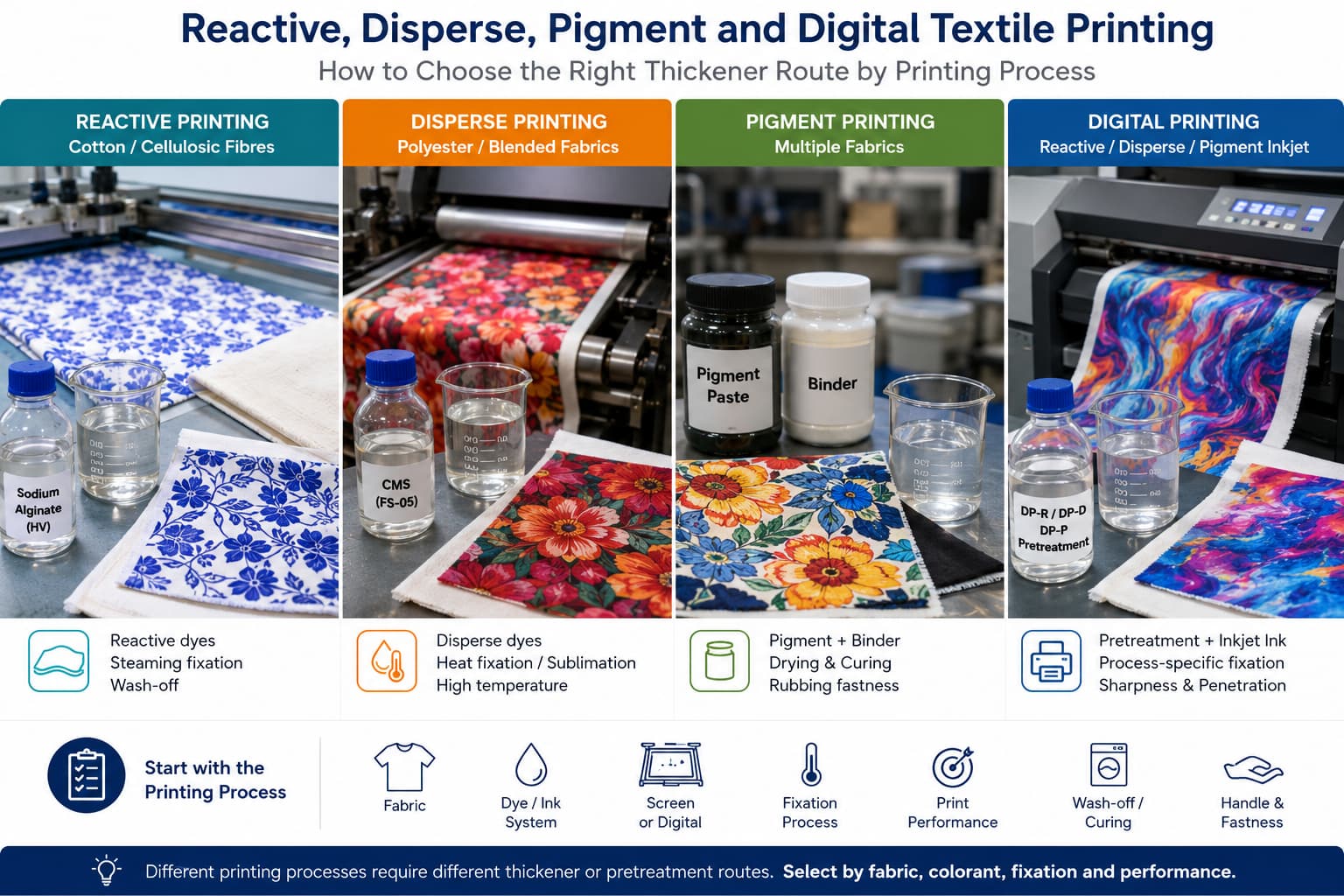
कपड़े, रंग या स्याही, स्थिरीकरण, धोने पर छूटना और मुद्रण गुणवत्ता की आवश्यकताओं के आधार पर प्रतिक्रियाशील, डिस्पर्स, पिगमेंट और डिजिटल टेक्सटाइल प्रिंटिंग के लिए गाढ़ा करने वाले पदार्थ और पूर्व-उपचार मार्ग चुनने का तरीका जानें।.
CMC-आधारित प्रिंटिंग पेस्ट का उपयोग पिगमेंट, रिएक्टिव और डिजिटल टेक्सटाइल प्रिंटिंग में किया जाता है। यह मार्गदर्शिका बताती है कि किन मापदंडों का महत्व है, आपूर्तिकर्ताओं की तुलना कैसे करें, और थोक ऑर्डर देने से पहले क्या अनुरोध करना चाहिए।.
सोडियम अल्जिनेट और सीएमसी दोनों का उपयोग वस्त्र मुद्रण में गाढ़ा करने वाले पदार्थ के रूप में किया जाता है, लेकिन ये विभिन्न रंग प्रणाली और प्रक्रिया की शर्तों के लिए उपयुक्त होते हैं। यह मार्गदर्शिका प्रमुख अंतर और प्रत्येक का उपयोग कब करना चाहिए, यह बताती है।.
सही टेक्सटाइल प्रिंटिंग थिकनर का निर्धारण केवल कपड़े के प्रकार से नहीं होता। खरीदारों को थिकनर को डाई या पिगमेंट सिस्टम, प्रिंटिंग विधि, लक्षित रेओलॉजी, धोकर हटाने की आवश्यकताओं और वास्तविक फैक्ट्री परीक्षण परिस्थितियों के अनुरूप चुनना चाहिए।.
टेक्सटाइल प्रिंटिंग की कार्यक्षमता एक समन्वित रासायनिक प्रणाली पर निर्भर करती है, न कि किसी एक सार्वभौमिक योजक पर। यह मार्गदर्शिका दस महत्वपूर्ण रासायनिक समूहों, उनके कार्यों, उनकी उपयुक्तता और उत्पादन परीक्षणों से पहले खरीदारों को किन बातों की जांच करनी चाहिए, समझाती है।.
टेक्सटाइल प्रिंटिंग थिकनर रासायनिक संरचना, प्रवाह विज्ञान, रंग संगतता और धोने पर छूटने के व्यवहार में भिन्न होते हैं। यह मार्गदर्शिका मुख्य थिकनर परिवारों, उनके सामान्य अनुप्रयोग दिशा-निर्देशों और उन मापदंडों की तुलना करती है जिन्हें खरीदारों को उत्पादन परीक्षणों से पहले सत्यापित करना चाहिए।.
डिजिटल प्रिंटिंग पेस्ट का चयन स्याही रसायन, कपड़े, अनुप्रयोग विधि और पश्चात-उपचार के आधार पर किया जाना चाहिए। यह मार्गदर्शिका वस्त्र इंकजेट प्रिंटिंग के लिए सोडियम अल्जिनेट, सीएमसी, सीएमएस, सिंथेटिक पॉलीमर और यौगिक पूर्व-उपचार मार्गों की तुलना करती है।.
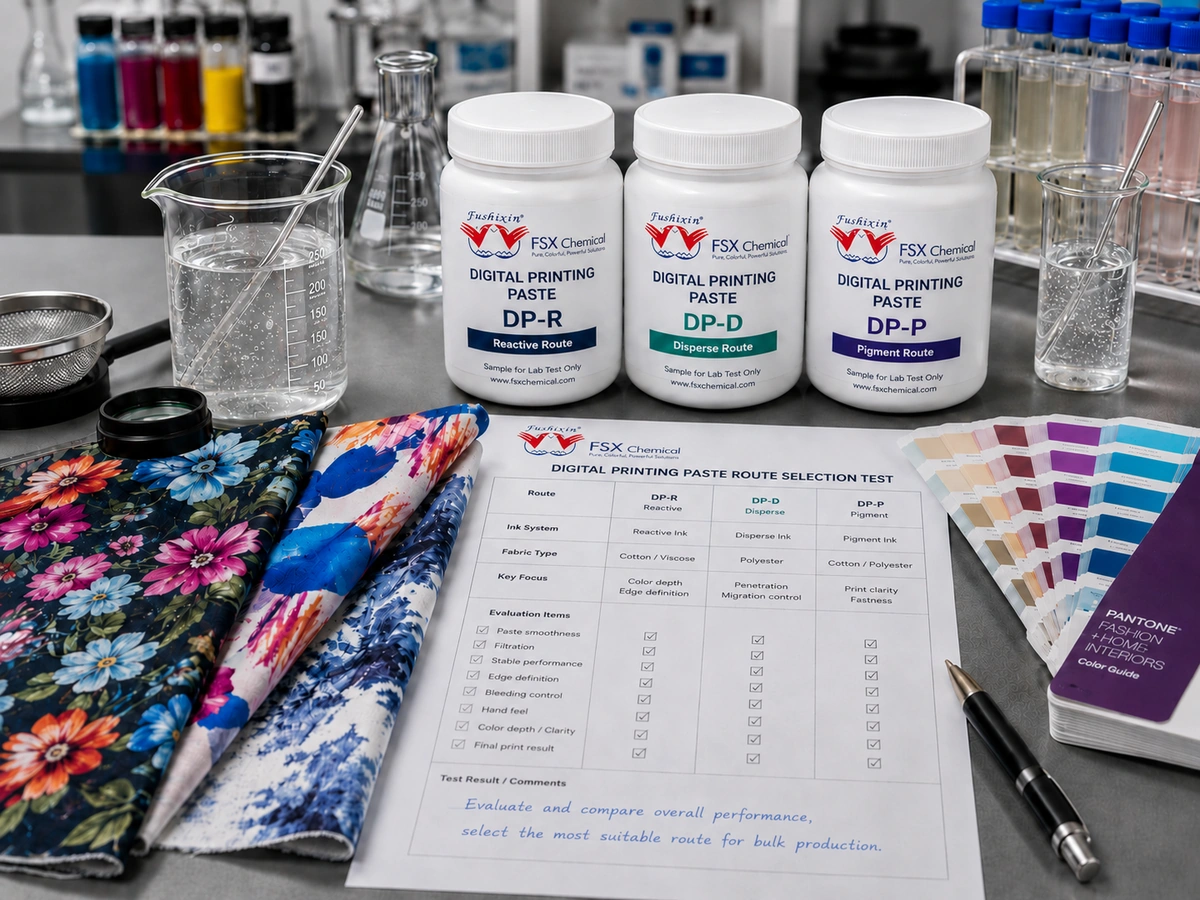
FSX Chemical प्रतिक्रियाशील, डिस्पर्स और पिगमेंट सिस्टम के लिए अलग-अलग डिजिटल प्रिंटिंग पेस्ट मार्ग प्रदान करता है, जिन्हें अनुप्रयोग समीक्षा, नमूना मिलान और तकनीकी दस्तावेज़ीकरण द्वारा समर्थित किया जाता है। यह मार्गदर्शिका बताती है कि खरीदार थोक खरीद से पहले सही मार्ग का मूल्यांकन कैसे कर सकते हैं।.
Stable digital printing paste requires more than a target viscosity. This guide explains how product selection, water quality, addition sequence, mixing, pH, temperature, filtration, hygiene, storage and quality records influence pretreatment and production consistency.
यह उत्पाद समीक्षा FSX डिजिटल प्रिंटिंग पेस्ट को वस्त्र इंकजेट पूर्व-उपचार और गाढ़ा करने के एक माध्यम के रूप में जांचती है, जिसमें स्याही-प्रणाली मिलान, प्रवाह-विज्ञान, छानन, मुद्रण परिभाषा, स्थिरता और वास्तविक उत्पादन परीक्षण पर ध्यान केंद्रित किया गया है।.
डिजिटल टेक्सटाइल प्रिंटिंग के लिए उन्नत स्याही और प्रिंटहेड से कहीं अधिक की आवश्यकता होती है। प्रतिक्रियाशील, डिस्पर्स और पिगमेंट इंकजेट प्रिंटिंग के लिए प्रक्रिया-विशिष्ट रासायनिक समाधानों का अन्वेषण करें, प्रीट्रीटमेंट और रियोलॉजी से लेकर फ़िल्ट्रेशन, फिक्सेशन और उत्पादन सत्यापन तक।.
Textile printing chemistry is evolving beyond simple viscosity and price comparisons. Explore five innovation directions shaping 2026, including safer chemical inputs, hybrid biopolymer thickeners, advanced pigment binders, shorter digital processes and multifunctional formulations.
उत्पाद का नाम, उपयोग, मात्रा, गंतव्य और आपके पास पहले से मौजूद कोई भी टीडीएस, नमूना फोटो या दस्तावेज़ साझा करें। FSX केमिकल इस जानकारी की समीक्षा करेगा और कोटेशन, नमूना मिलान या उत्पाद चयन के लिए अगले कदम की सिफारिश करेगा।.
उत्पाद की जानकारीउत्पाद का नाम, ग्रेड, मॉडल, लेबल की तस्वीर या आपूर्तिकर्ता संदर्भ।.
उपलब्ध दस्तावेज़टीडीएस, एसडीएस, सीओए, नमूना फोटो, उत्पाद सूची या परीक्षण डेटा।.
आदेश विवरणअनुमानित मात्रा, पैकेजिंग, गंतव्य देश, बंदरगाह या व्यापारिक शर्त।.
आवेदन या समस्याटेक्सटाइल मुद्रण प्रक्रिया, सूत्रीकरण आवश्यकता, वर्तमान समस्या या लक्षित प्रदर्शन।.