How to Test a Synthetic Textile Printing Thickener Before Production Approval
A synthetic textile printing thickener should not be approved from one viscosity result. Production approval...
A synthetic textile printing thickener should not be approved for production because one laboratory sample reaches a target viscosity. Production approval should connect product identity, solids and pH, activation behavior, electrolyte tolerance, binder and pigment compatibility, rheology, filtration, holding stability, screen performance, curing, rubbing fastness, fabric hand and first-commercial-batch consistency. The most reliable qualification method is a staged current-reference comparison with clear go / conditional / fail decision gates. This guide shows printing mills, formulators and buyers how to move a synthetic thickener from candidate sample to controlled production approval without confusing one good laboratory result with a repeatable commercial grade.
How Should a Synthetic Textile Printing Thickener Be Tested Before Production Approval?
Does it meet production and finished-textile requirements?
Screen running, definition, color, curing, rubbing, hand
Production approval is achieved only when all relevant levels pass.
Start with a Current Production Reference
The current approved thickener is the most useful control.
Run:
Current Approved Product vs. Candidate Synthetic Thickener
under the same:
Air
Pigmen
Binder
Fixer / auxiliaries
Kain
Screen
Squeegee conditions
Pengeringan
Pengeringan
Do not force equal dosage if the products have different thickening efficiency.
Instead, find the useful rheology window for each grade and compare the complete printing result.
A current reference prevents the laboratory from approving a candidate that looks technically acceptable in isolation but performs worse than the existing production standard.
1. Confirm Product Identity and Batch Traceability
Before technical testing, confirm exactly what has been received.
Catatan:
Supplier
Commercial grade
Batch / lot
Manufacturing or retest date where supplied
Package identification
TDS version
SDS version
COA
A development sample without a permanent commercial grade code can be useful for early screening, but it should not move directly into purchasing approval.
The approved sample must be connected to a repeatable production grade.
2. Inspect Appearance and Physical Condition
For liquid synthetic thickeners, check:
Color and uniformity
Separation
Settling
Surface skin
Gel particles
Graininess
Unusual odor
Damaged or swollen packaging
Appearance does not prove application performance, but abnormal physical condition should be investigated before the product enters the formulation.
If the product has experienced suspected freeze or heat exposure, use a separate storage-excursion review instead of normal approval testing.
3. Check Solids or Active Content
Liquid acrylic thickeners can have different supplied solids.
Solids affect:
Effective polymer addition
Dosage comparison
Cost
Final polymer deposit
Bandingkan:
As-Supplied Dosage
and:
Active Polymer Solids Introduced
A lower dosage does not automatically mean a more efficient or lower-solids product.
If the supplier specification uses total solids rather than active polymer, keep the terminology exactly defined in the test record.
4. Check pH and Activation Behavior
Many acrylic and polyacrylate thickeners are pH-responsive.
Before comparing viscosity, determine:
Is the product supplied ready to use?
Is it partially neutralized?
Does it require controlled alkali activation?
What activation window does the TDS recommend?
Then standardize:
Neutralizer identity
Neutralizer concentration
Addition order
Mixing speed
Equilibration time
Final pH
Do not reject an alkali-swellable grade as “low viscosity” before confirming it has been activated correctly.
5. Build a Dosage–Viscosity Working Curve
Do not test only one dosage.
Prepare several controlled points around the supplier-recommended or current working region.
Measure:
Dosis
pH
Fresh viscosity
Held viscosity
Penampilan
Plot:
Dosage → Complete-Paste Viscosity
The objective is to find:
A stable useful region
A steep region where small dosage changes create large viscosity changes
The lowest practical dosage that remains inside the production window
Do not assume dosage and viscosity are linear.
6. Compare Rheology, Not One Viscosity Number
A synthetic thickener can pass one Brookfield viscosity target and still print poorly.
Screen printing requires a flow sequence:
Low-Shear Body → Shear Thinning → Screen Transfer → Structural Recovery
Evaluasi:
Low-shear viscosity
Multi-speed viscosity where available
Penurunan viskositas akibat geseran
Recovery after controlled shear
Elasticity / stringiness
Thixotropy
Published polyacrylate-thickener research shows that shear sensitivity and viscosity recovery can be important application properties.
Therefore:
Same Brookfield Viscosity ≠ Same Printing Performance.
7. Run an Electrolyte-Tolerance Test
Many conventional polyacrylate thickeners are sensitive to ionic load.
Electrolytes can enter from:
Pigment dispersion
Binder
Fixer
Process water
Other auxiliaries
Run the candidate under a representative production electrolyte environment.
One viscosity number does not qualify a synthetic thickener.
Use the current production product as the reference.
Test the complete pigment-binder formula before printing.
Evaluate rheology, holding stability and screen performance separately.
Final approval requires cured-fabric color, rubbing and hand results.
Commercial approval requires grade traceability and first-batch verification.
Pertanyaan yang Sering Diajukan
1. What is the first test for a synthetic textile printing thickener?
Start by confirming the commercial grade, batch, TDS/COA and physical condition, then standardize solids, pH and activation before comparing viscosity.
2. Is water viscosity enough to approve a synthetic thickener?
No. The product must also be tested with the real pigment, binder, fixer and auxiliaries, followed by printing and curing.
3. Should two synthetic thickeners be compared at the same dosage?
Not as the only comparison. Find the useful rheology window for each grade, then compare printing, finished fabric and cost.
4. Why is electrolyte testing important?
Pigment, binder, fixer and process water can introduce ions that reduce thickening efficiency in some acrylic/polyacrylate systems.
5. How should binder compatibility be tested?
Add the binder under controlled conditions, record pH and viscosity, compare with a water-dilution control and check holding stability and final printing behavior.
6. Why should dark pigment shades be included?
High pigment loading can add more water, surfactant, dispersant and electrolyte, creating a stronger compatibility challenge.
7. How long should holding stability be tested?
Use the real production holding period. A four-hour production process requires evidence that the paste remains acceptable over that period.
8. What should be checked on the printed fabric?
Evaluate agreed color or K/S, print definition, penetration, dry/wet rubbing, relevant wash fastness, surface residue and fabric hand.
9. Is a successful laboratory trial enough for purchase approval?
No. Run a controlled production trial and verify the first commercial batch against the approved sample and specification.
10. Why keep retained samples?
They allow complaint batches to be compared with the approved reference using the same method and help separate batch issues from process issues.
11. What incoming QC is useful after approval?
Typical controls include identity, appearance, pH, solids or active-content parameter, applicable viscosity and batch documentation, with periodic application verification.
12. What should I send FSX Chemical before requesting a candidate synthetic thickener?
Send the current thickener/TDS, dosage, viscosity method, pigment, binder, pH, fabric, machine route, curing conditions, finished-fabric targets and estimated usage.
Qualify a Synthetic Thickener Before Bulk Production
If your mill is evaluating a new synthetic textile printing thickener, FSX Chemical can help structure a controlled current-vs-candidate comparison from laboratory screening through first commercial batch verification.
A synthetic thickener should be approved as a repeatable commercial system, not as one successful laboratory sample. Production approval begins with grade identity and ends with first-batch consistency, cured-fabric performance and a defined incoming-QC specification.
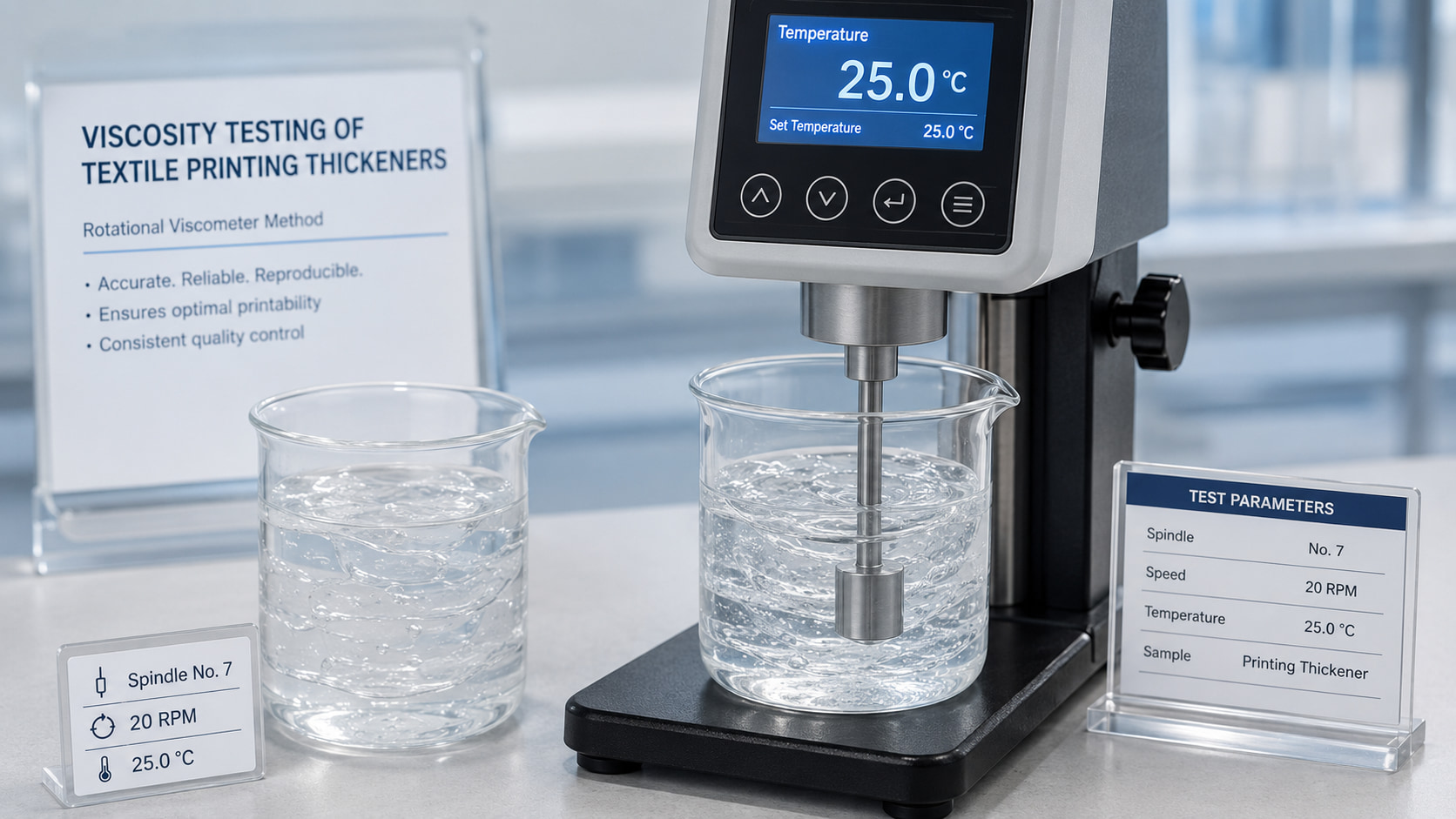
Ketahui mengapa nilai viskositas pengental dalam pencetakan tekstil tidak dapat dibandingkan tanpa menyesuaikan konsentrasi, suhu, alat ukur, spindel, kecepatan, metode persiapan, dan waktu pengujian.
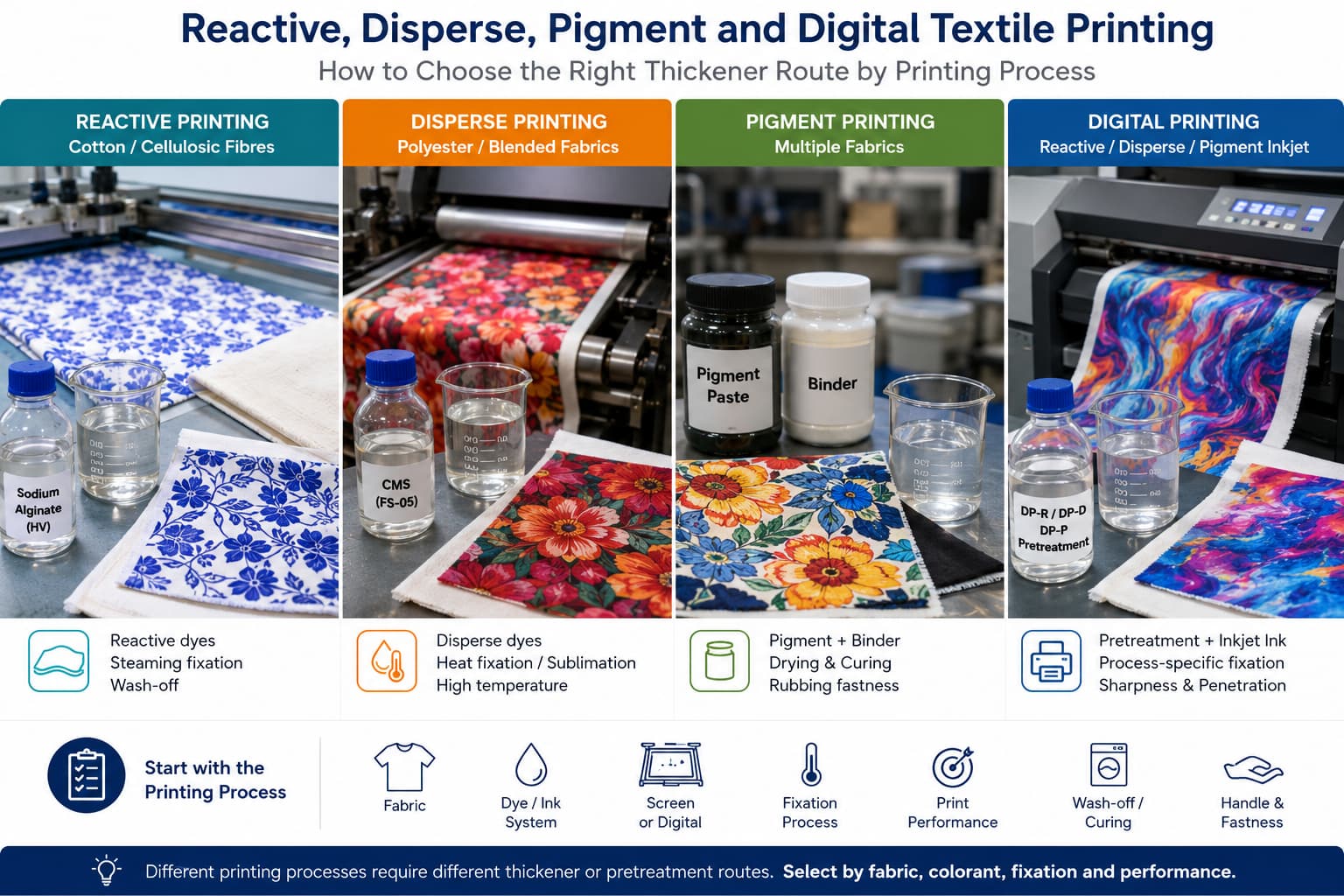
Pelajari cara memilih bahan pengental dan metode pra-perlakuan untuk pencetakan tekstil reaktif, disperse, pigmen, dan digital berdasarkan jenis kain, pewarna atau tinta, proses fiksasi, daya lepas saat pencucian, serta persyaratan kualitas cetakan.
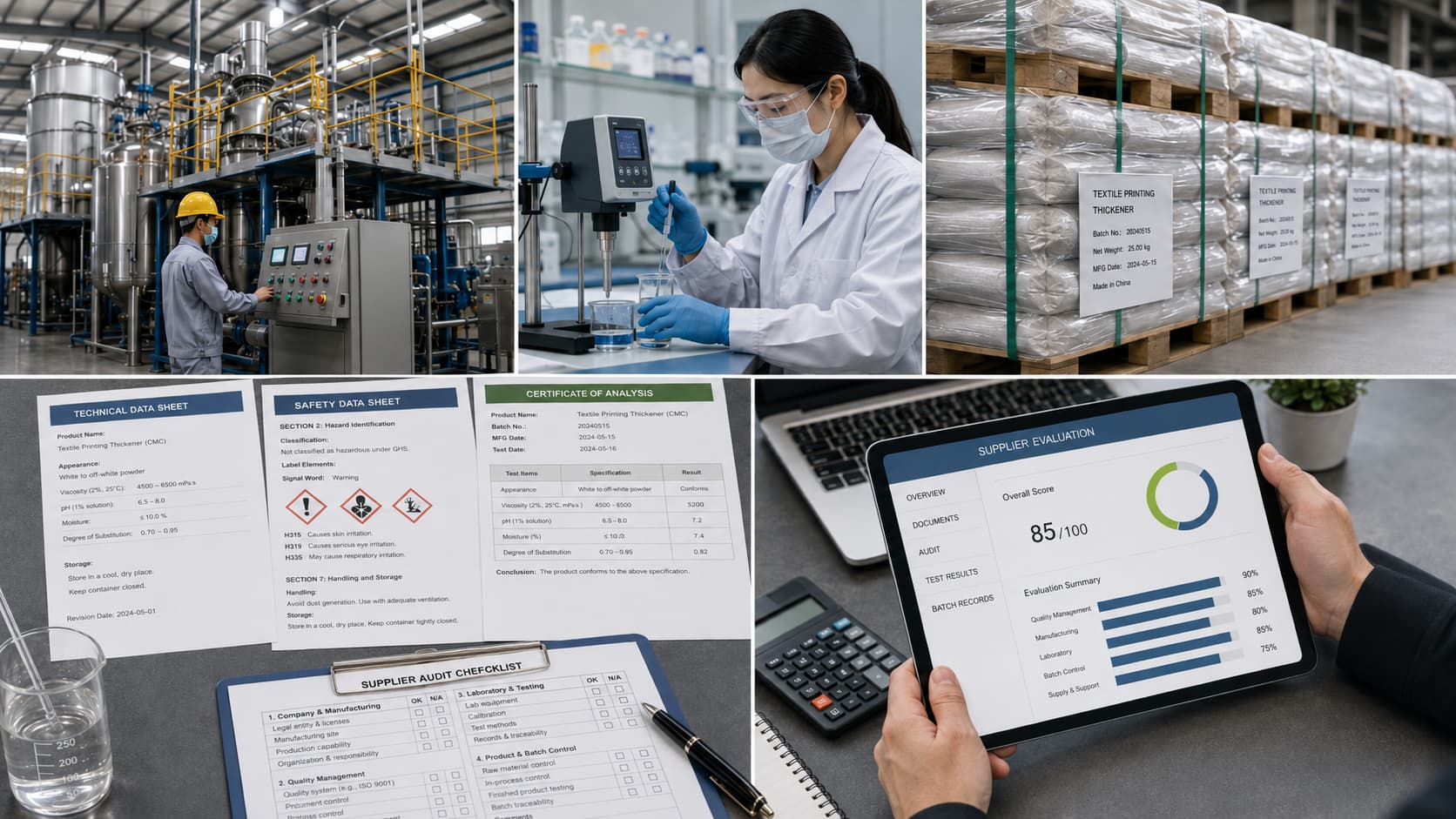
Pelajari cara mengevaluasi produsen pengental untuk pencetakan tekstil dengan memeriksa identitas perusahaan, kapasitas produksi, metode pengujian, keterlacakan batch, dokumen teknis, dukungan sampel, dan pasokan ekspor.
Pasta cetak berbasis CMC digunakan dalam pencetakan tekstil pigmen, reaktif, dan digital. Panduan ini menjelaskan parameter apa saja yang penting, cara membandingkan pemasok, serta hal-hal yang perlu diminta sebelum melakukan pemesanan dalam jumlah besar.
Baik natrium alginat maupun CMC digunakan sebagai pengental dalam pencetakan tekstil, namun keduanya cocok untuk sistem pewarnaan dan kondisi proses yang berbeda. Panduan ini menjelaskan perbedaan utama di antara keduanya serta kapan masing-masing harus digunakan.
Memahami sumber bahan baku natrium alginat serta proses pembuatannya dapat membantu tim pengadaan mengajukan pertanyaan yang lebih tepat dan mengevaluasi pemasok secara lebih efektif. Panduan ini membahas spesies rumput laut, langkah-langkah ekstraksi, asal-usul pengotor, serta seperti apa proses produksi yang konsisten sebagaimana tercantum dalam dokumentasi pemasok.
Penyimpanan yang tidak tepat merupakan salah satu penyebab paling umum dari masalah kinerja natrium alginat dalam pencetakan tekstil. Panduan ini membahas kondisi penyimpanan bubuk dan pasta, perkiraan masa simpan, indikator degradasi, serta hal-hal yang perlu diperiksa saat menerima kiriman baru.
Lembar data teknis (TDS) memiliki format dan tingkat kelengkapan yang bervariasi antar pemasok, dan tidak semua kolom memiliki tingkat penting yang sama untuk setiap aplikasi. Panduan ini akan memaparkan lembar data teknis (TDS) natrium alginat secara umum bagian demi bagian, menjelaskan arti setiap parameter serta cara mengidentifikasi kekurangan atau tanda-tanda peringatan.
Many suppliers market "customized sodium alginate," but the term covers very different things in practice. This guide explains which parameters are genuinely adjustable, which are fixed by fundamental chemistry, and how to evaluate a supplier's customization claims.
Ketika terjadi cacat cetak pada lantai, tantangannya adalah mengidentifikasi penyebabnya dengan cepat. Panduan referensi ini mengelompokkan cacat-cacat umum yang terkait dengan pasta natrium alginat berdasarkan gejalanya, dengan penyebab yang mungkin diurutkan berdasarkan tingkat kemungkinannya serta langkah-langkah pemeriksaan awal yang praktis untuk masing-masing kasus.
Harga natrium alginat bervariasi secara signifikan antar pemasok dan tingkat kualitas, namun tidak semua perbedaan harga mencerminkan perbedaan kualitas yang sesungguhnya. Panduan ini menjelaskan faktor-faktor yang memengaruhi biaya, cara menyusun perbandingan penawaran yang setara, serta hal-hal yang perlu diwaspadai saat mengevaluasi proposal pemasok.
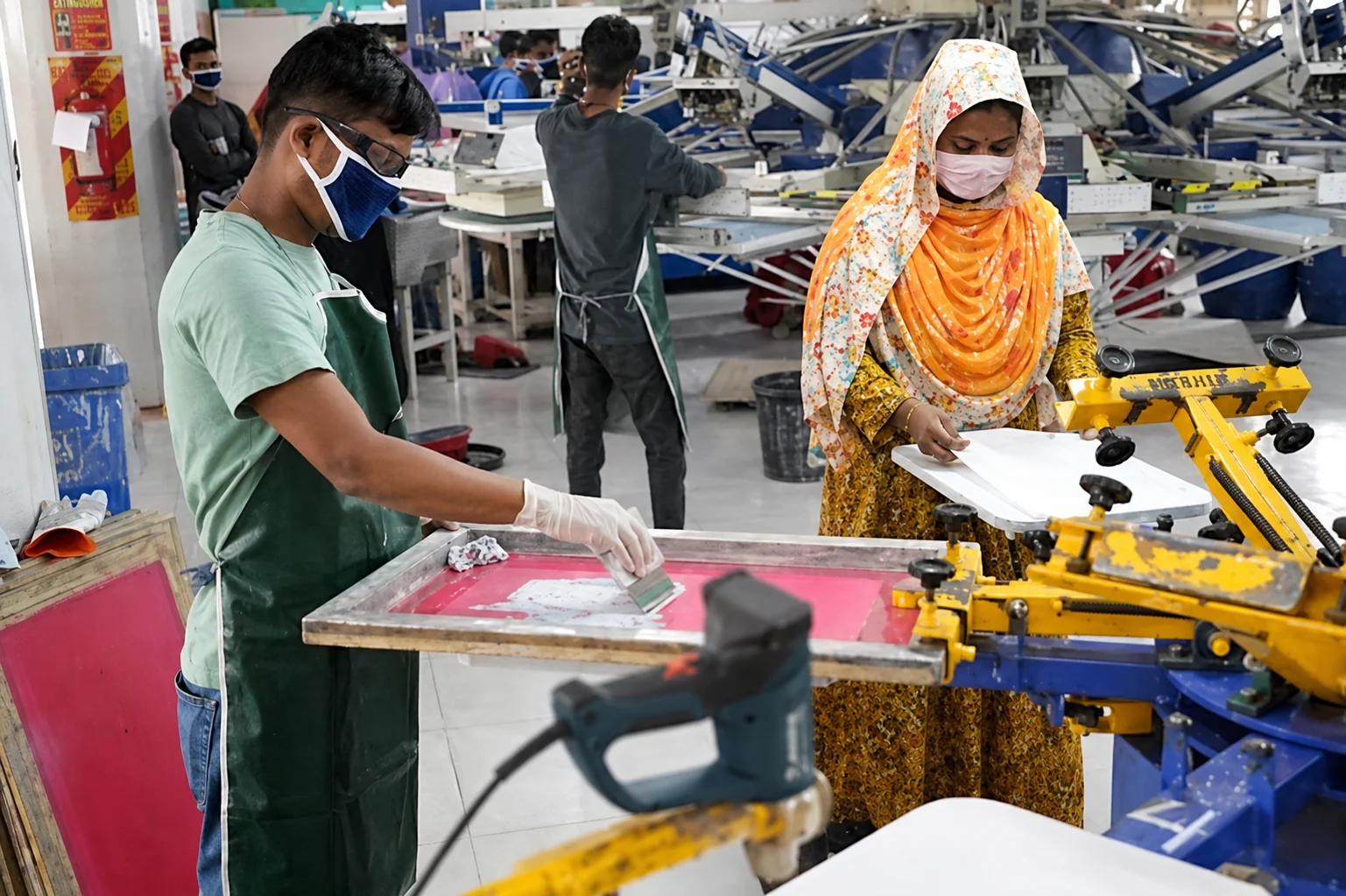
Pemilihan pengental yang tepat untuk pencetakan tekstil tidak hanya bergantung pada jenis kain saja. Pembeli sebaiknya menyesuaikan pengental tersebut dengan sistem pewarna atau pigmen, metode pencetakan, sifat reologi yang diinginkan, persyaratan ketahanan terhadap pencucian, serta kondisi uji coba aktual di pabrik.
Berikan nama produk, kegunaan, jumlah, tujuan pengiriman, serta TDS,
foto sampel, atau dokumen lain yang sudah Anda miliki. FSX Chemical akan meninjau
informasi tersebut dan merekomendasikan langkah selanjutnya terkait penawaran harga, pencocokan sampel,
atau pemilihan produk.
Informasi ProdukNama produk, grade, model, foto label, atau referensi pemasok.
Dokumen yang TersediaTDS, SDS, COA, foto sampel, daftar produk, atau data pengujian.
Rincian PesananPerkiraan jumlah, kemasan, negara tujuan, pelabuhan, atau syarat perdagangan.
Aplikasi atau KendalaProses pencetakan tekstil, kebutuhan formulasi, masalah terkini, atau target kinerja.