How to Test a Synthetic Textile Printing Thickener Before Production Approval
A synthetic textile printing thickener should not be approved from one viscosity result. Production approval...
A synthetic textile printing thickener should not be approved for production because one laboratory sample reaches a target viscosity. Production approval should connect product identity, solids and pH, activation behavior, electrolyte tolerance, binder and pigment compatibility, rheology, filtration, holding stability, screen performance, curing, rubbing fastness, fabric hand and first-commercial-batch consistency. The most reliable qualification method is a staged current-reference comparison with clear go / conditional / fail decision gates. This guide shows printing mills, formulators and buyers how to move a synthetic thickener from candidate sample to controlled production approval without confusing one good laboratory result with a repeatable commercial grade.
How Should a Synthetic Textile Printing Thickener Be Tested Before Production Approval?
Does it meet production and finished-textile requirements?
Screen running, definition, color, curing, rubbing, hand
Production approval is achieved only when all relevant levels pass.
Start with a Current Production Reference
The current approved thickener is the most useful control.
Run:
Current Approved Product vs. Candidate Synthetic Thickener
under the same:
الماء
الصباغ
مجلد
Fixer / auxiliaries
القماش
Screen
Squeegee conditions
التجفيف
المعالجة
Do not force equal dosage if the products have different thickening efficiency.
Instead, find the useful rheology window for each grade and compare the complete printing result.
A current reference prevents the laboratory from approving a candidate that looks technically acceptable in isolation but performs worse than the existing production standard.
1. Confirm Product Identity and Batch Traceability
Before technical testing, confirm exactly what has been received.
السجل:
Supplier
Commercial grade
Batch / lot
Manufacturing or retest date where supplied
Package identification
TDS version
SDS version
COA
A development sample without a permanent commercial grade code can be useful for early screening, but it should not move directly into purchasing approval.
The approved sample must be connected to a repeatable production grade.
2. Inspect Appearance and Physical Condition
For liquid synthetic thickeners, check:
Color and uniformity
الفصل
Settling
Surface skin
جزيئات الهلام
Graininess
Unusual odor
Damaged or swollen packaging
Appearance does not prove application performance, but abnormal physical condition should be investigated before the product enters the formulation.
If the product has experienced suspected freeze or heat exposure, use a separate storage-excursion review instead of normal approval testing.
3. Check Solids or Active Content
Liquid acrylic thickeners can have different supplied solids.
Solids affect:
Effective polymer addition
Dosage comparison
Cost
الترسب النهائي للبوليمر
Compare:
As-Supplied Dosage
و:
Active Polymer Solids Introduced
A lower dosage does not automatically mean a more efficient or lower-solids product.
If the supplier specification uses total solids rather than active polymer, keep the terminology exactly defined in the test record.
4. Check pH and Activation Behavior
Many acrylic and polyacrylate thickeners are pH-responsive.
Before comparing viscosity, determine:
Is the product supplied ready to use?
Is it partially neutralized?
Does it require controlled alkali activation?
What activation window does the TDS recommend?
Then standardize:
Neutralizer identity
تركيز المُحايد
ترتيب الجمع
Mixing speed
زمن التوازن
القيمة النهائية لدرجة الحموضة (pH)
Do not reject an alkali-swellable grade as “low viscosity” before confirming it has been activated correctly.
5. Build a Dosage–Viscosity Working Curve
Do not test only one dosage.
Prepare several controlled points around the supplier-recommended or current working region.
القياس:
الجرعة
الرقم الهيدروجيني
اللزوجة الحالية
اللزوجة الثابتة
المظهر
القصة:
Dosage → Complete-Paste Viscosity
The objective is to find:
A stable useful region
A steep region where small dosage changes create large viscosity changes
The lowest practical dosage that remains inside the production window
Do not assume dosage and viscosity are linear.
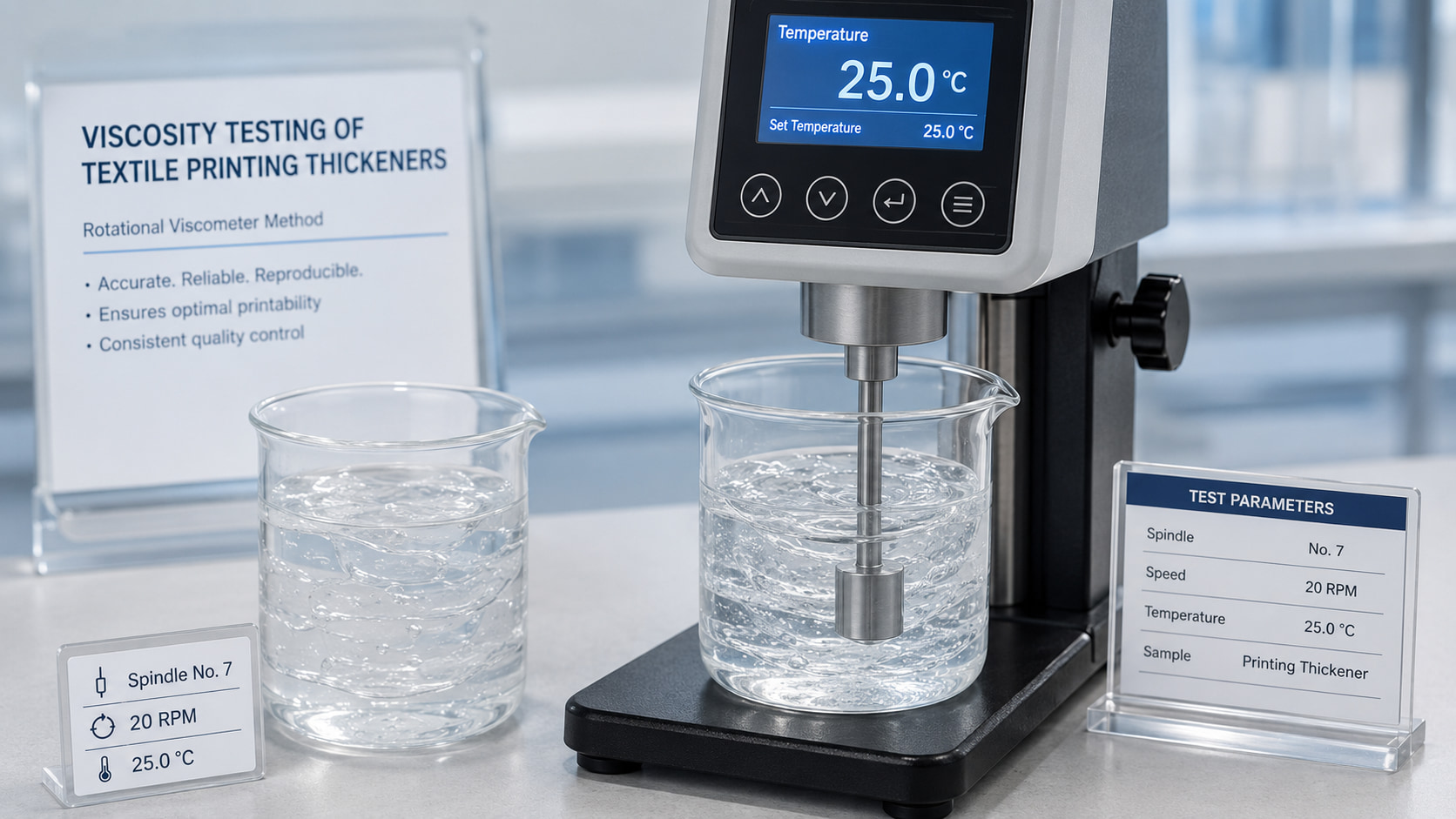
6. Compare Rheology, Not One Viscosity Number
A synthetic thickener can pass one Brookfield viscosity target and still print poorly.
Screen printing requires a flow sequence:
Low-Shear Body → Shear Thinning → Screen Transfer → Structural Recovery
تقييم:
اللزوجة عند القص المنخفض
Multi-speed viscosity where available
الترقق تحت تأثير القص
الاستعادة بعد القص المتحكم فيه
Elasticity / stringiness
التيكسوتروبيا
Published polyacrylate-thickener research shows that shear sensitivity and viscosity recovery can be important application properties.
لذلك:
Same Brookfield Viscosity ≠ Same Printing Performance.
7. Run an Electrolyte-Tolerance Test
Many conventional polyacrylate thickeners are sensitive to ionic load.
Electrolytes can enter from:
تشتت الصبغة
مجلد
المُصلح
Process water
Other auxiliaries
Run the candidate under a representative production electrolyte environment.
One viscosity number does not qualify a synthetic thickener.
Use the current production product as the reference.
Test the complete pigment-binder formula before printing.
Evaluate rheology, holding stability and screen performance separately.
Final approval requires cured-fabric color, rubbing and hand results.
Commercial approval requires grade traceability and first-batch verification.
الأسئلة الشائعة
1. What is the first test for a synthetic textile printing thickener?
Start by confirming the commercial grade, batch, TDS/COA and physical condition, then standardize solids, pH and activation before comparing viscosity.
2. Is water viscosity enough to approve a synthetic thickener?
No. The product must also be tested with the real pigment, binder, fixer and auxiliaries, followed by printing and curing.
3. Should two synthetic thickeners be compared at the same dosage?
Not as the only comparison. Find the useful rheology window for each grade, then compare printing, finished fabric and cost.
4. Why is electrolyte testing important?
Pigment, binder, fixer and process water can introduce ions that reduce thickening efficiency in some acrylic/polyacrylate systems.
5. How should binder compatibility be tested?
Add the binder under controlled conditions, record pH and viscosity, compare with a water-dilution control and check holding stability and final printing behavior.
6. Why should dark pigment shades be included?
High pigment loading can add more water, surfactant, dispersant and electrolyte, creating a stronger compatibility challenge.
7. How long should holding stability be tested?
Use the real production holding period. A four-hour production process requires evidence that the paste remains acceptable over that period.
8. What should be checked on the printed fabric?
Evaluate agreed color or K/S, print definition, penetration, dry/wet rubbing, relevant wash fastness, surface residue and fabric hand.
9. Is a successful laboratory trial enough for purchase approval?
No. Run a controlled production trial and verify the first commercial batch against the approved sample and specification.
10. Why keep retained samples?
They allow complaint batches to be compared with the approved reference using the same method and help separate batch issues from process issues.
11. What incoming QC is useful after approval?
Typical controls include identity, appearance, pH, solids or active-content parameter, applicable viscosity and batch documentation, with periodic application verification.
12. What should I send FSX Chemical before requesting a candidate synthetic thickener?
Send the current thickener/TDS, dosage, viscosity method, pigment, binder, pH, fabric, machine route, curing conditions, finished-fabric targets and estimated usage.
Qualify a Synthetic Thickener Before Bulk Production
If your mill is evaluating a new synthetic textile printing thickener, FSX Chemical can help structure a controlled current-vs-candidate comparison from laboratory screening through first commercial batch verification.
A synthetic thickener should be approved as a repeatable commercial system, not as one successful laboratory sample. Production approval begins with grade identity and ends with first-batch consistency, cured-fabric performance and a defined incoming-QC specification.
تعرف على السبب الذي يجعل من المستحيل مقارنة قيم لزوجة مكثفات الطباعة النسيجية دون مطابقة كل من التركيز، ودرجة الحرارة، والجهاز المستخدم، والمغزل، والسرعة، وطريقة التحضير، ووقت الاختبار.
تعرف على كيفية اختيار المُكثِّف وطرق المعالجة المسبقة للطباعة النسيجية التفاعلية، والطباعة بالتشتت، والطباعة بالصبغات، والطباعة الرقمية، بناءً على متطلبات النسيج، والصبغة أو الحبر، والتثبيت، وقابلية الغسل، وجودة الطباعة.
تعرف على كيفية تقييم شركة مصنعة لمكثفات طباعة المنسوجات من خلال التحقق من هوية الشركة، والقدرة الإنتاجية، وطرق الاختبار، وإمكانية تتبع الدُفعات، والوثائق الفنية، ودعم العينات، والقدرة على التوريد للتصدير.
يُستخدم معجون الطباعة الذي يعتمد على مادة CMC في طباعة المنسوجات بالأصباغ، والطباعة التفاعلية، والطباعة الرقمية. يشرح هذا الدليل المعلمات المهمة، وكيفية مقارنة الموردين، وما يجب طلبه قبل تقديم طلب شراء بالجملة.
يُستخدم كل من ألجينات الصوديوم وCMC كمكثفات في طباعة المنسوجات، لكنهما يناسبان أنظمة صبغ وظروف معالجة مختلفة. يشرح هذا الدليل الاختلافات الرئيسية بينهما ومتى يتم استخدام كل منهما.
إن فهم مصدر المادة الخام «ألجينات الصوديوم» وعملية تصنيعها يساعد فرق المشتريات على طرح أسئلة أكثر دقة وتقييم الموردين بشكل أكثر فعالية. يتناول هذا الدليل أنواع الأعشاب البحرية، وخطوات الاستخلاص، ومصادر الشوائب، وكيف تبدو عملية التصنيع المتسقة في وثائق الموردين.
يُعد التخزين غير السليم أحد الأسباب الأكثر شيوعًا لمشاكل الأداء التي تواجه مادة ألجينات الصوديوم في طباعة المنسوجات. يتناول هذا الدليل شروط تخزين المسحوق والمعجون، والتوقعات المتعلقة بفترة الصلاحية، ومؤشرات التدهور، وما يجب التحقق منه عند استلام شحنة جديدة.
تختلف أوراق البيانات الفنية من حيث الشكل ومدى اكتمالها باختلاف الموردين، ولا تحظى جميع الحقول بنفس الأهمية في كل تطبيق. يشرح هذا الدليل ورقة البيانات الفنية النموذجية لمنتج ألجينات الصوديوم قسمًا تلو الآخر، موضحًا معنى كل معلمة وكيفية اكتشاف الثغرات أو العلامات التحذيرية.
يُروّج العديد من الموردين لـ"ألجينات الصوديوم المُخصّصة"، لكن هذا المصطلح يشمل في الواقع أشياء مختلفة تمامًا. يشرح هذا الدليل المعلمات التي يمكن تعديلها فعليًّا، وتلك التي تحددها القوانين الكيميائية الأساسية، وكيفية تقييم ادعاءات الموردين بشأن التخصيص.
عندما يظهر عيب في الطباعة على الأرضية، يكمن التحدي في تحديد السبب بسرعة. يصنف هذا الدليل المرجعي العيوب الشائعة المرتبطة بمعجون ألجينات الصوديوم حسب الأعراض، مع ترتيب الأسباب المحتملة حسب احتمالية حدوثها، بالإضافة إلى الإجراءات العملية الأولية التي يجب اتخاذها للتحقق من كل منها.
تتفاوت أسعار ألجينات الصوديوم بشكل كبير بين الموردين والدرجات المختلفة، لكن الفروق في الأسعار لا تعكس جميعها اختلافات حقيقية في الجودة. يشرح هذا الدليل العوامل التي تؤثر على التكلفة، وكيفية إجراء مقارنة متكافئة بين عروض الأسعار، والعلامات التحذيرية التي يجب الانتباه إليها عند تقييم عروض الموردين.
لا يقتصر اختيار المكثف المناسب لطباعة المنسوجات على نوع القماش فحسب. بل يجب على المشترين مطابقة المكثف مع نظام الصبغة أو الصبغات، وطريقة الطباعة، والخصائص الريولوجية المستهدفة، ومتطلبات مقاومة الغسل، وظروف التجارب الفعلية في المصنع.
يرجى إرسال اسم المنتج، والتطبيق، والكمية، والوجهة، وأي بيانات تقنية (TDS)،
أو صورة عينة أو مستند متوفر لديكم بالفعل. وستقوم شركة FSX Chemical بمراجعة
هذه المعلومات وتقديم توصية بشأن الخطوة التالية سواء كانت تقديم عرض أسعار، أو مطابقة العينة،
أو اختيار المنتج.
معلومات عن المنتجاسم المنتج، الدرجة، الطراز، صورة الملصق أو مرجع المورد.
الوثائق المتاحةTDS، SDS، COA، صورة العينة، قائمة المنتجات أو بيانات الاختبار.
تفاصيل الطلبالكمية التقديرية، والتعبئة، وبلد المقصد، والميناء، أو الشروط التجارية.
الطلب أو المشكلةعملية طباعة المنسوجات، متطلبات التركيبة، المشكلات الحالية أو الأداء المستهدف.