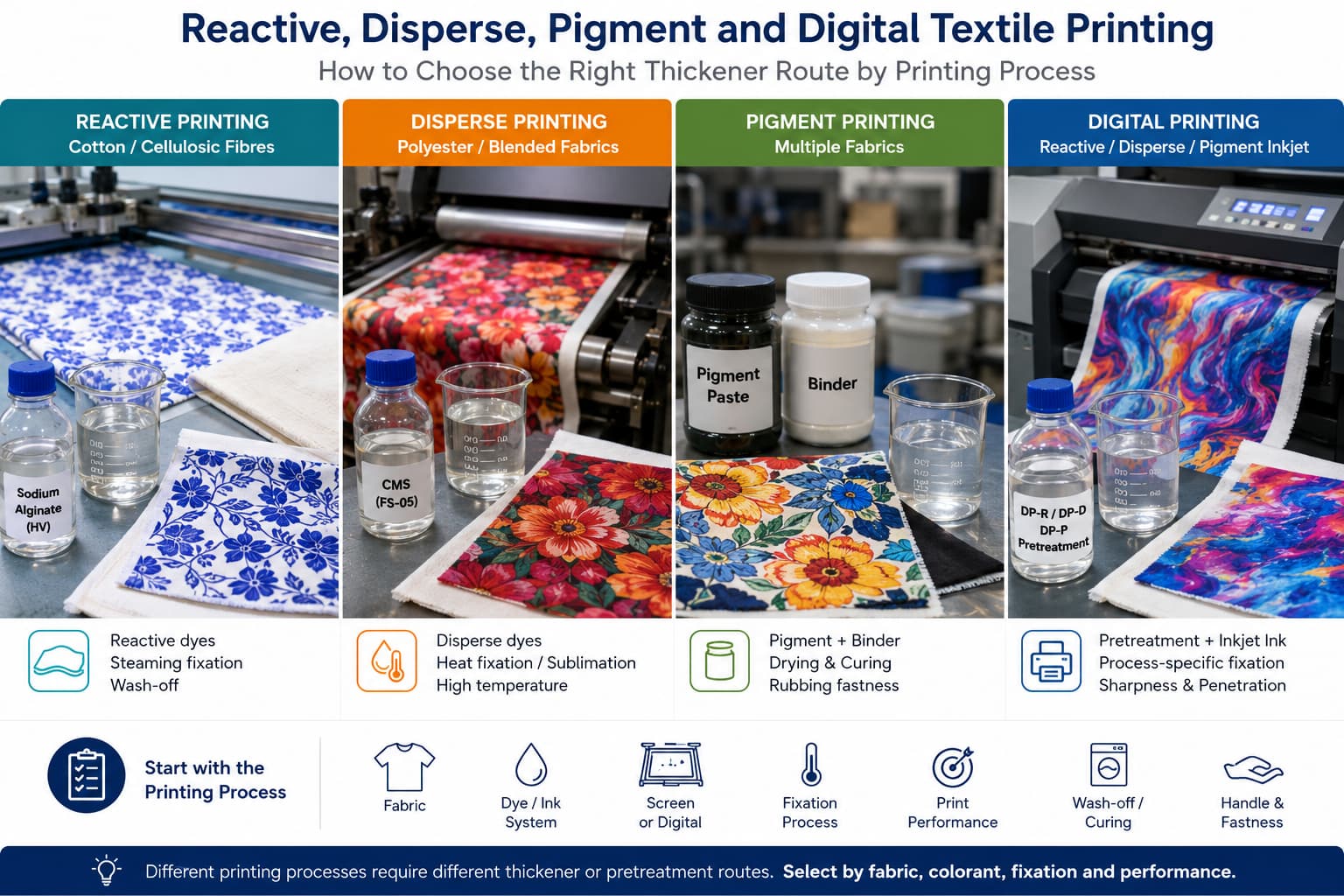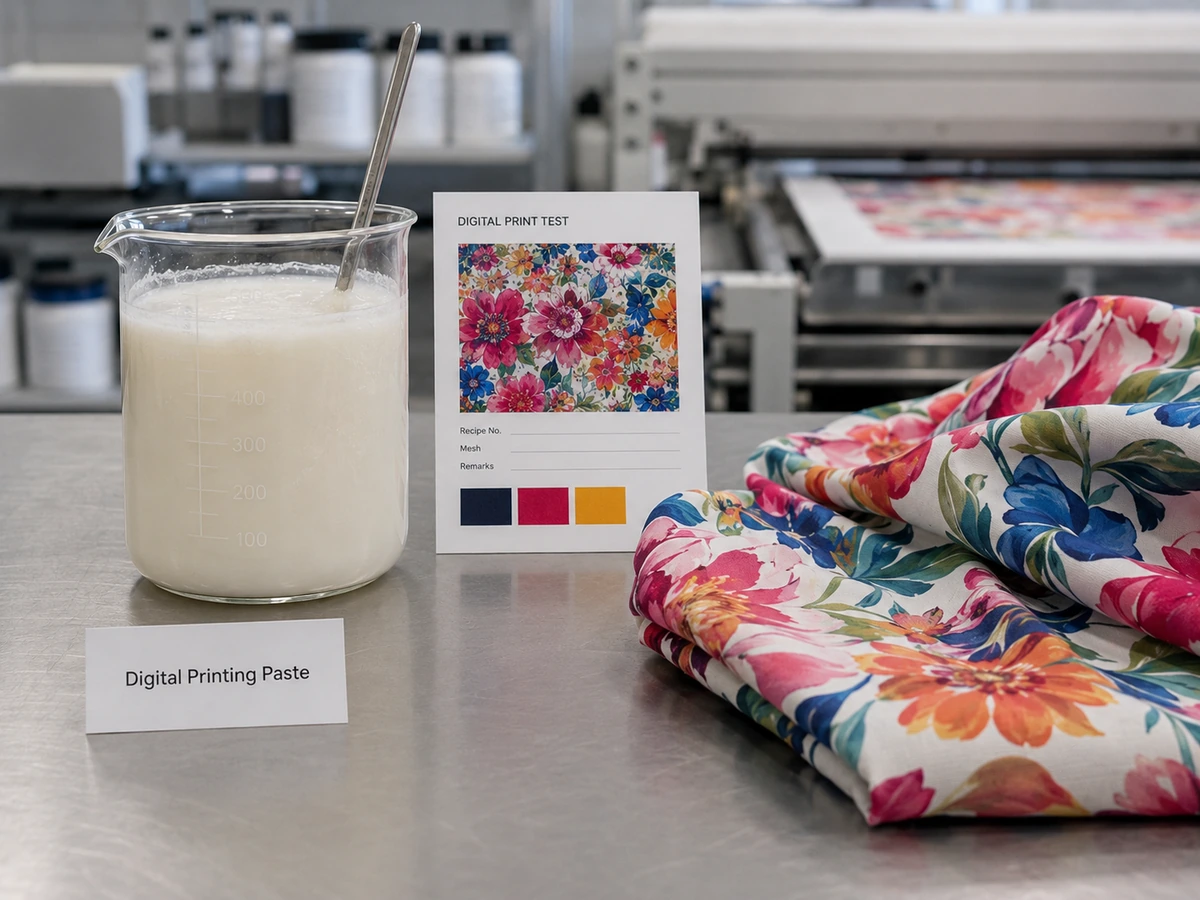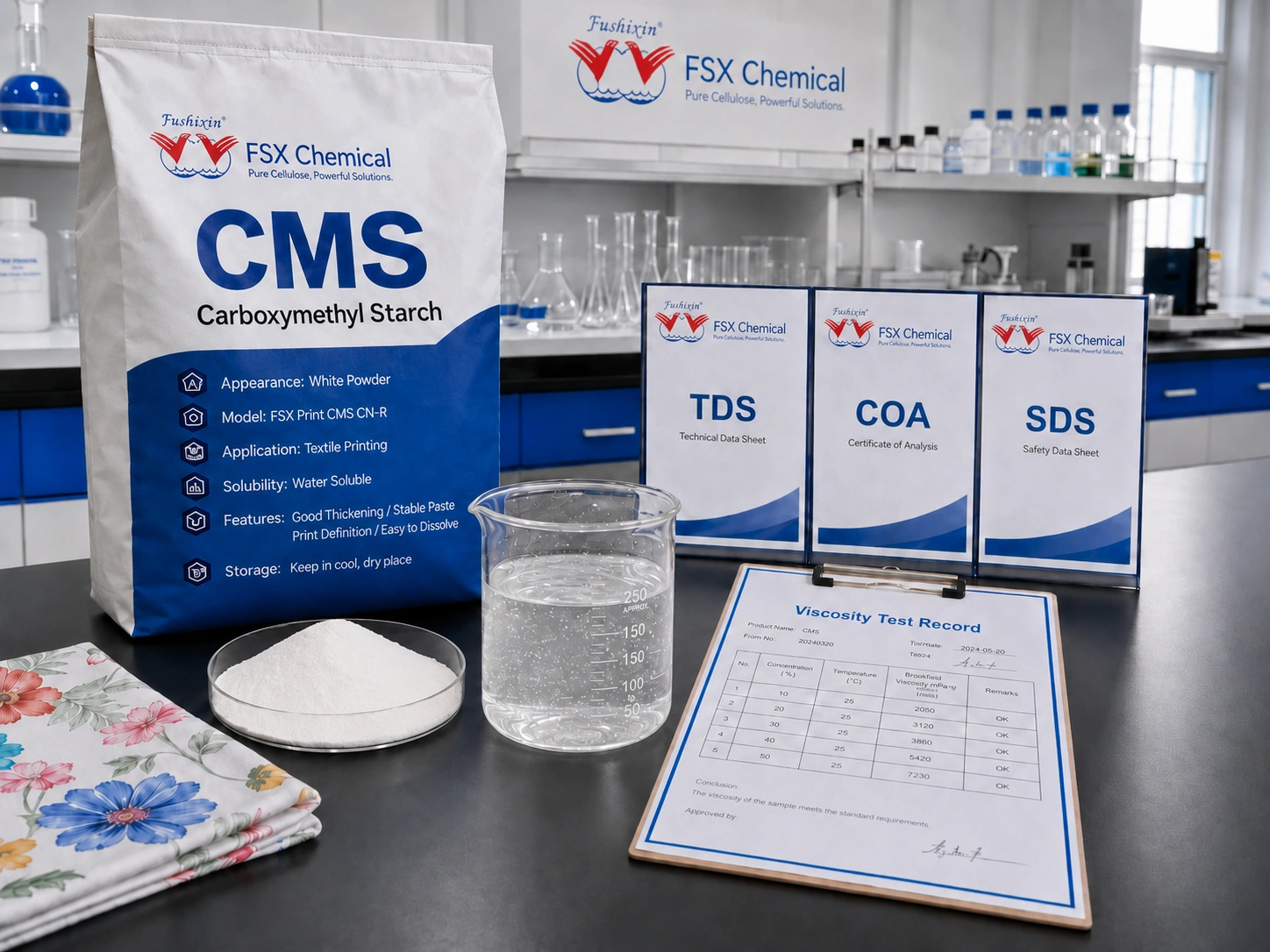















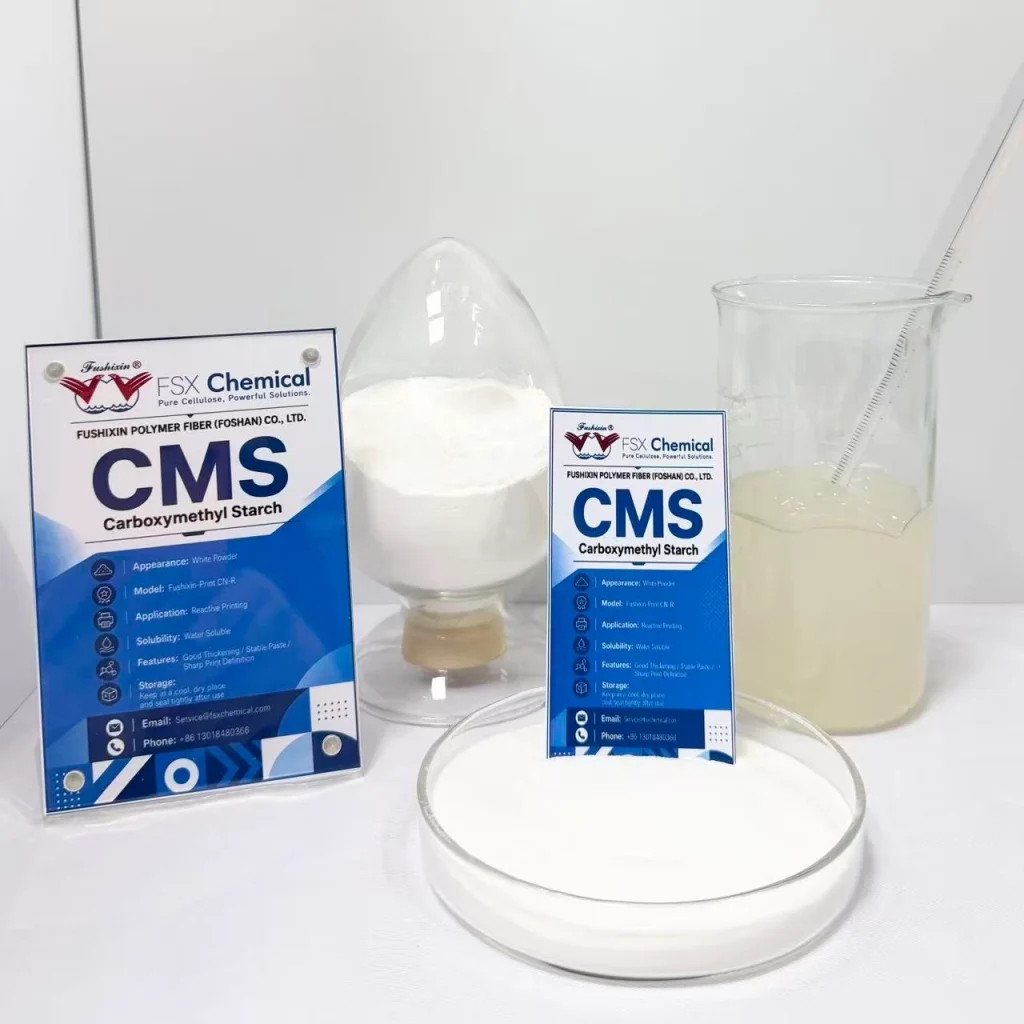
Match an FSX CMS printing thickener to the dye or ink system, fabric and printing process before comparing viscosity or price. The commercial range includes different application routes; confirm the exact grade and product form, then compare preparation, complete-paste behavior and the finished textile in your own process.
In technical literature, CMS can mean carboxymethyl starch. Here, FSX CMS identifies the commercial synthetic printing-thickener family. Use the exact grade’s current product declaration and TDS; the abbreviation does not supply a starch identity, a DS specification or approval for another printing route.
Why CMS Grade Matching Matters in Textile Printing Paste
Different Factories Need Different Viscosity Behavior
A CMS grade that works well in one printing factory may not perform the same way in another formulation. Printing paste concentration, stirring method, water quality, fabric type, and production speed can all affect the final paste behavior.
For buyers, it is better to define the target viscosity range and application requirement before asking for a quotation. This helps the supplier recommend a more suitable starting grade.
CMS Performance Depends on the Full Formulation
Before comparing price, confirm how the exact grade is prepared and used. A powder may require dispersion and hydration, while a liquid candidate has its own dilution or activation instructions. Compare complete-paste uniformity and stability after following the grade-specific procedure.

Sample Testing Reduces Purchasing Risk
Before placing a bulk order, sample testing helps reduce the risk of viscosity mismatch, poor dispersion, filtration problems, or unstable paste behavior.
A small laboratory trial can help buyers confirm whether the CMS grade is suitable for their own process before moving to larger production testing.
What CMS Can Support in Printing Paste Formulations
Viscosity Adjustment
CMS can help build and adjust the viscosity of textile printing paste. A suitable viscosity allows the paste to be mixed, handled, and applied more consistently.
If the viscosity is too low, the paste may spread too easily. If the viscosity is too high, it may be difficult to stir, filter, or apply evenly.
Paste Smoothness and Handling
Good paste smoothness is important for practical production. A suitable CMS grade should disperse properly and help form a uniform paste under correct mixing conditions.
Poor dispersion may lead to lumps, uneven texture, longer preparation time, or extra filtration work.
Formulation Stability During Production
In textile printing, paste stability affects production control. A stable paste is easier for operators to handle and helps reduce frequent adjustment during production.
However, stability should always be tested in the buyer’s own formulation. Water quality, pH, storage time, and auxiliary chemicals can all influence the final result.
Key Parameters to Confirm Before Buying CMS
Viscosity Range
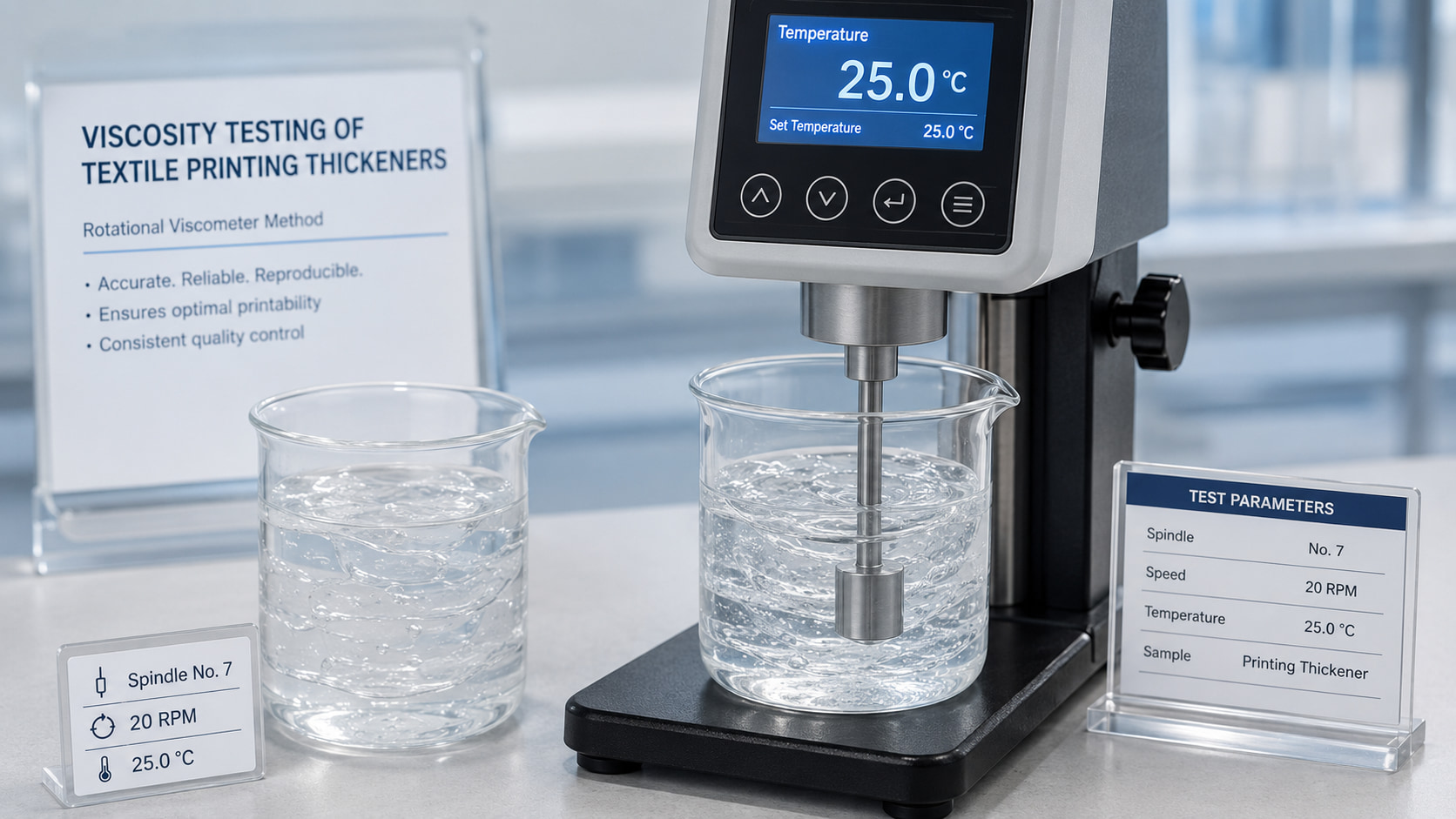
Record the exact grade, powder or liquid form and the viscosity method. Include concentration and its basis, water, preparation and hydration, temperature, instrument, spindle or geometry, speed and reading time. A stock-paste value cannot alone establish the final printing-paste behavior.

Grade Identity and Applicable Specifications
Check which specifications actually apply to the quoted grade. Discuss degree of substitution only when the supplier identifies a relevant substituted polymer and defines that parameter for this material. Do not require a carboxymethyl-starch DS for an unconfirmed compound or synthetic product.
For a replacement inquiry, provide the existing product or TDS, the printing route and the main performance requirement. Compare the identified candidate against that reference without assuming a universal one-to-one dose or equivalent chemistry.
Solubility and Dispersion
Solubility and dispersion performance affect paste preparation efficiency. A suitable CMS grade should disperse well and form a smooth paste under proper mixing conditions.
Buyers should pay attention to whether the paste has lumps, particles, uneven texture, or filtration difficulty during testing.
pH, Moisture and Batch Consistency
Review the grade-specific specification and the available batch results. Moisture may be relevant for a powder; solids, physical uniformity or as-supplied handling may matter for a liquid. Do not force every product form into the same QC panel, and distinguish TDS reference values from agreed release limits.
Batch consistency is especially important for distributors and factories that need long-term stable supply.
How to Test CMS Before Bulk Purchase
Prepare a Small Paste Trial
The first step is to test the CMS sample in a small paste preparation trial. The buyer should follow the same water quality, stirring method, concentration, and preparation process used in daily production.
This helps make the test result closer to real factory conditions.
Check Mixing and Filtration Behavior
Use a defined preparation and filtration procedure. Record water quality, concentration, mixing and hydration history, filter opening, sample amount and the filtration conditions. Compare the candidate with the current reference prepared the same way.
If filtration fails, inspect the residue and repeat a controlled preparation before rejecting the grade. Incomplete hydration, incompatible additions, contamination or an unsuitable product can produce different causes of the same visible symptom.
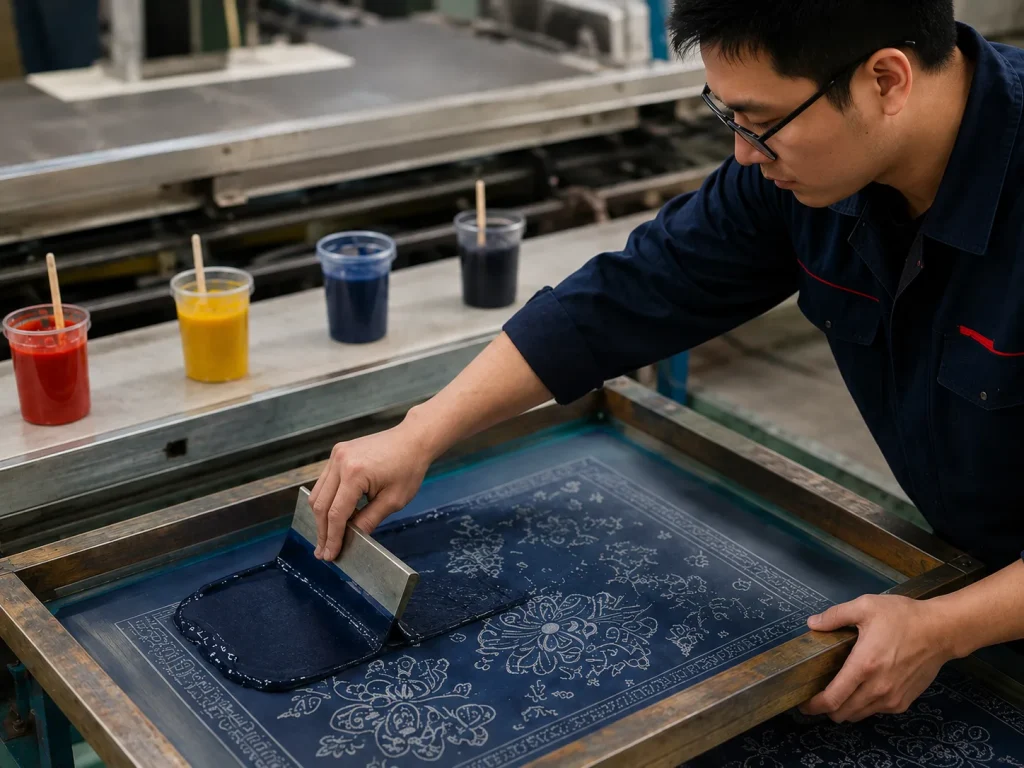
Compare Print Handling Under Real Conditions
After paste preparation, buyers should evaluate handling performance during application. Important observations include paste flow, spreading behavior, edge control, and overall production stability.
The final decision should be based on both technical data and actual application testing.
Use Route-Specific Approval Gates for a CMS Candidate
Use this proposed test plan with a locked reference recipe and agreed pass conditions before reviewing the candidate’s best print.
| Printing route | Critical trial stage | Release evidence |
|---|---|---|
| Reaktibong pagpi-print | Complete dye/alkali paste, printing, fixation and wash-off | Required washed shade, definition, removal and fastness at the recorded dose |
| Pagsasabog ng pagpi-print | Dye compatibility, screen transfer, drying and heat fixation | Required print quality and fastness after the defined post-treatment |
| Pigment formulation, if the grade is declared for it | Binder/pigment compatibility, transfer and curing | Required rubbing fastness and hand at the measured paste deposit |
| Specialty process | Exact dye, discharge or other chemical system stated for the candidate | The intended pattern effect and finished-fabric requirements within that scope |
Approval in one route does not cover the others. If the grade’s application declaration is unclear, resolve it before allocating a production trial.
What Information Should Buyers Send to the Supplier?
Current Formulation or Target Application
To recommend a suitable CMS grade, the supplier needs to understand the buyer’s application. Useful information includes the printing process, paste system, fabric type, and target performance.
If the buyer has an existing formulation, sharing the current thickener type and dosage can make grade matching more accurate.
Required Viscosity and Testing Method
Buyers should provide the required viscosity range if available. It is also helpful to specify the testing concentration, temperature, and instrument method.
Different testing methods can produce different viscosity results, so clear communication is important.
Fabric Type and Printing Process
CMS performance may vary depending on fabric type and process conditions. Buyers should tell the supplier whether the product will be used for cotton, blended fabric, or other textile materials.
The printing process, production scale, and application method should also be confirmed before sample selection.
How FSX Chemical Approaches CMS Grade Matching
The current FSX CMS range organizes candidates by printing route. Use sample matching to share the dye or ink system, fabric, process and current thickener or TDS. Confirm composition and any applicable structural parameter from the exact grade document rather than from the range name.
Mga Susunod na Hakbang
- Request a TDS — confirm the exact grade and product form, applicable specifications, preparation procedure, viscosity method and storage conditions. Request structural parameters only when they are defined for that identified material.
- Ask for Grade Matching — share your target viscosity, printing process, fabric type, and current formulation for a more practical recommendation.
- Humiling ng halimbawa — test the recommended CMS grade in your own paste preparation and printing conditions before committing to volume.
- Makipag-ugnayan sa aming teknikal na koponan — discuss whether the grade can realistically match your application requirements 📧 I-email: Service@fsxchemical.com